

Companies selling building materials to architects see this pattern all the time: they switch from a stale contact database to fresh, verified data and their reply rates jump overnight. One building supplies distributor we spoke with went from 3 callbacks a week to 11 — just by cleaning up their architect email list.
Here's the part nobody in this space wants to say out loud. The contacts exist. The money is there ($63.5 billion in US architectural services, per IBISWorld 2026 data). And most businesses are still blasting emails into inboxes that died two years ago. Then wondering why nobody replies.
So this guide covers how to build an architect email list that produces actual conversations. Three methods compared, real pricing, real companies who've done it, and the compliance stuff you can't skip. No filler.
(If you already know your way around architect databases and just want fresh contacts — Scrap.io indexes 33,548 US architect listings, 21,278 of them with a verified email, extracted in real time. Free trial, 100 leads included.)
Video: Why Your Google Maps Emails Don't Get Replies
- Why Architects Are a High-Value B2B Target in 2026
- What's Included in a Quality Architect Email List?
- 3 Methods to Build Your Architect Email List (Compared)
- Architect Email List Pricing: What to Expect in 2026
- Who's Actually Buying Architect Email Lists? (Real Use Cases)
- How to Run an Effective Email Campaign Targeting Architects
- Legal Compliance: GDPR, CAN-SPAM, and TCPA
- Frequently Asked Questions
Why Architects Are a High-Value B2B Target in 2026
The number of US architects just went up 6% — the first real rebound since 2023. And 14% of them are over 65. That combination is exactly why your architect list needs to be rebuilt, not refreshed.
Here are the actual numbers. According to NCARB's June 2026 survey, there are 123,398 resident licensed architects in the United States, up 6% in 2025 after dipping below 120,000 the year before. Total licenses, counting reciprocals, reach 269,720 — of which 146,322 are reciprocal. And just under 3,500 new architects got licensed last year.
Notice the age split, because it changes your targeting. 14% of the pool is over 65 (a full percentage point higher than 2024), and only 3% is under 30. Translation? A slice of this profession is about to retire, take their firm relationships with them, and leave your old contact file pointing at dead inboxes. Fresh data isn't a nice-to-have here. It's the whole game.
Where do these architects actually live? Below are the top five states straight from NCARB's 2026 jurisdiction breakdown.
| State | Total licenses | Resident architects | Top cities |
|---|---|---|---|
| New York | 22,068 | 12,039 | New York City, Buffalo |
| California | 20,262 | 16,241 | Los Angeles, San Francisco, San Diego |
| Texas | 17,162 | 10,343 | Houston, Dallas, Austin |
| Florida | 12,439 | 5,858 | Miami, Tampa, Orlando |
| Illinois | 9,804 | 5,676 | Chicago |
One detail worth a second look: California has more resident architects than New York (16,241 vs 12,039), but New York has more total licenses. Where architects live isn't the same as where they're allowed to practice. If you target by residency when you should target by license, you'll miss half the state.

Now the market context, because it shapes who actually opens your email. The AIA/Deltek Architecture Billings Index sat at 47.3 in June 2026 — that's 41 straight months without a majority of firms reporting billings growth, one of the longest downturns in the index's 30-year history. What does a 41-month slump mean for you? Firms are hunting for margin. Which makes them unusually receptive to a supplier who saves them time or money.
A soft market is a warm market, if you pitch it right.
The broader industry runs to 63.5 billion dollars across roughly 67,785 firms, growing at a modest 1.5% five-year CAGR (IBISWorld, 2026). Not explosive. Steady. And steady industries reward the vendors who show up consistently with relevant offers.
Why email and not the phone? Because architects don't pick up cold calls. They don't scroll LinkedIn looking for vendor pitches at 2 PM either. But they check their inbox between project reviews. Industry data from the DMA and Litmus puts B2B email ROI at $36–$42 for every $1 spent. When you're targeting a profession with long project timelines and high transaction values — median architect salary sits around $82,000 per the BLS, principals well above — those returns climb fast.
Scrap.io indexes 33,548 US architect listings — 21,278 with a verified email, filterable by state, city, specialty, and firm size. See the exact count for your target area for free (counts don't cost a credit). Check the numbers on Scrap.io →
What's Included in a Quality Architect Email List?
An architect email list is a structured database of licensed architects and architecture firms — name, firm, verified email, phone, address, website, and enrichment fields like specialization or firm size — used for B2B outreach such as cold email, cold calling, or CRM enrichment. That's the plain-English definition. Now here's why two lists with the same headline count perform completely differently.
Not all architect mailing lists carry the same data. Look at a bare architecture firm email list next to a fully enriched contact database, and the gap between "a spreadsheet of addresses" and "an actual prospecting database" is enormous. And that gap decides whether your cold email campaign lands 1% replies or 8%.
A good architect contact database includes: verified and deliverable email, phone number, firm name, owner or principal name, postal address, website URL, Google Maps profile, social media links, specialization tags, firm size indicators, and Google rating. Some platforms — Scrap.io being one — also surface whether a firm runs ad pixels on their site, has a contact form, or keeps active social profiles.
Then there's the email itself, which is where most vendors quietly disappoint you. A cheap list gives you one generic info@ and calls it a day. A real export classifies addresses: Individual Email (with the first and last name extracted), plus Contact, Sales, Marketing, Finance, and Administration inboxes. That's the difference between emailing "the firm" and emailing an actual named human who can say yes.
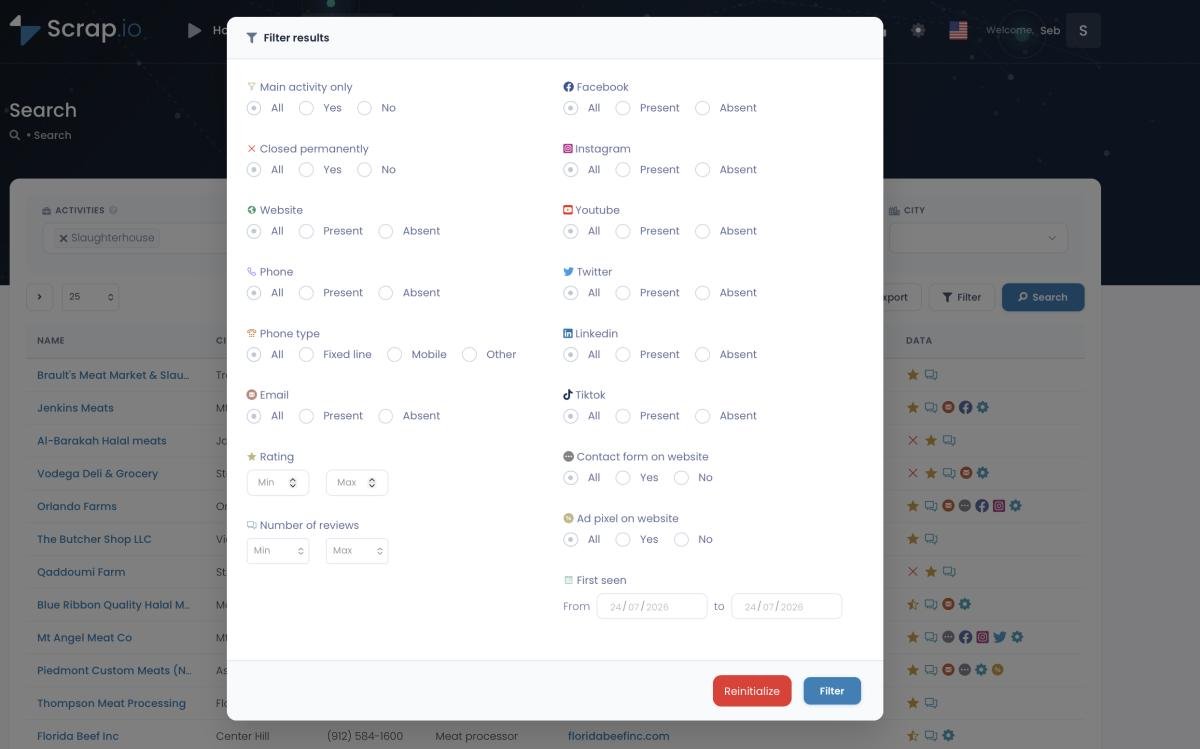
That last part matters more than most people realize. A firm with a website but no social presence is a completely different outreach target than one with 500 Instagram followers and a Houzz portfolio. The segmentation changes your entire messaging strategy.
Specialization-Based Segmentation
Architects aren't interchangeable. A residential architect email list targets people designing homes and small projects — they care about appliances, fixtures, interior finishes. A commercial architect email list reaches firms working on offices, retail, hospitality — totally different spec decisions.
Then there's the landscape architect email list segment, sustainable design specialists, and interior architecture professionals. Each specialty answers to a different value proposition. Residential architects respond to product and finish emails; commercial firms want scale, compliance, and ROI framed for them. Send both groups the same pitch and you lose both.
Geographic Targeting for Architect Outreach
Local targeting crushes national blasts for reply rates. An architect in Austin doesn't care about your next-day delivery if your warehouse sits in New Jersey. That said, if you need a broad architect email list USA-wide, platforms like Scrap.io let you start national and narrow down — rather than the painful other way around.
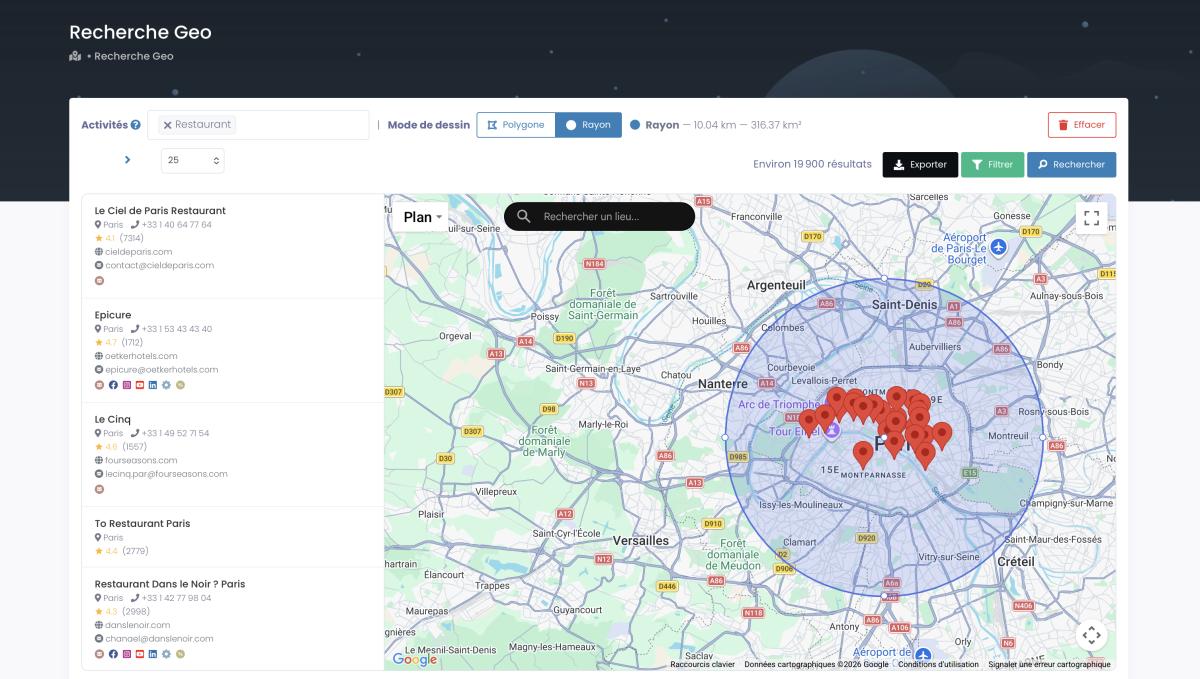
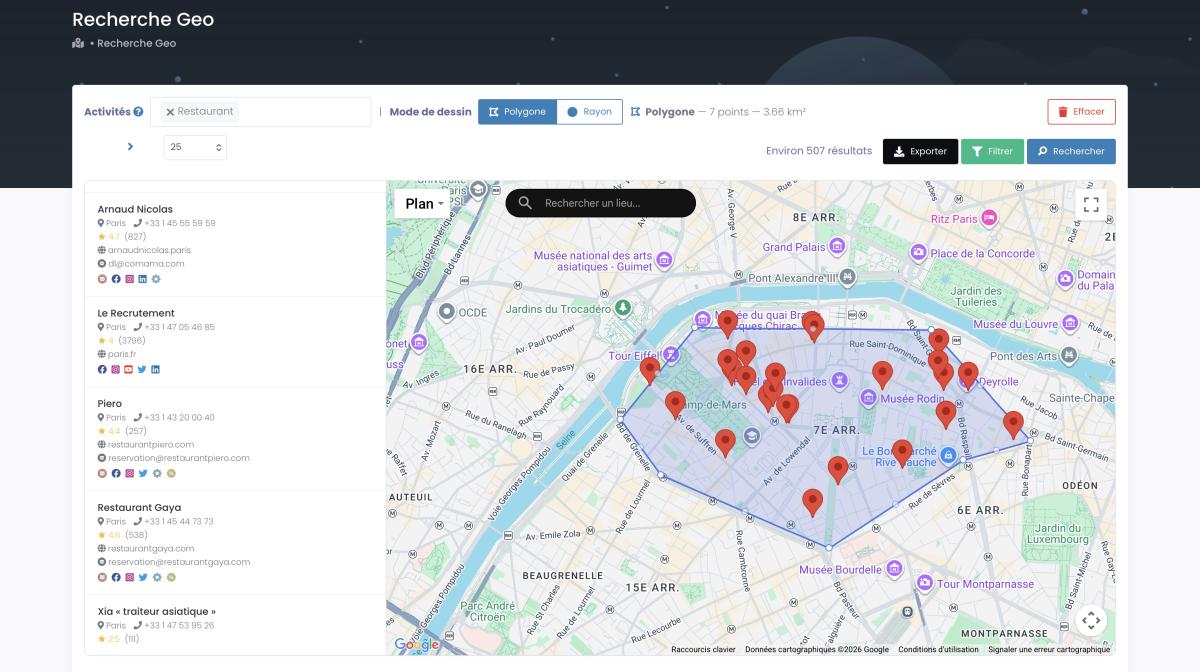
Scrap.io's GeoSearch lets you draw a radius around a specific area or trace a custom polygon on a map, so you're not boxed into pre-defined city limits. Want every architect within 40 km of downtown Denver? Draw it. Want a weird L-shaped territory that follows a highway corridor? Draw that too.
Firm Size and Project Type Filters
Solo practitioners make fast buying decisions but carry small budgets. A 30-person firm has procurement processes, but they buy in volume. Knowing who you're emailing before you write the first line — that's the edge.
Some databases also classify contacts by project type: new construction, renovations, historic preservation, mixed-use. If you sell a product that only matters for ground-up builds, you want that filter. Otherwise you're paying to email renovation specialists about something they'll never spec.
3 Methods to Build Your Architect Email List (Compared)
You've basically got three roads. Each one works for somebody. Each one fails for somebody else. Let's be honest about all of them — and if you want the broader playbook, our guide on how to build a cold email list covers the fundamentals that apply across every industry.
Option 1 — Buying Pre-Built Static Databases
This is the traditional approach. You buy an architect email list — really just a niche b2b email list — from Salesgenie or DataCaptive or InfoClutch, somewhere between $200 and $500 for 10,000–60,000 contacts. You get a CSV. You load it into your email tool. You hit send. (For a wider look at this approach across industries, see our USA business email database guide.)
The upside: speed. You can be running campaigns this afternoon.
The problem: that CSV was compiled weeks or months ago. Maybe longer. Architects change firms constantly, especially at the associate level. Industry estimates suggest static B2B databases lose 25–30% of their accuracy per year as people switch jobs, retire, or close up. So your "60,000 contacts" file might have 15,000 dead emails baked in. Bounce rate spikes. Sender reputation tanks. And the 45,000 that do work? Your three competitors bought the same list last Tuesday.
I've talked to sales teams who dropped $400 on an architect email list and got a 0.8% reply rate. That's not a targeting problem. That's a data-freshness problem. Different disease, different cure.
Option 2 — Manual Research & DIY Collection
You could do it yourself. Pull up the AIA directory, cross-reference state licensing boards, Google individual firms, copy-paste emails into a spreadsheet. People do this.
The math is brutal. At maybe 25–30 verified contacts an hour (being generous), building a list of 5,000 architects takes 150–200 hours. At $25/hour for a research assistant, that's $3,750–$5,000 — for a list that starts going stale the moment you finish it. Doing that at scale is basically masochism with a spreadsheet.
Oh, and compliance. Grab emails from somewhere you shouldn't, or miss a GDPR requirement for an EU-based firm, and you've bought yourself a legal headache nobody wants.
DIY makes sense for hyper-niche targeting — like 50 sustainable-design architects in Portland you want to research personally. For anything at scale? Skip it.
Option 3 — Live Scraping from Public Sources
This is where things shifted in the last couple of years. Instead of buying a static database compiled who-knows-when, live scraping pulls contact data in real time from public sources like Google Maps listings and company websites.
When an architect updates their business phone on Tuesday morning, that change is available for your export by Tuesday afternoon. No waiting on a quarterly refresh that may never come.
Video: Scrap.io - How to Start?
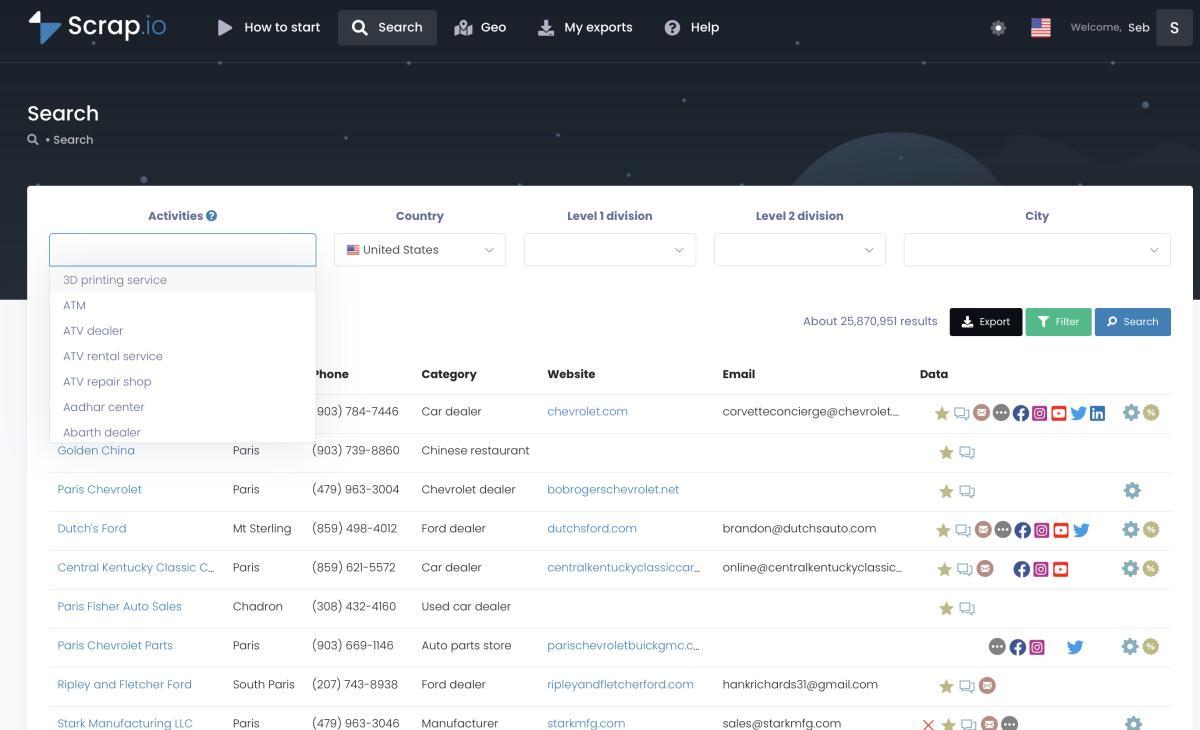
Scrap.io works this way. You pick a category (architect), pick a location (state, city, or a custom area you draw), apply filters (has email, has website, Google rating above X), and export. Two clicks. The data is scraped at the moment of your request — not pulled from a warehouse.
| Criteria | Pre-Built Database | DIY Research | Live Scraping |
|---|---|---|---|
| Cost per 10K contacts | $200–$500 | $3,000–$5,000 | $35–$49/mo |
| Data freshness | Weeks to months old | Days (quick to decay) | Real-time extraction |
| Time to first campaign | Hours | Weeks to months | Minutes |
| Compliance risk | Medium (vendor-dependent) | High (easy to mess up) | Low (public data only) |
| Scalability | Good | Poor | Excellent |
| Country-level extraction | ❌ | ❌ | ✅ (2 clicks) |
| Exclusivity | Shared with competitors | Unique to you | Unique per extraction |
That second-to-last row is the one nobody else offers. Pulling every architect in the entire United States in two clicks? Neither UpLead, nor Salesgenie, nor a DIY scraper does that. Scrap.io does.
Architect Email List Pricing: What to Expect in 2026
Let's talk money. Pricing across providers is all over the map, and most companies aren't transparent about what you actually get for the number they quote.
Here's a comparison based on publicly available pricing and our own research.
| Provider | Price Range | Volume | Data Freshness | Filtering | Notes |
|---|---|---|---|---|---|
| Salesgenie | $150–$400/mo | Varies by plan | Monthly updates | Basic (geo, SIC) | Subscription model |
| DataCaptive | $0.10–$0.30/contact | Custom quotes | Quarterly | Industry, title, geo | Minimum order applies |
| UpLead | $99–$399/mo | Credits-based | Weekly verification | 50+ filters | Adds technographics |
| InfoClutch | $0.08–$0.25/contact | Custom | Quarterly | SIC, geo, firm size | Phone verification extra |
| Scrap.io | $35–$49/mo · 10,000 credits | Unlimited categories | Real-time | 20+ filters | Public data, GDPR & CCPA compliant |
The pricing gap isn't a typo. Traditional providers aggregate data from multiple sources, license it, and mark it up. Live scraping pulls from public listings — cutting out the middleman and the markup with it.
And one number that trips people up: the credit. On Scrap.io, one credit equals one exported business, and each business is counted only once over a rolling 30-day window. So if you need to re-export the same architect list next week to feed a second tool? That re-export costs you nothing. No double-charging for the same contact.
That said, price per contact isn't everything. A $50 list with 95% deliverability beats a $500 list with 60% deliverability every single time. Do that math before you sign anything.
Video: Stop Paying $20,000/Year for ZoomInfo — This Does More for $49/Month
$35/month for 10,000 credits, extracted in real time. Compare that to a $400 static file compiled last quarter and shared with your competitors. Same list, one-tenth the cost, freshly pulled. See Scrap.io pricing →
Who's Actually Buying Architect Email Lists? (Real Use Cases)
This whole article is useless if it doesn't show you who's doing this and why. So here are four categories of companies that actively prospect architects via email — with real examples.
Building Materials & Supply Companies
This is the biggest segment. Companies selling roofing systems, insulation, flooring, glass, fixtures — they all need architects to specify their products. And specification happens early in the project lifecycle, which means getting in front of the architect before the contractor does. Miss that window and you're selling to whoever the architect already picked.
Platforms like Archiproducts and Architonic built entire businesses around connecting manufacturers with architects. Their whole model depends on accurate, segmented architect contact databases. If you're a building materials company and you're not running targeted email outreach to architects? Your competitors are. Right now.
Architecture & Design Software Vendors
Autodesk (AutoCAD, Revit) literally built their go-to-market around architect outreach. Webinars, email sequences, product demos — all segmented by specialization and firm size. When a 5-person residential firm gets a different email than a 200-person commercial practice, open rates go up.
Others — Archicad, SketchUp, Enscape — do the same. Software vendors who sell to architects run some of the most sophisticated email programs in all of B2B. They need architect mailing lists that are accurate and segmentable, not a dusty CSV.
Professional Services (Legal, Insurance, Accounting)
Architects carry professional liability insurance. They need project-based accounting. They need legal counsel for contract disputes. All of these professional services firms prospect architects directly by email.
BQE Software sells billing and project-management tools built specifically for architects. Their acquisition playbook includes cold email campaigns segmented by firm size and specialization — exactly the kind of targeting that requires a good architect contact database.
Marketing Agencies Serving the AEC Industry
Agencies that specialize in architecture, engineering, and construction (AEC) marketing need architect email lists to both win new clients and run campaigns for existing ones. If you run a marketing agency whose specialty is helping architecture firms grow, your lead gen starts with an accurate architect database. No database, no pipeline.
And here's a reality check from the community. A thread on r/sales asked for the best sources for email lists in the architecture and interior design space. The top answers pointed to the usual suspects — Google, ZoomInfo, Apollo, LinkedIn, Prospect AI. Useful tools, sure. But notice what nobody mentioned: the mapping data. Not one reply brought up Google Maps business listings, where these firms publish their own email and phone voluntarily. That blind spot is exactly the opening this article is built around.
Build your architect list now. 100 free leads to start, filter by state, specialty, and firm size, and pay only for the 21,278 listings that actually carry an email. Start on Scrap.io →
How to Run an Effective Email Campaign Targeting Architects
Having the list is step one. Getting architects to actually reply? That's a whole different game.
Most people get this backwards.
Personalization Strategies That Work with Architects
Architects are design professionals. They notice details. A generic "Hi [First Name], I hope this email finds you well" gets deleted in under two seconds. Gone.
What works: referencing a specific project from their portfolio, mentioning their Google rating, noting something about their firm's specialization. Scrap.io exports include firm names, websites, and social profiles — enough context to write cold email templates that don't feel cold.
One angle we've seen convert: "I noticed [Firm Name] focuses on sustainable commercial projects in [City]. We help firms like yours cut material-specification time by 40%." Specific. Relevant. Not a pitch — an observation, followed by a value statement. Big difference.
Subject Lines and Timing
Best send window for architect outreach: Tuesday through Thursday, 10 AM to 2 PM local time. Architects are in meetings early and on-site late. That midday gap, between the site visit and the design review, is when they're actually at their desk.
Subject lines that pull: short, specific, zero hype. "Quick question about [Firm Name]" beats "Revolutionize Your Architecture Workflow!" every time. (That second one? It gets caught by spam filters before a human ever sees it. Don't.)
A/B Testing and Campaign Optimization
Test one variable at a time. Subject line first — it's the highest-leverage element you've got. Then email length (architects prefer concise). Then CTA placement.
Track opens (aim for 20–25%), click-throughs (2–4% is solid B2B), and actual replies. If your bounce rate creeps past 3%, your list quality is the problem — not your copy. Run your contacts through an email validator before you hit send, every time.
Multi-Channel Approach: Email + LinkedIn + Contact Forms
Email alone works. Email plus a LinkedIn connection request plus a website contact-form submission? That's a multi-touch sequence most architects can't ignore.
Scrap.io exports include social profiles and website URLs, so you can orchestrate cross-channel outreach from a single data pull. Some teams plug these contacts straight into their warm outreach sequences for a better conversion rate.
Legal Compliance: GDPR, CAN-SPAM, and TCPA for Architect Outreach
Skipping this section would be irresponsible. Skipping compliance in practice could be expensive. Very expensive.
GDPR Requirements for EU-Based Architects
If you're emailing architects in Europe (or architects with EU citizenship working stateside), GDPR applies. You need a lawful basis for processing — for B2B cold email, "legitimate interest" is the usual justification. But you still need clear opt-out mechanisms, data minimization, and records of how you got each contact's info. For the country-by-country breakdown, our guide on GDPR rules for B2B cold email goes deep.
Penalties reach €20 million or 4% of global turnover. Not theoretical — enforcement actions happen regularly, and the fines have gotten bigger.
CAN-SPAM Compliance Checklist
For US outreach, CAN-SPAM is your baseline. The requirements: accurate "From" fields, non-deceptive subject lines, a physical mailing address in the email, and a clear unsubscribe that's honored within 10 business days. Violations can run over $50,000 per email — the cap is indexed by the FTC each year, so treat it as a five-figure mistake per message.
Not optional. Not negotiable. Build it into your workflow from day one. Our cold email compliance guide covers the specifics.
TCPA Rules for Phone-Based Outreach
If your architect contact database includes phone numbers and you plan to call or text, TCPA matters. Auto-dialers and pre-recorded messages require prior consent. A lot of companies have learned this one the expensive way.
Why Public Data Sourcing Matters for Compliance
Data pulled from public sources — a Google Maps business listing, a contact page on a company website — carries lower compliance risk than data scraped from private directories or bought from aggregators of murky provenance. When an architect publishes their email on their own Google Maps profile, they've made it public voluntarily.
This is a big reason live scraping has gained ground. Scrap.io collects only this kind of publicly posted business data, is GDPR and CCPA compliant, and — this is the underrated part — every single record is traceable back to its public source. So when a regulator asks "where did you get this?", you have an actual answer instead of a shrug. And since California is the #1 state for resident architects (16,241 of them), CCPA compliance isn't a footnote here. It's the main event.
For email authentication (which also drives deliverability), check the SPF, DKIM, and DMARC guide.
Frequently Asked Questions
How many architects are there in the United States?
123,398 resident architects as of NCARB's June 2026 survey — up 6% from 2024. Counting reciprocal licenses, total licenses reach 269,720. Just under 3,500 new architects were licensed in 2025, though 14% of the profession is now over 65 and only 3% is under 30.
How many US architects have a verifiable email address?
Out of 33,548 architect listings indexed on Google Maps across the US, 21,278 have at least one email address extracted from their website — about 63%. Another 26,299 have a website. Filtering for "has email" before you export means you don't pay for contacts you can't reach. (Source: Scrap.io, August 2026.)
How much does a quality architect email list cost?
Traditional providers like Salesgenie, DataCaptive, or UpLead run $0.08 to $0.30 per contact. Scrap.io offers real-time extracted data at $35–$49/month for 10,000 export credits — a fraction of the cost, because it scrapes directly from public sources instead of licensing and reselling.
Is buying an architect email list legal?
Yes, when the data comes from publicly available sources and you comply with CAN-SPAM, GDPR, and applicable state privacy laws. Using publicly posted business information for B2B outreach is on solid legal ground. Always include unsubscribe options and honor opt-out requests.
What is the ROI of email marketing to architects?
B2B email ROI averages $36–$42 per $1 spent (per industry reports from the DMA and Litmus). When you're targeting architects specifically — long project timelines, high-value purchasing decisions — returns can run well above that average with a well-segmented list.
Can I target architects by specialization?
Absolutely. Quality architect contact databases let you filter by commercial, residential, landscape, sustainable design, and interior architecture. On Scrap.io, you can refine further by geographic area, firm size, Google rating, and whether the firm has an active email or website.
What's the difference between live scraping and traditional databases?
Traditional databases are compiled periodically — monthly, quarterly, sometimes less. By the time you buy one, some contacts are already stale. Live scraping extracts data at the moment you request it, straight from current Google Maps listings and active websites. The data is as fresh as the business's most recent profile update.
Can I get a free architect email list?
Free lists exist, but they're almost always outdated, unverified, and shared with thousands of other senders. For a no-risk test of quality data, Scrap.io offers a 7-day free trial that includes 50 searches and 100 export credits — enough to validate the approach before you commit a cent.
What's in a comprehensive architect email list?
The essentials: email address, name, firm name, phone number, postal address. Better lists add specialization, project types, firm size, website URL, social profiles, and Google Maps rating. Scrap.io includes all of these, plus fields like ad pixels and contact-form availability.
What format can I export an architect email list in?
Most providers offer CSV and Excel. Scrap.io exports to CSV with color-coded columns — yellow for Google Maps data, orange for website-scraped information — which makes it easy to sort and import into your CRM or email platform. Need an architect email list PDF? Convert any CSV export.
How do I improve my email open rates with architects?
Personalization is everything. Reference their firm, their city, their specialization. Send Tuesday through Thursday, 10 AM–2 PM local time. Keep subject lines under 50 characters. And keep your list fresh — nothing kills open rates faster than a 30% bounce rate torching your sender reputation.
What's the best approach for a residential architect email list vs. commercial?
Residential architects respond to product-focused emails — new materials, finishes, fixtures — and they decide faster (smaller firms, shorter cycles). Commercial architects care about scale, compliance, and ROI, so frame the value differently. Segment the list before you write a single line.
How does Scrap.io compare to other architect database providers?
Scrap.io differentiates on three axes: freshness (real-time extraction vs. static files), price ($35–$49 for 10,000 credits vs. $200–$500), and filtering depth (20+ filters including Google rating, social presence, and website tech). It works across 195 countries and 4,000+ business categories, not just architects. The trade-off: it surfaces business emails, classified by department, rather than guessing personal inboxes.
Start Building Your Architect Pipeline Today
The US architecture market is a $63.5 billion industry (IBISWorld, 2026), and the professionals in it influence purchasing decisions on projects worth millions. Most of them still prefer email for business. That's your opening.
You can spend months building a contact list by hand. You can drop $400 on a static database compiled last quarter. Or you can pull fresh, filtered architect data in two minutes and start testing outreach today.
One of those is a good use of your week.
Try Scrap.io free for 7 days — 100 leads included, no commitment. Access 33,548 architect listings, 21,278 with a verified email, extracted in real time and filterable by state, specialty, and firm size. Start your free trial →
Related guides you might find useful: construction company email list, interior decorator email lists, graphic designer email list, and real estate developer email list.
By François | Scrap.io Team · Last updated: August 2026
Generate a list of architect with Scrap.io