

Video: Mistakes to Avoid when Cold Calling
- Why Cold Calling Still Works in 2026 (The Data)
- The 5-Step Framework Behind Every Winning Cold Call Script
- 15 Best Cold Calling Scripts for B2B Sales [Copy-Paste Templates]
- Industry-Specific Cold Calling Scripts
- Cold Calling Objection Handling: Scripts for the 7 Most Common Pushbacks
- How to Build a Targeted B2B Prospect List for Your Cold Calls
- Cold Calling Compliance: What You Need to Know in 2026
- FAQ: Best Cold Calling Scripts
Here's a number that annoys the "cold calling is dead" crowd. Cognism analyzed more than 200,000 real calls for their State of Cold Calling 2026 report and found the average success rate climbed back to 2.7%, up from 2.3% the year before. The channel isn't dying. It's sorting.
Because in that same dataset, the top reps hit 6% to 10% and beyond. Same market. Same phones. Same 24 hours. Four times the average success rate, and the thing separating them from everyone else is boring: a tight script and a list of people worth calling.
Most reps have neither. They wing the call and they buy a list nobody scrubbed.
So this guide fixes both. You get 15 copy-paste B2B cold calling scripts, the 5-step framework that makes any of them convert, an objection playbook for the seven pushbacks you'll hear every single day, and, the part almost nobody covers, how to build the call list that actually picks up. And no, we won't pretend a script alone will save you. It won't. A good cold call script for b2b needs a good b2b cold calling script example and a phone number that rings.
New to prospecting and just want the numbers to dial? Skip ahead to building a targeted B2B list and come back for the scripts. The list is the part that quietly decides whether any of this works.
Why Cold Calling Still Works in 2026 (The Data)
Let me put the real numbers on the table, because the debate is exhausting.
- 2.7% average success rate across more than 200,000 analyzed calls, up from 2.3% the year before (Cognism, 2026). Low? Sure. But it's rising, and that's the point.
- 82% of B2B buyers have accepted a meeting that started with a cold call (RAIN Group). Not "were open to." Accepted.
- 57% of C-level executives prefer being contacted by phone over any other channel (RAIN Group). The person who signs the check would rather you call.
- 78% of decision-makers say they've taken an appointment or attended an event after a cold outreach call (RAIN Group). The phone still opens doors.
Now the ugly side, because honesty matters. Only about 3% to 10% of your dials reach an actual human on the other end. And it takes roughly 8 attempts to get a decision-maker on the line. So most of your day is voicemail and dead air. That's not a reason to quit. It's a reason to be surgical about who you call.
Top performers land at 6% to 10%+ while the average rep sits at 2% to 3%. That gap isn't talent. It's a script and a list.
Here's the thing most reps get backwards. They think the script is what's holding them back, so they hunt for a magic sales script for cold calling and ignore their data. Wrong order. A great script read to the wrong 100 people still fails. Want the full breakdown of what actually moves the number? We wrote a whole piece on the real cold calling success rate, benchmarked by industry.
With a tight script, though, four things change. You stop sounding nervous, because you have a roadmap. You control the conversation, because you know where it's going. You handle objections in real time, because you've heard them before. And you book more meetings, because you actually know what to say when the person picks up.
Now the framework that makes all of it click.
The 5-Step Framework Behind Every Winning Cold Call Script
Every cold call script that converts follows the same skeleton. Most reps fail at step 3, and I'll bet you can guess which one before you read it.
Video: A Short Guide to Cold Calling
1. Permission-Based Opening (10-15 seconds)
Don't launch into your pitch. Ask for permission first. It lowers their defenses and, weirdly, makes them listen.
Bad opening: "Hi John, I'm calling because we help companies like yours save 40% on marketing spend..."
Good opening: "Hi John, this is [Your Name] with [Company]. I know you're busy, do you have 20 seconds for a quick question?"
Why it works: people say yes to small asks. You've lowered the barrier and set expectations. The opener is its own art form, honestly. We broke down ten of the best cold call intro lines if you want to go deeper on just the first seven seconds.
2. The Hook (20-30 seconds)
Your hook is one sentence that proves you understand their world. It is NOT your pitch. It's a conversation starter.
Weak hook: "We're a sales automation platform..."
Strong hook: "I noticed you're hiring sales reps right now. Most teams struggle to get them productive in the first 90 days. Is that showing up for you?"
Why it works: you've shown you did homework, and you've invited them to name a pain point.
3. Listening (30-45 seconds)
This is where most reps blow it. They talk too much.
Let them talk. Ask clarifying questions. Understand the situation before you pitch anything. Good listening questions sound like: "Is that a concern?" or "What does that look like for your team?" or "How are you handling that today?" or "What would it look like if that were solved?"
Then shut up and let them answer. The silence is uncomfortable. Live with it.
4. Relevant Insight (15-20 seconds)
Only after listening do you share an insight, and it should speak directly to what they just told you.
Bad insight: "We help companies improve sales productivity."
Good insight: "The reps we work with hit quota 30% faster because we automate their follow-up. Since you're onboarding new people, that might be worth a conversation."
5. Clear Next Step (10 seconds)
Don't ask for 30 minutes. Ask for 15. And be specific about what you'll cover.
Bad close: "Would you be interested in learning more?"
Good close: "What I'd like to do is spend 15 minutes showing you exactly how we've cut onboarding time for similar teams. Does Tuesday at 2 or Wednesday at 10 work better?"
That framework is your skeleton. It's the same structure we teach in our guide on how to start a cold call script, just condensed. Now let's put meat on the bones with scripts you can steal.
15 Best Cold Calling Scripts for B2B Sales [Copy-Paste Templates]
Fifteen scripts, each built on the 5-step framework, each for a different scenario. Steal them, tweak them, test them. Don't read them word-for-word like a hostage note. (You'll sound like one.)
Quick note before you dive in: these are templates, not case studies. The bracketed bits are yours to fill. If you want an even bigger vault sorted by scenario, our roundup of cold calling script examples that work goes wide on openers and rebuttals. This page is the B2B pillar. That one is the examples annex.
Here's the cheat sheet first, then the full scripts below it.
| Script | Best For | When to Use It |
|---|---|---|
| 1. Problem Discovery | Consultants, service providers | You suspect a pain but need them to name it |
| 2. Social Proof | SaaS, product companies | You have recognizable clients to name-drop |
| 3. Personalized Research | High-ticket B2B | Few accounts, deep research per prospect |
| 4. Referral Leverage | Warm-adjacent leads | You share a mutual connection |
| 5. Curiosity Trigger | Gatekeeper-heavy targets | You need to intrigue before revealing |
| 6. Value-First | Trust-building, no pitch | You have a genuinely useful resource |
| 7. Credibility Check | Skeptical prospects | You need to prove you're not a typical caller |
| 8. Industry Pain Point | Vertical specialists | You know the industry's shared headache |
| 9. Case Study | B2B tech, agencies | You have a concrete before/after story |
| 10. Time-Sensitive | New launches | You have a real reason for urgency |
| 11. Competitive Switch | Displacing incumbents | Prospect already uses a rival tool |
| 12. CEO / Decision Maker | C-suite | You have 60 seconds and one shot |
| 13. Partner / Integration | Complementary products | You add to their stack, not replace it |
| 14. LinkedIn Research | Personalized outreach | You've researched them personally |
| 15. Soft Qualifier | Filtering bad fits | You want to disqualify fast |
Script #1: The Problem Discovery Script (Best for consultants and service providers)
Goal: uncover a pain point and position yourself as a problem-solver, not a salesperson.
Opening: "Hi [Name], this is [Your Name] with [Company]. I know you're busy, but I reached out because I saw you recently [hired someone / expanded to a new market / launched a product], and I had a thought that might be relevant. Do you have 20 seconds?"
Hook: "Most [industry] teams scaling as fast as you usually hit the same bottleneck. They can't keep [hiring / systems / data clean] moving at the pace they want. Is that ringing true?"
Listening: "What's your biggest challenge with that right now?" Then let them answer. Don't interrupt.
Insight: "That makes sense. The reason I called is we work with [similar companies] and help them [specific outcome]. Sounds like that could be relevant for you."
Close: "I'd like to spend 15 minutes showing you how it works. Are you free next Tuesday or Wednesday?"
Script #2: The Social Proof Script (Best for SaaS and product-based companies)
Goal: use proof points to make your credibility undeniable.
Opening: "Hi [Name], this is [Your Name] from [Company]. I'm calling about a 15-minute conversation, do you have that?"
Hook with proof: "The reason for the call is we've worked with [Recognizable Company], [Another Company], and [Third Company] in your space, and we recently helped them [specific result]. I thought the same might apply to you."
Listening: "Are you currently dealing with [problem their peers have]?"
Insight: "That's exactly what they were dealing with. Here's what we did for them..."
Close: "It takes 15 minutes to see if we can do the same for you. Tuesday morning or Thursday afternoon?"
Script #3: The Personalized Research Script (Best for high-ticket B2B)
Goal: show deep research on their business to stand out from the noise.
Opening: "Hi [Name], this is [Your Name] with [Company]. I know you're getting a lot of calls, but I spent 15 minutes researching [their company] and your role, and I had a thought that might be worth your time. Do you have two minutes?"
Hook: "I noticed on your site that you recently [expanded to X / released a new product / hired aggressively]. Companies at that stage usually struggle with [specific problem]. Are you seeing that?"
Listening: "What's the impact on your business right now?"
Insight: "I ask because we specifically help companies like yours with that. Want to see how it works?"
Close: "What does your calendar look like next Tuesday? I have 10am or 2pm."
Script #4: The Referral Leverage Script (Best if you have mutual connections)
Goal: use a warm introduction angle to boost answer rate and trust.
Opening: "Hi [Name], this is [Your Name] with [Company]. [Mutual contact] actually suggested I call, said you'd be a good person to chat with about [topic]. Do you have 15 minutes?"
Hook: "[Mutual contact] mentioned you're focused on [their goal], and given what we've been doing with [similar companies], I thought it made sense to reach out."
Listening: "How's that project coming along?"
Insight: "That aligns with what we're seeing. Here's how we can help..."
Close: "Would it make sense to spend 15 minutes going deeper? When are you free?"
Script #5: The Curiosity Trigger Script (Best for getting past gatekeepers)
Goal: intrigue them without revealing your hand too early.
Opening: "Hi [Name], this is [Your Name] from [Company]. The reason for my call is a bit unusual. I came across something that might be interesting for your team. Is this a good time for a quick word?"
Hook: "I noticed [specific observation about their business], and we've figured out a way to [solve it / leverage it]. Thought it was worth mentioning."
Listening: "Does that sound like something that could be valuable for you?"
Insight: "Great, here's what we do..."
Close: "Let's set up a short demo. Morning or afternoon?"
Script #6: The Value-First Script (Best for building credibility without a pitch)
Goal: deliver value upfront before asking for anything.
Opening: "Hi [Name], quick call. I've got a resource that might save you some time. Do you have 30 seconds?"
Hook: "I noticed your team is building in [specific technology]. I came across a [template / benchmark / guide] that helped [similar company] cut development time by 30%. Thought you might find it useful."
Listening: "Is that something you could use right now?"
Insight: "I'll send it over. And if it proves useful, I'd love to chat about how we might help further."
Close: "Would it make sense to grab 15 minutes next week to discuss what we do?"
Script #7: The Credibility Check Script (Best for proving you're not a typical cold caller)
Goal: establish credibility fast so they take you seriously.
Opening: "Hi [Name], this is [Your Name] with [Company]. We work with [recognizable companies], and I thought it made sense to reach out. Is now an okay time?"
Hook: "The reason I'm calling is we've helped [industry] companies reduce [metric] by [X%]. I saw you recently [specific action], so I thought this might be timely."
Listening: "What's your biggest priority right now?"
Insight: "That makes sense. Here's how we've solved that for similar companies."
Close: "Worth 15 minutes? What does your week look like?"
Script #8: The Industry Pain Point Script (Best for targeting industry-specific pain)
Goal: show you understand their industry's unique challenges.
Opening: "Hi [Name], this is [Your Name] with [Company]. I've worked with [industry] companies for [X] years, and I reached out because I see a pattern. Do you have 20 seconds?"
Hook: "Most [industry] leaders we talk to say their biggest challenge is [specific pain point]. Is that something you're dealing with too?"
Listening: "How are you currently managing that?"
Insight: "Interesting. We've built a solution specifically for that."
Close: "Let's go deeper. Are you available for 15 minutes this week?"
Script #9: The Case Study Script (Best for B2B tech and agencies)
Goal: use a specific success story to make your solution feel real.
Opening: "Hi [Name], this is [Your Name] with [Company]. I wanted to share a quick case study that might be relevant. Do you have two minutes?"
Hook: "We recently worked with [Company], which is in [similar industry], and they were struggling with [problem]. Here's what happened..."
Story (keep it to 30 seconds): "They implemented [your solution], and within [timeframe], they [specific result]. The ROI was [X%] in the first [timeframe]."
Listening: "Does that kind of result sound valuable to you?"
Close: "Let me show you exactly how we did it. Can you do 15 minutes Tuesday or Thursday?"
Script #10: The Time-Sensitive Script (Best for creating urgency without being pushy)
Goal: create legitimate urgency and boost callback rates.
Opening: "Hi [Name], quick heads-up. I'm reaching out to [number] decision-makers in [industry] this week because we just launched [new offering]. Is this a good time?"
Hook: "It's built for companies like yours dealing with [pain point]. I thought you should know it exists."
Listening: "Is that something you'd want to explore?"
Insight: "Great. Here's what makes it different..."
Close: "I've got availability this week and next. What works for your schedule?"
Script #11: The Competitive Switch Script (Best against incumbent solutions)
Goal: position yourself as a better alternative without trash-talking anyone.
Opening: "Hi [Name], this is [Your Name] with [Company]. I know you likely have a solution for [problem], but I reached out because we've found a way to do it differently. Do you have 15 minutes?"
Hook: "Most teams using [competitor] find it [common complaint]. We've figured out a way to [solve it differently]."
Listening: "Are you dealing with any of that?"
Insight: "That's where we come in. We've built a solution that [key difference]."
Close: "Let me show you how it works. Are you free for a demo next week?"
Script #12: The CEO / Decision Maker Script (Best for reaching C-suite)
Goal: get to the point fast and respect executive time.
Opening: "Hi [Name], this is [Your Name] with [Company]. I've got a one-minute thought that might be relevant to your strategic priorities. Is now okay?"
Hook: "We work with [recognizable companies in their space], and across all of them, [pattern you've noticed]. Thought it was worth mentioning."
Listening: "Is that showing up for you?"
Insight: "Here's what we're doing about it..."
Close: "I'll send you one example. If it looks interesting, we can find 15 minutes next week. Fair?"
Script #13: The Partner / Integration Script (Best for complementary services)
Goal: position yourself as an extension of their existing stack, not a replacement.
Opening: "Hi [Name], this is [Your Name] with [Company]. I see you're using [their solution], and I reached out because we work really well as a [complement / integration]. Is this a good time?"
Hook: "Most teams using [solution] find they need [additional capability]. We provide that without switching platforms."
Listening: "Is that something you're looking for?"
Insight: "Perfect. We integrate natively, so implementation takes [timeframe]."
Close: "Let me show you how it works in your environment. When are you available?"
Script #14: The LinkedIn Research Script (Best for warming up a cold call with online research)
Goal: show you did homework on them personally, not just their company.
Opening: "Hi [Name], this is [Your Name] with [Company]. I saw you recently [changed jobs / shared content about X / got promoted], and I thought it was worth a call. Do you have 20 seconds?"
Hook: "Your recent work on [specific topic] caught my attention because we work on [similar problem]. I thought you might find what we're doing valuable."
Listening: "How's that coming along?"
Insight: "That aligns with our approach. Here's what we've learned..."
Close: "Worth a conversation? I've got time this week if you do."
Script #15: The Soft Qualifier Script (Best for filtering out bad fits early)
Goal: qualify fast so you don't waste time on deals that won't close.
Opening: "Hi [Name], this is [Your Name] with [Company]. I wanted to quickly qualify whether this is even worth your time. Do you have 30 seconds?"
Hook: "We work with [type of company], and typically with [type of person]. Are you dealing with [specific problem]?"
Listening: "How critical is that for you right now?"
Insight: "Got it. If it's a priority, I've got a solution. If not, I don't want to waste your time."
Close: "Should we set up 15 minutes, or is this not the right time?"
You'll find bigger lists elsewhere. Pipedrive publishes 25 scripts and Zendesk runs 21. Both are solid, and both stop at the scripts. Neither tells you where to find the numbers or how to build the list, which, as you'll see below, is the part that actually decides your success rate. That's the gap this guide closes.
One more reality check. Reddit's r/sales has a legendary thread titled "My Best Cold-Calling Script & Tips" where one rep shares a personal script and a hundred others pile in with tweaks. It's great for vibes. But it's one person's anecdote, not data. A field-tested framework plus a targeted list beats a borrowed script every time.
Industry-Specific Cold Calling Scripts
The 15 scripts above are frameworks. But a wholesaling cold calling script and a cold call script for web design don't sound the same, because the pain isn't the same. Here's how to adapt for the verticals people search for most.
SaaS Cold Calling Script Template
"Hi [Name], this is [Your Name] from [Company]. We help [specific SaaS type] reduce [metric] by [X%]. I saw you recently [event/update], so I thought it was worth a call. Do you have 15 minutes this week?"
Why it works: SaaS buyers care about specific metrics and ROI. Name the metric upfront.
Agency & Digital Marketing Cold Calling Script Template
"Hi [Name], I noticed your agency is scaling to [new market/service]. Most agencies at your stage hit bottlenecks with [specific operational challenge]. True for you? I ask because we've helped [similar agencies] solve this in [timeframe]."
Why it works: agencies live and die on growth and operational efficiency. This is also your cold calling script for digital marketing shops selling services to other local businesses. Show you understand agency dynamics and you're already ahead.
Web Design Cold Calling Script Template
"Hi [Name], this is [Your Name] with [Company]. I pulled up your business on Google Maps and noticed there's no website linked to your listing, or the one there hasn't been touched in a while. For [industry], most new customers check online first. We helped [local business] fix exactly that. Worth 15 minutes?"
Why it works: a cold call script for web design lands hardest when you can point to a real gap. Businesses with no website on their Google Maps listing are the cleanest signal there is. (More on how to find them in a second.)
Wholesaling Real Estate Cold Calling Script Template
"Hi [Name], this is [Your Name]. I'm reaching out to property owners in [area] because I buy houses in [neighborhood] for cash, as-is. I noticed [specific signal about the property or area]. If you ever thought about selling without the hassle of listing, would you be open to a number?"
Why it works: a wholesaling cold calling script is blunt on purpose. Motivated sellers want speed and zero friction, so lead with cash, as-is, and no listing. A realtor cold calling script for a traditional agent softens the ask, but the wholesaling version leans into directness.
Professional Services Cold Calling Script Template
"Hi [Name], we work with [similar professional service firms] and help them [attract top talent / win bigger deals]. I thought it was worth mentioning because you're [specific observation about their firm]."
Why it works: professional services firms care about talent and deal quality. Focus there.
Now here's where local B2B gets interesting, and where most reps leave money on the table. LinkedIn won't show you the plumbers, dentists, agencies, and shops in a given city. Google Maps will. Concrete example: there are 89,732 marketing agencies indexed in the US on Google Maps right now, and 83,144 of them, about 93%, have a phone number ready to dial (Scrap.io, September 2026). That's a call list LinkedIn simply doesn't have. And it generalizes to any local vertical you sell into.
89,732 US marketing agencies on Google Maps. 93% with a phone number ready to dial. That's one vertical, in one country. Pick yours, filter for "has a phone number," and see exactly who's in your niche. See who's in your niche →
Cold Calling Objection Handling: Scripts for the 7 Most Common Pushbacks
Objections aren't deal-killers. They're conversations. Roughly half of them are reflexive brush-offs, not real rejections, so the rep who pauses and asks one question beats the rep who argues. Here's how to handle the seven you'll hear most. For the full framework, we built an entire objection-handling playbook for prospecting around this.
Objection #1: "I'm not interested."
Why they say it: they don't know enough about you yet. You triggered defense mode.
The right response: "I understand, and I'm not trying to sell you anything. I came across [specific situation about their company], and I thought you should know about [specific outcome]. Would it make sense to spend 15 minutes talking about it?"
Why it works: you've reframed. You're not selling. You're informing.
Objection #2: "We already have a solution for this."
Why they say it: they're protecting an existing relationship.
The right response: "That makes sense. Can I ask quickly, are you happy with [result they should be getting]? Most teams using [competitor] tell us they wish they could [specific gap we solve]."
Why it works: you've pivoted to curiosity without attacking their current choice.
Objection #3: "We're not in the market right now."
Why they say it: the timing isn't right. But timing changes fast.
The right response: "Got it. When things shift, it's usually fast. Would it make sense to schedule a brief call in [3-6 months] when you're in planning mode? That way you'll already know what we do."
Why it works: you've respected their timeline and stayed in the game.
Objection #4: "I don't have time right now."
Why they say it: they're busy. That's actually a good sign.
The right response: "I get it, you're swamped. That's why I'm calling. Most of the [roles] I talk to are dealing with [problem], and I think I can save you time. What does your calendar look like next week?"
Why it works: you've positioned yourself as someone who saves time, not takes it.
Objection #5: "What's the cost?"
Why they say it: they're price-sensitive, or fishing for a reason to hang up.
The right response: "Fair question. Pricing depends on [variable], so it's hard to quote without understanding your situation. What I can tell you is our average client sees [specific ROI] in the first [timeframe]. Sound valuable?"
Why it works: you sidestepped the trap and redirected to value. Once they see ROI, price becomes secondary.
Objection #6: "Can you send me something?"
Why they say it: they want off the call without committing. This almost never converts.
The right response: "I can, but emails get buried. Here's what I'd rather do. Let me spend 15 minutes showing you how this works in your specific situation. Then, if it makes sense, I'll send materials. Fair?"
Why it works: you called out the trap and offered a better path.
Objection #7: "Who did you say you're with again?"
Why they say it: they forgot or drifted. Neither is bad.
The right response: "This is [Your Name] from [Company]. We help [target audience] with [specific solution]. The reason I'm calling is [your hook]. Does that sound worth 15 minutes?"
Why it works: you reset the conversation and gave them context to engage.
Real talk from the trenches: a much-cited Reddit r/sales thread asking for a B2B cold calling script example to a decision-maker lands on the same lesson every time. Don't fight the objection. Ask a question and keep the conversation alive. The Quora thread "What would be the best cold-calling script for B2B sales?" reaches the same conclusion from a hundred different angles: the script matters less than staying curious when they push back.
How to Build a Targeted B2B Prospect List for Your Cold Calls
The best script in the world won't help if you're calling the wrong people.
Let me be blunt about why this section exists. Every guide gives you scripts. Almost none tell you where the numbers come from. And that's the actual bottleneck. Here's how to build a list that answers.
1. Define Your Ideal Customer Profile (ICP)
Before you prospect, nail down company size, industry, geography, company stage, tech stack, and revenue model. Example ICP: B2B SaaS companies with 20-200 employees, in the US, Series A or beyond, using HubSpot or Salesforce, with $3M-50M ARR. The tighter the ICP, the fewer wasted dials. If you've never formalized one, our guide on what an ICP is and how to build one walks through it step by step.
2. Use the Right Data Sources to Build Your List
You've got options, and they're not interchangeable.
Paid B2B databases: Apollo.io, ZoomInfo, Clearbit, LinkedIn Sales Navigator, Hunter.io. Great for tech companies and corporate org charts. Weak for local businesses.
The one nobody uses enough: Google Maps. For local B2B, plumbers, agencies, dentists, contractors, restaurants, retailers, it's the richest source of dial-ready phone numbers on the planet. And here's the kicker: a phone number is usually easier to find than an email. On a Google Maps listing, the number is right there. The email you have to hunt for.
This is exactly the gap Scrap.io fills. It extracts business data in real time from Google Maps: 225M+ listings across 195 countries and 4,000+ categories, with phone numbers, emails, ratings, and social profiles. Three reasons it beats a static database for cold calling:
- The list LinkedIn doesn't have. Local B2B is invisible on LinkedIn. Scrap.io indexes it, all 225M+ business records.
- Fresh data at every extraction. Data is pulled in real time when you export, not from a file that decayed eight months ago. Fewer dead numbers.
- Filter before extraction, so zero wasted credits. Only want businesses with a phone number present? Filter for it before a single credit is spent. You never pay for a record you can't call.
Here's the search step. Pick a category and a location, and Scrap.io counts every matching business before you spend anything (counts are always free).
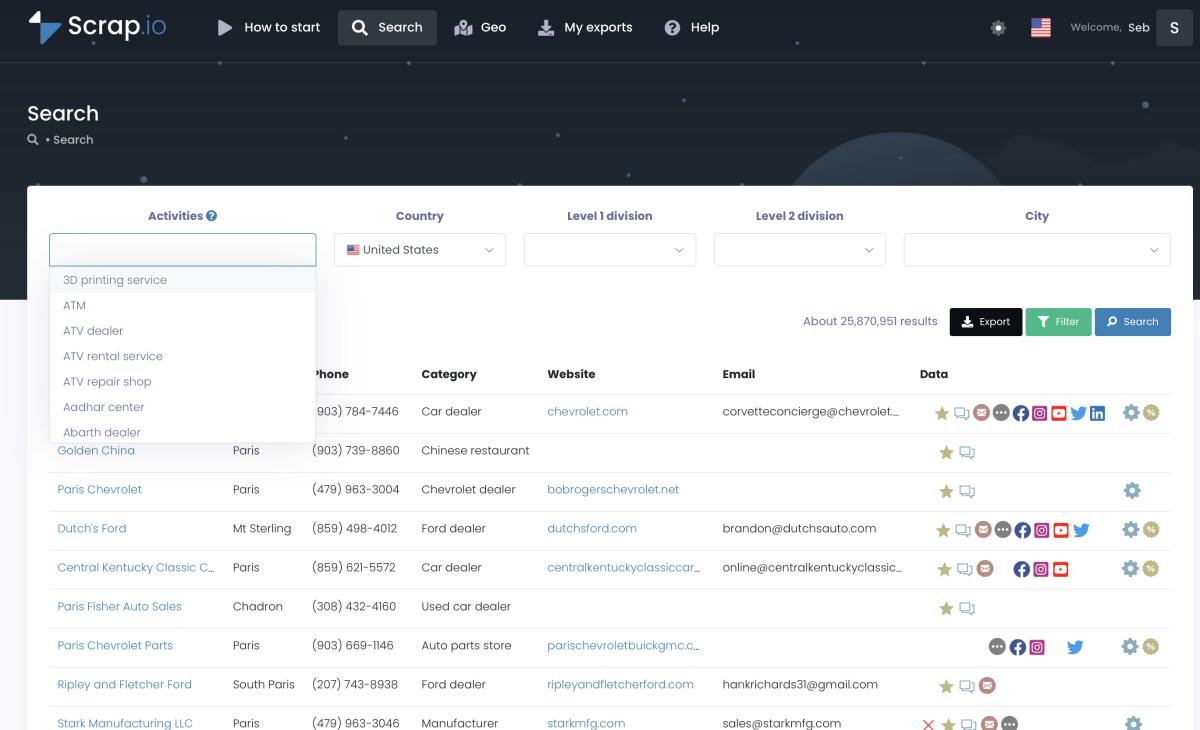
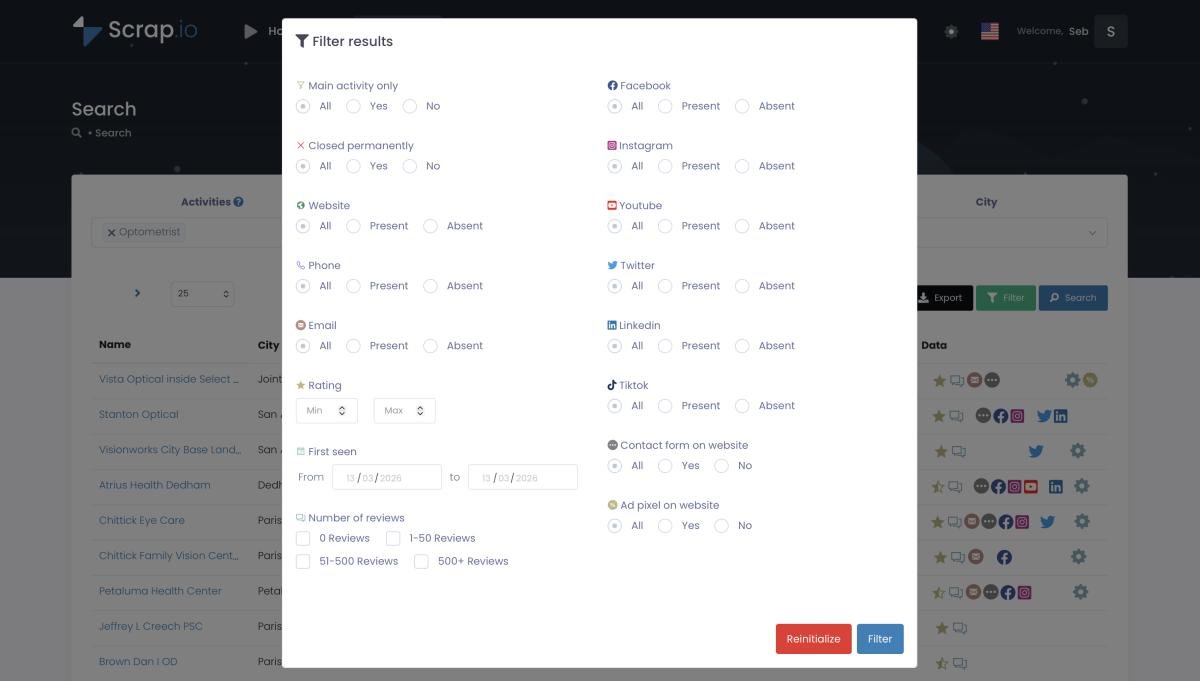
Then you filter before extraction, by phone presence, phone type, rating, review count, website status, and a couple dozen more criteria. That's how you go from "every business in the city" to "only the ones worth calling." Doing this by hand? Try building a list of 83,000 agency phone numbers manually. I'll wait.
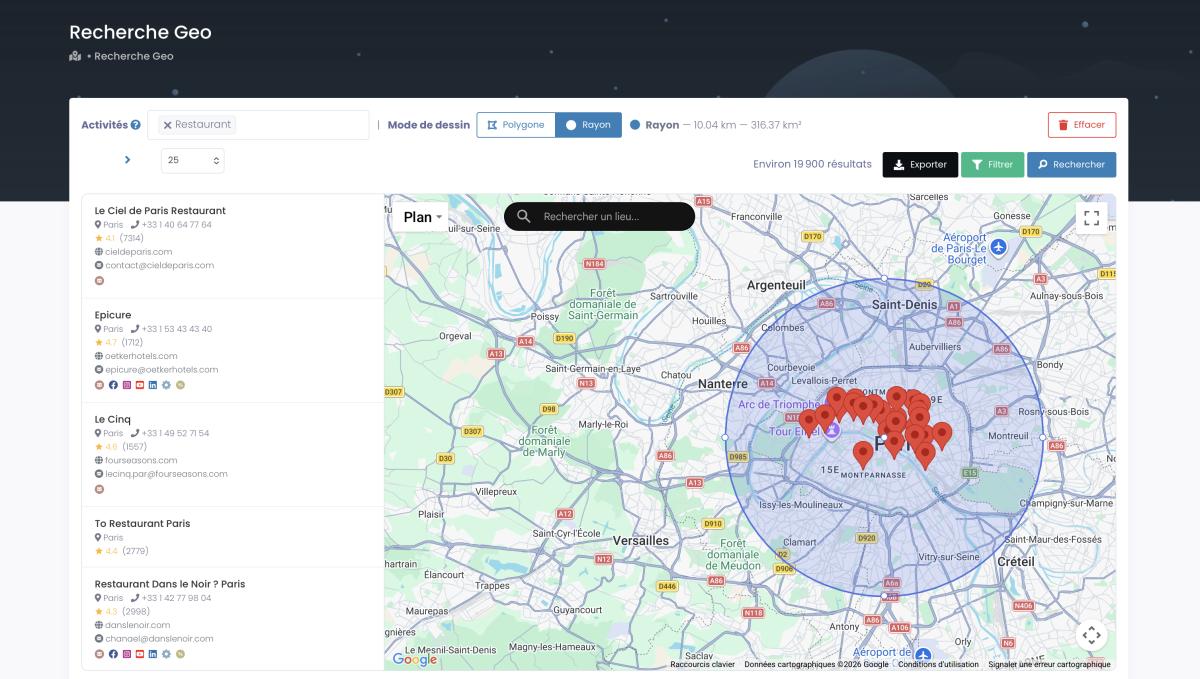
Need a zone that isn't a whole city? Draw it. GeoSearch lets you set a radius around any point, perfect for drive-time, local prospecting.
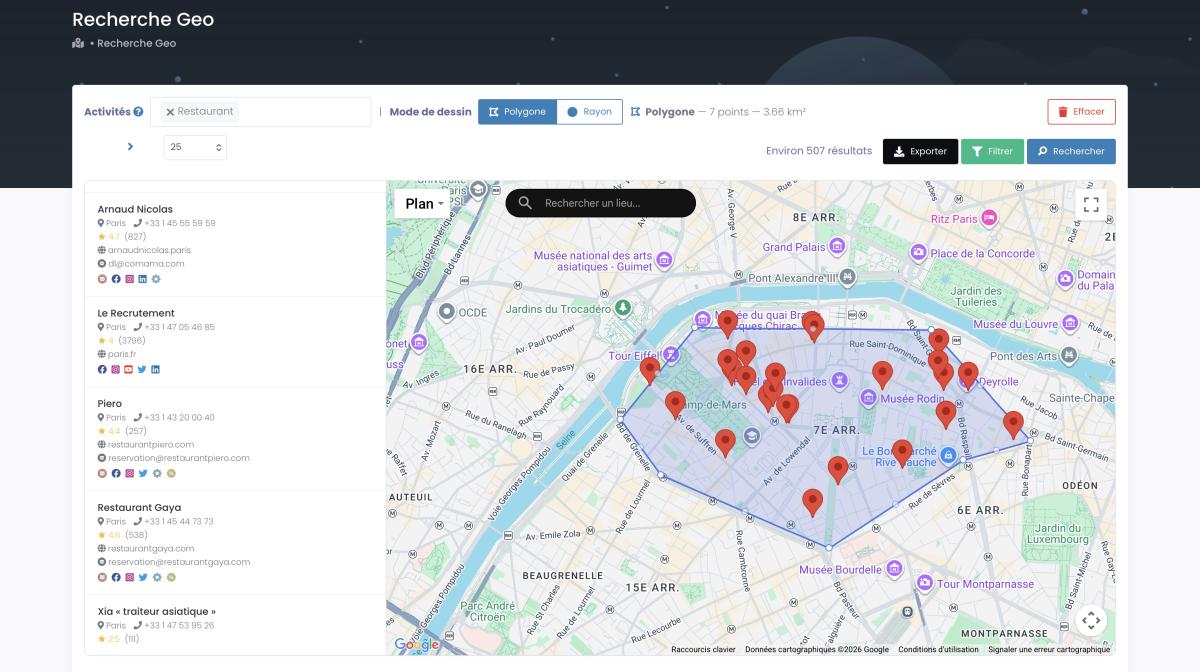
Or draw a hand-made polygon around exactly the neighborhood or sector you want, no administrative boundary required.
Not sure how to pull those numbers into a spreadsheet? We wrote a full tutorial on how to scrape phone numbers from Google Maps, five methods compared. And here's the two-minute version on video.
Video: How to Scrape Local Leads at the Country Level
Build your first targeted call list in minutes. Try Scrap.io free for 7 days and get 100 leads on the house. Pull dial-ready phone numbers from 225M+ Google Maps businesses across 195 countries, filter before you export so every credit buys a number that can actually ring, and start testing your new scripts on real prospects. Start your free trial →
3. Identify the Right Decision Maker
Don't just call anyone. For operational solutions, target Operations Manager, VP of Operations, or COO. For sales tools, VP of Sales or Sales Director. For HR, Head of HR. For finance, CFO or Controller. For tech, CTO or IT Director. Calling the wrong title is a dial you'll never convert.
4. Research Before You Call
Spend 2-3 minutes per prospect. Check their LinkedIn for recent activity, look for company news, scan their website, look for mutual connections. Research separates the 2.7% crowd from the 11% crowd. It's the single highest-leverage habit in cold calling.
5. Quality Over Quantity
Don't build a list of 10,000 random companies. Build a list of 100 perfect fits. Do the math: 100 calls to ideal prospects at a 10% answer rate gives you 10 conversations and 2-3 qualified meetings. 1,000 calls to random companies at a 2% answer rate gives you the same 2-3 meetings, but you burned ten times the hours. Same result. One path is faster and far less soul-crushing.
6. Organize Your List for Follow-Up
You won't connect on the first call. Remember, it takes about 8 attempts to reach a decision-maker. First call, no answer? Call back in 3-5 days. Second attempt, nothing? Try email or LinkedIn. Third attempt, call at a different time (early morning or end of day often works better). After three attempts, move to a nurture sequence. And pair your calls with a good cold email sequence, because the prospects you can't reach by phone, you can often catch in the inbox.
Cold Calling Compliance: What You Need to Know in 2026
Cold calling is legal. But there are rules, and breaking them gets expensive. Quick disclaimer: this isn't legal advice, just the lay of the land in the main markets. Check your specifics before you dial across borders.
United States: TCPA and the FTC Telemarketing Sales Rule
Two separate things people constantly confuse.
The Telephone Consumer Protection Act (TCPA), enforced by the FCC, governs how you call. Statutory damages run $500 to $1,500 per violation, per call. You cannot autodial or use prerecorded messages to cell phones without prior express consent. You can call business lines without prior consent. You must call between 8am and 9pm in the prospect's timezone.
The FTC Telemarketing Sales Rule (TSR) is the other regime, and it's where that scary "$43,792 per violation" figure actually comes from. It's a civil penalty maximum that the FTC adjusts for inflation annually (it now sits above $50,000 per violation), not a TCPA fine. Under the TSR, you must disclose your identity, maintain a Do Not Call list, honor the National DNC Registry, and avoid misrepresentation.
B2B is safer than B2C. Business phone lines carry fewer restrictions than personal cells, and they answer better anyway. Always target business numbers when you can.
European Union: GDPR
Stricter. Under GDPR, you generally need a lawful basis (legitimate interest for B2B), you must offer a clear opt-out, and you must respect national Do Not Call registers. Fines reach up to 4% of annual global turnover. Build your consent and legitimate-interest documentation before you dial into the EU.
United Kingdom (Post-Brexit)
B2C calls need prior consent. B2B is more flexible, you can call business numbers, but you must honor TPS (Telephone Preference Service) registrations. Serious violations run £50,000 and up.
Canada: CASL
The strictest regime globally. CASL wants express consent and covers all electronic messages. Fines reach up to $15M per violation, and a private right of action means customers can sue you directly. Calling Canada? Get explicit consent first.
Key Compliance Checklist
- Target business phone numbers when possible.
- Verify numbers before calling to reduce accidental cell calls.
- Maintain an internal Do Not Call list.
- Disclose your name and company on every call.
- Keep call records for compliance review.
- Train your team on TCPA, TSR, GDPR, and CASL.
- Have a clear opt-out process.
- Only call during business hours in the prospect's timezone.
One quiet upside: clean, compliant data actually raises your conversion rate. Scrubbed lists remove junk calls from your funnel, and junk calls are what tank your averages. Sourcing from publicly available business data, like the info businesses publish on their own Google Maps listings, keeps the sourcing side clean and traceable. The dialing side is on you.
FAQ: Best Cold Calling Scripts
Is B2B cold calling illegal?
No. B2B cold calling is legal in the US when you follow TCPA and the FTC Telemarketing Sales Rule: disclose who you are, honor Do Not Call requests, call within legal hours, and avoid autodialing cell phones without consent. Business lines carry fewer restrictions than personal cells. In the EU you need a lawful basis like legitimate interest, and in Canada CASL requires express consent.
What are the 5 stages of cold calling?
Five stages, in order: (1) the permission-based opening, your name, company, and a quick ask for 20 seconds; (2) the hook, one sentence proving you understand their world; (3) listening, where you ask questions and let them talk; (4) the relevant insight, tied to what they just told you; and (5) the clear next step, a specific 15-minute meeting. Nail all five and the call has a shape. Skip one and it falls apart.
What is the 80/20 rule in cold calling?
It works two ways. One: listen 80% of the time and talk 20%. The best callers ask a question and then shut up while the prospect reveals the pain. Two: 80% of your meetings come from 20% of your list, almost always the 20% that was well-targeted. Fifty calls to the right people beat 200 random dials. Prioritize ruthlessly.
Should I use a script word-for-word, or make it my own?
Use it as a framework, not gospel. A script keeps you on track, but rigidity kills conversations. Personalize every script with the prospect's situation. The structure stays the same. The details change.
What if they interrupt my script?
Stop talking and listen. That's a good sign, they're engaged. Let them talk, understand the concern, then pivot based on what they said.
How many times should I call before giving up?
Three times minimum, though the data says it takes about 8 attempts to reach a decision-maker. First call, no answer. Second call 3-5 days later, still nothing. Third call at a different time. After that, move to email or nurture. Don't assume they're not interested until you've genuinely tried.
Is cold calling dead?
No. Cold calling is harder in 2026 than in 2020, but more valuable to those who do it right. The average success rate actually rose to 2.7% (Cognism), and 82% of B2B buyers have accepted a meeting that started with a cold call (RAIN Group). Most competitors quit, so the bar is low and the rewards are high for quality reps.
What's the best time to call?
Early morning (8-9am) or late afternoon (4-5pm) usually works best. Mid-morning and early afternoon, people sit in meetings. Test your specific market, though, every industry is a little different.
Should I mention price on the cold call?
No. Never quote price on a cold call. Your goal is a conversation, not a sale. Pricing comes later, once they understand the value.
What if I keep getting voicemail?
Leave a good voicemail, not a rambling one. Name, company, why you called (specifically), and a clear ask to call back. Keep it under 20 seconds. It's your second shot at a first impression, so make it count.
How do I know if I'm calling the right person?
Ask on the first call. "Are you the right person to talk about [problem]? If not, who is?" Most people either claim the role or point you to the right person. Either way, you win.
Can I use AI to dial and record cold calls?
Be careful. Recording laws vary by state and country (some require all-party consent), and automated dialing can violate TCPA. If you use tools, make sure they comply with your local regulations.
What's the difference between cold calling and warm calling?
Warm calling means you have a mutual connection or a reason to call, they downloaded your content or visited your site. Cold calling means complete stranger. Warm calls convert better, but cold calls aren't dead, they're just harder.
Should I cold call prospects already in our sales funnel?
No. If they're in your funnel, follow your nurture sequence. Cold calling existing leads can feel aggressive and hurt your brand. Let them move through the funnel naturally.
How do I handle gatekeepers?
Treat them with respect, they're not your enemy. "Hi, I'm trying to reach [person]. Is he or she available?" If they ask why, be honest: "I had a thought I wanted to run by them, it'll take 20 seconds." Honesty and brevity beat tactics.
What's a good cold calling conversion rate?
5-10% of calls turning into meetings is solid, meaning 90-95 calls per 10 meetings. Below 5%, your script, list, or timing needs work. Above 10%, you're probably not screening hard enough for quality. Top performers hit 6-10%+ while the average sits at 2-3% (Cognism, 2026).
The Bottom Line
Cold calling isn't going anywhere. It's more valuable now, precisely because fewer reps do it. The companies that master it in 2026 get an unfair edge over everyone leaning on email and ads.
Here's your move. Pick the right framework from the 15 scripts above. Customize it with real research on your prospect. Build a targeted list of ideal customers, quality over quantity. Practice until it sounds natural, not robotic. Follow the compliance rules for your region. Track your results and iterate.
The reps who win at cold calling aren't the most charismatic. They're the ones with the best process, and the best list.
You've got the scripts. Now get the list. Start your free 7-day Scrap.io trial, 100 leads included. Pull dial-ready phone numbers from 225M+ Google Maps businesses across 195 countries, filter before you export so every dial can actually ring, and put these scripts to work on prospects who pick up. Start your free trial →
Generate a list of restaurant with Scrap.io