

$24 billion.
That's the US chiropractic industry right now (IBISWorld, 2026). We're talking 66,061 businesses across every state. Run a quick search on Google Maps and you'll pull up 138,673 chiropractor results in the US alone — and 53,349 of them have a real email address sitting on their website. Tons of potential buyers for whatever you're selling — equipment, software, billing services, marketing, you name it.
But here's the thing nobody warns you about. Most companies trying to reach these chiropractors are doing it wrong. Like, embarrassingly wrong. They'll drop $700 on what some database company calls a "premium" chiropractor email list. Send out a campaign. And then watch half their emails bounce back because the contacts are six months old. Some of those chiropractors retired. Others moved clinics. A few switched to cash-only practices and ditched their old business emails entirely.
A medical equipment rep in Ohio — I was talking to him last month — told me he burned through $2,100 on three separate lists before he found anything usable. Two out of three were recycled junk with nice branding slapped on top. Twenty-one hundred dollars. For spreadsheets full of dead email addresses.
That's the state of this market. But the fix actually isn't complicated. Most people just don't know it exists yet.
This guide walks through the whole thing — who you're actually targeting when you buy a chiropractor email list, the three ways to get contacts (and why one of them is dramatically cheaper and better than the other two), what the chiropractic market looks like in 2026 with real numbers you can cite, plus email strategy, compliance rules, and actual company names selling into this space. No made-up case studies.
Video: Why Your Google Maps Emails Don't Get Replies?
What's In This Guide
- What Is a Chiropractor Email List?
- Types of Chiropractors You Can Target
- Why Chiropractor Email Lists Matter for B2B Sales
- The 2026 Chiropractic Market: Key Numbers
- Build, Buy, or Scrape: 3 Ways to Get Contacts
- Why Live Data Scraping Changes Everything
- How to Choose a Good Chiropractor Email List
- Real Companies Selling to Chiropractors
- Email Marketing Tips for Reaching Chiropractors
- Legal Compliance: CAN-SPAM, GDPR, and Healthcare Rules
- FAQ
- Bottom Line
What Is a Chiropractor Email List?
Pretty straightforward concept. A chiropractor email list is a database packed with contact info for chiropractic professionals. Emails, obviously. But the good ones go way beyond that — phone numbers, office addresses, practice names, what type of chiropractic they focus on, sometimes even their Google rating and how long they've been in business.
Why does that matter? Because you're not just collecting email addresses. You're building a shortcut past the gatekeeper. Instead of cold-calling some office and sitting on hold while the front desk person juggles three patients and a FedEx delivery, you land straight in the inbox of whoever signs purchase orders.
A solid chiropractic mailing list gives you contact details (emails, phones, addresses), professional stuff (name, title, experience level), business info (clinic name, staff size, rough revenue), specialty focus (sports medicine, kids, rehab, wellness), and location data for geographic targeting.
Here's where people mess up, though. They think an email address is an email address. It's not. An email with zero context is basically useless for B2B outreach. If you know the chiropractor specializes in sports rehab, runs a 3-person clinic in Austin, and has a 4.2 Google rating — you can write something worth reading. Without that context? Your email sounds like every other generic pitch they delete before lunch.
One more thing. A chiropractor email list isn't the same as a Yelp listing or a Google directory. Those are for patients. A B2B chiropractor database is structured data — exportable, filterable, ready to drop into your CRM or email platform. Totally different use case.
Types of Chiropractors You Can Target
A solo doc in rural Montana buying her first digital X-ray machine is a completely different buyer than a 5-location franchise in suburban Dallas upgrading all their EHR systems. You need to know who you're actually going after.
General Practice DCs — your bread and butter. Back pain, neck stuff, headaches, general musculoskeletal complaints. They handle everything. They're always looking for reliable suppliers and they make up the biggest chunk of the market. Not glamorous, but these are the chiropractors who buy the most stuff overall because there are so many of them.
Sports Medicine Chiropractors are where the money gets interesting. They work with athletes, sports teams, sometimes entire athletic departments at colleges. Bigger budgets. Way more willing to spend on cutting-edge tech — laser therapy, shockwave devices, advanced imaging equipment. One of our users sold $50K of laser equipment to a single sports clinic in Phoenix last year. Single transaction. These folks have cash to burn on the right product.
Pediatric Chiropractors. Smaller niche but almost zero competition from other B2B sellers, which is kind of nice. They need gentle, specialized equipment and kid-friendly office setups. And parents eat up educational content, so if you've got anything related to patient education, this is your crowd.
Rehab Specialists tend to be embedded in bigger medical groups alongside physical therapists and physiotherapists. More budget. More buying power. They want stuff that integrates with other modalities — not standalone equipment that doesn't talk to anything else in the clinic.
Wellness-Focused DCs. Prevention, supplements, lifestyle coaching. Growing like crazy since 2020. Their patient base tends to be engaged and health-conscious, which makes these chiropractors great targets for supplement companies, wellness platforms, and patient engagement tools. Less traditional, but the market is expanding fast.
Quick stat that matters here: the Bureau of Labor Statistics projects 10% job growth for chiropractors from 2024 through 2034. Faster than average. Every year, new chiropractors are entering the market. New clinics opening. New equipment needs. New software subscriptions. That's a constant flow of fresh prospects if you know how to find them.
The franchise angle is blowing up too. The Joint Chiropractic, which crossed 900 locations back in 2025, now sits above 950 across 43 states. Spine Labs launched back in April 2025 with a $200K startup cost per location. These franchise operations need every supplier an independent clinic needs, plus franchise-specific solutions. Most people selling chiropractor email lists completely overlook this segment.
Why Chiropractor Email Lists Matter for B2B Sales
Hospitals have purchasing committees. Six-month procurement cycles. Budget reviews. Chiropractors? Not so much.
Most chiropractors own their practice outright. They're the decision-maker AND the end user AND the person who signs checks. All one person. When you email a chiropractor, you're usually talking directly to whoever decides whether to buy your thing or not. That's rare in healthcare B2B. And it's wildly valuable — but it also means your message has to actually be good, because they'll spot a lazy generic pitch in about two seconds flat.
Let's talk money for a second. Say you hire someone at $20/hour to manually look up chiropractor contacts. A really fast researcher finds maybe 15-20 good contacts per hour. That's about a buck per contact, minimum. And that doesn't include tools, verification, or the fact that the data starts going stale the moment you collect it. Meanwhile, a decent chiropractor email list from a traditional provider runs 3-7 cents per contact. From a live scraping platform? Half a cent. The math is so lopsided it's almost silly.
Targeting is the other piece. Good chiropractic email databases let you filter by office size, location, specialty, years open, tech adoption — whatever you need. A wellness-focused solo practice in Portland has nothing in common with a 5-doctor sports rehab chain in Houston. Treating them the same in your outreach is a waste of everyone's time.
Healthcare email marketing pulls some solid numbers, by the way. Average open rates sit around 41% across the sector, and ROI averages about $42 back for every $1 spent. Way above most B2B verticals.
And here's one more thing people forget — chiropractors talk to each other. A lot. They share vendor recommendations at conferences, in Facebook groups, on Reddit. Get one happy chiro client and word-of-mouth can snowball. But none of that happens if you can't get your foot in the door in the first place. That's the whole point of having a good chiropractic email list.
I'll put it bluntly: if you're selling to chiropractors and you don't have a way to reach them at scale, you're basically hoping they stumble across your website or bump into you at a trade show. That worked in 2012. Not anymore.
The 2026 Chiropractic Market: Key Numbers You Need to Know
Before spending a dime on any chiropractor email list, you should know what you're actually selling into. Here are the numbers worth memorizing.
| Metric | Figure | Source |
|---|---|---|
| US Chiropractic Industry Size | $24.0 billion | IBISWorld, 2026 |
| Chiropractic Businesses | 66,061 | IBISWorld, 2026 |
| Google Maps Results (US) | 138,673 | Scrap.io, July 2026 |
| — with a listed email | 53,349 (38.5%) | Scrap.io, July 2026 |
| — with a website | 78,695 (56.7%) | Scrap.io, July 2026 |
| Revenue Growth (2026) | +2.6% | IBISWorld, 2026 |
| Projected Job Growth (2024-2034) | +10% | Bureau of Labor Statistics |
| Median Salary | $79,000/year | BLS, May 2024 |
| Annual Chiro Patients (US) | 35 million | American Chiropractic Assoc. |
| Market CAGR (2026-2034) | 7.49% | IMARC Group |
| Patient Split | 60% female | Grand View Research |
| Practitioner Split | 77% male | Grand View Research |
Now look at line four again, because it's the one nobody else in this SERP will show you. Your real addressable market by email isn't 138,673. It's 53,349 chiropractors with email addresses in the United States. Roughly six practices out of ten have a Google Maps listing with no email attached anywhere — phone and website only, or nothing at all. Every provider selling you a "full US chiropractor database" is quietly charging you for those six.
The right tool lets you filter for email presence before a single credit leaves your account. That's the entire difference between a $50 list and a $500 one, and we'll come back to it.
Couple other things jump out. The Joint Chiropractic — biggest US franchise — is now past 950 locations across 43 states, with more than 14 million patient visits a year. Aggressive suburban expansion, Midwest and Southeast mainly. When the largest chain in your market is growing that fast, it tells you something about where the industry is headed.
The patient-vs-practitioner demographic is interesting too if you think about it from a marketing angle. 60% of chiropractic patients are women, but 77% of chiropractors are men. If you sell patient engagement software, or marketing tools that help practices attract and retain female patients, that gap is your pitch. Right there.
Build, Buy, or Scrape: 3 Ways to Get Chiropractor Contacts
OK so you need a chiropractor email list. You've got three options. None of them are perfect but one is dramatically better than the other two.
Build Your Own List (DIY)
Full control. You know where every single contact came from. And you'll spend three months getting a list that's already 20% stale by the time you send your first email.
I watched a company do this once. Three months. Five thousand contacts. They launched their campaign and over 1,000 emails bounced right back. The data was rotting while they were still collecting it. That's the fundamental problem with manual research — it can't keep up with how fast people change jobs, switch emails, and move practices.
Only makes sense if you're chasing a micro-niche so specific that nobody else covers it. If you want the full methodology anyway, we wrote a whole guide on how to build a cold email list from scratch. Otherwise, skip it.
Buy from Traditional Providers
Way faster. A pre-built chiropractor contact list with some filtering options. Most of these companies charge 3-7 cents per contact. 10,000 chiropractor contacts? Somewhere between $300 and $700.
Catch is quality's a total crapshoot. Some providers keep genuinely solid data. Others? Their "verified" contacts include chiropractors who quit practicing when Blackberry was still a thing. Always ask for sample data before you hand over money. If they won't show you a sample, leave.
There's a deeper problem though. You're buying a snapshot. A photograph of reality taken weeks or months ago. And from the moment that photo was taken, it started decaying. B2B contact data goes bad at roughly 30% per year — industry-wide benchmark. So a 6-month-old list has already lost about 15% of its accuracy. For a $500 purchase, that's $75 you lit on fire before you even logged into your email tool. Plus the sender reputation damage from all those bounces, which compounds over time.
Use Live Data Scraping to Generate Chiropractor Leads (Scrap.io)
This is what's blown up the traditional buy email list model. Instead of buying someone else's stale database, you extract fresh chiropractor leads directly from Google Maps, practice websites, and professional directories. Real-time.
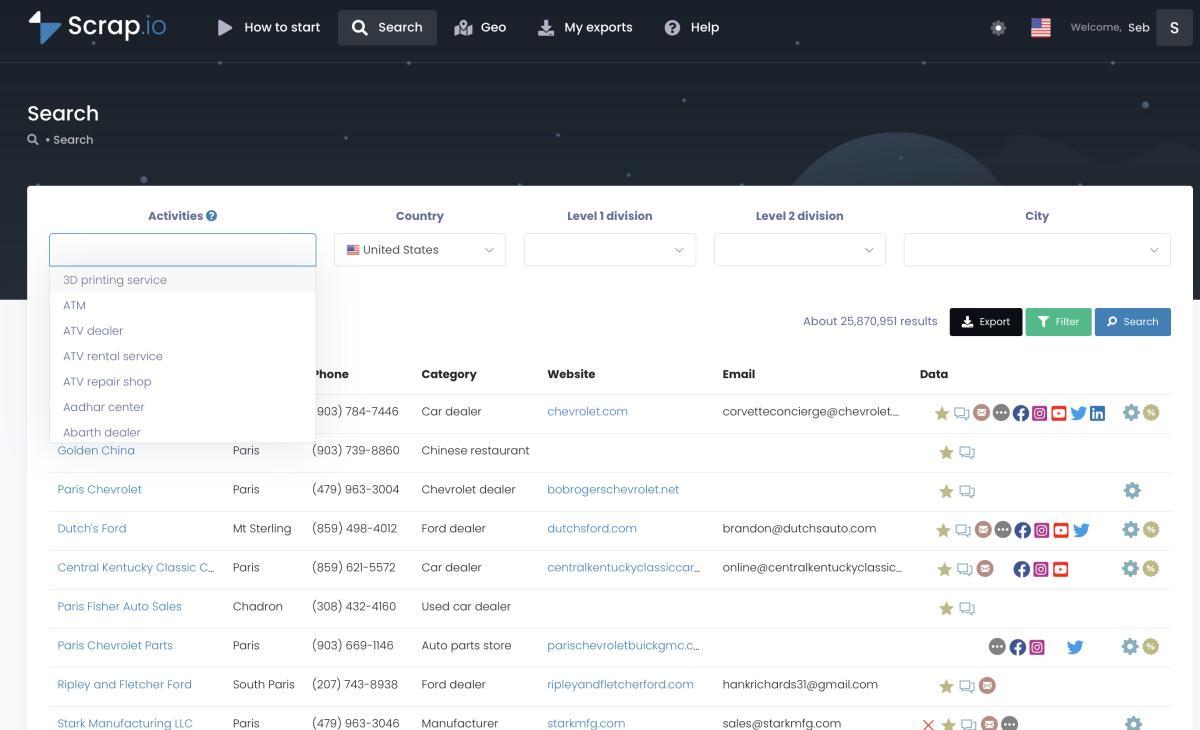
Chiropractor updates their Google Maps listing on a Tuesday morning? You can pull that updated info on Tuesday afternoon.
| Method | Cost (10K contacts) | Data Freshness | Time to Get | Effort |
|---|---|---|---|---|
| DIY | $10,000+ in labor | Stale when done | Weeks/months | Insane |
| Traditional | $300-700 | 3-6 months old | Days | Low |
| Live Scraping (Scrap.io) | ~$50 | Live | Minutes | Minimal |
Video: Scrap.io - How to Start?
10K contacts. $50. Live data. Scrap.io pulls chiropractor emails, phones, ratings and websites straight from Google Maps — 225 million businesses indexed across 195 countries, filtered before you spend a credit. Try it free for 7 days — 100 leads included.
Why Live Data Scraping Changes Everything in 2026
Traditional chiropractor email lists are photographs. Frozen in time. The second the list gets compiled, it starts going out of date. Six months in, you're working with a memory of what the market used to look like.
Live scraping is more like a mirror. Current. Always.
Scrap.io vs. Old-School Providers
| What You Get | Old-School Providers | Scrap.io |
|---|---|---|
| 10K contacts | $300-700 | ~$50 |
| Freshness | 3-6 months old | Real-time |
| Filters | Basic presets, applied after you pay | Applied BEFORE extraction |
| Coverage | US-only (usually) | 195 countries |
| Ready in | Days/weeks | Minutes |
| Source | Compiled databases | Google Maps (live) |
The filtering is what sold me honestly. And I don't mean "we have lots of filters" — every tool says that. I mean the filters run before a single credit gets consumed: email present or absent, website present or absent, Google rating range, review count, phone type, ad pixel detected on the site, date the listing was first seen on the map. You narrow 138,673 chiropractors down to the 53,349 with an email, then export only those.
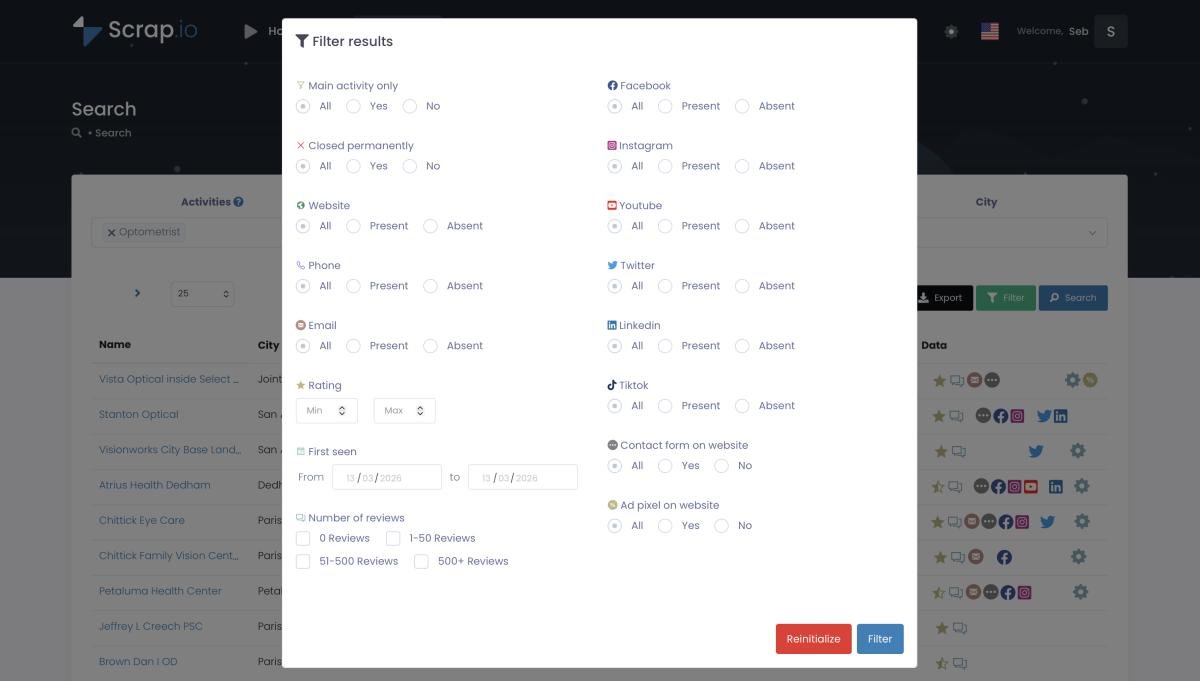
That's the part competitors can't copy easily. Everyone else sells you the whole haystack and lets you find out afterwards how much of it was hay.
Video: Finding Clients Through Google Maps Filters
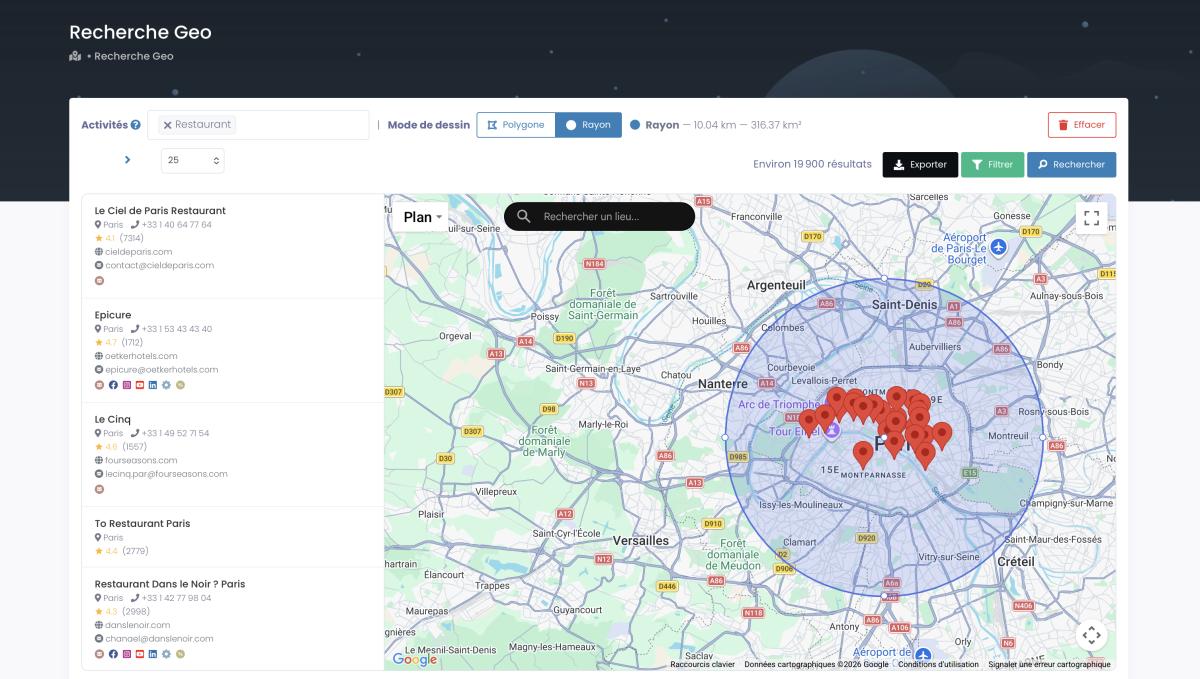
Scale works the same way whether you're thinking small or thinking national. "Chiropractors in Texas" and "every chiropractor in the United States" are the same two clicks. You can also draw a catchment area by hand on the map — a radius around a point, or an irregular polygon around three suburbs — and pull every business inside it without even specifying a category. Want the 12 chiropractors within 8 miles of your showroom? That's a search, not a project.
You want chiropractors in Texas with a Google rating under 3.5 who might need marketing help? Two clicks. Clinics that have an email but no Facebook page? Easy. Chiropractors who appeared on Google Maps in the last 12 months — probably new practices that need equipment? Yeah, you can find those too.
And before you ask — yes, it's legal. 100%. The data comes from stuff businesses posted publicly: Google Maps listings, their own websites, professional directories. Nobody's hacking anything. These chiropractors put their contact info online because they want to be found. You're just organizing what's already public.
If you want the full technical walkthrough, there's a solid guide to Google Maps filters to find clients on the blog. Also worth reading: how to find emails on Google Maps — covers the extraction methodology in detail.
Look, I get that "live data scraping" sounds technical and maybe a little sketchy if you've never heard of it. It's really not. You type "chiropractor" into a search bar, pick a location, hit export. The platform does the heavy lifting. Two minutes later you've got a CSV with hundreds or thousands of verified chiropractor contacts that are current as of today. No coding. No scraping scripts. No dark web nonsense. Just organized public business data.
How to Choose a Good Chiropractor Email List
Doesn't matter whether you go traditional or live scraping. Some things separate a database that's actually worth money from one that'll wreck your afternoon.
Freshness. That's the number one thing. The chiropractic market churns — docs relocate, clinics shut down, new ones open, email addresses get swapped. Old data doesn't just underperform. It actively trashes your sender reputation. Every bounce hurts your deliverability for future campaigns too. You want 90%+ accuracy or don't bother. And if a provider can't tell you when their data was last verified? Walk. The email validator guide goes deep on verification if you want the technical side.
Completeness is next. An email address by itself? Nearly worthless for B2B. You need names, clinic names, titles, phone numbers, office addresses, websites, specialties, and — if you can get it — practice size. That's what lets you personalize messages and run multichannel campaigns instead of just blind email blasts.
Then filtering. This is the one that most people skimp on and regret. Blasting the same generic email to every chiropractor in America is a guaranteed way to get ignored. You need to segment your chiropractor mailing list — by geography, specialty, practice size, online presence, whatever's relevant to your product. Once it's segmented, lead scoring for local leads tells you which segment to call first.
Here's the four options laid side by side, since everyone asks which chiropractor email list provider is actually best:
| Approach | Typical cost (10K) | Turnaround | Best for |
|---|---|---|---|
| Traditional list providers | $300-700 | Days | One-off campaigns, no tooling |
| Bespoke research agencies | $1,000+ | 1-2 weeks | Tiny, ultra-qualified lists |
| DIY manual research | $10,000+ in labor | Weeks/months | Micro-niches nobody covers |
| Live scraping | ~$50 | Minutes | Recurring, segmented outreach |
One word of warning on vocabulary. Every vendor page in this SERP promises a "premium" or professional chiropractor email list, and not one of them defines what that means. Ignore the adjective. Ask when the file was last verified. That's the only quality signal that survives contact with your bounce rate.
Four questions to ask any provider: How often do you update? What's your accuracy rate? Do you replace bounced contacts? Where does your data come from?
If they dodge even one? You already know.
Oh, and one more thing — test before you commit. Any provider worth dealing with will let you sample a batch of contacts before you buy the full thing. Ask for a chiropractor email list sample and run those contacts through an email verifier. If the bounce rate's above 10% on a sample, imagine what the full list looks like. I've seen people skip this step and regret it every single time.
Real Companies Selling to Chiropractors (And What You Can Learn)
Forget those "Case Study #1: Anonymous Equipment Company" examples you see on every other article about chiropractor email lists. Here are real businesses doing real things in this market. Go look them up yourself.
ChiroFusion. EHR provider built 100% for chiropractic offices, serving over 14,000 users at $129/month. They dropped an AI-powered SOAP note automation tool back in January 2025. Every single new chiropractor who opens a practice is a potential ChiroFusion customer. They need accurate contact databases to find those new practices before competitors do.
The Joint Chiropractic. Not buying email lists — they ARE the market. Past 950 locations across 43 states and more than 14 million patient visits a year, expanding into suburbs across the Midwest and Southeast. But think about the ecosystem around them. Equipment suppliers need to reach those locations. Software companies need to sell practice management tools. Marketing agencies need to pitch franchise owners. All of those companies need chiropractic contacts. And so do the independent clinics competing with The Joint — they need vendors who can help them keep up.
HealthSource Chiropractic + SpineSense. Partnered up back in March 2025 to integrate wearable posture tracking into clinical workflows. HealthSource now runs 250+ licensed chiropractors across 140+ locations. That tells you where the industry is headed. Chiropractors are adopting tech faster than most people in healthcare B2B realize. SaaS, sensors, patient engagement platforms — the market's receptive.
Spine Labs. Franchise from Dr. Ivi Bifsha, launched back in April 2025. Two locations, $200K startup per unit. Brand new franchises need literally everything: furniture, equipment, software, billing services, marketing help. If your product targets new chiropractic practices, these guys are your ideal customer.
TOV Chiropractic — a marketing case study worth looking at. Documented results of +58% patient visits and +876% website traffic over 18 months via strategic marketing. If you're an agency or consultant helping chiropractors grow, that's the kind of result you're pitching. And to find clients, you need... yeah. A chiropractor email list that actually works.
The 2026 story: AI scribes are eating chiropractic documentation
Here's the angle that didn't exist eighteen months ago. Chiropractic practice software is now an AI arms race, and it's worth real money — the chiropractic EMR market hit roughly $500 million in 2025 and is projected past $1.5 billion by 2033 (EMR Guides, 2026).
What's driving it? Ambient AI scribes. ChiroTouch's Rheo assistant listens to the doctor-patient conversation and spits out a structured SOAP note, cutting documentation time by up to 92%. Thirty to sixty minutes a day handed back to a practitioner who was charting at 9pm. zHealth and others are shipping similar features. Noterro built one too, and its own 2026 trends roundup puts AI note-taking at the top of the list alongside 3D posture analysis and wearables.
So if you sell SaaS to chiropractors in 2026, you're selling either against AI or with it. Either way the first problem is identical: knowing which 66,061 practices exist and which of them you can actually email. That hasn't changed at all.
Want to build your own chiropractor prospect list? Start free — 7 days, 100 leads included. Filter to the 53,349 US chiropractors who actually have an email before you spend a credit. Start your free trial →
Email Marketing Tips for Reaching Chiropractors
Good contacts are half the battle. The other half is not screwing up the email.
First rule: lead with their problem. Not your product. A chiropractor drowning in paperwork doesn't give a damn about your "comprehensive practice management solution." What they care about is getting home by 6 instead of 8. Talk about the pain. The features can come later.
Subject lines make or break you. Healthcare emails get around 41% open rates on average — which is excellent — but only if you earn the open. What actually works: specifics ("Cut 30 Minutes Off Patient Scheduling Every Day"), peer proof ("How Dr. Patel's Clinic Reduced No-Shows 40%"), local angles ("New Texas Chiro Insurance Rules: What Changed"). What gets you deleted: all caps, too many exclamation marks, anything that reads like a mass blast from a CRM nobody configured properly.
Personalization that goes beyond "Hi {first_name}." With data from Google Maps you've got their rating, review count, website quality, social media presence — use it. "I noticed your Austin clinic has 4.8 stars and 200+ reviews — your patients clearly love you. Here's how to turn that reputation into more referrals." That gets read. "Dear Chiropractor, We offer great services" gets trashed.
This is honestly the unfair advantage of live scraping over traditional lists. You don't just get an email address. You get enough business intelligence to write something personal at scale. A chiropractor with 12 Google reviews and no website has totally different problems than one with 300 reviews and a slick online presence. Match your pitch accordingly. The Google Maps email extractor guide goes deeper on this approach.
One email won't close anything, by the way. Plan 3-5 touchpoints. Alternate between educational stuff and soft pitches. Weirdly, emails 3 and 4 in a sequence often outperform email 1, because by then the chiropractor has seen your name enough times to stop treating you like a stranger.
Timing-wise? Chiropractors are with patients basically all day. Best windows for cold email outreach:
| Send Window | Why |
|---|---|
| Tue-Thu, 6-8 AM | Before patients show up |
| Tue-Thu, 12-1 PM | Lunch break email check |
| Tue-Thu, 6-8 PM | After the clinic closes |
| Avoid Mon & Fri | Monday = chaos. Friday = checked out. |
Legal Compliance: CAN-SPAM, GDPR, and Healthcare Rules
Rules exist. They're not that complicated. Ignoring them is expensive.
CAN-SPAM (US)
Your "From" line has to be accurate. Subject lines can't be deceptive. Every email needs a physical address and a clear unsubscribe link. When someone opts out, remove them within 10 days. Done. That's basically it.
Penalties hit $51,744 per email though, so yeah — take it seriously. The cold email compliance guide has the full breakdown. And if you're setting up technical infrastructure, SPF, DKIM, DMARC authentication isn't optional anymore — Gmail and Yahoo are blocking unauthenticated senders now.
GDPR (International)
Got even one European contact in your chiropractor email list? GDPR applies. You need a legitimate reason to process their data, can only collect what's necessary, and they can request deletion anytime. B2B has more flexibility under "legitimate interest" but you still need to be transparent about it. Not complicated, just needs attention.
Worth noting: if you're only targeting US-based chiropractors using data from US Google Maps listings, GDPR generally won't apply to you. But the second you include international contacts — or if someone from your list happens to have EU citizenship — you're in GDPR territory. Better to set up proper processes from the start than scramble later.
Healthcare-Specific Stuff
HIPAA covers patient data. Not B2B marketing to providers. But chiropractors are jumpy about privacy because of their healthcare context, so anything you can do to show you respect data protection builds trust.
Practical tip that saves headaches: always document where your data came from. If a chiropractor asks how you got their email, "from your publicly listed Google Maps profile" is a clean answer. "I bought a list from... some company" is not.
External resources worth bookmarking: the American Chiropractic Association for industry context, IMARC Group's US chiropractic market report for projections through 2034, BLS chiropractor data for employment stats, the FTC's CAN-SPAM guide, and GDPR.eu.
FAQ — Chiropractor Email Lists
How much does a chiropractor email list cost?
Traditional providers: 3-7 cents per contact, so $300-700 for 10K. Live scraping with Scrap.io: about $50 for the same volume. Roughly 80% cheaper and the data is actually current.
Is it legal to buy chiropractor email lists?
Yes. As long as the data's from public sources and you follow CAN-SPAM (unsubscribe link, honest sender info, physical address). Live scraping only collects info businesses published themselves on Google Maps and their websites. You're in the clear.
How many chiropractors are in the US?
IBISWorld counts 66,061 chiropractic businesses in the US in 2026. On Google Maps, Scrap.io shows 138,673 chiropractor listings — 53,349 of which have a published email address. The BLS expects 10% employment growth from 2024 to 2034.
How many chiropractors actually have an email address you can reach?
Out of 138,673 US chiropractor listings on Google Maps, 53,349 have a working email address published on their website — about 38.5%. The other 61.5% are phone-or-website only. Filtering for email presence before you export is what separates a $50 list from a $500 one.
How often should a chiropractor email list be updated?
Quarterly at minimum with traditional lists. Monthly is better. But even monthly doesn't keep up with how fast practitioners change contact info, switch clinics, or open new locations. That's why live scraping has an edge — you're pulling current data, not last quarter's snapshot.
What's the best chiropractor email list provider?
For pre-built databases, companies like InfoUSA and LakeB2B exist. But if you want fresh data, better filters, and a fraction of the price, live scraping tools like Scrap.io are where the market's going. Try the free trial and compare it to whatever you've been using.
Can I target chiropractors by location and specialty?
Yep. Good chiropractic email databases filter by state, city, zip, specialty, practice size, years open, Google rating — you name it. You can also draw a radius or a custom polygon on the map and pull only the practices inside your actual catchment area. More specific targeting = better results. Always.
What response rates should I expect?
Targeted chiropractor email campaigns typically pull 20-35% open rates, 3-7% click-through, 1-3% conversion. If you're below those numbers, either your data sucks, your emails suck, or both. (Usually both.)
How do I find chiropractor email addresses for free?
Three routes, cheapest to sanest:
- Manual search. Open Google Maps, click each chiropractor, visit their site, hunt the Contact page. Budget 1-2 minutes per business. Multiply by thousands. It's free in the same way that walking to another city is free.
- Free Chrome extension. Scrap.io's extension displays emails and social profiles directly on Google Maps listings, unlimited, at no cost. Great for checking 20 prospects. Not built for bulk.
- Free trial. 7 days, 100 leads, filtered and exported. Honestly the better use of your Tuesday.
Where can I find chiropractor leads for sale?
Plenty of brokers will sell you chiropractor leads by the thousand. The question is what "lead" means to them — usually a row in a file compiled months ago and sold to a dozen other buyers. Extracting your own from Google Maps costs less and nobody else has burned those inboxes first.
Should I use a chiropractor email list for cold calls too?
Lots of lists include phone numbers. Cold calling has its own rules though — Do Not Call registries, state telemarketing laws. And honestly, chiropractors are terrible on the phone during business hours because they're with patients. Email tends to work better for first contact.
How do I avoid spam filters when emailing chiropractors?
Set up proper SPF, DKIM, DMARC. Keep your list clean. Avoid spam trigger words. Include a clear unsubscribe link. And — this is the real one — send content worth reading. Chiropractors who find your email useful don't hit the spam button.
What info comes in a chiropractor database?
A proper chiropractic clinic contact database in 2026 gives you names, emails, phone numbers, practice names, addresses, specialties, years in practice, websites. Advanced platforms like Scrap.io also pull Google ratings, review counts, social media links, and even website technology data. Emails come classified too — the owner's personal address separated from contact@, sales@, and marketing@.
How does pricing compare to other healthcare lists?
Chiropractor lists price about the same as dental or physician lists from traditional providers — $300-700 for 10K contacts. Live scraping at ~$50 applies across healthcare categories.
Can I buy email lists by industry?
Yeah. Scrap.io covers 4,000+ Google Maps categories across 195 countries. Pull chiropractors specifically or expand to adjacent niches — doctor email lists, healthcare email lists, whatever you need.
Bottom Line
$24 billion market. 66,000+ businesses. Strong growth projections. And every single one of those chiropractors makes their own purchasing decisions without a procurement committee slowing things down. If you're selling anything to this market, the opportunity is about as good as B2B gets.
But the opportunity means nothing if your contact data is garbage.
Old-school email lists served their purpose for a long time. They're just not built for 2026. Paying $700 for a database that was compiled months ago when you can get 10K fresh contacts for $50 through live scraping — that's not even a close comparison anymore. It's like comparing a printed phone book to a live search engine.
Companies winning in chiropractic B2B right now all do the same thing. Start with current data. Segment aggressively. Lead with value in emails — not with a pitch. Follow up consistently. None of it works without that first step: accurate, fresh chiropractor contacts from a source you trust.
10% projected job growth over the next decade. Franchise expansion everywhere. AI reshaping how these practices run. The market's only getting bigger. Question is whether you'll keep overpaying for data that's already decaying, or try something that actually reflects what the market looks like right now.
Every week you spend emailing bounced addresses or cold-calling people who left their practice last year is a week your competitor is closing deals with current contacts. That's not a scare tactic — that's just what happens when one company has fresh data and the other doesn't.
Try Scrap.io free for 7 days — 100 verified chiropractor contacts included. No compiled database, no 6-month-old spreadsheet. Just what the market looks like the moment you click export. Start free →
Generate a list of chiropractor with Scrap.io