


- Why a Construction Company Email List Is Your #1 B2B Growth Lever in 2026
- What Makes a Construction Email List Actually Valuable
- 192,745 Construction Companies: What the Data Reveals
- 3 Ways to Get a Construction Company Email List (Compared)
- How to Target the Right Construction Contacts
- Turning Your Construction Email List Into Revenue
- Legal Compliance
- FAQ
I scraped 192,745 US construction companies last Tuesday. Took about 45 minutes. Names, emails, phone numbers, websites, Google ratings, the works.
The week before, a marketing agency pinged me asking where to buy a construction company email list that "actually works." They'd just burned $1,200 on a database from a big-name provider. Bounce rate? 38%. Almost four out of ten emails went nowhere. That's not a list. That's a bonfire for your sender reputation.
Here's what nobody in this industry wants to say out loud: most construction email databases are garbage. Stale data recycled between providers, contacts who retired during the pandemic, companies that closed shop years ago. And you're paying premium prices for it.
But the construction sector is booming right now. So there's real money on the table, if you can actually reach the right people. This piece breaks down how, with data you can verify yourself. (Numbers pulled live on August 21, 2026. They move in real time, so yours will differ slightly. That's the whole point.)
Why a Construction Company Email List Is Your #1 B2B Growth Lever in 2026
The Construction Industry Opportunity
The US construction market hit $2.31 trillion in 2026 (Market Data Forecast). That's not a forecast from some optimistic VC pitch deck. That's the real number. And the industry is growing at 5.6% annually according to Research and Markets.
Massive.
192,745 construction companies in the US have a Google Maps listing with extractable contact data. General contractors, specialty trades, infrastructure firms, residential builders. All of them needing equipment, software, materials, and services. Every. Single. Day.
And here's what makes this market wild: construction is one of the last industries where cold outreach still works absurdly well. Why? Because contractors aren't drowning in LinkedIn InMails like tech VPs. A roofer in Dallas gets maybe 5 prospecting emails a week. A SaaS director in San Francisco? Fifty before lunch.
Less noise, more attention. Simple math.
Why Email Beats Every Other Channel
Email marketing in the construction industry generates an ROI of 3,800% (Siana Marketing, 2026). That's $38 back for every dollar spent. Try getting that from a trade show booth at $15K a pop.
But wait. Don't contractors prefer phone calls? Some do, sure. And combining email with phone outreach is the move (more on that later). But email gives you scale. You can't cold-call 500 general contractors in a week. You can email them in an hour. And if your construction email list is actually fresh, you'll get real responses.
Average B2B cold email open rate sits at 27.7% according to Martal.ca. In construction? Often higher. Because, again, less inbox competition. Contractors check their email before 7AM on the job site and they actually read what's there.
What Makes a Construction Email List Actually Valuable
Anatomy of a High-Converting List
Not all construction email databases are the same. Some are glorified phone books from 2019 with a fresh coat of paint. Others are live-scraped, verified, and segmented down to the ZIP code.
What separates a list that converts from one that just burns your domain?
Three things. Freshness: was this contact updated today or three years ago? Completeness: do you have just an email, or also a phone number, website, Google rating, and social profiles? And relevance: is this a general contractor or a hot dog stand that someone miscategorized?
(Sounds obvious. But you'd be amazed how many $500 databases fail on all three counts.)
A solid construction company email list should include direct email addresses, phone numbers with type classification (mobile vs. landline), the company's Google Maps data, website URL, and social media profiles. The more data points you have, the more angles you can personalize your outreach. And personalization is what turns a 2% reply rate into an 8.5% one.
Email Classification That Changes the Game
Here's something most people miss. Not all emails are created equal. Hitting a generic info@ address is wildly different from reaching the owner's personal inbox.
Scrap.io classifies every extracted email automatically:
- Individual emails, with first and last name parsed out. Gold for personalization.
- Contact emails: contact@, info@, hello@. Fine for initial outreach, lower response rates.
- Sales emails: sales@, orders@. Perfect if you're selling supplies.
- Marketing emails: marketing@, partnerships@. Great for agency outreach.
This classification is automatic. No manual sorting. And it lets you prioritize individual emails (higher response rates) while still having the generic ones as backup. Try finding that in a $200 static database. Spoiler: you won't.
Want to see how many construction companies have emails in your target area? Scrap.io lets you run counts for free, no credits consumed, no commitment. Check the numbers for your market and decide from there.
192,745 Construction Companies: What the Data Reveals
Video: How to Scrape Google Maps - Ultimate Guide
How Many Have a Website? An Email? A Phone?
OK, let's talk real numbers. Because "193K companies" means nothing if half of them don't have an email address.
We extracted the full dataset of US construction companies from Scrap.io on August 21, 2026. Here's what the data actually looks like:
| Data Point | Coverage | What It Means for You |
|---|---|---|
| Have a website | 132,955 (~69%) | Most can be enriched with site-level data |
| Have an email | 98,411 (~51%) | Directly emailable contacts |
| Have a phone number | 185,845 (~96%) | Nearly all reachable by phone |
| Have Google reviews | ~80% | Activity indicator for lead scoring |
That 51% email rate matters. It means out of 192,745 construction companies, 98,411 have extractable email addresses. And with Scrap.io's email classification, you know exactly which ones are individual emails vs. generic inboxes.
Oh, and the ~31% without a website (roughly 59,790 firms)? Those are prime prospects if you're a web design agency. Filter for "website = absent" and you've got a ready-made client list. Bref, the data tells you more than just who to email. It tells you what to sell them.
One more thing worth flagging. Last time I pulled this category, the total sat at 195,176. Now it's 192,745. The number dropped. That's not a bug, it's the feature: businesses close, merge, rebrand constantly, and a static list you bought in January is already carrying dead records by summer. A count that moves is a count that's alive.
Geographic Distribution
No surprise here. Texas, California, and Florida dominate. Those three states alone account for roughly a third of all US construction companies. But that's where everyone is prospecting.
The smarter play? Mid-tier markets. States like Tennessee, Georgia, North Carolina, and Arizona are seeing construction booms with way less outreach competition. A well-targeted general contractor email list in Nashville or Phoenix can outperform a generic Texas blast ten times over.
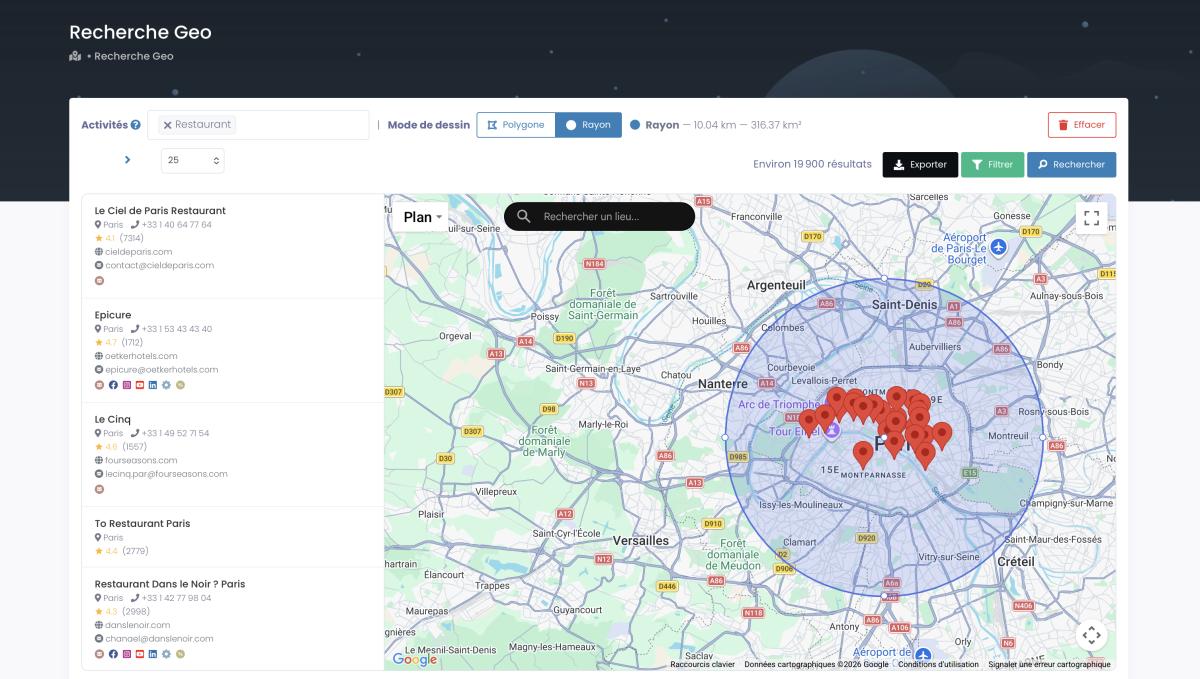
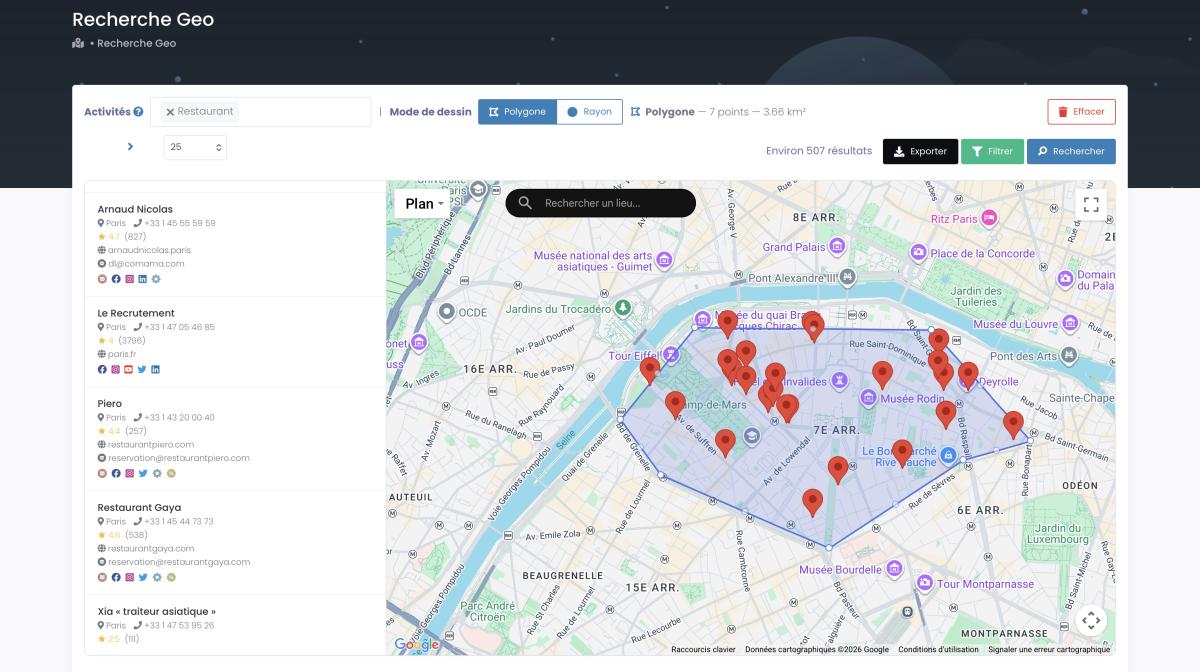
And with Scrap.io, you go as granular as you want. State level, county level, city level, or a custom polygon drawn on the map around a specific neighborhood. Try doing that with a pre-built database from 2023.
Data Freshness: Why Static Lists Fail
Construction has one of the highest business turnover rates in the US economy. Companies open, merge, close, or rebrand constantly. An employee who was a project manager at ABC Construction in January might be running their own firm by June.
Static email lists lose roughly 25-30% of their accuracy every year. That means the "verified" database you bought in January is already missing a quarter of valid contacts by December. And some providers don't update at all. They just slap a new year on the same PDF.
Real-time extraction solves this entirely. When you pull data through Scrap.io, you're getting what's on Google Maps right now. Not last quarter. Not last year. Right now.
That's not a small difference. That's the gap between a 4% bounce rate and a 35% one.
3 Ways to Get a Construction Company Email List (Compared)
Buy Pre-Built / Build Manually / Real-Time Extraction
Video: Scrap.io - How to Start?
You've got three options. Let's be honest about all of them.
Option 1: Buy a pre-built list. Fast? Yes. Providers like US Marketing Management (350K+ contacts) or DMDatabases (800K+ contacts) sell ready-made construction databases. You get thousands of contacts immediately. The catch? Shared with every competitor who bought the same list. Freshness is a coin flip. And pricing can be steep, sometimes $0.10 to $1.00 per contact for "premium" data that may or may not actually be premium.
Option 2: Build your own list manually. Maximum control. You pick every contact yourself. But realistically? Finding and verifying 1,000 construction company emails manually takes 40+ hours. That's soul-crushing work. (And no, before you ask, nobody at Scrap.io is hand-typing a spreadsheet either. A machine pulls it live. That's the whole idea.)
Contractors themselves know how this ends. On ContractorTalk, a cleaning-service owner asked the forum how to get "an e-mail list of Construction Companies" for his post-construction cleanup business. The very first reply? "So you're getting ready to spam a bunch of contractors?" Another regular piled on: "If they haven't agreed to receive mail from you, then they are going to bin it right away because it looks like spam." Harsh. But it's the honest truth about junk lists and lazy outreach, and it's exactly why fresh, targeted data plus a real message beats volume every time.
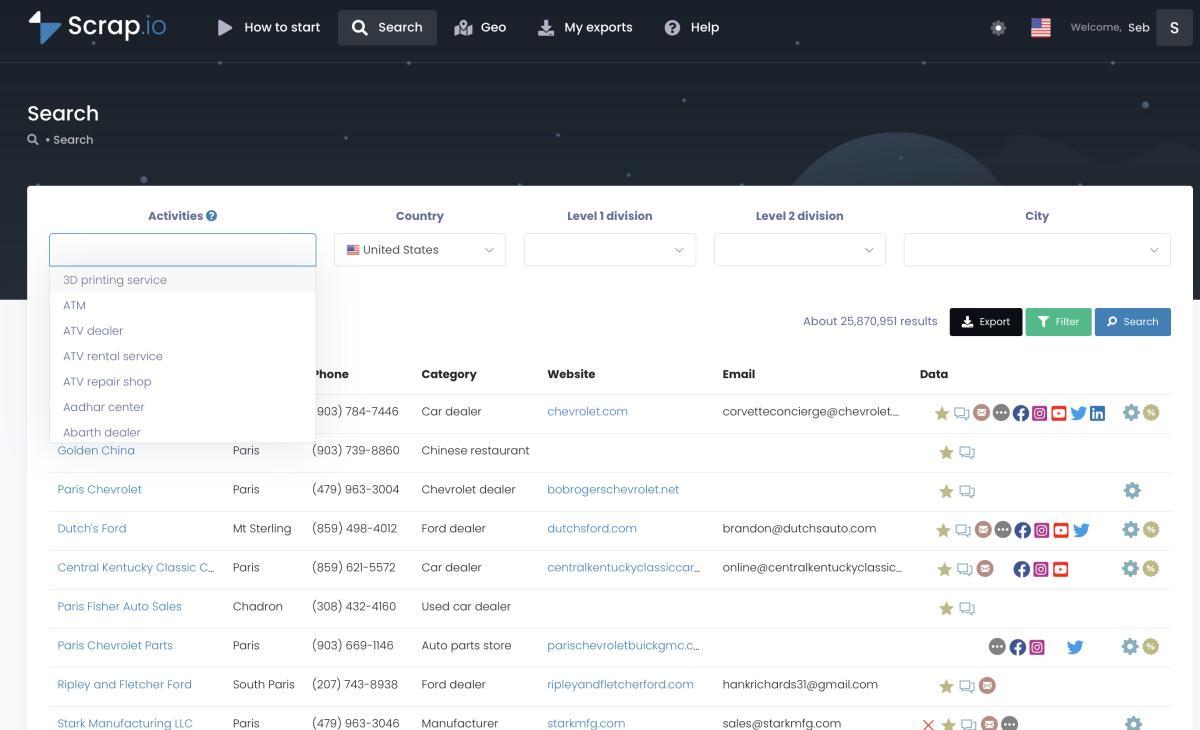
Option 3: Real-time extraction. Pull verified data directly from Google Maps and business websites as it exists right now. That's what Scrap.io does: fresh data, filtered before extraction (so you never pay for contacts you don't need), with full email classification. And at $35/month for 10,000 credits on the Basic plan, the math is hard to argue with.
Side-by-Side Comparison Table
| Criteria | Buy Pre-Built | Build Manually | Real-Time Extraction (Scrap.io) |
|---|---|---|---|
| Data Freshness | Quarterly updates (at best) | Fresh at time of research | Real-time, every extraction |
| Cost per 10K leads | $500 to $2,000+ | $0 (but 40+ hours of labor) | $35 to $69/month |
| Email Classification | Rarely available | Manual effort required | Automatic (individual, contact, sales, marketing) |
| Filtering Before Purchase | Limited segments | Full control | All filters, applied before credits are used |
| Exclusivity | Shared with competitors | 100% exclusive | Exclusive per search |
| GDPR/CCPA Compliance | Varies by provider | Your responsibility | Public data only, fully compliant |
| Speed | Instant download | Days to weeks | Minutes to hours |
The verdict is pretty clear. But don't take my word for it. The numbers speak.
Ready to test the difference? Start a free 7-day trial on Scrap.io with 100 leads included. Extract your first construction company email list in under 5 minutes, filtered by location, trade, and data quality. Start your free trial.
How to Target the Right Construction Contacts
Having 193K companies at your fingertips is nice. But blasting all of them with the same email? That's just spam with extra steps.
The magic is in the filtering. And this is where most providers completely fall apart.
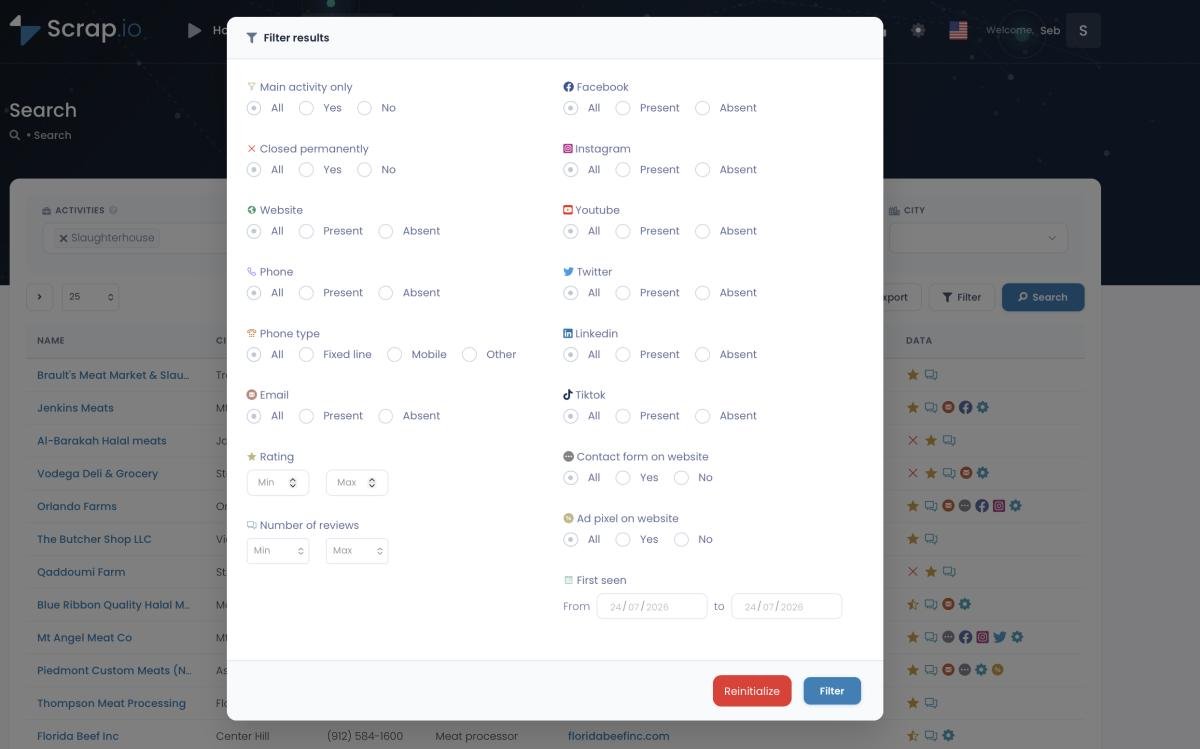
Filter by Type / Digital Presence / Location / Quality
By type. Selling roofing materials? Filter for roofing contractors specifically. Got project management software? Target general contractors with 10+ employees. Scrap.io lets you search across 4,000+ business categories, and you can combine multiple categories in a single search. Roofing + HVAC + electrical in one extraction. Done.
By digital presence. And this is where it gets interesting. You can filter for construction companies that have a website (or don't), that have an email (or don't), that are on Instagram (or not), or that have a contact form. Selling web design services? Filter for construction companies WITHOUT a website. There are nearly 60,000 of them. That's not just a list of construction companies. That's a client acquisition goldmine.
By location. City, county, state, or entire country. Or draw a radius around a specific address. Or create a custom polygon on the map. Want every contractor within 30 miles of a new housing development? Two clicks.
By quality signals. Google rating between 1.0 and 3.5? Those companies might need reputation management services. More than 50 reviews? They're established and probably have budget. Claimed their Google listing? More digitally engaged than those who haven't. These aren't just data points. They're intent signals.
And here's the kicker: all these filters are applied BEFORE extraction. You only spend credits on the contacts that match your criteria. No wasted budget on irrelevant leads. Zéro gaspillage. (Sorry, I slip into French sometimes. Old habit.)
For deeper targeting strategies, check out our guide on how to find emails on Google Maps. It covers the full process from search to export. And if you want the broader picture on the whole trade, our construction email list guide walks through what a list is and how to build one from scratch, where this page is the transactional, data-first companion.
Join 50,000+ professionals who use Scrap.io to build targeted lead lists from Google Maps data. Filter by trade, location, digital presence, and quality, then extract only what you need. Explore Scrap.io.
Turning Your Construction Email List Into Revenue
Video: How to Personalize your Cold Emails for Local Businesses
OK, you've got the list. Now what?
Having a great construction email list and not knowing how to use it is like having a Ferrari and no gas. Let's fix that.
Cold Email Best Practices for Construction
Contractors are busy. Like, genuinely busy. They're managing job sites, dealing with suppliers, chasing permits, and trying to keep their crews on schedule. They're not sitting around waiting for your email about "synergistic B2B solutions."
What works: short emails. We're talking 50-125 words max. Research from GrowLeads shows that this range gets +50% higher reply rates than longer messages. Lead with their problem, not your product. Mention something specific about their business: a recent Google review, their service area, a project you noticed on their website.
What doesn't work: anything that sounds like it was written by a marketing intern who just discovered ChatGPT. Contractors can smell corporate BS from a mile away. Be direct. Be real. Be useful.
For templates that actually get responses from contractors, check our full guide on how to write cold emails that get responses.
Timing and Personalization
Best time to email a contractor? Tuesday through Thursday, either early morning (6-7 AM, before they hit the job site) or evening (6-8 PM, after they get home). Mondays are chaos. Fridays, they've already checked out mentally.
For personalization, use the data you extracted. Got their Google rating? Reference it. "Saw you've got 4.8 stars across 127 reviews, clearly you're doing something right. That kind of reputation is exactly what makes [your product] worth trying." That's not creepy. That's showing you did your homework.
Reply rates jump from 1-5% average to 8.5% with genuine personalization (Belkins, 2025). That's not a marginal improvement. That's nearly doubling your pipeline.
Multi-Channel: The 287% Multiplier
Here's the stat that should change how you think about outreach: omnichannel sequences (email + LinkedIn + phone) boost results by +287% compared to email-only (Martal.ca, 2026).
Not a typo. 287%.
Email opens the door. LinkedIn builds familiarity (connect with them, engage with their posts). A well-timed phone call closes the deal. Construction professionals actually pick up the phone, unlike your average SaaS buyer who hasn't answered an unknown number since 2018.
For a complete playbook on moving from first contact to closed deal, read our guide on closing techniques for cold outreach. And once you've got leads in the pipeline, our lead nurturing guide shows how to warm them up without being annoying about it.
Need help with the inevitable "not interested" responses? Our objection handling playbook has scripts specifically designed for Google Maps-sourced leads.
Selling to a specific trade instead of the whole sector? We've got dedicated data pages for a roofing contractor email list, a plumber email list, a carpenter email list, and even a real estate developer email list if you're chasing the money behind the projects.
Legal Compliance
Nobody's favorite topic. But skip this and you'll have bigger problems than low open rates.
CAN-SPAM (US): Every email needs a real physical address, a clear unsubscribe link, and honest subject lines. B2B cold email is legal in the US. You just can't lie about who you are or make it hard to opt out. Violations can cost $50K+ per email. Don't mess around.
GDPR (EU) / CCPA (California): If you're targeting any European companies or California residents, you need legitimate business interest as your legal basis. Document why you're reaching out and how it's relevant to their business.
Why Scrap.io keeps you safe: all data comes from publicly available sources, information that businesses voluntarily published on Google Maps and their own websites. No scraping private databases. No buying from shady third-party brokers. Every data point is traceable to its public source.
Bon. That said, public data doesn't mean you can do whatever you want with it. Always include an unsubscribe option. Always honor opt-out requests immediately. And never, ever send from a domain you're not willing to burn. Use dedicated outreach domains.
For the full legal breakdown, read our comprehensive cold email compliance guide and our cold emailing strategy guide which covers deliverability best practices.
FAQ
How much does a construction company email list cost?
Prices vary wildly. Pre-built databases from traditional providers range from $0.10 to $1.00 per contact, so a 10,000-contact list can run $1,000 to $10,000. With Scrap.io, 10,000 construction leads cost as little as $35/month (Basic plan, annual billing). The difference? You get real-time data, email classification, and filters applied before you pay. Not recycled spreadsheets from 2022.
How many US construction companies exist?
Scrap.io's live database indexes 192,745 US construction companies with active Google Maps listings as of 2026 (pulled August 21, 2026). The actual total including businesses without an online presence is higher, but these 192,745 are the ones you can actually reach with verified contact information, and 98,411 of them have a usable email.
How much is a 1,000 email list worth?
Depends entirely on freshness and targeting. Traditional providers price a 1,000-contact construction list anywhere from $100 to $1,000 ($0.10 to $1.00 per contact), often shared with competitors and stale on arrival. Extract the same 1,000 verified, real-time contacts on Scrap.io and you're looking at a few dollars in credits. The value isn't the count. It's whether those 1,000 emails actually land.
What's the best way to get construction company emails?
Real-time extraction from Google Maps and business websites. It's faster than building manually, fresher than pre-built databases, and cheaper than most premium providers. Scrap.io lets you filter by location, trade type, digital presence, and quality signals before extracting, so you only pay for contacts you'll actually use.
Is it legal to email construction companies from a scraped list?
Yes, when the data comes from publicly available sources and you comply with CAN-SPAM (US) or GDPR (EU). Scrap.io only collects information businesses have voluntarily published online. Always include an unsubscribe option and honor opt-out requests. For the full legal rundown, see our compliance guide.
How often should I update my construction email list?
Static lists lose 25-30% accuracy per year. If you're using a traditional provider, update at least every 3-6 months. With Scrap.io, every extraction gives you fresh data, so there's nothing to "update." You pull current information every time you run a new search. That's the whole point.
Get Your Construction Company Email List, Today
Look, the construction industry is a $2.31 trillion market growing at 5.6% annually. There are 192,745 companies in the US alone with extractable contact data, 98,411 of them with a verified email. The opportunity is real.
But opportunity without access is just frustration.
Companies like Procore (16,000+ construction clients, $9B+ valuation) and Buildertrend (1M+ users) didn't build their pipelines by buying stale email lists and praying. They reached the right contractors with the right message at the right time. Jobber grew to 250,000+ home service professionals and $100M+ ARR by knowing exactly who to target.
You can do the same. But you need data that's actually current.
Wondering which article to read next? If you work with subcontractors specifically, our contractor email list guide goes deeper into specialty trade targeting.
Start your free 7-day trial on Scrap.io. Extract 100 construction company leads, with emails, phone numbers, websites, and Google ratings, in under 5 minutes. No stale data. No shared lists. Just fresh, verified contacts from 192,745 US construction companies. Start free trial.
Generate a list of construction company with Scrap.io