

By Seb — Co-Founder at Scrap.io · B2B lead generation & Google Maps data since 2021
Last updated: July 2026

True story. A buddy of mine runs a 6-person medical device company out of Minneapolis. Last year he dropped $2,400 on a "premium physician email list" from one of those big-name vendors. Five thousand contacts. Sounds great on paper.
Twelve hundred bounced. Instantly. Another 800 went to doctors who'd switched practices months ago. So that's 2,000 dead contacts — 40% of his list — before he even checked a single open rate. He called me to vent about it. I wasn't surprised. (I hear this story at least twice a month.)
Here's the thing about the US healthcare market: it's $4.5 trillion in national health expenditures. The AAMC counts 1,010,892 active physicians. And as of July 2026, Scrap.io indexes 1,265,889 "doctor" listings across the US pulled live from Google Maps. Massive market. But getting accurate contact data for even a few thousand of those doctors? That's where everyone bleeds money.
I wrote this guide because I'm tired of watching people waste budget on garbage data. What follows: what a doctor email list actually is, what yours should contain, three ways to get one (with real math, not marketing fluff), the compliance stuff you can't ignore, and how to write emails that doctors don't delete before their morning coffee goes cold.
Video: Scrap.io - How to Start?
Table of Contents
- What Is a Doctor Email List?
- Why You Need a Doctor Email List for B2B Marketing
- US Doctor Market Overview: Key Numbers for 2026
- 3 Ways to Get a Doctor Email List
- How to Choose the Best Doctor Email List
- Real Results: Who Uses Doctor Email Lists (And How)
- How to Email Doctors the Right Way
- Compliance Guide: HIPAA, CAN-SPAM & State Laws
- Doctor Email List Cost Comparison (2026)
- FAQ
Video: How to extract 12,000+ business contacts in a few clicks — including doctors
What Is a Doctor Email List?
Simple version: it's a database with contact info for doctors. Emails, phone numbers, practice addresses, specialties, hospital affiliations — the works. Think B2B contact directory, except exclusively for physicians.
But "simple version" doesn't cut it if you're actually spending money on this stuff. A good physician email list has way more than email + name. You want the doctor's specialty. Whether they're solo or part of a group. Their NPI number. Medical school. Board certs. Hospital vs. private practice. All of that changes how you write your pitch and who you're even targeting.
Send a cardiac device pitch to a pediatrician's old email address? Congrats, you've accomplished nothing and annoyed a stranger's abandoned inbox. That's what happens with bad data. And bad data is weirdly common in this industry.
For scale: Scrap.io currently sees 1,265,889 doctor listings in the US, of which 316,998 carry an email address and 641,829 have a website (Google Maps, July 2026). So the raw contact universe is huge — the trick is filtering down to the fraction that's actually reachable.
Types of Doctors in These Lists
Family and primary care doctors — about 280,000 of them across the US (AAMC/HRSA, 2024). They're volume machines. See tons of patients, drown in admin work, and desperately need tools that shave 20 minutes off their day. If you sell EHR systems or scheduling software, these are your people. Our family practice physician email list guide digs into this niche specifically.
Specialists are a different animal. Cardiologists don't buy like dermatologists. An oncologist has a wildly different budget than an ER doc. A cardiologist email list and a dermatologist email list serve completely different sales motions. Lumping them together is a rookie mistake I see constantly. Same goes for mental health — a psychologist email list targets an entirely separate buyer with its own budget and its own compliance sensitivities.
Hospital-based physicians can influence purchases in the hundreds of thousands — sometimes millions. Harder to reach, absolutely. But a single conversion might fund your entire quarter. See our hospital email list guide for that angle.
Private practice owners make every purchasing decision themselves. Printer toner, medical software, that $300K imaging machine collecting dust in the catalog — it all goes through one person. Less red tape. Faster yes or no.
Quick reference on the main specialties you'll find in most physician contact databases:
| Specialty | Est. US Practitioners | Avg. Annual Salary | Buyer Profile |
|---|---|---|---|
| Family Medicine | ~280,000 | $235,000 | High-volume, efficiency-obsessed |
| Internal Medicine | ~235,000 | $282,000 | Evidence-driven, methodical |
| Cardiology | ~92,800 | $438,000 | Big budgets, tech-forward |
| Dermatology | ~55,700 | $394,000 | Aesthetic + clinical, brand-aware |
| Orthopedic Surgery | ~42,000 | $558,000 | Top earners, equipment-heavy |
| Pediatrics | ~60,000 | $244,000 | Cost-conscious, safety-first |
| Emergency Medicine | ~48,000 | $310,000 | Speed-focused, shift-based |
| Neurology | ~53,300 | $301,000 | Research-heavy, growing fast |
| Psychiatry | ~37,000 | $275,000 | Telehealth early adopters |
| Anesthesiology | ~43,000 | $405,000 | Hospital-based, group buying |
Sources: AAMC, BLS, Medscape Physician Compensation Report 2025. Counts are approximate.
Pay attention to the salary column. A cardiologist pulling $438K isn't going to flinch at your $200/month SaaS the way a pediatrician earning $244K might. Different price sensitivity, different pitch. This matters more than most marketers realize.
Why You Need a Doctor Email List for B2B Marketing
Ever tried reaching a doctor through LinkedIn? Good luck. Most physicians I've talked to say they check LinkedIn "sometimes" — and by "sometimes" they mean once every three months when they get a notification about someone's work anniversary.
Cold calling? Even worse. Their receptionist is a professional blocker. That's literally part of the job description.
But email? Doctors actually check their email. Obsessively, even. Between patients, before rounds at 6 AM, during a sad lunch at their desk. It's the one channel where you've got a legitimate shot at catching a physician when they're actually thinking about practice operations instead of patient care.
The whole healthcare email list market exists because every other approach to reaching physicians is either prohibitively slow (conferences), ridiculously expensive (pharma rep armies), or flat-out doesn't work (LinkedIn InMails to people who haven't logged in since 2022).
The Real Cost of Building Your Own Doctor List
I always ask people to run this math before they decide to "just build it ourselves." Almost nobody does it. So let's do it together.
You hire someone at $20/hour. A reasonably competent researcher can verify maybe 10-15 doctor contacts per hour if they're fast. That's $1.50 per contact, minimum — and that's ONLY the research time. Doesn't include your email verification tool, the HIPAA compliance review, or the ongoing maintenance when 15% of your list goes stale every quarter because doctors move around constantly.
Now compare: traditional list vendors charge $0.05-$0.15 per contact. Live scraping runs about $0.005. Five-tenths of a cent.
I've watched a 4-person team at a medtech company in Austin burn four months building their own physician email database. Four months of salaries. Their competitors were already running campaigns and closing deals. By the time Austin's team launched their first email, half the contacts they'd gathered in month one were already outdated.
The math just doesn't work for DIY. I know that's not what people want to hear, but there it is.
US Doctor Market Overview: Key Numbers for 2026
I get annoyed when companies throw around "millions of healthcare professionals" without specifying what that actually means. So here are the real numbers — with sources, because I know you'll check.
- 1,010,892 active physicians in the US (AAMC, 2023 data)
- 1,265,889 "doctor" listings indexed live on Google Maps by Scrap.io, of which 316,998 have an email and 1,240,662 have a phone number (Scrap.io, July 2026)
- 851,282 in direct patient care. The rest are teaching, doing research, or pushing paper. (AAMC, 2023)
- ~280,000 primary care physicians (AAMC/HRSA, 2024)
- 1.5 million+ records in the AMA Masterfile (AMA Physician Professional Data)
- Projected shortage of up to 124,000 doctors in the next decade (AAMC Workforce Projections, 2024)
- Average physician earnings: roughly $350K/year (Medscape, 2025)
Notice the gap between the AAMC's 1,010,892 and Scrap.io's 1,265,889. The AAMC counts licensed physicians. Scrap.io counts listings — every clinic, group practice, and named doctor with a live Google Maps profile. Different lens, same conclusion: the reachable universe is bigger than the headline number, and it's sitting in public data right now.
That 124,000 shortage projection? Huge deal for B2B. Fewer doctors = each one busier, harder to reach, more valuable as a lead, and (here's the silver lining) more desperate for anything that saves them time. Software, automation, telehealth, staffing solutions — the shortage is your tailwind if you sell time-saving products.
Geography-wise, it's insanely uneven:
| State | Physician Density (PCPs/100K) | Notes |
|---|---|---|
| Massachusetts | 137 | Highest in the country |
| California | Largest total count | Biggest state market overall |
| New York | High density | Dense urban clusters |
| Idaho | Among lowest | Physician desert |
| Mississippi | Among lowest | Critical underservice |
| National avg. | 86/100K | Wild variation state by state |
Sources: AAMC, 2023; KFF/Statista, 2025
Here's a counterintuitive insight I've seen play out: if you sell telemedicine tools, Idaho and Mississippi might actually be better targets than California. Underserved areas have fewer physicians, yes — but those physicians are overwhelmed and actively looking for help. Meanwhile California docs are buried under pitches from every healthtech startup within driving distance of Sand Hill Road.
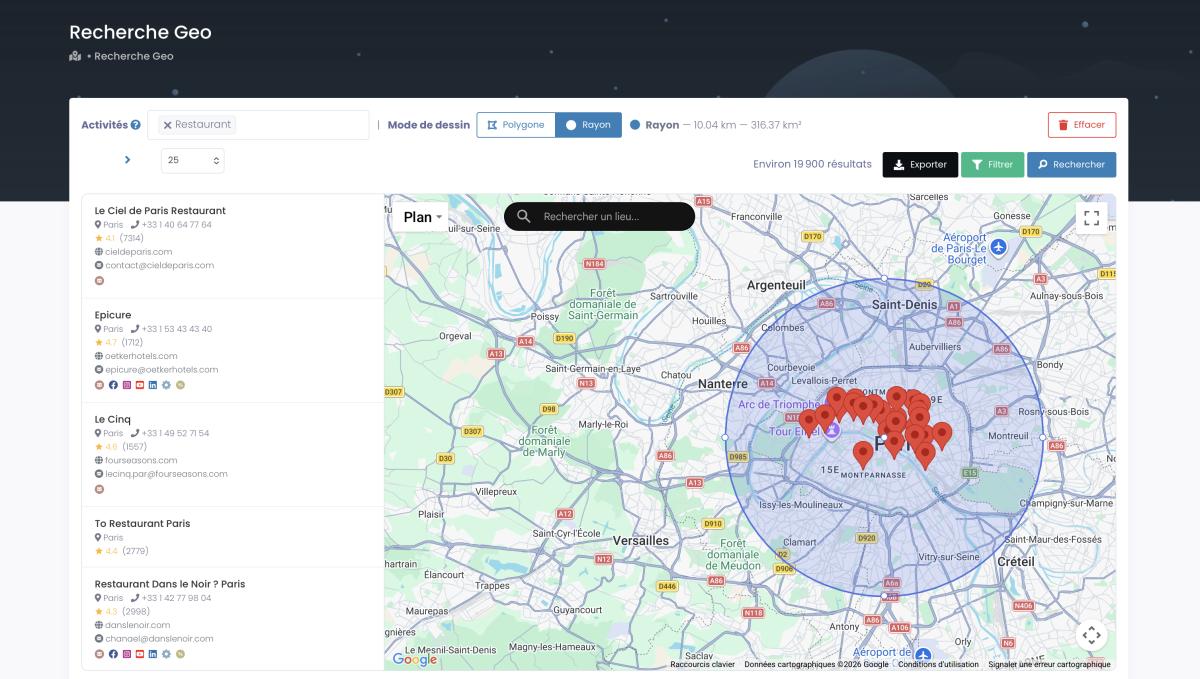
This is exactly where geographic filtering earns its keep. With Scrap.io you can draw a radius around a specific metro — or sketch a custom polygon over an underserved county — and pull only the doctors inside it. No guessing.
Our medical clinic email lists guide and internist email list guide go deeper on regional targeting if that's your thing.
Scrap.io covers doctor contact data across 195 countries and 4,000+ categories, all pulled live from Google Maps — try the free trial and get 100 leads to test before committing.
3 Ways to Get a Doctor Email List
I've tried all three. Helped clients with all three. Each one has a time and place, but I won't pretend they're equal.
| DIY (Build) | Buy (Traditional) | Scrape (Live Data) | |
|---|---|---|---|
| Cost / 10K contacts | ~$15,000 | $700–$1,500 | ~$50 |
| Time to launch | 4+ months | 1-2 days | Minutes |
| Data freshness | Depends on effort | 3-6 months old | Real-time |
| Accuracy | 85-95% (if thorough) | 60-70% real-world | 95%+ |
| Compliance risk | High (manual errors) | Medium | Low (public data) |
| Scalability | Very limited | Moderate | Excellent |
Option 1: Build Your Own (DIY)
Total control. Total misery. You're combing through NPI databases, state medical board directories, Googling individual practices, and manually verifying emails one by one. It'll take four months minimum before you have anything worth emailing.
The upside: you know exactly where every contact came from. No compliance surprises.
The reality: by the time you finish building, the contacts you gathered in month one are already stale. Doctors move. A lot. And they don't publicize their email addresses because — can you really blame them? — they already get 50-100 marketing emails a week.
Best suited for companies with hyper-niche targeting and zero time pressure. (Read: basically no one.)
Option 2: Buy from Traditional Providers
LakeB2B, Redi-Data, ReachStream, that whole crew. They've been selling doctor mailing lists for years. They aggregate data, do some verification, and charge you for access.
Typical price: $700+ for 10,000 contacts.
The dirty secret? Most update quarterly. At best. In healthcare, a quarter is ancient. Doctors switch practices, groups merge, offices close. Your shiny list from January is already rotting by March.
I've seen real-world bounce rates of 30-40% on traditional lists. Not a rumor. Not an exaggeration. A third of the contacts you paid for may be completely dead. So that $700 list? You're effectively paying $1,000+ for the contacts that actually work.
| Factor | Traditional Providers | Reality Check |
|---|---|---|
| Cost per contact | $0.07–$0.15 | Min. purchase usually applies |
| Freshness | Quarterly (maybe) | 3-6 months stale on avg. |
| Claimed accuracy | 90%+ | Real-world: more like 60-70% |
| Compliance | Varies widely | Always verify independently |
If you do go this route to buy a doctor email list, at minimum ask three questions: how often do you update? What's your REAL delivery rate from recent campaigns (not the website number)? And do you replace contacts that bounce for free? If they dodge any of those, walk.
Option 3: Real-Time Data Scraping (Live Data)
OK, obvious bias here — I built Scrap.io. But I built it specifically because Options 1 and 2 kept failing people I knew personally.
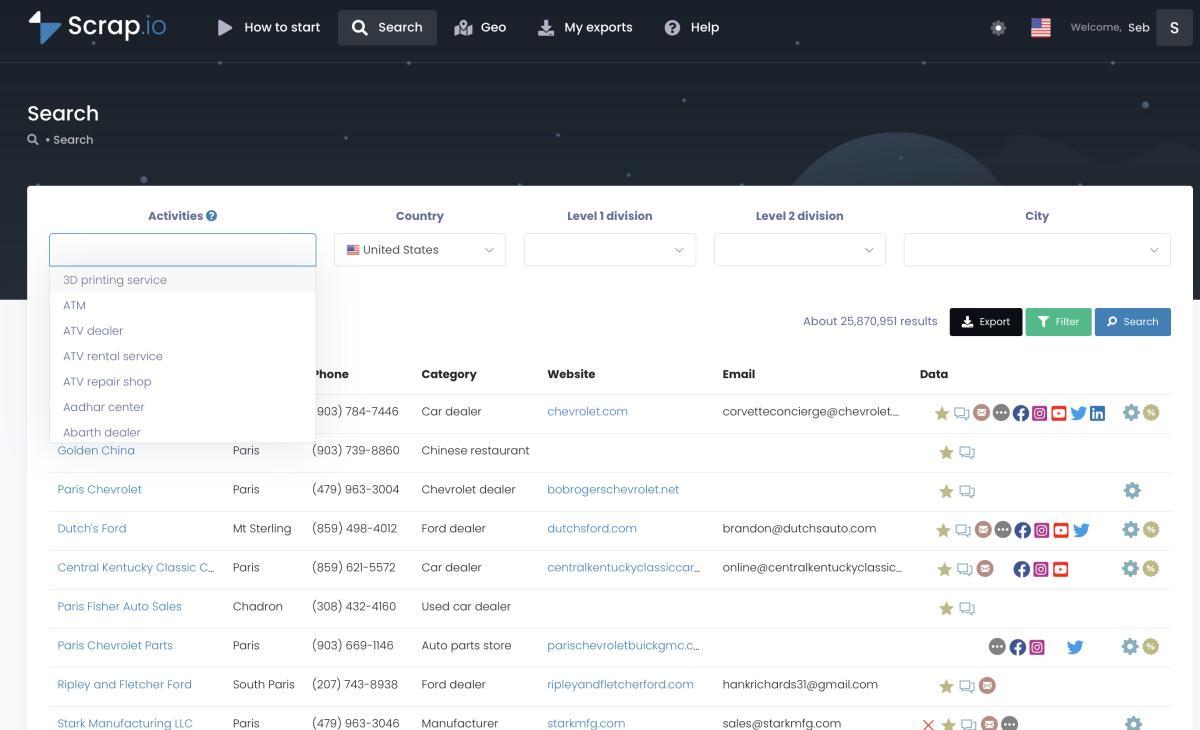
The concept: instead of buying a static spreadsheet compiled months ago, you pull physician contact data in real-time from public sources. Google Maps listings, practice websites, business directories. Doctor updates their Google Maps profile on Tuesday? That data's available Wednesday. Not next quarter. Here's how Scrap.io extracts data in real time if you want the mechanism under the hood.
What you get:
Fresh contacts. We're talking data that mirrors what's live on the internet right now. Not what someone scraped in Q3 of last year and has been reselling ever since.
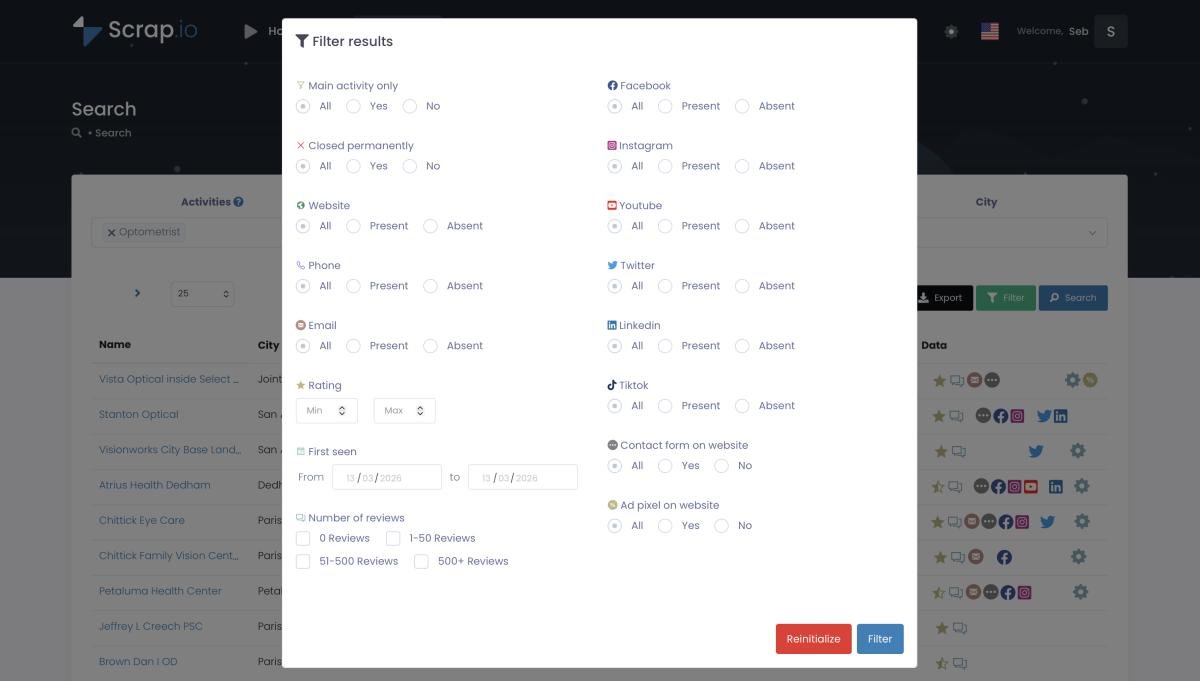
Crazy granular filters. Cardiologists in Houston with under 10 Google reviews? Doctors who have an email but no website? Private practices in rural zip codes? You can slice it however you need.
And here's the part that quietly saves you the most money: you filter BEFORE you extract. Toggle "email present" and Scrap.io only spends credits on the 316,998 doctor listings that actually have an email — you never pay a cent for the dead-end fiches. Most tools make you export everything first, then delete the junk you already paid for. That's masochism. Filter first, pay only for what you can use.
The cost part. About $50 for 10,000 contacts. Yes, $50. That's ~$0.005 per contact. I know it sounds too cheap to be real, but the economics of automated extraction are just fundamentally different from manual database compilation.
195 countries and 4,000+ business categories. Not US-only. And you can pull an entire country in two clicks, no code — watch it happen here:
Video: How to Scrape Local Leads at the Country Level
Compliance is straightforward. You're collecting information physicians themselves published on their own business listings and websites. Publicly available data. No gray area.
Check our guide on how to find emails on Google Maps for the step-by-step walkthrough, or how to generate Google Maps leads at scale if you want the full playbook.
See the live data for yourself: 100 doctor leads offered, 7-day free trial. Counting results is always free — size the US doctor market (1,265,889 listings and counting) before you spend a single credit. Start free →
How to Choose the Best Doctor Email List
Regardless of which method you pick, there's a short list of quality markers that separate a usable doctor email database from an expensive waste of disk space.
Accuracy above 92%. Below that and you're basically paying for bounces. Don't accept their website number — ask for documented delivery rates from actual campaigns they've run recently. Good providers share this readily. The ones who refuse? Red flag. And run a validation pass regardless; here's our email validator guide for hitting 95%+ deliverability.
Freshness. Monthly updates at a minimum if you're buying traditional. Live extraction is obviously better. Any doctor email database older than 6 months is already hemorrhaging accuracy because physicians move, retire, and update contact info way more often than, say, accountants.
Complete records. Email alone is not a list. You need specialty, practice type, location, phone, and ideally NPI or medical school. That extra context is the difference between a 2% response and a 0.1% response. Personalization works. Generic blasts don't.
Compliance paper trail. Where did the data come from? Can they prove opt-in or show it's public-source only? No documentation = no deal. Especially in healthcare.
Filtering. If you can't at least filter by specialty, location, and practice type, don't bother. A healthcare professionals email list that mashes cardiologists and pediatricians into one spreadsheet is useless for real targeting.
Real Results: Who Uses Doctor Email Lists (And How)
Theory is nice. Show me the money. Here's who's actually generating revenue from physician contact data.
Doximity (traded on NYSE as DOCS) has 80%+ of American doctors on its platform. Valued at over $5 billion. Their entire business is built on physician data and targeted messaging. A public company worth billions exists because doctor contact access is that valuable. (doximity.com)
IQVIA does $15 billion+ in annual revenue. Fifteen billion. Physician-level data is a core product line. Pharma, medtech, hospital systems — they all pay IQVIA serious money for accurate doctor contact data. If that's not proof of market demand, I don't know what is. (iqvia.com)
And it's not just the giants. The pain of bad data shows up constantly in practitioner communities. On the Adobe marketing community, one marketer posted a near-desperate plea — "need help explaining to my boss that purchased email lists are a bad idea" — after the boss bought roughly 30,000 addresses and the very first campaign got flagged for mass spam complaints. It's the same story my Minneapolis buddy lived. Buy cheap, blast wide, torch your domain.
Closer to home: Austin M. runs a mid-size pharmaceutical company. He'd been spending $800/month on traditional physician email lists. Bounce rates above 30%. His sales team wasted half their follow-up calls on disconnected numbers or wrong practices. When he switched to real-time data, bounce rates dropped under 5%. Qualified leads went up 340%. Not a typo. Three-forty. I documented this in our internist email list guide.
Then there's the skin device company that used Scrap.io in a way I genuinely hadn't anticipated. They searched for dermatologists with poor Google reviews in major metros — specifically sub-3.5 star ratings. Then they pitched reputation management services alongside their product demo. 23% response rate. In healthcare B2B, where 2-4% is "good," that's absurd. But the logic is airtight: they found doctors with a visible, specific problem and offered a relevant fix. That's not spam. That's a service.
Pattern across all of these? Generic mass emails produce garbage. Precision targeting with fresh data and a relevant pitch produces outsized results. Every single time.
That device company hit 23% replies with targeted data — test yours. Grab 100 free physician leads on Scrap.io and see the data quality firsthand. 7-day free trial. Try it →
How to Email Doctors the Right Way
Getting the emails is the easy part. The hard part? Not getting immediately deleted.
Doctors went through 11+ years of training. They can smell a sales pitch through a sealed envelope. Generic marketing language doesn't just fail — it gets you permanently blacklisted. One bad email and that physician will never open anything from your domain again.
Subject lines. Reference something clinical, specific, or regulatory. "New study shows 23% fewer hospital readmissions" works. "Exciting opportunity for your practice!" is instant trash. Also — never use ALL CAPS and never put "FREE" in a subject line. Spam filters flag it, and physicians judge you for it.
Content that actually gets read. Start with the outcome, not the product. No doctor cares that your tool has "AI-powered analytics." They care that practices using it reduced no-shows by 34% and freed up 8 hours/week of admin time. Lead with the result. Back it up with data — a study, a trial, a published paper. Physicians respond to things they can independently verify. Evidence-based content beats sales copy by 3-5x in healthcare email campaigns. That's not a guess; it's what we see across thousands of campaigns. Our full breakdown on how to write a cold email walks through the problem-first framework line by line.
When to send. This is underrated. 6-8 AM is prime time — many docs check email before morning rounds. Lunchtime (12-1 PM) gets decent opens too. After 6 PM works for some. But mid-morning through early afternoon? Patient hours. Your email gets buried under 40 others. Don't bother.
How often. Once a month. Twice tops. Doctors get crushed by email already. Push harder and you're getting unsubscribed or spam-reported.
| Metric | Realistic Range | Context |
|---|---|---|
| Open rate | 15-25% | Targeted, evidence-based content |
| Click rate | 2-4% | With strong, specific CTAs |
| Response rate | 0.5-2% | Depends heavily on offer |
| Bounce rate | <8% | Fresh data assumed |
Sources: Mailchimp/Constant Contact healthcare vertical benchmarks
More on this in our cold emailing strategy and cold email compliance guides.
Compliance Guide: HIPAA, CAN-SPAM & State Laws
Skip this section at your peril. Seriously. Healthcare compliance fines can annihilate a small business. I've seen it happen.
HIPAA
HIPAA mainly governs patient health data, not B2B marketing to physicians. But it still matters — your doctor email list can't contain ANY patient info. Your emails can't mention patient cases. And physicians will immediately distrust any company that seems sloppy about healthcare regulations. They deal with compliance pressure every day; they notice when you don't.
Three HIPAA rules to know: Privacy Rule (protects patient data), Security Rule (electronic health info standards), Breach Notification Rule (you must disclose data breaches).
Penalties: $100 to $50,000 per violation. Multiple violations in one campaign? Millions. (HHS.gov)
CAN-SPAM
Every marketing email to a doctor must comply. Honest subject lines. Clear sender ID. Physical mailing address in the email. Working unsubscribe button. Honor opt-outs within 10 business days.
The penalty just went up. As of the FTC's January 17, 2025 inflation adjustment, it's up to $53,088 per email. Per. Individual. Email. (The old $51,744 figure you'll still see quoted everywhere is out of date.) Fire off 10,000 non-compliant messages and the theoretical max clears half a billion dollars. The FTC doesn't play around. (FTC.gov)
State Rules and GDPR
California's CCPA adds extra hoops for data collection. New York has its own rules around marketing to licensed professionals. Running multi-state campaigns? Check each one.
Got international contacts in your doctor email database? EU physicians fall under GDPR — fines up to €20 million or 4% of global revenue. Platforms that pull only publicly available business directory data (like Google Maps listings) generally have cleaner GDPR footing since that info was voluntarily published.
Deep dive: our cold email compliance guide covers healthcare-specific scenarios.
Doctor Email List Cost Comparison (2026)
Here's the comparison I wish someone had shown me years ago:
| Factor | DIY | Traditional Provider | Scrap.io (Live) |
|---|---|---|---|
| Per contact | ~$1.50 | $0.07–$0.15 | ~$0.005 |
| 10K contacts | ~$15,000 labor | $700–$1,500 | ~$50 |
| Time to start | 4+ months | 1-2 days | Minutes |
| Freshness | Varies | Quarterly | Real-time |
| Accuracy | High (if done well) | 60-70% | 95%+ |
| Scope | Limited | US mostly | 195 countries |
| Filtering | Manual, custom | Basic | Reviews, social, geo, etc. |
Quick ROI scenario: one closed healthcare deal = $10K (conservative for medtech or SaaS). Email-to-deal conversion = 0.1%. You need 1,000 targeted contacts. At Scrap.io pricing, that's $5 in data cost. Five dollars for a $10K deal. Even traditional providers run $100-$150 for the same outcome. DIY? $15,000. And that's before adjusting for bounce rates — a 35% bounce on a traditional list means buying 1,540 contacts to deliver 1,000.
And if you're also targeting nurse email lists or pharmacy contacts alongside physicians, the savings compound fast.
$5 of data for a $10K deal. Launch your first export free. 7-day trial, 100 verified doctor leads included. Start now →
FAQ
How much do doctor email lists cost?
All over the map. Traditional vendors charge $0.07-$0.25/contact — so a 5,000-specialist list runs $350-$1,250. DIY research costs $1-3 per contact in labor alone. Scrap.io: about $50 for 10,000 contacts, roughly half a cent each. But beware — the cheapest option isn't always best if it bounces at 35%. The doctor email list cost depends almost entirely on data quality.
Are doctor email lists legal to use?
Yes, when sourced right. Lists from public data — Google Maps, practice sites, state medical boards — are generally legal for B2B outreach. You still need CAN-SPAM compliance (unsubscribe link, honest subject lines, sender ID) and can't include anything that touches HIPAA. If your provider can't tell you exactly where the data came from, that's a problem.
How to find doctor email addresses?
Three paths. Build your own from NPI databases and medical board registries (thorough but slow as hell). Buy from an established physician email database vendor (fast, hit-or-miss quality). Or pull live data from Google Maps and practice sites (fastest, freshest). Our Google Maps email extraction guide covers the third approach in detail.
Do all doctors have an email address?
No — and that's the catch most buyers miss. Of the 1,265,889 US doctor listings Scrap.io tracks on Google Maps, only 316,998 have a public email — that's about 25%. Nearly all have a phone number (1,240,662), so many practices are reachable by call before they're reachable by email. The fix: filter for "email present" before you extract, so you only build a list of the doctors you can actually email — and you don't pay for the rest.
How often should a doctor email list be updated?
Monthly at absolute minimum. The BLS projects big workforce turnover through 2033, and doctors change practices more often than people realize. Quarterly updates (the industry standard for traditional vendors) just aren't fast enough. Real-time extraction sidesteps the whole problem because the data reflects what's live online right now.
Can I target doctors by specialty?
Absolutely. Any decent list lets you filter — cardiology, dermatology, internal medicine, family practice, neurology, oncology, you name it. A dentist email list demands totally different messaging than a cardiologist list. Subspecialty filtering (interventional cardiology vs. general, for example) is available on more advanced platforms.
What info is included in a doctor email list?
The good ones include: email, full name, specialty, practice name, phone, physical address, NPI number, med school, board certs, years in practice, hospital affiliations, and practice size. More data = better personalization. And personalization is the gap between a 0.5% response and a 2% response.
Are doctor email lists GDPR compliant?
US physicians fall under CAN-SPAM, not GDPR. But if your USA doctors email list includes any EU-based physicians, GDPR kicks in. Platforms that pull only publicly available business data (Google Maps, company websites) typically have cleaner compliance footing since the info was voluntarily published. Still worth verifying with your specific provider.
What's a good response rate for medical email marketing?
Lower than other B2B verticals — doctors are overwhelmed with email. Realistic targets: 15-25% open rates (with good targeting and relevant content), 2-4% clicks, 0.5-2% response rates. If your opens are below 10%, your data is stale or your subject lines stink. Probably both.
Are there free doctor email lists?
Technically? You can compile a list of doctors emails manually from state medical board sites and Google Maps. That's "free" if your time has zero value. Some platforms (including Scrap.io) offer free trials — ours gives you 100 leads to test. But genuinely free, high-quality, pre-compiled physician lists? Don't exist. If someone's giving away doctor data for nothing, the accuracy is going to be awful.
What's a doctor email address example?
Varies by setting. Hospital physicians often use [email protected]. Private practice: [email protected] or [email protected]. Some doctors use personal Gmail or Outlook for vendor comms. A doctor email address format depends entirely on the practice setup — which is exactly why you need verified emails from current business listings, not guessed formats from some template.
Your Move
You've now got a better understanding of the doctor email list market than most people who are actively spending money on it. Over a million active physicians in the US — 1,265,889 listings on the map, 316,998 with an email you can actually reach. A 124,000-doctor shortage coming. Every single one of them needs tools, tech, services, and supplies. The companies that reach them with relevant, evidence-based messaging are going to win big.
But that only works if your data is actually good.
Try Scrap.io free — 7-day trial plus 100 verified doctor leads. Filter by specialty, location and email before you spend a credit, and see the data quality for yourself. Start your free trial →
Generate a list of doctor with Scrap.io