

Table of Contents
- What Is a Florist Email List (And Why Most Are Garbage)
- The US Florist Market in 2026: Numbers You Need to Know
- 3 Ways to Get a Florist Email List
- Choosing a Provider: Red Flags & Must-Haves
- How to Use Scrap.io to Build a Florist Email List
- Cold Email Strategies for Florist Outreach
- Legal Compliance: CAN-SPAM, GDPR
- FAQ
A client screwed up his first florist outreach campaign. Badly. Bought a "premium florist email list" for $400, sent 5,000 emails, and watched 2,100 of them bounce. Forty-two percent. Gone.
That was three years ago. Since then he tested pretty much every way to get flower shop contacts, building lists manually, buying from providers, scraping in real time. Some methods are great. Most are a colossal waste of money.
Here's what I know now: there are 70,141 florists listed across the US right now (Scrap.io data, August 2026). Of those, only 26,685, about 38.0%, have an email address attached to their listing. And 26,792 don't even have a website.
So yeah. Reaching florists is harder than it looks.
This guide covers what actually works for building a florist email list that doesn't implode on contact with reality. No fluff, no "top 10 tips" nonsense. Just what I've seen work (and spectacularly fail) in the real world.
What Is a Florist Email List (And Why Most Are Garbage)
A florist email list is exactly what it sounds like, a database of email addresses belonging to flower shop owners, managers, and buyers. It usually comes with phone numbers, business addresses, and sometimes extras like revenue estimates or employee counts.
Simple concept. Terrible execution, most of the time.
The problem? The floral industry churns. Hard. Small flower shops open and close constantly, owners retire, businesses change hands without updating a single online listing. A florist mailing list that was 90% accurate six months ago might be 60% accurate today. And 60% accuracy means 40% of your emails are hitting dead inboxes. That tanks your sender reputation faster than you can say "undeliverable."
Video: How to Scrape Google Maps - Ultimate Guide
What data should a list include?
At bare minimum: business name, owner/manager name, verified email, phone number, physical address. That's table stakes.
But a good florist contact database goes further. You want to know if they have a website (38.2% don't, that's a selling opportunity right there if you're a web agency). You want their Google Maps rating, how many reviews they have, whether they're on social media. All of that tells you something about how sophisticated the business is and what they might actually need.
In short, the more data points, the better you can segment. And segmentation is the difference between "Dear Business Owner" and an email that actually gets read.
Types of florists (retail, wedding, wholesale, corporate)
Not all flower shops are created equal. Not even close.
Retail florists, your neighborhood shops. Birthday bouquets, get-well arrangements, "I forgot our anniversary" panic orders. They operate on thin margins and are usually drowning in work. About 12,000+ of these exist as standalone retail operations (IBISWorld).
Wedding florists, specialists who charge premium prices and deal with brides who have Pinterest boards longer than War and Peace. High-value clients if you sell anything wedding-adjacent. If you're targeting this segment, check out our guide on wedding planner email lists too, there's serious overlap.
Wholesale florists, the middlemen between growers and retail shops. Bigger budgets, more professional operations, harder to break into. One wholesale account can be worth dozens of retail ones.
Corporate/event florists, hotels, restaurants, conference venues. Recurring contracts, predictable revenue. They buy in volume and they buy on schedule. Similar targeting applies for event planner email lists, caterer email lists, and event venue email lists, the whole events ecosystem overlaps here.
The mistake people make? Treating them all the same. A wedding florist in Manhattan and a small-town retail shop have almost nothing in common except flowers. Your flower shop email list needs to reflect that.
The US Florist Market in 2026: Numbers You Need to Know
Before you spend a dime on a florist email list, you should understand what you're actually targeting. The numbers might surprise you.
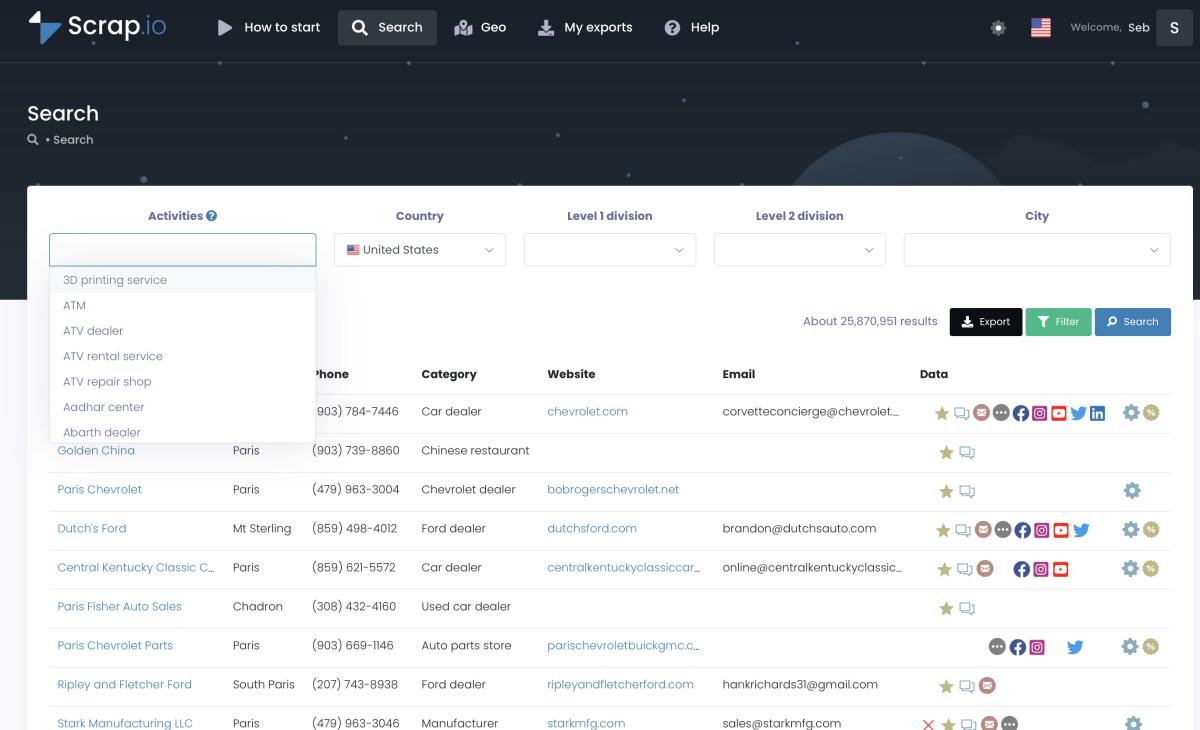
Searching "florist" + a US location on Scrap.io, the count appears instantly and it's free.
Market size and trends
The US floriculture market is worth $7.91 billion in 2026, growing at a CAGR of 5.43% and projected to hit $10.3 billion by 2031 (Mordor Intelligence). That's not a dying industry. That's a growing one.
But here's the twist, the money is growing while the number of shops is shrinking. Consolidation is eating independent florists alive. Online platforms, supermarket floral departments, and subscription services are stealing market share from mom-and-pop shops every quarter.
What does that mean for you? The surviving florists are the ones adapting. They're investing in tech, building online presence, upgrading their POS systems. Companies like BloomNation (a SaaS POS + marketplace that's grown 40% year over year) and FloristWare (cloud POS with wire service integration) exist because florists are spending money on modernization. Even smaller shops are forming B2B partnerships, Pink Clover LA, a boutique florist, has documented how supplier partnerships transformed their margins. These are businesses with budgets.
How many florists in the US? (Scrap.io data)
70,141. That's the current count across the entire US on Google Maps, as of August 2026.
Of those:
- 26,685 (38.0%) have a publicly available email address
- 26,792 (38.2%) don't have a website at all
Think about that second number. Over a third of US florists have zero web presence beyond their Google Maps listing. If you sell web design, SEO, or digital marketing services, that's 26,792 potential clients who literally need what you're offering.
Digital gap: 26,792 florists without a website
This is the number that should make B2B marketers sit up straight. 26,792 businesses operating in 2026 without a website. Some are doing fine, they're established shops with loyal local customers who find them on Maps or by word of mouth. But many are leaving money on the table and they know it.
The trick is finding them. And that's where having a quality florist contact database with filtering capabilities matters. You don't want to pitch web design to a florist who already has a gorgeous Shopify store. You want the ones showing up as "no website" in the data. Scrap.io can literally filter for businesses without websites before you export a single contact.
3 Ways to Get a Florist Email List
Build it, buy it, or scrape it. Those are your options. Let me save you some trial and error. (If you want the full playbook, we wrote a whole guide on how to build a cold email list from scratch.)
Build your own
Ah, the DIY approach. Sounds noble. Usually ends in tears.
You (or some poor intern) go through Google Maps, Yelp, Yellow Pages, and florist directories one by one. Copy name, copy email, copy phone number. Paste into spreadsheet. Repeat 10,000 times.
I've watched companies try this. One marketing agency I know spent four months building a florist mailing list of 3,000 contacts. Four months. Their competitor had already closed 12 deals by then.
Cost: $15-25/hour labor. At ~10 verified contacts per hour, you're looking at $1.50-2.50 per contact just in labor. Before any tools. And by the time you finish? The first contacts you added are already going stale.
Verdict: only makes sense if your target is hyper-local (one city, one neighborhood) and you need fewer than 200 contacts.
Buy from a provider ($0.03-0.08/contact)
The traditional route. Companies like Openmart (25K+ verified florist contacts, 97% claimed accuracy) or Email Lists US (static lists, ~10K records for around $50) sell pre-built florist databases.
Prices range from $0.03 to $0.08 per contact. So 10,000 florist emails might cost $300-800 depending on the provider and data quality.
(Spoiler: "data quality" is doing a LOT of heavy lifting in that sentence.)
The problem with bought lists is freshness. Or rather, the complete lack of it. Most providers update quarterly at best. Some... don't really update at all. They just slap a new date on the same database and call it "2026 data." I've seen it happen. And if you want to understand why buying email lists can be risky, we've covered that in depth.
Live scraping with Scrap.io (from $35/mo)
This is the approach I've landed on after testing everything else. Instead of buying a static file that's already aging the moment you download it, you pull fresh data directly from Google Maps and business websites in real time.
How it works with Scrap.io: search "florist" + "United States," see 70,141 results instantly. Apply filters, only businesses with email addresses, only ones with fewer than 50 reviews, only ones without a website, whatever you need. Then export.
Two clicks. Fresh data. Starting at $35/month for 10,000 credits.
The key difference? You filter before you pay. With a static list, you buy 10,000 contacts and then discover half of them don't have emails. With Scrap.io, you filter for "has email" first, and only export (and pay for) contacts that match. No wasted credits on useless records.
Try Scrap.io free for 7 days, 100 leads included. Search "florist" in any US state, filter for emails, and export your first targeted list in under 2 minutes. Real-time Google Maps data, 195 countries, and you only pay for contacts that match your filters. Start your free trial.
Choosing a Provider: Red Flags & Must-Haves
I once paid $800 for a "premium florist email database" that had a 40% bounce rate. Eight hundred dollars. For a list where nearly half the emails were dead. That experience made me obsessive about vetting providers.
5 red flags
Run, don't walk, if a provider:
- Promises 100% accuracy. Impossible. Any provider claiming this is lying to your face. Even the best databases have 3-5% decay per month.
- Won't show samples before purchase. What are they hiding? A confident provider hands over 20-50 sample records without blinking.
- Has prices that seem too good. A "complete US florist database" for $29.99? That's a con. That's recycled garbage data repackaged with a fresh label.
- Is vague about sources. "Proprietary data collection methods" is code for "we scraped this once in 2019 and haven't touched it since."
- Uses high-pressure sales tactics. "This price expires today!", no it doesn't. Data vendors with good products don't need urgency tricks.
Questions to ask
"When was this data last verified?" (anything older than 90 days is sketchy for small businesses)
"What's your bounce rate guarantee?" (if they don't offer replacement credits for bounces above 5%, walk away)
"Can I filter by sub-niche?" (wedding florists vs wholesale vs retail, if they can't segment, it's a dump file, not a database)
Static vs real-time comparison table
| Criteria | Static Email List | Live Scraping (Scrap.io) |
|---|---|---|
| Data freshness | Weeks to months old | Real-time at extraction |
| Filtering | Post-purchase only | Before export (before paying) |
| Exclusivity | Shared with every buyer | Your filters = your unique list |
| Typical cost | $0.03-0.08/contact | From $35/mo for 10,000 credits |
| Coverage | Fixed geography | 195 countries, any combination |
| Bounce rate | 15-40% typical | <5% on fresh exports |
| Re-export same contacts | Pay again | Free within 30 days |
And honestly, once you've used real-time data, going back to static lists feels like going from Google Maps back to a paper atlas. You can do it. But why would you?
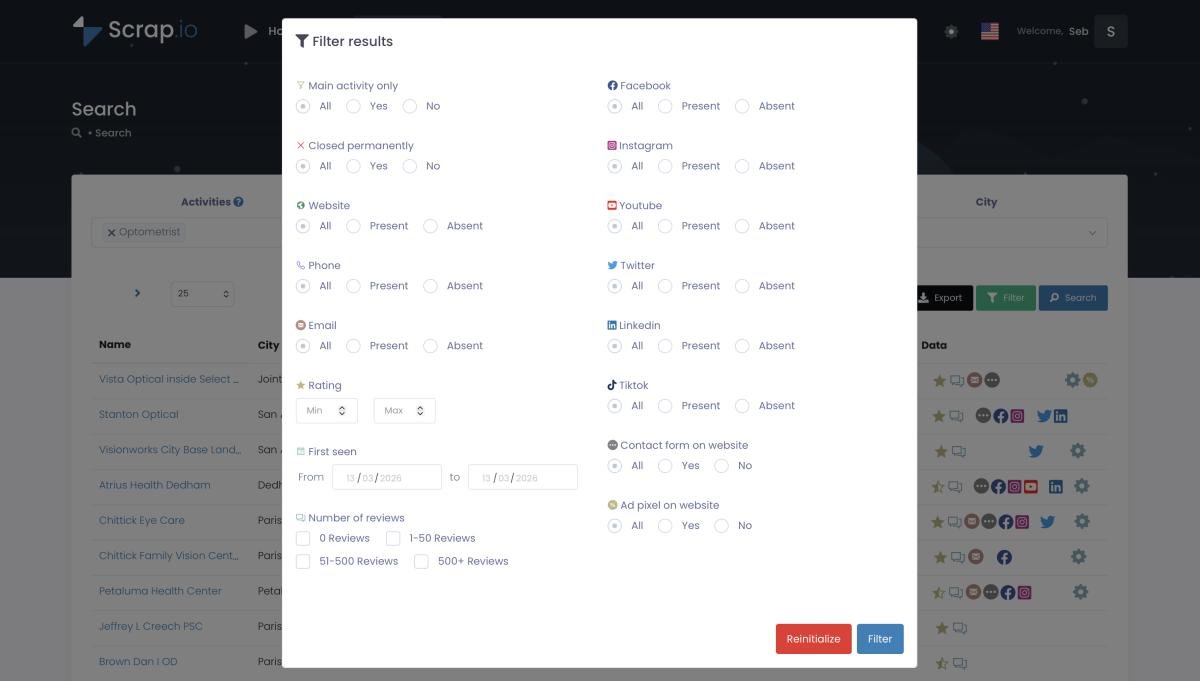
Filter before extraction: toggle "has email" or "no website" so you only pay for contacts you'll actually use.
How to Use Scrap.io to Build a Florist Email List
Let me walk you through a real example. I needed wedding florists in Texas last month, specifically ones with email addresses and at least 20 Google reviews (a signal they're established businesses, not fly-by-night operations).
Two clicks. 3,247 results. Exported in under a minute.
Here's how. And if you want the deeper mechanics, our Google Maps email extractor guide breaks down every step.
Video: Get Emails from Google Maps for Free
Search by category + location
Go to Scrap.io, type "florist" in the category search. Select your location, could be a city, a state, or the entire country. The Google Maps scraping engine does the rest.
The count appears instantly. And here's the beautiful part: counting is completely free. Zero credits consumed. You can run "florist + United States" right now and see that 70,141 number without paying anything. Try "florist + California", 8,400+. "Florist + New York City", 1,200+. Play with it.
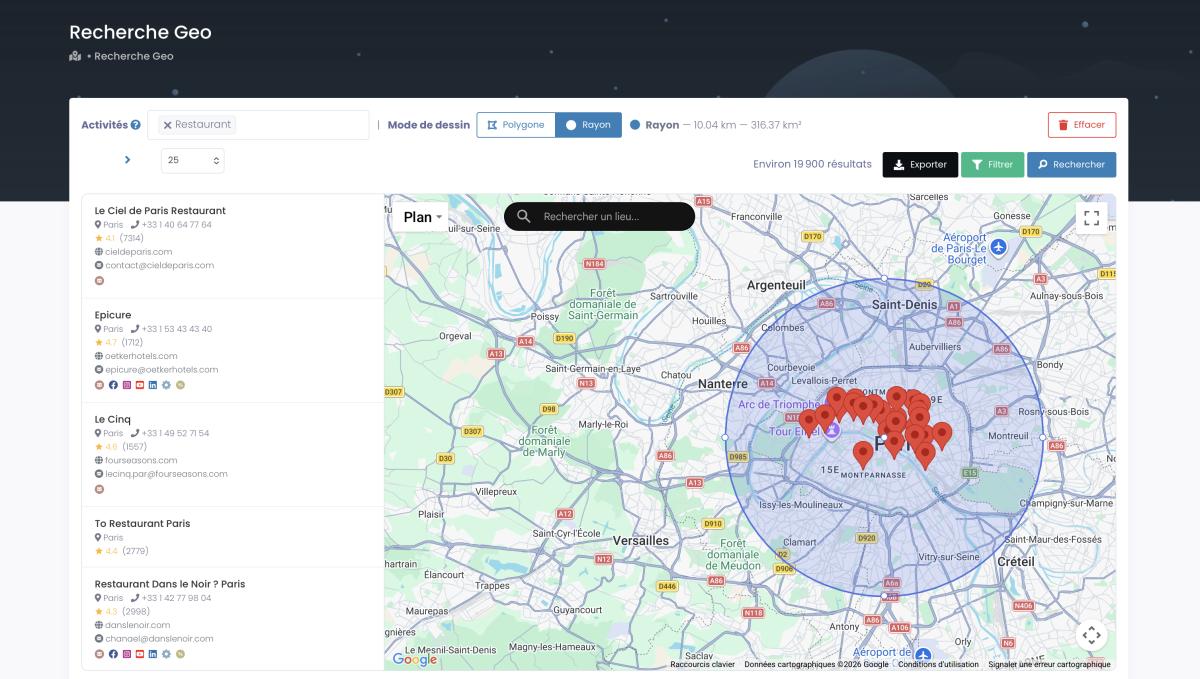
GeoSearch radius: draw a circle around any point to pull only the florists inside your service area.
Filter before extraction
This is where Scrap.io earns its keep. Before you spend a single credit, you apply filters:
- Has email: Yes, instantly cuts your list to only contactable businesses
- Has website: No, perfect if you sell web design
- Minimum reviews: 20, filters out brand-new or inactive listings
- Has Facebook/Instagram: Yes/No, segment by social media presence
- Phone type: Mobile, for SMS campaigns (not available in the US, heads up)
Every filter narrows your results before you export. You only pay for what you actually need. No more exporting 10,000 records to discover 6,000 don't have emails.
Export and segment
Hit export. You get a CSV or Excel file with everything: business name, owner name, email (classified, individual, contact, sales, marketing), phone, address, website, social media URLs, Google rating, review count, and more.
From there, segment however you want. High-rated florists (4.5+ stars) for premium service pitches. Low-review florists for reputation management. No-website florists for web design. Florists with Instagram but no website for social media management.
The data is already structured. You just slice it. Our email validator guide covers how to verify your list before sending, though with fresh Scrap.io data the bounce rate is typically under 5%.
Search "florist" + "United States" on Scrap.io, the count is free. See exactly how many flower shops match your filters before spending a cent, then export the ones with emails in two clicks. Try it now.
Cold Email Strategies for Florist Outreach
Having a great florist email list is step one. Not getting ignored is step two. And frankly, step two is where most campaigns die. (If you want the full framework, here's how to write a cold email that actually gets replies.)
Good news: florist outreach actually converts well when done right. Industry data from Klaviyo shows welcome emails in the floral sector can hit 62% open rates. Even cold outreach typically lands between 18-28% open rates, well above most B2B averages. And click-through rates around 2.9% beat the general retail average of 2.5% (CuFinder data).
Why? Florists are small business owners who read their own email. There's no executive assistant filtering your message. If your subject line doesn't suck, they'll see it.
Subject lines that work
Florists are practical people. Don't be clever. Be useful.
Works: "Quick question about [Shop Name]'s delivery area"
Works: "Saw your Google reviews, 4.8 stars is impressive"
Doesn't work: "REVOLUTIONARY SOLUTION FOR YOUR FLOWER BUSINESS!!!"
Personalization wins. Every time. Mention their shop name, their city, something specific. It takes 10 seconds per email and doubles your open rates. (And if you exported from Scrap.io, you already have their business name, rating, and location in the CSV. No extra research needed.)
Seasonal calendar
This matters more than you think. Florists have insane seasonal peaks where they literally cannot take a meeting or read a pitch email.
DO NOT pitch during: February (Valentine's Day madness), May first two weeks (Mother's Day), December (holiday rush). They're working 16-hour days. Your email will be deleted unread. Try anyway and you'll land straight in spam. Don't say I didn't warn you.
BEST times to reach out: January (post-holiday lull), March (between Valentine's and Easter), September-October (wedding season winding down, holiday planning not yet frantic). These are the windows when florists actually have bandwidth to evaluate new vendors and services.
Personalization
Don't just mail-merge their name. Mention something real:
"I noticed [Shop Name] doesn't have an online ordering system yet, wanted to share how similar shops in [City] added $2K/month in revenue after adding one."
"Your 4.2-star rating on Google could easily be 4.7, I've helped three florists in [State] do exactly that."
This works because it shows you actually looked at their business. Florists get generic "Dear Business Owner" emails daily. They trash them instantly. Show you've done your homework and you're already ahead of 95% of cold emailers.
Follow-up cadence
Three follow-ups. Maximum. Spaced 5-7 business days apart. After that, you're annoying them.
Email 1: Value proposition + personalization. Email 2: Different angle or case study. Email 3: Breakup email ("Seems like this isn't a priority right now, no worries, I'll stop emailing"). Breakup emails consistently get the highest reply rates. Weird but true. For more on building a solid outreach sequence, see our cold emailing strategy guide.
Legal Compliance: CAN-SPAM, GDPR
Boring but necessary. Skip this and you're risking fines up to $50,120 per email under CAN-SPAM. Not theoretical. It happens.
CAN-SPAM essentials
For US florist outreach, CAN-SPAM applies. The rules aren't complicated:
- Don't use deceptive subject lines
- Include your physical mailing address
- Provide a clear unsubscribe mechanism
- Honor opt-outs within 10 business days
- Identify the message as an advertisement if it's commercial
That's it. Follow these five rules and you're compliant. Not optional, not "nice to have." Legal requirements.
GDPR for international contacts
Targeting florists in the EU or UK? GDPR kicks in. The short version: you need a "legitimate interest" basis for B2B cold outreach, which generally means the email must be relevant to their business, you must identify yourself clearly, and you must make opt-out trivially easy.
Scrap.io covers 195 countries, so if you're building a florist email list that spans multiple regions, know your compliance obligations before you hit send. The USA business email database guide covers US-specific compliance in more detail.
Why Scrap.io data is compliant
All data extracted through Scrap.io comes from publicly available sources, Google Maps listings and publicly accessible business websites. No private databases, no scraped personal accounts, no purchased third-party data of questionable origin. Every data point is traceable to its public source, which is exactly what regulators want to see if questions arise. Scrap.io is GDPR and CCPA compliant.
FAQ
How much does a florist email list cost?
Static lists from providers like Openmart or Email Lists US typically run $0.03-0.08 per contact, so roughly $300-800 for 10,000 florist emails. Live scraping with Scrap.io starts at $35/month for 10,000 export credits, which works out to $0.0035 per contact. Massive difference, especially if you're running ongoing campaigns and need fresh data regularly.
How many florists are there in the US?
70,141 as of August 2026 (Scrap.io data from Google Maps). IBISWorld estimates around 12,000+ standalone retail florist shops, but that excludes wedding specialists, wholesale operations, and florists operating inside larger businesses. The Google Maps count captures the full picture.
Can I get a free florist email list?
Free complete lists? No. Anything labeled "free florist email list" online is either bait for a lead gen form, ancient data, or both. However, you can count florists for free on Scrap.io (no credits needed) and the 7-day trial gives you 100 export credits to test with real data. That's enough to validate the quality before committing.
What's the best florist email list provider?
Depends on your use case. For one-time purchases of static data, Openmart (97% accuracy claim, 25K+ records) is solid. For ongoing, filterable, always-fresh data, Scrap.io is hard to beat, you get real-time extraction from 195 countries with filters applied before you pay. If you're looking at all your options, our guide to buying email lists compares approaches in detail.
Where can I find a wedding florist email list?
Same place you'd build any florist list, Scrap.io, just filter tighter. Search "florist" in your target US state, filter for "has email" and a minimum review count, then segment the export by keywords like "wedding," "bridal," or "events" in the business name and website data. Wedding florists tend to overlap with the broader event industry, so pairing this with our wedding planner email list guide gives you the full vendor map for that niche.
How often should a florist email list be updated?
Every 90 days minimum. Monthly is better. Small businesses like florists change fast, new owners, closed shops, changed emails. With static lists you're stuck re-buying every quarter. With live scraping, every export is automatically fresh. No update schedule needed because there's nothing to update, you're pulling live data each time.
Ready to build your florist email list? Scrap.io gives you access to 70,141 US florists with real-time data, filterable before export, across 195 countries and 4,000+ categories. Start your 7-day free trial, 100 leads included. Get started here.
Generate a list of florist with Scrap.io