

Nine reviews. That's what a dental practice in Phoenix had on Google when they reached out to a local marketing consultant last fall. Nine. In a city with 400+ dental offices fighting for the same patients.
Six months later, they had 94. No fake reviews purchased. No shady tactics. Just a system — one they could've built themselves if they'd known where to start.
But here's the part nobody was talking about last fall, and everybody's panicking about now: the rules changed. On April 17, 2026, Google quietly banned a review tactic that half the businesses reading this are probably still using. So before we get to the 12 strategies, understand this — how to get more Google reviews in 2026 isn't just about volume anymore. It's about getting them without torching the ones you already have.
And the stakes keep climbing. BrightLocal's 2026 Local Consumer Review Survey (1,002 US adults, surveyed February 2026) found that 31% of consumers flat-out refuse to use a business rated below 4.5 stars. One in three potential customers, gone, before they even read a word about you.
Now sit with the number that reframes the whole game. According to Scrap.io data pulled in August 2026, 49.3% of US restaurants on Google Maps sit at 4.4 stars or lower. Almost half the industry is invisible to a third of the market. Read that twice.
What follows are 12 strategies that actually work — and still comply with Google's April 2026 policy. Templates you can copy-paste today. Tools worth your money (and one that's free). The mistakes that get profiles suspended. And a walkthrough of exactly what became illegal this spring.
First, a quick primer on how Google Maps review data actually works behind the scenes, and how businesses put it to use:
Video: Using the Google Maps API and Google Reviews — Scrap.io
- Why Google Reviews Matter More Than Ever in 2026
- What Changed in April 2026 (And Why Your Review Process Might Now Be Illegal)
- 12 Proven Strategies to Get More Google Reviews
- Google Review Templates You Can Use Today
- Common Mistakes That Kill Your Google Review Strategy
- Tools to Automate Your Google Review Collection
- FAQ
- Conclusion
Why Google Reviews Matter More Than Ever in 2026
Go read a Reddit thread from June 2026 titled "How are you guys actually getting customers to leave Google reviews in 2026?" and you'll see the same quiet panic on repeat. Owners who used to get reviews on autopilot suddenly can't. The bar moved. Customers got pickier. And Google got a lot more aggressive about what it allows.
The Numbers Behind Google Reviews
People aren't casually glancing at star ratings anymore. They're reading. Carefully. BrightLocal's 2026 survey found 41% of consumers "always" read reviews — up from 29% the year before. That's not a glance. That's due diligence.
The pull works both ways, too. 85% of consumers say they're more likely to use a business after reading positive reviews, and 77% are put off by negative ones (BrightLocal LCRS 2026). Reviews used to be a signal. Now they're a filter — people screen you out before they ever hit your website.
And the sheer concentration of it all lives on one platform. 73% of all online reviews worldwide are hosted on Google, and 81% of consumers read Google reviews to size up a local business. Google now hosts reviews across 225,676,406 businesses indexed in 195 countries (Scrap.io, August 2026). If you're not actively in that ecosystem, you're invisible where it counts most.
Here's the stat that should keep you up at night, though. Scrap.io pulled the full US restaurant category in August 2026: 663,153 restaurants indexed on Google Maps, and 327,195 of them — 49.3% — sit at 4.4 stars or below. BrightLocal says 31% of consumers won't touch a business under 4.5 stars. Do the math. Nearly half of American restaurants are dark to a third of their market, right now, tonight. No competitor writing about this topic can produce that number. We can, because we index the map.
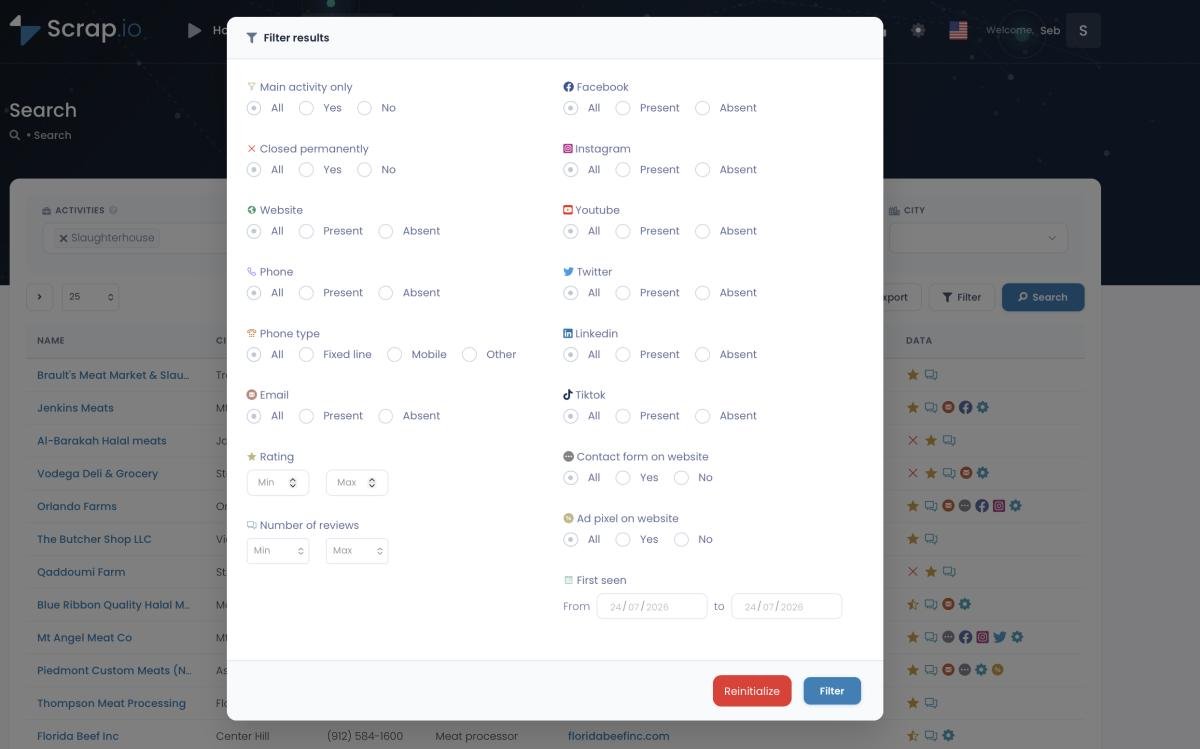
Scrap.io lets you filter Google Maps businesses by rating and review count — counting is free.
How Reviews Impact Local SEO Rankings
Review signals make up roughly 20% of local pack ranking factors — that's from Whitespark's Local Search Ranking Factors study, the one basically every local SEO practitioner cites.
Sterling Sky ran a case study tracking an insurance agent's listing. Three reviews. Then 16. Then 31. A real ranking boost kicked in around the 10-review mark — then diminishing returns. Top-ranking local businesses sit at about 47 reviews on average. You don't need thousands. You need enough to cross the threshold, then keep the momentum.
Where it gets interesting: reviews compound. More reviews push you higher. Higher rankings bring visibility. Visibility brings customers. Customers leave reviews. We wrote a whole piece on how businesses leverage Google Maps reviews as social proof — that flywheel is the whole game. For the tactical breakdown of everything beyond reviews, see our guide on how to improve your Google Maps ranking. And if you want to understand why the raw data underneath all of this matters, here's how local SEO and data scraping work together.
Curious where your own market actually sits? Scrap.io lets you filter Google Maps businesses by review count and rating — and counting is completely free, no credits used. Check how many businesses in your category are sitting under 4.5 stars before you spend a cent. Start with a free trial — 100 leads included.
What Changed in April 2026 (And Why Your Review Process Might Now Be Illegal)
On April 17, 2026, Google quietly banned something almost every business does. There was no announcement. No blog post. A Google Diamond Product Expert spotted it buried in the policy text and posted about it. That's how most of the industry found out — and it's the single change people mean when they search "google review policy 2026."
The anxiety was already showing. A December 2025 thread on r/GoogleMyBusiness — "How should I legally get more Google reviews?" — pulled 70 replies. Notice the word "legally." Business owners could feel the ground shifting before Google confirmed anything.
Here's what actually happened, across two days. On April 16, Bibek Samantaray, Group Product Manager for User Generated Content at Google, announced three new Maps protections: pre-publication scam detection, Gemini-powered moderation of profile edits, and proactive email alerts for verified owners. That's the defensive stuff — Google protecting businesses from external abuse.
Then April 17 brought the part that puts you at risk. Amy Toman, the Google Diamond Product Expert, spotted two new clauses added to the Maps Rating Manipulation policy. Google now explicitly prohibits merchants from directing staff to hit a specific number of reviews (quotas), and from asking customers to include specific content — including naming a staff member. Toman noted she expects Google acted because it was seeing too many review contests and quota-based programs. Miriam Ellis of Miriam Ellis Consulting flagged a bigger worry: the phrase "reviews that include specific content" is broad enough to cover asking a customer to review a particular dish or product. Google hasn't clarified the scope yet. Until it does, keep every ask completely open-ended. (Full timeline documented by Launchcodex.)
So what's still fine, and what'll get you flagged? Here's the line, drawn clean:
| ✅ Still allowed | ❌ Now banned |
|---|---|
| Inviting any customer to share an honest experience | Asking a customer to mention a staff member by name |
| Sending the same neutral request to every customer | Selectively asking only customers you expect to be happy (review gating) |
| QR codes and follow-up emails through your own channels | Pressuring customers to review while still on your premises |
| Responding to every review, positive or negative | Directing staff to hit a review quota in a set period |
| Reminding a customer where to find your profile | Offering any incentive — discount, freebie, entry to a draw |
| Leaving the content of the review entirely to the reviewer | Asking for reviews that "include specific content" |
This isn't a paper policy, either. Google's 2025 Trust and Safety Report (published April 16, 2026) shows 292 million policy-violating reviews blocked or removed in 2025 — out of more than a billion submitted. That's roughly 22% of all review activity classed as a violation. Fake reviews on Google Maps also rose 21% year over year in 2025, a direct consequence of generative AI. And when Google detects a spike now, it doesn't just delete the fakes — it can pause new reviews and slap a public "fake reviews detected" banner on your profile that every potential customer sees. That banner is a reputational cost even when the attack wasn't your fault.
12 Proven Strategies to Get More Google Reviews
The short version, for anyone skimming: to get more Google reviews, ask every customer at the right moment, make the ask frictionless with a direct link, follow up by SMS and email at a compliant pace, respond to everything, and track your velocity against competitors. Here are the 12 in order:
- Ask in person right after a positive experience
- Create a direct Google review link
- Use QR codes at physical locations
- Send SMS follow-up requests
- Automate email review requests
- Train your staff to ask (without scripting the answer)
- Leverage your existing customer base
- Respond to every review
- Optimize your Google Business Profile
- Add review prompts to your website and emails
- Use video testimonials as review catalysts
- Monitor and analyze your review performance
1. Ask in Person Right After a Positive Experience
Embarrassingly obvious. Also embarrassingly underused.
68% of customers will leave a review if you ask. But almost nobody asks. Owners assume customers will just... do it? They won't. They've got groceries to buy and kids to grab. Your HVAC repair isn't top of mind by dinner.
The window is 24–48 hours after a positive experience. After that, motivation evaporates. The best moment is when someone's face lights up — the AC kicks back on in August, the leaky faucet finally shuts up at midnight, the wedding cake looks perfect. That's your window.
One rule under the new policy: keep the ask open. Don't tell them what to write, don't ask for a star count, don't ask them to name your tech. Here's a script. Steal it:
"Hey, I'm really glad we could sort that out for you. If you've got 30 seconds, it'd mean a lot if you left us an honest Google review. I can text you the link right now."
"I can text you the link" is the money phrase. It kills the friction and commits them to the next step.
2. Create a Direct Google Review Link
Nobody — and I mean nobody — is going to open Google Maps, search your business name, scroll to reviews, and tap "Write a Review." That's five steps. You lost them at step two.
So generate a direct Google review link instead. Good news: Google officially standardized link and QR-code generation on December 31, 2025, so the old ambiguity is gone. Here's the four-step how-to:
- Log into your Google Business Profile
- Go to the "Home" tab
- Find the "Get more reviews" card
- Copy the short link
That link drops customers straight onto the review form. From the customer's side, all it takes to write a Google review is that single tap — no searching, no scrolling. This is the highest-leverage move on the whole list — searches for "google review link" run north of 8,000 a month, and it's the reason: everyone needs one and few businesses have set theirs up properly. If you'd rather not dig through your dashboard, a google review link generator does the same thing in seconds (just search the term — plenty of free ones exist). Want a google review link for my business without a verified profile? That's the one case where you're stuck — you can't create a google review link or get a google review link without a business profile, because the link points at a profile that has to exist first. Claim it, then generate it.
Create this link once and it becomes the backbone of everything else here: QR codes, SMS, email templates. For the full profile setup, our Google My Business optimization guide covers every field worth filling out.
3. Use QR Codes at Physical Locations
A google review qr code works passively. Print it once, stick it somewhere visible, and it collects reviews while you're in the kitchen or on a job site. No staff training, no awkward conversation. Point it at the direct link from step #2.
But — and this is new for 2026 — where the code gets scanned matters now. A printed QR on a receipt, a table tent, or a business card is fine. A QR displayed on a tablet or device you hand the customer on your premises counts as a kiosk, and on-premises review pressure is banned as of April 2026. Print it. Don't kiosk it.
Where to put yours:
- Receipts and invoices
- Table tents, counter displays, thank-you cards
- Business cards (great for plumbers, electricians, consultants)
- Packaging inserts — if you ship anything, this one's huge
Need a code? A free google review qr code generator like QR Code Generator, QRCode Monkey, or Canva does it in a minute, and most offer a google review qr code free tier plus a google review qr code template you can brand. One warning: test it before printing 500 copies. Print one. Scan it. I've watched businesses print entire batches pointing at dead pages. Expensive lesson.
4. Send SMS Follow-Up Requests
Email open rates for review requests: 20–25%. SMS open rates: north of 90%. That gap is absurd, and yet most businesses still default to email because it feels more "professional." Professional and ignored.
SMS works because it's immediate. Nobody lets a text sit unread for three days. And a review is the definition of quick action — 30 seconds, tops.
"Hi [Name], thanks for choosing [Business]! If you had a great experience, we'd love an honest Google review. Takes 30 seconds: [link]. Thanks! — [Your first name]"
Under 160 characters. Always include the direct link. Always sign off with a real person's name, never "NOREPLY-BIZ." Notice what it doesn't say: it doesn't ask for five stars. That's not a style choice anymore — it's what keeps you compliant.
5. Automate Email Review Requests
If you've got a CRM — even a spreadsheet and Mailchimp duct-taped together — automate this. Trigger it 24–48 hours after a completed service and let it fire on its own.
Subject: Quick favor, [First Name]?
Hi [First Name], thanks for [specific service]. We hope everything's working perfectly. If you've got a minute, we'd really appreciate an honest Google review — it helps other [homeowners / patients / customers] find us: [REVIEW LINK]. Either way, thanks for choosing us.
Specificity is everything. "Thanks for your business" is wallpaper. "Thanks for trusting us with your kitchen renovation" makes them re-live the positive outcome. That's what triggers the review.
Now the compliance bit, and it's the part most guides miss: cadence matters. Send 3–5 requests a day, max, spread over a 7–10 day campaign. A sudden volume spike is one of the exact patterns Google's filters look for — hammer out 200 requests in an afternoon and you can trigger removal on the reviews you just earned. Slow is safe. And whatever you do, one follow-up only. Nobody wants to feel nagged.
6. Train Your Staff to Ask — Without Scripting the Answer
This is the strategy that changed the most in 2026, so read carefully. Making review-asking part of everyone's job still works. What you can no longer do is script what the customer says.
The old playbook — "get customers to mention you by name," monthly contests, a bonus tied to ten five-star reviews — is now a direct policy violation. Widewail, a reputation-management platform, put it plainly: tying a salesperson's bonus to ten five-star reviews a month is a liability today. Google treats quotas as evidence of biased solicitation, because pressure shapes what the customer actually writes.
So train the ask, not the answer. Give each employee a neutral line they're comfortable with — "If you've got a sec, an honest Google review really helps us out" — and drop the quotas and the contests entirely. One approach that works for restaurants: print small cards with the review QR and hand them out with the check. Servers treat it like giving out a mint. Quick, natural, zero pressure, fully compliant.
7. Leverage Your Existing Customer Base
Quick question: how many customers have you served in the last two years who loved the work and never left a review? Hundreds, probably.
A "review reactivation" campaign goes after them. But here's the 2026 trap — don't segment by who you think will be happy. Cherry-picking only your delighted customers is review gating, and it's explicitly banned. Reactivate all your past customers with the same neutral ask, not a filtered list of your fans.
This is still how you get more reviews on Google for free — the goodwill already exists, you're just collecting on it. A warm ask after a recent positive touchpoint (a renewal, a resolved ticket, even a holiday note) converts far better than a cold blast. Just send it to everyone equally.
8. Respond to Every Review (Positive and Negative)
89% of consumers now expect businesses to respond to reviews (BrightLocal, 2026), and 19% expect a same-day response — up from 6% a year ago. Responding to the good ones signals to future reviewers that their words get seen. It's a loop that feeds itself.
For negatives — and you'll get them — never argue, never get defensive. But one 2026 caveat: keep your responses clean. Responses that stuff in promotional language, discount offers, or links to sales pages are now flagged as violations. Address the feedback, offer to fix it offline, and stop there.
Here's what I've noticed across hundreds of profiles: businesses at 4.2–4.7 with genuine responses outperform businesses with a spotless 5.0 and zero engagement. The responses prove someone's home. That's trust you can't manufacture.
9. Optimize Your Google Business Profile
A half-finished profile is a closed door. Nobody leaves a review for a business that looks like it stopped caring in 2019.
The basics: NAP consistency (Name, Address, Phone) across every directory, real photos uploaded regularly, Google Posts, and a Q&A section you answer before some stranger named Dave answers it wrong. 58% of consumers say a complete profile makes them more likely to visit in person. More visits, more potential reviewers.
New for 2026: turn on the proactive email alerts Google rolled out April 16. Verified owners now get notified before suggested edits to their profile go live — so you can approve or reject a competitor quietly changing your category. Unverified profiles get none of these protections. Verify first.
10. Add Review Prompts to Your Website and Emails
A "Review us on Google" button on your homepage, your thank-you page, your order confirmation, and in every email signature. Five minutes of setup turns every customer touchpoint into a potential review.
For e-commerce, the order confirmation page is prime real estate — customer just bought, feels good, the page is otherwise a receipt. Email signatures are criminally underused, too. Every invoice, every support reply, a small "Leave us a Google review" link in the footer. Costs nothing. Works passively across every interaction. I'm baffled by how few companies do it.
11. Use Video Testimonials as Review Catalysts
Newer tactic, but it lands. When a customer records a video testimonial, they've already crossed the biggest barrier — publicly endorsing you on camera. Asking for a written Google review afterward feels trivial, and most say yes.
One nuance under the new rules, though. The old "ask them to add a photo of the finished project" trick edges into content direction — the exact zone Miriam Ellis flagged as unclear. If you nudge for a photo, keep it a genuine invitation, not a requirement, and never pair it with what to write. Reviews with photos do stand out and get more engagement. Just don't script them.
12. Monitor and Analyze Your Review Performance
You can't fix what you can't see. Track three things: review velocity (new reviews per week), average rating trend, and the keywords customers use. If "slow service" keeps showing up, that's not a review problem — it's an operations problem wearing a review costume. To do that reading at scale, analyze review sentiment at scale instead of skimming one review at a time.
Then benchmark. If the top three businesses in your niche have 150+ reviews and you're at 22, you know the gap. And here's where the Scrap.io data earns its keep: 38.3% of US restaurants — 253,673 of them — don't even have 50 reviews, while top-ranking local businesses average 47. Pull your category, sort by review count, and you'll know in seconds whether you're ahead of your local pack or behind it. Review velocity is a documented KPI — see the local prospecting KPIs that matter — and if you want the full competitive picture, here's how to run a full competitor analysis on Google Maps. Tools like Scrap.io let you filter Google Maps businesses by review count and rating to see exactly where you stand, or, if you're an agency, to find companies with negative reviews — those are your prospects. For the technical crowd, you can even scrape Google Maps reviews using Python for deeper analysis.
Video: Finding Clients Through Google Maps Filters — Scrap.io
Austin M., CX Director at a 51–200 person marketing agency, scraped 11,734 companies matching his exact criteria in under 45 minutes with Scrap.io — a prospect list most agencies would spend weeks building by hand. Filter Google Maps by review score, rating, and location, export with emails and phone numbers, done. Free trial — 100 leads included.
Google Review Templates You Can Use Today
Every template below is open-ended by design. That's not a style choice — it's what keeps you compliant with the April 2026 policy. None of them ask for a star rating, name a staff member, or tell the customer what to write. That's the whole point. This is also the cleanest answer to how to ask for google reviews without stepping on a landmine.
In-Person Ask Script
"Hey [Name], glad everything went well. Would you be open to leaving us an honest Google review? I can send you the link right now — takes less than a minute."
Email Template
Subject: How was your experience, [Name]?
Hi [Name], just checking in after [your visit / the project]. We put a lot into [specific thing], and we'd love to know if we hit the mark. If you have 60 seconds, an honest Google review would really help us out: [LINK]. Thanks either way. — [Your name]
SMS Template
"Hi [Name]! Thanks for choosing [Business]. Got 30 seconds? An honest Google review helps us tons: [link] — [Your first name]"
Review Response Templates
| Scenario | Template |
|---|---|
| Positive review | "Thanks so much, [Name]! Thrilled to hear it. Come back anytime!" (Keep it clean — no offers, no links.) |
| Negative review | "[Name], I'm sorry about this — that's not our standard. Please reach out at [contact] and I'd like to fix it personally. — [Owner]" |
| Suspected fake review | "We don't have a record matching this experience. If genuine, please contact us at [email] so we can investigate." |
Common Mistakes That Kill Your Google Review Strategy
$53,088. Per fake review. That's the FTC's number under its Consumer Review Rule, and in December 2025 they stopped bluffing — the first wave of enforcement went out as 10 warning letters to businesses. The old "buy a few reviews, who's checking" era is over.
The mistakes below aren't just ineffective now. Some of them are expensive. A few are illegal. A historic r/smallbusiness thread on how to get more Google reviews — 880+ comments and still ranking — is full of owners who learned these the hard way.
Buying Fake Reviews
Dead end. Google blocked or removed 292 million policy-violating reviews in 2025, and its detection keeps sharpening — language patterns, posting clusters, account age, device fingerprints, all analyzed across millions of businesses at once. Fake reviews on Maps rose 21% year over year in 2025 thanks to AI, and Google's response has been Gemini-powered detection that catches coordinated content before it posts.
People still ask how much is it to buy google reviews and is it legal to buy google reviews — the honest answers are "around $3–15 each on shady marketplaces" and "no, and the FTC now fines up to $53,088 per violation." Can google detect fake reviews? Yes, alarmingly well. Buy 50 on Fiverr, look great for three weeks, then watch the cluster get flagged — same writing style, accounts made last Tuesday, all posted in 48 hours. Reviews gone. Sometimes the whole profile suspended. Take that $200 and put it into an SMS follow-up system instead.
Review Gating
This is the most common violation and the least understood. The mistake isn't the ask — it's the filter. Sending review requests only to customers you expect to respond positively, while skipping the unhappy ones, is gating. And it's banned regardless of how politely you phrase it. Requests have to go to everyone equally.
Why does Google care so much? Because 96% of consumers actively seek out negative reviews before deciding. A profile with gated reviews looks too clean — and "too clean" reads as manipulation to both shoppers and algorithms. A suspiciously perfect wall of five stars works against you.
Staff Quotas and Contests
Newly illegal in 2026, and worth repeating because so many businesses still run them. Monthly "whoever gets the most reviews wins" contests, bonuses tied to review counts, sales targets that include five-star tallies — all now explicit violations under the Rating Manipulation policy. Google reads quotas as proof that pressure is shaping what customers write. Kill the scoreboard.
Offering Incentives for Positive Reviews
"Leave a 5-star review, get 10% off." Sounds harmless. Directly violates Google's review policies, which prohibit tying any incentive to reviews — positive, negative, doesn't matter. The 2026 policy tightened here too: even the old workaround of "incentivize general feedback" is riskier now, because anything that looks like it's steering the review is fair game for removal. Safest path: no incentives attached to the act of reviewing, full stop.
Ignoring Negative Reviews
A negative review sitting unanswered for two weeks tells every future customer "we don't care enough to reply." Counterintuitively, a thoughtful response to a bad review can build more trust than a flawless profile. People are suspicious of perfection. They're not suspicious of an owner who says "I'm sorry, let me fix this."
Not Having a Systematic Process
Businesses that win at review collection have one thing in common: a system that runs whether the owner's thinking about it or not. Automated email 24 hours post-service. Staff trained to ask at checkout. QR codes on receipts. Somebody checking incoming reviews daily. No system means reviews in bursts when you remember and droughts when you're busy — and Google rewards steady velocity, not sporadic panic.
Tools to Automate Your Google Review Collection
Once you're past the manual phase, one of these saves you hours a week:
| Tool | Starting Price | Best For | Key Feature |
|---|---|---|---|
| Podium | ~$399/mo | Multi-location businesses | SMS-first review requests |
| Birdeye | ~$299/mo | Mid-size businesses | AI-powered review responses |
| Grade.us | ~$110/mo | Agencies & resellers | White-label review funnels |
| NiceJob | ~$75/mo | Small businesses | Automated review campaigns |
| GatherUp | ~$99/mo | Multi-location brands | Review reporting & analytics |
| Google Business Profile | Free | Everyone | Direct review link generator |
Podium's the priciest, but its SMS-first approach performs for high-traffic businesses. NiceJob is the best value for small outfits. And GBP itself — free forever — is honestly enough for a solo operator starting out. You don't need a $400/month tool. You need a link and a habit. For a deeper breakdown, our review monitoring tools guide covers the full landscape, including industry-specific options.
For agencies and consultants, it's a different game entirely. You don't need to convince a business with 200 reviews to get more — you need to find the ones that need help. That means filtering by low rating, low review count, and geography. At scale.
Scrap.io does exactly that. Filter across 225M+ Google Maps listings by review score, rating, category, and location, then export with emails and phone numbers. Here's a number to make it concrete: 96,895 US restaurants have both a sub-4.4 rating AND fewer than 50 reviews (Scrap.io, August 2026). That's not a vague promise — it's a counted, filterable prospect list. Cross it with the "no website" filter and you've got a triple pain point in a single data pull: reputation, web design, local SEO.
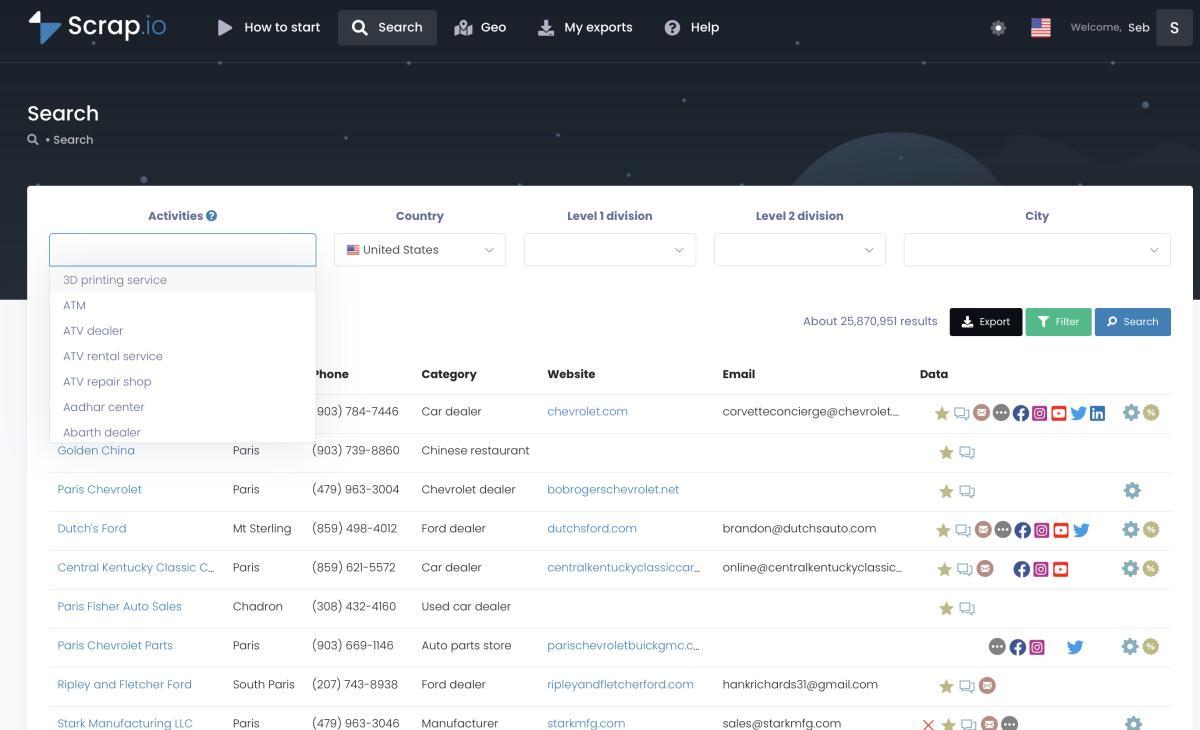
Scrap.io search — extract an entire category and territory in two clicks.
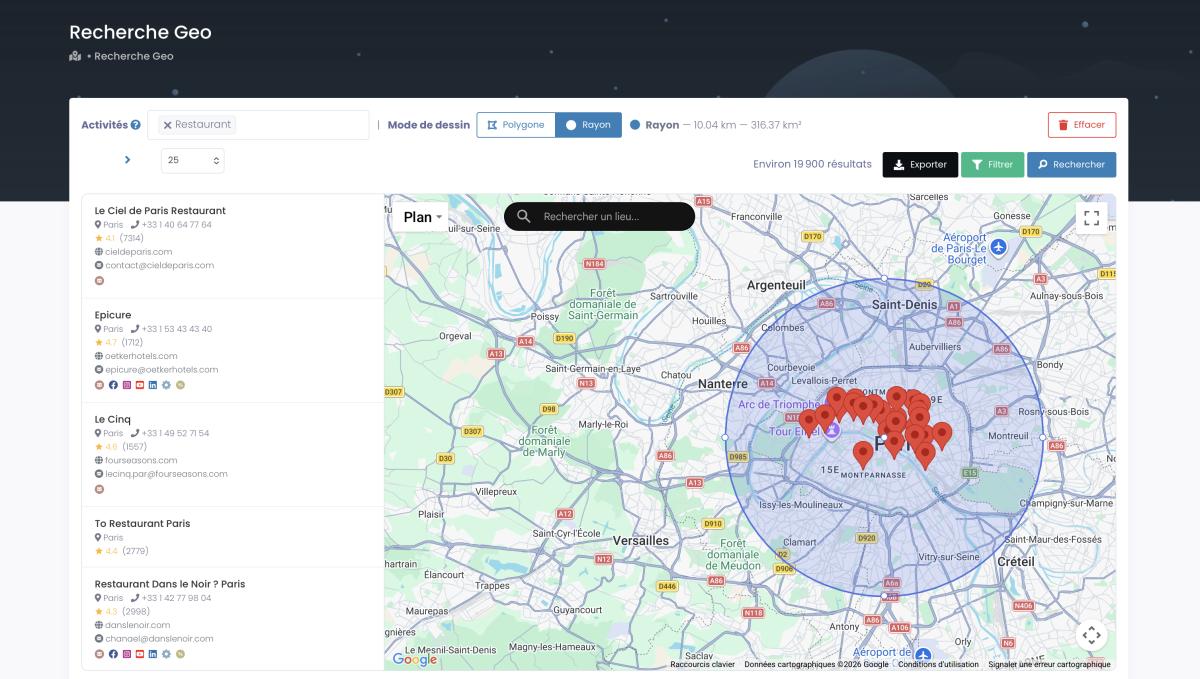
Scrap.io GeoSearch radius — target the exact trade area you prospect in.
96,895 US restaurants have both a sub-4.4 rating and fewer than 50 reviews. That's your prospect list. Filter it, export it, email it. Counting is free — you only spend credits on contacts you actually keep. Try Scrap.io free — 100 leads included.
Video: Scrap.io - How to Start?
For the outreach workflow itself, our guide on extracting emails from Google Maps covers how to reach those prospects. And if you're exploring how review management fits a broader revenue model, how to make money with Google Maps walks through the exact playbook.
FAQ
How can I increase my Google reviews fast?
Fastest compliant path: SMS your existing customers a direct Google review link. Today. Pick a batch who had a good experience recently, and text them the link — but keep the ask open-ended and send it to everyone, not just your favorites. Then pair it with in-person asks from trained staff and a QR code at point of sale for passive collection. Most businesses see real momentum within 2–4 weeks. Just watch your pace: 3–5 requests a day beats a single big blast that trips Google's filters.
Is it legal to buy Google reviews?
No. It violates Google's Terms of Service and gets profiles suspended and reviews stripped — Google removed 292 million policy-violating reviews in 2025 alone. It's also now a real financial risk: the FTC's Consumer Review Rule carries penalties up to $53,088 per violation, and the first enforcement letters went out in December 2025. Build real reviews. They compound in ways fakes never can.
How many Google reviews do I need to rank higher?
Sterling Sky's case study shows a ranking boost kicks in around 10 reviews, and top-ranking businesses average 47. But how many google reviews to rank higher is the wrong question — count matters less than velocity. Fifty reviews with nothing new in six months reads as stale; thirty with 2–3 arriving weekly reads as alive. Get to 50 as fast as you reasonably (and compliantly) can, then hold 3–5 new ones a month.
What is a good Google review rating?
Weirdly, 4.7 beats 5.0. People don't trust perfection — it smells curated. The sweet spot sits at 4.5–4.8 with healthy volume. BrightLocal's 2026 survey found 31% of consumers filter out anything below 4.5 stars, so that's your floor. If you're at 4.3, a dozen honest five-star reviews from genuinely happy customers moves the needle fast.
Can Google detect fake reviews?
Yes, and it's gotten scary good. Google's Gemini models now catch coordinated fake content before it publishes, on top of analyzing posting patterns, account history, device fingerprints, and language similarity across millions of businesses. Roughly 22% of all review activity in 2025 was flagged as policy-violating. VPNs don't help. "Premium" review services don't help. If your pattern looks anomalous, you're flagged.
How do I remove a negative Google review?
If it's legitimate, you can't — that's just someone's experience. You can flag reviews that violate Google's policies (fakes, spam, off-topic rants, hate speech): click the three dots, select "Flag as inappropriate." Google reviews the flag slowly — days or weeks, not hours. Your best play for a real negative review is a public, professional response. Future customers judge you more by the reply than by the complaint.
How often should I ask customers for reviews?
Every time. Every customer. Every positive experience — and, importantly, without filtering by who you think will be kind, because that's gating. 68% leave a review when asked; zero percent when you don't. Make it routine, not a campaign. Campaigns end. Routines run forever. That's the difference between 20 reviews and 200.
How do you get 1000 reviews on Google?
Slowly, and by system rather than campaign. At a compliant pace of 3–5 requests per day, a business collecting at a 30% response rate adds roughly 30–45 reviews a month. That's 1,000 in about two years. There's no shortcut — and the shortcuts that exist got 292 million reviews deleted in 2025. Businesses that hit four figures did it by building the ask into the customer journey, not by running a push.
What happens when you hit 100 reviews on Google?
Nothing changes on Google's side — there's no badge, no threshold unlock. What changes is statistical: at 100 reviews, a single one-star review moves your average by about 0.03 stars instead of 0.3. You become resilient. Since top-ranking local businesses average around 47 reviews, crossing 100 usually means you're ahead of your local pack — but review velocity still matters more to Google than the total.
Conclusion
The playbook for how to get more Google reviews hasn't changed dramatically — ask, make it easy, follow up, respond. What changed in 2026 is the cost of doing it wrong. Consumers are pickier, response-time expectations have nearly tripled, a third of your market won't look at you below 4.5 stars, and Google will now delete reviews and banner your profile if you cut corners. And in 2026, the fastest way to lose 50 reviews is to collect them the wrong way.
You don't need all twelve strategies. Pick three. Get your direct review link. Send it to ten happy customers tonight — an open-ended ask, no scripting. Set up one automated follow-up at a sane pace.
The dentist in Phoenix didn't do anything complicated. She picked three strategies and didn't stop. Consistency beats intensity. A steady drip every week outperforms a burst of 30 followed by six months of silence — both for ranking and for how customers perceive you. Momentum is the whole game. Start building it.
Whether you're a business owner growing your reviews or an agency helping others do it, Google Maps data is your starting point. Try Scrap.io free — get 100 leads instantly.
Generate a list of restaurant with Scrap.io