

$304.93 billion. That's the size of the US legal services market in 2025, per Precedence Research. Growing at 4.82% annually. Projected to hit $488 billion by 2035.
Numbers like these make lawyers one of the most lucrative B2B audiences you can target. But actually reaching them? Whole different story.
Lawyers ignore cold calls. They skim past LinkedIn DMs. And generic emails? Trashed before you finish your subject line. I watched a SaaS sales team spend six weeks piecing together a prospect list of 2,000 attorneys — manually checking state bar sites, copying emails from law firm "Contact Us" pages, cross-referencing LinkedIn profiles. The list was already 15% inaccurate by the time they started sending. That's not a workflow. That's punishment.
There are really only three paths to a solid lawyers email list: buy a pre-built one (fast, but stale), build it yourself (slow, painful), or scrape real-time data from Google Maps — which is what Scrap.io does. Right now, the platform indexes roughly 166,341 lawyers across the US. Fresh data. Not recycled garbage from 2022.
This guide covers all three approaches with actual numbers, real companies, and the compliance stuff you absolutely can't skip when your audience literally sues people for a living.
Video: How to Extract Every Business in 1 Click with Scrap.io
- What Is a Lawyers Email List?
- The US Legal Market in 2026: Why Lawyers Are a Gold Mine
- 3 Ways to Get a Lawyers Email List
- How to Use Scrap.io to Build Your Lawyers Email List
- Who Targets Lawyers with Email Lists? Real B2B Use Cases
- Lawyers Email List: Real-Time Data vs. Traditional Providers
- Best Practices for Email Marketing to Lawyers in 2026
- Legal Compliance: CAN-SPAM, GDPR & State Privacy Laws
- Top States for Lawyer Email Outreach
- FAQ: Lawyers Email Lists
What Is a Lawyers Email List?
Pretty much what it sounds like. A lawyers email list is a database packed with contact info for attorneys — emails, phone numbers, office addresses, practice areas, firm names, sometimes even bar admission dates. You'll also hear people call it an attorney email list, a lawyer email database, or a law firm mailing list. Same concept.
But a raw dump of 50,000 lawyer email addresses in a CSV? Useless. What actually makes these databases valuable is segmentation. The ability to slice and filter. Because blasting "Dear Legal Professional" to every attorney in the country is a fast track to the spam folder (and honestly, you deserve it if you do that).
Quick reality check on the raw numbers, because they matter here. Of the 166,341 US lawyers indexed on Scrap.io, only 75,414 have a public email address attached to their listing — roughly 45%. That gap is the whole game. A good lawyers email list isn't the biggest one. It's the one where every row is actually reachable. (Same logic applies whether you're building an email list by industry or drilling into one specific vertical.)
Here's how segmentation breaks down in practice:
By Practice Area
Family law, corporate, criminal defense, IP, personal injury, immigration, bankruptcy, employment, civil litigation — a proper attorney email list segments by specialty. If you're selling case management software built for personal injury attorneys, emailing divorce lawyers is just... burning money. Target the right people or don't bother.
By Geographic Location
Where the lawyer practices matters as much as what they practice. California and New York are packed with attorneys. Texas is booming. Florida's personal injury market is enormous. Some platforms let you drill down to specific cities, metro areas, even zip codes. The tighter the geo-targeting, the higher your response rate. Always.
By Firm Size & Decision-Maker Role
A solo practitioner running a two-room office in Tucson doesn't have the same budget, problems, or buying process as a managing partner at a 300-lawyer firm in Chicago. And the person who picks the software isn't always the person who uses it — sometimes it's the office administrator, sometimes the IT director. A good law firm email list lets you filter by both.
The US Legal Market in 2026: Why Lawyers Are a Gold Mine
Before dropping a cent on any lawyer email address list, look at the numbers. They're kind of absurd.
| Metric | Value | Source |
|---|---|---|
| US legal services market (2025) | $304.93 billion | Precedence Research |
| Projected value by 2035 | $488.11 billion | Precedence Research |
| Growth rate (CAGR 2026-2035) | 4.82% | Precedence Research |
| Global legal services market | $1.03 trillion | Precedence Research |
| US law firms | ~450,000 | Grand View Research |
| Lawyers on Scrap.io | 166,341 | Scrap.io (July 2026) |
| Lawyers with a public email (Scrap.io) | 75,414 (~45%) | Scrap.io (July 2026) |
| Legal industry email open rate | ~39.3% | Industry benchmark |
| Law firm demand growth (2025) | 2.5% avg, 4.4% peak July | Thomson Reuters / Georgetown |
| Midsize firm demand growth | ~5% in H2 2025 | Thomson Reuters Institute |
That 39.3% open rate deserves a second look. Most B2B sectors sit around 20-25%. Lawyers actually read their inbox. (They kind of have to — deals, filings, court dates, all of it runs through email.)
Demand isn't flattening either. Midsize firms grew demand by roughly 5% in the second half of 2025. AI adoption in legal tech keeps accelerating, which means firms are actively shopping for new tools, services, and vendors. If you sell anything — SaaS, consulting, cybersecurity, office equipment, insurance — to the legal vertical, this market is begging for attention.
Search 166,341 US lawyers with real-time Google Maps data — filter by state, practice area, and verified email before you spend a single credit. Free 7-day trial, 100 leads included. Try Scrap.io free →
3 Ways to Get a Lawyers Email List
Three options. Each has tradeoffs. None is universally best.
Option 1: Buy a Pre-Built Attorney Email List
Fastest route. Pay a vendor, get a spreadsheet. Could be running outreach by lunch.
Cost? Anywhere from $200 for a small generic list to $5,000+ for a segmented attorney email database with verified contacts. The appeal is speed and simplicity — zero effort on your end.
The problems are just as obvious. Pre-built lists go stale fast. Lawyer email data decays roughly 30% within six months. Attorneys switch firms, make partner, retire, shift practice areas. And here's the part nobody tells you upfront: if you can buy that lawyer email list, so can your five competitors. Same contacts, same inbox, same fatigue.
Not saying never buy. Just don't expect miracles from a list that ten other companies are hammering simultaneously.
Option 2: Build Your Own Legal Database
The DIY approach. Pull data from state bar directories, law firm websites, LinkedIn, legal publications, court records. Verify each email manually. Maintain the whole thing monthly.
Sounds like total control. In reality? Brutally slow. One dedicated researcher can compile maybe 50-100 verified lawyer contacts per day. Need 5,000? That's 10-12 weeks of full-time work. And every single day you're not updating, the data rots a little more.
Compliance gets tricky here too. You need to understand how to find email addresses from Google Maps and other public sources without stepping on privacy regulations. Not impossible, but it adds a whole layer of headaches.
This method works if you're going ultra-niche — say, 150 patent lawyers in one metro area — and you have the staff to keep it current. For anything at scale? You'll spend more in labor than you'd ever spend on a tool or a pre-built list.
Option 3: Real-Time Data from Google Maps (Recommended)
OK so here's the third path, and it's the one I'd pick nine times out of ten.
Instead of buying a frozen snapshot of data or spending months building a list by hand, you pull lawyer contact data live from Google Maps business profiles. Why Google Maps? Because attorneys maintain their business listings there — name, address, phone, website, reviews, hours, category. It's public data. And it updates constantly.
Think of it like the difference between buying a newspaper from last Tuesday and checking the news feed right now. A traditional lawyers email database gets refreshed quarterly if you're lucky. Real-time data from Google Maps? Current every time you run a search.
This is what Scrap.io does. Search "lawyer" or "criminal defense attorney" or "immigration law firm" — narrow by state, city, review count, email availability — export your results. Done. A fresh lawyer email address list, built in minutes.
Cost comparison is brutal for the traditional vendors. Instead of a $2,000+ one-time buy for a static list, Scrap.io runs $49/month with access to the full USA business email database. Math's not complicated.
How to Use Scrap.io to Build Your Lawyers Email List
Four steps. Takes about 10 minutes.
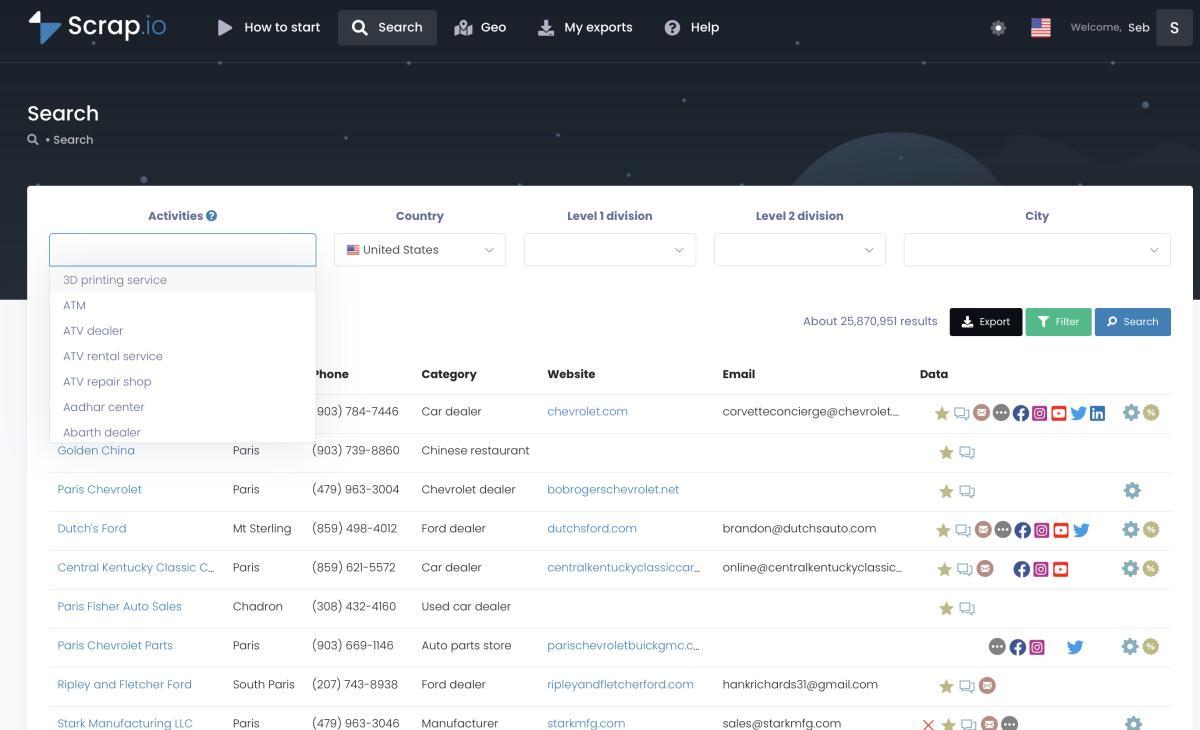
Step 1 — Search. Type "lawyer," "attorney," "law firm," or something more specific like "personal injury attorney" into Scrap.io. The platform pulls matching businesses from Google Maps across the US (or globally, your pick).
Step 2 — Filter. Here's where things get sharp. Narrow by state or city. Filter by Google rating, number of reviews, whether an email address is available, whether they have a website. Stack filters to get ridiculously targeted. Want divorce lawyers in California with at least 20 reviews and a confirmed email? Two clicks. This is also where the credits math works in your favor: filters apply before extraction, so you only ever pay for the 75,414 lawyers who actually have an email — not the dead rows.
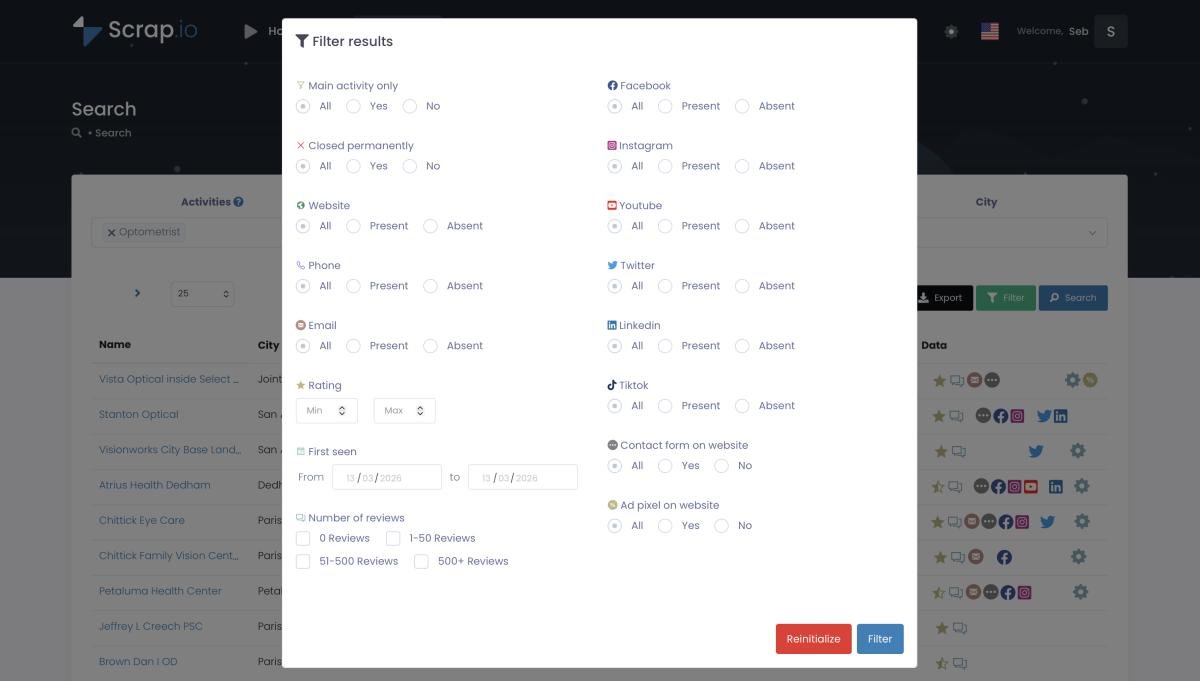
Video: Finding Clients Through Google Maps Filters
Step 3 — Preview. Check the data before exporting. Firm name, address, phone, email, website, Google rating — it's all visible. Make sure you're looking at actual attorney contacts and not a bunch of generic info@ addresses.
Step 4 — Export. Download as CSV or Excel. Every available field comes with it: name, email, phone, address, website URL, Google Maps link, review count, rating, categories. Drop it straight into your CRM or outreach tool.
One more number worth knowing before you export: 105,741 US lawyers (~64%) in the Scrap.io index have a website attached. That's a filter too. Selling web services, SEO, or anything that plugs into a firm's existing site? Toggle "has a website" and you've narrowed to prospects who already invest in their online presence. Or flip it — target the ones without a site if that's your pitch. The counting is free either way.
Ten to fifteen minutes for a targeted list of, say, 500 criminal lawyers in Texas. Compare that to weeks of manual research. Or to a $3,000 pre-built list that's already losing accuracy the moment you download it.
One caveat: Scrap.io pulls from Google Maps profiles, so the data quality depends on how well law firms maintain their listings. Established firms tend to keep things pretty current — they rely on Google for local SEO and client acquisition. Solo practitioners can be spottier. But overall, accuracy beats most pre-built databases I've compared it against.
Start building your lawyer list now — real-time contacts pulled straight from Google Maps, filtered by state, practice area, and verified email. 7 days free + 100 leads, no commitment. Start your free trial →
Who Targets Lawyers with Email Lists? Real B2B Use Cases
More companies than you'd guess. Here's who's actually using this stuff — and why.
Legal tech SaaS companies. Clio is the poster child here. They make practice management software — case management, billing, client intake — used by over 150,000 legal professionals. Their sweet spot is solo and small-firm attorneys. To reach them, you'd filter Scrap.io for firms with 1-10 lawyers, export the list, and run segmented campaigns by practice area. A family law solo in Ohio cares about different features than a corporate boutique in Boston. Same product, completely different pitch.
Legal research platforms. Think Thomson Reuters and Westlaw. They sell firm-wide subscriptions — big ticket, long sales cycle. Their target isn't the junior associate doing the research. It's the managing partner or the firm librarian who controls the budget. A law firm email list filtered by mid-to-large firms gets you in front of the right person.
Document and e-signature tools. DocuSign processes mountains of legal paperwork — contracts, NDAs, closing docs. They need to reach the IT decision-maker or the office admin who actually rolls out new tools. Filter by firm size, prioritize operational contacts. Campaign writes itself.
Cybersecurity vendors. Less obvious, massively underserved. Law firms sit on the most sensitive data imaginable — M&A financials, litigation strategy, client records. The average top-200 firm spends around $2.35M a year on digital infrastructure and marketing. They know they're targets for cyberattacks. A targeted attorney email list filtered for mid-to-large practices is gold for security sales teams.
Insurance brokers. Every law firm needs malpractice coverage. Most also need commercial liability and cyber insurance. Brokers who can segment by practice area and firm size skip the spray-and-pray entirely.
Lawyers Email List: Real-Time Data vs. Traditional Providers
Side by side. No sugarcoating.
| Feature | Real-Time (Scrap.io) | Traditional Pre-Built Lists |
|---|---|---|
| Data freshness | Updated with every search | Quarterly updates (best case) |
| Accuracy | Reflects current Google Maps data | 60-80% after 6 months |
| Cost | From $49/month | $200-$5,000+ one-time |
| Contacts available | 166,341+ lawyers indexed (75,414 with email) | Varies by vendor |
| Filters | Location, rating, reviews, email, website, category | Location, practice area, firm size (varies) |
| Compliance | Public data from Google Maps (legal basis) | Depends on vendor sourcing |
| Ongoing access | Unlimited searches while subscribed | One-time download |
| Exclusivity | Your filters = your unique list | Same list sold to multiple buyers |
Quick math. A $3,000 pre-built attorney email list with 10,000 contacts sounds like a deal until 30% bounce. That's $0.43 per usable lead. On Scrap.io at $49/month, you pull thousands of fresh contacts — and re-pull updated versions next month at no extra cost. The per-lead economics aren't even close.
And remember the filtering angle. A broker charges you for all 10,000 rows, bounces included. Scrap.io only bills the ~75,414 lawyers that actually have an email, because you filter before you export. You're not paying for the dead weight. That's the difference between $0.43 a usable lead and something closer to a dime.
Traditional vendors aren't completely useless. If you need hyper-niche data points that Google Maps doesn't carry — bar admission year, law school, specific firm revenue brackets — a specialty provider might have it. But for the vast majority of use cases where you need email, phone, location, practice area, and firm info? Real-time wins and it's not a debate.
See the difference for yourself: pull a fresh, filtered attorney list in minutes instead of buying a snapshot that's already aging. 7 days free, 100 leads on us. Try Scrap.io free →
Best Practices for Email Marketing to Lawyers in 2026
Having the list is step one. Getting lawyers to actually open, read, and reply? That's the hard part. They see dozens of vendor pitches every week. Most get deleted in under two seconds.
What separates campaigns that work from campaigns that tank:
Lead with their world, not yours. "I noticed your firm handles personal injury cases in Houston" lands completely differently than "Our software is the #1 solution for legal professionals." Use the practice area and location fields from your attorney email list to personalize the first line. Takes 30 seconds. Doubles response rates. Yet almost nobody does it. There's a full framework for this in our guide on how to write a cold email that gets replies — worth a read before you send anything.
Why does the personalization matter so much with this audience? Do the math from their side. A firm decision-maker gets around 15 cold emails a week (Saleshandy / demand-pulse benchmarks, 2026), and every one gets the same silent question: "is this worth six minutes of my time at $400-900 an hour?" Your generic "innovative solution for legal professionals" opener loses that math instantly. A specific, relevant first line survives it.
Speaking of what actually gets through — here's a data point that surprised me. An entrepreneur targeting personal injury firms put it bluntly on a cold outreach forum thread: "99% of the firms I cold-call have secretaries trained to shut down solicitation — but every single time I've reached an attorney directly, the conversation was positive." Read that again. The gatekeeper problem is a phone problem. Email skips the receptionist entirely and lands on the person who can actually say yes. That's a structural advantage cold calling just doesn't have with this audience.
Send when lawyers actually check email. Here's something most marketers miss: attorneys don't work 9-to-5. They check email at 6:30 AM before court. They clear their inbox at 9 PM after the kids are in bed. A/B test send times and you'll probably find 7-8 AM and 7-9 PM crush the standard 10 AM blast. Just try it.
Make subject lines specific. "Quick question about [Firm Name]'s client intake" outperforms "Innovative Solution for Legal Professionals" by an embarrassing margin. Reference the firm name, the practice area, the city. Make it feel like a real email from a real person — because that's what gets opened.
Give before you ask. A compliance checklist. A relevant industry stat. A genuinely useful resource. Not a 40-page whitepaper that's really just a sales deck with extra padding. Lawyers respect people who bring substance. A warm outreach approach where you lead with value converts dramatically better than cold pitching. If you want ready-made structures to start from, these cold email templates for law-firm outreach are a solid launch pad.
Fix your technical setup first. SPF, DKIM, DMARC — if your email authentication isn't configured properly, your messages hit spam before any attorney sees them. Google and Microsoft tightened sender requirements throughout 2025-2026. This stuff isn't optional anymore.
And that 39.3% average open rate for legal emails? That's your benchmark. If you're significantly below it, the problem is usually sender reputation or subject lines — not the list itself. Fix those first before blaming your cold email outreach data.
Legal Compliance: CAN-SPAM, GDPR & State Privacy Laws
You're emailing lawyers. Think about that for a second. These are people who litigate compliance violations professionally. Sloppy outreach isn't just risky — it's handing them a case study they can use against you.
CAN-SPAM (US). Every commercial email must include: an honest subject line, your physical mailing address, a working unsubscribe mechanism (must process within 10 business days), and accurate "From" and "Reply-To" headers. Violations can hit $50,120 per email. The full requirements are spelled out in the FTC's compliance guide. Read it. Not optional.
GDPR (international). Any attorney contacts in Europe — or any company with EU operations — falls under GDPR. You need a lawful basis for processing (legitimate interest is the common one for B2B), clear opt-out options, and documentation of your data sources. It sounds bureaucratic because it is. But the fines make CAN-SPAM look cheap. If any slice of your list touches Europe, our breakdown of GDPR-compliant cold email for B2B walks through exactly what "legitimate interest" requires.
CCPA (California). California's privacy law gives residents the right to know what data you hold and to request deletion. Given that California has one of the highest concentrations of lawyers in the country, skipping this isn't an option.
Why Scrap.io's model holds up. Scrap.io pulls data from Google Maps business profiles — information that businesses publish specifically to be found by potential clients and partners. Public, commercial, transparently sourced. That's a much stronger legal foundation than buying a list from some broker who won't disclose where they scraped their data or whether consent was ever given.
But good data doesn't excuse bad practices. Always include an unsubscribe option. Always identify yourself clearly. Keep records of where every single contact came from. Lawyers will ask. And they'll know if you're making it up.
Top States for Lawyer Email Outreach
Not every state offers the same opportunity. Here's where the density — and the money — is:
| State | Key Cities | Opportunity Level |
|---|---|---|
| New York | NYC, Albany, Buffalo | Very High — Wall Street, corporate law, immigration |
| California | LA, SF, San Diego, Sacramento | Very High — Tech, entertainment, PI |
| Texas | Houston, Dallas, Austin, San Antonio | High — Energy, corporate, immigration |
| Florida | Miami, Tampa, Orlando, Jacksonville | High — PI, real estate, immigration |
| Illinois | Chicago, Springfield | High — Corporate, criminal defense |
New York and California together hold a disproportionate chunk of the country's attorneys. But competition for attention in those markets is brutal too — every vendor on earth is emailing Manhattan law firms.
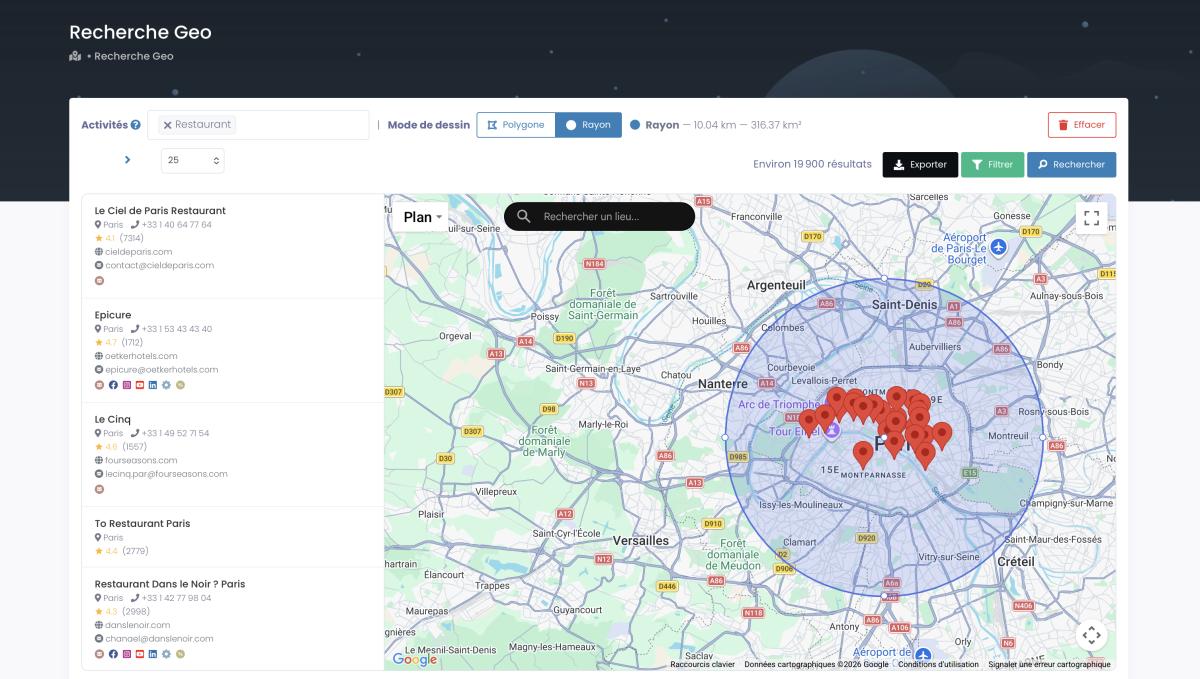
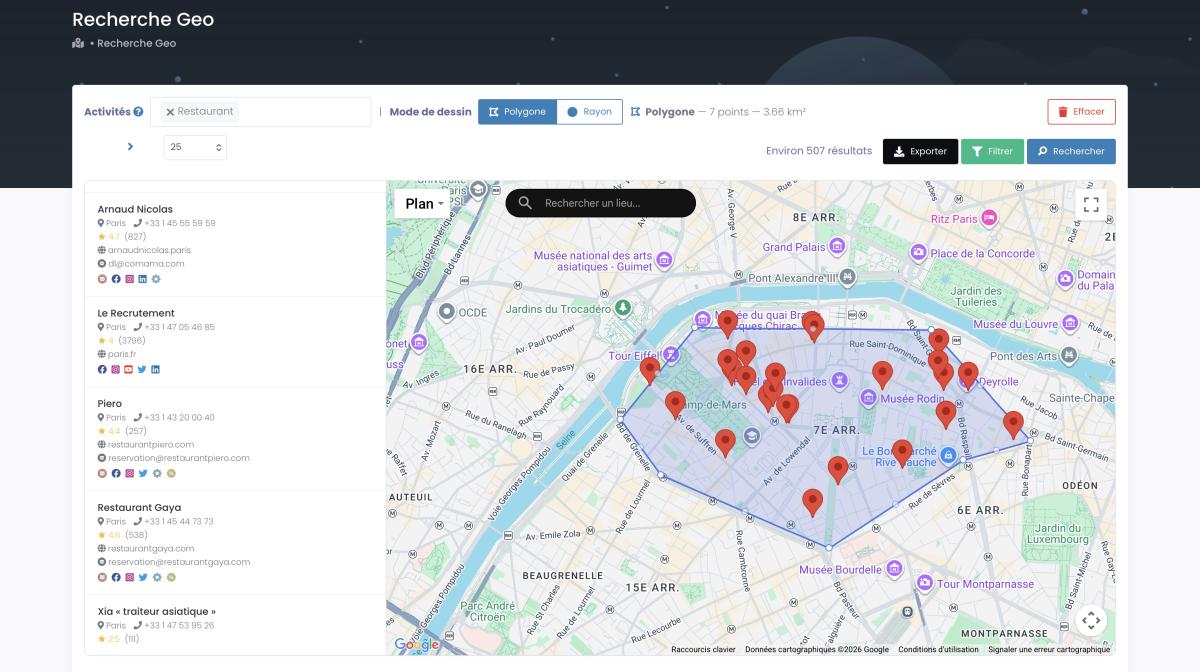
Here's a smarter play that most people miss: target midsize markets. A personal injury lawyer in Nashville or a corporate attorney in Denver gets dramatically fewer cold emails than their counterpart in Midtown. Less noise, better response rates. Scrap.io lets you filter by any state, city, or even neighborhood — draw a polygon on the map and you've isolated a single metro's attorneys — so building a targeted lawyers email address list for these secondary markets takes minutes, not days.
FAQ: Lawyers Email Lists
Where can I get a lawyers email list?
Three routes. Buy a pre-built list from a data vendor (fast but goes stale quickly), manually assemble your own from bar directories and law firm sites (slow and expensive in labor), or use a real-time platform like Scrap.io that scrapes live attorney data from Google Maps. Scrap.io currently indexes 166,341+ US lawyers, 75,414 of them with a verified email.
How much does a lawyers email list cost in 2026?
Depends on the method. A pre-built vendor list runs $200-$5,000+ (roughly $0.30-$1.00 per lead). Building your own by hand costs $2,000-$5,000 in labor ($2-$5 per lead). Real-time scraping with Scrap.io starts at $49/month and works out to $0.01-$0.10 per lead — the cheapest option at scale because you only pay for contacts that actually have an email.
| Method | Price Range | Est. Cost Per Lead |
|---|---|---|
| Pre-built vendor list | $200-$5,000+ | $0.30-$1.00 |
| Build your own (manual) | $2,000-$5,000 in labor | $2.00-$5.00 |
| Real-time scraping (Scrap.io) | From $49/month | $0.01-$0.10 |
Are lawyers email lists GDPR compliant?
Depends entirely on sourcing. Lists built from publicly available business data (like Google Maps profiles) have a stronger compliance basis than lists from unknown brokers. Scrap.io pulls from public Google Maps listings — information attorneys published themselves. You're still responsible for compliant outreach though: opt-outs, clear identification, records. Our GDPR cold email guide covers the legitimate-interest details.
What data is included in a lawyers email list?
A solid lawyer email database should include: full name, email address, phone number, firm name, office address, practice area(s), website URL, and firm size. Scrap.io also pulls Google Maps review count, average rating, and a direct link to the business listing. Some premium vendors add bar admission year or law school — less common though.
How accurate are lawyer email databases?
Pre-built lists typically claim 85-95% accuracy at purchase. Six months later? More like 60-80%. Real-time platforms like Scrap.io reflect whatever's currently on Google Maps, so accuracy tracks with how recently the firm updated their profile. For established practices, that's usually quite recent.
Can I target lawyers by practice area?
Yes. On Scrap.io, you search by keyword — "criminal lawyer," "immigration attorney," "divorce lawyer," "personal injury attorney" — and the platform returns matching Google Maps results. Pre-built vendors also segment by practice area, though their categories tend to be broader and less granular.
What's the difference between buying an email list and real-time scraping?
Buying gets you a static snapshot that's aging from the second you download it. Real-time scraping gives you fresh data every time you search. The bought list is shared with whoever else bought it; your scraped list is unique to your specific filters and search criteria. Cost model is different too — one-time purchase vs. monthly subscription with unlimited pulls.
How do I use a lawyers email list for marketing?
Segment by practice area and location first. Personalize every email with firm name, specialty, and city. Lead with value, not a pitch. Use proper cold email outreach strategies with A/B testing on subject lines and timing. And make sure your email authentication is configured — otherwise you're landing in spam regardless of how good the list is.
Is it legal to email lawyers for B2B outreach?
Yes — when done properly. CAN-SPAM requires a physical address, unsubscribe link, and honest subject lines. CCPA applies if you're reaching California attorneys. B2B cold email is legal in the US under these conditions. Our cold email compliance guide has the full breakdown.
How many lawyers are in the US in 2026?
The American Bar Association puts the number at over 1.3 million active licensed attorneys. Of those, Scrap.io indexes approximately 166,341 with verified Google Maps business listings — meaning they have a discoverable practice with published contact information, and 75,414 of them come with a public email address.
Try Scrap.io free — get 100 verified lawyer leads (email, phone, and practice area) instantly, pulled live from Google Maps. 7 days free, 100 leads included. Start now →
Generate a list of lawyer with Scrap.io