

Last year, a friend of mine who sells injectable supplies dropped $1,100 on a plastic surgeon email list from one of those big-name providers. He was pumped. Ten thousand contacts, "95% verified," all the buzzwords. Then he launched his campaign. Bounce rate? 31%. Replies? Four. One of them was a retired dermatologist who hadn't touched a syringe since 2019.
Four replies. Eleven hundred dollars.
Meanwhile, companies like Galderma are out there running entire HCP loyalty programs for Restylane and Sculptra. Allergan has Allē — basically a mini-ecosystem to keep surgeons hooked on Botox and Juvederm. These guys aren't blasting emails into the void. They've got fresh contact data, segmented lists, and messaging that actually speaks to what plastic surgeons care about.
The market they're playing in? Massive. Precedence Research puts the US cosmetic surgery market at $21.63 billion (2025 figure), growing at 7.4% CAGR through 2034. IBISWorld's 2026 number for the broader plastic surgeons industry — surgical plus non-surgical — is $27.4 billion across 13,399 businesses. Scrap.io currently tracks 24,163 plastic surgeon listings in the US alone.
So the opportunity's there. The question is whether you're going to reach these doctors with data from this month or data from the Obama administration.
Video: Why Your Google Maps Emails Don't Get Replies?
Table of Contents
- The Plastic Surgery Market in 2026
- What's Actually in a Plastic Surgeon Email List?
- 3 Ways to Get a Plastic Surgeon Contact List
- How to Choose a Provider
- What Makes a High-Quality Cosmetic Surgeon Email Database
- How to Actually Email Plastic Surgeons
- Real Examples: Who's Marketing to Plastic Surgeons?
- Legal Compliance
- Getting Maximum ROI
- FAQ
The Plastic Surgery Market in 2026: Why These Doctors Are Worth Targeting
I know a 12-person med device team in Tampa that closed $340K in new accounts last year. Plastic surgeons only. No other specialty. They told me their average deal size with cosmetic practices is 3× what they close with general surgeons. That tracks — these doctors have money, they spend it fast, and they don't send purchasing decisions through six committees first.
ASPS puts annual cosmetic procedures in the US somewhere between 6.2 and 6.6 million. Precedence Research says 84% of cosmetic surgery patients are female, with the 30-54 age bracket making up 61% of demand. And social media? It's basically a free advertising engine for cosmetic work. Every before-and-after post on Instagram creates more patients, which creates more revenue, which creates more purchasing power for the surgeons doing the work.
For anyone selling B2B into this space, the ROI math is stupid simple. DMA/Litmus 2025 data puts email marketing at $42 returned per dollar spent. Multiply that by the lifetime value of a single plastic surgeon account and... yeah. Even a tiny plastic surgeon email list can pay for itself in one campaign.
If you're already targeting healthcare professionals broadly, think of plastic surgeons as the premium tier. Higher budgets. Faster decisions. Stickier relationships once you earn their trust. The same logic applies one level up, across the whole physicians email list universe — but plastic surgery is where the margins live.
How Much Do Plastic Surgeons Spend?
BLS data puts the average plastic surgeon's income above $400K. The ones running busy cosmetic-only practices in markets like Beverly Hills, Miami, or Scottsdale? Seven figures. Comfortably.
That income isn't just vanity. It translates to real buying power. A cosmetic surgeon won't flinch at a $50K laser system if the clinical data checks out. And they buy consumables — fillers, sutures, implants, skincare lines — on repeat. If you sell anything to these practices, you're looking at recurring revenue, not one-off transactions.
Geographic Hotspots
California, Florida, Texas, New York. Predictable, right? High population, high income, warm weather (at least for the first two). But secondary markets are getting interesting. Nashville's cosmetic surgery scene has exploded. Denver and Charlotte too. These cities have growing populations with disposable income and fewer competitors fighting for the same surgeon's inbox.
Scrap.io lets you filter down to specific zip codes, which is useful if you're testing a new market before going all-in.
Curious how many surgeons are actually in your target market? Counting is free on Scrap.io — no credits, no card charge, no export needed. Type "plastic surgeon," pick a state or a zip, and see the number before you decide anything. Run a free count →
What's Actually in a Plastic Surgeon Email List?
A plastic surgeon email list is a database of contact details for surgeons performing cosmetic and reconstructive procedures — emails, phone numbers, practice addresses, credentials, and ideally specialty focus and practice size. In 2026, the useful ones are pulled live from public business listings rather than compiled quarterly, because roughly a third of US plastic surgeons publish a working email and that set changes every week.
That's the textbook definition. Here's the real one: it's a spreadsheet where between 60% and 95% of the data actually works, depending on who sold it to you and when they last bothered to update it.
I've watched doctor email list providers ship contacts for surgeons who moved states two years ago. Or email addresses pointing at hospital domains the surgeon left in early 2023. The word "verified" on a sales page means absolutely nothing if nobody re-verified it in the last six months.
Cosmetic Surgeons vs Reconstructive Surgeons
This matters way more than most marketers think. And getting it wrong wastes your entire campaign.
Cosmetic surgeons — breast augmentation, rhinoplasty, liposuction, facelifts — overwhelmingly run private practices. They sign their own checks. They respond to marketing because patient acquisition keeps the lights on. They're aggressive buyers: lasers, injectables, patient management platforms, digital marketing services. If you've got something that helps them get more patients or deliver better results, they'll hear you out.
Reconstructive surgeons? Totally different animal. Hospital-based, usually. Post-cancer reconstruction, trauma repair, congenital defects. Their purchasing runs through procurement departments with approval chains longer than a CVS receipt. You're looking at a 6-12 month sales cycle instead of 6-12 weeks.
A cosmetic surgeon mailing list and a reconstructive surgeon list should be treated as two completely different products. If your provider lumps them together, you're going to waste a ton of outreach on the wrong audience.
Decision-Makers Beyond the Doctor
Here's what nobody tells you until you've already wasted three months emailing surgeons who never check their inbox. In a lot of practices — especially the mid-size ones with 3-8 staff — the office manager runs purchasing. The surgeon might sign off, but the office manager researched the options, got the quotes, and already made the decision before the doctor even heard about it.
Your cosmetic surgeon contact database should include these people. If it only lists surgeon names, you're missing the person who actually opens vendor emails.
3 Ways to Get a Plastic Surgeon Contact List
Three paths. All of them work. Only one of them makes financial sense for most teams.
Building Your Own List (the Hard Way)
Someone on your team spends two or three weeks pulling contacts from state medical boards, Google, LinkedIn, practice websites. On a good day they find 10-15 usable contacts per hour.
Let's do the math nobody wants to do. At $25/hour, that's about $2 per contact in labor alone. Add email verification tools ($50-200/month), a CRM to store everything, and the ongoing cost of re-checking contacts that go stale every few weeks. For a list of 5,000 plastic surgeons, you're looking at months of work and $10K+ all-in.
Or you could pull 10,000 contacts for about $50. But we'll get there.
DIY lists only make sense if you need fewer than 50 highly specific contacts and you already know who they are. For everyone else, it's a time sink disguised as a cost-saving measure. (We've watched smart teams fall into this trap. It always ends the same way — three months in, half-built list, demoralized researcher, project quietly abandoned.) If you want the structured version of this exercise, we broke it down in our guide on how to build a cold email list.
Video: How to Scrape Local Leads with Claude & Vibe Prospecting
Buying from Traditional Providers
LakeB2B, MedicoReach, 360Marco, BookYourData, DataCaptive, Med Stream Data — these are the names you'll find when you Google "buy surgeon mailing list." You pay, they email you a spreadsheet, you start your campaign.
Fast. Easy. And the data is... fine. Maybe. Sometimes.
The problem isn't accuracy on day one. It's that these companies compile data quarterly. By the time you receive your list, some contacts are already wrong. And because they sell the same file to dozens of buyers, you're competing in the same inboxes as every other vendor who bought the same batch last month. Pricing runs $500-1,500 for 10,000 contacts depending on what filters and guarantees they throw in.
Practitioners who do cold outreach for a living have basically stopped assuming a purchased file is safe. In an r/coldemail thread on building lists, the top advice isn't about the list at all — it's damage control: "Do not send cold emails from your primary company domain... buy trycompany.com." Read that again. People plan around the blowback instead of avoiding it. That's what a decade of stale purchased data does to an industry.
ASPS also rents member lists for targeted campaigns — worth exploring if you specifically want board-certified surgeons, though access is more restrictive and pricing less transparent.
Live Data Scraping with Scrap.io (the Smart Way)
This is the part where the economics stop making sense for traditional providers.
Scrap.io pulls contact data directly from Google Maps and business websites. Real time. When a plastic surgeon updates their listing — new email, new address, new phone — it's reflected immediately. No quarterly updates. No stale data. No sharing with competitors, because every pull is unique to you.
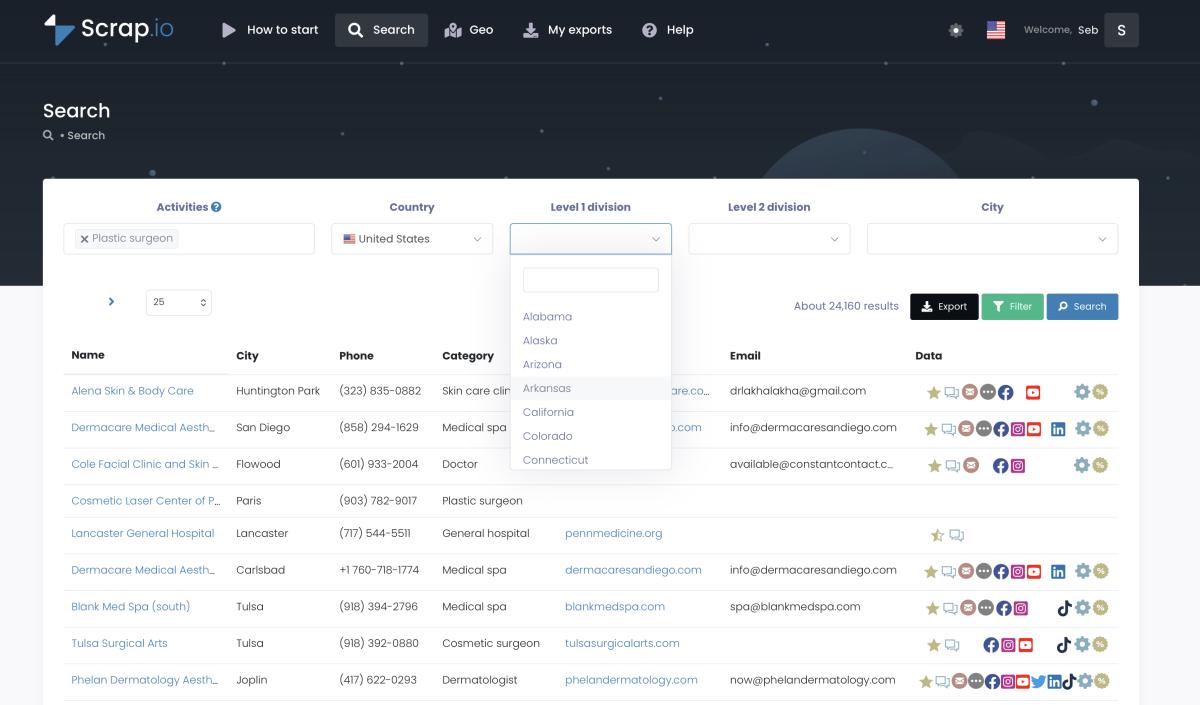
Right now the platform returns 24,163 plastic surgeon results across the US. But the number that should actually interest you is the breakdown:
| Data point | US plastic surgeons | Share |
|---|---|---|
| Total listings | 24,163 | 100% |
| With a phone number | 23,786 | ~98% |
| With a website | 19,081 | ~79% |
| With an extractable email | 8,035 | ~33% |
Out of 24,163 US plastic surgeons, only 8,035 expose a usable email. Barely a third. Which is exactly why Scrap.io applies the "has email" filter before extraction — you don't spend a single credit on the 16,128 listings you could never write to anyway. Most providers happily sell you all 24,163 and let you discover the gap after payment.
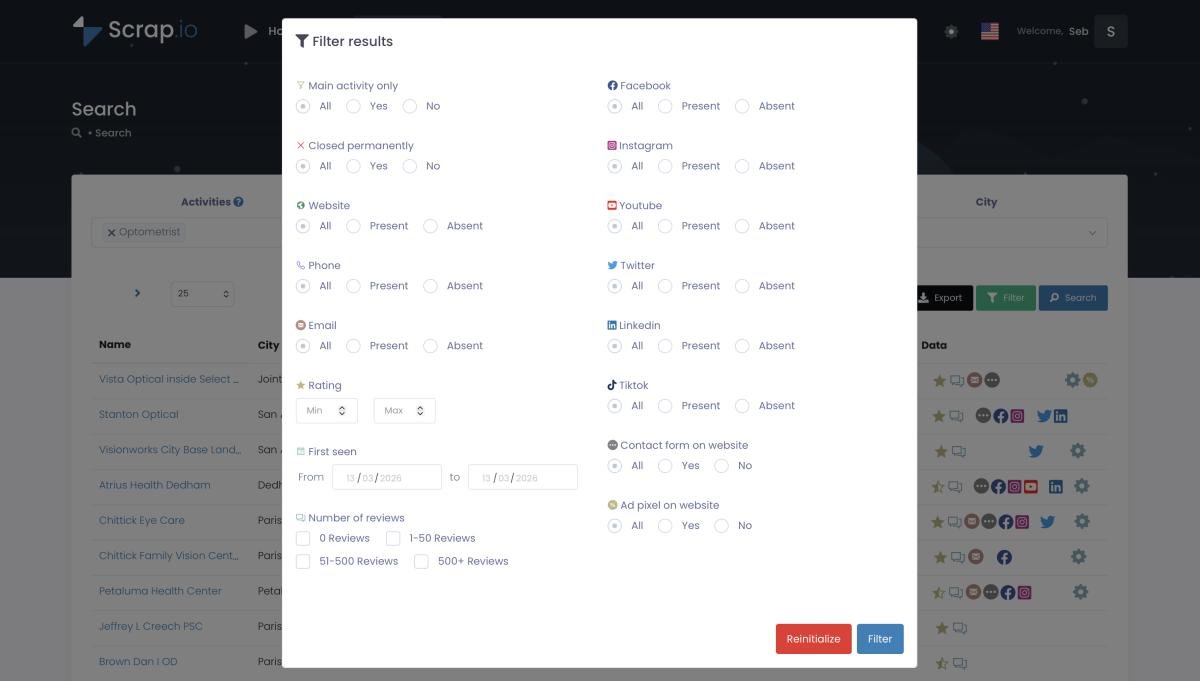
The filters go beyond basic geography — sort by Google review count, social media presence (or absence), whether they have a website, and more. Need cosmetic surgeons in South Florida with fewer than 15 Google reviews and no Instagram account? That's two clicks and a CSV download. The mechanics are the same ones we cover in how to find emails on Google Maps.
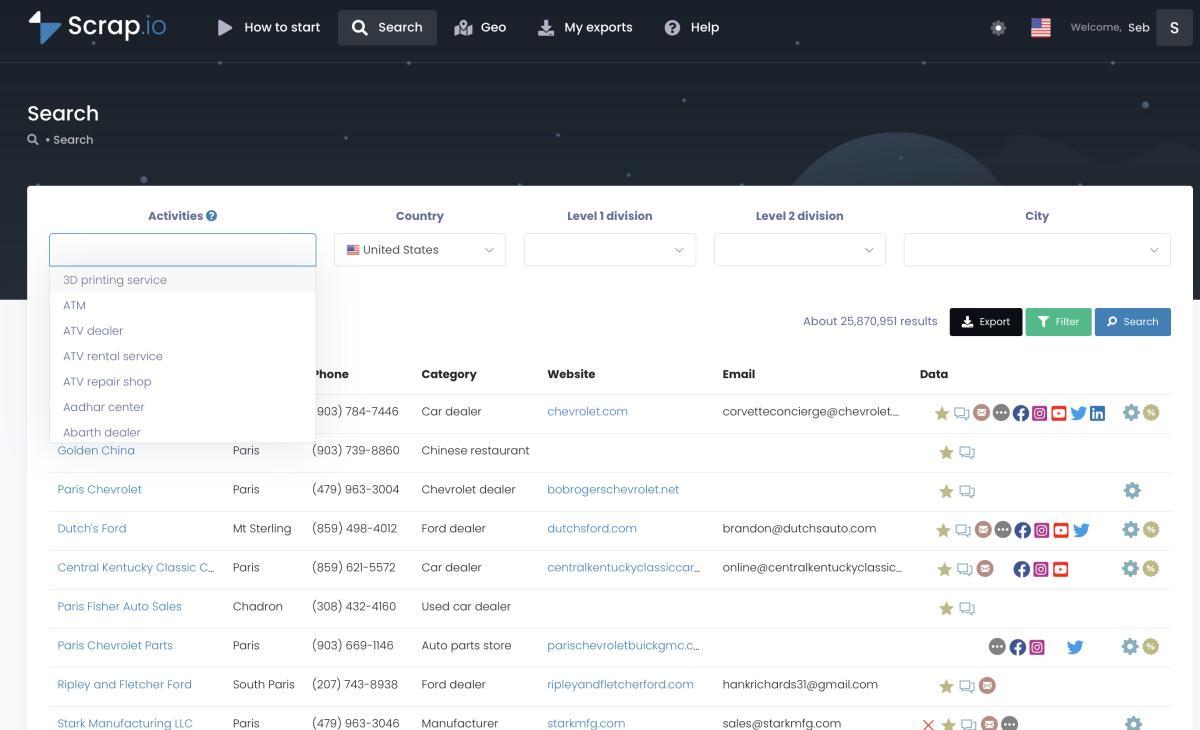
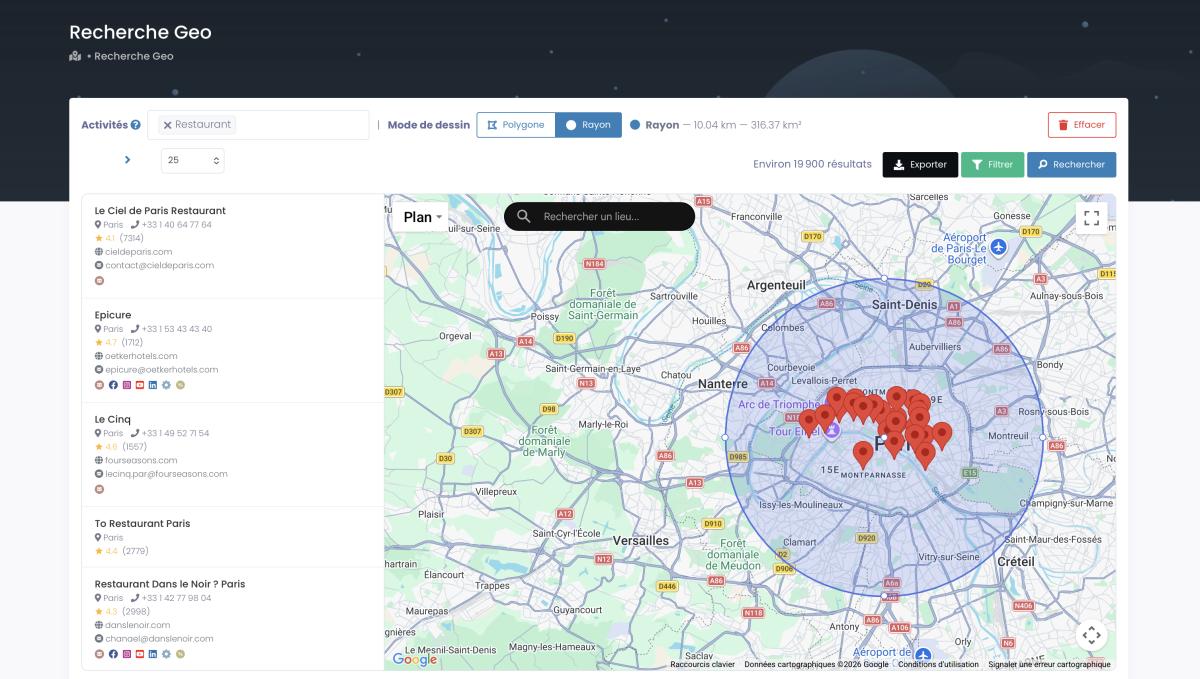
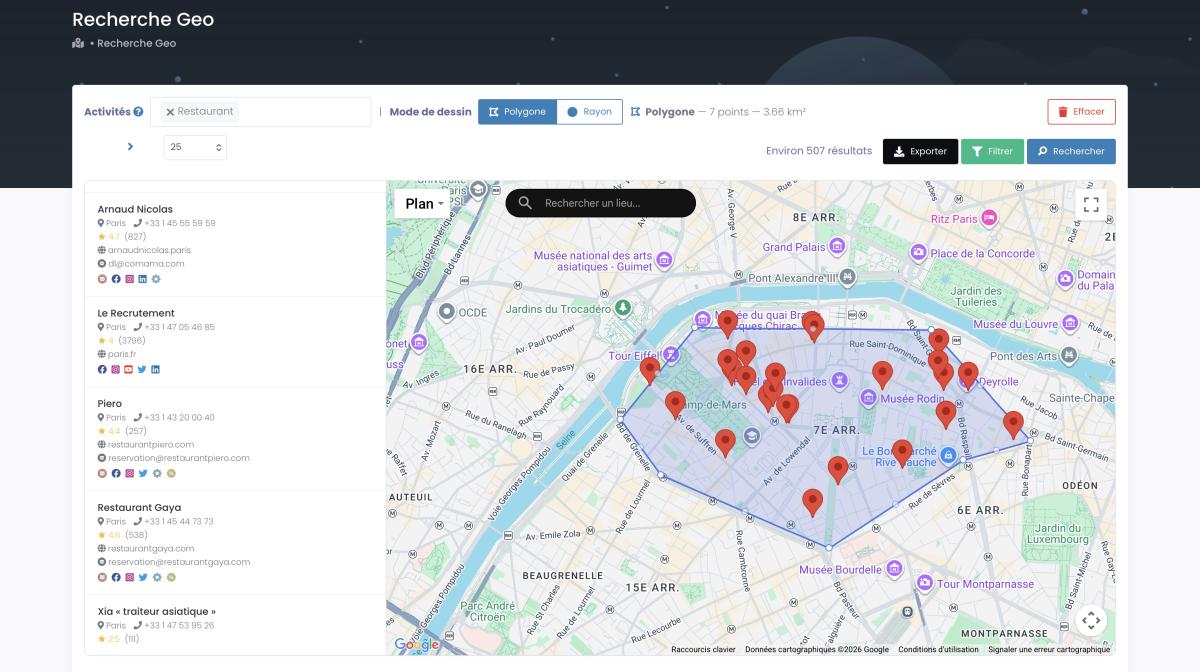
And if your territory doesn't match a state line — a 40-mile radius around Scottsdale, or a hand-drawn polygon over three affluent zip codes in Miami — GeoSearch handles that too.
Video: Scrap.io - How to Start?
Cost? About $50 for 10,000 contacts. Half a penny per lead. Try comparing that to $800-1,200 from traditional providers and keeping a straight face.
24,163 plastic surgeons. 8,035 with a real email. You pay for the second number. Start your free 7-day trial — 100 leads included — and export a filtered, email-present list from any US state, county, city, or radius. 225 million businesses indexed across 195 countries, all pulled live. Start your free trial →
How to Choose a Plastic Surgeon Email List Provider
Doesn't matter whether you go traditional or real-time — you need to know what separates a quality provider from one that's going to waste your budget.
Red Flags to Watch For
"100% accurate data" — Impossible. Surgeons retire. They switch practices. They change email domains when they leave a hospital system. Anyone promising perfection is either delusional or counting on you not to check.
Suspiciously cheap pricing — There's a reason some lists are $99 for 10K contacts. The bounce rate will eat that savings alive. I know a laser equipment rep who bought one of these bargain lists. 43% bounces. He would've been better off throwing the money out a car window — at least that wouldn't have tanked his sender reputation.
No samples available — Every reputable provider will show you sample records before you buy. If they dodge this request, they already know the data won't impress you.
Vague about sourcing — "Proprietary multi-source aggregation" usually means "we bought someone else's old file and renamed it." Ask specifically: where does the data come from, how is it verified, when was it last updated?
Questions to Ask Before You Buy
Keep it simple. Four questions will tell you 90% of what you need to know:
"How often is your data updated?" Monthly is great. Quarterly is acceptable. Anything longer — walk away.
"What's your bounce rate guarantee?" Under 10% with credit for anything above that. If they won't commit to a number, that tells you something.
"Can I see sample records for plastic surgeons in [specific city]?" Look at completeness. Are phone numbers included? Specialties? Practice names? Or is it just a name and email?
"What filtering options do I get?" Location and specialty are table stakes. Practice size, review scores, and online presence are what separate useful tools from glorified phone books.
Price Comparison Table (2026)
| Provider | ~Price per 10K Contacts | Data Freshness | Accuracy Guarantee | Filtering |
|---|---|---|---|---|
| LakeB2B | $800-1,200 | 3-6 months | 85-90% | Specialty, location |
| MedicoReach | $600-1,000 | 3-6 months | 85-92% | Specialty, location, practice size |
| 360Marco | $500-900 | 3-6 months | 80-90% | Location, specialty |
| BookYourData | $700-1,100 | Quarterly updates | 90-95% | Location, specialty, job title |
| DataCaptive | $500-800 | 3-6 months | 85-90% | Location, specialty |
| Med Stream Data | $500-1,000 | Not disclosed | Not disclosed | Specialty, location |
| Apify (DIY actors) | Usage-based | Real-time | Depends on your config | Technical setup required |
| Scrap.io | ~$50 | Real-time | 95%+ (public data) | Location, reviews, social, website, email present, and more |
Note the Apify row. It's real-time, which is genuinely good — but you're configuring actors, handling your own proxies, and debugging when Google changes a selector. That's a developer's afternoon versus two clicks. Pick based on whether you have a developer with a free afternoon.
What Makes a High-Quality Cosmetic Surgeon Email Database
We've reviewed a lot of lists over the years. Good ones and terrible ones. The difference always comes down to four things.
Is the data actually fresh? Not "verified in Q3 2025." Fresh as in this month. Plastic surgeons change practices, open new locations, update emails. A cosmetic surgeon email database that was accurate in October might be 15-20% wrong by March. If your email validator flags more than 8% of a list you just purchased, you got ripped off.
Are the records complete? Emails alone aren't enough. You want direct phone numbers, office addresses, specialty info, and ideally social media handles. Some surgeons live in their inbox. Others won't respond to anything short of a phone call. Without multiple contact channels, you're handcuffed to one approach. (Remember: 23,786 of these listings carry a phone number versus 8,035 with an email. Ignoring the phone column is leaving two-thirds of your reachable market on the table.)
Can you filter beyond geography? Sorting by state is nothing special. But what about practice size? Subspecialty focus? Google review count? Whether they're on Instagram or not? Scrap.io does all of this. Want to find plastic surgeons in Austin with bad online reviews who clearly need a reputation management vendor? That's a real filter you can run. That's not cold outreach — that's practically a warm introduction.
Where does the data come from? Your healthcare email list should come from publicly available sources — Google Maps listings, practice websites, medical directories. When the contacts published their own info publicly, most compliance headaches disappear before they start.
How to Actually Email Plastic Surgeons (Without Getting Ignored)
Okay. You've got your list. Here's where 90% of B2B teams screw it up.
They send the exact same email that every other vendor sends. "Hi Dr. Smith, I hope this finds you well. I'd love to schedule 15 minutes to discuss how our solution can help your practice..." Delete. Instantly. These surgeons get 30+ vendor emails a week. Yours has to earn its right to exist in their inbox.
Subject Lines That Work
"Reduce breast revision rates by 40%: new implant data" — that gets opened. "Exciting opportunity for your plastic surgery practice!" — that goes straight to trash. (Or spam. Same thing.)
Plastic surgeons are scientists who happen to run businesses. They respond to numbers, outcomes, and specifics. Vague promises insult their intelligence. We've A/B tested this more times than we can count: subject lines under 8 words with one concrete number beat everything else in medical B2B. Not close. By 2-3× in open rates.
Personalization That Shows You Did Your Homework
Real personalization takes 60 seconds of research per contact. Most competitors are too lazy to do it. That's your edge.
Instead of "Dear Dr. Rivera," try: "Dr. Rivera — noticed your Scottsdale practice focuses on post-mastectomy breast reconstruction. We just published 18-month outcomes data on [product] for exactly that procedure. Figured you'd want first look."
Or this angle: "Your Google profile shows 4.2 stars across 180 reviews. Solid, but the top-ranked practice in your market sits at 4.8. We've helped three Arizona practices close that gap in under six months."
See the difference? The first version could've been sent to anyone. The second proves you looked at their specific practice. That alone puts you ahead of 95% of the emails hitting their inbox.
And this is where the "who am I even writing to?" problem usually surfaces. Somebody on r/coldemail put it exactly right: "Let's say I scrape a list of companies from Google Business Profiles. How can I get the emails of the business owners/decision makers from that list?" Fair question. That's the difference between a generic info@ address and a named contact — and it's why Scrap.io classifies every email it finds (individual with first and last name, contact, sales, marketing, admin) instead of dumping a column of addresses on you.
Best Times to Send
Forget "business hours." At 10 AM, plastic surgeons are elbow-deep in a tummy tuck. They're not checking email.
The best time to email plastic surgeons is early morning, 6-7 AM, before the first OR case — or 7-9 PM, when they're doing admin work at home. Tuesdays through Thursdays consistently outperform Mondays (inbox avalanche from the weekend) and Fridays (mentally checked out).
That said — test it yourself. We've seen practices where Wednesday at 6 AM crushed everything else, and others where Thursday evening was the sweet spot. Your audience isn't identical to anyone else's.
Want to test fresh data against your current list? Grab 100 free plastic surgeon leads with your 7-day Scrap.io trial, run the same sequence on both, and compare bounce rates side by side. Filter to email-present contacts first so you don't burn a single credit on a dead end. Get 100 free leads →
Real Examples: Who's Marketing to Plastic Surgeons?
Theory's nice. Here's what actual companies are doing.
Galderma (Restylane, Sculptra) runs dedicated Healthcare Professional programs — educational content, product training, loyalty incentives — all targeted by procedure type and geography. They don't blast their full database with one email. They segment by what each surgeon actually injects. That's why their open rates stay healthy while generic senders get ignored.
Allergan Aesthetics / AbbVie (Botox, Juvederm) built Allē, which is basically a CRM disguised as a loyalty program. It connects Allergan directly to practicing surgeons through email, in-app messaging, and dedicated rep outreach. They've turned their plastic surgery marketing database into a two-way relationship instead of a one-way megaphone.
PatientPop by Tebra sells practice marketing and patient management SaaS. They serve 8,000+ medical practices and built a big chunk of their pipeline through outbound email to doctor email lists segmented by specialty. Plastic surgery is one of their highest-converting verticals — makes sense, given how much these practices care about online reputation and patient acquisition.
RealSelf is a cosmetic procedure review platform that actively markets premium listing packages to surgeons. Their outreach goes specifically to doctors who are already active in aesthetics — they're not wasting time on orthopedic surgeons who'll never convert. Smart targeting, current data, relevant offer.
Notice the pattern? None of these companies send "Dear Healthcare Professional" emails. They know exactly who they're writing to and why that specific person should care.
Legal Compliance for Plastic Surgeon Email Marketing
I'll keep this tight. Compliance isn't complicated, but ignoring it is expensive.
CAN-SPAM — your emails need a real business address, an honest subject line, and a working unsubscribe link. Process opt-outs within 10 business days. Current FTC penalties run up to $46,517 per violation. Per email. (Source: FTC CAN-SPAM Compliance Guide)
TCPA — different beast entirely. If you're planning to call or text contacts from your list, you need to check the Do Not Call Registry and get consent for automated messages. A lot of B2B teams treat phone outreach like email outreach. It's not. The rules are stricter and the penalties are nastier.
HIPAA — quick clarification. HIPAA protects patient health information. It does not prohibit you from emailing a plastic surgeon about your product. A business email address published on Google Maps isn't "protected health information." That said, never reference specific patients or cases in your outreach. And knowing how HIPAA works signals to surgeons that you understand their world. They notice.
State laws. California's privacy laws are the most aggressive, but several other states have their own requirements for commercial email. Research your target states before launching. Or just read this compliance guide — it covers the main frameworks.
One more thing. When your data comes from publicly available sources — Google Maps listings, business websites — most compliance gray areas evaporate. The business published that information themselves. You're just organizing it. Scrap.io is GDPR and CCPA compliant, and every record traces back to its source.
Getting Maximum ROI from Your Plastic Surgeon Email List
Buying the list is step one. What you do with it determines whether you see $0 or $50K in return.
Lead Scoring — Stop Treating Every Contact Equally
A solo cosmetic surgeon in Miami who controls their own purchasing is worth 10× more effort than a reconstructive surgeon at a university hospital who needs six approvals to buy a stapler. Prioritize accordingly.
Score your leads on practice type (private cosmetic = gold), geography (are they in a market you can actually serve?), and engagement (did they open your last email? click anything?). Spend 80% of your follow-up time on the top 20% of your list. The rest stays in an automated nurture sequence until they show interest.
Segmentation That Matters
Cosmetic surgeons care about patient acquisition, aesthetic outcomes, and looking premium. Reconstructive surgeons care about clinical evidence, insurance reimbursement, and functional results. Practice administrators care about cost savings and workflow efficiency.
If you're sending all three groups the same email, you're basically setting money on fire. Create separate sequences. Yes, it's more work upfront. No, there's no shortcut. The response rate difference between segmented and unsegmented campaigns is usually 2-4× — and in medical B2B, that gap pays for itself immediately.
Also worth exploring adjacent specialties. Dermatologist email lists, medical spa contacts, skin care clinic databases, and broader medical clinic email lists overlap heavily with the plastic surgery world. A lot of med spas are run by or affiliated with plastic surgeons. Don't ignore those contacts.
Track the Numbers That Pay Your Bills
Delivery rate below 90%? Your list is bad. Fix the data before wasting more sends.
Open rate below 15%? Your subject lines need surgery. (Sorry.) Aim for 20-35% on targeted medical B2B campaigns.
Click-through rate below 2%? Your content doesn't match your audience. Something's off — wrong message, wrong segment, wrong offer.
And stop obsessing over vanity metrics. Opens and clicks are nice. Revenue is better. Track how many email conversations convert into calls, demos, and closed deals. That's the only number your boss actually cares about.
FAQ — Plastic Surgeon Email Lists
How many plastic surgeons are there in the US?
As of 2026, Scrap.io tracks 24,163 plastic surgeon listings across the US, pulled live from Google Maps. About 8,035 display a working email and 19,081 have a website — which is why filtering before extraction matters.
How do I find plastic surgeon email addresses?
Three options. You can build a list manually from state medical boards and Google searches — works but takes forever and costs more than you'd think. You can buy from traditional providers like LakeB2B or MedicoReach — faster, but the data's already aging by the time you get it. Or you can use Scrap.io to pull real-time data from Google Maps listings — fastest, freshest, and cheapest by a wide margin. Most B2B teams we talk to have moved to option three.
How much does a plastic surgeon email list cost?
Traditional providers: $500-1,500 for 10,000 contacts. Scrap.io: about $50 for the same volume. The cost gap is wild, but the real difference is freshness. A $1,200 list full of six-month-old data will underperform a $50 list of contacts pulled this morning.
Can I get a plastic surgeon email list by state?
Yep. Every serious provider supports geographic filtering. Scrap.io goes deeper — city, county, zip code, radius around a specific address, or a polygon you draw yourself. Handy if you're testing a regional campaign before going national.
| State | Relative Density | Notes |
|---|---|---|
| California | Very High | Largest concentration nationally, heavy cosmetic focus |
| Florida | Very High | Strong cosmetic market, retirement demographics |
| Texas | High | Growing fast, especially DFW and Houston metros |
| New York | High | Manhattan is a cosmetic surgery hub |
| Illinois | Moderate-High | Chicago metro drives most activity |
Is it legal to email plastic surgeons?
Yes. Follow CAN-SPAM (unsubscribe link, honest subject line, real business address), respect state-specific rules, and you're fine. Using publicly posted business data — which is what Scrap.io collects from Google Maps — removes most gray areas entirely. Full breakdown in this cold email compliance guide.
Can I get plastic surgeon contacts with phone numbers?
Most providers include them. Scrap.io pulls phone numbers straight from Google Maps listings — 23,786 of the 24,163 US listings have one — so they're generally current. If you're going to call, remember TCPA rules apply. Phone outreach has different (stricter) regulations than email. Check the Do Not Call Registry first.
What's a HIPAA compliant plastic surgeon email list?
Bit of a misnomer. HIPAA covers patient health information, not business contact data. A surgeon's office email and phone number published on their website aren't protected under HIPAA. You won't violate HIPAA by emailing a plastic surgeon about your product. But your outreach should never reference patient data, and showing you understand HIPAA earns credibility with healthcare buyers.
What's the best time to email plastic surgeons?
6-7 AM (before their first case) or 7-9 PM (admin catch-up time). Tuesday through Thursday. But this varies. Test your own send times — we've seen data that contradicts every "best practice" rule just listed. The only thing that matters is what works for your specific list and offer.
How often should I update my contact data?
Traditional lists: every 3-6 months at minimum. Doctors change practices constantly. With real-time plastic surgeon data scraping through Scrap.io, this isn't even a question — every pull is fresh data. That's the whole point.
What's the difference between buying a list and using Scrap.io?
Traditional lists are frozen in time. Compiled once, sold to many buyers, deteriorating from day one. Scrap.io grabs live data from public sources every time you search. Unique to you, current as of today, and dramatically cheaper. Works the same way for dental clinics, dermatologists, or any other medical specialty.
What response rates should I expect?
With fresh data and decent personalization on plastic surgeon email marketing campaigns: open rates of 20-35%, click-through rates of 3-8%, conversion rates of 1-5%. Those numbers crater with stale data — we've seen campaigns on old lists pull 12% opens and sub-2% clicks. Same message, same offer. Only difference was data freshness. That should tell you everything.
Stop paying for the 16,128 listings you can't email. Start your free 7-day Scrap.io trial — 100 leads included — and pull a filtered plastic surgeon email list from all 24,163 US listings: email-present only, any state or radius, exported in minutes. Counts are free, so check your market before you spend a credit. Rated 4.8 on Capterra and 4.9 on G2 by 50,000+ professionals. Start your free trial →
Last updated: July 2026 · By L'Équipe Scrap.io — About us
Generate a list of plastic surgeon with Scrap.io