

Someone scraped 800 plumbers last summer, personalized every message, warmed up nine inboxes, and hit send. The result? 400+ opens. Zero replies. Not even a polite "stop emailing me." Just, in his words, "pure, soul-sucking silence" (documented publicly, the whole post-mortem is worth a read).
Here's the part that stings more.
There are 73,254 plumbing businesses open on Google Maps in the US right now. And only 27,347 of them — about 37% — have an email address you can actually use. That $191.4 billion industry everyone keeps pitching? Two-thirds of it is unreachable by inbox. Nobody selling you a "78,000-contact plumber email list" mentions that little detail.
So this guide does something the rest of the SERP won't. It gives you the real numbers, compares eleven providers side by side, tells you what these lists actually cost in 2026, and shows you how to avoid paying for data that bounced three months ago. Plumbers don't sit at desks refreshing their inbox — they're under a sink at 11 PM on a Tuesday. Reaching them takes fresh data and a bit of strategy. Let's get into it.
Video: Scrap.io — How to Start? (a 2-minute walkthrough of the whole workflow)
- What Is a Plumber Email List?
- US Plumbing Industry in 2026: Key Numbers
- Types of Plumber Mailing Lists Available
- Plumber Email List Providers: Complete Comparison (2026)
- How to Choose the Right Plumber Contact List
- How to Use Your Plumber Email List (Best Practices)
- Email Compliance for Plumber Outreach
- Frequently Asked Questions
What Is a Plumber Email List?
Nothing complicated here. A plumber email list is a database of contact information for plumbing businesses — emails, phone numbers, addresses, owner names, sometimes their Google rating and social profiles too. Think of it as your shortcut to reaching plumbers without manually googling "plumber + city name" for the next six weeks.
But not every list is created equal. Some are a spreadsheet full of random addresses. The good ones give you enough data to actually segment and target — which, spoiler, is the whole game.
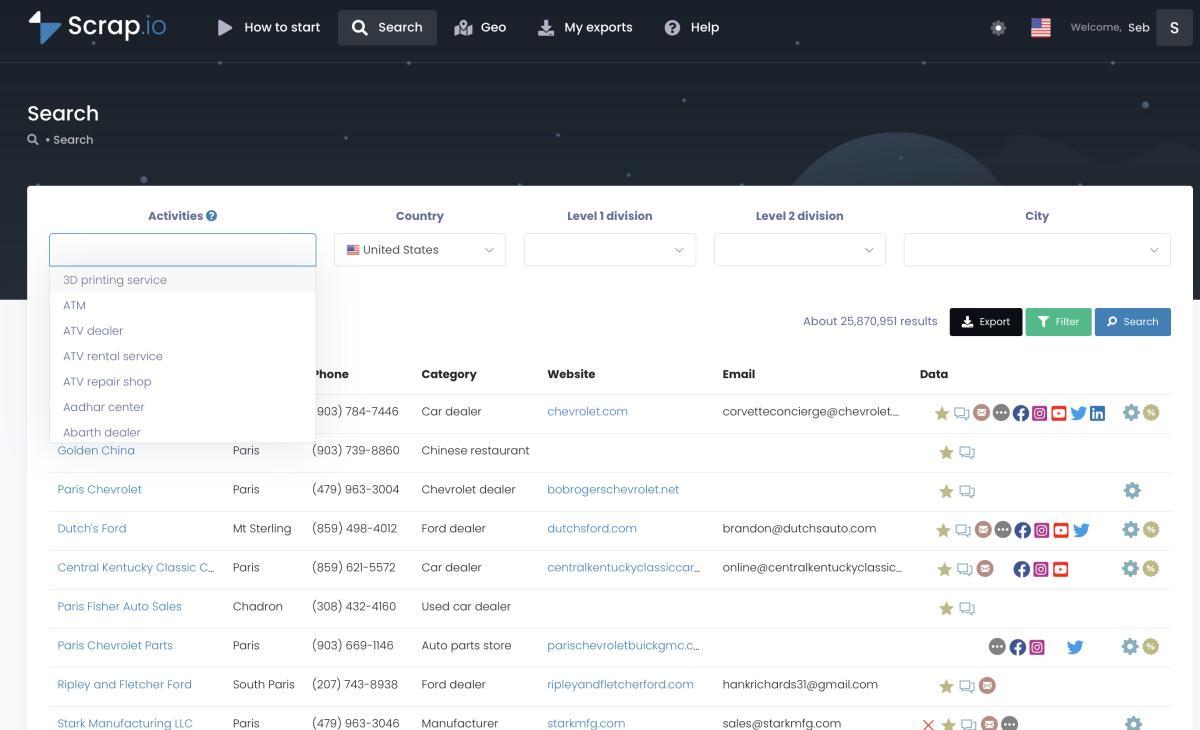
Building a plumber email list on Scrap.io — search all 73,254 open US plumber establishments in real time.
What Data Does a Plumber Contact List Include?
A decent plumber contact list should have the business name and — this matters — the owner name, not just "Joe's Plumbing" with no human attached. Working emails. Phone numbers someone actually answers. Physical address and service area. License and specialization info when it's available. The premium ones also pack in Google review ratings, website URLs, social links, and years in business. That extra context is what separates a useful plumber leads database from a glorified phone book.
Here's the field most people sleep on: a plumber email list with owner name attached. Generic info@ inboxes get ignored. A nominative email — a real first name, a real last name — changes your reply rate completely. Scrap.io actually classifies this automatically, splitting emails into individual (with first and last name parsed out), contact, sales, marketing, finance, and administration buckets. On an audience of tradespeople who barely check email, hitting the owner directly instead of a shared inbox is the difference between a reply and the trash.
And multi-channel matters. Plumber email lists with phone numbers and social profiles let you layer touches — email, a LinkedIn nudge, a follow-up call. Email alone gets you maybe a 20% open rate on a good day. Add channels and you're building relationships, not just spraying.
Where Do Plumbers Concentrate in the US?
Plumbing businesses cluster where construction booms and aging infrastructure meet population density. Texas leads — Houston alone has thousands of active shops. California (the LA metro especially), Florida's I-4 corridor from Orlando to Tampa, and the Northeast from NYC down to Philly are all dense markets.
But here's something most people overlook. Some of the best response rates come from mid-tier cities. A plumber email list by state targeting Oklahoma City or Memphis faces way less competition than one hitting NYC, where every SaaS company and their mother is already spamming plumber inboxes. Want to go even tighter? A plumber email list by zip code lets you own a single service area instead of fighting for the whole map.
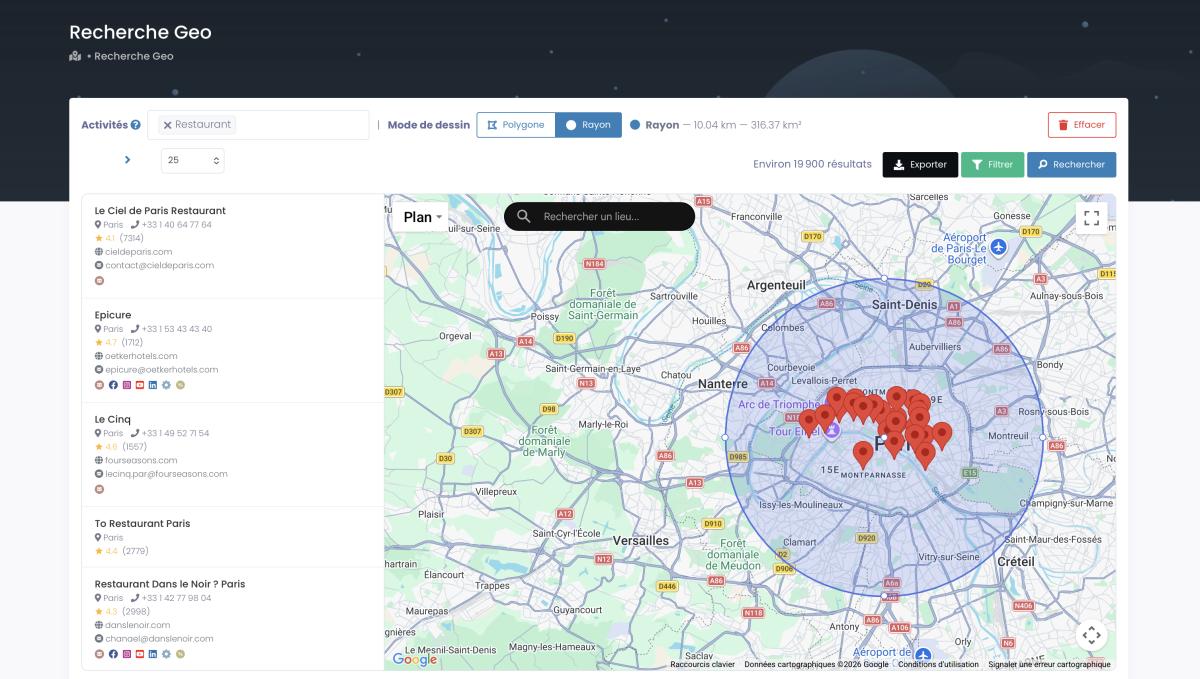
Target plumbers within a specific radius using Scrap.io's GeoSearch feature.
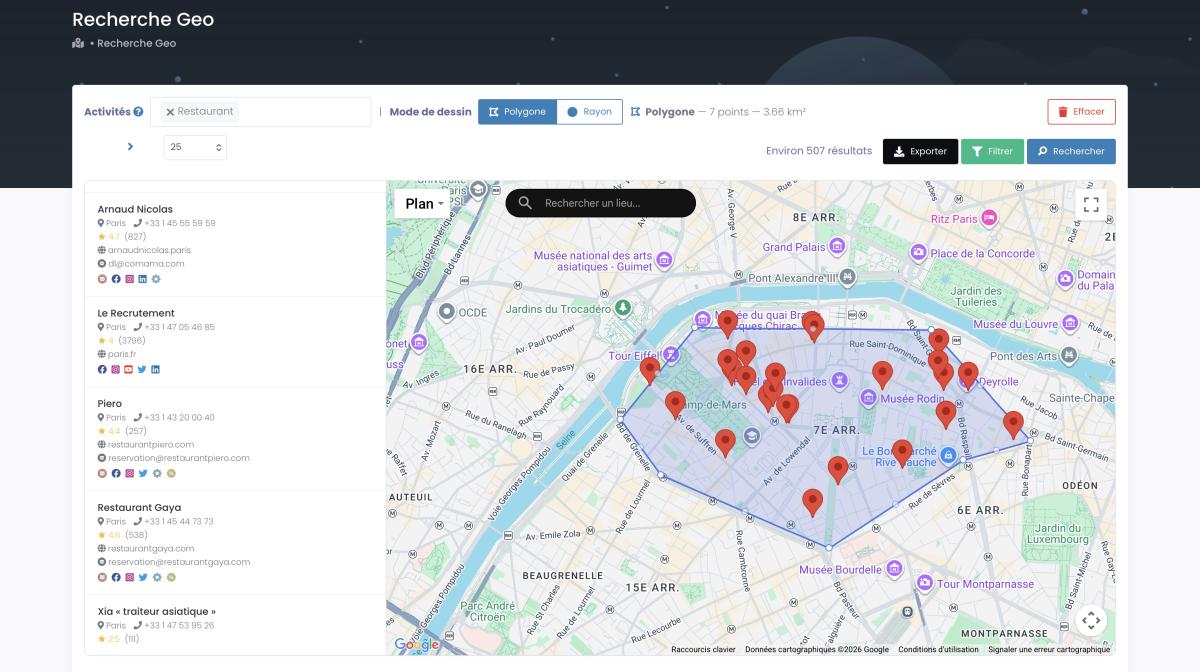
Draw a custom polygon to target plumbers in any shape — city districts, service zones, custom territories.
US Plumbing Industry in 2026: Key Numbers
44,000 plumbing jobs open up every single year. Nobody's filling them.
That one stat tells you almost everything about why this market is worth your time. Before you invest in a plumbing contractor database, though, it helps to know the scale of what you're targeting. Here's what the data actually says.
The US plumbing industry hit $191.4 billion in revenue in 2026 (IBISWorld), across roughly 129,000 plumbing companies, growing at a steady 3.1% CAGR over the past five years. Average revenue per plumbing business? About $1.48 million (IBISWorld, 2026). That's a real B2B ticket — these aren't hobbyists, they're businesses with budgets.
On the workforce side, around 736,000 people work in US plumbing (BLS), with a median wage of $62,970 (BLS, May 2024 — latest available). Employment is projected to grow 4% from 2024 to 2034, with those 44,000 openings a year. But the real headline is the shortage: the industry faces a projected gap of 550,000 skilled workers by 2027 (Linxup), and over 20% of working plumbers are already past 55. Not enough apprentices are coming in to replace them.
What does that mean for your outreach? Plumbing companies are actively buying tools that let them do more with fewer hands. Software. Equipment. Financing. Marketing. Your timing is good — if your data is fresh.
💡 Scrap.io data check (pulled August 2026). Scrap.io's real-time Google Maps database shows 73,254 open plumber establishments in the US, of which 54,242 list plumbing as their primary activity. Total listings, open and closed, sit at 75,612 — which means 2,358 plumber businesses are already marked permanently closed. Sit with that number. Any static list "refreshed quarterly" is already carrying thousands of dead records. Now the two numbers that matter most: 43,543 plumbers (59.4%) have a website, and only 27,347 (37.3%) have a recoverable email on that site.
Quick note on the apparent contradiction — IBISWorld counts ~129,000 plumbing companies while Google Maps shows 73,254 open. They're counting different things. IBISWorld tracks registered legal entities, including sole traders with zero online presence. Google Maps lists physical, publicly findable, currently-open establishments. For outreach, the 73,254 is the one that matters. Those are the businesses you can reach today.
Curious how many plumbers are open in your state right now? Counting is free on Scrap.io — no credits burned to see the number. Frame your market before you spend a dime, whether you want a statewide pull or a single emergency plumber contact list for one metro.
Types of Plumber Mailing Lists Available
Not every plumber mailing list works the same way. The source matters, the freshness matters, and the price-to-quality ratio swings wildly. Here's the breakdown.
Pre-Built Commercial Databases
Companies like DMDatabases (78,000+ plumbing companies) and DataCaptive sell ready-made lists. You pay, download a spreadsheet, start emailing that afternoon. TargetNXT claims 97% deliverability — take that with a grain of salt, but they're a known player.
Quick reality check on that 78,000. Google Maps shows 73,254 plumbers open in the entire US, and only 27,347 with a usable email. So when a broker advertises 78,000 "plumbing companies with email," you have to ask where the extra data came from. The honest answer is usually: reconstructed addresses, or records that stopped being accurate a while ago.
The upside of pre-built? Speed. The downside? Everyone buying that same list is hammering the same plumbers, and "updated quarterly" often means "some of this is three months stale." Fine for testing a market. Rough for sustained outreach.
Custom-Built Targeted Lists
Services like Coldlytics build bespoke lists to your exact specs. Want residential plumbers in Georgia and Alabama, 5+ years in business, fewer than 20 employees? They'll research each one by hand. Companies using custom plumber contact lists typically report 40–60% better conversion versus generic databases.
The tradeoff is cost. Custom runs $0.50–$2.00 per contact versus $0.05–$0.25 for pre-built. For a high-ticket B2B product, the math still works. For a $29/month SaaS? Probably not.
Live Data Scraping (Real-Time Google Maps Data)
This is the approach that's been quietly eating the traditional database market. Instead of buying a static spreadsheet that ages by the minute, you pull contact data straight from Google Maps and business websites in real time. When a plumber updates their email or number, you get it the same day. Not three months later when some vendor gets around to a "quarterly refresh."
Remember those 2,358 plumber listings already marked closed? That's the entire argument in one number. A list compiled last quarter is carrying dead businesses you'll pay to email. Live data isn't.
Video: How to Scrape Local Leads at the Country Level — pulling every plumber in the country, not city by city.
Scrap.io is the leader here. You search "plumber" in any US city, state, or the whole country, apply filters (email available? Google rating above 3? has a website? no Instagram?), and export. The whole thing takes about two minutes. Cost? 10,000 leads for $49/month — $0.0049 per contact, or $0.0035 on annual billing. Roughly a hundred times cheaper than manual research, and every record is validated at the moment you export.
Companies like ServiceTitan (field service software serving 100,000+ contractor businesses) and Jobber are exactly the kind of B2B firms that use plumber email lists to reach their market. When your product targets plumbing pros, accurate current data isn't optional — it's the difference between a 2% bounce rate and a 15% one. If you want the technical side, here's the guide on how to find emails on Google Maps and the complete Google Maps scraping guide.
Self-Generated Prospect Lists
You could build your own. Google plumbing companies one by one, visit each site, copy-paste emails into a sheet. Some people do this.
The math: roughly 2–3 hours per quality contact. For 1,000 contacts, that's 300+ hours of grunt work. At $25/hour, you're looking at $7,500–$10,000 before a single email goes out. And by the time you finish, 15–20% of those contacts have already changed. Plumbing businesses move, close, rebrand, and switch email providers constantly. (Trust me, we've watched customers try it once, hate every minute, and never go back.)
For a hyper-targeted list of 50–100 dream accounts? DIY makes sense. For anything bigger, you're just burning money. If you'd rather buy smart, this plumber database CSV download approach — export straight to CSV, filtered — beats a manual spreadsheet every time. Here's the honest breakdown on how to buy email lists without getting burned.
Hybrid Approach
Smart companies don't pick one method. They start with a pre-built database to test messaging, spot which segments convert, then use live scraping to build deep, fresh lists in the winning segments. A contractor email list combined with trade-specific lists — HVAC contractors, electricians, air conditioning contractors, or a handyman email list — lets you cross-sell across related trades using the same buyer profile. Going broader into construction? The construction company email list guide covers the full landscape, and adjacent trades like roofing, paving, and heating contractors follow the same playbook.
And a note from real life. Remember the guy who emailed 800 plumbers and got nothing? His own post-mortem nailed the reason: plumbers "have probably been pitched 100 different services they never used." His data wasn't even the main problem — his pitch was. Fresh data plus a sharp, specific message is the combination. One without the other is a coin flip.
| List Type | Cost per Contact | Data Freshness | Setup Time | Best For |
|---|---|---|---|---|
| Pre-Built Database | $0.05–$0.25 | Quarterly updates | Instant | Quick testing |
| Custom-Built | $0.50–$2.00 | Built on demand | 1–3 weeks | High-ticket B2B |
| Live Scraping (Scrap.io) | $0.0049 | Real-time | 2 minutes | Volume + freshness |
| Self-Generated (DIY) | $7.50+ | Varies | Weeks/months | Tiny, hyper-targeted lists |
Plumber Email List Providers: Complete Comparison (2026)
This is the table the SERP doesn't have. I looked. Every competitor page waffles about "finding the right provider" without ever comparing anyone side by side. So here it is — the best plumber email list providers in 2026, on the metrics that actually matter.
Best Plumber Email List Providers 2026 — Side by Side
| Provider | Volume (US Plumbers) | Price Range | Data Freshness | Volume Published? | Export Format |
|---|---|---|---|---|---|
| Scrap.io | 73,254 open (27,347 with email) | $49/mo for 10K leads | Real-time | Yes — live count, free | CSV, Excel |
| DMDatabases | 78,000+ (claimed) | $0.10–$0.25/contact | Quarterly | Yes | CSV, Excel |
| DataCaptive | 60,000+ (claimed) | Custom quote | Monthly/Quarterly | Partial | CSV, Excel, CRM |
| Coldlytics | Custom (on-demand) | $0.50–$2.00/contact | Built fresh | N/A (bespoke) | CSV |
| TargetNXT | 50,000+ (claimed) | Custom quote | Quarterly | Partial | CSV, Excel |
| FountMedia | Not published | Custom quote | Unclear | No | CSV, Excel |
| BizProspex | Varies | $0.15–$0.50/contact | Bi-monthly | No | CSV, Excel, API |
| Dietrich Direct | Not published | From $69 | Unclear | No — call a "list advisor" | CSV |
| The Email List Company | Sold by state | $127.36 (Massachusetts alone) | Unclear | Partial (per state) | CSV |
| LimeLeads | Varies | Credit-based | Ongoing | No | CSV |
A few notes. There's the transparency problem. Dietrich Direct dangles a $69 entry price but publishes no volume at all — you have to call a "list advisor" to find out how many contacts you're even buying. FountMedia sells a "plumbing contractor email list" on quote-only pricing. And The Email List Company sells by state — $127.36 for Massachusetts alone. Do that math for all 50 states and you're into several thousand dollars for national coverage. On Scrap.io's Company plan, the entire country is included.
The pricing gap is the real story. 10,000 plumber contacts from a traditional provider runs $1,000–$2,500. From Scrap.io, the same 10,000 costs $49. Even accounting for enrichment differences, that's a 20–50x spread. And Scrap.io is the only one on this list that lets you verify the volume yourself, for free, before you pay a cent.
73,254 plumbers, 27,347 with a usable email — see the live count yourself. Don't take a vendor's word (or ours). Run the numbers on Scrap.io and filter down to your exact market. 7-day free trial, 50 searches and 100 export credits included.
How to Choose the Right Plumber Contact List
Can you actually filter this list, or are you buying a spreadsheet you'll never segment? That's the first question. Here's the rest.
Volume and Coverage
More contacts isn't always better. A focused residential plumber email list of 1,000 contacts in your exact service area will beat 10,000 random plumbers scattered nationwide almost every time. That said, you do need statistical mass — most B2B campaigns need at least 2,500–5,000 contacts to generate meaningful signal. Ask yourself: how many plumbers match my ideal customer in my target geography? If the answer's 800, don't buy 50,000. You're paying for noise.
Data Quality and Verification
This is where people get burned. A "verified" list from a provider who last checked their data six months ago isn't verified — it's a list that used to be verified. Plumbing businesses churn faster than most industries. Guys retire, shops close, partnerships dissolve. Look for 90%+ deliverability guarantees with bounce replacement, or use live scraping where the data is current by definition because it's pulled from active listings. Either way, an email verification tool before any big send is non-negotiable.
Segmentation and Filtering
Can you filter by specialization — residential vs. commercial, drain cleaning vs. new construction? By geography? By company size? By whether they have a website or active socials? If you're after a commercial plumbing contractor email list specifically, generic providers will just shrug. This is where the tooling separates.
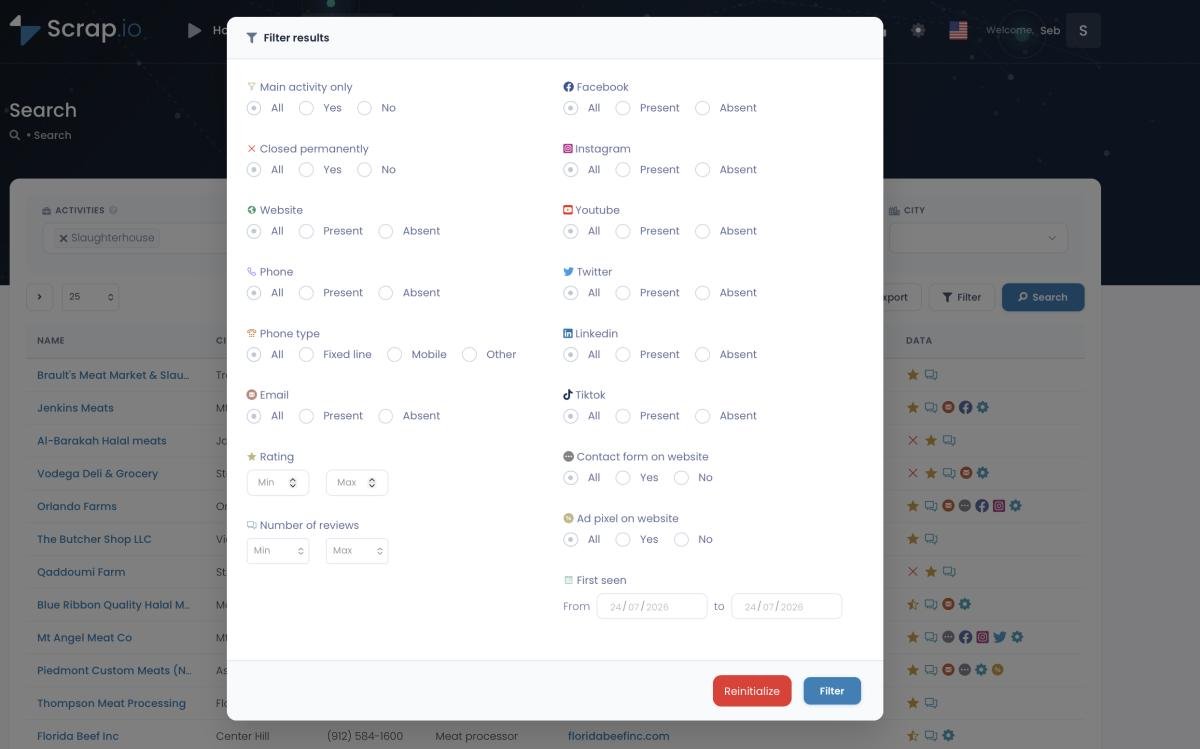
Filter plumbers by email availability, Google rating, social presence, and dozens of other criteria — before you spend a credit.
Video: Finding Clients Through Google Maps Filters — filtering before extraction, the whole point.
Scrap.io's filtering is where it gets genuinely creative, because the filters apply before a single credit is spent. Want plumbers with poor Google reviews? (Reputation-management pitch.) Plumbers with an email but no Instagram? (Social agency opportunity.) Plumbers with a website but no contact form? That's a web design pitch writing itself. You can also target by first-seen date to catch newly opened shops, detect an ad pixel (Meta or Google Ads) to find businesses already spending on marketing, and auto-exclude contacts you've exported before so you never pay for the same lead twice. For a deeper dive, the filtering guide walks through every option.
One honest caveat: phone-type filtering (mobile vs. landline for SMS targeting) exists globally but isn't available in the US and Canada — so don't plan a US SMS campaign around it. On this market, lean on the email classification instead.
Pricing and ROI
Stop comparing price per contact in isolation. Compare price per qualified lead. A $0.05 contact that bounces 30% of the time costs you more than a $0.0049 contact with 95%+ deliverability — plus the sender-reputation damage from all those bounces. One bad campaign can tank your domain for months. And CAN-SPAM fines reach $53,088 per violation (FTC). That's more than a new work van. Quality data is cheap insurance.
Filter before you export: email present, rating above 3, no website, contact form only. You only spend credits on contacts that match — nothing wasted on the 46,000 plumbers who don't have a usable email anyway. Start free for 7 days.
How to Use Your Plumber Email List (Best Practices)
Owning a plumber email list is step one. Making money from it is where campaigns either soar or faceplant. Plumbers are a unique audience — treat them like generic B2B leads and your emails end up in the trash.
Multi-Channel Outreach for Plumbing Contractors
Email alone rarely closes deals with contractors. These are relationship-driven people who trust handshakes over subject lines. The companies seeing real results combine email with LinkedIn touches, phone follow-ups, and sometimes direct mail for high-value prospects. A sequence that works: intro email with a specific value prop, LinkedIn connection two days later, follow-up email with a relevant case study, phone call to anyone who opened both. This cold email follow-up guide breaks down the timing.
Nominative Email Beats info@ Every Time
Here's the lesson from that failed 800-plumber campaign, in the sender's own words: plumbers "have probably been pitched 100 different services they never used." They're numb to it. A generic blast to [email protected] gets deleted before it's read. But an email that opens with the owner's actual name, references their city, and names a real number they recognize? Different story.
That's why the email classification matters so much on this audience. When your list separates the individual owner email (first name, last name attached) from the generic contact inbox, you can write "Hey Mike — noticed Rapid Rooter serves the east Tampa suburbs" instead of "Dear Business Owner." One of those gets a reply.
Seasonal Timing for Plumber Campaigns
Plumbing is seasonal, so your outreach should be too. Spring (March–May) is when plumbers stock up for peak season. Winter (December–February) means emergency calls and frozen-pipe chaos — they need time-savers. Summer they're slammed and barely checking email. The sweet spot for selling software or services? Late winter and early spring. They have a minute to breathe, they're planning, and they're thinking about what went wrong last year.
Personalization That Works with Plumbers
Generic pitches die on arrival. Plumbers can smell a mass email from three states away. Use the data — mention their city, reference their Google rating, acknowledge their specialization. And keep it short. Plumbers read email on their phones between jobs. Three paragraphs max, one clear ask, no jargon. (If you want to prospect on the fly, Scrap.io's free Chrome extension surfaces plumber contact data directly on Google Maps.)
Email Compliance for Plumber Outreach
Nobody wants to talk about legal stuff. But ignoring it can cost you five figures per email, so let's get it done fast.
CAN-SPAM Requirements
Every commercial email to US recipients needs your real physical address, a working unsubscribe link, accurate "From" and subject lines, and you must honor opt-outs within 10 business days. Violations run up to $53,088 per email (FTC, effective January 17, 2025). Get the date and the amount right — a wrong figure on a legal stat is exactly the kind of thing that costs you credibility. For the full breakdown, see the cold email compliance guide and these anti-spam tips for deliverability.
CCPA and GDPR
Since your market is US, CCPA is the framework that actually matters here — and publicly available business information is carved out of its scope. GDPR is less relevant unless some of your contacts have EU ties; if they do, B2B outreach can lean on "legitimate interest," but you still need clear opt-outs and data minimization.
Best Practices for Legal Protection
Use data from public sources whenever you can. When a plumber publishes their email on their Google listing or website, they've made it publicly available for business contact — far safer than a list scraped from a private database. Scrap.io only collects publicly posted business information and is GDPR and CCPA compliant, with every data point traceable to its source. That beats any list whose provider won't tell you where the data came from. And set up your email authentication — SPF, DKIM, and DMARC aren't optional anymore since Gmail, Yahoo, and Microsoft reject unauthenticated bulk mail. This email authentication guide walks through the setup.
Frequently Asked Questions
How many plumbing companies are there in the US?
There are 73,254 open plumbing businesses listed on Google Maps in the United States as of August 2026, according to Scrap.io's real-time data. IBISWorld counts roughly 129,000 plumbing companies — the gap comes from how each source counts: IBISWorld tracks registered legal entities including sole traders with no online presence, while Google Maps lists physical, publicly findable establishments. For outreach, the 73,254 figure is the one that matters — those are the businesses you can actually reach today, and 27,347 of them have a usable email address.
How much does a plumber email list cost?
Prices range from $0.0049 to $2.00 per contact depending on provider type and data quality. Pre-built databases cost $0.10–$0.25/contact, custom-researched lists run $0.50–$2.00, and live scraping platforms like Scrap.io offer 10,000 contacts for $49/month — or $35/month on annual billing. In practice: 5,000 plumbers from a traditional provider costs $500–$1,250. A custom list of 1,000 perfect-fit contacts runs $500–$2,000. With Scrap.io, the same 5,000 contacts costs about $25. Cheapest isn't always smartest — price per qualified lead matters more than price per contact.
Can I get a free plumber email list?
Free lists floating around online are almost always outdated garbage with bounce rates over 40%. That said, you can start for free a few legitimate ways: research contacts manually (slow but free), or use Scrap.io's 7-day free trial, which includes 50 searches and 100 export credits (a card is required to activate the trial). If you'd rather buy an email list, focus on providers with transparent sourcing and deliverability guarantees.
Is there a plumber email list PDF I can download?
Some providers offer a plumber email list PDF, but honestly, PDF is a terrible format for this. You can't filter, sort, or import a PDF into your CRM without converting it first. Always go for CSV or Excel exports — every serious provider offers them.
What's the best plumber email list provider in 2026?
It depends on your budget and goals, but Scrap.io leads for volume and freshness with 73,254 real-time US plumber contacts (27,347 with a usable email) at $0.0049 each. For hand-researched, ultra-targeted lists, Coldlytics delivers quality at a premium. DMDatabases works for quick pre-built downloads with 78,000+ claimed contacts, while DataCaptive, and TargetNXT round out the mid-range with monthly-to-quarterly data. See the comparison table above for the full side-by-side on all eleven providers.
How do I verify plumber email addresses?
To verify plumber email addresses, follow these four steps:
- Run a syntax check to catch formatting errors.
- Validate that the domain exists and accepts mail.
- Verify the individual mailbox is active.
- Flag role-based addresses like info@ or contact@.
Tools like ZeroBounce and NeverBounce automate all four in bulk. With live-scraped data from Scrap.io, verification matters less because emails come from current, active listings — but a quick check before any big campaign is still smart.
Are plumber mailing lists GDPR compliant?
Plumber mailing lists are GDPR compliant when the data comes from publicly posted business information — Google Maps listings, company websites — and is used for B2B outreach under the "legitimate interest" basis. Lists scraped from private databases or bought from unclear sources carry much higher risk. Always ask where the data came from. Scrap.io only collects public data that businesses published themselves, which keeps compliance straightforward.
How often should plumber databases be updated?
Quarterly at absolute minimum, monthly for active campaigns. The plumbing industry has high turnover — remember, 2,358 US plumber listings are already marked permanently closed. Live scraping platforms sidestep the problem entirely because the data is pulled fresh every search. No stale spreadsheet sitting on a shelf.
How to email plumbers for business?
Keep it short, specific, and relevant. Mention their city and specialization. Lead with a problem they recognize — "struggling to fill emergency call slots?" beats "our innovative solution transforms business operations." One clear call to action. Send early morning or late evening when they're off job sites. Follow up 3–5 times, since most responses come after the second or third touch.
What's the difference between exclusive and shared plumber leads?
Exclusive leads go to only one buyer (you) — higher conversion, premium pricing, typically $25–$100+ per lead. Shared leads go to 3–5 buyers at $5–$25 each, with lower conversion because you're competing for the same plumber's attention. With Scrap.io you can create functionally "exclusive" lists by using creative filtering that competitors don't think to apply.
Can I build a plumber email list for marketing by myself?
Yes, but the economics rarely justify it at scale. Budget 200–400 hours for 1,000 solid contacts. At $25+/hour, that's $5,000–$10,000 before a single email goes out. Most companies find even a modest investment in a quality provider pays for itself in the first campaign. The same pattern holds for adjacent trades — a waterproofing company email list or a water damage restoration email list is subject to the exact same DIY math.
What data fields should I look for in a plumbing company contact database?
At minimum: business name, owner/contact name, verified email, phone number, physical address. For serious targeting you also want Google rating, review count, website URL, social links, business hours, and service specializations. Scrap.io exports dozens of fields per listing — split across map data (yellow columns) and website enrichment (orange columns) — and, importantly, all export columns are available on every plan. Nothing's gated behind a higher tier.
Start with 100 free plumber leads. 7-day trial, access to all 73,254 US contacts, real-time data, filter before you export, CSV download. See for yourself why fresh data beats a static database every single time. Try Scrap.io free →
A good plumber email list isn't a magic bullet. It's a tool, and the results depend entirely on how you use it. Focus on quality over volume, segment ruthlessly, personalize everything, and respect the compliance rules. The plumbing market is massive, growing, and badly underserved by smart B2B outreach — most of your competitors are still buying the same stale databases from 2024 and wondering why their bounce rates keep climbing. Start small. Test your messaging on a few hundred contacts. Track what converts, then scale the segments that work. Those 73,254 plumbers aren't going anywhere. The window to reach them before your competition does is another matter.
Written by François — Scrap.io Team. Last updated: August 2026.
Generate a list of plumber with Scrap.io