


282,035 real estate agencies listed on Google Maps in the United States. That's the raw count as of August 2026. And here's the part nobody tells you upfront: only 150,626 of them have a public email address. That's 53.4%.
Just over half. Which, believe it or not, is good news.
Rewind twelve months and that number was 49.9%. The share of agencies publishing a reachable email went up, not down. Live data catches that shift. A static CSV you bought last year never will.
So when someone sells you a "complete real estate agency email list," ask them where the other 131,409 agencies went. Because either they have data you can't find publicly (unlikely), or they're padding the file with guesses and generic info@ addresses scraped three years ago. (Spoiler: it's usually the second one.)
This article covers how to actually get a reliable agency-level real estate email list in 2026: what it should contain, what it costs, who the major providers are, and why live-extracted data from Google Maps beats every pre-packaged CSV on the market. No "request a quote" nonsense. Real numbers.
Table of Contents
What Is a Real Estate Agency Email List?
A real estate agency email list is a structured database of contact information for real estate brokerages, offices, and firms. Not individual agents. Think Keller Williams offices, RE/MAX franchises, Coldwell Banker branches, and the thousands of independent brokerages scattered across every US metro. It's a real estate email address list built around businesses, not people.
And that distinction matters more than most marketers realize.
One number worth sitting with before we go further: of those 282,035 US agencies, 201,873 (71.6%) run a website. That's the layer where the email actually lives. The map pin gets you the business; the site gets you the address. A tool that reads both is doing the work a static real estate industry email list can't.
Agencies vs. Agents: Why the Distinction Matters
An individual real estate agent email list targets licensed professionals, salespeople who work under a brokerage. An agency list targets the brokerage itself: the entity that makes purchasing decisions, signs software contracts, and controls marketing budgets. Agents move around constantly. One Reddit user put it perfectly: "Agents switch companies faster than they change For Sale signs."
Agencies don't. They have offices, employees, recurring expenses, and decision-makers who actually have authority to buy. If you're selling B2B, whether that's CRM software, marketing services, or transaction management tools, the agency is your real customer. Not the agent who might switch brokerages next quarter.
What Data Fields Should a Quality List Include?
The bare minimum: business name, email, phone, physical address, website URL. But bare minimum is a waste of money. A quality real estate agent contact list also includes Google rating, review count, business category, social profiles, and, critically, whether the email is a generic info@ or a named contact. The gap between reaching info@ and reaching a named broker is the gap between the trash folder and a reply.
Oh, and also, you want the data to be current. A real estate agency email list PDF you downloaded six months ago? Already stale. More on that problem shortly.
The Real Estate Agency Market in 2026: Key Numbers
The US residential real estate market hit $3.81 trillion in 2026, according to Mordor Intelligence. That's not a typo. Trillion with a T. The National Association of Realtors counts roughly 1.2 million members, and there are over 250,000 active brokerage offices across the country.
Massive market. Massive opportunity. And surprisingly few B2B companies are actually working it systematically.
Want to see the scale of a full-country extraction before you read another word? This one's worth four minutes.
Video: How to Scrape Local Leads at the Country Level
NAR Membership Trends and Prospecting Impact
NAR membership has fluctuated significantly over the past decade, surging during the pandemic boom, pulling back as rates climbed, and now stabilizing around 1.2M. What matters for prospecting: even in a "slow" year, the US still has more licensed real estate professionals than dentists, lawyers, and accountants combined. And 93% of agents prefer email for business communication (NAR, 2025). Not phone. Not LinkedIn. Email.
That's a staggering stat if you're building a mailing list for real estate agents and agencies. Your target audience literally prefers the channel you want to use.
Why Agencies Are High-Value B2B Targets
Individual agents spend $500-2,000/year on tools and marketing. Agencies? They're making decisions on tech stacks, office subscriptions, training platforms, and marketing retainers that run $10,000-100,000+ annually. A mid-size brokerage with 50 agents doesn't buy one CRM license. They buy fifty. They don't hire one photographer. They contract a marketing agency on retainer.
One commercial real estate professional nailed it on a prospecting forum: "One CRE deal from cold email pays for years of infrastructure." That applies to selling to agencies just as much as it applies to agencies selling properties.
3 Ways to Get a Real Estate Agency Email List
You need 10,000 contacts by Friday. What won't blow your budget?
There are exactly three paths: buy a pre-built list, build one yourself, or extract live data from Google Maps. Each has tradeoffs. Let me be blunt about all of them.
Buy a Pre-Made List (Pros, Cons, Cost)
The fastest option. Dozens of vendors sell pre-packaged real estate contact databases. You pay, you download, you start emailing. RealtyOutreach claims 2M+ verified realtor emails. Salesgenie, LakeB2B, and others offer segmented lists by state, specialty, and company size.
The problem? Decay. A real estate agency email list sample from any static provider starts going stale the moment it's compiled. One frustrated buyer on Reddit summed it up: "$2,200 on a premium list. Half bounced. The other half had changed brokerages."
That's not an exaggeration. Real estate has some of the highest contact turnover of any industry. If you want to buy email lists, go in with open eyes about shelf life.
Build Your Own List Manually
You could search Google Maps, Yelp, state licensing boards, and NAR's real estate agent directory with emails, then copy-paste into a spreadsheet. It's free. It's also brutally slow. Expect 15-25 contacts per hour if you're fast.
Try doing that manually with 10,000 agencies. I'll wait.
For anyone Googling "how to get a list of real estate agents" or looking for a free list of real estate agents email addresses, this is what free actually looks like. Hours of mind-numbing work for a few hundred contacts. A free real estate agency email list doesn't exist in any useful form. Anyone offering a "free list of real estate agents email addresses pdf" is either selling your data or handing you garbage contacts. There's a smarter route, and it's covered in our full walkthrough on how to build a cold email list.
Live Scraping from Google Maps with Scrap.io
Third option: extract data in real time. Scrap.io indexes 225+ million business listings across 195 countries and 4,000+ categories. You search "real estate agency" in any US state, city, or zip code, apply filters (rating, review count, has email, has website), and export to CSV or Excel. The data is pulled live from Google Maps, not from a database compiled last quarter.
Here's the two-minute version of the workflow, start to finish.
Video: Scrap.io - How to Start?
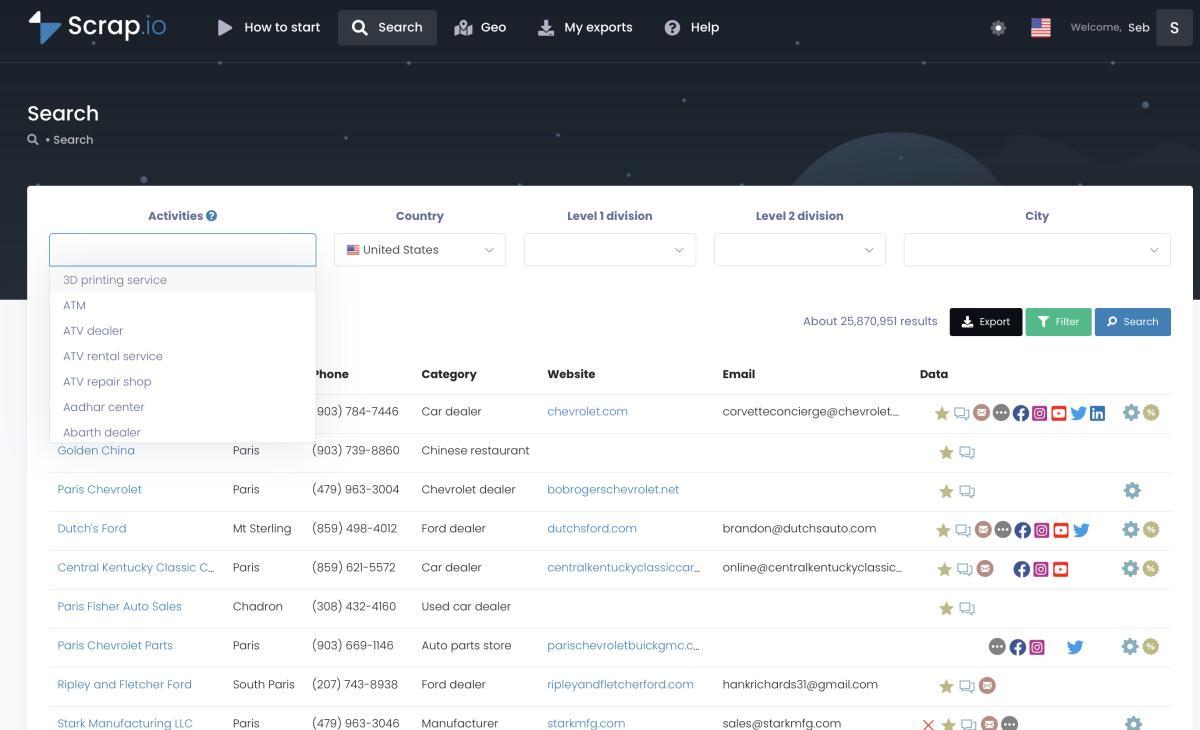
For a Florida real estate agency email list or a California real estate agency email list, you just set the geography and hit export. One credit = one establishment exported. No double-counting within a 30-day window. Filters apply before credits are consumed, so you're not wasting credits on agencies without emails.
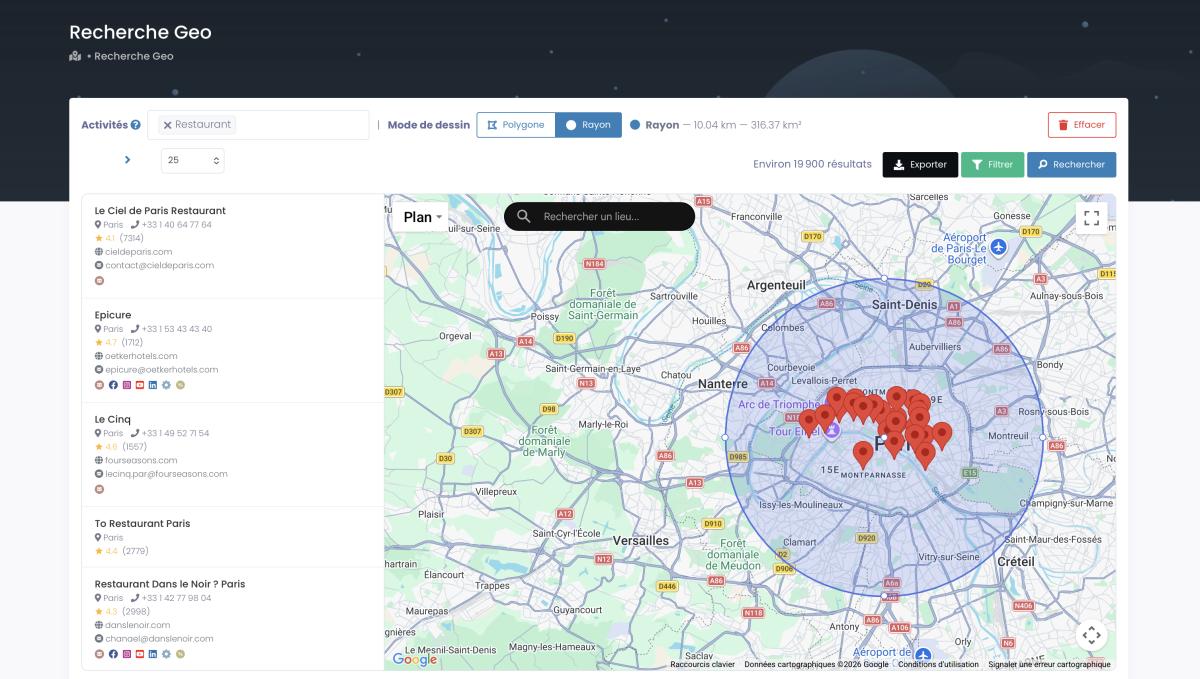
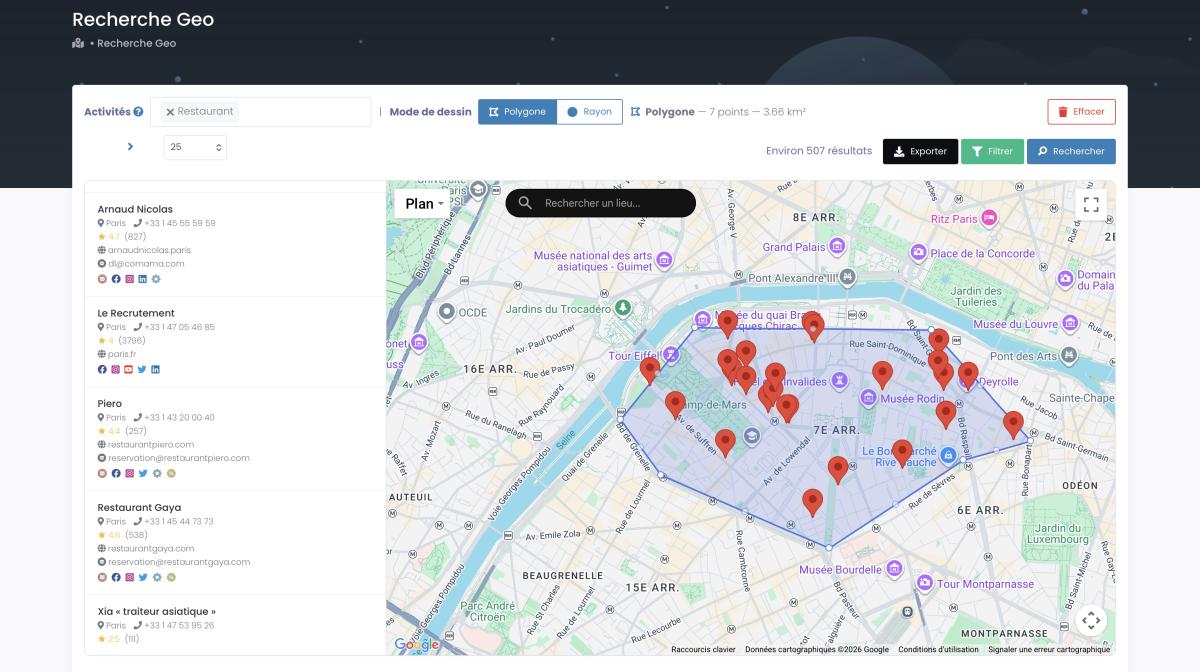
Prefer to draw your own catchment instead of picking a city or state? GeoSearch lets you set a radius around a point or trace a polygon by hand over an exact neighborhood.
Cost? Plans start at $35/month billed annually. At roughly $0.005 per contact, it's not even in the same universe as traditional list brokers.
Try Scrap.io free. 7-day trial, 100 export credits included. Search "real estate agency," filter to email-present firms, and see the data quality on 150,626 reachable US agencies before you commit. Start your free trial.
Comparing Top Providers (2026)
Most real estate data providers charge $5K-$30K+ for a comprehensive list. One charges $0.005 per contact. Same data quality. Sometimes better, because the data is live.
Let me show you the math.
RealtyOutreach, Salesgenie, LakeB2B, Prospeo Overview
RealtyOutreach is the most well-known player in the realtor email list space, claiming 2M+ verified emails. They're solid for volume. Salesgenie (now Data.com) offers broader B2B data including real estate verticals, but their pricing is enterprise-heavy and filters are limited. LakeB2B positions itself as a premium provider, and charges premium prices to match. Prospeo takes a different approach, pulling contacts from LinkedIn rather than business listings.
They all work. They're all overpriced for what you get. Especially when the underlying data goes stale within weeks. If you want the full field ranked and priced, our roundup of the best mailing list companies goes vendor by vendor.
Scrap.io: Real-Time Data at a Fraction of the Cost
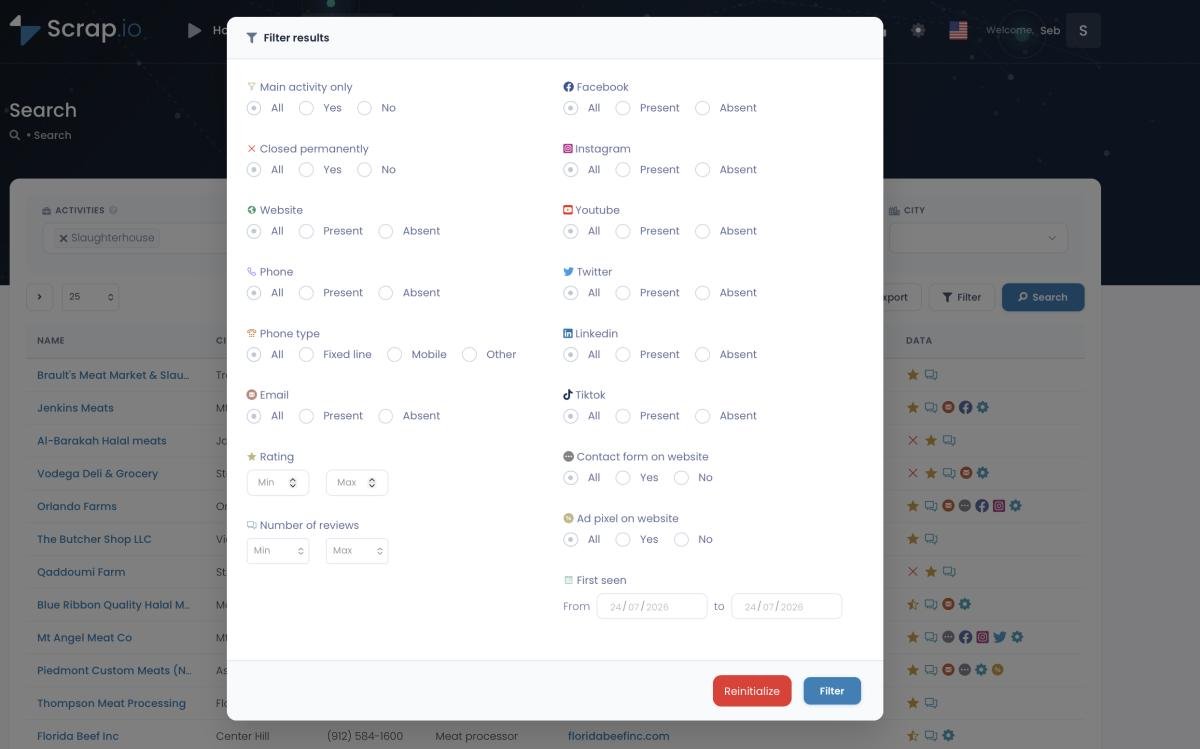
Scrap.io doesn't store a static database. It extracts data from Google Maps in real time: 282,035 US real estate agencies available right now, with 17+ filters to narrow down exactly who you want. Need agencies with 4+ star ratings, a website, and a public email in Texas? That's a 30-second search, not a "contact our sales team" conversation.
Rated 4.8 on Capterra, 4.9 on G2, and 4.5 on Trustpilot. Over 50,000 professionals already use it. And it's GDPR and CCPA compliant. All data comes from publicly listed business information on Google Maps.
Price-per-Lead Comparison Table
Here's what it actually costs to get 10,000 real estate agency lead list contacts from each provider:
| Provider | Price / 10K Leads | Data Freshness | Filters | Email Verified |
|---|---|---|---|---|
| RealtyOutreach | $2,000-$5,000 | Monthly | Basic | Yes |
| Salesgenie | $3,000-$8,000 | Quarterly | Limited | Partial |
| LakeB2B | $5,000-$30,000+ | Quarterly | Basic | Yes |
| Prospeo | $390-$990 | Weekly | LinkedIn-focused | Yes |
| Scrap.io | ~$50 | Real-time | 17+ filters | Yes |
Look at that last row. $50 vs. $5,000+ for the same number of contacts. And Scrap.io's data is extracted live, not sitting in a warehouse aging like bad milk.
Anyway. The price gap speaks for itself.
Join 50,000+ professionals already using Scrap.io to build targeted prospecting lists. $50 vs. $5,000 for 10K contacts, filtered before you spend a single credit. Try free for 7 days, 100 export credits included. Start your free trial.
How to Use Your List Effectively
A PropTech SaaS company targeted 20,000 Texas real estate agents with a segmented cold email campaign. The result: 32% open rate, 150+ demo bookings in 30 days (CampaignLake case study). Another example: Thomas Productions hit a 37% reply rate and 52 meetings in four months by cold emailing brokerages with hyper-personalized video pitches.
Numbers like that don't happen by accident. And they definitely don't happen by blasting the same template to 20,000 people.
Video: Scrap.io + Make.com: Turn Google Maps into Business Leads
Segment by Size, Location, Specialization
A 3-person boutique agency in Scottsdale doesn't have the same needs as a 200-agent franchise in Chicago. Your messaging shouldn't treat them the same either. Segment your real estate agent email address list by agency size (review count is a decent proxy), geography, and specialization: luxury, commercial, residential, property management.
If you're also prospecting property managers, a property management email list is a separate but adjacent play worth running in parallel.
Personalize Beyond {first_name}
Dead wrong: just dropping a first name token into your subject line is not personalization. Real personalization means referencing their market, their recent listings, their Google rating, or a specific challenge facing agencies in their area. Scrap.io's export includes review counts and ratings, so use that data. "I noticed your agency has 847 reviews and a 4.6 rating in Miami Beach" beats "Hi {first_name}" every single time.
Luxury Presence ran a 3-email drip sequence with deep personalization and saw a 43% boost in engagement compared to their generic campaigns. That's not marginal. That's transformational.
Multi-Channel Outreach
Email first, but don't stop there. Layer in LinkedIn connection requests, a retargeting ad on Facebook or Instagram, maybe even a handwritten note for your top 50 target accounts. The cold emailing strategy that works best in 2026 treats email as the opening move, not the entire game.
And honestly, with email ROI sitting at $36 for every $1 spent (industry benchmarks, 2026), it's still the highest-leverage channel. But combining it with touchpoints on other platforms is what separates good campaigns from great ones. Target a CTR of 2-5% on your email campaigns. That's the benchmark for real estate outreach according to InsiderOne.
A/B Testing That Moves the Needle
Test subject lines. Obviously. But also test send times (Tuesday 10am vs. Thursday 2pm), email length (3 sentences vs. 7), CTA type (book a call vs. watch a video), and sender identity (founder vs. account executive). Use a tool like Instantly.ai to manage rotation and deliverability.
Most teams test once, declare a winner, and never touch it again. That's leaving money on the table. Your best real estate agency email list is only as good as the campaign you put on top of it.
Export your first targeted agency list today. Pick a state or draw a radius, filter to the 150,626 US agencies with a public email, and pull a fresh CSV in two clicks. 7-day free trial, 100 export credits included. Start with Scrap.io.
CAN-SPAM, GDPR & Compliance
The FTC's maximum penalty for a CAN-SPAM violation: $53,088 per email (FTC.gov, 2025). Per. Email. Send 1,000 non-compliant messages and you're looking at $53 million in theoretical liability.
That's absurd in scale, but the law is real. And ignorance isn't a defense.
CAN-SPAM Requirements
The rules are straightforward: don't use deceptive subject lines, include your physical mailing address, provide a clear unsubscribe mechanism that works within 10 business days, and honor opt-outs. No buying "suppression lists" from sketchy vendors. No hiding the unsubscribe link in 6pt gray text.
Look, this isn't complicated. Include an unsubscribe link, use your real name, don't lie about what's inside the email. If your mailing list for real estate agents is sourced from public business data and you follow basic CAN-SPAM hygiene, you're fine.
GDPR Legitimate Interest
If you're emailing agencies in the EU (or EU nationals operating in the US), GDPR applies. The good news: B2B prospecting using publicly available business contact data generally falls under "legitimate interest," one of GDPR's six lawful bases for processing. You still need to offer an opt-out and be transparent about how you got their data. Our GDPR cold email B2B guide walks through the documentation that keeps you out of trouble.
But wait, most US real estate agencies aren't subject to GDPR at all. This is primarily relevant if you're a European company prospecting US agencies, or targeting agencies with international operations. Selling into the UK specifically? Our list of estate agents UK guide covers the local rules and the 29,039 agencies on the British map. For a deeper look at how prospecting data intersects with privacy law, check our guide to building a realtor email database compliantly.
Why Public Data Sources Keep You Safe
Here's the compliance cheat code: use data that businesses themselves published. A real estate agency that lists its email on Google Maps, its website, and its Yelp profile has made that information public. You're not scraping private databases or buying stolen contact lists. You're reading what they put on the internet for the explicit purpose of being contacted.
Scrap.io only extracts publicly listed business data from Google Maps. It's GDPR and CCPA compliant by design, not by afterthought. That matters when your legal team starts asking questions.
Who Should Use These Lists?
If you sell to businesses that sell houses, you're leaving money on the table without a targeted agency contact list. But the use cases go way beyond the obvious.
SaaS & PropTech
CRM platforms, transaction management tools, virtual tour software, e-signature solutions, lead generation platforms: every real estate agency needs a tech stack, and most are unhappy with the one they have. A well-targeted real estate agency lead list focused on agencies is how PropTech companies fill their pipeline without burning cash on ads that convert at 1%. Selling into the commercial side? A dedicated commercial real estate database reaches the CRE firms behind the buildings.
Marketing & Web Agencies
Real estate agencies are famously bad at marketing themselves. (Trust me, we've all been there, browsing a brokerage website that looks like it was built in 2009.) Web design, SEO, social media management, video production: there's an enormous services market here. And agencies that do invest in marketing tend to become long-term retainer clients. Targeting the advisory tier instead? A real estate consultant email list reaches higher-budget decision-makers.
Financial Services & Insurance
Mortgage lenders, title companies, E&O insurance providers, commercial lenders: all of them need access to agency decision-makers. If you're building a mortgage lender email list, the reverse also applies: real estate agencies are a prime channel for mortgage referral partnerships.
Construction & Home Services
Contractors, home inspectors, staging companies, cleaning services, photographers: agencies are the gatekeepers to a steady stream of referral business. Getting on a brokerage's preferred vendor list can mean dozens of jobs per month without spending a dime on advertising. Pair this with a construction company email list for a full real estate ecosystem approach.
FAQ
How many real estate agencies are there in the US?
As of 2026, Scrap.io indexes 282,035 real estate agencies on Google Maps in the United States. Of those, 150,626 (53.4%) have a publicly listed email address, and 201,873 (71.6%) run a website.
How much does a real estate agency email list cost?
Prices range wildly. Traditional data brokers charge $0.20-$3+ per contact ($2,000-$30,000 for 10,000 leads). Scrap.io offers real-time extraction at roughly $0.005 per contact (~$50 for 10,000 leads). The cost to buy a real estate agency email list depends entirely on where you buy.
Is it legal to email real estate agencies from a purchased list?
Yes, provided you follow CAN-SPAM requirements (unsubscribe link, physical address, honest subject lines) and the data comes from public sources. Sending commercial email to publicly listed business addresses is legal in the US. GDPR adds requirements for EU contacts.
What's the difference between an agency list and an agent list?
Agencies are companies: brokerages with offices, staff, and purchasing authority. Agents are individual licensed professionals who work under those agencies. For B2B sales, agency lists reach decision-makers. For individual outreach (recruiting, personal services), an agent-level list is more appropriate.
How do I keep my real estate email list updated?
Static lists decay at 25-30% per year in real estate. The only reliable solution: use a live data source. Scrap.io extracts from Google Maps in real time, so every export reflects current business listings. Re-export quarterly at minimum to maintain list hygiene.
How much is a real estate email list worth?
A bought list of 1,000 real estate contacts typically runs $200 to $3,000 from traditional brokers, versus about $5 to extract the same volume live with Scrap.io. But the real value isn't the count. It's freshness and deliverability. A verified, current list of 500 agencies beats a stale file of 5,000 every time, because bounced emails wreck your sender reputation faster than volume ever helps it.
Conclusion
282,035 agencies. 150,626 with public emails, up from 141,268 a year ago. A $3.81 trillion market. And most of your competitors are still buying overpriced static lists that go stale before the invoice clears.
Or don't. Keep paying $5,000 for 10,000 contacts that were "verified" last quarter.
The smarter play: extract real-time data from the source, Google Maps, filter by location, rating, and email availability, and build a list that actually reflects today's market. Pair it with a solid cold emailing strategy, and you've got a prospecting engine that scales without scaling your budget.
Start your free trial and export your first 100 real estate agency contacts today. 7-day trial, 100 export credits included, on 282,035 live US agencies. Get started with Scrap.io.
Generate a list of real estate agency with Scrap.io