

By the Scrap.io Team · Last updated: July 2026
True story. A medical device rep — sells IPL machines out of Dallas — dropped $800 on what his vendor called a "premium" dermatologist mailing list last year. Half the emails bounced on the first send. Another quarter went to people who'd quit those clinics months prior. Eight hundred bucks, and his inbox was full of delivery failure notices before lunch.
He's not some outlier. That's the default experience for anyone buying contact data in healthcare B2B.
If you sell equipment, SaaS, skincare products, or marketing services to clinics, you already know the frustration. A reliable skin care clinic email list is the difference between reps who book 8 meetings a week and reps who leave voicemails into the void.
This guide covers how to actually get a list that works. Real company names. Sourced numbers. Honest comparison of your options. No fluff.
Video: Why Your Google Maps Emails Don't Get Replies?
📋 What's in This Guide
- Why Target Skin-Care Clinics in 2026?
- What Is a Skin-Care Clinic Email List?
- Types of Skin-Care Clinics You Can Target
- Who Needs This Data? (B2B Use Cases)
- Build vs Buy vs Live Scraping
- How Scrap.io Works for Skincare Clinic Data
- Real Companies Targeting Skincare Clinics
- Email Marketing Best Practices
- Compliance: CAN-SPAM, HIPAA, and GDPR
- Measuring Your Results
- FAQ
Why Target Skin-Care Clinics in 2026?
72,653. That's how many skin care clinics Scrap.io currently indexes across the US (July 2026 platform data). And the count keeps climbing month over month.
The money behind those clinics is frankly absurd. Grand View Research pegged the US skincare market at around $22.9 billion in 2023, growing at 4.2% CAGR through 2030. Globally? Fortune Business Insights puts it at $122.11 billion in 2025 — headed toward $227 billion by 2034.
Your prospects' industry is drowning in cash. That matters.
The $24 Billion Opportunity
Skincare clinics aren't like your average family practice. Huge chunks of their revenue come from elective procedures — Botox, laser treatments, chemical peels, fillers. Insurance covers almost none of it. Higher margins. Flexible budgets. Less red tape around purchasing decisions.
Consumer demand isn't slowing either. 89% of US adults buy skincare products. 46% follow a daily skincare routine (Tricociuniversity, 2025). The average American spends $492 a year on skincare. These clinics have foot traffic. They have revenue. And they need vendors.
Another thing people miss: skincare is non-seasonal. Orthodontists slow down in summer. Tax accountants disappear after April. Skincare clinics stay busy year-round because sun damage, acne, and aging don't take vacations. For anyone selling to these practices, that means a 12-month selling window — not the 3-4 month sprints you get in seasonal verticals.
High-Value Decision Makers Who Actually Buy
When you target dermatology clinic contacts, you're talking to people who authorize purchases like:
- Medical lasers at $50,000-$200,000+ a pop
- Professional-grade skincare products and prescription formulations
- Practice management / EHR software — Nextech built an entire business around this niche
- Patient acquisition and marketing services
- Continuing education, certifications, staff training
Not impulse buyers. But when they pull the trigger, one contract can make your quarter.
What Is a Skin-Care Clinic Email List?
A skin care clinic email list — call it a skincare professional contact database, a dermatology email list, same thing — is a structured collection of contact info for the people who run and work in skincare practices. Dermatologists, clinic managers, practice owners, aestheticians, front-desk administrators who actually forward vendor emails to the decision-maker.
Quality varies wildly. Some "lists" are recycled Excel files from 2022 with a fresh coat of branding. Others pull from live public sources and reflect what was accurate yesterday. The gap between those two experiences? About a 30% bounce rate and a lot of wasted afternoons.
I talked to a pharma rep last month who described her prospecting database as "basically a graveyard with email addresses." She wasn't wrong. Half the contacts were retired dermatologists. A few were deceased. That's what happens when you trust data that hasn't been touched in two years.
What Should Be in a Good List?
Emails alone aren't enough. A useful skincare clinic database should include:
Contact details — emails, direct phone numbers, mailing addresses. Practice info — clinic name, website, social media profiles. Professional data — doctor names, titles, specialties. Business signals — Google review count, star rating, whether they even have a website. Location data — city, state, ZIP.
That last one matters more than you'd think. A 12-person cosmetic clinic in Scottsdale has zero in common with a solo medical derm in rural Ohio. If your list can't tell them apart, you're sending the same generic pitch to both. (Guess how that goes.)
Types of Skin-Care Clinics You Can Target
Lumping all skincare practices together is a rookie mistake. Different clinic types buy different things, respond to different pitches, and operate on different budgets.
Medical Dermatology Clinics
The clinical side. Skin cancer screenings, eczema management, psoriasis, severe acne. Around 55,741 dermatologists are practicing in the US right now. They buy diagnostic tools, biopsy equipment, EHR software, and prescription-grade products.
This crowd cares about clinical evidence. FDA approvals. Peer-reviewed studies. Skip the flashy marketing copy — send them a data sheet. If you're building a dermatologist email list, medical derm is where you start.
Worth noting: medical dermatologists tend to be harder to reach but higher-value when you do connect. They're less active on social media than cosmetic derm, less responsive to cold email in general. But the deals are bigger and the relationships stickier. A laser company that lands one large medical derm practice often keeps that account for 5-10 years.
Cosmetic and Aesthetic Clinics
Where the money gets interesting. Botox, laser resurfacing, body contouring, injectable fillers. Bigger budgets because they compete on patient experience and tech, not just clinical outcomes.
They invest in advanced lasers, premium product lines, digital marketing, staff training. An aesthetic clinic email list for this segment is gold if you sell anything that helps clinics attract or retain patients. Overlap is heavy with plastic surgeon email lists and beauty salon email lists. (Ever noticed how many "aesthetic clinics" also do semi-permanent makeup, microblading, and IV vitamin drips? The lines between categories blur fast in this space. Which is exactly why having detailed dermatologist contact list data with specialty tags matters.)
Medical Spas (Med Spas)
Part medical clinic, part luxury spa. CoolSculpting in a room that smells like eucalyptus. These businesses spend hard on patient experience, equipment, membership software, and retail skincare products they sell directly to patients.
Great targets because they care about clinical outcomes and Instagram aesthetics. They're also more marketing-savvy than traditional derm clinics — med spa owners often came from business backgrounds, not medical ones. Which means they're more receptive to B2B pitches, more comfortable evaluating ROI claims, and less likely to default to "we'll discuss at the next board meeting."
Check medical spa email lists, spa contact databases, and wellness center email lists for adjacent segments. The audience overlap across these categories is significant — a beauty clinic mailing list will often catch med spas too.
Multi-Specialty Practices
Medical derm plus cosmetic plus spa under one roof. Bigger teams, bigger budgets, longer sales cycles, multiple decision-makers. The person choosing the new laser is not the person evaluating EHR vendors. Know which door you're knocking on. Selling broader healthcare tools too? A medical clinic email list covers these multi-specialty groups under the same roof.
| Clinic Type | What They Buy | Budget Level | Targeting Notes |
|---|---|---|---|
| Medical Dermatology | Diagnostic tools, EHR, Rx products | Medium-High | Evidence-driven. Send data sheets, not brochures. |
| Cosmetic / Aesthetic | Lasers, injectables, marketing | High | ROI-obsessed. Show them numbers. |
| Med Spas | Equipment, retail products, booking software | High | Brand-conscious. Experience-obsessed. |
| Multi-Specialty | All of the above | Very High | Multiple gatekeepers. Patience required. |
Who Needs a Skin-Care Clinic Email List? (B2B Use Cases)
Real names. Not hypotheticals.
SaaS and software vendors. Nextech — dermatology-specific EHR, 9,000+ providers, 50,000+ staff, 2024 Best in KLAS winner. Ezderm — EHR with 3D body mapping, built by a practicing dermatologist. Clinicminds — aesthetic clinic management software, multiple countries. Appointible — scheduling plus SMS marketing for aesthetic clinics specifically.
All of them need skin care clinic leads and dermatology practice email contacts to feed their pipelines. Every single one.
Medical equipment suppliers. Lasers, IPL devices, microneedling tools, cryotherapy units. These companies live and die by how well they segment their lists by clinic type and budget. A $180,000 fractional CO2 laser doesn't get sold through generic email blasts — it gets sold by reaching the 200 right clinics with a demo invitation that speaks to their specific treatment mix.
Pharma and product companies. Prescription retinoids, professional serums, private-label lines. Classic skincare B2B lead generation. The interesting angle here: product companies often need geographic targeting. Regional reps cover specific territories, so they need state-level or even city-level lists to match their sales org structure. Someone building a skin care clinic email list california segment, say, wants exactly that granularity.
Marketing agencies. Healthcare and beauty agencies use aesthetic clinic contacts for B2B outreach to land retainer clients. Socratik Agency has a case study showing 308% organic traffic growth for a professional skincare brand in 8 months through content marketing. That kind of documented result gets a clinic owner to call you back. For agency prospecting specifically, filtering by "has no social media presence" or "has a bad Google rating" on Scrap.io surfaces clinics that obviously need marketing help — warm leads before you even write the email.
Training companies. CME providers, laser certification programs, aesthetic technique courses — all need targeted practitioner lists.
73% of B2B decision-makers say case studies influence their buying decisions (Content Marketing Institute, 2025). Proof wins. Every time.
Build vs Buy vs Live Scraping: 3 Ways to Get Contacts
Three paths. Each with real tradeoffs. I'll be blunt about all of them.
Building Your Own List
Sounds smart on paper. Save money, control quality, own everything.
In reality? Brutal.
The math: $25/hour for a researcher. Optimistic pace is 20 verified contacts per hour. That's $1.25 per contact — labor alone. Add tools (email verification, CRM seats, LinkedIn Sales Navigator), and you're at $1.50-$2.00 each. For 10,000 skin care clinic leads, budget $15,000-$20,000 and several months. And by the time you finish, the first batch is already rotting. Doctors move. Clinics close. Emails change.
I've watched startups try this. One SaaS company spent 4 months building a list of 3,000 skincare clinics by hand. Their intern scraped clinic websites, cross-referenced LinkedIn, verified emails one by one. By month 3, the first 500 contacts had a 19% bounce rate because people had already changed jobs. They ended up buying a list anyway and writing off the manual work as a learning experience. An expensive one.
Building makes sense if you need 200 hyper-targeted contacts in one metro area. Beyond that? You're just overpaying for stale data with extra steps.
Buying from Traditional Providers
Most brokers sell databases compiled months ago. Sometimes longer. They'll tell you "95% accuracy" and conveniently dodge the question of when the data was last verified. Not compiled — verified. Big difference.
Pricing: $0.10-$0.50 per contact. A 10,000-contact list runs $1,000-$5,000.
A different device rep I know (this happens constantly) bought 5,000 contacts from a name-brand provider. 1,200+ bounced on the first send. Another 800 went to ex-employees. That's 40% waste. On a list he paid serious money for.
If you go this route, demand a sample first. Ask the last verification date. And definitely run everything through email validation tools before hitting send.
Live Data Scraping with Scrap.io
Third option. This is where the economics flip upside down.
Live scraping pulls contact data from public sources — Google Maps, business websites, social profiles — as they exist right now. Clinic updates their Google listing? Available immediately. No waiting for quarterly database refreshes.
Scrap.io indexes 72,653 skin care clinics in the US currently. The pricing: 10,000 contacts for about $50. Half a cent each. Compare that to ten to fifty cents from traditional brokers.
72,653+ skin care clinics indexed. Real-time data, 195 countries, filtering before you spend a single credit. Scrap.io gives you a 7-day free trial with 100 free leads to test outreach before spending a dime.
| Method | Cost per Contact | Data Freshness | Filtering | Time to Launch |
|---|---|---|---|---|
| Build Yourself | $1.25-$2.00 | Current (but painfully slow) | Manual | Weeks to months |
| Traditional Provider | $0.10-$0.50 | Weeks to months old | Basic | Days |
| Scrap.io (Live) | ~$0.005 | Real-time | Advanced | Minutes |
How Scrap.io Works for Skincare Clinic Data
Price is one thing. The filtering is what actually makes Scrap.io different for skincare clinic marketing. Traditional list vendors hand you a CSV and wave goodbye. Scrap.io lets you get weirdly specific.
Here's the July 2026 breakdown of those 72,653 clinics: 55,870 have a website (that's 77%), and 38,450 have a publicly listed email (53%). Read those two numbers again. The 23% without a website? That's a ready-made prospect list for web design agencies — clinics with money and no digital storefront. And the email filter means you only burn credits on the 38,450 contacts you can actually reach by inbox. No paying for dead ends.
Video: Scrap.io - How to Start?
Google Reviews filtering. Clinics below 3 stars? Those are practices hemorrhaging patients — possibly receptive to new solutions. 4.5+ stars growing fast? Different list, different pitch entirely.
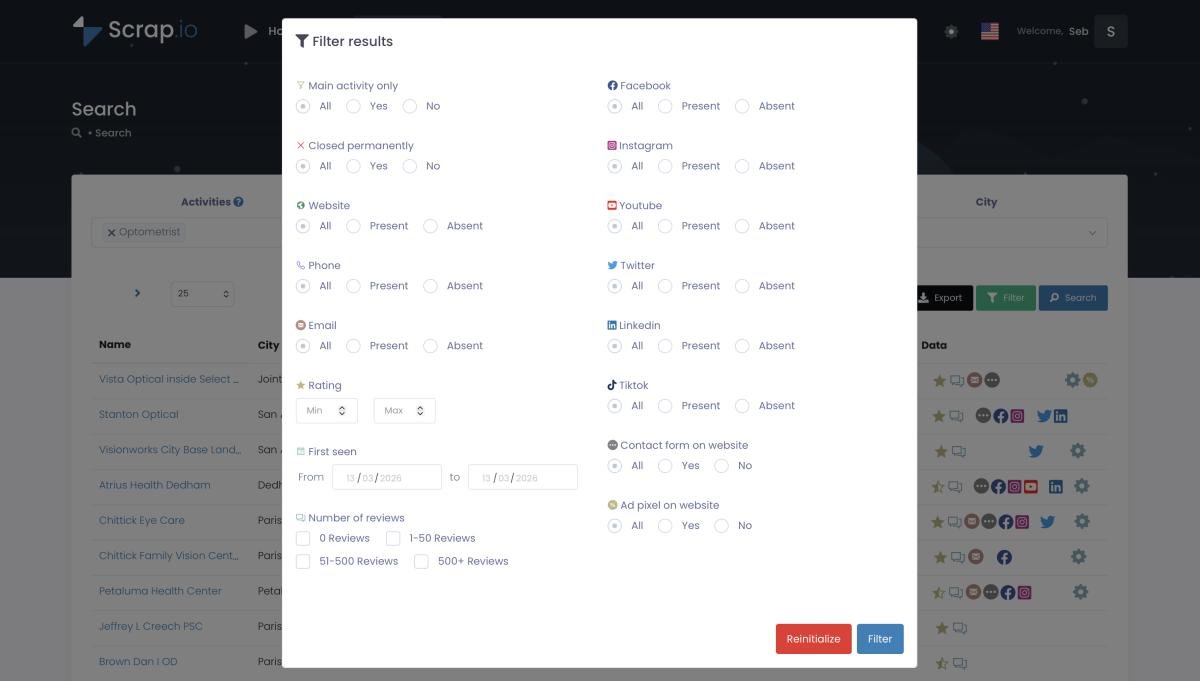
Social media gaps. Clinics with email addresses but no Instagram presence. If you're a marketing agency, you just built yourself a prospect list without trying.
Website analysis. Practices running sites that look like they were built in 2014. Or no website at all. Web design agencies, this is your lane.
Geographic precision. Every skincare clinic in Austin. All of Florida. The entire US. Two clicks. Same price. Draw a radius around a single city or trace a custom polygon — the tool pulls every skin care clinic email inside that zone.
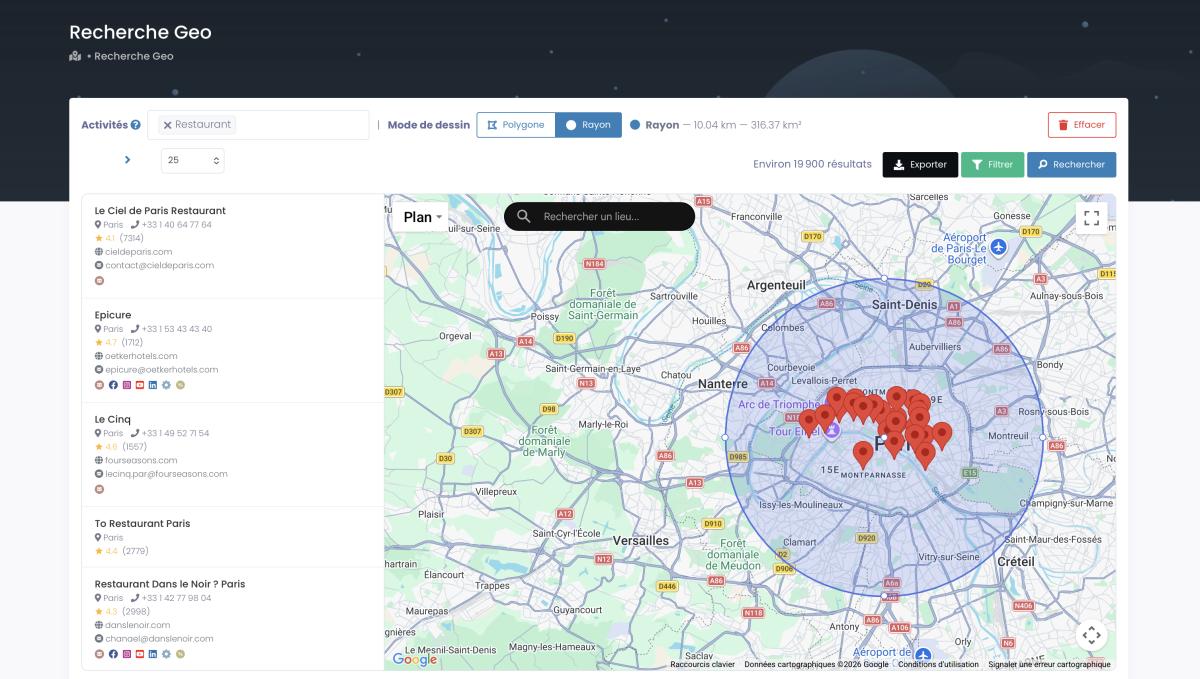
Once you've drawn your zone, the live search returns the matching clinics in seconds — filters, count, and all.
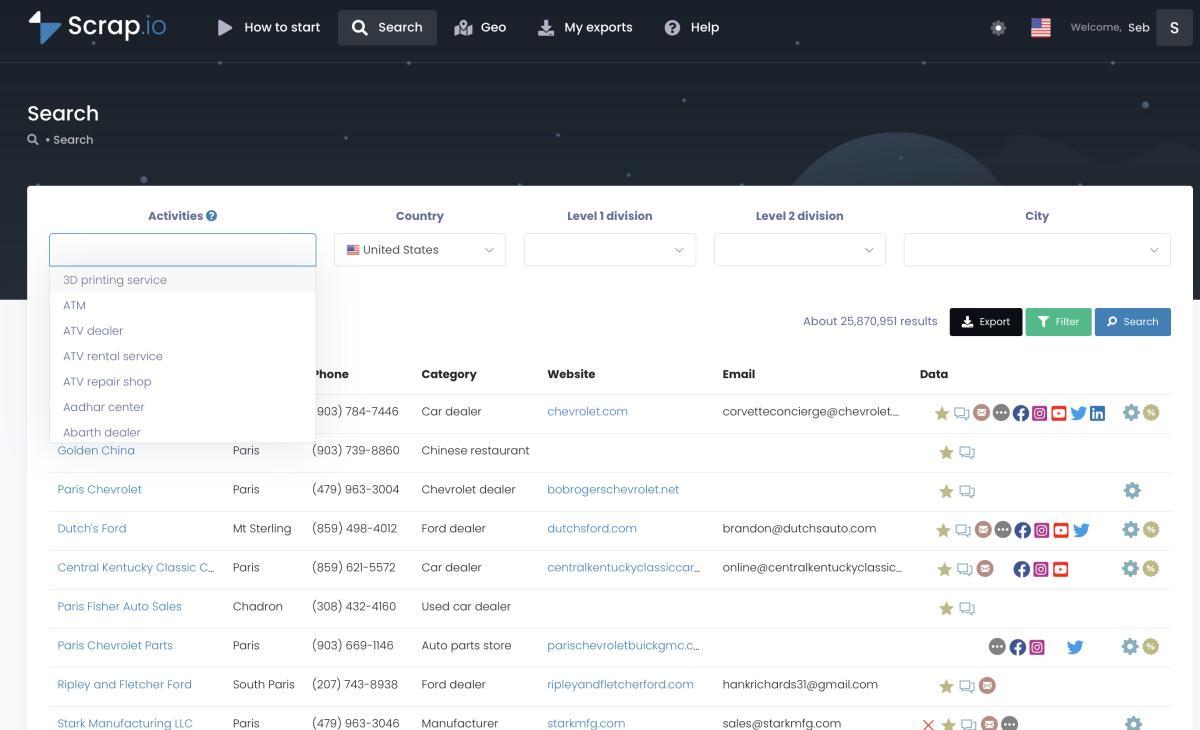
195 countries. 4,000+ business types. Need healthcare email lists beyond skincare? Same platform. Doctor email lists for a broader campaign? Also covered. Even adjacent verticals like a dental clinic email list run off the exact same engine.
The data fields go beyond what most people expect from a scraping tool. You're not just getting name + email. Each record can include Google review count, star rating, phone numbers (multiple if the business has them), social media profiles (Facebook, Instagram, LinkedIn, YouTube), website URL, website technologies detected, business hours, and photos count. That depth turns your cold outreach into targeted outreach. You can reference their Google rating in the subject line. Mention that you noticed they don't have Instagram. Point to a specific review trend. That level of personalization is what separates a 2% reply rate from a 12% reply rate.
And for anyone doing email marketing to dermatologists at scale, Scrap.io also works well with email validation tools — though live-scraped data tends to have lower bounce rates than purchased lists to begin with, because the contacts haven't had time to go stale.
The $50-per-10K pricing doesn't change based on filter complexity. Try requesting "skincare clinics in Miami with under 3 Google stars and no Instagram page" from a traditional broker. You'll be on hold for 45 minutes, and they'll upcharge you for the custom query.
Real Companies Targeting Skincare Clinics (Case Studies)
Enough abstractions. Here's who's actually doing this.
Nextech has 9,000+ providers on their dermatology EHR platform. They didn't cold-call random doctor directories to get there. They went after dermatology practices specifically — segmented outreach, messaging built around derm-specific workflow pain points. The 2024 Best in KLAS award became their door-opener with evidence-minded buyers.
Ezderm plays a different card. Their founder is a practicing dermatologist — so their pitch carries instant clinical credibility. "Built by one of you." Three words that outperform any marketing copy. But they still need fresh dermatologist contact data to reach new clinics they haven't touched yet.
Clinicminds sells aesthetic clinic management software internationally. Testimonials on their site come from clinic managers — exactly the contacts sitting inside an aesthetic clinic email list. International expansion means they need a data provider that covers more than just the US.
Appointible goes narrow: scheduling plus SMS marketing for aesthetic dermatology clinics. Interesting angle — shows how a dermatology clinic marketing database feeds multi-channel outreach. Email opens the door. SMS keeps it open. And when you combine the two channels using the same contact data, response rates go up significantly because you're hitting the prospect in two contexts — their inbox during admin time and their phone during clinic hours.
One detail the brief surfaced that's easy to overlook: geographic concentration matters. California, Florida, Texas, and New York have the highest density of skincare clinics in the US — which makes sense given population and climate. But it also means those are the most competitive territories for vendor outreach. If you're entering the market, consider starting with secondary markets where clinics get fewer vendor pitches. A practice in Nashville or Charlotte might be more receptive than one in LA that's already drowning in cold emails.
Want to reach skincare clinics the way Nextech and Clinicminds do? Scrap.io gives you 100 free skin care clinic leads on a 7-day trial — filtered by city, reviews, social media, and more. ~$0.005 per contact once you scale.
Email Marketing Best Practices for Skin-Care Clinics
Having a list is table stakes. Using it well is where campaigns live or die.
A dermatologist I spoke with — runs a mid-size practice in Phoenix — told me she deletes roughly 90% of vendor emails without reading past the subject line. The 10% she opens? Specific. Relevant. Clearly written by someone who understands what a dermatology clinic actually needs. Not a template with her name pasted in.
Subject Lines That Work
Healthcare professionals have a sixth sense for vendor BS. "REVOLUTIONARY BREAKTHROUGH" gets you archived. Immediately.
What gets opened:
- "New IPL device — 40% faster treatment times"
- "FDA just approved this retinoid compound"
- "Q3 patient volume trends for aesthetic derm"
What gets trashed:
- "SHOCKING SKINCARE SECRET REVEALED!!!"
- Anything with more than one exclamation mark, honestly
TargetBay's Q3 2025 report says 35.68% of beauty industry email leans on discount messaging. Fine for B2C. For email marketing to dermatologists and clinic decision-makers? Lead with clinical value and business relevance. Save the coupon codes for the consumer brands.
Personalization Beyond First Name
"Dr. Smith" at the top of a mail-merged template isn't personalization. It's the bare minimum and everyone knows it.
Video: How to Find the Best Email to contact?
Real personalization pulls from your skincare clinic database:
- "Dr. Smith, saw your clinic added CoolSculpting last year — hitting the ROI targets you expected?"
- "Jessica, noticed your Scottsdale practice just expanded into medical aesthetics..."
- "Given your acne-focused work in the Phoenix market..."
Rich data makes this possible. Google reviews, social profiles, website URL, specialties — when your list includes those fields, personalization isn't hard. It's just homework. And your competitors aren't doing it.
For outreach mechanics, two resources worth bookmarking: how to write a cold email that doesn't get trashed, and warm outreach strategies for when you want to skip the cold intro entirely.
Optimal Send Times
TargetBay's Q3 2025 data points to Monday and Thursday as best send days for beauty-related email broadly. For B2B healthcare specifically: Tuesday through Thursday, 9 AM-12 PM and 12 PM-3 PM local time.
Avoid Monday mornings. (Everyone's catching up on weekend backlog.) Friday afternoons. (Mentally gone.) Medical conference weeks. (Physically gone.)
One software vendor I talked to A/B tested send times for three months straight. Tuesday at 10:30 AM beat Monday at 8 AM by 40% on open rates. Same list. Same email. Just a different send time. Forty percent. They also found that emails sent during lunchtime (12-1 PM) performed surprisingly well — their theory was that dermatologists were checking email while eating at their desk between patients. Not glamorous, but that's how these professionals actually operate.
Compliance: CAN-SPAM, HIPAA, and GDPR
Marketing to healthcare pros adds regulatory layers that don't apply to normal B2B email. Mess this up and you're looking at fines, not just unsubscribes. (I'm not being dramatic — read the penalty structure.)
CAN-SPAM Basics
Non-negotiable requirements: clear sender identification, honest subject lines, working unsubscribe mechanism, physical mailing address in every email. The FTC's CAN-SPAM compliance guide spells it all out. Penalties go up to $53,088 per email violation. Per email.
For a practical walkthrough on what's permitted and what isn't in cold email specifically, read is cold emailing legal.
HIPAA Considerations
Your email list contains business contacts — not patient records. You're not handling protected health information directly. But healthcare professionals are paranoid about data privacy (understandably so), and any hint that you've accessed patient-level info will get you blocked and reported faster than you can type "unsubscribe."
Keep messaging strictly B2B. Reference practice-level data only — location, specialty, clinic size. Never patient data. Don't even reference things like "we noticed your patient volume seems to be growing" — that implies you have access to info you shouldn't have, even if you're just guessing from their Google reviews. Stick to publicly observable signals and you'll be fine.
If you want to understand the regulatory framework better, HHS.gov's HIPAA for Professionals page is the authoritative source. It's dense reading, but if you're selling into healthcare, you need to know the basics. Your legal team will thank you for not creating headaches.
GDPR for International Campaigns
Targeting clinics outside the US? GDPR applies. Scrap.io covers 195 countries, so you might end up there sooner than expected. The advantage of live scraping from public sources: since Scrap.io only collects info that businesses voluntarily posted on Google Maps and their own websites, the consent question is simpler than it'd be with purchased lists of unclear origin.
A GDPR compliant skincare email list starts with how the data was collected. Public Google Maps profiles are a much cleaner legal foundation than mystery CSVs from third-party data brokers.
Measuring Your Results
How do you know if your skin care business email marketing is actually working? Here are the benchmarks that actually matter — not the vanity metrics your marketing dashboard defaults to.
| Metric | B2B Healthcare Benchmark | Good Performance |
|---|---|---|
| Open Rate | 18-25% | 25%+ |
| Click-Through Rate | 3-6% | 6%+ |
| Reply / Conversion Rate | 1-3% | 3%+ |
| Best Days | Tuesday-Thursday | Test yours |
| Best Times | 9 AM-12 PM, 12 PM-3 PM | Test yours |
Opens and clicks are fine to track. But what you really want to measure: demo requests, consultation bookings, resource downloads, and — the actual money metric — sales conversations started.
The number I'd watch closest is the "meaningful response" rate. Not clicks. Not opens. Replies that turn into business conversations. 2% meaningful response on 5,000 contacts = 100 real conversations. If your average deal is $10,000, the math doesn't need much explaining.
Also — and this is something most email guides skip — track response quality by list source. When a software company I know compared their results across three different data sources, live-scraped contacts from Scrap.io consistently outperformed purchased lists on every metric: 22% higher open rates, 35% fewer bounces, and nearly double the reply rate. The freshness of the data was the obvious variable. When someone's contact info was verified yesterday versus six months ago, everything downstream improves.
One more thing. If you're running campaigns to dermatology practice email contacts across different clinic types, segment your reporting by type. Cosmetic clinics respond differently than medical derm. Med spas respond differently than multi-specialty. Blending them into one report masks the signal. You might discover that your messaging kills it with med spas but falls flat with medical derm — and that's actionable intel you'd lose in aggregate numbers.
FAQ
How much do skin care clinic email lists cost?
Traditional brokers: $0.10-$0.50 per contact, so $1,000-$5,000 for 10K contacts. Scrap.io: about $50 for 10,000 — roughly 200x cheaper. But price alone doesn't tell the story. Stale data costs less upfront and vastly more in bounced emails and wasted rep time downstream.
What's the difference between dermatology and aesthetic clinic lists?
Medical derm clinics treat diseases — skin cancer, eczema, psoriasis. Aesthetic clinics focus on cosmetic procedures — Botox, fillers, laser resurfacing. Your product determines which matters. Plenty of practices straddle both, so segment by treatment focus rather than clinic name for better targeting.
How to find a dermatologist's email address?
Three options. Manual research — clinic websites, Google Maps, LinkedIn — slow and free. Buy from a broker — faster but frequently outdated. Live scraping through Scrap.io — fastest, cheapest per contact, and current. The American Academy of Dermatology directory is another starting point for identifying practitioners, though it won't give you emails directly.
How often should dermatology email lists be updated?
Healthcare contacts change fast. Doctors switch practices, offices relocate, staff turns over. Static lists need re-verification monthly at minimum. Live scraping eliminates the update cycle entirely — data is current every time you pull it.
How to promote services to skincare clinics?
Email is the most scalable channel. Layer in LinkedIn outreach, direct mail for high-value prospects, retargeting ads. Start with a segmented skin care clinic email list, personalize by clinic type and geography, and address specific pain points. Generic mass blasts are dead in healthcare B2B. Have been for years.
Is it legal to email dermatologists for B2B marketing?
Yes — provided you comply with CAN-SPAM in the US and GDPR in the EU. Clear sender ID, honest subject lines, easy unsubscribe, physical address. Public data (Google Maps, clinic websites) is a legally cleaner source than opaque third-party lists. More detail at cold email compliance.
When's the best time to email skincare professionals?
Tuesday through Thursday. 9 AM-12 PM or 12 PM-3 PM local time. Avoid Mondays, Fridays, holidays, and major dermatology conference weeks (AAD Annual Meeting especially). These people check email during admin blocks, not between patients.
What types of companies see the best results?
SaaS vendors (EHR, practice management, scheduling tools), medical equipment suppliers, pharma companies, marketing agencies, and professional training companies. Basically anyone selling to dermatology or aesthetic practices. Common thread: a value proposition tied to how clinics actually operate, not abstract buzzwords.
How many skin care clinics are there in the US in 2026?
Scrap.io indexes 72,653 as of July 2026. That covers medical derm, cosmetic clinics, med spas, and multi-specialty offices with a skincare component. Of those, 55,870 have a website and 38,450 have a publicly listed email. The number keeps growing as new practices launch and get indexed.
What's the ROI of email marketing to skincare clinics?
Depends on deal size and conversion rates. Quick scenario: 5,000 targeted emails → 20% open rate → 5% click rate → 2% meeting conversion = 20 real sales conversations. Average B2B deal of $5,000-$50,000 means even 2-3 closes more than pays for the data and the campaign. The variable that tanks everything: bad list quality. Stale data breaks every metric downstream. I've seen companies spend more on their CRM subscription than on the contact data they feed into it — and then wonder why their pipeline is empty. The data is the foundation. Everything else is downstream.
Your Move
72,653 clinics. $24 billion US market. 4.2% annual growth. Decision-makers who authorize six-figure equipment purchases and five-figure software contracts without blinking.
That's the opportunity. The only question is whether you're reaching them with current data or torching your budget on bounced emails.
I've seen it both ways. The reps using stale lists from 2024 are still making 50 dials a day and hoping for callbacks. The ones using live data are booking meetings from their first batch.
Try Scrap.io free — grab 100 verified skin care clinic contacts on a 7-day trial. Filter by city, rating, social media presence, whatever you need. Half a cent per contact once you scale. The downside risk is basically zero.
Nextech didn't wait for derm practices to come to them. Clinicminds didn't sit around hoping aesthetic clinic managers would Google their software. They went out, got the data, and executed.
Every week you spend debating which data source to use is another week your competitors are already emailing the clinics you want to reach. The skincare market isn't getting smaller. The number of vendors chasing these clinics isn't getting smaller either. Speed to contact matters more than most sales teams realize.
That's it. Your move.
Generate a list of skin care clinic with Scrap.io