

Video: Skrapp.io vs Scrap.io, Email Finder Tools Tutorial
- What Are Email Finder Tools? (And Why the Right One Matters)
- Skrapp.io in 2026: Features, Strengths & Limitations
- Scrap.io in 2026: Features, Strengths & Data Power
- Skrapp.io vs Scrap.io: Head-to-Head Comparison
- Which Tool Should You Choose? (Decision Framework)
- Real-World Results: Email Finder Tools in Action
- Email Finder Compliance: What You Need to Know
- Getting Started: Your First 100 Leads for Free
- Frequently Asked Questions
What Are Email Finder Tools? (And Why the Right One Matters)
B2B email marketing delivers $36 to $42 for every $1 spent. That's not a typo. But here's the catch. That ROI only happens if you're reaching real, valid email addresses. Send to garbage data and you're burning money while tanking your sender reputation.
So yeah, the tool you use to find business emails for cold outreach matters. A lot.
Email finder tools do exactly what the name suggests: they help you find professional email addresses at scale. But not all of them work the same way. Some dig through LinkedIn profiles. Others crawl company websites. And a few, like Scrap.io, pull contact data straight from Google Maps listings and their associated websites. The data source changes everything about what you get, how much it costs, and whether the emails actually work.
With 80% of B2B marketers calling lead generation mission-critical (Snov.io, 2026), picking the wrong email finder isn't just annoying. It's expensive.
Email Finders vs Email Scrapers: Key Differences
People use these terms interchangeably. They shouldn't. As the Instantly.ai blog noted: "The tools still separate into very different buying paths. Some are database-led prospecting platforms. Some are finder-first verification tools." Right.
An email finder takes a name + company and guesses (or looks up) the associated email address. Think: you know someone works at Acme Corp, and the tool figures out it's [email protected]. That's what Skrapp.io does. The email scraper vs email finder difference is significant: a scraper extracts emails from live sources (websites, business directories, Google Maps pages) without needing to know who works there first. Scrapers tend to find more emails per company (Scrap.io pulls up to 10 classified addresses), while finders focus on one verified individual email.
Different tools. Different jobs.
Skrapp.io in 2026: Features, Strengths & Limitations
Looking for individual email addresses of decision-makers at enterprise companies? That's exactly what Skrapp was built for. It's a LinkedIn email finder tool that connects to LinkedIn and Sales Navigator to surface professional emails tied to specific people at specific companies.
How Skrapp.io Works (LinkedIn-First Approach)
Skrapp's workflow is straightforward. Install the Chrome extension, browse LinkedIn, and the tool attempts to find verified email addresses for the profiles you're viewing. You can also use their web app to search by company domain: type in a company name, and Skrapp crawls its database to match employees with their professional emails.
The linkedin email finder tools approach works well when your ICP lives on LinkedIn. SDRs prospecting VPs of Marketing at SaaS companies? Solid use case. But the platform is fundamentally limited by LinkedIn's ecosystem. If your prospect isn't active on LinkedIn, or doesn't have a profile at all, Skrapp can't help you.
Skrapp.io Pricing in 2026
Skrapp's Starter plan runs $49/month for 1,000 credits. That's $0.049 per email lookup. They offer a free tier with 50 credits per month: enough to test, not enough to run a real campaign. And here's the kicker: one credit gets consumed per lookup, even if Skrapp doesn't find an email. The only exceptions are "Invalid" and "Unknown" results. So you're paying for attempts, not results. Derrick App's independent pricing analysis breaks this down in painful detail.
For email finder tools free options, Skrapp's 50 monthly credits are... fine. But they vanish fast when you're prospecting at any real scale.
Skrapp.io Limitations
Look, I'll be direct. Independent testing from WizLeads' 2026 email enrichment benchmark and reviews on G2 paint a mixed picture. Skrapp claims a 92% email search success rate. But independent tests, including one by Prospeo.io and SyncGTM, found an actual verified email rate of 42.8%. That gap between "found" and "verified and deliverable" is the gap between a successful campaign and a wrecked sender reputation.
As one SyncGTM review puts it: "Skrapp.io is not worth it for any team serious about outbound in 2026. The product has not kept pace with modern alternatives, with lower accuracy, no phone data, no signals, and limited CRM support." Harsh? Maybe. But the data backs it up.
No phone data. No Google Maps coverage. Limited CRM integrations. And if your targets are local SMBs (restaurants, contractors, clinics) they probably aren't on LinkedIn in the first place. Trying to find a plumber's email through LinkedIn is an exercise in futility.
Scrap.io in 2026: Features, Strengths & Data Power
225 million businesses indexed across 195 countries. No code, no API setup, no LinkedIn dependency.
Bold claim. Here's why it holds up.
How Scrap.io Works (Google Maps-First Approach)
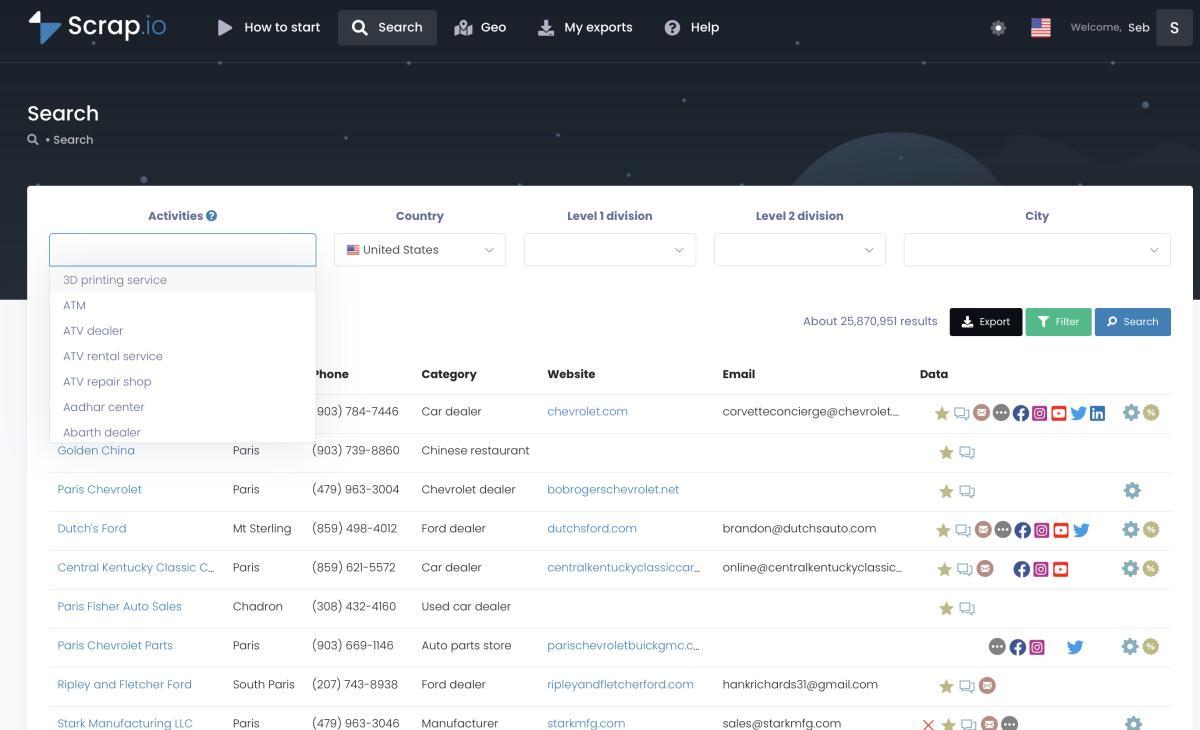
Scrap.io is a google maps email finder tool that turns the world's largest business directory into a lead generation machine. Pick a category from 4,000+ options, select a location (city, region, or entire country), apply filters, and export. The platform crawls each business listing and its associated website in real time. No stale database, no cached results from six months ago. If you want the full walkthrough, here's our step-by-step Google Maps email extractor guide, and for a wider tool roundup, our tested list of the best Google Maps scrapers.
Every email gets automatically classified: individual (with first and last name), contact, sales, marketing, finance, or admin. You know exactly who you're writing to before you hit send. And because Scrap.io finds emails directly from Google Maps business websites, you reach companies that LinkedIn-based tools simply can't see.
Here's what that search looks like: you pick a category, pick a location, and the platform does the rest.
Scrap.io Pricing in 2026
Basic plan: $35/month (annual) or $49/month (monthly) for 10,000 credits. One credit = one business exported. Re-export the same business within 30 days? Free, no extra credit consumed.
Compare that to Skrapp's $49/month for 1,000 credits. Scrap.io gives you 10x the volume at the same price point. The skrapp.io pricing vs scrap.io pricing math is brutal. Scrap.io works out to $0.0035 per lead versus Skrapp's $0.049. That's roughly 14x cheaper per contact.
Free trial: 7 days with 100 export credits. Full platform access. Cancel anytime.
What Sets Scrap.io Apart
Three things no other email finder for local businesses does:
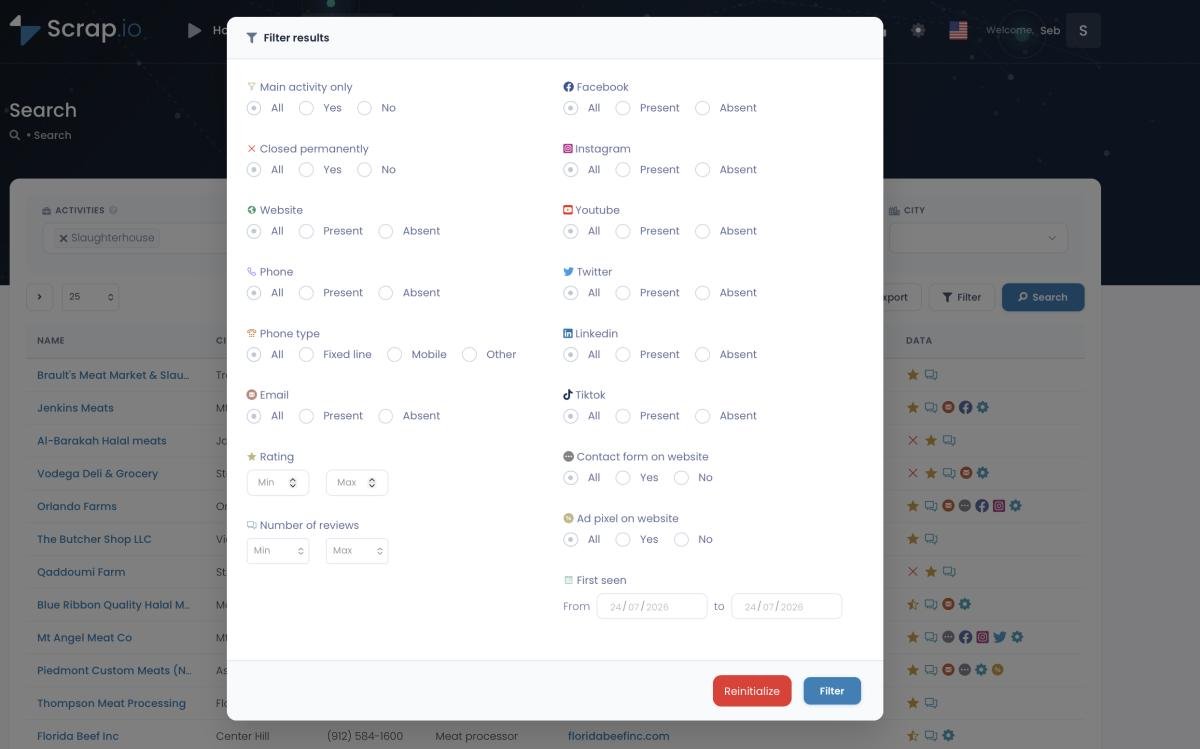
1. Filtering BEFORE extraction. Apply filters (email present, mobile phone only, minimum rating, review count) before a single credit is consumed. Zero waste. Skrapp charges you per lookup whether it finds anything or not.
2. Multiple classified emails per business. Up to 10 emails per company, auto-categorized by type. Skrapp gives you one email per LinkedIn profile. Period.
3. Country-scale extraction in two clicks. Extract every dentist in France or every contractor in Texas without writing a line of code. No other tool on the market does this.
Want to see for yourself? Scrap.io offers a free 7-day trial with 100 leads included: full access to filters, exports, and all 225 million+ businesses across 195 countries. Try Scrap.io free →
Skrapp.io vs Scrap.io: Head-to-Head Comparison
Meet Sarah. She runs a web design agency targeting local businesses without websites. And meet Tom. He's an SDR prospecting VPs of Marketing at SaaS companies. They need very different tools, and this skrapp.io vs scrap.io comparison 2026 explains exactly why.
Video: How to Find Someone's Email Address, Hunter.io vs Scrap.io
Data Sources: LinkedIn vs Google Maps
Skrapp pulls from LinkedIn profiles and company websites. That works brilliantly for enterprise: Fortune 500 companies, SaaS vendors, anyone with an active LinkedIn presence. But linkedin email finder vs google maps scraper is really a question of audience. Local businesses (restaurants, plumbers, real estate agents, hair salons) barely exist on LinkedIn. They do exist on Google Maps. All 225 million+ of them.
Ask yourself: when was the last time you found a roofer's contact info on LinkedIn?
Email Types: Individual vs Business Emails
Skrapp finds one individual email per LinkedIn profile. Useful if you know exactly who you want to reach. Scrap.io finds multiple emails per business, classified as individual (with extracted first/last name), contact, sales, marketing, finance, or admin. For agencies doing volume outreach to local businesses, having 5-10 contact points per company is a game changer.
Accuracy & Verification
Here's where things get uncomfortable for Skrapp. Their claimed 92% search success rate sounds great, until independent testing (Prospeo.io, SyncGTM) reveals an actual verified delivery rate of 42.8%. That's less than half. Scrap.io extracts emails in real time from live business websites, meaning the data is as fresh as the website itself. For maximum deliverability, always run your lists through an email validator before sending (here's how to check if an email is valid without hitting send), regardless of which tool you used to find them.
Which email finder tool is most accurate? Accuracy depends on context. For LinkedIn individual emails: Skrapp is decent (when it works). For business contact data at scale: Scrap.io's real-time extraction wins. No stale database, no guessing.
Pricing Comparison Table
| Feature | Skrapp.io | Scrap.io |
|---|---|---|
| Starter Price | $49/mo | $35/mo annual / $49/mo monthly |
| Credits Included | 1,000 | 10,000 |
| Cost Per Lead | $0.049 | $0.0035 |
| Free Tier | 50 credits/month | 7-day trial + 100 leads |
| Credit Consumption | 1 credit per lookup (even if no email found) | 1 credit per business exported (re-export free within 30 days) |
| Data Source | LinkedIn + company websites | Google Maps + business websites (real-time) |
| Emails Per Company | 1 | Up to 10 (classified) |
| Coverage | LinkedIn users | 225M+ businesses, 195 countries |
You want to pay $0.049 per lead or $0.0035? Take your time.
Filtering & Targeting Capabilities
Skrapp lets you filter by department, role, and email type (personal vs. generic). Reasonable for LinkedIn-based prospecting. Scrap.io? Rating range, review count, website presence, email availability, social media profiles, contact forms, ad pixels, phone type (mobile vs. fixed), business status, and all of this before you spend a credit. The best email finder for small business prospecting needs this level of granularity, and Skrapp simply doesn't offer it.
Oh, and Scrap.io also has a comparison with Hunter.io that's worth reading if you're evaluating multiple options.
Export & Integration Options
Both tools export to CSV. Scrap.io also exports Excel files with color-coded columns (yellow for Maps data, orange for website-enriched data). Scrap.io offers a REST API (300 requests/min), a Make.com integration, and an MCP connector for AI agents. Skrapp integrates with Salesforce, HubSpot, and offers an API, solid for enterprise CRM workflows.
50,000+ professionals already use Scrap.io to find verified business contacts from Google Maps. Rated 4.8 on Capterra, 4.9 on G2. Join them →
Which Tool Should You Choose? (Decision Framework)
The worst mistake in B2B prospecting isn't picking the wrong tool. It's trying to use a LinkedIn email finder on local businesses that aren't even on LinkedIn. I've seen agencies waste months (and thousands of dollars) on this exact mistake.
Here's a dead simple framework. If you need a skrapp alternative for google maps leads, the answer is obvious. But let's break it down anyway.
Choose Skrapp.io If...
Your ICP is enterprise. You're targeting C-suite executives, VPs, directors at companies with 500+ employees. They have LinkedIn profiles. They have company websites with employee directories. Skrapp's strength is individual email discovery from known companies. SDRs at SaaS companies selling to other SaaS companies? That's Skrapp's sweet spot. If your best tool to find company email addresses needs to be LinkedIn-native, Skrapp works, and it's worth weighing against the wider field in our roundup of the best Apollo.io alternatives.
Choose Scrap.io If...
Your targets have a physical location. Restaurants, clinics, agencies, contractors, salons, gyms, hotels, repair shops: if they show up on Google Maps, Scrap.io is your tool. It's also the clear winner for bulk email finder tool comparison scenarios where volume and cost matter. 10,000 credits for $35/month versus 1,000 for $49? Not a hard decision. And if you're building B2B lead generation campaigns targeting SMBs, Scrap.io is built for exactly that. Targeting the US specifically? Here's how to build a real-time USA business email database.
Can You Use Both Together?
Absolutely. And smart teams do. Use Scrap.io to identify businesses (category, location, filtering), then use LinkedIn to find the specific decision-maker inside that business. A web design agency can pull every restaurant in Miami without a website via Scrap.io, then look up each owner on LinkedIn. Your outreach references their 3.8 Google rating, mentions their competitor three blocks away just launched a new site, and offers to fix the problem.
That's not cold outreach anymore. That's warm outreach wearing a cold email's clothes.
Real-World Results: Email Finder Tools in Action
B2B Email Outreach Benchmarks (2026)
The numbers are sobering. Average cold email open rate: 27.7%. But honestly? Ignore that number. Open tracking is broken in 2026, Apple Mail Privacy Protection auto-loads tracking pixels and inflates opens, so the open rate tells you almost nothing about real engagement (Cleverly, 2026). Reply rate is the metric that matters, and it's humbling: the average B2B reply rate now sits at 3.43%, with a good campaign landing in the 5-10% range. Inboxes are more crowded, spam filters are smarter, and generic blasts just don't cut it anymore.
Here's the part that should change how you prospect. Tightly targeted lists crush big blasts: small, segmented sends pull around a 5.8% reply rate versus 2.1% for mass campaigns, and 2-3 well-timed follow-ups can drive up to 42% of your total replies (Cleverly, 2026). Fewer, better-targeted contacts win. Which is exactly why filtering before you extract, instead of blasting a bloated list, isn't just a cost thing. It's a deliverability thing. That's the whole point of pre-extraction filtering.
But 59% of B2B marketers still plan to increase their email budgets through 2026 (SQ Magazine). Why? Because when done right (verified contacts, personalized messaging, smart follow-ups) email still delivers. Companies using verified contact data reported 208% more booked meetings (ZoomInfo, Brown & Brown Insurance case study). That's not a marginal improvement. That's massive.
Case Studies with Verified Contact Data
Brown & Brown Insurance combined intent data with verified contacts for their prospection pipeline. The result: 208% more meetings booked. The verified data made targeting precise enough that reps stopped wasting time on dead-end leads.
Redwood Logistics replaced manual email research with automated enrichment workflows. They cut cost per contact by 99% and saved 25 hours per week. Twenty-five hours. That's basically an entire employee's workweek recovered.
Outreach (the SaaS company) switched to verified data across their sales engagement platform. Connect rates multiplied by 7x. Not 7%. Seven times.
And the cold emailing strategy you pair with your data matters enormously. The best email finder tools in the world won't save a terrible email. But terrible data will absolutely kill a great one.
Email Finder Compliance: What You Need to Know
Here's something most comparison articles won't tell you: not all email finder tools handle compliance the same way. And getting this wrong isn't just embarrassing. It's expensive.
GDPR, CAN-SPAM & CCPA Considerations
GDPR (EU): B2B prospecting with publicly available business data generally falls under "legitimate interest" (Article 6). But every email must include an opt-out mechanism. Non-negotiable.
CAN-SPAM (US): Unsolicited commercial email is legal, it's just regulated. Include accurate sender info, a physical address, and a clear unsubscribe link. Honor opt-outs within 10 days.
CCPA (California): Publicly available business information is explicitly carved out of CCPA's scope. You're extracting commercial data, not consumer profiles.
How Scrap.io Handles Data Compliance
Scrap.io only extracts publicly available business data: information that companies voluntarily published on their own websites and Google Maps listings. GDPR and CCPA compliant. Every data point is traceable to its source. No shady databases, no scraped personal inboxes, no purchased lists of questionable origin.
Nope. Just business contacts that exist on public web pages. Clean.
Getting Started: Your First 100 Leads for Free
Enough comparing. Here's how to get your first leads in under 5 minutes.
Video: Scrap.io - How to Start?
- Go to scrap.io and create an account (takes 30 seconds).
- Pick a business category, plumber, restaurant, law firm, whatever your ICP is.
- Select your target geography, a city, a state, or a whole country.
- Apply filters: only businesses with email, minimum rating, review count.
- Export your first 100 leads. CSV or Excel. Done.
You now have verified business names, emails, phone numbers, websites, Google ratings, and social profiles, ready to import into your CRM or cold email tool. The entire process? Faster than making coffee.
Start your free trial: 7 days, 100 leads, full access. Search any category in 195 countries, apply advanced filters, and see the data quality for yourself. No commitment. Cancel anytime. Get your first leads now →
Frequently Asked Questions
Is Skrapp.io worth it in 2026?
Skrapp.io is worth it if your targets are enterprise contacts active on LinkedIn. For local SMBs, high volume, or tight budgets, it's not: independent tests show a 42.8% verified rate and it charges per lookup. For Google Maps leads at $0.0035 each, Scrap.io is the better value.
What is the most accurate email finder tool in 2026?
Accuracy depends on your data source and target market. For LinkedIn individual emails, tools like Hunter.io claim 95% deliverability on verified addresses. For business emails from Google Maps, Scrap.io extracts data in real time from live websites, so freshness is built in. Independent tests show Skrapp.io has a 42.8% actual verified rate despite claiming 92% search success. The answer to how accurate are email finder tools really comes down to what you're measuring: "found" vs. "verified and deliverable" are very different numbers.
How much does Skrapp.io cost compared to Scrap.io?
Skrapp.io starts at $49/month for 1,000 credits ($0.049/email). Scrap.io starts at $35/month (annual) for 10,000 credits ($0.0035/lead). Scrap.io is roughly 14x cheaper per lead. Both offer free tiers: Skrapp gives 50 credits/month, Scrap.io offers a 7-day trial with 100 leads. For a free email finder for B2B leads, Scrap.io's trial gives you more room to actually test a real campaign.
Can I use Skrapp.io and Scrap.io together?
Yes. And this is the smart play. Use Skrapp for enterprise targets on LinkedIn (C-suite executives, VPs at large companies) and Scrap.io for local SMBs on Google Maps. This dual approach covers both ends of the B2B spectrum. Sarah's agency targets restaurants via Scrap.io. Tom prospects SaaS VPs via Skrapp. Both win.
What's the difference between an email finder and an email scraper?
An email finder searches databases to match a name + company to an email address, one contact at a time. An email scraper extracts emails from live sources (business websites indexed on Google Maps, public directories). Scrapers like Scrap.io find more emails per company (up to 10 classified addresses). Finders like Skrapp focus on one verified individual email per LinkedIn profile. The email scraper vs email finder difference matters most when you're choosing between volume and precision.
Is it legal to use email finder tools for cold outreach?
Yes, when done compliantly. In the US, CAN-SPAM requires honest headers, a physical address, and a clear opt-out link. In the EU, GDPR requires legitimate interest and opt-out mechanisms. In California, CCPA explicitly carves out publicly available business data. Scrap.io only extracts publicly available business information and is GDPR and CCPA compliant. Bottom line: legal, just don't be spammy about it.
Generate a list of restaurant with Scrap.io