

- What Is a Spa Email List, and Why Does It Matter in 2026?
- The US Spa Market in Numbers: 160,681 Businesses and Counting
- Types of Spa Email Lists: Day Spa vs Medical Spa vs Resort Spa
- Where to Get a Spa Email List in 2026 (3 Methods Compared)
- How to Extract Spa Emails from Google Maps with Scrap.io
- What Data Is Included in a Spa Email List?
- How to Use a Spa Email List for Cold Email Campaigns
- Compliance & Legal: CAN-SPAM, GDPR, and Spa Outreach
- FAQ
- Conclusion
What Is a Spa Email List, and Why Does It Matter in 2026?
A spa email list is a database of contact information (emails, phone numbers, addresses) for spa businesses. Day spas, med spas, resort spas, wellness centers. Basically any business where people go to get pampered, injected, or both.
Sounds simple. But here's what most people get wrong: they think any old list will do.
It won't.
The spa industry did $22.5 billion in revenue in 2024, up 5.8%, with 187 million visits across the US (ISPA, 2024). That's a massive market. And if you're selling spa management software, booking platforms, skincare products, or marketing services, a quality spa email list is how you get in front of decision-makers. Not the receptionist. The actual owner who signs the checks.
But most spa email lists you'll find online are garbage. Recycled CSVs from 2022. Generic info@ addresses that nobody checks. Lists that were "verified" sometime during the last presidential administration. The spa owners who actually make purchasing decisions? Good luck finding them in those databases.
So yeah, the list matters. But the freshness of that list matters way more.
The US Spa Market in Numbers: 160,681 Businesses and Counting
Let's talk numbers. Real ones.
As of 2026, there are 160,681 spa businesses listed on Google Maps in the US, including 65,423 medical spas. Of the total, 78,164 (48.6%) have a verified email address (Scrap.io, August 2026). So just under half of all spas publicly list an email, which tells you something important: half of them don't, and buying a list that pretends otherwise is how you end up with a bounce report instead of a pipeline.
Now the context. The US spa industry is worth $23.2 billion in 2026 (IBISWorld), and it employs 376,200 people (ISPA, January 2025). That's huge. And the growth isn't slowing down, particularly in the med spa segment, which is projected to hit $78.3 billion by 2033 with a CAGR of 15.77% (Grand View Research, 2025).
Here's the part people miss. Six months ago that Google Maps count read 155,008 spas with 73,693 verified emails. Today it's 160,681 and 78,164. That's 5,673 new spas and 4,471 fresh verified emails in a matter of months. The market moves every single week. Your list has to move with it, or it rots.
For context on the digital side of things: of the businesses filed under the core "spa" category alone, 54,835 have a website (Scrap.io, August 2026). That's your pool of prospects with a real online presence, and usually a real inbox behind it.
Video: How to Scrape Local Leads at the Country Level
What does this mean if you're building a spa contact database for outreach? Two things. First, the market is big enough to support hyper-targeted campaigns. Second, the data changes constantly. New spas open, others close, ownership changes hands. Any spa email list older than 6 months is already decaying. Seriously.
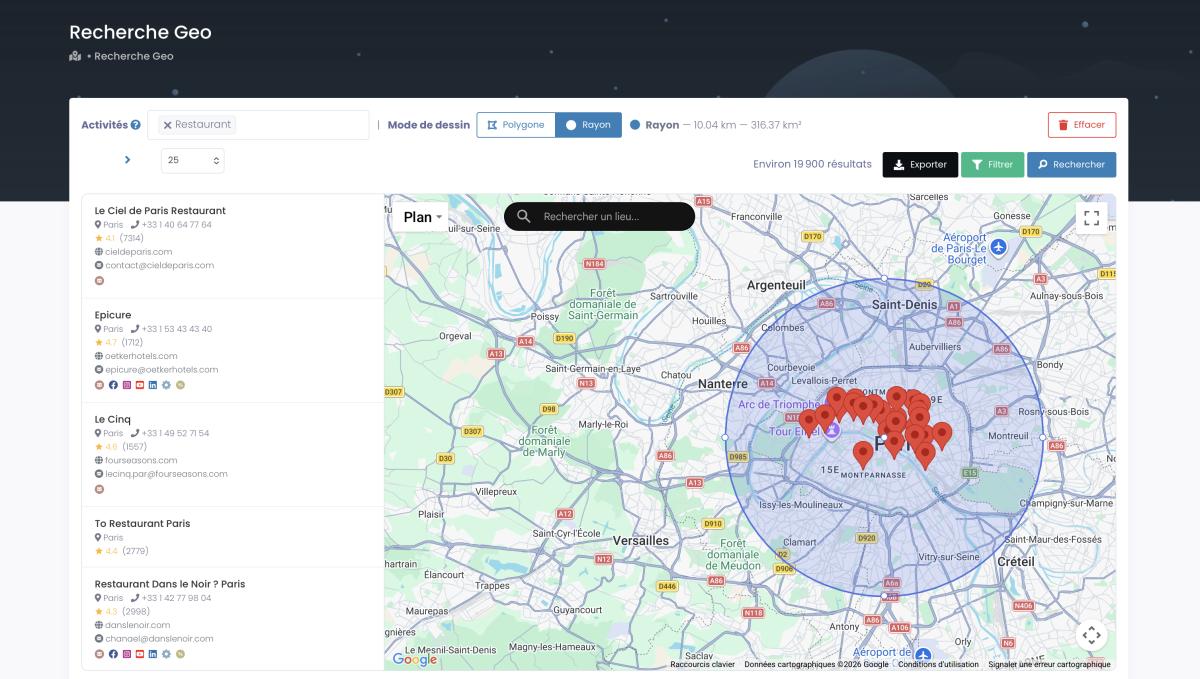
Want to see the spread across a whole region before you commit? A tool like Scrap.io lets you draw a catchment area (a radius or a hand-drawn zone) and count every spa inside it, for free.
If you're looking at related verticals, we've also covered beauty salon email lists and wellness center email list data. The overlap is real, but the targeting is different.
Types of Spa Email Lists: Day Spa vs Medical Spa vs Resort Spa
Not all spas are the same. And your spa mailing list shouldn't treat them like they are. Here's the breakdown:
Day Spa Contact Lists
Day spas are the bread and butter of the industry. Facials, massages, body wraps, the works. Typically small businesses, 3 to 15 employees, run by an owner-operator. Getting day spa owner contact information is relatively straightforward because these businesses are almost always listed on Google Maps. The challenge? Many use personal Gmail addresses or don't list an email at all. (And good luck getting a reply from a generic info@ inbox.)
Med Spa Email List
This is where the money is. Medical spas offer Botox, fillers, laser treatments, IV therapy, anything that requires medical oversight. The average med spa generates significantly more revenue than a traditional day spa, which is why medical spa decision maker emails are the most sought-after contacts in the space. We have a full deep-dive on the medical spa email list, plus a companion guide to building a filterable med spa directory if that's your primary focus.
Wellness Spa Email List
Wellness spas blend traditional spa services with holistic health. Think float tanks, infrared saunas, cryotherapy, sound healing. This segment is growing fast, particularly in cities like Austin, Denver, and Portland. If you're targeting this niche, also check out massage therapist email list resources. There's significant crossover.
Resort and Hotel Spa Lists
These are the hardest to crack. Resort spas are typically part of a larger hotel operation, so the decision-maker for spa purchases isn't always the spa director. It could be a VP of operations or a corporate procurement team. Totally different sales process. The emails you need here aren't on Google Maps. They're buried in corporate directories.
My advice? Know which type you're targeting before you try to build a spa mailing list. A cold email that works for a solo day spa owner will bomb with a Marriott spa director. Different audiences, different copy, different approach. (Ask me how I know.)
Where to Get a Spa Email List in 2026 (3 Methods Compared)
OK so you need spa leads. How do you actually get them? Three options. Let me break each one down, and be honest about the tradeoffs.
Option 1: Buy a Pre-Built Spa Email List
The old-school approach. Companies like Coldlytics offer custom-built spa owner lists. SphereScout claims 33,960+ spa contacts in the US. You pay, you get a CSV.
The problem? Data freshness. These lists are snapshots. The moment they're compiled, they start decaying. Bounce rates of 15 to 25% are common on purchased lists. And you're paying per contact whether the email works or not.
Oh, and whatever price you're imagining, it's probably higher. How much does a spa email list cost from traditional providers? Anywhere from $0.10 to $0.50 per contact for basic data, and $1 to $3+ per contact for "verified" leads. That's $1,000 to $5,000 for 10K contacts. Ouch.
Option 2: DIY Manual Research
Google each spa. Visit the website. Find the email. Copy-paste into a spreadsheet. Repeat 10,000 times.
Try doing that manually. I'll wait.
(Spoiler: at 2 minutes per business, that's 333 hours of work. About 8 weeks of full-time research. For one list. That'll be outdated by the time you finish.)
Option 3: Live Extraction from Google Maps
This is what tools like Scrap.io do. Instead of buying a static list, you extract spa emails from Google Maps in real time. The data is fresh because it comes directly from Google's business listings, the same profiles that spa owners actively maintain. If you want the mechanics, here's the full guide on how to find emails on Google Maps.
Here's how the three spa email list providers compare:
| Criteria | Traditional List Provider | DIY Manual Research | Scrap.io (Live Extraction) |
|---|---|---|---|
| Cost for 10K contacts | $1,000 to $5,000 | Free (but 333+ hours labor) | $49 to $499/mo (unlimited searches) |
| Data freshness | Weeks to months old | Fresh at time of research | Real-time from Google Maps |
| Email coverage | 40 to 60% | Whatever you find | 48.6% (78,164 of 160,681) |
| Filtering control | Limited segments | Full (but manual) | Full (location, rating, type, etc.) |
| Accuracy | 70 to 85% | High (if done well) | 90%+ (direct from source) |
| Speed | Instant download | Weeks | Minutes |
And honestly, beyond spa data, the same logic applies to hair salon email lists, nail salon email list campaigns, and any local business vertical. Fresh beats stale. Every time.
How to Extract Spa Emails from Google Maps with Scrap.io
Alright, let's get practical. Here's how to find spa business emails using Scrap.io, step by step. No fluff.
New to the tool? This two-minute onboarding walks you through your very first search before you touch a single filter.
Video: Scrap.io - How to Start?
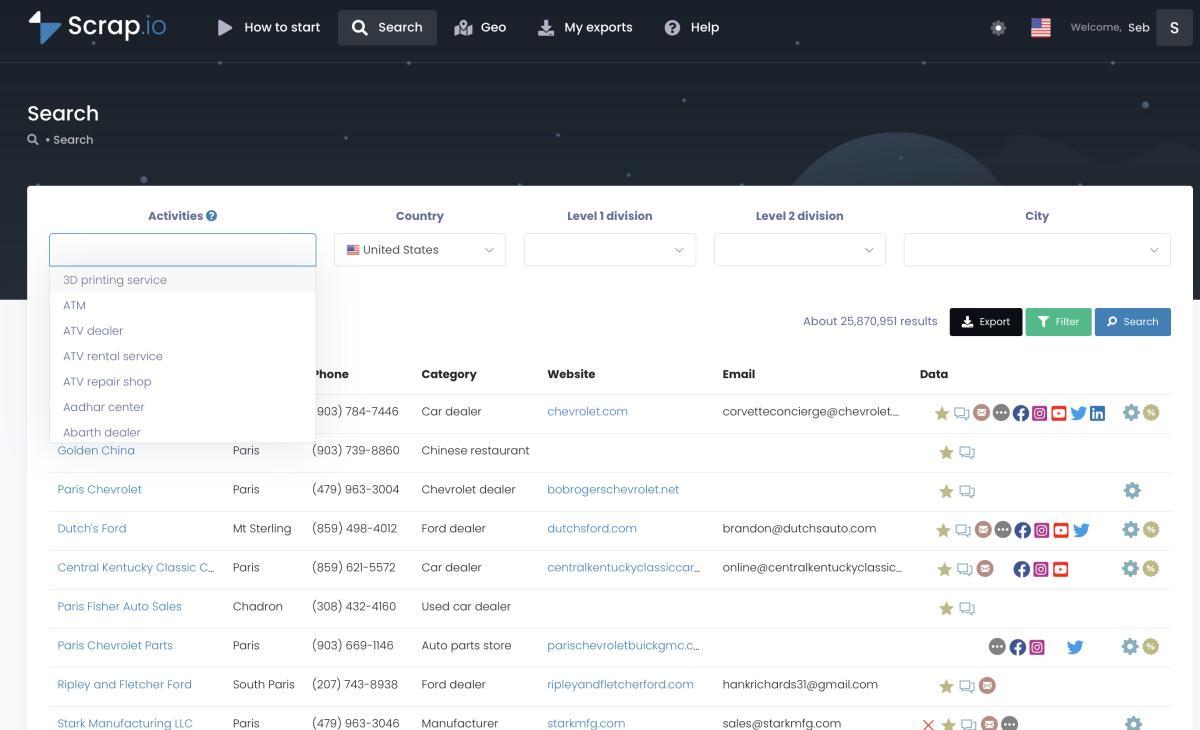
Step 1: Search for spa businesses. Go to Scrap.io, type "spa" in the search bar, and select your target location. Want all day spas in Florida? Med spas in California? Wellness spas in New York? Just set the filters. Filters are applied before extraction, so you're not wasting credits on irrelevant businesses.
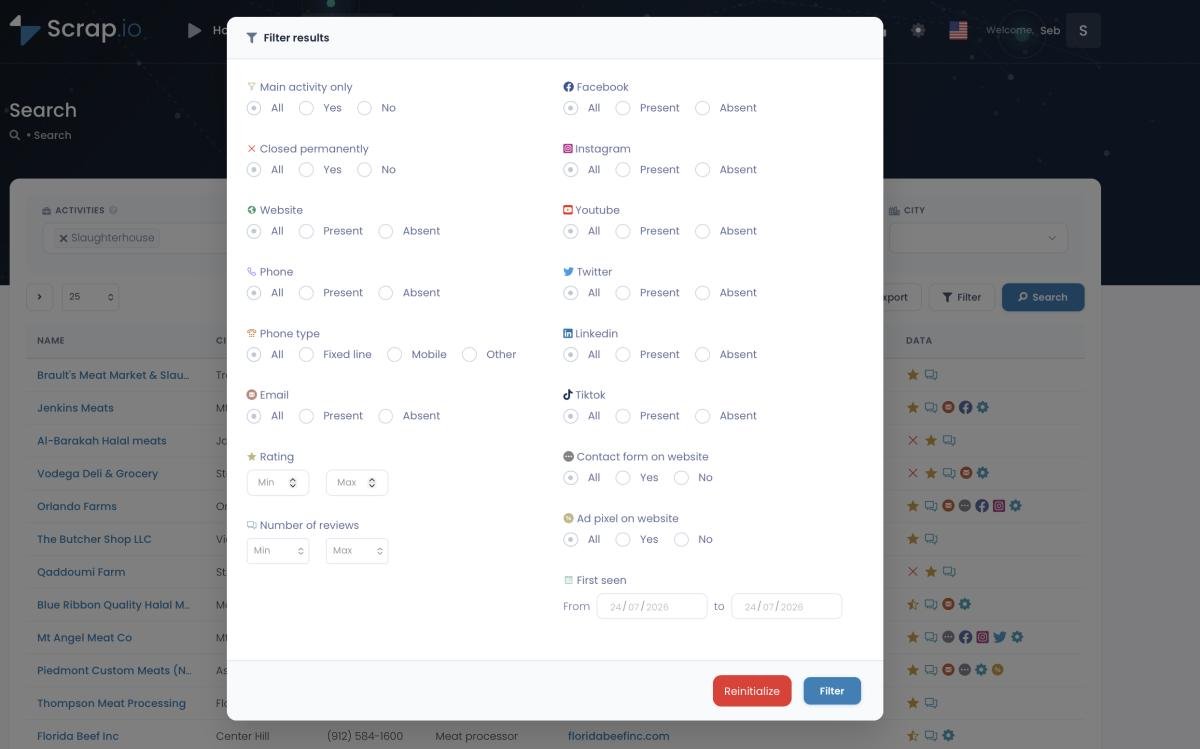
Step 2: Preview and refine. Scrap.io shows you the results on a map view. You can see business names, ratings, review counts, and whether an email is available, all before you export a single contact. Want only spas with 4+ stars? Only those with a website? Filter it down. This is the part that saves your money: you only pay for the 78,164 spas that actually have an email, not the whole 160,681.
Step 3: Export your spa email list. Hit export. You get a clean CSV or Excel file with every data point: business name, email, phone, address, website, rating, review count, Google Maps URL, and more. That's it. Two clicks, fresh data.
Watch it in action:
Video: How to Find the Best Email to Contact
One thing I want to be upfront about: Scrap.io pulls what's publicly listed on Google Maps. That 48.6% email coverage? It's real. Some spas simply don't list an email. But the emails you do get are the ones the business actually published, which means they're far more likely to be monitored than some random contact scraped from a WHOIS record.
Pricing starts at $35/mo for the Basic plan (annual), or $49/mo with no commitment, and includes 10,000 credits per month. One credit equals one exported business. If you re-export the same business within 30 days, it's free. And there's a 7-day free trial with 100 export credits to test it out.
Anyway, the best spa email list in 2026 is the one you pull yourself, right now, with live data. Not the one sitting in someone's database from last year.
What Data Is Included in a Spa Email List?
When people search for "buy spa email list verified contacts," they usually expect a CSV with names and emails. But a proper spa contact database gives you way more than that.
Here's what a typical Scrap.io export includes for each spa business:
- Business name and Google Maps category
- Email address (when publicly listed), classified as individual, contact, sales, marketing, or admin
- Phone number, yes, a spa email database with phone numbers exists
- Full address (street, city, state, ZIP)
- Website URL
- Google rating and total review count
- Business hours
- Google Maps URL (direct link to the listing)
- Google Place ID
Why does the extra data matter? Because a spa email list for marketing is only step one. The rating tells you if a business is thriving or struggling. The review count signals how established they are. The address lets you run hyper-local campaigns. And the phone number? That's your follow-up channel when email doesn't land.
Tools like Mangomint (spa management software) and Boulevard (high-end med spa platform) use exactly this kind of multi-point data for their outreach. Vagaro, which serves 220,000+ beauty and wellness businesses, also relies on enriched contact data for their partner acquisition campaigns.
How to Use a Spa Email List for Cold Email Campaigns
Having a spa email list for B2B sales is one thing. Actually getting responses? Totally different game.
Here's what works, and what doesn't, based on real-world spa outreach campaigns.
Segment Before You Send
Don't blast the same email to 10,000 spa owners. Would you pitch a $200/month booking tool to a rural day spa that's barely surviving on Yelp? Exactly. A day spa owner with 12 reviews in rural Ohio has nothing in common with a 5-star med spa in Beverly Hills. Segment by spa type, location, rating, and size. Your conversion rate will thank you.
Personalize Beyond {First_Name}
Spa owners get pitched constantly. Software vendors, product suppliers, marketing agencies, everyone wants their attention. A lazy "Hi {First_Name}" merge tag won't cut it. Reference their Google rating, mention their specific location, acknowledge their specialty. Show you actually looked at their business.
And here's something people on Reddit's r/coldemail keep running into. As one operator put it: "Let's say I scrape a list of companies from Google Business Profiles. How can I get the emails of the business owners/decision makers from that list?" That's the whole battle right there. Most outreach hits a receptionist inbox or a generic info@ that nobody checks. Individual emails (the ones Scrap.io tags with a first and last name) convert 3 to 5x better, but they're harder to find, which is exactly why the classification matters.
Keep It Short. Like, Actually Short.
5 sentences max for cold email. Spa owners are busy people running physical businesses. They're not sitting at a desk reading long emails. Your first email should be scannable in 10 seconds.
Follow Up (But Don't Be Annoying)
Three follow-ups, spaced 3 to 5 days apart. That's the sweet spot. After that, you're just burning goodwill. And whatever you do, don't follow up with "just checking in." That's a total waste of an email.
Email marketing still delivers $36 to $42 for every $1 spent (Litmus, 2025). But only if you do it right. Spray-and-pray doesn't work with spa owner leads for cold email. Targeted, relevant, and concise, that's what gets replies. Want the full playbook? Here's how to build a cold email list that actually lands.
Oh, and also, if you're targeting the broader beauty industry, check out our guide on skin care clinic email list sourcing. Similar audience, similar tactics.
Compliance & Legal: CAN-SPAM, GDPR, and Spa Outreach
Let's talk about the elephant in the room. Is it legal to use a spa email list for outreach?
Short answer: yes, with conditions.
In the US, the CAN-SPAM Act allows unsolicited commercial email as long as you: (1) don't use deceptive subject lines, (2) identify the message as an ad, (3) include your physical address, and (4) provide a working unsubscribe mechanism. That's it. No opt-in required for B2B email in the US.
GDPR is a different beast. If you're emailing spas in the EU, you need a "legitimate interest" basis for processing, and you must be transparent about how you got their data. Public business data listed on Google Maps generally qualifies, but you should still offer easy opt-out and be able to explain your data source if asked. We break the whole thing down in our cold email compliance guide if you want the country-by-country version.
Scrap.io is GDPR and CCPA compliant. They only extract publicly available business data. No personal consumer data, no scraped social profiles, no shady stuff. And every record is traceable back to its source, which is the one answer a regulator actually wants when they ask "where did you get this?"
My take? Follow the rules. Include an unsubscribe link. Honor opt-outs immediately. Don't spam. It's not just about avoiding fines. It's about building a reputation that lets you keep emailing long-term. One spam complaint to your ESP can torch your sender reputation faster than any fine ever could. (Trust me, rebuilding sender reputation is way more painful than just doing it right from the start.)
FAQ
How much does a spa email list cost?
It depends on the source. Traditional list brokers charge $0.10 to $0.50 per contact for basic data, or $1 to $3+ per "verified" contact. For 10,000 spa emails, you're looking at $1,000 to $5,000. With Scrap.io, plans start at $35/mo (annual) with a 7-day free trial and 100 export credits. The difference? You get live, fresh data instead of a static file that's already aging.
How many spas are there in the United States?
As of 2026, there are 160,681 spa businesses listed on Google Maps in the US, including 65,423 medical spas. Of those, 78,164 (48.6%) have a verified email address. The industry employs 376,200 people and generates $23.2 billion in annual revenue.
Is it legal to use a spa email list for outreach?
In the US, yes, under CAN-SPAM rules. You must include an unsubscribe option, your physical address, and honest subject lines. GDPR applies for EU contacts. Using publicly available business data (like Google Maps listings) is generally permissible, but always include opt-out mechanisms and honor them immediately.
How often should a spa email list be updated?
Every 30 to 90 days, minimum. The spa industry has high turnover. New businesses open, others close, ownership changes. Email addresses change too. Remember, the US count jumped by 5,673 spas in just a few months. A verified spa contact list from January could have a 15 to 20% bounce rate by June. That's why live extraction beats static lists: you get current data every time you pull.
Can I filter spa email lists by type (day spa, med spa) or location?
With Scrap.io, absolutely. You can filter by business category (day spa, medical spa, wellness spa), by location (state, city, ZIP code), by rating, by review count, and by whether an email or website is available. Filters apply before you export, so you only spend credits on contacts that match your criteria. Want only 4+ star med spas in Texas with a website? Done in seconds.
Is there a spa email list template I can download?
Sort of, and it's better than a blank template. Instead of formatting a spreadsheet by hand, Scrap.io hands you a ready-to-use CSV or Excel export with structured columns already in place: business name, classified emails, phone, address, website, rating, review count, and more. So the "template" fills itself with live spa data. Drop it straight into your CRM or cold email tool and you're sending the same afternoon.
Conclusion
Look, the spa market is massive. 160,681 businesses. $23.2 billion in revenue. Growing fast, and growing every single month.
But reaching spa owners with the right message at the right time requires the right data. Stale lists with bounced emails and receptionist inboxes aren't going to cut it. Not in 2026.
Whether you're selling spa software, beauty products, marketing services, or equipment, a fresh, verified spa email list is the difference between emails that land and emails that bounce. And building that list from live Google Maps data means you're always working with what's current. Not what was current six months ago, when there were 5,673 fewer spas to reach.
The question on Quora keeps popping up: "Where can I buy a spa email list?" The better question is: why buy yesterday's data when you can extract today's?
Generate a list of spa with Scrap.io