

Video: How to Extract Every Business in 1 Click (No Category)
- Texas Business Landscape in 2026: 3 Million Opportunities
- Major Business Hubs: Where Texas Companies Concentrate
- Industries Dominating the Texas Business Directory
- How to Search the Texas Business Directory in 2026
- Use Cases: Who Needs a Texas Business Directory?
- Texas Business Data: Key Statistics for 2026
- California Exodus: Why Companies Are Moving to Texas
- How Scrap.io Works for Texas Business Data
- Is Texas Business Data Legal to Use? (Compliance Guide)
- Frequently Asked Questions
- Ready to Tap Into 3 Million+ Texas Businesses?
Texas Business Landscape in 2026: 3 Million Opportunities
Texas just crossed the 3 million mark for registered businesses in late 2025. To put that in perspective, that's more than most European countries.
That's not a typo. That's not an estimate. That's the official count from the Texas Secretary of State as of November 2025.
And it's growing. Texas isn't slowing down. It's accelerating.
Key Economic Indicators
The numbers don't lie. Texas in 2026 is a different animal than it was five years ago.
Start with the headline: $2.77 trillion GDP (Texas Comptroller, 2024). That makes Texas the second-largest economy in the United States—bigger than the UK, bigger than India, bigger than almost every country on Earth.
But GDP is just one metric. Here's what matters more if you're looking for business opportunities: new businesses are being created at an insane pace. In 2025 alone, Texas saw 449,838 new business formations (Wolters Kluwer). That's 1,232 new companies. Every. Single. Day.
And jobs? Texas added 132,500 new jobs in 2025—#1 in the United States (Texas Governor's Office). Not second. Not tied. First. That's people starting companies, people expanding payroll, people betting on Texas.
Business Growth Trends (2024-2026)
Here's what you need to know about the trajectory.
Texas is concentrating Fortune 500 wealth like nowhere else. 54 Fortune 500 companies now call Texas home (Axios Dallas, 2025). Apple moved a campus there. Elon Musk moved Tesla's headquarters there. Oracle opened a major innovation hub.
It's not random migration. It's capital. It's tax policy. It's workforce.
But the real story isn't the mega-corporations. It's the SMBs. 3.5 million of Texas's 3+ million businesses are small businesses—99.8% of the economy (SBA Texas Profile). That's your addressable market if you're selling B2B. That's your prospect pool if you're doing outbound.
And they're not just surviving. They're hiring. They're spending. They're opening locations.
Why Texas Is the New Business Capital
You've heard this story before. Lower taxes. Lower regulation. No state income tax. But why does that matter to a business directory user?
Because density creates opportunity. When you concentrate growth, you concentrate leads. When businesses are actively relocating to a state, they're hiring. They're buying. They're expanding. They're moving their operations. All of that means budget. All of that means decision-makers.
Texas exports $455 billion annually (USTR, 2024). That's manufacturing, logistics, energy, software, pharmaceuticals. Every sector. Every vertical.
And here's the thing: Texas business data is fragmented. No single source has it all. If you want to find businesses registered in Texas—with actual contact information—you need more than one source. That's exactly why people search for a texas business directory.
Major Business Hubs: Where Texas Companies Concentrate
If you're targeting Texas businesses, where do you even start? With 254 counties and dozens of metro areas, the answer matters.
You don't prospect the whole state. You target the clusters.
Houston: 600K+ Businesses, Energy & Healthcare Hub
If you're searching the Houston Texas business directory, you're entering the oil capital of North America. Full stop. But it's not just energy anymore.
The Houston metro area is home to 600,000+ registered businesses. That's a city-state economy. The Texas Medical Center is the largest medical complex in the world. Royal Dutch Shell, ExxonMobil, ConocoPhillips—all HQ'd here. So are healthcare tech startups and biotech incubators.
Check out our Houston business directory for a deeper dive on targeting this market.
If you're selling to oil & gas, chemicals, refining, or healthcare—Houston is where the budget is concentrated.
Dallas-Fort Worth: 500K+ Businesses, Corporate HQ Capital
The Dallas Texas business directory tells a story of massive corporate migration. DFW is the new hot zone for corporate relocations. 100 major company headquarters have moved to DFW since 2018 (CoStar). Not branches. Not satellite offices. Headquarters.
We're talking 500,000+ businesses across the metro area. Toyota. Kodak. Bosch. Charles Schwab. JP Morgan has a massive operations center. American Airlines. Every major consulting firm.
This is white-collar concentrated. If you're selling SaaS to enterprise, if you're doing HR tech, financial services, logistics—DFW is density.
Austin: 200K+ Businesses, Tech & Startup Scene
The Austin Texas business directory reads like a Silicon Valley migration report. The "Silicon Hills" narrative is no longer narrative—it's reality. 200,000+ businesses in the metro area, with tech founding happening at warp speed.
Oracle, Apple, Tesla, Elon's X (formerly Twitter), IBM, Google—they've all moved major operations to Austin. But the story isn't the mega-companies. It's the venture capital flood. It's Y Combinator startups. It's the density of founders per capita.
Austin is where you're scraping for venture-backed SaaS companies, fintech, AI/ML, biotech. It's where the early-stage energy is.
San Antonio: Military, Healthcare & Tourism
San Antonio often gets overlooked in the Texas narrative. Mistake.
150,000+ businesses and a different economic engine: military (Fort Sam Houston, JBSA), healthcare, hospitality. USAA is HQ'd here—one of the largest insurance companies in America.
If you're targeting government contractors, healthcare logistics, or hospitality tech—San Antonio has a high concentration.
Here's what the geography looks like in a single table:
| Metro Area | Businesses | Fortune 500 | HQ Relocations (2018-24) | Source |
|---|---|---|---|---|
| Houston | 600,000+ | 26 | 31 | Houston.org, CoStar |
| Dallas-Fort Worth | 500,000+ | 21 | 100 | Axios, CoStar |
| Austin | 200,000+ | 4 | 81 | CoStar |
| San Antonio | 150,000+ | 1 (USAA) | — | City data |
Why does this matter? Because when you're searching a texas business directory by city, location is everything. You don't want 3 million results. You want the 600,000 in Houston if you're selling energy solutions. You want Austin if you're selling dev tools. The key is knowing how to find texas business contacts in the right metro.
Industries Dominating the Texas Business Directory
Texas doesn't just have businesses. It has entire ecosystems—from oil fields to operating rooms to server farms.
Industry concentration matters because it tells you where to point your prospecting efforts.
Energy & Oil/Gas ($190B+ GDP contribution)
Texas produces more oil than most countries. The numbers are staggering—and the B2B opportunity is equally huge.
If you're selling industrial software, equipment maintenance, supply chain logistics, or safety compliance—you have a multi-billion-dollar addressable market in Houston and the surrounding areas alone.
Technology & Software (Austin-Dallas-Houston triangle)
The Austin-Dallas-Houston tech corridor is real. Thousands of software companies, hundreds of VC-backed startups, dozens of major tech employers.
This is where you're sourcing engineering talent, this is where fundraising happens, this is where you're targeting if you're selling developer tools, cloud infrastructure, or SaaS.
Healthcare & Biotech (1.4M+ workers)
Texas has 1.4 million healthcare workers (BLS). That's a bigger population than several states. The Texas Medical Center alone employs 150,000+.
EHR software, medical device distribution, biotech manufacturing, clinical research—all massive verticals with concentrated opportunity in Houston and Austin.
Construction & Real Estate (fastest growth: +2.3% in 2025)
Texas is building. Dallas, Austin, Houston—all three are in major growth phases. Real estate is the second-largest sector in Texas, and it's accelerating.
Construction management software, workforce scheduling, materials procurement—every tool that keeps projects running is in demand.
Professional & Business Services (1.9M+ employed)
Accounting firms, law firms, consulting agencies, staffing companies—1.9 million people work in professional services across Texas.
This is the market for accounting software, client management tools, and HR platforms. If you want to search texas businesses by industry, professional services is where the volume is.
How to Search the Texas Business Directory in 2026
Sarah needed contact info for 500 HVAC companies in the Houston metro. She started with SOSDirect—and gave up after 47 searches at $1 each.
She wasn't dumb. The platform just wasn't designed for bulk discovery. If you need a texas business directory free search that returns actual contacts—SOSDirect isn't it. It's designed for compliance, not prospecting.
So what are your actual options for a texas business search in 2026?
SOSDirect (Texas Secretary of State) — $1/search, entity data only
This is the official state of Texas business directory. When you incorporate a business in Texas, it goes here.
You get registered business names, filing dates, registered agents, ownership structure. You do NOT get email addresses, phone numbers, revenue, or employee count.
And the interface? Manual search. One texas company search by name at a time—that sos direct business name search flow. At $1 per search. If you need 500 results, you're spending $500 and spending four hours minimum.
Visit sos.state.tx.us if you need basic entity data only.
Texas Comptroller Taxable Entity Search — free, tax status
This one's free. It shows businesses that have filed for sales tax, which means they're actively operating and generating revenue.
But again: no contact information. No employee count. No revenue data. You're just verifying that a business is real and tax-registered.
Check comptroller.texas.gov for tax entity verification.
Chambers of Commerce — local, limited
Join a local chamber, and you get access to a directory of member businesses. Good for local networking. Bad for bulk prospecting.
Limited data, high cost ($500-$2,000+ per year), and coverage that only extends to chamber members—maybe 10-20% of actual businesses in any given area.
Scrap.io — 3M+ businesses, real-time Google Maps data, 70+ data points
Different model entirely. Real-time Google Maps data—which means you're pulling verified business information that companies actively maintain.
Email addresses? We've got them. Phone numbers? Check. Website? Address? Google rating? Review count? Open hours? Photos? All of it.
Bulk export. API. Filtering. GeoSearch by radius or polygon.
You can target the Houston HVAC companies Sarah needed in about 10 minutes. Emails included.
Here's how the tools compare when you actually need to scale:
| Method | Cost | Data Points | Coverage | Real-Time | Bulk Export |
|---|---|---|---|---|---|
| SOSDirect | $1/search | 5-6 | Registered entities only | ❌ | ❌ |
| TX Comptroller | Free | 3-4 | Tax entities only | ❌ | ❌ |
| Chambers | Free-$500/yr | Varies | Local only | ❌ | ❌ |
| Scrap.io | From $49/mo | 70+ | 3M+ all TX businesses | ✅ | ✅ |
Now, when you're actually building outbound campaigns, you need more than just existence. You need contact information. You need filtering. You need the ability to extract all businesses from a city with specific attributes.
That's where a proper data platform matters. And that's why people use our USA business email database to build texas business directories—and, yeah, a proper texas business database—for their own use cases.
💡 Try it yourself: Scrap.io lets you search all 2.1M+ Texas businesses live on Google Maps and count the results for free—before you spend a single credit. Free trial included, with 100 leads to test the data on your own city and industry. Start your free trial →
Use Cases: Who Needs a Texas Business Directory?
You know what's worse than having no leads? Having 3 million potential leads and no way to filter them.
A texas business directory isn't useful unless it solves a real problem. So who's actually using this data?
Marketing Agencies & Lead Gen Companies
Lead gen agencies need volume. They need to scrape thousands of companies, validate contact information, and spin up outbound campaigns at scale.
Example: ResearchFDI works with Team Texas and has closed 4 enterprise wins since 2019 through prospecting, including Sunrider International: 200 jobs + $56M capital (Source: researchfdi.com).
They're pulling from a texas business directory. They're filtering by industry, size, location. They're validating emails. They're running sequences.
SaaS Companies Selling to Local Businesses
If you build software for SMBs—accounting, HR, scheduling, payment processing—you need a way to reach that market at scale.
Example: InboxArmy (based in Grapevine, TX) is a Klaviyo Silver Partner with 5,000+ brands using their platform and a 4.8x revenue increase (Source: klaviyo.com). They did that by targeting e-commerce businesses across regions—and Texas is one of their biggest playgrounds.
They needed a texas business list. They built one. That's also where a guide like our local business leads playbook comes in handy.
Commercial Real Estate & Insurance
Real estate agents and insurance brokers need to know who owns what. Who just moved HQ. Who's expanding operations. Who might need commercial space or liability coverage.
Example: Elevated Roofing (DFW-based) used outbound lead gen from a roofing contractor database and saw +340% leads, +300% revenue, +109% traffic (Source: improveandgrow.com).
They pulled from local directories. They filtered for residential and commercial properties. They ran paid ads to those lists. It worked.
Private Equity & Investment Research
PE firms, angel investors, and growth equity groups need to know what's happening in specific markets. Which industries are hot. Which companies are growing. Which are prime acquisition targets.
TAB (Texas Association of Business) partnered with Belkins on outbound lead gen targeting Oil, Gas & Tech sectors with 200 chamber partners. They built a full outbound sales channel from a curated texas business directory.
Oh, and there's also Texas Business Leads (texasbusinessleads.com)—they've been delivering weekly fresh Texas business leads since 1997. One customer testimonial: 41% business increase. 27+ years in the game.
Platforms like B2BLeads.io also maintain dedicated Texas databases—897,750+ businesses indexed. Point is, the demand for a comprehensive texas business contact database is massive.
Real talk from the community: "Best way to build a prospect list for Texas-based SMBs? I've tried ZoomInfo but it's too expensive for our startup budget." — r/sales
That's the gap. ZoomInfo is comprehensive but expensive. Government directories are free but unusable at scale. People looking for a texas business email list for marketing need something in the middle—affordable, verified, and bulk-ready.
Check out our guide on contractor email list for how to build prospecting lists for specific trades.
Texas Business Data: Key Statistics for 2026
449,838 new businesses were registered in Texas in 2025 alone. That's 1,232 new companies every single day.
But here's the number that actually matters if you plan to email anyone. The Secretary of State counts 3M+ registered entities. Registrations aren't contacts, though. A filing gives you a name and an agent, not an inbox. So we counted the reachable market ourselves.
Right now, Scrap.io indexes 2,120,792 Texas businesses live on Google Maps (Scrap.io data, July 2026)—1,232,677 with a website (58%) and 719,202 with a verified email (34%). That last number is your real addressable market for cold email. Not three million ghosts. Seven hundred thousand businesses you can actually contact.
Here's what the broader data looks like:
| Stat | Value | Year | Source |
|---|---|---|---|
| Total registered businesses | 3+ million | Nov 2025 | Texas Secretary of State |
| Businesses live on Google Maps | 2,120,792 | Jul 2026 | Scrap.io |
| With a verified email | 719,202 | Jul 2026 | Scrap.io |
| GDP | $2.77 trillion | 2024 | Texas Comptroller |
| New business formations | 449,838 | 2025 | Wolters Kluwer |
| Jobs added | 132,500 (#1 US) | 2025 | Texas Governor's Office |
| Fortune 500 companies | 54 | 2025 | Axios Dallas |
| Small businesses | 3.5 million (99.8%) | 2025 | SBA Texas Profile |
| Exports | $455 billion | 2024 | USTR |
| HQ relocations to DFW | 100 companies | 2018-2024 | CoStar |
These aren't predictions. These aren't projections. This is the list of all businesses in texas—right now, as of 2026.
And every single one of those live listings is a potential prospect. If you're looking for a texas business directory with phone numbers, emails, and verified addresses—this is your texas small business directory 2026.
California Exodus: Why Companies Are Moving to Texas
California lost 237+ businesses to relocation since 2005. Guess where most of them went.
12 of 17 California departures in 2024 went to Texas (CRE Daily). That's not a trickle. That's a wave.
And 2025 is continuing the trend. Chevron moved its headquarters from San Ramon to Houston. John Paul Mitchell Systems relocated from Beverly Hills to the Dallas area. Realtor.com moved operations to Texas.
Why? Tax policy. Workforce. Cost of living. Regulatory environment.
Dallas-Fort Worth is now the #1 destination for corporate HQ relocations in North America (Local Profile). That means hundreds of new decision-makers arriving every year. New CFOs. New procurement officers. New operations directors.
And when companies relocate, they hire. They expand. They invest. That's captured in a texas business directory. (Building the other side of that move? Our California business directory covers the state they're leaving.)
From the community: "Local Chambers of Commerce & Industry Associations are great starting points, especially for region-specific outreach."
How Scrap.io Works for Texas Business Data
You need every HVAC company in Houston with an email address, 4+ Google stars, and a website. Here's how long that takes.
About 10 minutes using Scrap.io. (Not 47 searches at $1 each. Not hours of manual data entry. 10 minutes.)
And the reason it's fast is the same reason the numbers up in section 6 exist: those 719,202 emailable Texas businesses come from filtering the full 2,120,792 Google Maps listings before you ever spend a credit. You're not buying a frozen file. You're pulling live data at the moment of export.
Video: Scrap.io - How to Start?
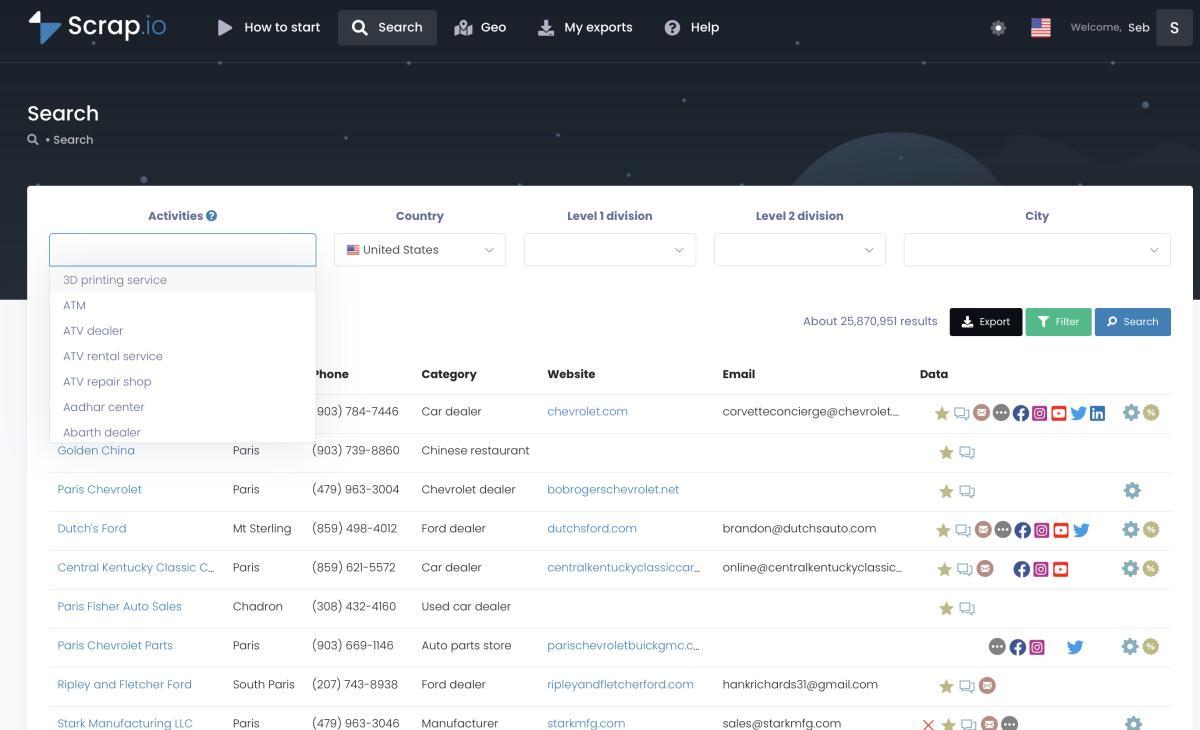
Step 1: Search by Location
Start with Houston or a radius around it. Add your industry filter (HVAC). Go.
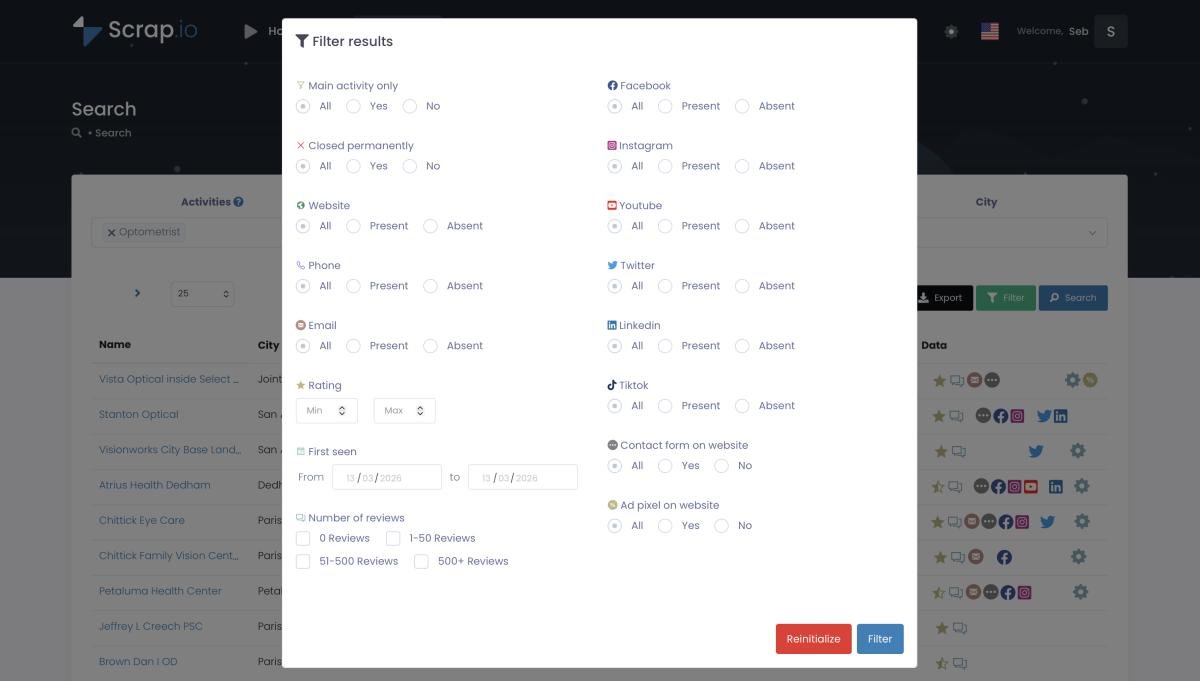
Step 2: Filter by Industry, Rating, Contact Data
Minimum Google rating? 4.0+. Must have email? Yes. Must have website? Yes. Industry codes? Narrow to HVAC contractors.
You're not looking at 600,000 Houston businesses anymore. You're looking at the exact subset you need. And because filters run before extraction, you only ever pay for the fiches worth calling.
Step 3: Export with 70+ Data Points
CSV. JSON. API. Pick your format. You get everything: company name, address, phone, email, website, review count, rating, hours, photos, CEO name if available. It's a texas company database with emails, phone numbers, and 70+ data points.
Want to download a texas business list? One click. Done.
Step 4: GeoSearch for Precise Targeting
Don't want to target all of Houston? Draw a radius. Or draw a polygon. Or target a specific neighborhood. This is how to access texas business data at the granular level—Scrap.io finds every business inside those boundaries.
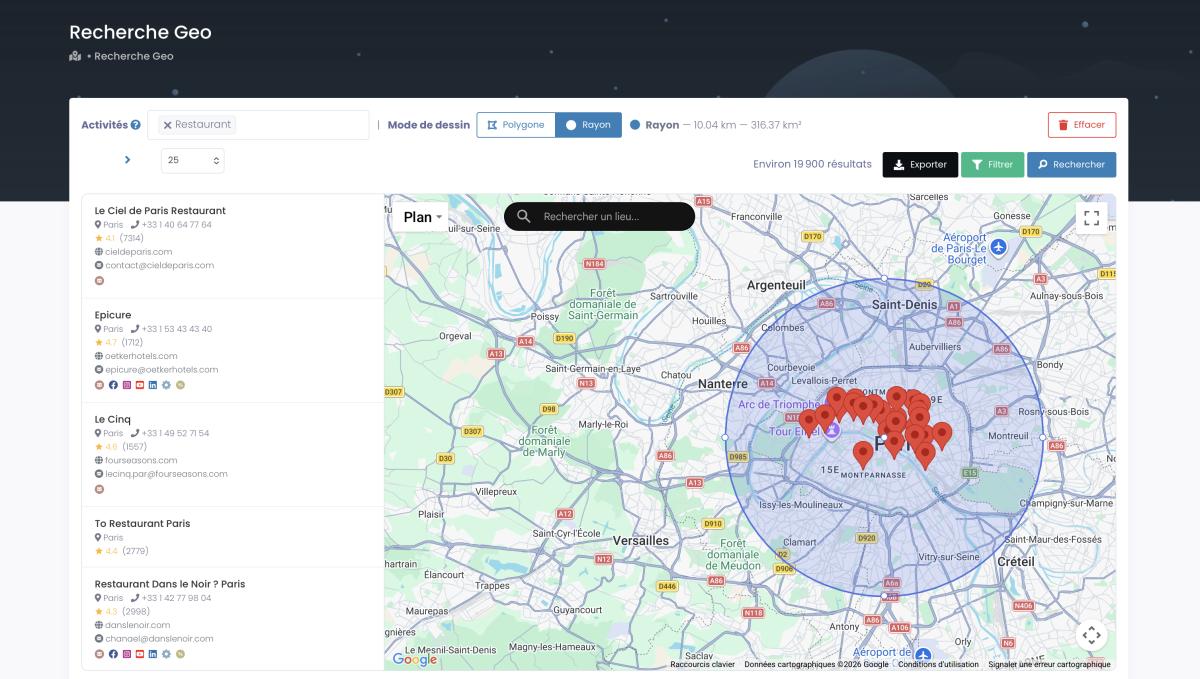
Need a shape that isn't a circle? Draw a polygon by hand over an exact district—downtown Houston, a single DFW suburb, whatever catchment area you're actually selling into. Every filter still applies inside it.
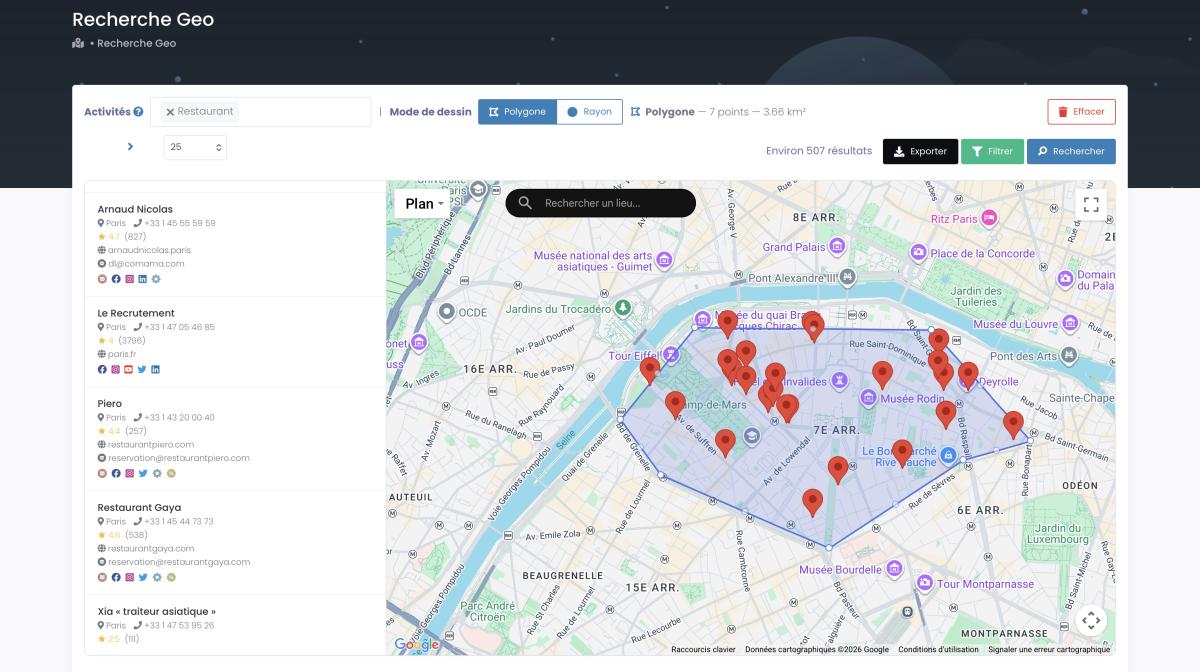
This is how you build a texas business list that's actually usable.
Read our full guide on how to find email addresses from Google Maps.
Or dive into our Google Maps scraping guide for advanced tactics.
Video: How to Scrape Local Leads at the Country Level
🚀 See it in action: Target the exact Houston HVAC list—email present, 4+ stars, website—in about 10 minutes, pulled live from the 719,202 emailable Texas businesses on Google Maps. Free trial, 100 verified leads included. Start free →
Is Texas Business Data Legal to Use? (Compliance Guide)
Before you download a single email, let's talk about what's legal—and what isn't.
Here's the short answer: Public data from Google Maps is legal to use in the US. Full stop.
Google publishes business information publicly. Anyone can view it. You're not hacking anything. You're not accessing private databases. You're not stealing trade secrets. You're reading what Google shows you and organizing it into a spreadsheet.
But (and this is important), you still need to follow email compliance laws.
CAN-SPAM: If you're sending emails to those business contacts, you need to include an unsubscribe link, your physical address, and identify the message as promotional if it is. B2B outbound is technically less regulated than B2C, but compliance still matters.
CCPA (California Consumer Privacy Act): If any of your Texas prospects are also California residents (for sole proprietorships, for instance), you need to honor their privacy rights. But for business contacts? B2B data is generally exempt.
Texas Law: Texas doesn't have state-level privacy laws that restrict business data usage. Your main compliance concern is CAN-SPAM and FCC rules for any automated calling.
Bottom line: Scraping business data from Google Maps is legal. Using that data for outbound prospecting is legal. Scrap.io only pulls publicly available business data, keeps it GDPR and CCPA compliant, and every field stays traceable to its source. Just follow email compliance laws and you're fine.
Read our detailed guide: Is it legal to scrape Google Maps?
From the community: "How do I find contact information for all restaurants in Houston?" — Quora
Answer: Legal tools and methods. No grey area needed.
Frequently Asked Questions
How many businesses are registered in Texas in 2026?
Over 3 million active business entities as of late 2025, with 449,838 new filings in 2025 alone. Texas adds roughly 1,232 new businesses every day. (Source: Texas Secretary of State, Wolters Kluwer)
What industries dominate the Texas business landscape?
Energy ($190B+ GDP), professional services (1.9M employed), technology, healthcare (1.4M workers), and construction (+2.3% growth). The Texas economy is diversified but concentrated in specific metro areas. (Source: Texas Comptroller, BLS)
How can I access a complete Texas business directory?
Scrap.io indexes 2,120,792 Texas businesses live on Google Maps (719,202 with a verified email) with 70+ data points each—email, phone, website, and social media. It's the most comprehensive texas local business directory online. You can filter by city, industry, rating, and contact availability, then export everything in one click.
Which Texas cities have the most businesses?
Houston (600K+), Dallas-Fort Worth (500K+), Austin (200K+), and San Antonio (150K+). DFW leads nationally for corporate HQ relocations with 100 companies moving there since 2018. (Source: Houston.org, CoStar)
Is Texas business data legal for commercial use?
Yes. Public business data from directories and Google Maps is legally available under US law. CAN-SPAM compliance is required for email outreach (unsubscribe link, physical address, no deceptive headers). Scrap.io data is 100% CCPA compliant.
Ready to Tap Into 3 Million+ Texas Businesses?
You now know what's in the texas business directory. You know where the concentration is. You know what data sources actually work at scale.
Now it's time to act.
Stop manually searching SOSDirect. Stop paying $1 per lookup. Stop building lists by hand.
The reachable market is sitting right there: 719,202 Texas businesses with a verified email, live on Google Maps, filterable by city and industry before you pay for a thing.
🎯 Start your free 7-day trial — 100 verified Texas business leads included, with emails, phones, and 70+ data points per listing. Trusted by 50,000+ professionals (4.8 on Capterra, 4.9 on G2). Claim your free leads →
3 million+ companies registered. 2.1 million live on Google Maps. 719,202 you can actually email. Real-time updates. No BS.
That's your texas business directory in 2026.
Generate a list of restaurant with Scrap.io