

Here's a number that should make you uncomfortable: roughly 23% of email lists decay every single year, and for B2B it climbs to 25-30%. That's according to ZeroBounce's 2026 Email List Decay Report, built on more than 11 billion verified emails. One in four addresses sitting in your CRM right now? Probably dead.
And yet people keep blasting cold emails into the void, hoping for the best. Bold strategy.
The thing is, you don't need to send an email to know if an address is real. There are at least seven ways to verify an email address without sending an email, from quick syntax checks to full SMTP handshakes. Some are free. Some are instant. And the best ones can process thousands of addresses in minutes.
This guide walks through all of them, with real tools, real benchmarks, and zero guesswork.
Video: How to Identify Spam Emails: A Guide to Avoid Sending Them in Your Prospecting Campaigns
Table of Contents
- Why You Should Never Send a Test Email to Verify an Address
- 7 Methods to Verify an Email Without Sending One
- The Catch-All Domain Problem (And How to Handle It)
- Manual vs. Automated Verification: Which One Should You Use?
- Top Email Verification Tools Compared (2026)
- How to Verify Emails Extracted from Google Maps (The Scrap.io Workflow)
- Compliance & Legal Considerations
- FAQ
Why You Should Never Send a Test Email to Verify an Address
What happens when you hit Send on a bad address? Nothing good.
The email bounces. Your ESP logs it. Your sender reputation takes a hit. Do that enough times, and Gmail, Outlook, and Yahoo start routing your legitimate emails straight to spam. According to Snov.io's outreach team, recovering from sender reputation damage takes 15 to 45 days. Send a hundred bad emails in one batch? You might not recover at all.
The industry benchmark is clear: keep your bounce rate under 2%. Anything above that, and email providers start treating you like a spammer. (Clean.email's 2026 industry report backs this up.) A quick refresher on what actually counts against you: the difference between a soft bounce and a hard bounce is the difference between a second chance and a permanent black mark.
But here's what kills me. People still use "send a test email" as their verification strategy in 2026. That's like testing whether a bridge is safe by driving a truck across it. There are better ways.
Way better.
7 Methods to Verify an Email Without Sending One
The good news? You don't have to play Russian roulette with your sender score. Here are 7 methods that check if an email is valid, without ever hitting Send. Ranked from basic to bulletproof.
1. Syntax & Format Check
The simplest filter. Does the address follow the standard format? [email protected], no spaces, no double @, no missing dots. You'd be surprised how many lead lists contain garbage like john@@company..com or addresses with accidental spaces.
A regex pattern catches these instantly. Free, fast, and it eliminates the obvious junk. But it tells you nothing about whether the mailbox actually exists. Think of it as a bouncer checking IDs at the door: it catches the fakes, not the expired ones.
2. DNS & MX Record Lookup
Now we're getting somewhere. An MX record lookup checks whether the domain in the email address has a mail server configured. No MX record? No mail server. No mail server? That address isn't receiving anything.
You can do this manually with tools like MXToolbox or via the command line (nslookup -type=MX domain.com). This step catches typo domains, defunct companies, and addresses using domains that were never set up for email in the first place. Fast, free, and genuinely useful.
3. SMTP Handshake (Without Sending)
This is where SMTP email verification gets interesting. Here's how it works.
Your server connects to the recipient's mail server. It initiates the send sequence (HELO, MAIL FROM, RCPT TO) and then, it disconnects. Before any message is actually delivered. The server's response code tells you everything: a 250 OK means the mailbox exists, a 550 means it doesn't.
Sounds perfect, right? Almost. Some servers accept everything (more on that in the catch-all section). And some servers will block you if you run too many SMTP checks in rapid succession. Still, for single-address verification, this is as close to certainty as you can get without pressing Send.
As one Quora contributor put it: "You can start an SMTP session with MAIL FROM and RCPT TO, then quit before DATA. This verifies the recipient without actually sending."
4. Use a Dedicated Email Verification Tool
OK but here's the practical reality: if you're verifying more than a handful of addresses, you need a tool. An email address validator like ZeroBounce, Hunter.io, or Verifalia runs all of the above checks automatically. Syntax, DNS, MX, SMTP, disposable detection, catch-all flagging. The whole stack. For a broader look at the manual and automated options side by side, we cover nine of them in the guide on how to check if an email is valid.
ZeroBounce reported 97% verification accuracy in Instantly.ai's 2026 benchmark test of 8 leading tools. That's the highest score recorded. And they found 2.6 billion invalid emails in their 2025 dataset alone. Let that sink in.
Most tools offer free tiers for small volumes. For serious prospecting, expect to pay $0.003-$0.01 per email. Worth every cent when the alternative is a blacklisted domain.
💡 Want to test this on real business emails? Scrap.io gives you 100 free leads from Google Maps to practice with, pulled in real time from live listings across 225M+ businesses. Extract real business contacts, then run them through any verification tool. Free trial, 100 leads included.
5. Leverage Google & Social Media Profiles
Old school, but it works. Paste the email address into Google. Check LinkedIn. Check the company's About page. If the person exists and the email format matches the company pattern ([email protected]), you've got a strong signal.
This isn't scalable. Obviously. But when you absolutely need to confirm that one critical lead before your outreach campaign? Five minutes of Googling beats a bounced email any day.
6. Check Against Known Disposable Email Providers
Mailinator. Guerrilla Mail. 10MinuteMail. There are hundreds of disposable email services, and people use them to sign up for things they don't care about. If a lead gave you a throwaway address, you want to know before wasting a cold email on it.
Most verification tools include disposable detection. As one Quora contributor explained, "Some services detect disposable or temporary email addresses by checking against a database of known disposable providers." You can also check against open-source lists on GitHub. One more junk filter before you hit Send on your campaign.
7. Bulk Verification via API
When you're working with 5,000+ leads (and you should be, if you're doing B2B prospecting seriously), manual verification is masochism. An email verification API lets you pipe your entire list through automated checks in minutes. If bulk is your world, our email validator guide goes deep on verifying whole lists and the fresh-data-vs-old-lists math.
ZeroBounce, NeverBounce, Hunter, and Verifalia all offer REST APIs. Upload your CSV or connect via webhook. Get results in JSON. Integrate it into your CRM or outreach tool. Companies using real-time API verification at form capture see a 74% reduction in invalid addresses compared to batch-only verification.
For developers, this is the obvious path. For everyone else, the CSV upload works just fine.
The Catch-All Domain Problem (And How to Handle It)
A 250 OK response from the mail server looks like a green light. But with catch-all domains, it's more like a yellow. Sometimes a red.
Here's the deal. Some companies configure their mail servers to accept email for any address at their domain. [email protected]? Sure, accepted. [email protected]? Also accepted. The SMTP handshake returns 250 OK for everything. Useless.
No verification tool can reliably distinguish real inboxes from fake ones on catch-all domains. Not one. Anyone who tells you otherwise is selling something. A developer on the r/webdev thread said it flat out: "There's no way to verify a given email address exists without sending an email and having them perform some action (click on a one-time link)." He's not wrong about the edge case. The SMTP handshake gets you 95% of the way; a catch-all mailbox that accepts the connection can still be a black hole.
So what do you do? Flag them. Most decent tools label catch-all addresses separately. From there, you can either risk sending (with a lower confidence score) or cross-reference with LinkedIn and company websites to confirm the person exists. My advice? If you're sending cold email, treat catch-all results as "proceed with caution" rather than "verified."
Manual vs. Automated Verification: Which One Should You Use?
Meet Sarah. She's a sales rep at a SaaS startup, and every Monday she manually verifies 50 email leads. She Googles each name, checks LinkedIn profiles, looks up MX records. It takes her 3 hours. Her colleague Jason uses an API and does 5,000 in 4 minutes.
Guess who closes more deals.
Manual verification makes sense in exactly two scenarios: when you have fewer than 10 addresses to check, or when you need absolute certainty on a high-value lead (think C-suite contact at a target account). For everything else, automated tools deliver a 10-20x ROI through prevented blacklisting and a 15-25% lift in open rates.
And honestly? Even the "manual" approach should use at least an MX lookup and a syntax check. Nobody should be eyeballing email formats in 2026. That's not verification. That's guessing with extra steps.
Bottom line: if you're verifying more than 20 emails per week, automate it. Your time is worth more than $0.004 per email.
Top Email Verification Tools Compared (2026)
The email verification market crossed $1.2 billion in 2026, projected to hit $3.5B by 2033 at a 15.8% CAGR (OpenPR / Business Research Company). With dozens of tools fighting for your budget, here's how the top 5 actually stack up.
| Tool | Accuracy | Price (per 1K) | Free Tier | API | Best For |
|---|---|---|---|---|---|
| ZeroBounce | 97% ✅ | $16 | 100/month | ✅ | Maximum accuracy |
| NeverBounce | 95% | $8 | 1,000 free | ✅ | Budget-conscious teams |
| Hunter.io | 94% | $49/1K credits | 25/month | ✅ | Find + verify combo |
| Verifalia | 96% | $14.90 | 25/day | ✅ | API-first teams |
| Snov.io | 93% | Included in plan | 50/month | ✅ | All-in-one outreach |
Quick reality check: ZeroBounce wins on accuracy, but it's also the priciest per verification. NeverBounce is the sweet spot if you're processing large volumes on a budget. Hunter shines when you need to find emails and verify them in one workflow. Snov.io bundles verification into its outreach platform, which makes sense if you're already using it for cold email.
Oh, and one honest caveat: no tool hits 100%. That Quora thread saying "the only guaranteed method is sending a verification email and getting a response" isn't wrong. But a 97% accuracy rate is more than good enough for cold outreach. The remaining 3% is what your bounce rate tolerance is for.
📌 Over 50,000 professionals use Scrap.io to extract verified emails from Google Maps before running them through these tools. Fresh data from Google Maps, filtered to email-present listings before you spend a credit, plus a verification pass equals a clean list, low bounces, more replies. Free trial, 100 leads included.
How to Verify Emails Extracted from Google Maps (The Scrap.io Workflow)
You just scraped 5,000 local business emails from Google Maps. Exciting, right? Until 23% bounce and your domain gets flagged.
That's where the workflow matters. Here's how smart prospectors handle it.
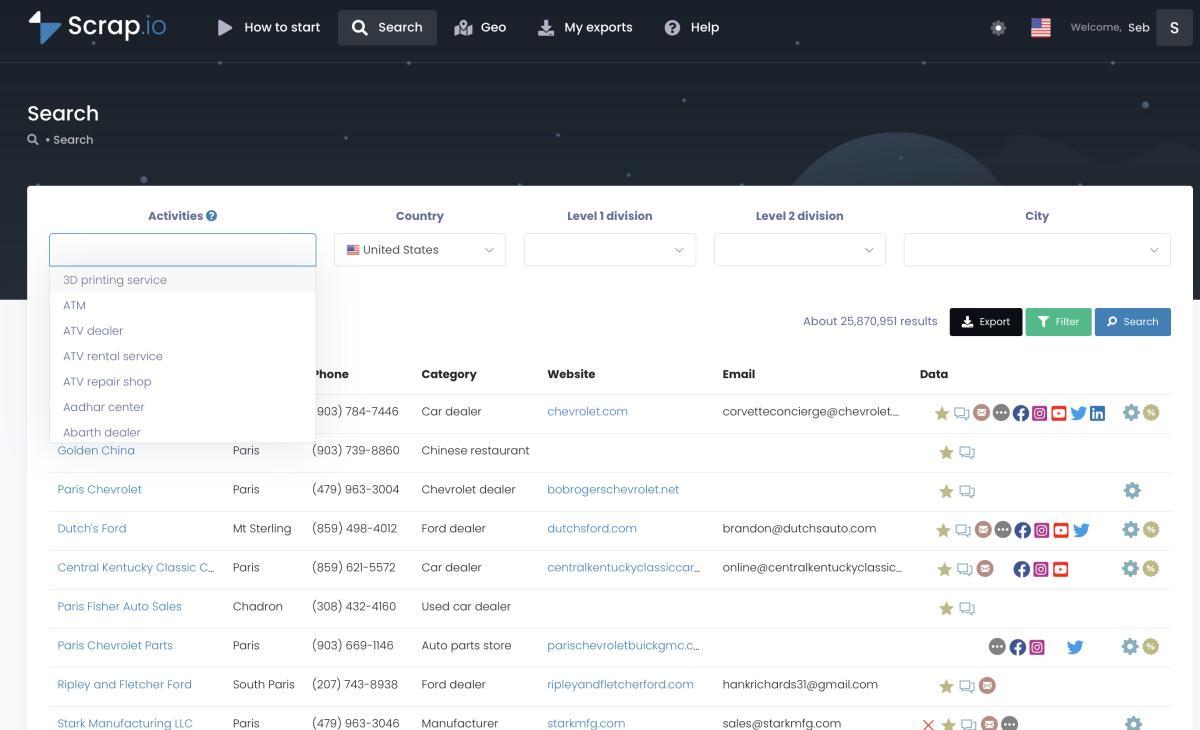
- Extract your leads with Scrap.io (search by industry, location, ratings, whatever). You get business names, emails, phones, addresses, and more. The advantage over static cold email lists you build the old way? Google Maps data is continuously updated by the business owners themselves, so it's fresh at the moment of export instead of rotting at 23% a year like a purchased file.
- Filter to "email present" before extraction. This is the part that saves your budget. Toggle the email filter so you only export listings that actually have an address on file. Zero credits wasted on blanks.
- Export to CSV in one click.
- Run it through a verification tool (ZeroBounce, NeverBounce, or Verifalia). Upload the CSV, wait a few minutes, get your results with status flags: valid, invalid, catch-all, disposable.
- Clean the list. Remove invalid and disposable addresses. Move catch-all results to a separate "maybe" segment.
- Launch your campaign. With a verified list, your bounce rate stays under 2% and your sender reputation stays intact.
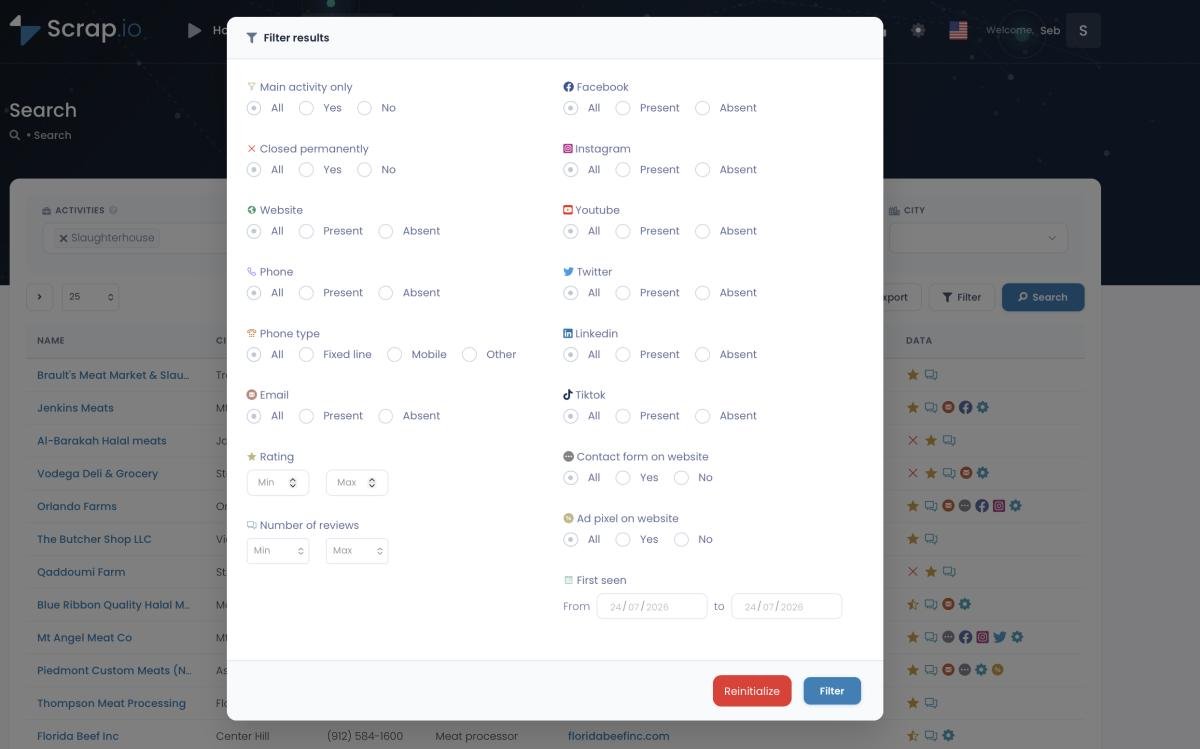
The whole process takes maybe 20 minutes for 5,000 leads. Compare that to manually Googling each address. (Try it. I'll wait.)
For a deeper dive on the extraction side, check out the complete Google Maps scraping guide or learn how to find email addresses from Google Maps.
Video: Why Your Google Maps Emails Don't Get Replies?
🚀 Extract, export CSV, verify, launch. Scrap.io pulls fresh business emails from Google Maps across 195 countries and 4,000+ categories, filtered to email-present contacts before you spend a credit. Try it free, 100 leads included.
Compliance & Legal Considerations
Verifying an email address isn't the same as sending unsolicited messages. But CAN-SPAM, GDPR, and CCPA still have rules you need to know.
Good news first: the verification process itself (syntax checks, MX lookups, SMTP handshakes) doesn't involve sending any content to the recipient. No message reaches their inbox. So the act of verifying doesn't trigger anti-spam regulations.
Now the slightly less fun but absolutely essential part. What you do with those verified addresses matters. CAN-SPAM requires an opt-out mechanism in every commercial email. GDPR requires a legal basis for processing personal data (including email addresses) in the EU. CCPA gives California residents the right to know what data you hold on them.
Bottom line: verify freely, but send responsibly. If you want to keep those campaigns landing in the inbox, it's worth learning how to avoid sending spam emails in prospecting. And if you're scraping business data from public sources like Google Maps, make sure you understand the legal landscape around Google Maps scraping. It's less scary than people think, but it's worth reading up on.
FAQ
Can you check if an email exists without sending anything?
Yes. Tools and manual checks (syntax, DNS/MX lookup, SMTP handshake) confirm whether a mailbox exists without delivering a message. No email reaches the recipient. Catch-all domains are the one exception, since they accept mail for every address and can't be confirmed individually.
Can I verify an email address for free without sending a message?
Yes. Free tools like Verifalia and Hunter's free tier let you verify a handful of emails daily using syntax checks, MX lookups, and SMTP probes, all without sending a single email. For bulk verification, you'll need a paid plan, but the per-email cost is tiny ($0.003-$0.01).
How accurate are email verification tools in 2026?
Top tools like ZeroBounce achieve 97% accuracy. However, catch-all domains remain a blind spot for all verification services, which is why no tool claims 100%. That's not a bug. It's a technical limitation of how email servers work.
What is an SMTP handshake and how does it verify an email?
An SMTP handshake connects to the recipient's mail server and initiates a send sequence (MAIL FROM then RCPT TO) but disconnects before actually delivering a message. The server's response code (250 OK for valid, 550 for invalid) tells you whether the mailbox exists. No email is ever sent.
How often should I verify my email list?
At minimum, quarterly. For B2B lists used in cold outreach, monthly is better. B2B contacts decay at roughly 2-3% per month, which works out to more than 20% a year: people change jobs, companies fold, domains expire. A list you verified in January is already about 10% less accurate by April.
Is it legal to verify someone's email address without their consent?
Verification itself doesn't send any message and doesn't violate CAN-SPAM, GDPR, or CCPA. However, how you use the verified address afterward must comply with applicable regulations, especially if you plan cold outreach in the EU, where GDPR requires a legitimate interest basis.
Conclusion
Look, the math is simple. Verifying emails costs pennies. Not verifying costs you your sender reputation, your open rates, and potentially weeks of recovery time. Every method in this guide, from a basic syntax check to a full API integration, gives you a layer of protection.
And if you're building lead lists from Google Maps (which, honestly, you should be for local B2B prospecting), the workflow is dead simple: extract with Scrap.io, verify with any tool from the comparison table, launch your campaign with confidence.
Stop guessing. Start verifying.
🚀 Try Scrap.io free, 100 leads included. Extract real business emails from Google Maps, filtered to email-present contacts before you spend a credit, verify them before your first campaign, and keep your bounce rate where it belongs: under 2%. Build your cold email list next →
Generate a list of restaurant with Scrap.io