

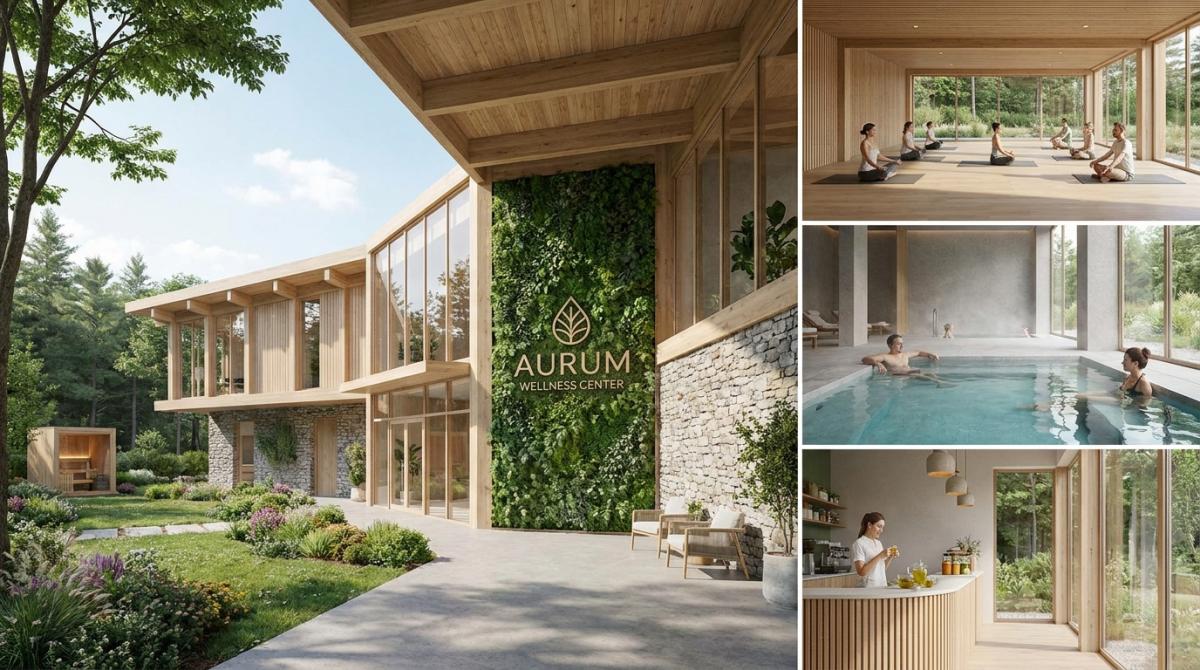
85,355. That's how many wellness centers are currently listed on Google Maps in the United States. Not a round estimate pulled from some industry report two years ago. An actual, live count.
Now here's the part that should bother you: most people selling to these businesses have no idea how to reach them. They buy some generic "health and wellness" list from a broker, blast 5,000 emails, get a 0.8% open rate, and conclude that cold email doesn't work. Nah. Their list didn't work.
I've been watching the wellness industry email game for a while now, and the gap between people who do this well and people who waste money is almost entirely about data. Not copywriting. Not subject lines. Data. Who you're emailing, whether that email address actually exists, and whether the person on the other end runs a wellness center or retired three years ago.
This guide covers everything you need to build a wellness center email list that actually converts in 2026: how to find wellness center emails using Google Maps extraction, what data points matter, how to stay legal, and what kind of results you can realistically expect. No fluff. No "comprehensive overview of the wellness landscape." Just the stuff that works.
Video: Scrap.io - How to Start?
- What Is a Wellness Center Email List (And Why 85,355 US Businesses Are Up for Grabs)
- The $2.1 Trillion Wellness Market Opportunity in 2026
- What Data Should a Wellness Center Email List Include?
- Building vs. Buying Wellness Email Lists: The Real Comparison
- How to Pick the Right Wellness Center Email List Provider
- How Scrap.io Gives You 48,178 Verified Wellness Emails in 2 Clicks
- Cold Email Best Practices for Wellness Centers in 2026
- Legal Compliance: CAN-SPAM, GDPR & HIPAA for Wellness Outreach
- Measuring ROI: What to Expect from Wellness Email Campaigns
- FAQ
What Is a Wellness Center Email List (And Why 85,355 US Businesses Are Up for Grabs)
There are exactly 85,355 wellness centers listed on Google Maps in the US right now (Scrap.io live data, August 2026). The question is: how many of them know you exist?
A wellness center email list is a database of contact information (emails, phone numbers, addresses, owner names) for businesses operating in the wellness space. We're talking yoga studios, holistic health centers, wellness retreats, day spas, meditation centers, acupuncture clinics, even mindfulness practices. Need a mental health wellness center email list specifically? Same workflow, you just filter the category. The whole ecosystem of places where people go to feel less terrible about being alive in 2026.
(OK, that's a bit dramatic. But you get the point.)
Here's what makes this niche interesting for B2B outreach. Wellness center owners aren't sitting in offices scrolling LinkedIn all day. They're hands-on. Running sessions, managing staff, doing actual wellness stuff with actual humans. Which means traditional sales channels (cold calls, LinkedIn DMs, trade shows) are brutally inefficient. Email catches them during the 20 minutes they spend reviewing business stuff before their first client shows up.
But not all wellness center contact lists are worth your time. The spa email list space is full of brokers selling the same recycled database from 2023 to everyone. Half the emails bounce. A quarter of the businesses have closed. And the other quarter are being hammered by your competitors who bought the same file. Sound familiar?
Out of those 85,355 US wellness centers, 70,852 have a website (83.0%) and 48,178 have an extractable email address (56.4%), all Scrap.io live data from August 2026. The rest? No online presence, no email on file, no way to reach them digitally. Knowing these numbers before you start saves you from paying for contacts that don't exist. If you're wondering how to get wellness center email addresses without wasting time on dead ends, that's literally what this guide is for. The same logic applies whether you're chasing yoga studios, a massage therapist email list, or holistic clinics next door.
The $2.1 Trillion Wellness Market Opportunity in 2026
The US wellness economy just crossed $2.1 trillion. That's not a projection, that's where we are, according to the Global Wellness Institute. The US market alone dwarfs every other country and grew at 7.9% a year from 2019 to 2024.
Drill down a bit. The Health & Wellness Spas segment specifically is worth $23.2 billion with roughly 19,400 businesses, per IBISWorld 2026 data. And the broader picture is even bigger: the global wellness economy hit a record $6.8 trillion in 2024 and is forecast to reach $9.8 trillion by 2029 (Global Wellness Institute, 2024 Global Wellness Economy Monitor), growing around 7.6% annually.
So the money is there.
Massive.
But here's what those macro numbers actually mean for someone trying to sell to wellness centers: these businesses buy stuff. Regularly. Equipment, software, supplies, marketing services, payment solutions, booking platforms. And they make purchasing decisions fast because most are independently owned. No procurement committee, no 6-month approval process. The owner decides, the owner buys.
The challenge? Reaching them. A wellness retreat owner in Sedona isn't browsing vendor catalogs between crystal healing sessions. You need their email. And it needs to be current. Whether you're looking for a healthcare email list or a niche health spa mailing list, the fundamentals are the same: fresh data beats everything.
Curious how many wellness centers are in your state? Count them for free on Scrap.io. Counting consumes zero credits, in the app or the API. See exactly how many wellness centers, yoga studios, or holistic health centers exist in any US state or city before you commit to anything.
What Data Should a Wellness Center Email List Include?
What's worse than having no email list? Having one where half the addresses bounce.
A good wellness center database goes way beyond email addresses. Here's what you should expect, and what you should refuse to pay for if it's missing:
- Business email (ideally classified: owner email, contact@, info@, sales@)
- Phone number (for calls or SMS follow-up)
- Physical address (for geographic targeting)
- Website URL (to verify the business is real and active)
- Google rating + review count (tells you a LOT about business health)
- Social media profiles (Facebook, Instagram, LinkedIn, TikTok)
- Business category (yoga studio is not a medical spa is not a wellness retreat)
If a provider hands you a CSV with just names and emails, no phone, no website, no rating, that's not a medical spa email database or a wellness center contact list. That's a gamble. The more data points per record, the better you can segment, personalize, and avoid wasting credits on dead leads. Scrap.io even classifies the emails it finds: the owner's personal address gets separated from contact@, sales@, and marketing@, so you know who you're actually writing to.
Bref, don't settle for thin data. You'll regret it at campaign time.
Video: How to Find the Best Email to contact?
Building vs. Buying Wellness Email Lists: The Real Comparison
Meet Jake. He spent 3 weeks manually collecting wellness center email addresses from Google Maps. He ended up with 200 contacts and a repetitive stress injury. There's a better way.
You've got three options for building a wellness center contact database USA: do it yourself, buy a static list, or scrape live data. Let me save you the suspense. One of these is dramatically better than the other two.
| Factor | DIY Manual Collection | Buy Static List | Live Scraping (Scrap.io) |
|---|---|---|---|
| Data freshness | Outdated immediately | Static snapshot | Real-time |
| Cost per contact | Free (but time-expensive) | $0.05 to 0.25 / contact | ~$0.004 / contact |
| Coverage | City-by-city | Limited database | Country-wide (195 countries) |
| Filtering | None | Basic demographics | 15+ filters (email, rating, reviews...) |
| Duplicates | Manual check | Unknown overlap | Auto-deduplication |
| Time to 10,000 leads | Weeks/months | Minutes (payment) | Minutes (scraping) |
| Exclusivity | Your data | Shared with competitors | Unique per export |
The math is pretty brutal for DIY. If you're paying someone $25/hour and they find 15 contacts per hour (optimistic), that's $1.67 per contact in labor alone. No verification, no filtering, no deduplication. Just raw research time. And by the time you finish your list of 10,000, the first contacts you collected are already going stale.
Buying a static list from a broker? Faster, sure. But you're getting the same wellness industry email database that your competitor bought last month. And the data was probably compiled three to six months ago. In a sector where businesses open and close constantly, that's an eternity. If you want the full teardown of why that model breaks, we wrote a whole guide on how to build a cold email list from scratch.
And then there's live scraping. Extract every wellness center in the entire US, all 85,355 businesses, with current data, filtered before you pay. Only want businesses with an email AND a website AND a 4+ star rating? Two clicks. That's the approach that companies like Zenoti (SaaS for wellness chain management, operating in 50+ countries, source) use to find their next clients. When you're selling software to wellness centers at scale, stale data is basically burning money.
How to Pick the Right Wellness Center Email List Provider
90% of email list providers sell you the same stale database they sold to your competitor last month. Here's how to spot them.
Red Flags
They promise 100% accuracy. Impossible. Run. Even the best datasets have some decay: wellness centers close, owners change, emails get updated. Anyone claiming perfection is lying.
They won't show sample data. If a provider refuses to show you 10 to 20 actual records from their wellness center contact list before you pay, they're hiding something. What exactly? Probably a lot of bounced emails and closed businesses.
Suspiciously cheap pricing. A "wellness center email database" for $0.01/contact? You get what you pay for, quoi.
Vague about data sources. "Our proprietary methods" translates to "we bought this from someone who bought it from someone who scraped it in 2022." Good providers tell you exactly where their data comes from.
This exact frustration shows up constantly in outreach communities. Over in r/SaaS, someone just put it flat out: "Where to find an email list to cold email your users?" (r/SaaS). There's no magic vendor. There's a fit between your target and a source you can actually trace.
Questions to Ask
"How often do you update?" Monthly is ideal. Quarterly is acceptable. Anything less is probably stale.
"What's your accuracy guarantee?" Look for 90%+ with a replacement policy for bounced contacts.
"Can I filter by specialty, location, and online presence?" If they can't segment yoga studios from healthcare centers, their data isn't granular enough.
"Where does the data come from?" Traceable sources (Google Maps, business websites, public directories) beat opaque "proprietary databases" every time.
The best wellness center email list provider in 2026 isn't necessarily the biggest. It's the one giving you the freshest data with the most filtering control. Period.
How Scrap.io Gives You 48,178 Verified Wellness Emails in 2 Clicks
What if you didn't have to buy a list at all? What if you could build one, with verified wellness center emails, ratings, and social profiles, in under 10 minutes?
That's the pitch.
And honestly, it's not even exaggerated.
Scrap.io extracts data in real time from Google Maps, not from some pre-packaged database sitting on a server since last year. When a wellness center updates their Google listing or website, that new data is available immediately. No quarterly refresh. No waiting.
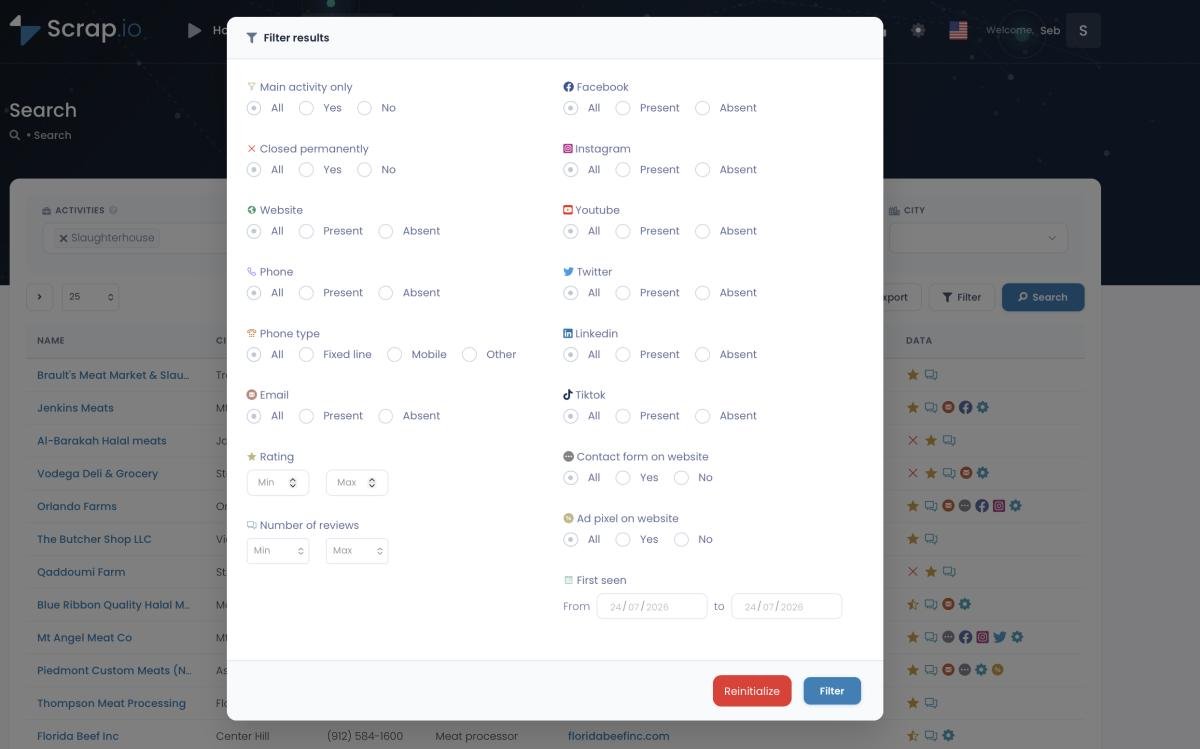
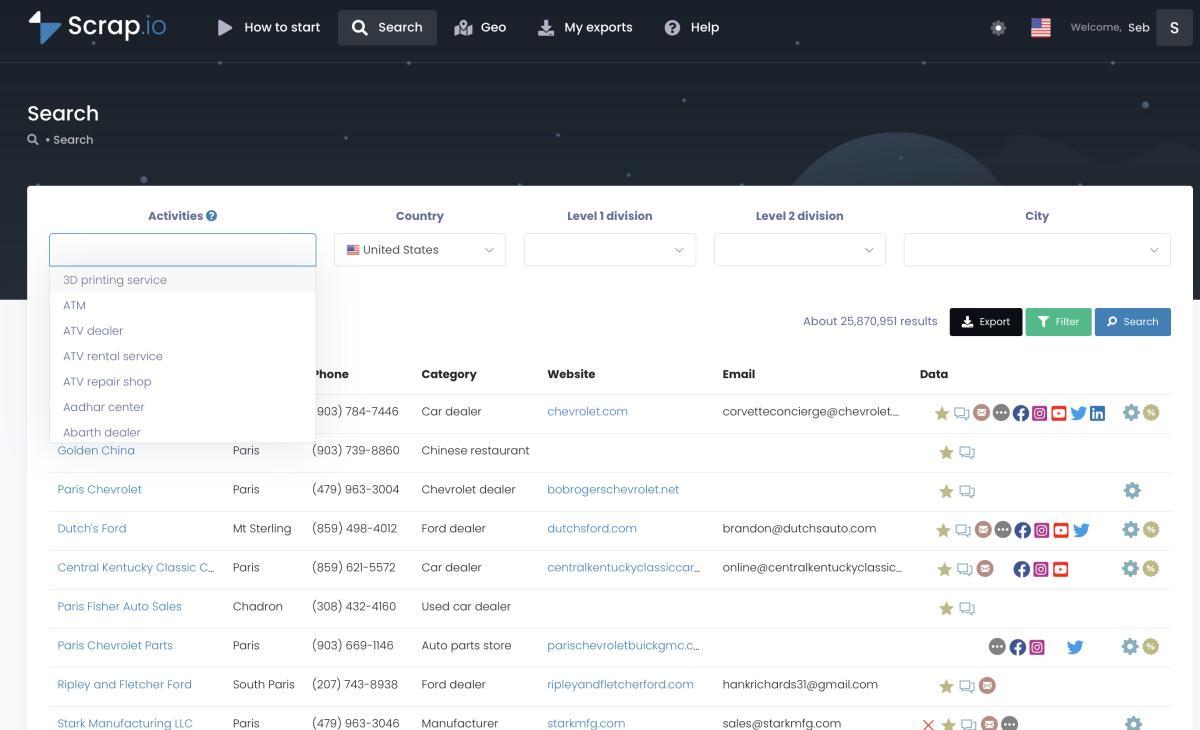
Here's what that looks like in practice:
- Search "Wellness center" in the United States and 85,355 results appear instantly
- Apply filters (has email, has website, 4+ star rating, 10+ reviews) and boom, you're down to exactly the prospects you want
- Export to CSV/Excel with business name, email (classified by type), phone, website, Google rating, social profiles, everything
The cost? Scrap.io starts at $35/month (annual) for 10,000 credits. That's about $0.004 per wellness center contact. Compare that to traditional list brokers charging $0.05 to 0.25 per contact. The math does the talking. And because filters run before extraction, you never burn a credit on a listing with no email. You only pay for the useful ones.
Oh, and also: Booksy, the booking platform with 40M+ appointments processed, grew by targeting wellness and beauty businesses through direct outreach. And Treatwell, Europe's largest beauty/wellness marketplace, built their supplier network the same way. When these companies need holistic health center mailing lists or Google Maps business data, they don't buy static lists. They extract fresh data.
Video: How to Scrape Local Leads at the Country Level
Try Scrap.io free for 7 days and get 100 wellness center leads on us. Filter by email availability, Google rating, location, review count, and 15+ other criteria, then export a fresh list in minutes. No stale broker file, no recycled data. Start your free trial →
Cold Email Best Practices for Wellness Centers in 2026
The average cold email response rate in 2026 is 3.43% (source: Martal Group / Reachoutly). That's down from 8.5% in 2019.
Ouch.
But here's the thing. For wellness center leads for cold email, personalized campaigns hit 45%+ open rates and 12%+ click-through rates (Ambrose Marketing, 2026). The difference? Knowing who you're talking to. A generic "Dear Business Owner" to 5,000 random contacts is dead on arrival. A targeted email to 200 yoga studio owners in Denver mentioning their Google rating and missing online booking? That gets replies.
Subject Lines That Work
Good: "Your Denver wellness center, noticed you don't have online booking yet"
Bad: "REVOLUTIONARY WELLNESS SOLUTION THAT WILL TRANSFORM YOUR BUSINESS!!!"
Wellness center owners are authenticity detectors. They spend their days creating calm, trust-based environments. Hit them with corporate hype and they'll delete you faster than you can say "synergy." My advice? Write like a human.
Personalization That Isn't Fake
Don't just mail-merge their first name. Reference something specific:
- "Saw your center just added sound healing sessions, are you handling the booking intake manually?"
- "Your Google reviews mention long wait times for appointments, we might be able to help with that"
- "Noticed your Instagram hasn't posted in 3 months, is social media management something you're looking for help with?"
That's where having rich data per contact matters. If your email list for spa marketing, or a broader fitness wellness email list, only has names and emails, you can't personalize beyond "Hi Sarah." But if you have their rating, review count, social presence, and website status, now you're dangerous. (In a good way.)
Protect Your Sending Domain
One rule the people who do this for a living never break: keep your cold sends off your main domain. As one operator bluntly put it in r/coldemail, "Do not send cold emails from your primary company domain... buy trycompany.com" (r/coldemail). Spin up a secondary domain, warm it for two or three weeks, and send from there. If a campaign goes sideways, and cold email always goes sideways eventually, your primary domain stays clean.
Timing
Wellness professionals check email at weird hours. They're with clients 9-to-5, so business emails get reviewed early morning or late evening. Test Tuesday through Thursday, 7 to 8 AM or 6 to 8 PM. But honestly? Every market's different. Test it with your specific cold emailing strategy.
The Naples Med Spa Example
A med spa in Naples ran personalized email campaigns around "neurocosmetics routines 2026," targeting wellness-adjacent businesses. Result: 3x repeat bookings and $120K+/month in revenue (Ambrose Marketing case study, 2026). Personalization plus fresh data plus right timing equals real money.
And then there's Alo, a SaaS company that used signal-based cold email, targeting recently funded companies. 35+ qualified leads in 90 days, 33 meetings in 6 months, 31% reply rate (Martal Group benchmark report 2026). The same approach works for wellness: target newly opened centers, centers without websites, centers with declining reviews. The signal IS the pitch.
Legal Compliance: CAN-SPAM, GDPR & HIPAA for Wellness Outreach
Can you legally cold-email a wellness center? Short answer: yes. Long answer: it depends on three laws you need to know.
CAN-SPAM (US)
B2B cold email is legal in the United States under the CAN-SPAM Act. The requirements are straightforward: include your real physical address, use honest subject lines, provide a working unsubscribe link, and honor opt-out requests within 10 business days. That's it. No prior consent required for B2B outreach.
Screw it up and fines go up to $53,088 per email. Per. Email. Don't screw it up.
GDPR (EU Contacts)
If you're targeting wellness centers in Europe, GDPR applies. B2B outreach is allowed under "legitimate interest," meaning your email must be relevant to the recipient's business role. Generic blasts to purchased lists? That's where you get in trouble. For the country-by-country breakdown, check our guide on GDPR cold email for B2B and our broader cold email compliance guide.
Good news: Scrap.io only collects publicly available business data from Google Maps and company websites. No personal data scraping, no gray areas. Every record traces back to its source, which makes documenting your legitimate-interest basis a lot easier. You can build a GDPR compliant wellness email list without losing sleep.
HIPAA Considerations
Here's where wellness centers get tricky. Some, especially medical spas and integrative health centers, operate under HIPAA-adjacent regulations. You're not handling protected health information (PHI) when you email them a B2B pitch. But be aware that wellness professionals are MORE cautious about data privacy than average business owners. They deal with client health information daily. Mention data security in your outreach. It builds trust.
And please, never buy a list from a vendor who can't explain exactly where their data comes from. That's a compliance nightmare waiting to happen.
Measuring ROI: What to Expect from Wellness Email Campaigns
Email marketing for wellness businesses returns $36 to $42 for every $1 spent (Brenton Way / Lasso Up, 2026). But only if your list is fresh and your targeting is right.
Let's run some real math. Say you export 10,000 wellness business leads from Scrap.io at ~$50 total cost. You send a targeted campaign. Conservative benchmarks for well-targeted wellness outreach:
- Open rate: 35 to 45% (wellness professionals over-index on email engagement)
- Click-through rate: 5 to 12%
- Response rate: 3 to 8%
- Conversion rate: 1 to 3%
At a 2% conversion rate on 10,000 contacts, that's 200 new clients. If your average deal is worth $500, you just turned $50 in data costs into $100,000 in revenue. Even with conservative numbers and additional costs for your email platform, the ROI is absurd.
But (and this is the part nobody says loud enough) those numbers assume clean data. Send to an unverified list with 25% bounce rate and your sender reputation tanks. Then even your GOOD emails end up in spam. Dead spiral. Start with verified data or don't start at all.
$50 of data, 200 new clients. Do the math on your own numbers. Pull a filtered wellness center list from any US state on Scrap.io, export only the records with a verified email, and see what your real cost-per-lead looks like. 7 days free, 100 leads included. Run the numbers with Scrap.io →
FAQ
How much do wellness center email lists cost?
Traditional list brokers charge $0.05 to $0.25 per contact for static lists. So 10,000 wellness retreat email contacts might run $500 to $2,500. Scrap.io offers 10,000 credits/month from $35/month (annual billing), that's about $0.004 per contact, with live data and full filtering. If you want to buy email lists, or specifically buy wellness center mailing list data, understand the real cost difference: static data depreciates fast, live data doesn't.
Are wellness center email lists legal to use for cold outreach?
Yes. In the US, B2B cold email is legal under the CAN-SPAM Act: include a physical address, a working unsubscribe option, and honor opt-out requests within 10 business days. For EU contacts, GDPR allows B2B outreach under legitimate interest. Scrap.io only collects publicly available business data from Google Maps, which avoids most compliance complications. That said, always consult legal counsel for your specific situation.
How often should wellness center email lists be updated?
Every 30 days minimum. Wellness businesses open and close frequently (IBISWorld data shows a -0.1% annual decline in the spa segment alone, meaning regular churn). Static lists degrade at 2 to 3% per month. Scrap.io solves this by extracting fresh data in real time at every export. No "last updated: January 2025" situation.
Can I filter wellness centers by location, specialty, and online presence?
Yes. Scrap.io lets you filter by city, state, or entire country, plus 15+ criteria: has email, has website, has phone, Google rating, review count, social media presence (Facebook, Instagram, LinkedIn, TikTok), ad pixels, contact forms, and even the date a listing first appeared on the map. You can get as granular as "wellness centers in Texas with 4+ stars, 50+ reviews, and an Instagram account but no Facebook page." Want a wellness center email list California edition instead? Filter to one state and export only that. Try doing that with a static broker file.
What's the difference between buying a list and scraping live data?
A purchased list is a static snapshot. It starts aging the moment you buy it, and your competitors probably have the same file. Live wellness center data scraping with Scrap.io gives you real-time data extracted directly from Google Maps at the moment of your request. You can also exclude previously exported contacts to avoid duplicates. Freshness, exclusivity, and cost: live scraping wins on all three.
Your Move
85,355 wellness centers in the US. 48,178 with an email you can actually reach. A $2.1 trillion market that's still growing.
The businesses winning in this space aren't the ones with the cleverest subject lines or the fanciest CRM. They're the ones with the freshest data. Full stop.
Whether you're selling booking software, wellness equipment, marketing services, or payment solutions, the foundation is the same. Get clean, filtered, current contact data. Write emails that sound like a human wrote them. Follow the rules. Measure what works. Scale it. And if wellness is only one slice of your market, the same two clicks build you a gym email list or a chiropractor email list next.
Your competitors are already scraping. The question is whether you're still buying last quarter's leftovers.
Start your free trial today: 7 days, 100 leads, zero risk. Extract verified wellness center emails, filter by rating, location, review count, and 15+ criteria, and export a country-wide list in minutes. Fresh data from Google Maps, not recycled broker files. Try Scrap.io free →
Generate a list of wellness center with Scrap.io