

26,652. That's how many aviation businesses are sitting on Google Maps in the United States right now. We counted. Flight schools, FBOs, maintenance shops, aircraft dealers, airports, the lot.
Now go find a current aviation industry email list for even a slice of them. Go on, I'll wait.
Here's what actually happens. You search the term, and page one of Google is a wall of data brokers selling you the exact same frozen file: Avention Media, DataCaptive, Blue Mail Media, ReachStream. Buy now, download, blast. Not one of them tells you how to just build a fresh aviation email list yourself, filtered to the operators you actually sell to. So that's the gap this guide fills. We'll cover what these lists really are, how big the US aviation market is, and how to pull your own verified email database straight from Google Maps in about the time it takes to make coffee.
Video: How to Scrape Google Maps at the Country Level
- What Is an Aviation Industry Email List?
- Why the US Aviation Market Is a Goldmine for B2B
- Buy vs Build: The Honest Comparison
- How Many Aviation Companies Can You Actually Reach?
- The List of US Airports as a Data Segment
- How to Build Your Aviation Email List in 2 Clicks
- Finding the Right Contact: Email Classification
- Real Companies That Sell to the Aviation Industry
- Staying Compliant: CAN-SPAM, CCPA and GDPR
- FAQ
- The Bottom Line
What Is an Aviation Industry Email List?
Aviation industry email list. Sounds specific. But specific to whom, exactly, the airline CEO in a glass tower, or the guy running a two-plane flight school out of a hangar in Nebraska?
Both, actually.
An aviation industry email list is a targeted B2B contact file for companies and decision-makers across the aviation world: flight schools, fixed-base operators (FBOs), maintenance and repair shops, aircraft dealers, charter outfits, airports, and aerospace manufacturers. A useful one carries more than an address. It gives you the company name, a phone number, a website, a location, and ideally the right person's email, so your outreach lands as a message to a human instead of a flare into a generic inbox.
That's the plain version. The trap is hiding in the word "industry."
You'll hear the same thing sold under a dozen labels: aviation email database, aviation industry contact list, aviation industry mailing list, sometimes stretched into an aerospace industry email list, an air transportation email list, or an air transportation mailing list for the neighboring sectors. Same core idea, different sticker. One genuinely different animal is an aircraft owners email list, which leans B2C and targets individual plane owners rather than the businesses we're focused on here.
Because aviation isn't one audience. A charter operator, an MRO shop, a regional flight academy and an aircraft parts distributor all live under the same umbrella, and they buy wildly different things. A good aviation contact database lets you carve out exactly the sub-sector you want. A bad one hands you 50,000 rows labelled "aviation companies list" and wishes you luck. That gap, between a targeted file and a generic dump, is the whole game.
Why the US Aviation Market Is a Goldmine for B2B
Let me give you the lay of the land first, because the sheer size of this market is the reason the outreach pays off at all.
General aviation alone pumps $339.2 billion into the US economy and supports 1,330,200 jobs, according to a 2025 PwC study (NBAA / PwC). That's up more than $92 billion and 150,000 jobs since the 2020 figures. This isn't a niche you're squinting to find. It's a third of a trillion dollars, and most of it runs through businesses, not consumers.
The hardware side is booming too. Manufacturers delivered 3,230 airplanes in 2025, worth roughly $31 billion in revenue, a 16.1% jump, with business jet shipments up 11.8% to 854 units (AOPA, citing GAMA's annual data). More jets means more owners, more maintenance contracts, more handling, more fuel. Every one of those is a company that buys something from someone.
And here's the part the glossy market reports keep underselling: most of this industry is small and local. The FBO world runs across nearly 3,000 locations nationwide (NATA). Flight schools are mostly single-field operators. These are real businesses with real budgets, and nearly none of them have a VP of Marketing posting on LinkedIn. They have an owner who checks a shared inbox between flights. That's your edge, if you can reach them directly.
Buy vs Build: The Honest Comparison
So you bought the list. "85,000 verified aviation contacts," a few hundred dollars, instant download. Here's the uncomfortable truth the invoice doesn't mention: the vendor sold that exact same file to your competitor last week. And the week before that, to three other people pitching the same flight schools.
That's the business model. Compile once, resell forever.
It gets worse when you look at the numbers these vendors throw around. They range from suspiciously round to frankly fantastical, and none of them come with a way to check.
| Data vendor | Claimed aviation contacts | Can you verify it? |
|---|---|---|
| DataCaptive | 52,000 | No, samples masked |
| Blue Mail Media | 95,000 | No |
| ContactMetrix | 200,000 | No |
| BookYourData | 608,900 | No |
| Point2Business | 980,000 | No |
| ReachStream | 1,000,000+ | No |
A million aviation contacts. Think about that for a second against a US general aviation sector that employs 1.3 million people total, pilots and mechanics and receptionists included. The number is doing a lot of lifting.
If your search was really "where to buy aviation industry email list," here's the plot twist: the best aviation industry email list isn't for sale at all. You build it.
Building is the opposite motion. Instead of renting someone's recycled rot, you pull the data fresh, right now, from public Google Maps listings and the websites behind them. When a new flight academy opens or an MRO shop updates its site, that's in the data you extract today. Not last quarter's. Today's. It's the whole argument for live data vs static databases, and once you've seen a bounce report from a bought file, you don't go back.
| Factor | 🔴 Bought list | 🟢 Built with Scrap.io |
|---|---|---|
| Freshness | ❌ Frozen the day it was compiled | ✅ Fresh at the moment of export |
| Exclusivity | ❌ Resold to everyone, your rivals included | ✅ Unique to you, every time |
| Targeting | ❌ Broad, generic buckets | ✅ Filter by category and zone before you pay |
| Cost model | ❌ Pay for every row, bounces included | ✅ Spend a credit only on listings with an email |
| Source transparency | ❌ "Various partners" | ✅ Every contact traceable to a public listing |
Which file bounces less? You already know.
How Many Aviation Companies Can You Actually Reach?
Right now, there are 26,652 aviation businesses on Google Maps in the US, spread across nine core categories. We counted them, live, at the end of September 2026. And counting is free, so you can re-run that number yourself any morning you like.
Here's the part that matters for your budget. Of those 26,652 listings, 11,741, roughly 44%, publish an email address on their website. That's your actual cold-email pool, the one you'd pay to reach. With a static vendor, you'd buy all 26,652 and discover the dead weight later. Build it yourself and you filter down to the 11,741 that are contactable before a single credit leaves your account.
| Segment (US) | Listings on Google Maps |
|---|---|
| Airport facilities (all types) | 12,204 |
| Flight schools | 5,793 |
| Aircraft maintenance (MRO) | 3,996 |
| Aircraft dealers | 453 |
| All aviation categories combined | 26,652 |
Source: Scrap.io, live Google Maps counts, 2026-09-27.
A static vendor can't show you a table like that, because their number froze the day they built the file. This one re-counts every time you look. If you've ever built a restaurant email list the same way, the workflow will feel familiar: same engine, different category.
Flight Schools
Flight schools are the beating heart of general aviation prospecting, and the segment is growing. There were 1,105 flying schools counted as formal businesses in the US in 2025, up 4.0% on the year before (IBISWorld). On Google Maps, where every satellite academy and club operation shows up as its own listing, the number balloons to 5,793. A proper list of flight schools is one of the highest-intent slices you can build: they buy scheduling software, training tools, insurance, fuel contracts, and headsets by the dozen.
Aircraft Maintenance (MRO) and Aircraft Dealers
Maintenance shops keep the fleet flying, and there are 3,996 of them listed. They behave a lot like auto shops in buying terms, parts, diagnostics, software, which is exactly why the playbook behind our car repair and maintenance email list transfers cleanly to building an aircraft maintenance companies email list here. Aircraft dealers are a smaller, sharper target at 453 listings, but each one moves high-ticket inventory and is worth a personalized approach rather than a mass blast. Small segment, big deal size. Treat it accordingly.
These 26,652 businesses are already on Google Maps. See them, and the live count for your own state, inside Scrap.io. Counting costs nothing, so you know the size of your market before you spend a thing. Free trial, 100 leads offered.
The List of US Airports as a Data Segment
How many airports are there in the US, really? Depends who you ask. But Google Maps lists 12,204 airport facilities, and that's the number that matters when you're building a reachable airport list USA rather than reading an almanac.
That 12,204 isn't all international hubs with control towers, obviously. It's the whole spread: regional and municipal fields, private airstrips, heliports, seaplane bases, and the small public-use airports where most general aviation actually happens. For a seller, the long tail is the interesting part. The big international airports are managed by authorities with procurement departments and locked gates. The thousands of smaller fields are run by operators who answer their own email.
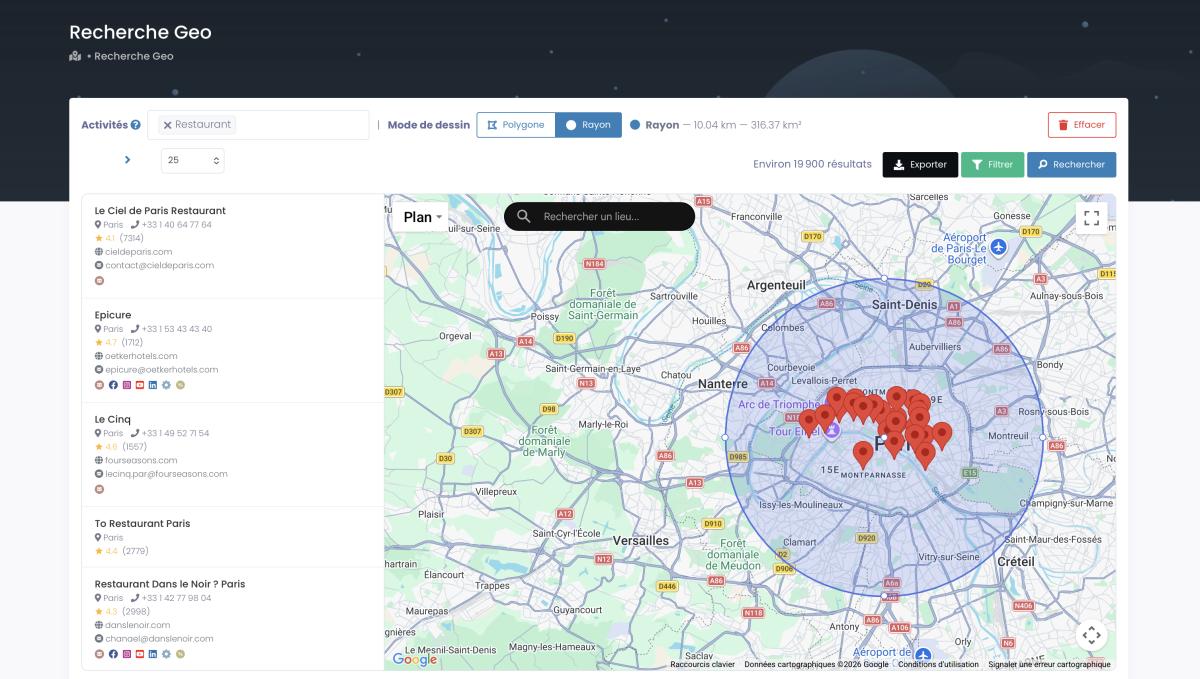
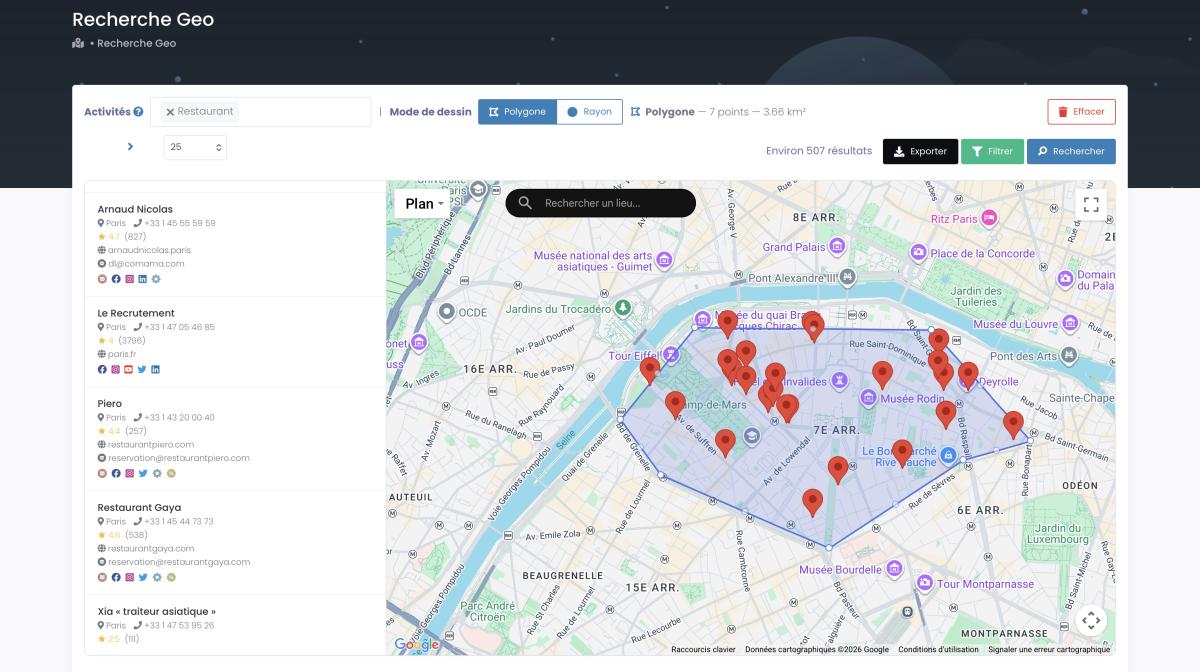
This is where geographic targeting earns its keep. Say you only sell within 100 miles of a maintenance hub. Draw a radius on the map and pull every airport facility inside it. Need an odd shape, like a stretch of coastline or a single state's panhandle? Sketch a polygon by hand and extract only what falls within. The administrative boxes (city, county, state, country) are there too, if you prefer clean borders.
How to Build Your Aviation Email List in 2 Clicks
You don't need a data broker. You need a category and a country. Here's the whole process, start to finish, no code and no scraper to babysit. This is how to build an aviation email list that's actually yours.
Step 1: Pick your categories
Log into Scrap.io and choose your activity from 4,000+ categories. "Flight school." "Aircraft maintenance." "Airport." Cross several in a single search if your audience spans them. This is where you set your lane, a flight school email list, an FBO contact list, or the full aviation umbrella in one pull. Be specific. Narrow targeting is the single biggest lever on reply rate, full stop.
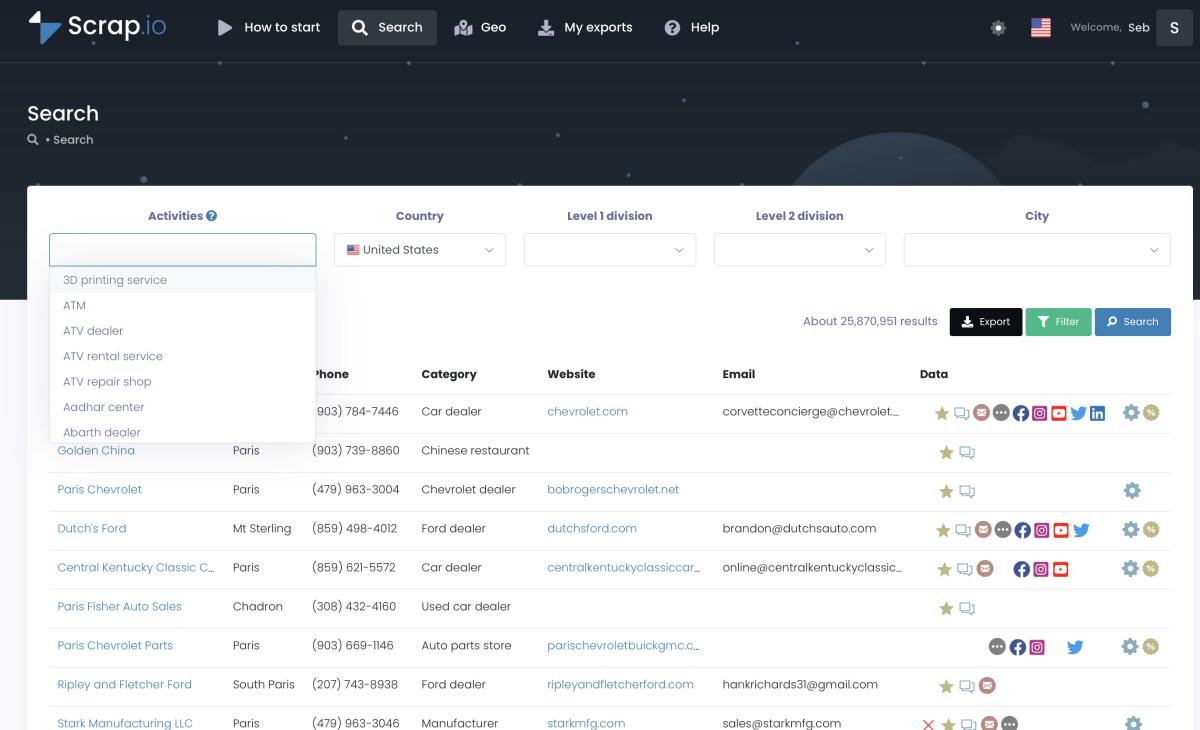
Step 2: Choose your territory
Now the geography. A city, a county, a state, or the entire United States if your plan reaches that far (country-level extraction is the Company plan). Pulling all 26,652 aviation businesses nationwide is literally two clicks from here. Or narrow it with GeoSearch, a radius around an airport, a polygon over a specific corridor, whatever matches how you actually sell.
Step 3: Filter before you pay
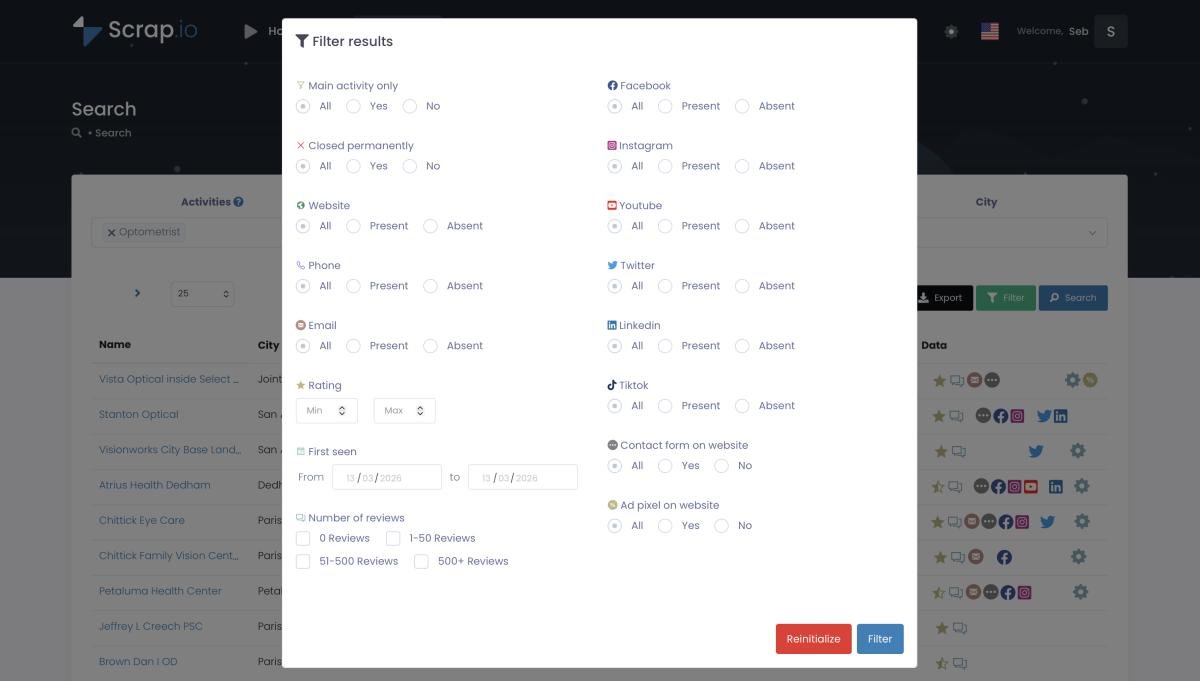
This is the step that makes building cheaper than buying. Toggle "Email: present" and you only ever spend a credit on a listing that genuinely has an address, which is how you pay for 11,741 contactable records instead of all 26,652. Want only the ones with a website? A rating above 4.0? A recently created listing, to catch new flight schools before your competitors do? Set it all before extraction. Filtering upfront is the difference between a tight list and a pile of wasted credits.
Step 4: Export and load it into your CRM
Hit export. CSV or Excel, 30+ columns per business: emails sorted by type, phone number, socials, website metadata, opening hours, the works. Import it straight into HubSpot, Salesforce, Pipedrive, whatever you run, and those rows are your aviation industry leads now. One real client extracted 11,734 businesses in 45 minutes. The same category-plus-territory method powers our construction company email list guide and dozens of other verticals, so once you've done it once, you can do it for anything.
Build your aviation list now. Start a free 7-day Scrap.io trial: 50 searches and 100 export credits, real-time data from Google Maps across 195 countries and 4,000+ categories. Pull your first flight school or FBO list in about 30 seconds. Free trial, 100 leads offered.
Finding the Right Contact: Email Classification
An email to info@ is where your pitch goes to die.
You know it, I know it, the owner who never checks that inbox knows it. So the single most useful thing a good aviation data tool does isn't finding emails. It's sorting them.
Scrap.io classifies every address it extracts. The generic ones (contact@, info@, hello@) get tagged as what they are. The sales@ and marketing@ inboxes are flagged separately. And when the tool finds a named individual's address on the site, it pulls the first name and last name along with it, which is the holy grail for cold email: "Hi Sarah" beats "Dear Sir or Madam" every single time.
Why does this matter so much for aviation specifically? Because these are small operators. A flight school's "team page" often lists the owner, the chief instructor, and the office manager by name, with their direct emails. Hit the chief instructor about scheduling software and you've skipped three gatekeepers. That's how a raw export turns into an aviation decision makers email list, or a tighter aviation executives email list, instead of a stack of info@ addresses nobody opens. That one detail, sending to a person instead of a department, can double your reply rate. Honestly, it's worth more than raw list size.
Video: How to Find the Best Email to contact?
Real Companies That Sell to the Aviation Industry
Flight Circle didn't sign up thousands of flight schools by luck. It happened because the company knew exactly who its buyers were and went straight at them. If you sell to aviation, these businesses are both your market and your proof that the market is real and reachable.
Flight Circle (flightcircle.com) builds scheduling, billing and maintenance software for flight schools and flying clubs, and serves customers across every US state. Its entire addressable market is, well, a flight school email list.
Flight Schedule Pro (flightschedulepro.com) runs operations for more than 1,300 universities, flight schools and pilot training centers. Scheduling, maintenance, invoicing, the full stack.
Aviatize (aviatize.com) calls itself an operating system for flight schools and serves operators in 47+ countries, covering both FAA and EASA training frameworks.
FlightAware's FBO Toolbox (flightaware.com) sells flight-tracking and marketing tools built specifically for FBOs, starting around $110 per airport each month.
Notice the pattern? Every one of these companies lives or dies by its ability to reach a specific slice of the aviation world: flight schools, FBOs, training centers. None of them got there by buying a generic million-row file. They targeted. You can target the same way, with data you pulled this morning instead of a list they rented last year.
Staying Compliant: CAN-SPAM, CCPA and GDPR
Now the slightly less fun but absolutely essential part: staying legal. The good news is it's simpler than the fine print makes it look.
In the US, cold-emailing businesses you found online is legal under CAN-SPAM, as long as you play by the rules: a truthful subject line, your real physical mailing address in every message, clear sender identity, and an unsubscribe link you honor within 10 business days (FTC). Break those and the penalties are brutal, over $53,000 per email. So don't break them.
On the data side, this is where building beats buying on the legal front too. Scrap.io only ever surfaces publicly available business data, and every record is traceable back to its source listing, which means the platform is both CCPA and GDPR compliant. When a prospect asks "where did you get my address?", you have an honest, boring answer: your public website. Try giving that answer for a file you bought from "various partners."
One caveat worth saying out loud. Legal and welcome aren't the same thing. Keep your list tight, your targeting relevant, and your volume sane, and you stay on the right side of both the law and the people in your inbox.
FAQ
What is an aviation industry email list?
It's a targeted B2B contact database of aviation companies and decision-makers: flight schools, FBOs, MRO shops, aircraft dealers, charter operators, airports and aerospace manufacturers. It's used for cold email, account-based marketing and CRM enrichment. You can buy one pre-built, or build a fresh, filtered one yourself from public Google Maps data.
How many aviation companies are there in the US?
On Google Maps, there are 26,652 aviation businesses across nine core categories as of September 2026 (Scrap.io), including 5,793 flight schools and 12,204 airport facilities. Around 44% of them, about 11,741, publish a public email address you can reach.
Should I buy an aviation email list or build my own?
Buying gets you a static file that's usually resold to everyone and already decaying. Building from Google Maps with a tool like Scrap.io gets you fresh, unique, filtered data, almost always at a lower cost per usable contact. For most sellers, building wins on freshness, exclusivity and price.
Is scraping an aviation email list legal?
Yes, when you use publicly available business data and follow CAN-SPAM in the US, plus CCPA and GDPR where they apply. Scrap.io extracts only public business information, and every contact is traceable to its source, so your sourcing stays clean and defensible.
Can I get a free aviation industry email list?
Free downloadable lists are almost always tiny, outdated, or bait for an upsell. The better route to a free aviation industry email list is a Scrap.io trial: 7 days, 50 searches and 100 export credits, enough to build a real, verified sample and judge the data quality for yourself. Chasing a free PDF download or an international aviation industry email list instead? Same answer: build it. Scrap.io covers 195 countries, so "international" is just a different territory setting, and the data stays fresh instead of aging in a static file.
The Bottom Line
The US aviation market is huge, fast-growing, and mostly made of small operators who answer their own email and never show up in an enterprise database. The data brokers on page one want to sell you a frozen snapshot of it, resold to every competitor you have. That's not your only option.
Build a fresh list instead. Pick your categories, draw your territory, filter to the 11,741 that actually have an email, and export. Fresh beats bought. Every single time.
Stop renting a stale list. Build your own in 2 clicks. Try Scrap.io free for 7 days: 50 searches, 100 export credits, real-time aviation data pulled live from Google Maps. Free trial, 100 leads offered. Your first list takes about 30 seconds.
Generate a list of aircraft maintenance company with Scrap.io