

- What Is Hotel Rate Shopping (and Why Does It Matter)?
- Why Every Hotel Needs a Rate Shopper in 2026
- Top 7 Hotel Rate Shopping Tools Compared
- How Hotel Price Monitoring Actually Works
- The Google Maps Angle: Competitor Intelligence Beyond OTAs
- How to Choose the Right Rate Shopping Tool for Your Property
- Data & Compliance: Is Any of This Legal?
- FAQ: Hotel Rate Shopping Tools
I spent last Tuesday morning doing something embarrassing. Three browser tabs open, Booking.com, Expedia, Google Hotels, manually copying competitor rates into a Google Sheet. Cell by cell. For a 90-room boutique hotel in Austin. Took me four hours. By the time I finished the last row, the first prices had already changed.
Pointless.
And that's the thing nobody wants to admit about hotel revenue management in 2026: most properties are still doing some version of this. Checking rates by hand, guessing at positioning, reacting to competitor moves two days late. Meanwhile the hotel across the street has a rate shopping tool pinging 200 OTAs every fifteen minutes and adjusting prices before breakfast service ends.
This guide breaks down how hotel rate shopping tools actually work, which ones are worth your money, and (here's the part no competitor article will cover) how Google Maps data gives you intelligence that rate shoppers literally cannot provide. Comp set building. Market mapping. Contact data for prospecting. Stuff that lives outside OTA feeds entirely.
Fair warning: some of the tools on this list are genuinely excellent. Others are overpriced dashboards with nice logos. I'll tell you which is which.
What Is Hotel Rate Shopping (and Why Does It Matter)?
Rate Shopping Defined
A hotel rate shopping tool does one thing: it monitors what your competitors charge across booking channels, in real time, so you don't have to. That's it. No magic. Just automation replacing the soul-crushing spreadsheet work that revenue managers have been doing since the internet existed.
The best hotel rate shopping tools pull pricing data from OTAs (Booking.com, Expedia, Agoda, the whole crew), GDS feeds, and direct booking engines. They show you room-level pricing by date, room type, rate plan, and length of stay. Some overlay demand signals like events, flights, and search volume, so you can see why prices are moving, not just that they moved.
But here's where most people get confused. A rate shopper tells you what competitors charge. It does not tell you what you should charge. That's a revenue management system's job. Big difference.
Rate Shopper vs Revenue Management System (RMS): What's the Difference?
A rate shopper is a pair of binoculars. An RMS is a GPS. One watches. The other tells you where to go.
Rate shoppers collect competitor pricing data and display it. That's their entire job. An RMS takes that data, plus your occupancy, booking pace, historical performance, and demand forecasts, then recommends or automatically sets your rates. Think of it this way: Lighthouse (rate shopper) tells you the Hilton down the road dropped their standard king to $149 for next Friday. An RMS like IDeaS or Duetto takes that information, weighs it against twelve other variables, and says "keep your rate at $159 because your booking pace is stronger."
Most serious hotels use both. The rate shopper feeds the RMS. Trying to run an RMS without competitor data is like driving with your eyes closed. (Some people do it. Doesn't make it smart.)
The hotel revenue management software comparison gets messier when vendors bundle features. Lighthouse added recommendation engines. Duetto has rate shopping built in. The lines are blurring. But the core distinction, monitoring vs deciding, still holds. If you want the broader view of how price-tracking works beyond hotels, our guide on how to track competitor pricing covers the fundamentals that apply to any industry.
Why Every Hotel Needs a Rate Shopper in 2026
The Numbers Behind the Shift
The hotel revenue management software market hit $2.74 billion in 2026, according to Verified Market Reports. Growing at 12.5% CAGR through 2033 (Market Research Intellect). That's not gradual adoption. That's an industry sprint.
Why the rush? Because the global B2B travel market is projected at $38.07 billion in 2026 with a 17.69% CAGR (ZentrumHub). Corporate travel is back. Leisure demand is volatile. And OTAs are getting better at dynamic pricing every quarter. If you're still checking competitor rates manually, you're bringing a clipboard to a data fight.
Hotels using rate shopping tools save 6-8 hours per week on competitor monitoring alone (AxisRooms Blog). As Hospitality Net reported, the acceleration of tech adoption in hospitality post-pandemic has made these tools table stakes, not luxuries. That's not a rounding error. That's almost a full workday back. For a revenue manager who also handles forecasting, group pricing, and channel management, those hours matter.
Quick aside on market intelligence: Knowing how many hotels you're actually competing against matters. Scrap.io indexes 121,312 hotels on Google Maps in the US alone, with ratings, contact data, and review counts. Counting is free, always. If you want to understand your competitive landscape before picking a rate shopping tool, start there.
What Happens When You Don't Monitor Competitor Pricing
Three things. None of them good.
First: you underprice without knowing it. Your comp set dropped rates for a Tuesday in October because a conference got cancelled. You didn't know about the cancellation. You kept your rate high. Sounds fine, right? Except now you're sitting at 40% occupancy while they're at 85% at a lower ADR, and still making more money than you. Real-time hotel pricing intelligence would have caught that by 9 AM.
Second: you overprice and bleed OTA ranking. Booking.com's algorithm rewards competitive pricing with better sort positions. Price yourself too high relative to comparable properties and you quietly slide off page one. No notification. No warning. Just fewer eyeballs on your listing.
Third, and this one's sneaky, you lose rate parity visibility. Hotel rate parity monitoring tools catch when an OTA undercuts your direct rate (happens more than you'd think, especially with opaque channels). Skip the monitoring and your direct booking strategy has a hole in it that you can't even see. Hotel rate parity testing exists for exactly this reason.
Try managing all of that manually. I'll wait.
Top 7 Hotel Rate Shopping Tools Compared
There are dozens of rate shoppers on the market. Most hotel comparison articles list them all without telling you which one actually fits YOUR property. Bref, let's fix that. Here are the seven that matter in 2026, with honest takes on each.
1. Lighthouse (formerly OTA Insight)
Lighthouse is the 800-pound gorilla. Renamed from OTA Insight in 2023, it's the #1 rated rate shopping platform on Hotel Tech Report with a 4.8/5 from verified hotel professionals. They process a staggering 1.7 billion data points per day across 16.4 million hotel listings. Those aren't marketing numbers. That's operational scale nobody else matches. Lighthouse rate shopping is the benchmark everyone else gets measured against.
Their Rate Insight product covers OTAs, metasearch, and direct channels. The UI is clean, the comp set configuration is flexible, and the data refresh rate is genuinely fast. Marc & Rose Hospitality, a multi-property group, uses Lighthouse Rate & Market Insight across their portfolio for exactly this reason.
Case study worth noting: Holiday Inn Express Yerevan used Lighthouse to identify pricing gaps against local competitors and adjusted their positioning accordingly. Not revolutionary. Just disciplined rate monitoring applied consistently.
Downside? Pricing. Lighthouse isn't cheap. And for a 30-room independent hotel, you might be paying for scale you don't need.
2. RateGain Navigator
RateGain connects to 400+ OTAs, which is more channel coverage than most properties will ever need. HTR reviews consistently highlight it as user-friendly with helpful customer service. That matters more than people think, because the best rate shopping tool in the world is useless if your team can't figure out the dashboard.
RateGain also offers 24/7 support, which is rare in this space. If your night auditor spots a competitor rate anomaly at 2 AM, someone actually picks up the phone.
The product has expanded beyond pure rate shopping into competitive intelligence and distribution analytics. Good if you want an all-in-one. Less good if you just want a clean, focused hotel rate shopper without the feature bloat.
3. SiteMinder Insights
SiteMinder earns its spot because of integration, not innovation. Their rate shopping module plugs directly into SiteMinder's channel manager and booking engine. If you're already on SiteMinder for distribution, and a lot of independents are, adding Insights means zero additional integration work.
The rate shopping data itself is solid but not best-in-class. Where SiteMinder wins is the workflow: see competitor rates, adjust yours, push to all channels, all in one place. For properties that hate toggling between five different dashboards, this is genuinely appealing.
4. RateTiger Shopper
RateTiger has been around forever. Their rate shopper covers the standard OTA landscape plus some regional channels that bigger players sometimes miss. Good for properties in Asia-Pacific and Middle East markets where Booking.com and Expedia aren't the whole picture. It holds a 4.9/5 across hundreds of verified reviews, which says something.
Interface feels dated compared to Lighthouse. But it works. Sometimes "it works and it's affordable" beats "it's beautiful and costs three times as much." Best rate shopper for small hotels that need reliable data without the premium price tag.
5. Mews
Mews is primarily a PMS, but they've been steadily adding revenue management capabilities including rate shopping. Their March 2026 update integrated competitive pricing data directly into the PMS workflow. Interesting approach. Instead of making you open a separate tool, the competitor data shows up where you're already working.
Early days for this feature though. If rate shopping is your primary need, a dedicated tool like Lighthouse or RateGain will give you deeper analysis. But if you're already on Mews and want "good enough" competitor monitoring without another subscription, it's worth evaluating.
6. Duetto
Duetto blurs the line between rate shopper and RMS. Their GameChanger product combines competitor rate data with demand forecasting and automated pricing recommendations. It's more expensive than a pure rate shopping tool because, well, it does more.
Best fit for larger properties or groups that want to automate pricing decisions, not just monitor competitors. If you have a dedicated revenue manager who likes manual control, Duetto might feel like overkill. If you're a 200-room hotel without a full-time RM, the automation is a lifesaver.
7. Amadeus RevenueStrategy360
The enterprise option. Amadeus RevenueStrategy360 combines rate shopping with deep demand data from their GDS network and forward-looking search data. If you're a large chain or resort property with complex rate structures, this is the heavyweight contender.
For independents and small groups? Overkill. The implementation is heavy, the pricing reflects it, and you'll use maybe 30% of the features. But for the right property, nothing else offers this depth of market intelligence.
Oh, and also, the hotel rate shopping tools list above isn't exhaustive. Plenty of regional players exist. But these seven cover 90% of the market.
| Tool | Best For | OTA Coverage | Key Strength | Price Range |
|---|---|---|---|---|
| Lighthouse | All property types | 200+ OTAs | 1.7B data points/day, #1 HTR rated | $$$ |
| RateGain Navigator | Multi-channel properties | 400+ OTAs | Widest channel coverage, 24/7 support | $$-$$$ |
| SiteMinder Insights | SiteMinder users | 150+ OTAs | Integrated with channel manager | $$ |
| RateTiger Shopper | APAC & ME properties | 100+ OTAs | Regional channel coverage, budget-friendly | $-$$ |
| Mews | PMS-first properties | Varies | Built into PMS workflow | $$ (bundled) |
| Duetto | Properties wanting automation | 150+ OTAs | RMS + rate shopping combo | $$$-$$$$ |
| Amadeus RS360 | Enterprise chains | 200+ OTAs + GDS | GDS demand data + forward search | $$$$ |
How Hotel Price Monitoring Actually Works
Meet Sarah, a revenue manager at a 120-room boutique hotel in Austin. She used to spend 6 hours a week manually checking competitor rates on Booking.com. Tab after tab. Screenshot after screenshot. By Friday she had a spreadsheet that was already outdated. Sound familiar?
Here's what replaced that nightmare.
Data Collection: OTAs, GDS, Direct Channels
A hotel price monitoring system works by systematically querying booking channels for rate data. Think of it as a bot that does what Sarah used to do, but across hundreds of channels, every fifteen minutes, without getting tired or making typos.
The data sources break into three buckets:
OTAs: Booking.com, Expedia, Agoda, Hotels.com, the usual suspects. Most rate shoppers scrape or receive feeds from 100-400+ OTAs depending on the vendor. This is where the bulk of competitor pricing data lives. OTA rate shopping for hotels is the bread and butter of every tool on the market.
GDS: Amadeus, Sabre, Travelport. Corporate travel rates live here. If business travelers are a significant segment for you, GDS visibility matters. Not all rate shoppers include GDS data, so ask before you buy.
Direct channels: Competitor hotel websites, brand.com rates. Harder to monitor because there's no standardized feed. Some tools do it, others don't. Useful for rate parity checks.
Real-Time vs Scheduled Shops
Two approaches. Real-time rate shopping queries competitor rates on demand, you click, it fetches. Scheduled shops run automatically at intervals (every 15 minutes, hourly, twice daily) and store the results for trend analysis.
Most tools do both. But here's what matters: the refresh frequency. A tool that updates twice daily is fine for a resort with 30-day average booking windows. For a city hotel where business travelers book same-day? You need something closer to real-time. How does a hotel rate shopper work if the data is six hours old? Badly. That's how.
The technical side is boring (API calls, web scraping, data normalization, the plumbing nobody sees). What matters is the output: clean, comparable data showing what your comp set charges, broken down by room type, rate plan, dates, and channel. Hotel competitor rate comparison software lives or dies by how cleanly it presents this information.
The Google Maps Angle: Competitor Intelligence Beyond OTAs
Video: How Pizzerias Spy on Competitors Using Google Maps
Here's what no rate shopping article will tell you: the most valuable competitor data isn't on OTAs. It's on Google Maps.
Seriously. Every rate shopper in that table above does the same thing, monitors pricing on booking channels. Important? Yes. Complete picture? Not even close.
Why Google Maps Data Matters for Hotels
Google Maps contains competitor intelligence that no OTA feed provides: guest review scores, review volume, physical proximity mapping, contact information (emails, phone numbers), website data, social media presence, and whether a competitor's listing is even claimed. None of this shows up in Lighthouse or RateGain.
Why does it matter? Because pricing strategy without context is just guessing with numbers. Knowing that the Marriott Courtyard charges $159 is useful. Knowing that they have 2,300 reviews at 4.4 stars, recently added a pet-friendly policy, and their website still runs on Wix? That's intelligence. That's how you decide whether $159 is a threat or an opportunity.
For hotel revenue management, Google Maps data for hotel competitor analysis fills the gap that rate shoppers can't. Rate shoppers tell you the price. Google Maps tells you the context. If you want the deep version of this playbook, we wrote a whole guide on competitive intelligence with Google Maps.
How Scrap.io Extracts Hotel Competitor Data at Scale
Scrap.io indexes 225+ million businesses across 195 countries, including 121,312 hotels in the US alone. The platform extracts data from Google Maps in real time: names, addresses, ratings, review counts, emails, phone numbers, websites, social media profiles, and more. No code. No API configuration. Two clicks.
And the coverage tells its own story. Of those 121,312 US hotels, 81,671 (about 67%) have a website and 35,613 (roughly 29%) have a usable email address published on it. That's not a vanity metric. It's the difference between a comp set you can actually research and a list of names.
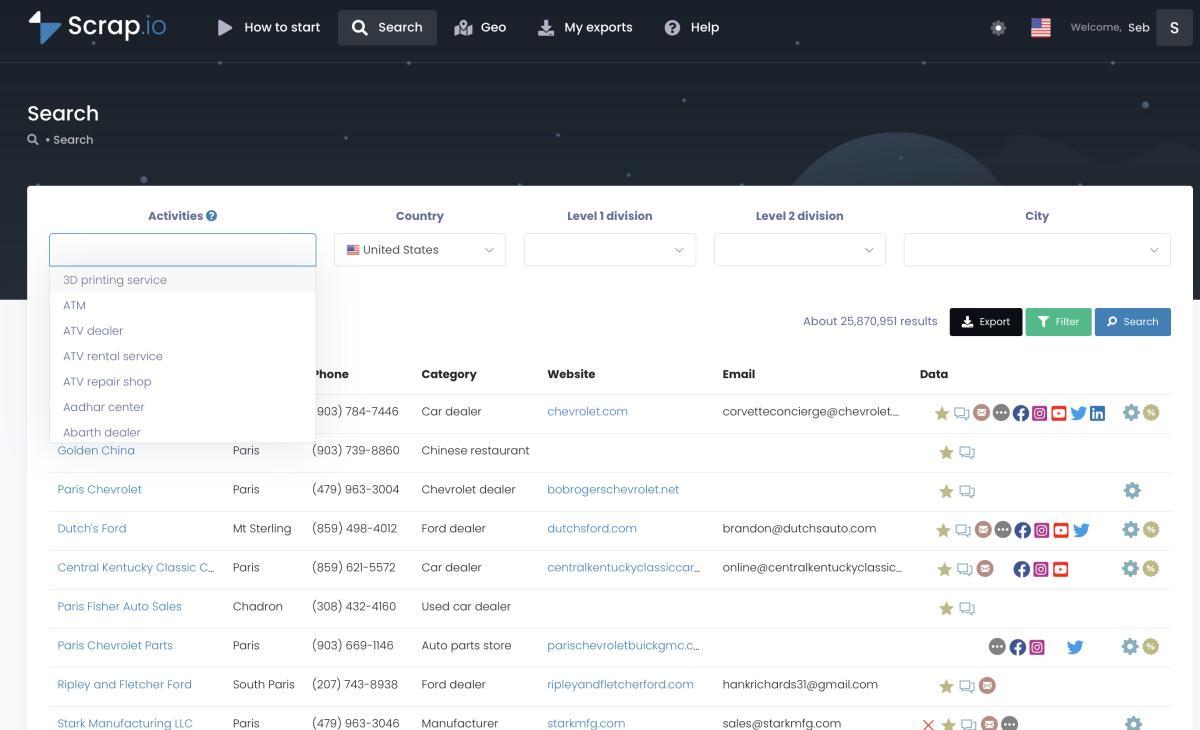
Start with a search. Type "hotels," pick your location, and the platform does the rest:
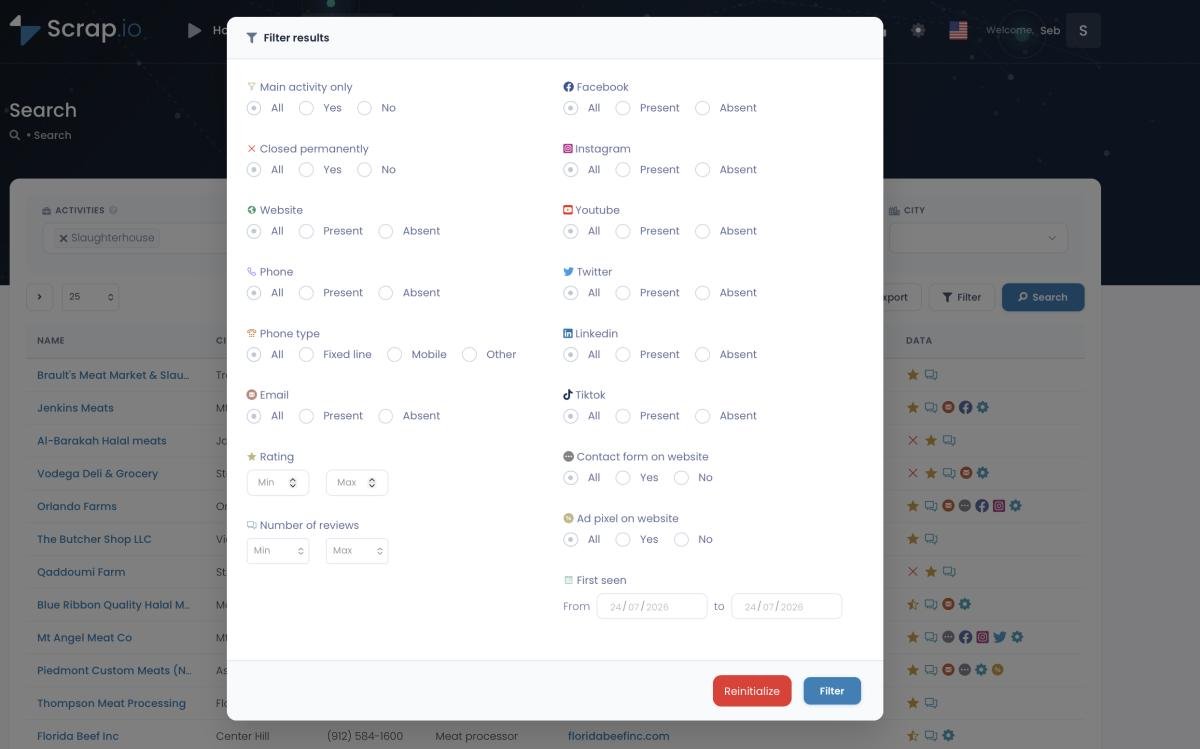
Then filter before you extract. Rating, review count, website present, email present, claimed listing. The filters run before a single credit is consumed, so you never pay for a hotel you can't do anything with:
Here's the four-step version in under three minutes:
Video: Scrap.io - How to Start?
And unlike rate shopping tools, the data includes contact information. Email addresses, phone numbers, website details. Useful if you're a hotel management company prospecting properties. Or a vendor selling to hotels. Or a revenue manager who wants to actually call a competitor's front desk to check direct rates. (We've all done it. Don't pretend you haven't.)
Scrap.io's filters let you narrow by rating, review count, and digital presence, so you can spot competitors that are gaining traction (rising review counts) or vulnerable (low ratings, no website). Under the hood it's the same engine we cover in our Google Maps scraping guide. Rated 4.8 on Capterra, 4.9 on G2, 4.8 on Software Advice. Built for anyone who needs Google Maps data for hotel competitor analysis at scale.
Use Case: Building a Local Comp Set with Google Maps
Standard comp set building: you pick 5-8 hotels that "feel" competitive. Maybe your brand suggests them. Maybe you've always used the same ones. The problem? Your comp set might be wrong. Properties open and close. Boutique hotels pop up on Airbnb-style platforms without OTA distribution. A new-build Hyatt Place opens three miles away and suddenly your entire competitive position shifts. Spotting those emerging competitors the moment they appear is exactly the kind of signal Google Maps surfaces first.
Better approach: use Scrap.io to pull every hotel within a 10-mile radius of your property. Set a radius search, filter for hotels, export. You get a complete competitive landscape, not just the 5-10 hotels your rate shopper comp set includes, but every property guests might consider.
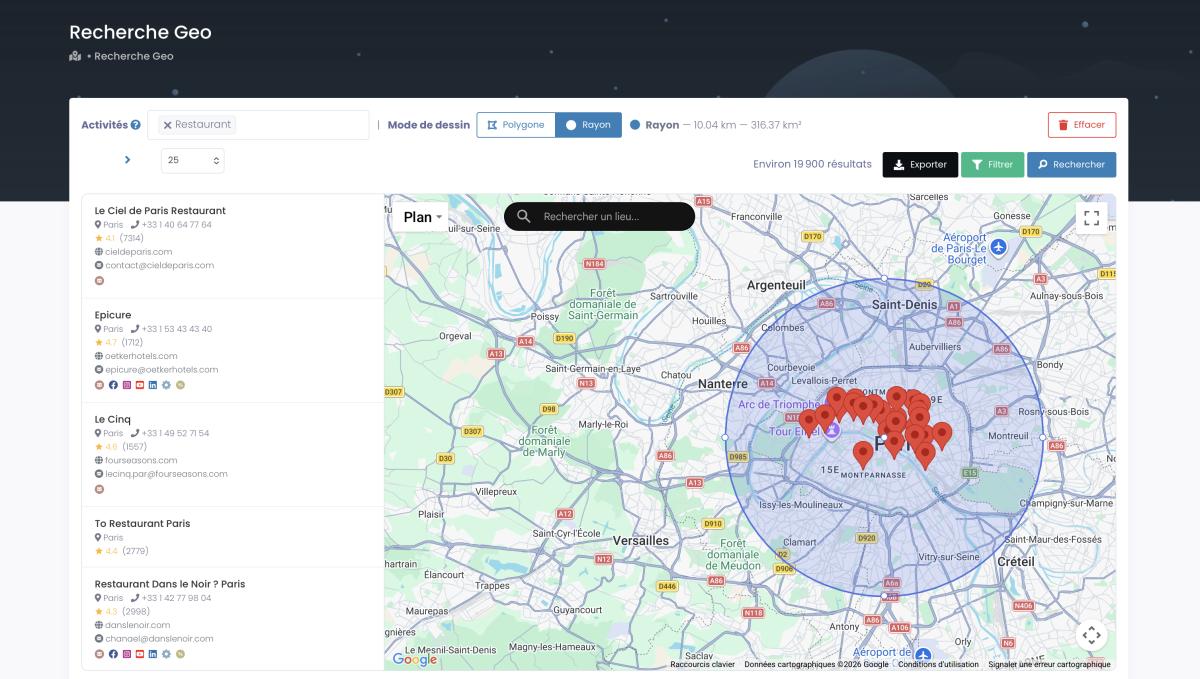
Sort by rating and review volume. Cross-reference with your rate shopper data. Now you have a comp set based on evidence, not habit. You might discover that the real threat isn't the Marriott. It's the boutique hotel with 400 five-star reviews that didn't exist eighteen months ago. Need the whole country instead of one radius? Same workflow, bigger canvas:
Video: How to Scrape Local Leads at the Country Level
This is what hotel pricing strategy tools 2026 should look like: rate shopping for pricing data, Google Maps intelligence for market context. Together, not either/or.
See your competitive landscape in minutes. Try Scrap.io free for 7 days, 100 leads included. Search "hotels" in your city, filter by rating, and export your real comp set from an index of 121,312 US properties. Fresh data on every export, counting is always free.
How to Choose the Right Rate Shopping Tool for Your Property
A $500/month tool that doesn't match your comp set is worse than a spreadsheet. At least the spreadsheet was free.
Key Criteria: Property Size, Budget, Integration Needs
Property size dictates complexity. A 40-room B&B doesn't need Amadeus RS360. A 400-room convention hotel probably can't survive on RateTiger alone. Match the tool to your actual operations, not your aspirations. The best hotel rate shopping tool for a small boutique looks nothing like the best option for a multi-property group.
Budget is real. Lighthouse and Duetto run $300-800+/month depending on property size and features. RateTiger and SiteMinder Insights come in lower. For the hotel rate shopping tools free crowd, sorry, there's no genuinely free rate shopper that provides reliable data. Some offer free trials (take advantage of those), but ongoing monitoring requires a subscription. It's a cost of doing business.
Integration saves time. If your PMS, channel manager, or RMS can receive rate shopping data via API, you eliminate manual steps. Ask every vendor: "Does this plug into my [specific PMS]?" If the answer involves "export CSV and upload," that's not integration. That's extra work with a fancy name.
Checklist: 5 Questions to Ask Before You Buy
Before you sign anything, ask these five questions. And actually listen to the answers. Don't just nod along during the demo.
1. How many OTAs do you actually monitor in my market? Global numbers are meaningless. If you're a hotel in Bangkok, 400 OTAs means nothing if the tool doesn't cover Agoda, Traveloka, and local Thai booking sites well.
2. How often does data refresh? "Real-time" means different things to different vendors. Pin them down. Every 15 minutes? Hourly? Twice a day? Get specifics.
3. Can I customize my comp set beyond your defaults? If the tool only lets you pick from their pre-loaded hotel database, you might miss key competitors. You want to add any property you consider competitive, even the unbranded ones.
4. What does onboarding look like? The fanciest tool is useless if your team never learns to use it. Ask about training, support availability, and how long until you're actually getting value from the platform.
5. What's the real total cost? Some vendors charge per property. Others per user. Some add fees for additional comp set hotels, extra reports, or API access. Get the all-in number before you commit. And ask about your hotel revenue management software comparison options. Most vendors will discount if they know you're evaluating alternatives.
Data & Compliance: Is Any of This Legal?
Short answer: yes. And it's worth 60 seconds to understand why.
The Google Maps data behind a comp set (business names, addresses, ratings, review counts, public contact details) is publicly available business information. Pulling it for competitive analysis and B2B prospecting is standard practice. Scrap.io extracts only that public business data, is GDPR and CCPA compliant, and every single data point is traceable back to its source. No logins bypassed, no private data harvested.
The practical takeaway: monitoring what competitors charge and mapping who they are sits comfortably in the legal zone, as long as you stick to public business data and use it for legitimate market intelligence. Rate shoppers do it. Google Maps intelligence tools do it. You're on solid ground. (Scaling this into a serious data operation? Loop in your legal team anyway. That's not a cop-out, just good practice.)
FAQ: Hotel Rate Shopping Tools
What is a hotel rate shopping tool?
A rate shopping tool automatically monitors competitor hotel pricing across OTAs, GDS platforms, and direct booking channels. It collects rate data by room type, date, and rate plan, then displays it in a dashboard so revenue managers can make informed pricing decisions. Think of it as automated competitive intelligence for hotel pricing. The tool replaces manual rate checks, which typically eat 6-8 hours per week.
What is the best rate shopping tool for hotels?
There's no single "best" one. It depends on your property. Lighthouse leads on data depth and review scores, RateGain covers the most OTAs (400+) with 24/7 support, and RateTiger wins on budget and APAC coverage. For context beyond the OTA price, pair any of them with Google Maps data from Scrap.io to map your full local comp set and spot competitors your rate shopper never sees.
How much does a hotel rate shopper cost?
Pricing varies wildly. Entry-level tools like RateTiger start around $100-200/month for smaller properties. Mid-range options (SiteMinder Insights, RateGain) run $200-500/month. Premium platforms like Lighthouse and Duetto can cost $500-800+/month depending on property size and feature set. Enterprise solutions (Amadeus RS360) price on custom quotes. Bon, there's no way around it, hotel rate shopping isn't cheap, but the ROI typically justifies the spend within 2-3 months of proper use.
Can small hotels benefit from rate shopping?
Absolutely. In fact, small hotels arguably need rate shopping more than large chains. Big brands have dedicated revenue management teams and proprietary data. A 40-room independent? You're the GM, the revenue manager, the marketing director, and probably the person fixing the ice machine. A rate shopping tool gives you the competitive visibility that chains have by default. The best rate shopper for small hotels is one that's affordable, easy to use, and doesn't require a PhD in data science to interpret. RateTiger, SiteMinder Insights, and Mews are worth evaluating first.
What's the difference between a rate shopper and an RMS?
A rate shopper monitors, it shows you what competitors charge. An RMS (Revenue Management System) decides, it recommends or sets your own rates based on competitor data, demand signals, booking pace, and historical performance. Most hotels benefit from both: the rate shopper feeds market data into the RMS, which then optimizes your pricing. Using an RMS without a rate shopper is like forecasting weather without looking outside. Using a rate shopper without an RMS means you still interpret the data and set rates yourself.
How can Google Maps data complement rate shopping?
Rate shoppers tell you what competitors charge. Google Maps tells you who your competitors actually are, and gives you context no OTA feed provides. Review scores, review volume, physical location mapping, digital presence, contact information. Scrap.io extracts this data at scale, letting you build evidence-based comp sets, identify emerging competitors, and map your entire local market. Combine rate shopping (pricing data) with Google Maps intelligence (market context) for the complete competitive picture. One vendor doing this well is Scrap.io, which indexes 121,312 US hotels with full contact and review data.
And if you're building hotel prospecting lists for vendor outreach, cold email strategies work particularly well when you can filter hotels by rating, size, and location before sending a single message. Also worth checking: restaurant email lists if your product serves multiple hospitality segments, and the Google Maps API pricing guide if you're evaluating the cost of building competitor monitoring in-house.
Stop guessing. Start knowing. Your competitors are monitoring you. Return the favor, but smarter. Start your free Scrap.io trial and see exactly who you're competing against: ratings, reviews, contacts, digital presence. 121,312 US hotels, 225+ million businesses worldwide. The data is there. Use it.
Generate a list of hotel with Scrap.io