

📋 What's in This Guide
- Why Most Cold Emails Die in 3 Seconds
- The Cold Email Crisis Nobody Talks About
- Cold Email in 2026: What the Numbers Say
- The 3-Line Cold Email Formula (Subject → Preview → Hook)
- Real Examples and Case Studies
- How to Personalize Your First Line at Scale
- Staying Compliant With Anti-Spam Laws
- FAQ: Cold Email Opening Lines
So. You want to know how to start a cold email. Cool. But I need to tell you something first.
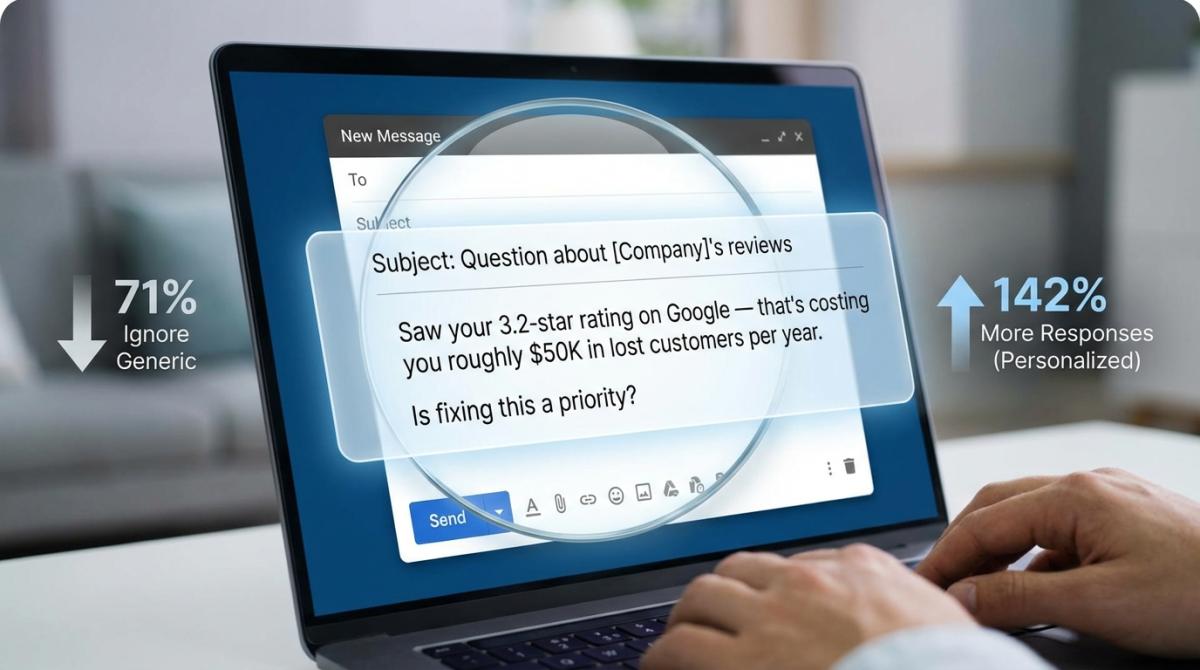
71% of B2B decision-makers ignore cold emails that don't talk about their problems. And they decide that in about three seconds. Maybe less. They glance at the subject line. They peek at the first sentence. Done. Deleted. Gone forever.
Your email doesn't die at the call-to-action. It doesn't die in the middle. It dies right there. In those first three lines. Before anyone even gives you a chance.
I've seen smart people spend hours on the perfect pitch. Beautiful CTAs. Clever closing lines. None of it mattered. Because the prospect bounced after reading "Hi, I'm John from Acme Corp."
Okay. Let's fix this thing.
Why Most Cold Emails Die in 3 Seconds
You know what almost every cold email sounds like?
"Hi, I'm [Name] from [Company], and we help businesses like yours..."
Yeah. You've gotten 400 of those this month. You deleted all of them. So did everyone else.
Here's a number that should scare you. Instantly's 2025 report says 69% of people mark emails as spam just from the subject line. They don't even open the thing. They see a boring subject. They hit spam. That's it.
And get this. Mailshake found that only 5% of senders personalize every email. Five percent. Everyone else? Copy-pasting the same template. Fighting over scraps. The 5% who personalize? They get 2-3X the results. Not surprising when you think about it.
But here's what really bugs me. Almost nobody talks about this part.
Your first line IS your preview text. That little snippet in the inbox? Right next to the subject line? That's literally your first sentence. It's like a second subject line. And people just... ignore it. They write "I hope this email finds you well" and wonder why nobody opens their stuff.
If you actually want to learn how to write a cold email people read? It starts here. These three lines. Nothing else matters until you get these right.
The Cold Email Crisis Nobody Talks About
Let me tell you about Marco. He runs a B2B consulting firm called FiddleCube. Good service. Happy clients. Solid case studies. He sends 300 cold emails. Gets a 9% response rate.
Not terrible. But not great.
When he looked closer? Pattern was obvious. Emails that got replies all had something in common. The opening line mentioned something specific about the prospect. A real pain point. A real problem. Something that showed Marco actually looked at their business before hitting send.
The generic openers? Dead on arrival. Every single one.
This is everybody's problem though. Average cold email response rate? Between 1-5%. That means out of 100 emails you send, maybe one to five people write back. And some of those replies are just "unsubscribe me." Rough.
But then Woodpecker went and analyzed 20 million emails. What they found is kind of wild. Personalized opening lines got a 17% response rate. Generic ones? 7%. Same product. Same offer. Same CTA. Only difference was the first line. That's a 142% jump.
So before you blame your pricing or your market — look at your opener. That's probably where the wheels come off. Learning how to start a cold email properly isn't some nice-to-have skill anymore. It's the whole game.
People make 7 common cold email mistakes all the time. The biggest one? Starting with themselves instead of the prospect.
Cold Email in 2026: What the Numbers Say
Quick context. Over 160 billion emails go out every day. Billion with a B. Your cold email is competing with... well... everything.
Good news though. A study of 5 million emails found the average B2B cold email open rate is 44%. That's actually okay. Top performers hit 65%+. Bottom performers sit below 28%.
What separates them? Not magic. Not secret software. The first three lines.
Belkins studied 5.5 million emails. Personalized subject lines got a 46% open rate. Without personalization? 35%. Eleven-point gap. Just from making the subject feel like it was meant for one person.
And if you're thinking "cold email is dead" — nope. Wrong. 44% open rates. 17% reply rates with good openers. Cold email isn't dead. Bad cold email is dead. Big difference.
Here's what the best cold email first line examples have in common. They treat those first three lines as one system. Subject line. First line. Opening sentence. Each one does a job. Each builds on the last. Skip one and it all falls apart.
One of the most practical cold email tips I can give you? Master these three lines before worrying about anything else. Your CTA structure, your follow-up sequence — none of it matters if nobody reads past the opener. That's why figuring out how to start a cold email matters more than anything else in your outreach stack.
The 3-Line Cold Email Formula (Subject → Preview → Hook)
Okay. Framework time. No more talking about problems. Let's fix them. If you want to know how to start a cold email that gets replies — not just opens — here's the formula.
Three elements. Working together.
Line 1 = subject line. Line 2 = first sentence (also your preview text). Line 3 = the hook that makes them keep reading.
Let's break each one down.
Line 1 — The Subject Line
Short wins. Period.
Belkins' 5.5-million email study? 2-4 word subject lines got the highest open rate. 46%. Not long ones. Not clever ones. Short ones.
Questions beat statements. 46% versus 36%. Makes sense right? A question creates a little gap. You want the answer. So you open.
Numbers help too. Instantly says numbers in cold email subject lines boost opens by 113%. So "3 ideas for [Company]" crushes "Some ideas for your company." Every time.
Personalized subject lines — with a company name or something specific — get 26% more opens.
Good subject lines look like this:
- "Question about [Company]'s reviews"
- "3 ideas for [specific thing]"
- "[Mutual connection] suggested I reach out"
Bad ones look like this:
- "Revolutionary Solution That Will Transform Your Business Forever!!!"
- "Quick Question" (everybody uses this. It's dead.)
- "Touching Base" (about what exactly?)
Line 2 — The First Line (Your Preview Text)
This is where most people mess up. Big time.
They don't realize their first sentence shows up as preview text. Right there in the inbox. Before anyone opens anything. Cold email preview text optimization is basically a lost art. And that's a huge opportunity for you.
So what do most people write? "I hope this email finds you well." Come on. That has never made a single person want to open an email. Ever. If you're wondering what to write in the first line of a cold email — it's definitely not that.
Three levels of cold email opening lines:
Generic: "I help companies grow their revenue." Trash. Deleted.
Semi-personalized: "I noticed your company is in the [industry] space." Better. Still lazy though.
Hyper-personalized: "Saw your 3.2-star rating on Google — that's costing you roughly $50K in lost customers per year." Now we're getting somewhere.
Best approach? Observe something real about their business. Acknowledge it. Ask a question that connects to your offer.
Golden rule. Use "you" and "your." Never start with "I." The second you write "I wanted to reach out" or "I'm the founder of" — you lost them. They don't care about you yet. They care about themselves. If you're hunting for cold email icebreaker ideas? Start there. Best icebreaker is showing you get their world.
Knowing how to personalize a cold email opening separates the top 5% from everyone else. And AI-powered cold email personalization can help you generate personalized cold email first lines at scale. No need to spend 20 minutes researching each person manually.
Line 3 — The Hook Sentence
Prospect opened the email. Scanned the first line. Now they're deciding. Keep reading? Or close?
A good cold email opener that works follows one of these four approaches:
Problem-first. Ask about a pain point they actually have. "Struggling to get responses from your Google Ads leads?" Only works if you know they run Google Ads though. Otherwise it's just noise.
Competitor reference. Create some FOMO. "Three agencies in [city] switched to [approach] last quarter." Nobody wants to be the last one doing things the old way.
Data-driven. Use a number from their actual business. "Your website loads in 6.2 seconds — that's losing you 40% of mobile visitors." Hard to ignore when someone knows a specific fact about your business.
Brutal honesty. For certain contexts only. "Your Google reviews dropped from 4.1 to 3.4 in six months. Every potential customer sees that." Risky? Yeah. Effective? Very. When done respectfully.
Cold email templates that work all share this structure. Subject gets them curious. First line proves you did homework. Hook makes ignoring you feel expensive. That's the cold email opening hook formula right there. Every solid email introduction line for business outreach follows this same pattern. SaaS, consulting, marketing — doesn't matter.
Want to see dozens of proven variations? The guide on cold email templates that generated $20M in sales has actual copy you can adapt.
🎯 Want to personalize your first line at scale? You need real data about your prospects — reviews, location, digital presence. Scrap.io extracts business contact data from Google Maps in real time so every opener references something specific. Try it free for 7 days with 100 leads included.
Real Examples and Case Studies
Theory is nice and all. But what does this actually look like? Let me walk you through five cold email examples with real documented results. These aren't hypothetical. Real campaigns. Real companies. People who figured out how to start a cold email that converts.
Cleverly — 31% Reply Rate
Cleverly is a B2B lead gen agency. They ran cold campaigns for Alo Media Group. Their thing? Every opening line referenced a specific challenge the prospect faced. Not vague industry stuff. Actual researched pain points.
Result? 31% reply rate. Over 35 qualified leads in 90 days. 33 booked meetings in 6 months. Average reply rate is 1-5%. They beat that by 6X.
Jake Jorgovan — $12,030 from Cold Email
Jake's a freelance creative strategist. Quality-over-quantity guy. Instead of blasting thousands of emails he researched each prospect individually. Wrote custom first lines for each one.
Got $12,030 in revenue. Including Fortune 500 clients. No fancy tool. No expensive list. Just taking time to write a cold email first sentence that gets replies. One that showed real understanding of each person's situation.
Justin McGill / LeadFuze — Zero to $30K/Month
Justin used cold email to grow LeadFuze from nothing to $30,000 per month in 12 months. His cold outreach email sequences were built around first-line personalization. Not "Hi [First Name]" stuff. Real personalization. Business details. Specific references. Things that showed he actually looked.
Marco / FiddleCube — 9% → 13% Response
Marco again. 300 personalized emails. Pain points and case studies right there in the opener. Started at 9% response rate. Added follow-ups with different angles. Hit 13%. Each follow-up used a different hook. Because the best way to open a cold email changes depending on whether it's your first touch or your third.
Woodpecker — 20 Million Emails
Their analysis of 20 million+ emails confirmed everything. Real personalization in opening lines — not just name merging but actual business-relevant stuff — delivered 17% response rates versus 7% for generic. That 142% improvement isn't a fluke. It's a pattern.
As one top-voted thread on r/sales put it: "be less than 90 words, use 2-sentence paragraphs so it can be scanned, never include more than 1 link, write like you talk." Honestly that's the whole formula in one sentence right there.
🚀 Want to build a prospect list with enough data for killer first lines? Start with a free 7-day trial on Scrap.io — each record includes emails, phone numbers, review counts, and website data you can drop right into your opener.
How to Personalize Your First Line at Scale
Okay so the obvious pushback. "Personalization doesn't scale. I can't research every single prospect for 20 minutes."
Fair. But here's the biggest cold email tip I can give you. You don't need individual research on everyone. You need smart segmentation. That's it.
Group prospects by shared traits. Create openers for each group. Done.
Like. All restaurants in Austin with under 50 Google reviews. All dentists in Chicago without a website. All plumbers in Miami with bad ratings. Each group gets a specific opening line about that shared thing. Not hyper-personal to one person — but it feels personal because it's about something real. That's how to start a cold email when you're sending hundreds per week. Not five.
Someone on r/coldemail asked recently: "If I were to start cold emailing today where do I start?" Answer's always the same. Start with data. Real data about your prospects. Not assumptions.
To write good opening lines at scale you need actual info about your prospects. Their reviews. Location. Whether they have a website. Social media presence. Stuff like that. Scrap.io pulls business contact data straight from Google Maps in real time. When a business updates their listing you get that info right away. With 200 million businesses indexed across 195 countries you can filter by review count, rating, social presence, and tons of other things. Then write openers based on real facts.
And for people on r/salestechniques asking "What icebreakers / opening lines work best for you?" — answer's always the same. The ones built on real data. Not templates from some blog. Actual business intelligence.
The cold email tools that actually work in 2026 are the ones giving you this kind of data before you write anything.
Staying Compliant With Anti-Spam Laws
Quick section. Important though. Most guides skip it.
CAN-SPAM stuff: Put an unsubscribe link in every email. Use real sender info. Don't lie in subject lines. Include your actual business address. Handle unsubscribe requests fast.
GDPR: Emailing people in Europe? Legitimate interest covers B2B outreach. But respect opt-outs. Be upfront about who you are and why you're writing.
Simple version. Don't be sketchy. Say who you are. Make unsubscribing easy. Don't lie. Do that and you're fine.
For the detailed breakdown check the guide on staying compliant with cold email anti-spam laws.
FAQ: Cold Email Opening Lines
How do I start off a cold email?
Look at the prospect's business first. Find something specific — a Google review, a recent hire, something on their website. The best way to open a cold email is mentioning that thing in your first sentence and connecting it to a problem or opportunity they'd care about. Don't start with "I" or your company name. Start with them.
What is the 30/30/50 rule for cold emails?
It's a benchmark. Aim for 30% open rate. 30% of those opens should turn into clicks or replies. 50% of engaged prospects should become meetings or next steps. If you're way below these numbers? Your subject line, first line, or offer needs work. Probably the first line honestly.
How long should a cold email first line be?
Under 15 words. Under 100 characters. This line shows up as preview text in the inbox. Too long and it gets chopped off. Loses all impact. Keep it short. Specific. Relevant. That beats long and clever.
Should I personalize every cold email?
High-ticket prospects? Yes. Always. Every time. Volume outreach? Use segment-based personalization. Group prospects by shared stuff — industry, location, review count, no website, whatever. Write specific openers for each group. The 5% who personalize everything get 2-3X the results. Math speaks for itself.
What are the worst cold email opening lines to avoid?
Oh man. Where to start. "I hope this email finds you well" — meaningless filler. "My name is [Name] from [Company]" — nobody cares yet. "I'm reaching out because" — leads with you not them. "We're the leading provider of" — every company says this. "I wanted to touch base" — about what? These all scream generic mass email. Instant delete. Or worse — spam folder.
Stop Guessing. Start Personalizing.
The data is pretty clear on this one. 71% of decision-makers ignore irrelevant cold emails. 69% flag them as spam from the subject line alone. But personalized openers pull 17% reply rates and 142% more responses than generic stuff.
Whether you're figuring out how to start a cold email for the first time or how to start a cold sales email at scale — same principles apply.
Your first three lines aren't an introduction. They're the decision point. Subject line earns the open. First line (preview text) earns the read. Hook keeps them going.
Cleverly got 31% reply rates. Jake landed Fortune 500 clients. Justin hit $30K months. Woodpecker proved it across 20 million emails. Same conclusion every time. The best cold email introduction isn't clever. It's specific. Based on real data. Showing you know something about the person you're emailing.
Stop guessing. Try Scrap.io free for 7 days — get 100 verified business leads with enough data to write first lines that actually get replies.
These contacts won't convert themselves. And every day you wait your competitors are getting further ahead. Get after it.