

In 2022, there were 4,760 federally insured credit unions in the United States. By the first quarter of 2026, that number had fallen to 4,250 (NCUA). Roughly one credit union disappears every four days. And yet the sector has never held more money: $2.48 trillion in assets across 145.8 million members.
So when someone searches for a "list of credit unions," what do they actually get? A government locator built for consumers. A Wikipedia table last refreshed in 2022. A "best credit unions in Michigan" listicle. None of which hands you a file you can sell to.
Here is the gap. If you sell anything to credit unions, core banking software, compliance tools, marketing services, insurance, you don't need a locator. You need a contact-ready directory: names, websites, emails, phones, filterable by state and asset profile. This guide shows you how to build exactly that in 2026. No fluff.
Video: B2B Lead Gen, Google Maps vs LinkedIn
Table of Contents
- How many credit unions are there in the US? (2026)
- Where to find an official list (NCUA & state directories)
- Banks vs credit unions: what a complete list should include
- Largest credit unions in the US by asset size (2026)
- List of credit unions by state
- Why build your own credit union list? (B2B angle)
- How to build a contact-ready list in 2 clicks
- Building a credit union email list the right way (compliance)
- Real examples: who prospects credit unions
- FAQ
How Many Credit Unions Are There in the US? (2026)
As of Q1 2026, there are 4,250 federally insured credit unions in the United States, serving 145.8 million members and holding $2.48 trillion in assets (NCUA, data as of March 31, 2026). That is the headline number, and it is the one most "list of credit unions in the US" searches are really after.
But that 4,250 figure is shrinking, and fast. Consolidation has been relentless.
| Metric | Value | Source |
|---|---|---|
| Federally insured credit unions | 4,250 | NCUA, Q1 2026 |
| Members | 145.8 million | NCUA, Q1 2026 |
| Total assets | $2.48 trillion | NCUA, Q1 2026 |
| Count in December 2022 | 4,760 | NCUA / Wikipedia |
| Loan-to-share ratio | 81.5% | NCUA, Q1 2026 |
Here is the part nobody in the search results tells you. The NCUA counts 4,250 institutions. But those institutions operate thousands of branches, and each branch is a physical location with its own phone, its own manager, sometimes its own email. On Google Maps, that granularity shows up as 23,605 credit union listings across the US (Scrap.io, September 2026). Of those, 21,694 have a website (about 92%), 14,835 have a usable email (about 63%), and 23,219 list a phone number (about 98%).
| Data point | Count | Share |
|---|---|---|
| Credit union listings on Google Maps (US) | 23,605 | 100% |
| With a phone number | 23,219 | ~98% |
| With a website | 21,694 | ~92% |
| With an email address | 14,835 | ~63% |
Source: Scrap.io live data, September 2026. Counts are always free to check.
Read that again. The regulator gives you 4,250 names. Google Maps gives you 23,605 contact points, with phones, sites, and emails the NCUA file simply does not contain. That difference is the whole reason this article exists.
Where to Find an Official List (NCUA & State Directories)
Let's start with the free, official route, because it's the first thing everyone tries. And it's genuinely useful, for exactly one job.
The NCUA list of credit unions (and its hard limit)
The NCUA runs a Credit Union Locator at mapping.ncua.gov. You can look up any federally insured institution, see its charter number, address, and basic financials pulled from call reports. For verifying that a credit union is real and insured? Perfect. For researching a single institution before a meeting? Great.
For prospecting? It falls apart.
The locator is built for consumers checking whether their deposits are insured, not for a sales team building a campaign. There is no bulk export of emails. No phone list you can drop into a dialer. No "download all 4,250 as a CSV with contact data" button. You get institution records, one lookup at a time, with zero outreach-ready fields. The "ncua list of credit unions" people keep searching for exists, but it answers "who is insured," not "how do I reach them."
State regulators publish directories too (North Carolina's cud.nc.gov is a common top result), but each covers a single state and has the same problem: institutional records, no contact file. Wikipedia's "Credit unions in the United States" page is a solid primer on history and definitions, but its headline count still cites the 2022 figure of 4,760. Useful context. Useless for a 2026 campaign.
Banks vs Credit Unions: What a Complete List Should Include
A lot of people actually search for a "list of banks and credit unions" together, and lump the two into one spreadsheet. Understandable. They look similar from the outside. But if you are prospecting, treating them as one blob is a mistake.
Banks are for-profit, shareholder-owned. Credit unions are not-for-profit, member-owned financial cooperatives. That changes everything about how you pitch them: their budgets, their buying committees, their regulators (NCUA for credit unions, OCC/FDIC for banks), and their priorities. A core-banking vendor sells to both, sure, but the messaging that lands with a $200M community credit union is not the messaging that lands with a regional bank.
So what should a genuinely complete credit union list contain? Not just names. Names are where bad lists stop. A list you can actually work needs:
- Institution and branch name, so you know whether you are reaching HQ or a branch.
- Website, your single best signal of digital maturity and tech stack.
- Email, classified: a generic info@ address is not the same as a named person's inbox.
- Phone, with type: landline for B2B calls, mobile for anything else.
- Location and state, for territory assignment and compliance.
- Google rating and review count, a quick proxy for size and member engagement.
Miss those fields and you are back to copy-pasting from a locator, one record at a time. Which, at 4,250 institutions, is not a plan. It's a punishment.
Largest Credit Unions in the US by Asset Size (2026)
If you are chasing the whales, "list of credit unions by asset size" is the search that matters. The biggest institutions hold a wildly disproportionate share of that $2.48 trillion, and they have the budgets to match. Navy Federal alone holds over $200 billion in assets, more than the next several combined.
Here are ten of the largest US credit unions by assets. Exact rankings shift quarter to quarter as new call reports post, so treat this as the top tier rather than a frozen leaderboard (figures and order per NCUA call reports and Callahan & Associates, 2026):
| Rank | Credit Union | Headquarters |
|---|---|---|
| 1 | Navy Federal Credit Union | Vienna, VA |
| 2 | State Employees' Credit Union (SECU) | Raleigh, NC |
| 3 | PenFed Credit Union | Tysons, VA |
| 4 | BECU (Boeing Employees') | Tukwila, WA |
| 5 | SchoolsFirst Federal Credit Union | Santa Ana, CA |
| 6 | Golden 1 Credit Union | Sacramento, CA |
| 7 | America First Credit Union | Riverdale, UT |
| 8 | Mountain America Credit Union | Sandy, UT |
| 9 | Alliant Credit Union | Chicago, IL |
| 10 | Suncoast Credit Union | Tampa, FL |
Notice the geography. Virginia, the Carolinas, the West Coast, Utah, the Mountain West. The giants cluster, and that clustering is a clue for how you should actually slice a national list: by state.
List of Credit Unions by State
"List of credit unions by state" and "credit unions near me" are two of the most common follow-up searches, and for good reason. Nobody runs a national campaign on day one. You start where your territory is.
Credit unions aren't spread evenly. A handful of states carry outsized weight, each for its own reason:
| State | Why it matters |
|---|---|
| California | Largest population, many of the biggest CUs (SchoolsFirst, Golden 1) |
| Texas | Fast-growing finance sector, dense community CU network |
| Virginia | Home to Navy Federal and PenFed, the two heavyweights |
| Michigan | Historically one of the highest CU-per-capita states |
| Utah | America First and Mountain America anchor a strong market |
| Florida | Large retiree base, big community CUs like Suncoast |
How many credit unions are in your state, exactly? That is a count, and counts are free. In Scrap.io you type "credit union," pick a state, and see the number before spending a single credit. No guessing, no scraping a PDF, no emailing the regulator.
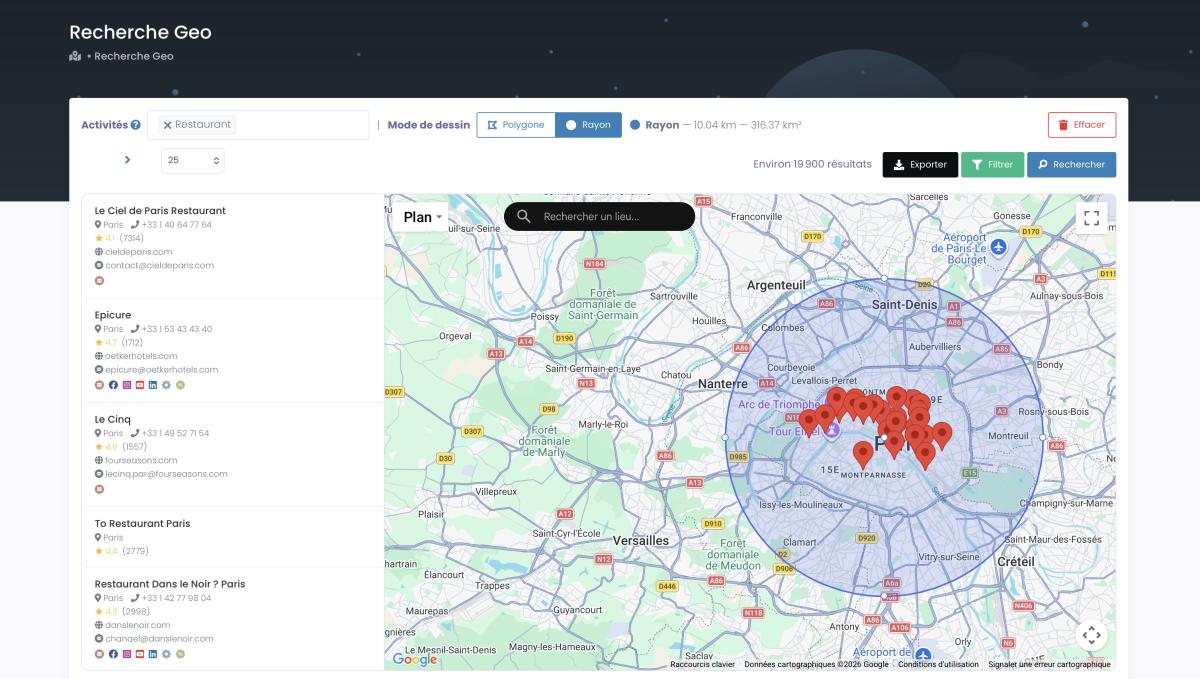
Better still, state lines are administrative fiction when your real target is "every credit union within 40 miles of Charlotte." For that, you draw the area yourself. GeoSearch radius sets a circle around a point:
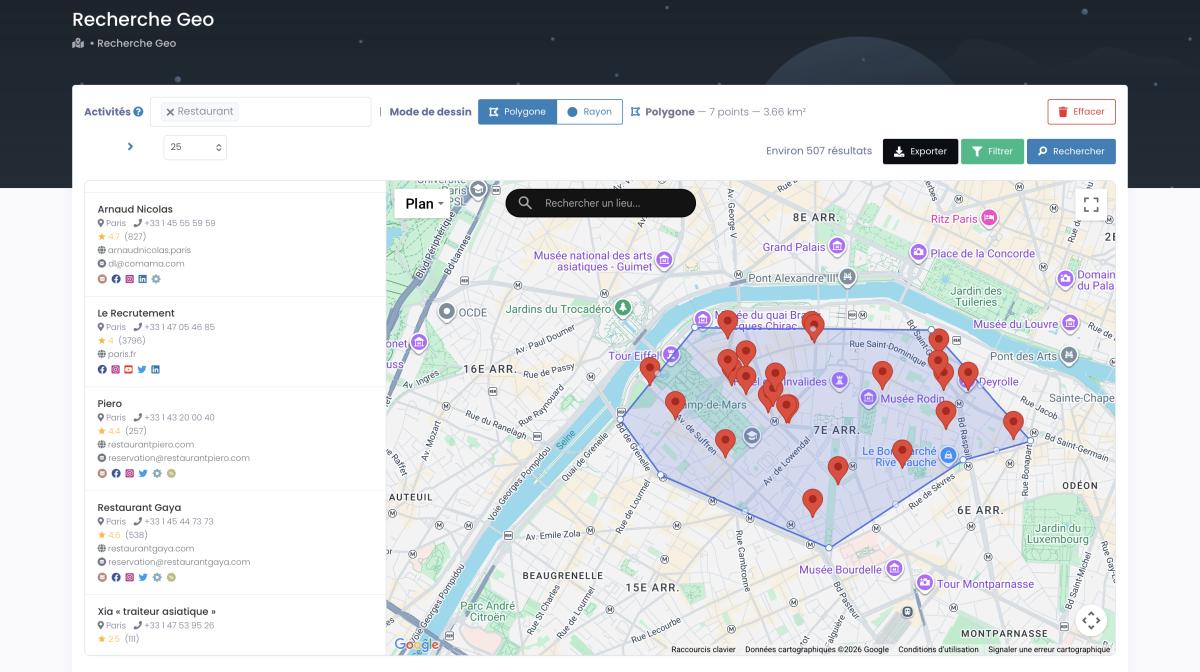
And when a circle doesn't match reality, a sprawling metro, a specific corridor, you hand-draw a polygon over the exact zone:
Why Build Your Own Credit Union List? (B2B Angle)
Meet Jessica. She sells a compliance SaaS to credit unions. Her product is good, her demo converts, her pricing is fair. Her problem was never the pitch. It was the list.
She tried the NCUA locator: no emails. She bought a "credit union mailing list" from a broker for a few thousand dollars: 30% of it bounced, because the credit union database behind it was compiled before the last wave of mergers. She kept paying for data that was dead on arrival. Sound familiar?
Here is the reframe. "4,250 credit unions" sounds like a small market. It isn't. Those institutions run 23,605 contactable locations, serve 145.8 million members, and sit on $2.48 trillion. These are high-value, slow-churn, long-contract accounts. Landing even a handful pays for a year of outreach. The market isn't small. It's concentrated. Different thing entirely.
And the companies who win it are the ones who build their own list instead of renting a stale one. Same lesson applies across financial services, which is why we wrote the same playbook for the financial advisor email list and the financial planner email list. Credit unions are the same shape of problem: public data, scattered, decaying fast, enormously valuable once it's clean.
See how many credit unions Scrap.io finds in your target state. Counts are always free, no credit spent, no card charged to look. Type the category, pick a state, read the number. Check your market free →
How to Build a Contact-Ready List in 2 Clicks
Here's how to go from "I need a list of credit unions" to a clean, contact-ready CSV in about the time it takes to make coffee. Jessica did it in one afternoon, after months of fighting broker files.
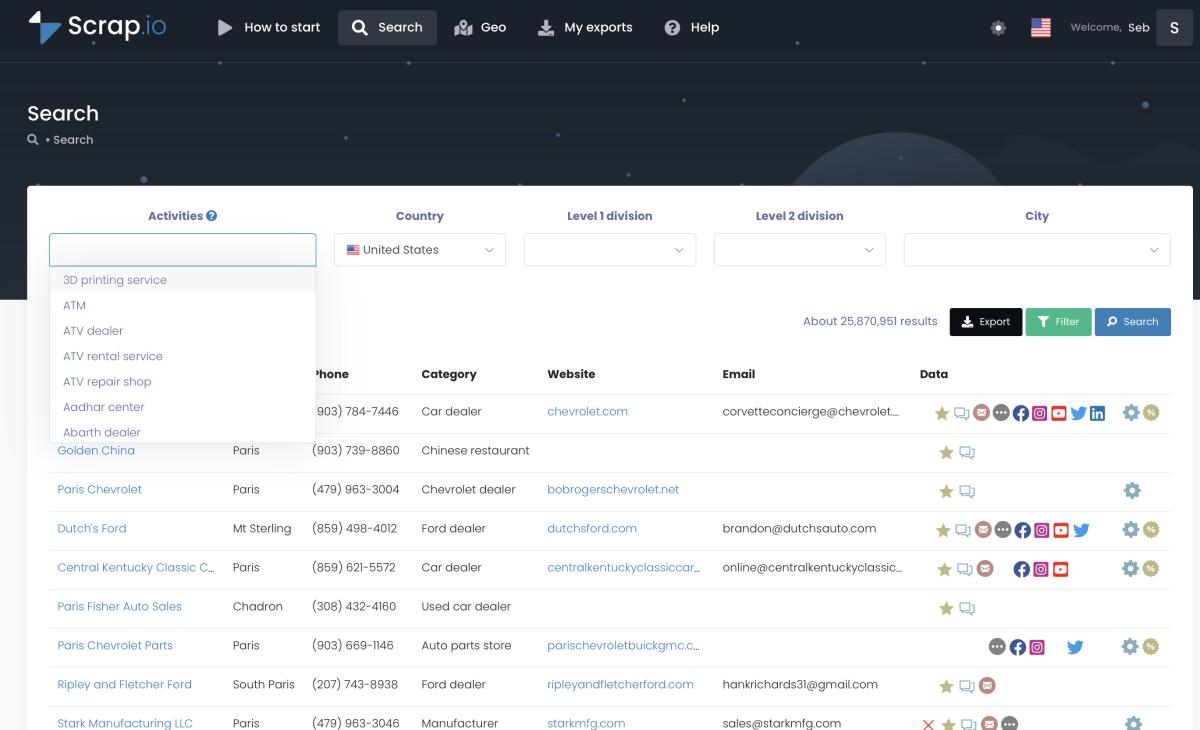
Scrap.io pulls business data live from Google Maps, across 195 countries and 4,000+ categories, 225 million+ listings indexed. For credit unions, the part that matters is this: you can extract the entire US, or a single state, in two clicks, with no code. Here is the search screen:
Four steps, start to finish:
- Pick the category and location. Type "credit union," choose a state or the whole US. Country-level search comes with the Company plan.
- Count for free. Scrap.io shows the exact number of matching listings instantly, zero credits spent. This is where you sanity-check your market.
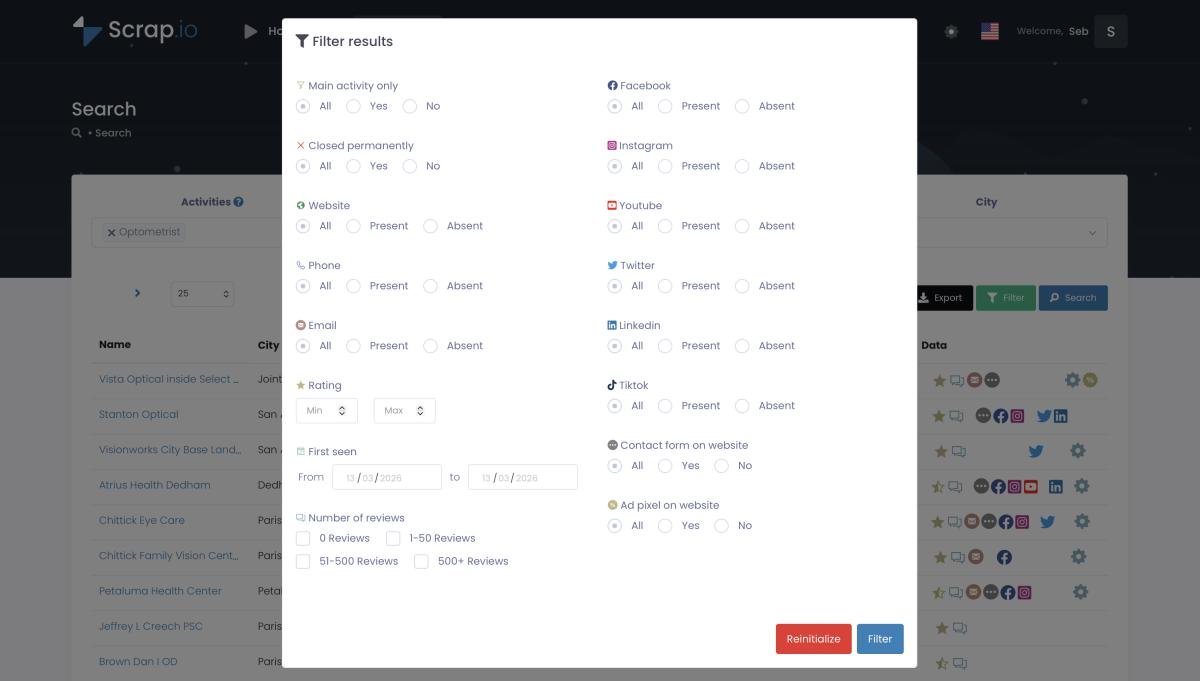
- Filter before extraction. Only the ones with an email? Toggle it. Only those with a website, or a certain review count? Toggle those too. This is the step brokers physically cannot offer, because they already charged you for the whole file.
- Export. One click to CSV or Excel: name, address, phone with type, classified emails, website, social links, rating, tech stack. Drop it straight into your CRM.
The filtering point is worth dwelling on. Out of 23,605 listings, 14,835 have an email. With a broker, you pay for all 23,605 and discover the dead ones yourself. With Scrap.io, you filter for email-present before a single credit is consumed, so you never pay for the other 8,770. That is not a feature. That is the entire economic argument.
Want to see it run at national scale? This short walkthrough shows a full country pulled in a couple of clicks:
Video: How to Scrape Google Maps at the Country Level
Build your credit union list now. 7-day free trial, 100 leads included. 23,605 US listings, filtered before you pay, exported live the moment you hit download. Start free for 7 days →
Building a Credit Union Email List the Right Way (Compliance)
A fresh list is step one. Sending without torching your domain is step two, and it's the step most people skip until it's too late.
Is it legal to email credit unions you found online? Yes, with conditions. B2B outreach to publicly listed business emails is legal in the US under the CAN-SPAM Act, which requires no prior opt-in for commercial email to business addresses. You must identify yourself accurately, include a valid physical postal address, avoid deceptive subject lines, and honor opt-outs promptly. Phone and SMS outreach is a different animal, governed by the TCPA, which is strict about calling and texting, especially mobile numbers. And if you're reaching California-based contacts, CCPA gives them rights over their data.
The source of your data matters as much as the sending. Scrap.io only collects publicly available business information, each record traceable to its source, and is GDPR and CCPA compliant. That's a very different starting point from a grey-market file of unknown origin. When a credit union's compliance officer asks where you got their address, "public Google Maps business listing" is an answer. "A broker, no idea where they got it" is not.
Practical hygiene still applies: authenticate your domain, warm it up, personalize, and send in waves rather than blasting 14,835 contacts on a Tuesday. The mechanics are the same across every vertical, so our accountant email list guide and our email database guide both walk through deliverability in detail. Steal from them.
Real Examples: Who Prospects Credit Unions
Still think 4,250 institutions is too small a market to build a business around? An entire B2B ecosystem disagrees. These companies exist to sell to credit unions, and they're not small:
- Jack Henry / Symitar: one of the leading core banking platforms for credit unions. Core processing is a multi-year, high-value contract. They live and die by reaching the right institutions.
- Callahan & Associates (CreditUnions.com): data, analytics, and peer benchmarking built entirely for the credit union industry. A whole company, on this one vertical.
- Core processors like Fiserv, Corelation, and CU*Answers: more than twenty software vendors compete for credit union core and digital banking contracts.
- America's Credit Unions (formed from CUNA and NAFCU): the national trade association, proof the sector is organized, well-funded, and worth selling to.
- List brokers like Data Axle and InfoUSA openly sell "credit union mailing lists." That's your proof of demand, and your differentiation target: their files are static, yours is live.
The pattern is clear. Serious companies build serious businesses selling to credit unions, and the ones who treat the list as a living, filtered, compliant asset outperform the ones renting stale CSVs. It's the exact dynamic we documented for the insurance agency email list: a "small" vertical that is anything but, once you can actually reach it.
Join 50,000+ professionals who prospect with real-time map data. Agencies, SaaS vendors, and sales teams across 195 countries build their lists live instead of buying them stale. See the data for yourself →
FAQ
How many credit unions are there in the US in 2026?
As of Q1 2026, there are 4,250 federally insured credit unions, serving 145.8 million members and holding $2.48 trillion in assets (NCUA). That's down from 4,760 in December 2022, driven by steady consolidation. On Google Maps, those institutions appear as roughly 23,605 branch and office listings.
What are the largest credit unions in the US?
By assets, the biggest are Navy Federal (over $200 billion), State Employees' Credit Union (SECU), PenFed, BECU, and SchoolsFirst Federal Credit Union. Navy Federal is by far the largest, holding more assets than the next several combined.
Where can I find an official list of credit unions?
The NCUA Credit Union Locator (mapping.ncua.gov) is the official source. It's excellent for verifying a single institution's insurance and charter status, but it offers no bulk export of emails, phones, or websites, so it isn't usable for prospecting on its own.
Can I get a list of credit unions with email addresses?
Yes. Credit union emails are public business data published on their own websites and Google Maps profiles. About 14,835 US credit union listings currently have a detectable email, and a tool like Scrap.io lets you filter to export only those, so you never spend credits on records without one.
Is it legal to email credit unions I found online?
Yes, for B2B outreach to public business emails, under the CAN-SPAM Act: identify yourself, use an accurate subject line, include a physical address, and honor opt-outs. Phone and SMS outreach is governed separately by the TCPA, and California contacts have CCPA rights. Using publicly sourced, traceable data keeps you on solid ground.
Build Your 2026 Credit Union Directory
The official count is 4,250 and falling. The contactable reality is 23,605 locations, 145.8 million members, and $2.48 trillion in assets, sitting in public view on Google Maps. The NCUA locator will confirm who they are. It will never hand you a way to reach them.
That's the gap your competitors are still stuck in, copy-pasting from a government map one record at a time. You don't have to be. Filter for the 14,835 with an email, export, and start your outreach today. Fresh beats stale. Every single time.
Get your full 2026 list of credit unions. Start free for 7 days, 100 leads on us. Real-time data, filtered before you pay, every contact traceable to its source. Try Scrap.io free →
Generate a list of cooperative bank with Scrap.io