

Last year, a SaaS founder I know spent $4,200 on a "premium" financial advisor email list from one of those big data brokers everyone recommends on Reddit. Ten thousand contacts. Looked legit. Then he launched his first campaign and 3,400 emails bounced before lunch. Another 1,800 went to advisors who'd already jumped ship to different firms. Quick math: that's $4,200 for roughly 4,800 usable contacts — most of which were ice-cold anyway.
I see this happen constantly. (If you want the technical version of what killed his domain reputation that morning, we broke it down in our guide on soft bounce vs hard bounce.)
Here's the reality: investment advisors in the US manage $144.6 trillion in assets (SEC, 2024). There are 116,731 investment services in Scrap.io's database right now, with 24,859 operating investment advisory as their main activity. The financial advisory services market hit an estimated $146.7 billion in 2026 according to Research & Markets — projected to reach $245.5 billion by 2032 at an 8.94% CAGR.
Massive opportunity. Can't reach these people with recycled data from six months ago, though.
If you need a financial advisor email list that won't torch your budget — or you're trying to figure out where to buy financial advisor email addresses that actually land in inboxes — keep reading. I'll skip the motivational preamble.
📋 What's in This Guide
- Why Investment Service Email Lists Matter
- Live Data vs Old Email Lists
- Where to Find Investment Services (Geography)
- Who Actually Needs These Email Lists?
- Real Success Stories
- How to Build Your Investment Email Database
- Compliance & Legal Framework
- Email Marketing Tips That Work
- Cost Breakdown: Scrap.io vs Traditional vs DIY
- FAQ
Why Investment Service Email Lists Matter
You've got something that could genuinely help financial advisors. A compliance tool, a portfolio analytics dashboard, a CRM that doesn't make people want to throw their laptop. Whatever it is. These advisors aren't on Twitter waiting for your pitch. They're knee-deep in client reviews, SEC filings, and compliance paperwork that somehow multiplies overnight.
Email is your way in. But only if the data behind it is real.
The Financial Advisory Market is Huge ($146.7 Billion)
The US financial advisory services market is valued at $146.7 billion in 2026 (Research & Markets). It's heading toward $245.5 billion by 2032. And the US alone accounts for 87.40% of the entire North American financial advisory market (Mordor Intelligence, 2025). Not 40%. Not "a big chunk." Eighty-seven percent.
Who works in this market? 326,000 personal financial advisors across the US (Bureau of Labor Statistics, 2024). Of those, 15,870 are SEC-registered investment advisers managing assets for 68.4 million clients. Average salary sits at $168,465/year (BLS). These are people who can write checks for $20K software licenses without blinking. And the industry is growing — 12.8% job growth projected over the next decade (BLS).
More advisors entering the market every year. More money under management. More demand for tools, training, and services. If you're selling to this market, the math works. If you can actually reach them.
Platforms like Scrap.io give you all 116,731 US investment services with real-time data — pulled fresh at the moment you export, not compiled last quarter. Free 7-day trial — 50 searches and 100 export credits, no commitment.
Who's Trying to Reach These Advisors
Everyone in the B2B financial orbit. Software companies pushing CRM platforms like Wealthbox and portfolio management tools like Orion. Fintech startups building AI-powered analytics. Training companies — Kitces.com, CFP Board, Kaplan Financial Education. Marketing agencies selling SEO and lead gen services (the same playbook we describe in our marketing agency email list guide).
And there's a tech spending wave happening: 67% of advisory firms adopted AI-enabled platforms in 2026 (Business Research Insights), with 72% investing in automation. These firms are opening their wallets for new technology right now. If your product solves a real problem for them, the timing is about as good as it gets.
Competition for their attention is brutal, though. Same story when companies go after accountants, attorneys, or consultants. Without good data, you're yelling into a void.
Where to Find Financial Advisor Leads That Convert
Quick note on terminology, because it trips people up constantly. Financial advisor leads and a financial advisor database aren't the same thing. A database is raw inventory — names, emails, addresses. Leads are what's left after you've filtered that inventory down to people who plausibly need what you sell.
Most vendors sell you the first and call it the second. That's the whole scam, honestly.
Filtering is where the value lives — geography, website presence, review volume, specialization, whether there's a working email at all. Do it before you pay and your 116,731-record database becomes a few thousand real leads. Do it after and you've bought a spreadsheet you're about to delete 90% of.
Live Data vs Old Email Lists
Two options. Traditional list brokers or real-time data extraction. I've watched enough campaigns crash with option one to have a strong opinion here.
And the demand for a straight answer is real. On the BenefitsLink message boards, a retirement plan professional posted looking for exactly this: "Hello All - would like to have a regular advisor email list to send out newsletters too, especially with Secure Act changes. Is there a particular company that is better, to one, purchase the list for certain areas..." (BenefitsLink Message Boards, October 2023). The thread got one reply. One. That's how thin the useful information is out there.
Why Old Financial Advisor Databases Suck
Traditional financial advisor mailing list providers sell you spreadsheets compiled weeks or months ago. Finance is particularly brutal for data decay — commonly cited industry benchmarks put the rate at roughly 30-40% of B2B contact data going stale every year, and it's worse in finance because advisors hop between firms so often. Younger ones especially — they'll move three times in five years chasing better comp or going independent.
You pay $0.35 per contact for an investment service email database where a huge chunk of the entries are dead. Every bounced email dings your sender reputation, which means even the valid emails start hitting spam. Vicious cycle.
What that actually looks like from the inside, from a B2B marketer on the HubSpot Community: "In my first email campaign I experienced a bounce rate of 7.64%... I explained to my boss that if we send another email with a bounce rate above 5% our account will be suspended and he is pretty adamant about sending them the newsletter as well." (HubSpot Community, June 2023.) Boss wants volume. Platform wants hygiene. Marketer is stuck in the middle holding a list nobody validated.
Bref — this isn't unique to financial data. Business management consultant email lists have the same problem. So does every professional database that isn't updated in near-real-time. Static lists in dynamic industries bleed money. If you're going to buy email lists in 2026, at least know what you're paying for. And run an email validator over anything you didn't extract yourself — that's the difference between 60% and 95%+ deliverability.
How Scrap.io Gets You Fresh Data
Live data extraction flips the whole model. Instead of buying a frozen snapshot from three months ago, you pull current business information straight from Google Maps listings and company websites. When an advisor updates their Google Business profile or changes their firm's contact page, that data shows up immediately. Not next quarter. Now.
Here's the number nobody else in this SERP will give you. Of those 116,731 US investment services, 79,058 have a usable email address. That's 68%. And 104,987 have a website — a solid digital footprint signal if you're selling anything tech-adjacent.
Now think about what 68% means commercially. A broker charges you for all 116,731 records and lets you discover the dead 32% on your own time. Scrap.io lets you filter for the email-present ones before a single credit is consumed. You never pay for the other 37,673.
That's not a feature. That's the entire argument.
What's actually different:
- Real-time updates — the data is refreshed at extraction, every single time. No frozen base, no file that quietly rots on a server.
- Compliant by design — only publicly available business information
- Smart filtering — target by location, specialty, review score, online presence, tech stack — all applied before credits burn
- Full coverage — all 116,731 investment services across the US, and Scrap.io is the only tool that pulls an entire country's listings in two clicks without writing code (Company plan)
Cost? About $0.05 per contact versus the $0.35 traditional brokers charge. Deliverability jumps from maybe 60% to north of 95%. You can do the math. (It's not complicated math.)
Where All These Investment Services Actually Are
Blasting the same email to every advisor in America is lazy. Doesn't work either. Different regions, different advisor profiles, different buying habits. A retirement planning specialist in Boca Raton has nothing in common with a growth-focused RIA in San Francisco.
Which States Have the Most Investment Services?
Roughly 40% of top investment advisors cluster in a handful of states. Here's where the money concentrates:
| State | Why It Matters | Advisor Profile |
|---|---|---|
| New York | Wall Street, major RIA firms, old-money families | High AUM, institutional focus, premium budgets |
| California | Tech wealth, innovation-friendly advisors | Early adopters, AI-curious, growth portfolios |
| Texas | Fastest-growing finance sector in the US | Quick decision-makers, deal-oriented, less bureaucratic |
| Florida | Retirement capital, international wealth | Retirement planning, high net worth, estate focus |
| North Carolina | Independent advisors, lower operating costs | Solo practitioners, fee-only, open to new tech |
| Illinois | Chicago commodity trading, institutional investors | Institutional focus, conservative, big-ticket |
| Massachusetts | Old money, university endowments | Relationship-driven, long sales cycles, cautious |
| Pennsylvania | Diverse financial sector, insurance overlap | Blended practices, insurance + advisory |
| New Jersey | NYC spillover, suburban wealth management | Family offices, estate planning specialists |
| Washington | Tech-money boom, younger wealthy clients | Growth-focused, startup-friendly, ESG-interested |
Source: SEC IAPD data and Scrap.io geographic analysis, 2026.
Other Money Centers Worth Targeting
Beyond state-level targeting, some cities punch way above their weight. Miami is drowning in international wealth management. Denver's independent RIA scene has exploded in the last three years. Nashville is emerging as a finance hub — lower cost of living, growing advisory presence, and almost nobody is emailing these advisors yet. Less inbox competition. Think about that.
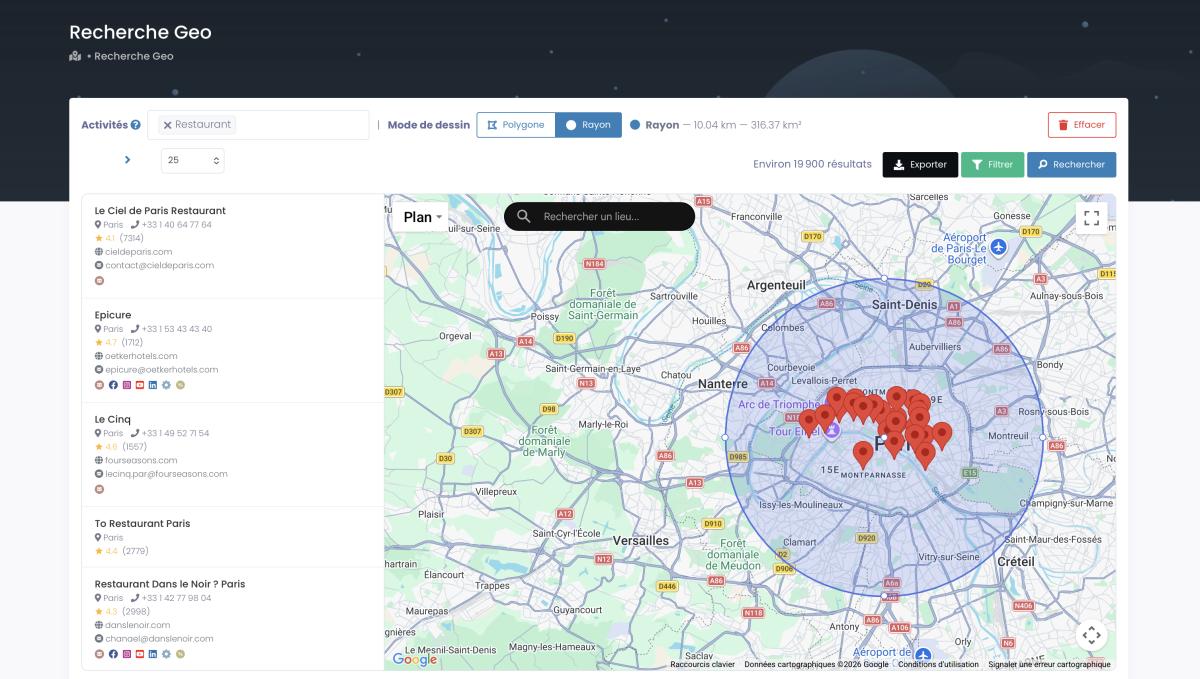
State lines are administrative fiction anyway. If your target is "every advisor within 40 miles of downtown Denver," a state filter hands you Colorado Springs too. GeoSearch radius draws the circle you actually meant.
Who Actually Needs These Email Lists?
Not "businesses." Actual companies with actual use cases.
Tech Startups Going After Financial Advisors
Nitrogen (they used to be called Riskalyze — rebranded in 2023) built a risk assessment platform for financial advisors. It helps RIAs quantify client risk tolerance so portfolios actually match what clients can stomach during a downturn. Useful tool. But building it is one thing. Getting it in front of the right advisors is another thing entirely.
Nitrogen doesn't need 100,000 random advisor emails. They need 5,000 RIAs in California and Texas who manage over $50M, have active websites suggesting tech adoption, and specialize in growth portfolios. That's financial advisor lead generation done properly — targeted, not sprayed.
And the demand is real: 67% of advisory firms now run AI-enabled platforms (Business Research Insights, 2026). Startups selling tech to advisors aren't chasing a fantasy. They're tapping actual budget allocation.
Same principle whether you're going after insurance agencies or real estate professionals.
Software Companies Selling to Investment Pros
CRM and portfolio management is stupidly crowded. Wealthbox, Redtail, Orion, eMoney Advisor — all scrapping for advisor subscriptions. The edge? Finding advisors who hate what they're using now. Maybe their CRM doesn't integrate with their custodian. Maybe they're still — and I'm not making this up — tracking client interactions in a spreadsheet. In 2026.
A well-filtered financial advisor database that lets you ID advisors by tech stack, firm size, and geography turns a spray-and-pray campaign into something that actually converts.
Training and Education Companies
Michael Kitces runs the largest educational platform for financial planners in the country. Between Kitces, the CFP Board, and Kaplan Financial Education, these companies survive by constantly reaching advisors who need continuing education credits. With 12.8% job growth coming over the next decade (BLS), there's a steady stream of new advisors who need training — plus every established advisor who needs ongoing CE. Two different segments, two different pitches, but both need to be reached somehow.
Worth flagging: if your product is aimed at certified financial planners specifically rather than investment services broadly, that's a different pool. We cover it separately in the financial planner email list guide — 148,994 listings under the Google Maps "Financial Planner" category, versus the 116,731 "Investment Service" records this article is about. Overlapping, not identical. Pick the one that matches your buyer.
Real Success Stories: How Companies Reach Financial Advisors
Enough theory. Documented results.
SmartAsset's Advisor Marketing Platform (AMP): SmartAsset built a lead generation platform for financial advisors. One of their clients — Pure Financial Advisors, a fee-only RIA — reported $1 billion in new AUM attributed to SmartAsset referrals. A billion dollars. Through one lead gen channel. That's what targeted financial advisor prospecting looks like when the data and the strategy both work.
Craft Impact + Burney Wealth Management: Craft Impact (a marketing agency) helped Burney Wealth Management rebuild their email marketing infrastructure, implement HubSpot, and build structured lead nurturing workflows. Cold advisor contacts became qualified conversations. Took months, not days. But the system compounds. Clean data in, warm leads out.
Want to run a targeted campaign to financial advisors in your state? Filter by location, rating, specialty, and email presence — the same live-data approach 50,000+ professionals already use across 195 countries. Get started free.
How to Actually Build Your Investment Email Database
Here's the practical part.
Smart Filtering for Investment Pros
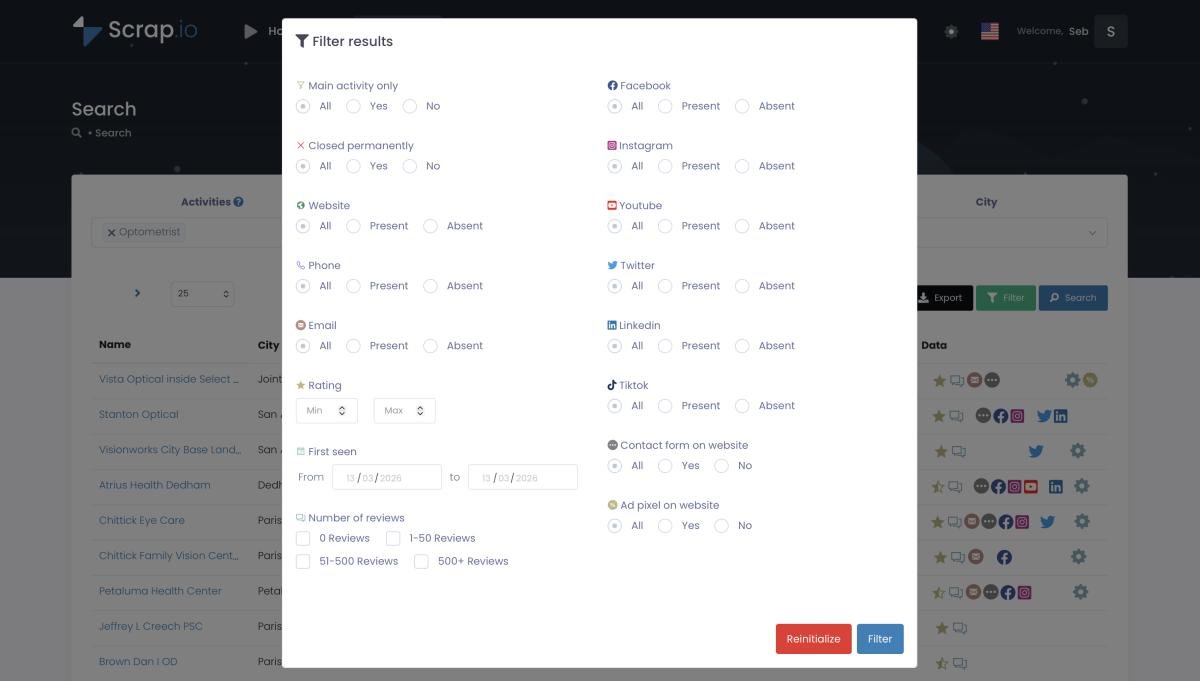
This is where Scrap.io pulls ahead of every traditional financial advisor list provider I've tested. You filter investment services by criteria that actually matter:
Geography: City, county, state, or the whole country. Need every RIA in Austin? Done. Every independent advisor in the Research Triangle? Two clicks.
Firm indicators: Employees, revenue range, online presence signals.
Digital footprint: Advisors with websites, social media profiles, or specific tech on their site.
Review data: Low Google ratings? (They might need reputation help.) High ratings? (They clearly invest in client experience.)
Specialization: Investment focus, service type, business category.
Try asking a traditional broker for all registered investment advisors in North Carolina with a website, fewer than 10 Google reviews, and "wealth management" as their specialty. They'll stare at you. Scrap.io does it in seconds.
Video: Finding Clients Through Google Maps Filters
Oh, and one more thing that list vendors structurally cannot do — territory extraction without a category. A broker sells you "financial advisors." That's their product. But if you sell to advisors and to the CPAs, attorneys, and insurance brokers in the same three-block corridor of downtown Charlotte, Scrap.io lets you draw a radius or a hand-drawn polygon on the map and pull every business inside it. No category filter at all. That's an economic map of a territory, not a list. Nobody selling static CSVs can produce that.
79,058 of those 116,731 advisors have a working email. Filter for them before you spend a single credit — that's the part brokers can't do, because they already charged you for all 116,731. Try the filters free for 7 days.
How the Live Data Thing Actually Works
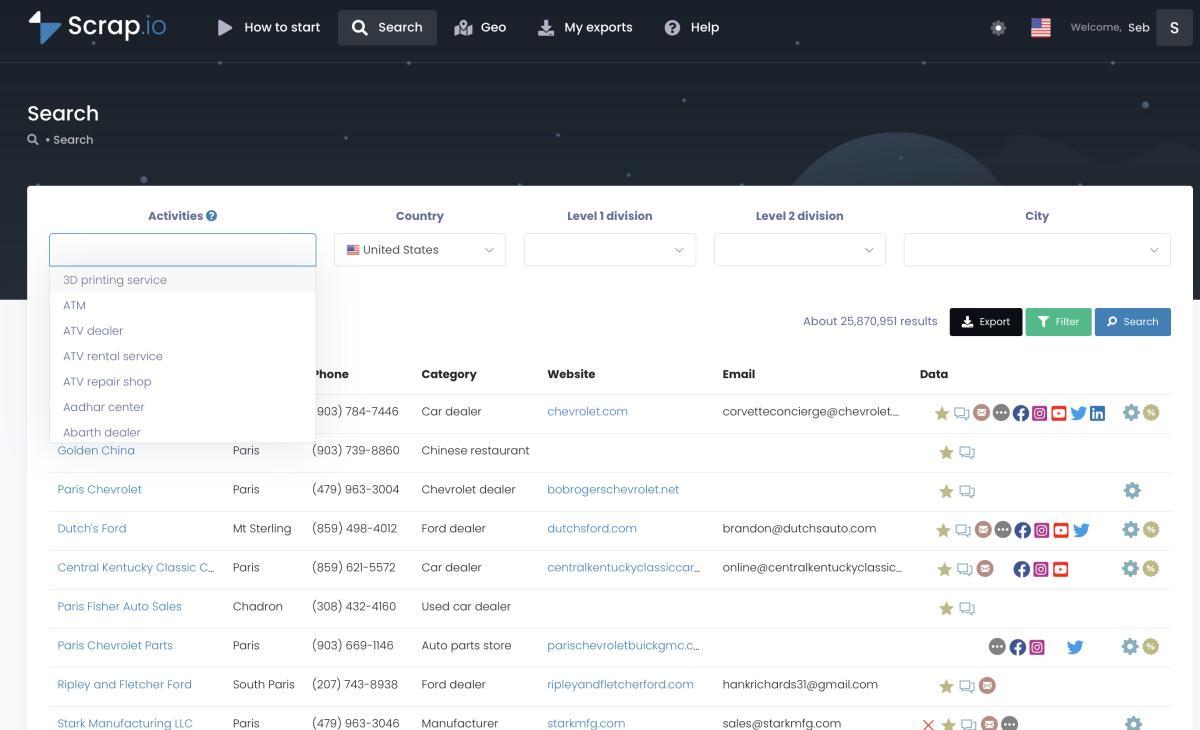
Four steps. Not complicated:
- Set filters — geography, business type, and whatever additional criteria you need
- Data collection — the system pulls current info from Google Maps listings and company websites
- Verification — emails and phone numbers get checked for deliverability
- Export — clean CSV or Excel, ready for your CRM or email platform
Takes minutes. The data reflects what's live today, not what was accurate whenever someone last bothered to update a static database.
Video: Scrap.io - How to Start?
For the full technical walkthrough: how to find email addresses from Google Maps. And if you want to push it further, our CRM automation guide shows how to pipe this data directly into your CRM with Make.com — zero manual entry.
Compliance & Legal Framework for Financial Advisor Outreach
Finance is heavily regulated. You know this. But a surprising number of people treat advisor outreach like any other B2B email campaign. It's not — and the advisors themselves know it. They'll spot sloppy compliance from the subject line.
| Regulation | What It Requires | How Scrap.io Complies |
|---|---|---|
| CAN-SPAM Act (FTC) | Accurate sender info, clear opt-out, no deceptive headers | Public B2B data only; you control messaging + opt-out |
| GDPR | Legitimate interest basis, data minimization, right to erasure | Only publicly listed business data; no personal scraping |
| SEC Marketing Rule 206(4)-1 (SEC) | Governs how advisors market themselves — applies to RIAs, not to vendors emailing them | N/A — regulates advisors, not your outreach |
| FINRA Communications Rules | Applies to broker-dealers' own communications | Same — governs their outreach, not yours |
| Investment Advisers Act | Advisor registration data is public record (SEC IAPD) | Collects only publicly available business info |
Is It Legal to Email Financial Advisors?
Yes. Cold B2B email to financial advisors is legal in the US under the CAN-SPAM Act, which requires no prior consent for commercial email to business addresses. You must include accurate sender information, a valid physical postal address, and a working opt-out mechanism honored promptly. SEC and FINRA rules govern what advisors say in their own marketing — not what vendors send to them.
That said — keep it clean. Financial professionals are wired to be paranoid about compliance. A dodgy-looking email from a suspect sender gets nuked instantly. Authenticate your domain (here's the SPF, DKIM & DMARC setup guide for 2026), follow cold email compliance best practices, and make sure you know how to avoid the spam folder.
Email Marketing Tips That Actually Work
Good financial advisor email list = step one. Execution = everything else.
Financial advisors are skeptical, time-starved, and get pitched six times before breakfast. A generic "Hi {First_Name}, I'd love to show you our platform" email? Deleted in two seconds flat. Maybe less.
How to Find Emails of Financial Advisors
- Buy a pre-built list from a data broker — fastest option, but the data is typically 3-6 months old and bounces hard.
- Build one manually from SEC IAPD filings and LinkedIn — accurate, and painfully slow at roughly 20 contacts per hour.
- Use live extraction — a tool like Scrap.io pulls current emails from Google Maps listings and company websites at the moment you export, filtered before you pay.
Option three is the only one that gives you speed and freshness at the same time. Options one and two make you pick.
Before blasting anything, honestly assess whether cold emailing is even the right channel for your product. Sometimes a contact form approach performs better with finance professionals who expect formal communication. And check out the warm outreach course — it's the exact system Scrap.io uses internally for its own outbound.
How to Segment Your Financial Advisor Contact Database
Don't send the same email to everyone. That's not a strategy. That's hope. Segment by:
AUM: A solo RIA managing $30M has completely different problems than a firm with $2B. Different budgets. Different approval chains. Different pain points.
Specialization: Retirement planners want distribution tools. Growth-focused advisors want analytics platforms. ESG specialists want impact reporting. One email fits exactly zero of these people.
Geography: Texas advisors operate in a completely different regulatory and market environment than Massachusetts advisors. Treating them identically is a rookie mistake.
Tech adoption: Some advisors run Orion, Salesforce, and three browser extensions. Others still keep client notes in a leather-bound notebook. Your pitch has to start where they are, not where you wish they were.
Whether you're building wealth management email lists or financial planner prospecting lists, segmentation is what separates a 2% reply rate from a 15% one.
Making Emails Feel Personal
Not mail-merge personal. Actually personal. Use the data from your financial advisor contact database to say something specific:
"Noticed your Charlotte firm just expanded into ESG investing — we help RIAs build compliant ESG reporting for quarterly client reviews..."
"Your Google profile mentions retirement planning for medical professionals. We built a withdrawal calculator specifically for physician retirement scenarios — happy to share it."
That kind of specificity takes five extra minutes per email. Worth it. According to YCharts' 2024 financial advisor survey, 61% of advisor clients preferred email as their communication channel — a 2024 figure, so treat it as directional rather than current. Advisors live in their inbox. You just need to earn your spot.
For scaling this without losing the human touch, see our guide on AI-powered cold email personalization. And when you're ready to think about nurturing beyond the first email, there's a solid framework in our B2B lead nurturing guide.
Scrap.io vs Traditional Providers vs DIY: The Cost Breakdown
Video: Stop Paying $20,000 a Year for ZoomInfo — This Does More for $49/Month
How Much Does a Financial Advisor Email List Cost?
Here's what 10,000 financial advisor contacts actually cost — three approaches, side by side:
| Traditional List Broker | Scrap.io | DIY (LinkedIn + Manual) | |
|---|---|---|---|
| Cost for 10K contacts | $3,500 | ~$500 | ~$2,500 (labor) |
| Price per contact | $0.35 | $0.05 | ~$0.25 |
| Data freshness | 3-6 months old | Real-time at export | Varies wildly |
| Estimated deliverability | ~60% | ~95% | ~70% |
| Working contacts | ~6,000 | ~9,500 | ~7,000 |
| Real cost per good contact | $0.58 | $0.053 | $0.36 |
| Filtering | Basic (state, industry), applied after you pay | All filters, all plans, applied before credits burn | Manual only |
| Time to get data | 1-3 days | Minutes | Weeks |
Scrap.io comes in at roughly 11x cheaper per working contact than traditional brokers. And you skip the data-cleaning phase entirely, which is where most campaigns stall out for a week.
One clarification on the pricing, because people ask. The ~$500 figure maps to the Basic plan at $35/month with 10,000 export credits. One credit = one business exported. Re-export the same record inside a rolling 30-day window and it doesn't cost you a second credit. And every filter is available on every plan — plans differ on search territory size and simultaneous categories, not on what you're allowed to filter.
FAQ: Common Questions About Investment Service Email Lists
How much does a financial advisor email list cost?
Between $0.05 and $0.35 per contact, depending on the provider and how old the data is. Traditional brokers charge more for data that's often months stale. Scrap.io delivers real-time verified contacts at $0.05 each — with deliverability rates that justify the difference.
Is it legal to email financial advisors for B2B purposes?
Yes. B2B cold email is legal under CAN-SPAM. Include accurate sender info, a physical address, and a working opt-out. Scrap.io only collects publicly available business data from Google Maps and company websites — fully compliant with GDPR and US privacy regulations.
How do I find emails of financial advisors?
Three ways: buy a pre-built list (fast, often stale), build one from SEC IAPD filings and LinkedIn (accurate, painfully slow), or use a live extraction tool like Scrap.io that pulls current contact info from Google Maps automatically. The third option gives you speed and freshness.
Is it worth buying a financial advisor email list?
If it's a stale database with 40% bounce rates — no, it's money down the drain. If it's a real-time investment advisor database with 95%+ deliverability and advanced filtering? Absolutely. At $0.053 per working contact, the ROI math works for almost any B2B product.
What data do you get in an investment service email list?
From Scrap.io: company name, verified emails classified by type (individual with first and last name, contact, sales, marketing, finance, admin), phone number with landline/mobile classification, business address, GPS coordinates, website URL, Google Maps rating, review count, photo count, specialization categories, social media links, detected CMS and tech stack, and ad pixels. Every column is available on every plan.
Which states have the most investment services?
New York, California, Texas, Florida, North Carolina. In that order. These five states hold a disproportionate share of US-registered investment advisors and assets under management.
How often should I refresh my financial advisor email list?
Traditional lists decay fast — commonly cited estimates put it at 30-40% accuracy loss within a year. With Scrap.io, you get fresh data every time you run a search. No refresh cycle needed because the extraction is always live.
Are there free financial advisor email lists?
Sort of. The SEC's IAPD database provides advisor registration data for free, but it doesn't include direct email addresses or detailed contact info. Free lists from random sites are almost always outdated garbage. Scrap.io offers a 7-day free trial with 50 searches and 100 export credits — enough to test whether the data quality meets your standards. Result counts are always free, on every plan, with no credit consumption.
What's the best financial advisor email list provider in 2026?
For real-time data with geographic precision, Scrap.io offers the best value. Traditional providers like ZoomInfo and Dun & Bradstreet have broader datasets but at 5-10x the cost, and static vendors like BizProspex, DataCaptive, LakeB2B and Exact Data sell compiled files without publishing volumetrics or freshness dates. For targeting local and regional advisors specifically, Scrap.io's Google Maps-based approach is hard to beat. See the comparison: Scrap.io vs Hunter.io for local targeting.
Can I get a financial advisor email list template?
Scrap.io exports directly to CSV and Excel, pre-structured with columns for every data field — name, email, phone, address, rating, specialty, tech stack, and more. That's effectively a financial advisor email list template populated with live data. Import it straight into your CRM.
Time to Build Your Investment Service Database
The financial advisory market is worth $146.7 billion. There are 116,731 investment services managing $144.6 trillion across the US. Growing at almost 9% a year.
None of that matters if your emails bounce. Or hit spam. Or land in the inbox of someone who left the firm last winter.
Current data. Verified contacts. Filtering that matches your actual ICP — not some generic "financial services" bucket. That's the baseline. Anything less is a waste of your outreach budget and your sales team's time.
Stop paying broker prices for stale financial advisor lists. Try Scrap.io free for 7 days — 50 searches, 100 export credits, and 116,731 US investment services extracted live the moment you hit export.
Generate a list of investment service with Scrap.io