

145,014. That's how many mortgage lenders are operating across the US right now, according to Scrap.io's live database. Not a projection. Not rounded up to look good in a headline. 145,014 actual businesses — 106,390 of which list mortgage lending as their primary activity.
Quick clarification first, because every other page in this search result gets it wrong: this article is about a list of mortgage lenders — the businesses. Not a list of people who have a mortgage. If you're hunting for consumer refinance leads, you're on the wrong page. Sorry. But if you sell software, services, or insurance to lending companies, keep reading. This is exactly your page.
I bring the 145,014 up because I've watched too many B2B companies hand over $1,500+ for a mortgage broker email list that was compiled six months ago. Then they act surprised when a third of their emails bounce. Or when the "loan officer" they're emailing left that company back in November.
You can get the same contacts — fresher, more accurate, better filtered — for under fifty bucks. I'm not exaggerating. We'll get there.
First, some context. Americans currently owe $13.19 trillion in mortgage debt as of the end of Q1 2026 — that's 70.2% of all US household debt (New York Fed, Household Debt & Credit report). The Mortgage Bankers Association forecasts $2.2 trillion in single-family originations for 2026, up 8% over last year — roughly 5.8 million loans. And here's the number that actually changes behavior: lenders made just $727 in pre-tax profit per loan in Q1 2026 (16 basis points), against a long-run average north of double that (MBA/Milliman, May 2026). Margins cut in half. That's a buying trigger, not a footnote.
Money is moving. Lots of it. And the companies selling to mortgage lenders — fintechs, software vendors, marketing agencies, insurance brokers — they all need one thing: accurate contact data for the people spending it.
So. How do you actually get a mortgage lender email list that works? That's the whole article.
Table of Contents
- The US Mortgage Lending Market in 2026: Key Numbers
- Why Traditional Mortgage Lender Email Lists Are Failing
- Live Data vs Static Lists: The Scrap.io Advantage
- The Numbers Don't Add Up: What Mortgage List Vendors Actually Sell
- Top Use Cases for Mortgage Lender Email Lists
- How to Build Your Mortgage Lender Email Database
- Cost Comparison: Scrap.io vs Traditional Providers
- Best Practices for Mortgage Lender Outreach
- Compliance: CAN-SPAM, TCPA & GDPR in 2026
- Who Are the Top Mortgage Lenders in the US?
- FAQ: Mortgage Lender Email Lists
- Conclusion
The US Mortgage Lending Market in 2026: Key Numbers
$727. That's what a US mortgage lender made in pre-tax profit on each loan it originated in Q1 2026. The long-run average since 2008 is 39 basis points — more than double the 16 bps lenders are living on today. Production costs climbed roughly $800 per loan over the quarter. Read that again. Lenders are working harder to make less.
Here's what the rest of the numbers look like right now. The 30-year fixed sits at 6.66%, with the 15-year at 6.04%, as of the week of July 30, 2026 (Freddie Mac PMMS). Refinance demand has been a rollercoaster all year — up 132% year-over-year in February, up 52% in April, down 18% week-over-week in May, up 7% in July — with refis making up 39.5% of applications the week of July 24 (MBA Weekly Applications Survey). And there's roughly $11 trillion in tappable home equity sitting across about 48 million holders — about $213,000 each (ICE Mortgage Monitor, March 2026).
What does all that actually mean if you're trying to sell to mortgage professionals?
It means they're stressed. Squeezed. Fighting the mega-lenders and the fintech newcomers at the same time, on half the margin they had two years ago. Which is precisely why they're spending on tools that save time or win loans. The lenders who fell behind on tech are the ones most desperate to catch up. Those are your prospects.
Scrap.io currently tracks 145,014 mortgage lending businesses across the United States, 106,390 of them with lending as their primary activity. California, Texas, Florida lead the concentration — California alone holds 17,431. But there's been real growth in the Carolinas, Tennessee, Arizona. Markets that barely registered five years ago.
145,014 mortgage lending businesses in the Scrap.io database. Free 7-day trial, 100 leads included — test the data quality yourself before committing. One search covers the entire US, not fifty state-by-state exports.
Why Traditional Mortgage Lender Email Lists Are Failing
Let me just hand you a real one. Posted on r/DigitalMarketing:
"I recently bought about 3000 leads from a website (I forget the name but they're very popular) and every single one of those emails bounced. It was extremely frustrating. 1000 bucks down the drain only to get my email address borderline blacklisted. How can a company charge so much and not even have their leads verified?" — u/Funkychunks123
And the reply that reframes the entire problem: "What's the definition of 'a lead' to you? Buying mailing lists really is not to me. 'A lead' is someone who's showing interest in my product or service. You just bought 'contact info'." — u/BelgianMagician (thread).
That's the whole failure mode in two comments. You paid for a spreadsheet. You thought you bought interest.
The Math Doesn't Work Anymore
Traditional mortgage lender mailing list providers compile data once or twice a year, then resell it to hundreds of buyers. You pay $0.15–$0.30 per contact for info that might've been accurate in September. Maybe.
10,000 contacts × $0.20 = $2,000. Need a refresh next quarter? Pay again. And again. It adds up brutally fast. If you've been through this with buying email lists in any industry, you know the pattern — fresh-looking spreadsheet, promising deliverability numbers, then the bounce reports start rolling in.
Why Mortgage Data Goes Stale Faster Than Most Industries
Here's the stat that should be on a poster in every mortgage marketer's office: loan officer turnover runs 30–45% a year (STRATMOR Group's long-run average, via National Mortgage Professional). Nearly half the people on a "verified" list can be at a different shop — or out of the business entirely — within twelve months.
Think about what that does to a bought file. Loan officers jump between companies constantly, chasing better commission splits, better lead flow, a better tech stack. New brokerages spin up monthly. Others merge, get acquired, or just fold. A "verified" mortgage company email database starts rotting the moment it's compiled — and mortgage rots faster than almost anything.
So you get a third of the emails bouncing, wrong job titles, and state-level filtering as your only knob. No company size. No online-presence signal. No way to tell whether a business closed three months ago. You're spraying into the void and calling it marketing.
Insurance brokers buying stale mortgage broker mailing lists. Compliance vendors emailing defunct shops. Agencies pitching website redesigns to companies that rebranded last spring. Same story, different vertical.
The real estate market has the same challenge, by the way. If you work that vertical too, the real estate agent email list guide covers the overlap. And for adjacent financial niches, the financial planner email list and insurance agency email list guides go deep on the same dynamics.
Live Data vs Static Lists: The Scrap.io Advantage
When a mortgage company changes its phone number on Google Maps, that change is public the same day. Your list vendor will notice in about four months. That's the entire pitch, and it's not close.
How It Works (Short Version)
Scrap.io pulls business data directly from Google Maps listings and company websites — the info that businesses publish and maintain themselves. There's a complete technical guide if you want the full breakdown. Short version: public data, scraped in real time, filterable by dozens of criteria.
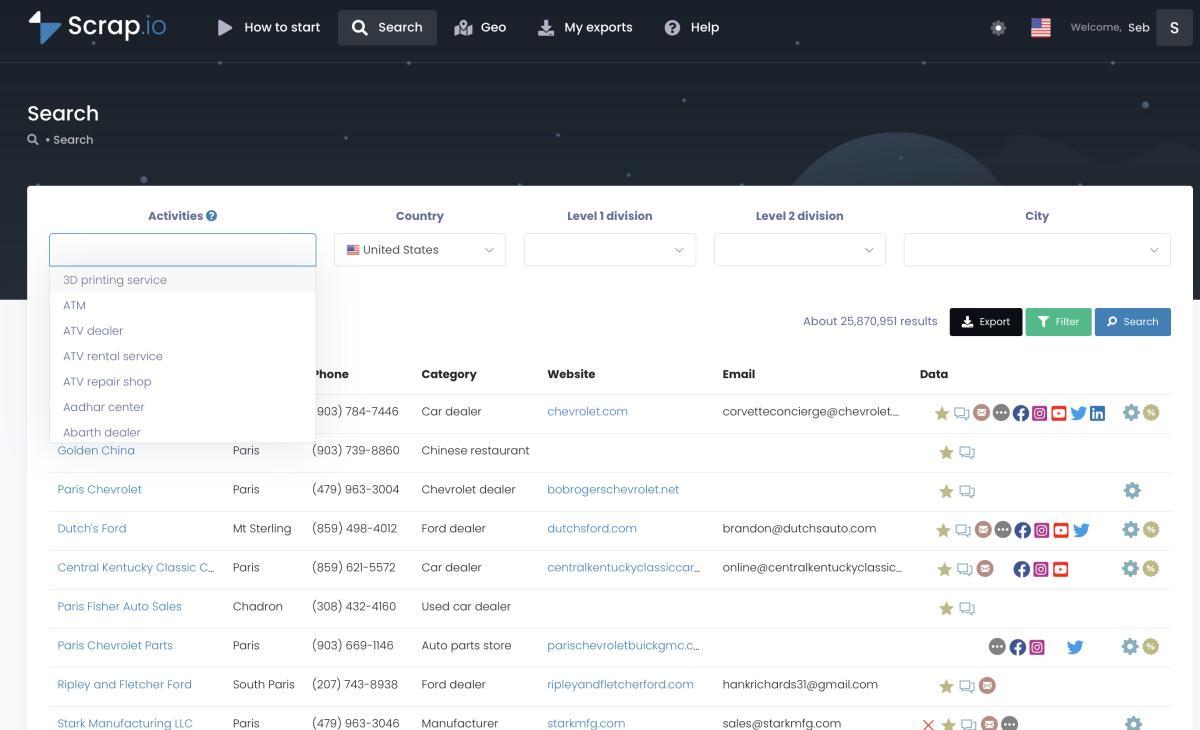
Beyond email addresses, you can see which lenders recently expanded or moved offices, which ones have terrible Google reviews (a reputation-management pitch waiting to happen), which have websites that look built in 2009, which have zero social presence. Every gap is an opening — if your data is fresh enough to see it.
145,014 Lenders — But the Filtering Is the Real Story
The raw number matters less than what you can do with it. Of those 145,014 lenders, 122,296 have a website, and 89,776 have at least one email detected on that site. Need mortgage brokers in California with a confirmed email and no LinkedIn profile? Two clicks. Lending companies in fast-growing Texas markets with under 50 reviews? Done. A loan officer email list filtered by city, review score, and website presence? All possible.
And here's the part that separates Scrap.io from the whole category: the entire country in two clicks. The 145,014 US mortgage lenders are a single search — not fifty exports stitched together in a spreadsheet at midnight. Try doing that with a list vendor. I'll wait.
Video: How to Scrape Local Leads at the Country Level — the national extraction in action.
One more thing, and it's the real kicker. Scrap.io's filters apply before extraction. You only spend a credit on the 89,776 records that actually have an email — never on the 55,238 that don't. That's the exact inverse of the list-buying model, where you pay first and discover the bounces after.
The Numbers Don't Add Up: What Mortgage List Vendors Actually Sell
Four vendors sell you "the" mortgage broker email list. Their contact counts disagree by a factor of nine. Somebody's wrong, and it might be all of them.
Here's what the major sellers claim, side by side:
| Vendor | Claimed count | What they're counting |
|---|---|---|
| ExactData | 28,296 | mortgage brokers |
| Blue Mail Media | 48,000+ | mortgage brokers |
| LakeB2B | 292,622 emails / 418,031 contacts | mortgage brokers |
| Scrap.io | 49,178 brokers + 145,014 lenders (166,436 deduped) | brokers & lenders, counted live |
Now the calculation that kills it. LakeB2B claims 418,031 American mortgage brokers. The MBA projects 5.8 million total loans in all of 2026. That's one broker for every 14 loans a year. In an industry where a working broker closes dozens of loans annually, 418,031 is not a database — it's a fantasy with a checkout button.
Then there are the promises that can't both be true. Blue Mail Media stamps "100% Verified" at the top of the page and "90% accuracy" further down. LakeB2B pledges "100% verified" and "95% delivery guaranteed." Pick one. You cannot have both, and a vendor that hasn't noticed the contradiction on its own sales page hasn't checked the data either.
My favorite detail? Blue Mail Media's "Free Sample Data of the Mortgage Brokers Email List" table has, on inspection, zero mortgage brokers in it — the rows are an executive assistant at Ipsos Canada, a French headhunter, a finance director at a Brazilian John Deere dealership. Sample data for a mortgage list, with no mortgage anyone in it. That's the tell.
We're not claiming our number is the "true" one either. We're claiming we'll tell you exactly where it came from and when it was counted. Nobody else in this list will. For the broader teardown of the list-buying model, we wrote a whole honest guide on buying email lists and when it does (rarely) make sense.
Top Use Cases for Mortgage Lender Email Lists
Not every company chasing mortgage lender leads runs the same play. A fintech selling AI underwriting has nothing in common with an agency pitching SEO. Here's who's buying these lists and how.
Fintech Companies
AI underwriting. Automated document processing. Digital lending platforms. Income and employment verification. All of them need decision-makers at lending companies.
The sweet spot is mid-size lenders. Not the top-20 giants (procurement cycles that outlive your runway) and not solo brokers (no budget). A 15-person brokerage making good money but drowning in manual work? They decide fast. They pay for time back. Argyle, which automates income and employment verification, covers roughly 90% of the US workforce, hits verification rates above 55%, and delivers up to 80% savings versus manual checks — Compass Mortgage cut verification costs 43% with it. That pitch lands hard with that audience.
But you need current data to find them. Whether you're building a mortgage broker email list or a tighter loan officer list, the filtering decides whether outreach hits or misses.
Software Companies
CRM systems, loan origination software, compliance tools, marketing automation — lenders need a stack of specialized tech, and plenty haven't modernized. ICE Mortgage Technology (Encompass) owns roughly 50% of the LOS market with about 3,200 lenders and posted $557 million in Q2 2026 revenue. Dominant, yes. But that leaves thousands of lenders still running on spreadsheets.
How do you find the laggards? Filter for lenders with basic websites, no social media, thin reviews. That's not guesswork — that's a segment.
Borrower-Intelligence & Retention Platforms
Here's a beautifully on-the-nose example. TrustEngine (formerly Sales Boomerang + Mortgage Coach) monitors a lender's existing database — credit scores, equity, rate opportunities — and pings loan officers when someone's ready to transact. Reported results: 7× ROI, 20–40% more loan volume, 200+ lenders served since 2017.
The irony writes itself. TrustEngine's entire value prop is "work the database you already own instead of buying new contacts." That's this article's thesis, validated by a real company with a real number. Which is precisely why fresh, accurate data matters — you can't re-engage a database that's 40% ghosts.
Origination & Point-of-Sale Platforms
Blend reports saving lenders $650 and cutting 18.78 hours per loan, shortening the cycle by 9.41 days, with an average 10.67× ROI on the tech spend — and in March 2026 it launched Autopilot, which completes an origination review in 15 seconds. Sit with the first number: $650 saved per loan, against a $727 profit per loan. That nearly doubles the margin. That's why lenders are buying right now.
Marketing Agencies
Agencies selling SEO, reputation management, paid ads, or CRM buildouts to mortgage companies need a constant pipeline. A client of ours automated their entire mortgage broker prospecting flow with Make.com wired into Scrap.io — auto-find lenders with poor Google reviews, no social presence, or dated websites, then drop them into personalized sequences. Our Make.com tutorial walks through the build. (There's also a video of the Scrap.io + Make.com workflow if you'd rather watch.)
Argyle, Total Expert and Blend all built their pipeline on precise targeting, not volume. 100 free leads on Scrap.io — real-time data, filter by state, city, reviews and online presence. 7-day trial included.
Selling into adjacent financial verticals too? The financial advisor email list guide covers the same targeting playbook one door over.
How to Build Your Mortgage Lender Email Database
Three paths. Build your own mortgage lender database by hand (takes forever, stale before you finish). Buy a pre-made list (fast, with all the quality problems above). Or use live extraction (fast and fresh). The third is where the market's heading. Here's how it works in practice — and if you want the deeper playbook, our guide on how to build a cold email list is the pillar piece behind this.
Video: Scrap.io — How to Start (two-minute onboarding).
Location Targeting by State and City
Mortgage is hyper-local. Rules differ by state. Market conditions swing wildly. Pitching California refi tools to Iowa lenders wastes everyone's afternoon.
Live extraction lets you go as narrow as you need — a single city, a metro, a state, a multi-state region. California alone holds 17,431 mortgage lenders; you can slice that down to one county with an email filter before you spend a cent. Traditional vendors might offer state filtering (for an upcharge), but the data behind the filter is still months old. Precise targeting doesn't matter if the contacts are ghosts.
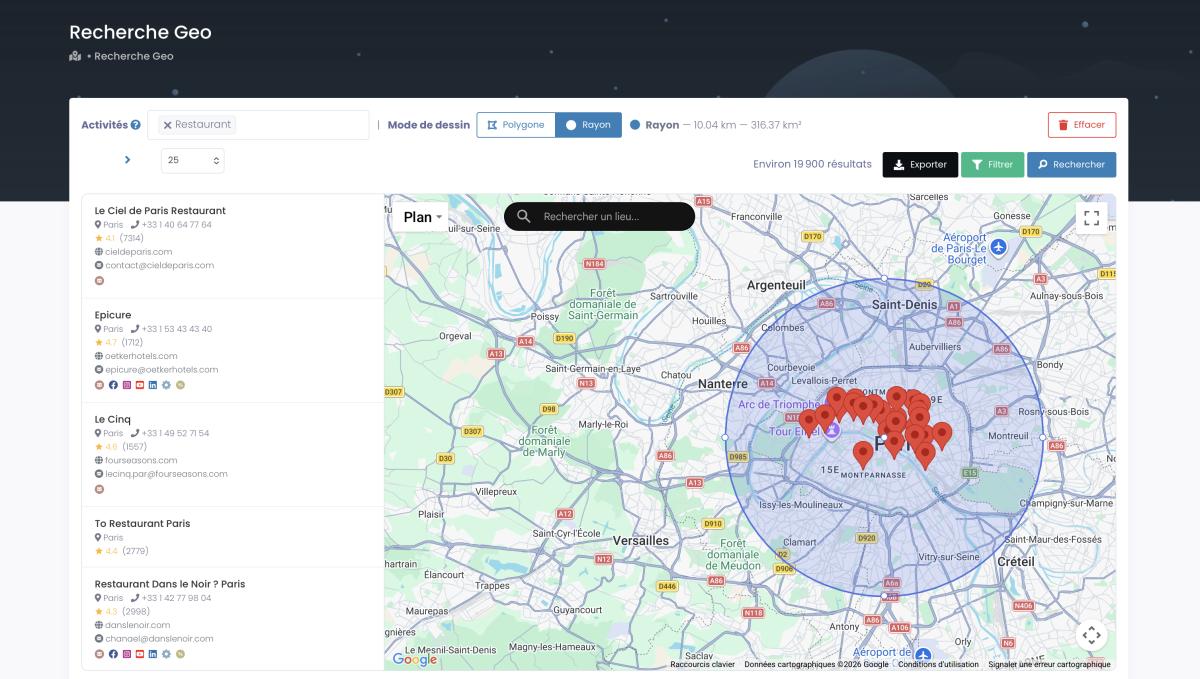
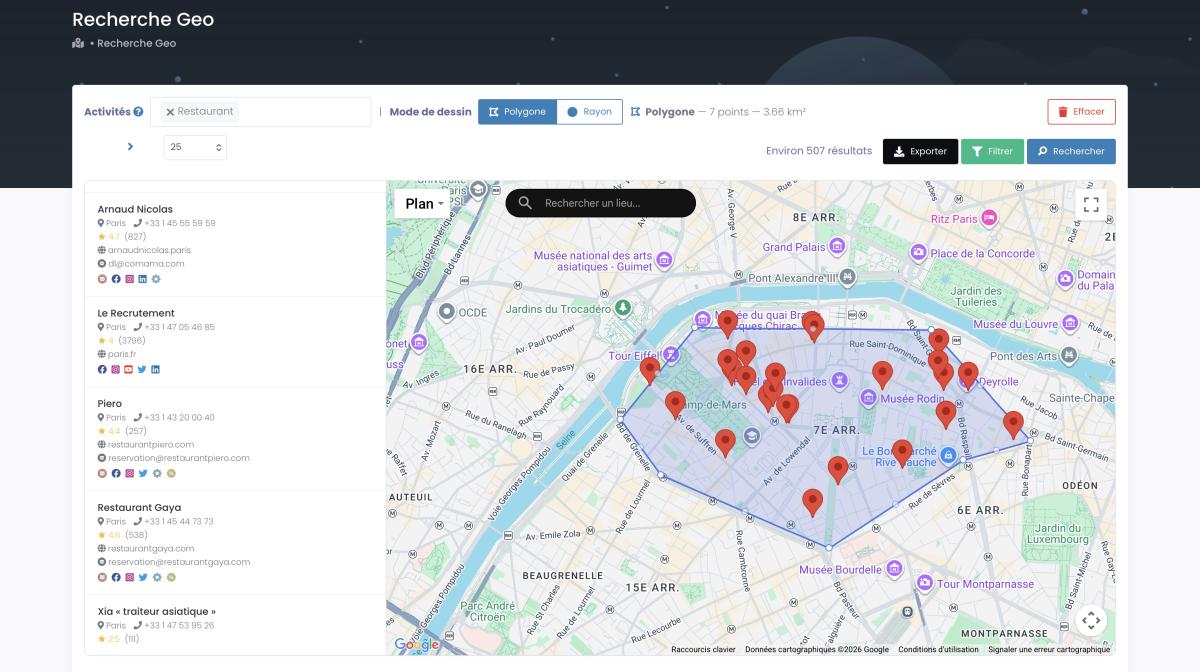
Radius mode and polygon mode. Target "every mortgage lender within 30 miles of downtown Phoenix" or hand-draw a zone around a specific corridor. Try getting that from a list broker. (You can't.)
Advanced Filtering
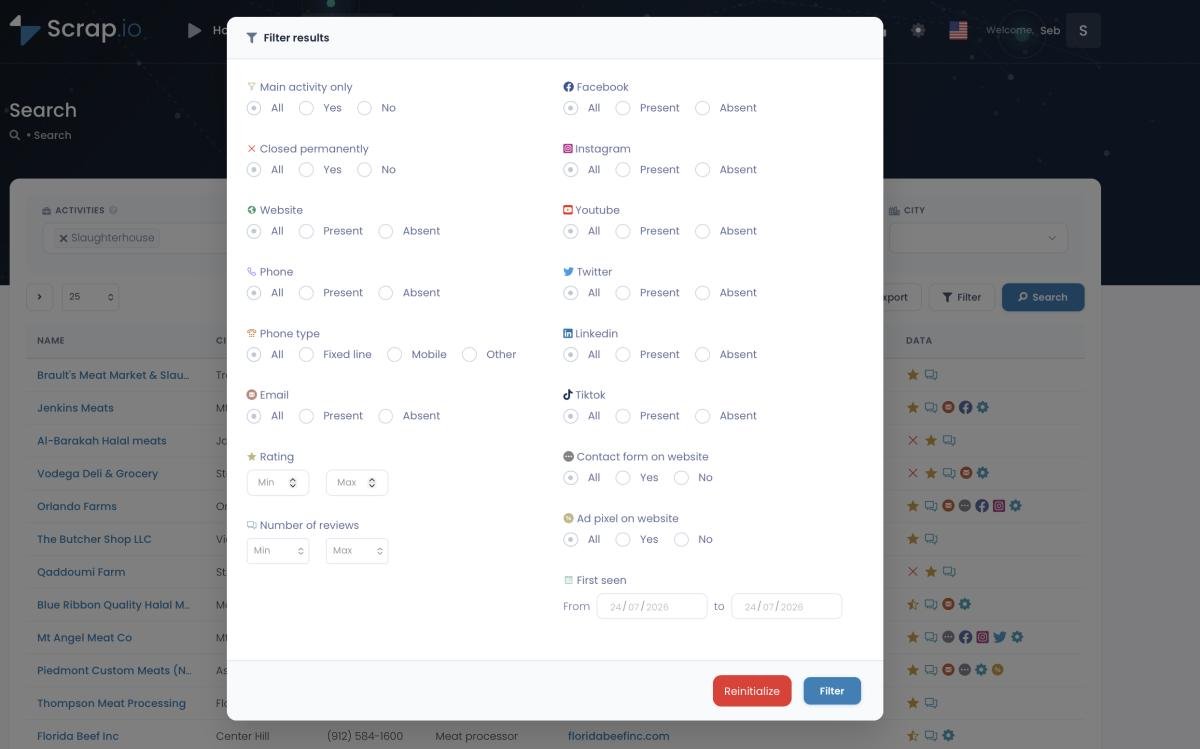
Business characteristics: primary vs secondary activity, Google rating, review count, website presence, social engagement. Contact availability: email, phone, social profiles, contact forms. Market signals: recently opened businesses, poor reviews, no modern website, no social presence.
Each filter is an outreach angle. Bad reviews = reputation pitch. No website = web-dev pitch. No social = digital-marketing pitch. The data tells you what to sell before you write the first line.
A California mortgage lender email list is one of the most-requested segments — makes sense, it's the biggest market. But "California mortgage lenders" is still far too broad. Layer on city targeting, filter for lenders with a website and email but poor ratings, and you've got 200 lenders who provably need reputation help. That's a campaign. Not spray-and-pray.
Want to see how Scrap.io picks the best email for each business? This video explains the approach.
Cost Comparison: Scrap.io vs Traditional Providers
Alright, money. This is where the traditional model falls apart completely.
| Feature | Traditional Providers (ExactData, LakeB2B, Blue Mail Media) | Scrap.io |
|---|---|---|
| Price per lead | $0.30/lead B2B, $0.21/lead B2C (ExactData, public) | Basic: $35/mo annual (10,000 credits) = well under $0.01/lead |
| Data freshness | 3–12 months old | Real-time at export |
| Filtering | Basic (location, maybe industry) | 50+ criteria, applied before you pay |
| Updates | Pay again each quarter | Always current |
Give ExactData credit for one thing: it's the only vendor in the set that publishes its prices — $0.30 per lead B2B, $0.21 B2C. That transparency is rare, and it makes the comparison honest. At $0.30 a lead, 10,000 mortgage contacts run $3,000. On Scrap.io's Basic plan — $35/month billed annually ($49 without commitment), 10,000 credits a month — the same 10,000 records cost a fraction of a cent each. Fresher, too.
Let me be precise so it doesn't sound too good: "under $50" isn't a gimmick, it's the Basic plan. And a credit is one exported business, counted once per rolling 30-day window — re-export the same lender and you don't pay twice. For a broader tool comparison, the Hunter.io alternative breakdown is worth a read.
Video: Stop Paying $20,000/Year for ZoomInfo — This Does More for $49/Month.
What about free mortgage lender email lists? They exist. They're garbage. Compiled from outdated public records, shared with thousands, zero filtering. You'll spend more time cleaning the data than you'd spend paying for fresh. Hard pass.
And mortgage lender email list PDFs? Some vendors still sell static downloads. PDF, CSV, whatever — the format isn't the problem. A file is a photograph. Accurate the day it was taken, less accurate every day after. Live extraction means you pull fresh contacts when you actually need them.
Best Practices for Mortgage Lender Outreach
Here's the view from the other side of the inbox, from a real estate agent on r/realtors:
"i do get 50+ spam type emails/texts every day. LO's, recruiters, health ins providers, title companies, cleaners, photographers, contractors, stagers, wholesalers, scammers... it's exhausting, even with all the filters in place." — u/novahouseandhome (thread).
Brutal. But not the whole story — same thread, different agent: "It works great. I'd be happy to work with LOs that actually do something... I like doers. People being proactive. Someone willing to cold call or reach out is at least willing to get my attention and maybe a shot in the future." — u/kdsathome.
So the channel isn't dead. Lazy outreach is. You have to earn the open, the click, the reply. Volume alone buries you in that 50-a-day pile.
Does cold email actually close loans? A loan originator on r/loanoriginators answered that better than any benchmark could. First the warning: "You won't get results with cold email unless you are sending hundreds of emails a day (without landing in spam)... Now if you have $7,500 to burn learning the ropes and can hire the proper people for it, by all means go ahead." Then, from the same person: "Well, I had $1.77M of closings the last month all from cold email. The learning curve is rough but now it costs me about $400/m to maintain." — u/mnmortgageguy (thread). Rough curve, real money at the end.
Now the benchmarks, so you know what "good" looks like. Cold email B2B in 2026 averages a 27.7% open rate and a 3.43% reply rate (according to Instantly's benchmark analysis). Compare that to Atlantic Bay Mortgage Group, which hits 86% email open rates — but on an audience it owns, through Total Expert's platform (case study). Three numbers, one lesson: 86% owned audience, 27.7% cold, "every single one bounced" bought list. Where you get your data decides which bucket you're in.
Subject lines that get opened: "New compliance tool — 4 hrs/week saved on reporting" · "How [competitor] boosted loan approvals 23%" · "Q4 mortgage trends + one automation trick."
Subject lines that go to trash: "Revolutionary lending solution!" · "Make millions with this one mortgage trick" · anything with more exclamation marks than facts.
On personalization: first-name merge tags impress nobody. Mortgage pros have seen "{first_name}" since 2014. What works is proof you looked at their business. "Noticed your team is expanding into reverse mortgages — compliance gets complicated fast." That's the bar.
On volume: do NOT blast 10,000 emails on day one from a fresh domain. Fastest way to crater your sender reputation and live in spam forever. Start at 20–30 a day. Scale over 2–3 weeks. Boring? Yes. Essential? Also yes.
And watch your bounce rate like a hawk — keep it under 2%, ideally under 1%. Verified lists run 0.5–1.5% hard bounces; bought, unverified lists run 2–5%+ (Prospeo). One campaign over 2% can send your whole domain to spam.
For sequences, our cold email templates guide covers what works. The cold email writing guide goes deeper on personalization for financial services. This video on why Google Maps emails don't get replies is worth fifteen minutes before you launch. On the technical side, SPF, DKIM and DMARC is mandatory in 2026 — Gmail and Microsoft reject unauthenticated mail, full stop — and email validation before sending saves your domain from that 5% bounce disaster.
Compliance: CAN-SPAM, TCPA & GDPR in 2026
$53,088. Per email. Not per campaign.
You're emailing financial-services people. They live and breathe compliance. If your outreach feels even slightly off, you've lost them — not because they'll sue (though they could) but because they'll delete it and mentally blacklist your company.
CAN-SPAM
Applies to every commercial email sent in the US. Requirements: honest subject line, your physical mailing address, a working unsubscribe (processed within 10 business days), accurate "From" and "Reply-To" headers. The penalty is $53,088 per email — and here's the E-E-A-T detail nobody else in this search result has right: that figure was set on January 17, 2025 and stayed flat for 2026 because the annual inflation adjustment was canceled (OMB memo M-26-11, Federal Register, July 7, 2026). Most pages still quote the old $50,120. Get it right and you look like you actually read the rule. The FTC's compliance guide is the primary source.
Good news for B2B: no prior opt-in needed to email a business contact. CAN-SPAM is more relaxed B2B than B2C. But honor unsubscribe requests immediately. No exceptions.
TCPA
Planning to call or text lenders alongside email? The TCPA requires prior express written consent for auto-dialed calls to cell phones — penalties $500–$1,500 per call. And clear up one thing you may have read elsewhere: the FCC's "one-to-one consent" rule was vacated by the Eleventh Circuit (Insurance Marketing Coalition v. FCC, January 24, 2025) and subsequently dropped by the FCC. It is not in force in 2026. The standard reverts to prior express written consent. Don't build your process around a rule that no longer exists.
State Privacy Laws
This is the argument most competitors miss entirely. Most state privacy laws follow the Virginia model and exempt B2B data — but California's CCPA/CPRA has had no B2B exemption since the end of 2022, and Rhode Island's new law (effective January 1, 2026) has no cure period at all. Indiana and Kentucky also came online January 1, 2026.
Now connect the dots. California is the single biggest mortgage market in the country — 17,431 lenders. So a bought "US mortgage lenders" list is disproportionately Californian, which means it's disproportionately exposed to the one state law with no B2B carve-out. The bigger your generic national list, the bigger your California liability. Fun.
GDPR
Relevant if you target lenders with UK/EU operations. Requires legitimate interest or consent, transparency about sources, and the right to be forgotten. B2B data scraped from public sources usually falls under "legitimate interest" — but document your basis.
Scrap.io only collects information businesses publish themselves — Google Maps listings and websites. Public data, GDPR and CCPA compliant, every record traceable to its source. If a lender put their email on their Google Business profile, they did it because they want to be contacted. You're organizing public information, not harvesting private data. If the legality question is nagging at you, we address it head-on in is it legal to scrape Google Maps. For the full outreach picture, the cold email compliance guide covers CAN-SPAM, GDPR and implementation.
Who Are the Top Mortgage Lenders in the US?
Rocket Mortgage. United Wholesale Mortgage. Wells Fargo Home Mortgage. loanDepot. Fairway Independent. Those are the giants. Knowing them helps you sell to everyone else — because every small and mid-size lender feels the pressure from those names daily. Bigger budgets, faster tech, better borrower experience. That anxiety is your angle. If your product helps a 20-person brokerage compete with Rocket's marketing machine, say that, explicitly.
And the field is churning hard. The sector tracked 62 M&A deals, exits and JVs in 2025, up from 37 in 2024 — and roughly one lender in four hasn't turned a profit in two years (HousingWire / STRATMOR). Translation: the list you bought in the spring already has closed shops and merged brands in it. The market moves; static data doesn't. That's the whole argument, made concrete.
Segmentation-wise: skip Rocket's generic inbox (they have procurement portals for that). Focus on the thousands of independent lenders in California alone, or the growing mid-market shops in Arizona and the Carolinas. These are people deciding this week, not next fiscal year. Mortgage also overlaps with property management and real estate — if you sell into adjacent verticals, the property management company email list guide covers the same targeting techniques.
FAQ: Mortgage Lender Email Lists
How much does a mortgage lender email list cost?
Legacy vendors charge $0.21–$0.30 per lead (ExactData's public pricing), or $1,000–$2,500 for a static database. Scrap.io: access to 145,014 US mortgage lenders with real-time data, starting under $50/month on the Basic plan. Cheaper, and current.
Is a mortgage lender email list the same as a list of homeowners with mortgages?
No — and confusing the two is the fastest way to burn a budget. A mortgage lender email list is B2B: the lending companies, brokerages and loan officers themselves (145,014 businesses in the US). A mortgage holder list is B2C: consumers who currently have a home loan (85M+ records). Different data, different laws, different price. This guide covers the B2B side.
Are mortgage lender email lists legal?
Yes — when sourced from publicly available data (Google Maps listings, company websites). Scrap.io only collects info businesses publish themselves. For outreach, follow CAN-SPAM: unsubscribe link, physical address, honest subject line. The compliance guide has the full breakdown.
What information is included?
Emails, phone numbers, company names, Google Maps data (ratings, reviews, photos), social profiles, detected website tech, primary/secondary classification. Whether you need a loan officer email list or a broader mortgage mailing list, same dataset — different filters applied.
How often is mortgage lender data updated?
Traditional databases: monthly or quarterly if you're lucky. Scrap.io: real-time. When a lender updates their Google listing, you capture the change the same day. Not months later. Given 30–45% annual loan-officer turnover, that gap is the whole game.
Can I target specific states or cities?
Yes. City-level, state-level, radius-based, or custom polygon zones. Layer on review scores, website presence, social — whatever narrows to your ideal prospect. California alone has 17,431 lenders to slice.
How do I find mortgage broker email addresses?
Three options: manual research (slow), pre-built lists (fast but stale), or live extraction from Google Maps. Scrap.io does the third. Search "mortgage broker" in your target geography, apply filters, export. Minutes, not months.
Is it legal to email mortgage lenders?
Yes. B2B email outreach using publicly available business information is legal under CAN-SPAM. Include an unsubscribe link, identify yourself honestly, honor opt-outs within 10 days. No prior opt-in required for B2B in the US.
What is the best mortgage lender email list provider?
Depends what you value. ExactData, LakeB2B, Blue Mail Media offer pre-built lists at premium prices for data that ages fast — and, as we showed above, with counts that contradict each other by a factor of nine. Scrap.io offers real-time extraction with 50+ filters at a fraction of the cost. For most B2B use cases, fresh data under $50 beats stale data at $2,000.
How many mortgage lenders are there in the US?
There are 145,014 mortgage lending businesses in the United States, according to Scrap.io's real-time database, with 106,390 listing mortgage lending as their primary activity. California, Texas and Florida have the highest concentrations.
Start Building Your Mortgage Lender Database Today
145,014 businesses. $13.19 trillion in mortgage debt. Margins cut to $727 a loan. A market churning through 62 M&A deals a year. The opportunity is right there — and it moves every single day.
Traditional mortgage broker mailing lists are expensive, shared with your competitors, contradictory in their own numbers, and stale before the invoice clears. Live extraction gives you current contacts, filtering that turns data into angles, and pricing that makes the legacy vendors look ridiculous.
I've watched this play out dozens of times. Company A buys a $2,000 list, emails it for three months, gets mediocre results, blames email marketing. Company B grabs fresh data for $50, filters hard, sends personalized messages to 500 targeted contacts, books 15 demos in two weeks. Same industry. Same product. Different results — because the data quality was different. Full stop.
Fintech, lending software, marketing services, insurance — doesn't matter. Fresh data is what separates the companies building pipeline from the ones complaining about response rates.
Try Scrap.io free for 7 days. 100 verified mortgage lender contacts, 100 leads included. Real-time data, filter by state, city and reviews. See what fresh actually looks like.
Generate a list of mortgage lender with Scrap.io