

Video: Scrap.io - How to Start?
- What a "UK companies database" really means
- How many companies are there in the UK?
- Where UK company data comes from: 6 sources compared
- Building your own UK business directory in 2026
- Filtering: turn 5.4M records into a targeted list
- Is it legal? UK GDPR, PECR, TPS & MPS
- Real examples: who uses UK business data
- Free vs paid options
- FAQ
The most popular UK companies database is free, official, government-run — and almost useless if you actually want to sell to those companies. That's Companies House. It'll tell you a firm exists, who directs it, when it filed accounts. It will not give you an email address. It will not give you a phone number that rings. Not one.
So here's the gap this article fills. Companies House tells you who exists. This guide is about how you get the means to contact them — email, phone, website, socials — across all 5.4 million UK businesses. Two clicks, no code, no scraper to babysit. Let's get into it.
What a "UK companies database" really means (and the 2 types)
People type "uk companies database" into Google and mean two completely different things. Worth sorting that out before you waste a week.
Type one: the legal register. This is the record of who is incorporated. Company number, registered office, directors, filing history, SIC codes, accounts. Companies House is the canonical source here, and it's genuinely excellent for what it does — due diligence, credit checks, confirming a company is real before you sign anything. A thread on r/datasets put it well: "Companies House is the official source and free… but it needs cleaning." Right. It's a legal archive, not a marketing list.
Type two: the prospecting database. Same companies, different job. Here you want the stuff that lets you start a conversation — the info@ inbox, the mobile number, the website, the LinkedIn page, whether they even have a website. This is a UK business database built for outreach, not for lawyers.
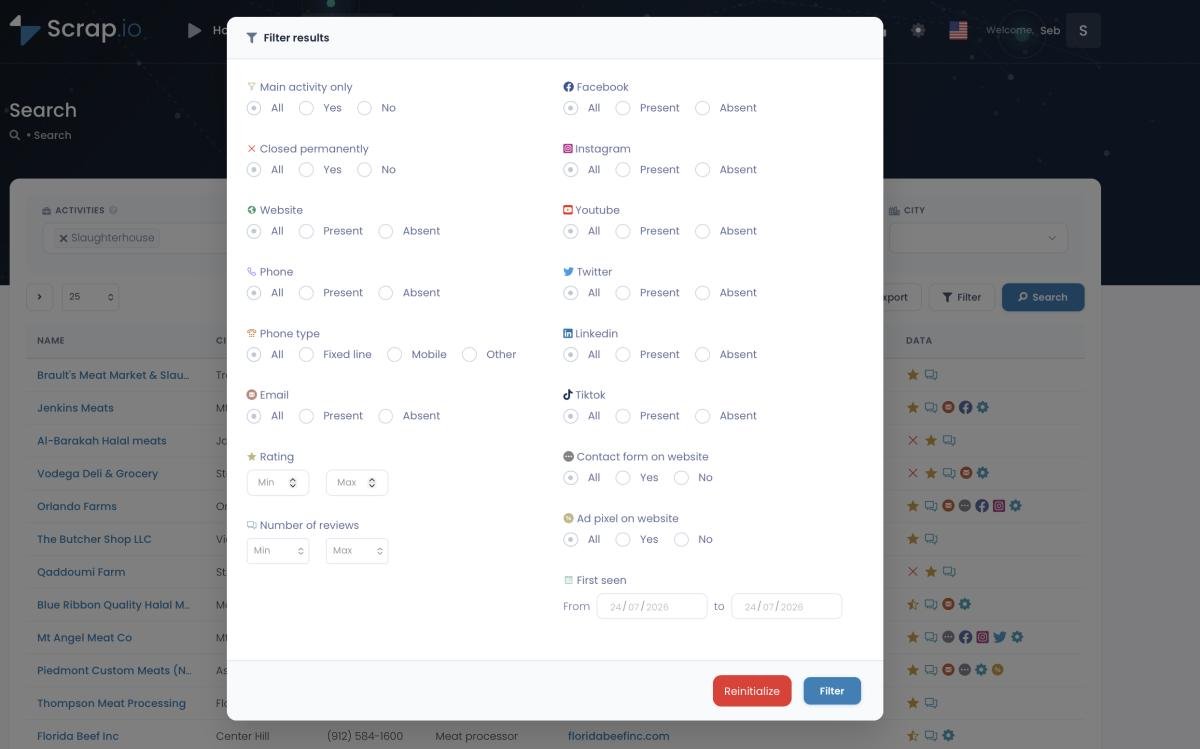
And that's the whole confusion in one sentence. The legal register has fields lawyers care about, all filled in. The contact fields marketers care about? Greyed out. Empty. A brilliant public asset that answers a question you probably weren't asking. If your goal is a list of uk companies you can email tomorrow morning, the register alone is a dead end.
How many companies are there in the UK? (2026 numbers)
At the end of March 2026, the total UK register held 5,479,045 companies, of which 4,930,634 were effectively active, according to Companies House register activity data on GOV.UK. That's the legal count.
Now the contactable count. On the mapping side, Scrap.io indexes 5,467,465 UK establishments (data from July 2026) — almost the same headline figure, but with something the register doesn't have. Of those:
- 3,941,670 have a phone number (~72%)
- 3,023,543 have a website (~55%)
- 2,065,683 have an email address (~38%)
Read those two paragraphs back to back. 5,479,045 companies on the register. 5,467,465 establishments on the map. Nearly identical scale — one gives you legal identity, the other gives you a way in. That's the entire point of this piece. (For context, the commercial provider HitHorizons claims 6M+ UK records, firmographics-heavy.)
Two million emails and nearly four million phones, sitting in public, on the map, right now.
Where UK company data comes from: 6 sources compared
OK but concretely, where do you actually get this stuff? There are six broad sources of UK company data, and they are not interchangeable. One question separates the useful ones from the pretty ones: which one gives you a phone number that rings?
| Source | Example | Gives contacts? | Freshness | Best for |
|---|---|---|---|---|
| Official register | Companies House | No | Live, legal | Due diligence, legal identity |
| Financial data provider | Endole | Partial | Filing-cycle | Credit & accounts research |
| Firmographic database | HitHorizons | Partial | Varies | Market sizing, firmographics |
| Data list broker | Marketing Data Lists | Yes | Frozen at sale | One-off bulk lists |
| Sales intelligence platform | Cognism | Yes | Rolling | Enterprise sales teams |
| Maps extraction | Scrap.io | Yes | Real-time | Targeted local & national outreach |
Notice the pattern. The two sources that dominate Google — the register and the financial providers — are exactly the two that don't hand you a way to contact anyone. That's not a coincidence. They were built for a different job. Meanwhile the brokers sell you contacts, sure, but frozen ones: the list is accurate the day it's compiled and rots from there. A business owner on r/smallbusinessuk described paying "£15k a year" for a database where "half the records are two jobs out of date," calling Experian and CorpData "very over-priced." Ouch. But not surprising — that's the flaw baked into any list you buy once and use for months.
See how many UK businesses match your niche — before spending a penny. Counts are free on Scrap.io: pick a category and a region, and it tells you exactly how many establishments (and how many with emails or mobiles) exist. No credit spent, no card charged for the number itself. Run a free count →
Building your own UK business directory in 2026 (step by step)
James runs a small web agency in Leeds. He needed every business in Yorkshire that didn't have a website — because those are the people who might actually buy a website from him. The old way: hire a VA, scroll Google Maps for a fortnight, copy-paste into a spreadsheet, hate your life. The new way took him two clicks and returned about 40,000 of them. That's the difference we're talking about.
Here's how you build the same kind of list — a business directory uk edition, a targeted list of companies in uk filtered to whatever you sell.
Video: How to Scrape Local Leads at the Country Level
To build a database of all UK companies in a niche — or a wider database of uk companies across a region — the flow looks like this:
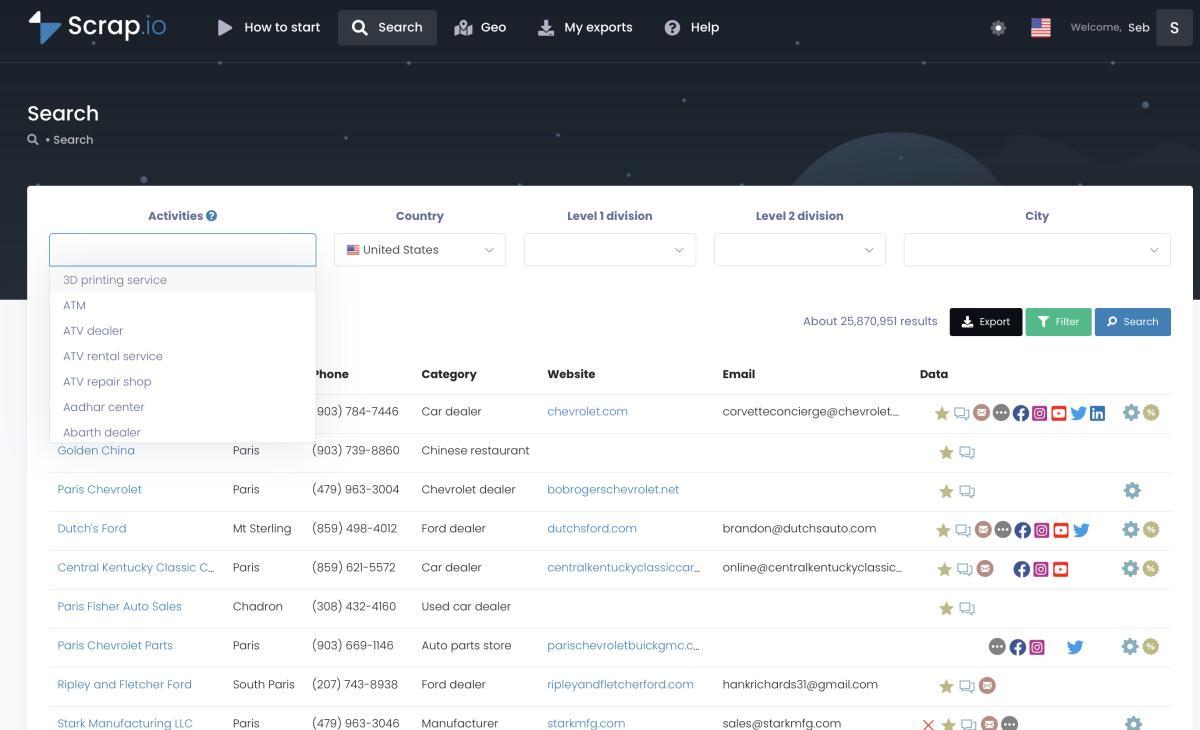
- Pick a category — from 4,000+ activity types. Plumbers, dental practices, marketing agencies, whatever. Or pick none, and grab every business in a zone (more on that below).
- Pick a location — a city, a county, a region (England, Scotland, Wales, Northern Ireland), or the whole country in one go.
- Apply your filters — has email, no website, mobile number only, and so on. Applied before extraction, which matters for your wallet.
- Check the count — free, instant, however many millions.
- Export — CSV or Excel, emails and phones and socials included, ready for your cold email tool or CRM.
No code at any step. And if you'd rather just ask for it, Scrap.io runs a Google Maps lead-generation engine plus an MCP connector — you tell Claude or ChatGPT "find every plumber in Manchester without a website" in plain English, and it builds the search for you.
Two clicks. Whole country. That's the bit that still feels slightly illegal (it isn't — we'll get to that).
Build your first UK list in two clicks. Scrap.io covers all 5.4M UK establishments in real time — pick a niche, pick a region, export emails and phones. Start with a free 7-day trial and 100 export credits. Try it free →
Filtering: turn 5.4M records into a targeted list
A database of 5 million is useless. There, I said it. Nobody emails five million people — you'd be blocked, blacklisted, and broke by lunch. What you want is 5,000 records that match your ideal customer exactly. That's a pipeline. The other 5,464,000? Noise.
This is where filtering earns its keep, and where the "filter before you pay" thing genuinely changes the maths. Because Scrap.io applies filters before consuming a single credit, you only ever pay for records you can actually use. Want only companies with an email present? Filter. Only mobile numbers, for an SMS campaign? Filter. Only businesses without a website, if you're James in Leeds selling websites? Filter. Zero credits wasted on records you'd have deleted anyway.
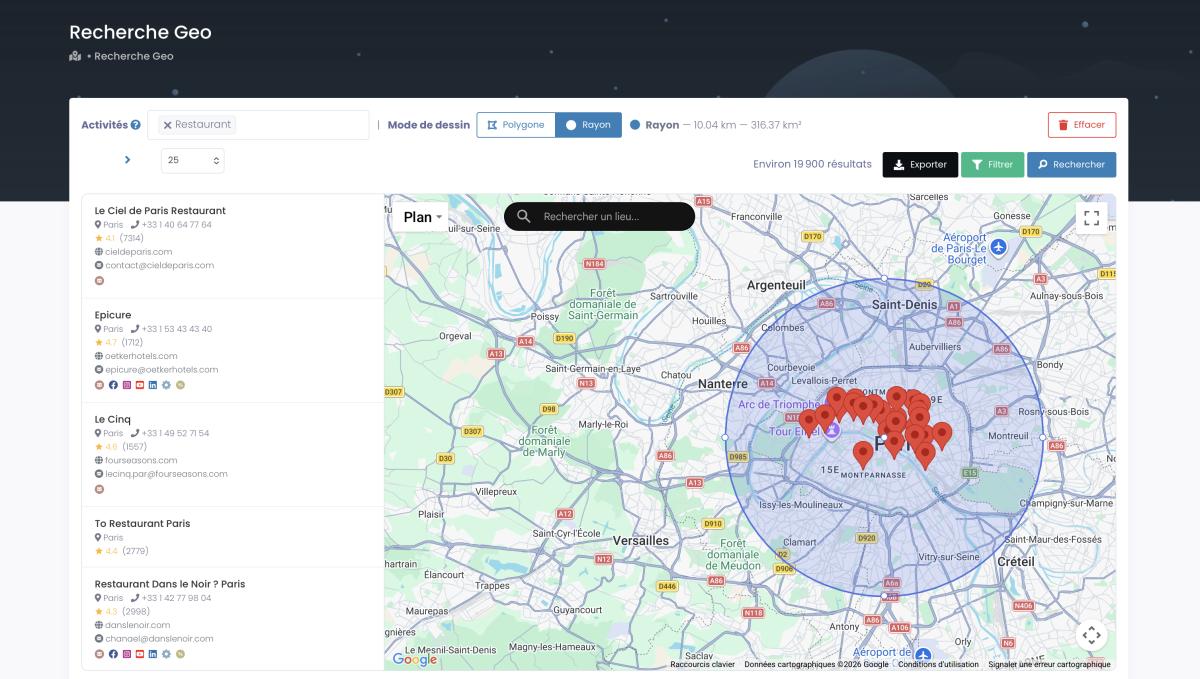
The filters that tend to matter most for UK prospecting:
- Digital presence — website yes/no, email yes/no, phone yes/no, plus individual socials (LinkedIn, Instagram, Facebook, TikTok, and the rest).
- Phone type — every number classified as landline or mobile, so SMS people target mobiles and cold-callers target landlines.
- First-seen date — catch businesses that only just appeared on the map. New openings, fresh prospects, less competition.
- Reviews, ratings, photos, claimed status — proxy signals for how active and how "findable" a business is.
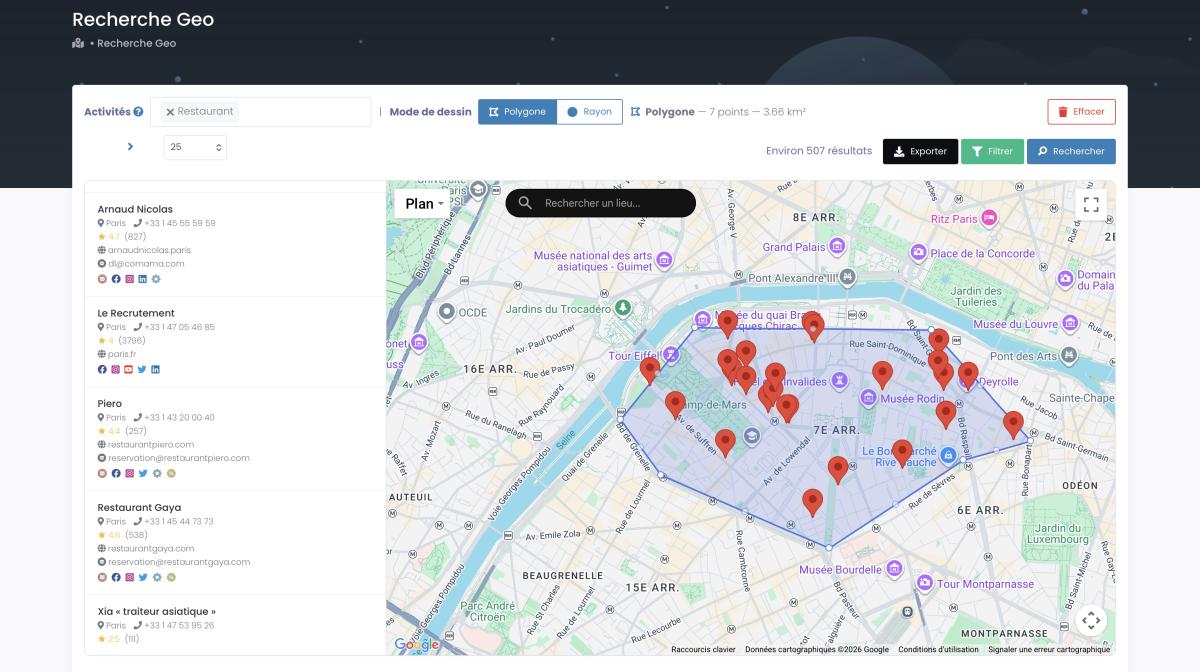
And there's a geographic trick worth knowing. You're not stuck with administrative boundaries. GeoSearch lets you draw a radius around a point, or hand-draw a polygon over an exact area — a single postcode district, one industrial estate, a slice of a city that no county line matches. Perfect when "Yorkshire" is too broad but "this specific patch" is what you actually work.
Video: How to Extract Every Business in 1 Click (No Category)
Want the whole economic map of a town, every trade, no category at all? That's the "zone of interest" search in the video above — one click, every business in the area. Then filter down from there.
Is it legal? UK GDPR, PECR, TPS & MPS explained
Short version: yes. B2B prospecting with this kind of data is legal in the UK — provided you know the four acronyms that govern it. Let's be honest, this is the section everyone skims and then panics about later, so read it now.
UK GDPR. Business contact data that's publicly available can be processed for B2B outreach under "legitimate interests," as long as you're relevant, you keep records, and you honour opt-outs. A generic [email protected] is a lower-risk business contact; a named individual's address needs more care. The ICO is the authority here, and its guidance is readable — go read it.
PECR covers electronic marketing. For B2B email to corporate subscribers (limited companies, LLPs, public bodies) the rules are looser than for consumers — but you must always identify yourself and offer an easy unsubscribe. Sole traders and partnerships get treated more like individuals, so tread carefully.
TPS and MPS — the Telephone and Mailing Preference Services. Before you cold-call or post, screen against these opt-out registers. Calling a TPS-registered number is a straight-up breach. This isn't optional politeness; it's the law.
Where does scraped map data sit in all this? It's public business information, each record traceable to its source. Scrap.io only pulls publicly available business data and is built to be GDPR and CCPA compliant. That doesn't outsource your responsibility — you still run the campaign lawfully — but the raw material itself is clean. As Experian UK bluntly advises: "Need B2B prospects? Don't buy a data list." Fresh, sourced, filterable beats bought-and-frozen every time.
Real examples: who uses UK business data (and how)
Agencies, recruiters, SaaS founders — they all mine the same 5.4 million. Different filters, same well. Here's who's actually pulling UK company records and what they do with them.
Web agencies filter for businesses without a website. That's the pitch writing itself: "I noticed you don't have a site." James in Leeds, 40,000 prospects in Yorkshire, one afternoon. This is the single most common use case we see.
Marketing agencies hunt for firms missing an ad pixel, or with weak social presence, or newly opened — signals that someone needs help and has budget to fix it.
B2B sales teams build a database companies uk list by exact category and region, then feed it straight into a cold email sequence or their CRM. No more scraping LinkedIn one profile at a time.
Recruiters and consultants map every firm in a sector across a region to find clients, partners, or hiring companies. A construction companies database uk or a uk manufacturing companies database is a couple of filters away, not a bought report.
The tools some of these teams graduate from are the expensive ones — Cognism, ZoomInfo, the enterprise crowd charging four or five figures a year. If that's your starting point, the ZoomInfo alternatives comparison is worth a look. Self-serve from $35/month versus enterprise contracts is not a close race for most small teams.
50,000+ professionals already prospect with Scrap.io — across 195 countries and 225M+ indexed establishments. Whatever your UK niche, the data's already mapped. See your niche's numbers →
UK companies database: free vs paid options
Let's talk money, honestly. The free option works. For about 200 records. Then it breaks.
Here's the real trade-off. A free uk companies database exists — Companies House gives you the full register and even a bulk download, at zero cost. Search "uk companies database free" and you'll land there every time. It's fantastic for legal identity and due diligence — and if what you specifically want is the best database to find financial data about uk companies, it's Companies House accounts or Endole, not a prospecting tool. But it hands you no marketing contacts, and the bulk file needs serious cleaning before it's usable. Great for lawyers. Rough for marketers.
The paid side splits again. Bought lists from the specialist database marketing companies uk teams lean on — brokers like Marketing Data Lists (trading since 1993, 3,243,000 contacts, GDPR/PECR-screened) or Prospect360 (6M+ records screened against MPS and TPS) — give you contacts up front but freeze the moment you buy, that "two jobs out of date" problem. Enterprise platforms like Cognism give you fresh contacts but charge enterprise money. Maps extraction sits in the sweet spot: real-time freshness, contacts included, filter-before-you-pay, and pricing that starts at $35/month on the Basic plan. The 7-day trial (100 export credits) lets you test it on your own niche before committing — card required to activate, and you can cancel any time.
Which should you use? Depends on the job. Checking if a company is solvent before signing a contract — Companies House, free, done. Building a fresh, filtered database of companies in uk — every dental practice in the Midlands, say — that's not a job the free register can do, and a bought list will be stale before your campaign ends. Different tools. Pick the one that matches the task.
The bottom line
Companies House tells you who exists. It's brilliant, it's free, and it stops exactly where your sales process begins. To actually reach those 5.4 million UK businesses you need contacts — emails, phones, websites — and you need them fresh, filtered to your ICP, and legal to use. That's a different tool for a different job.
Start from the whole country, filter down to the few thousand that match what you sell, export, go. This piece is the national UK pillar; if London specifically is your patch, the London business directory guide drills into the capital. Prospecting beyond Britain? See the USA business email database, the India business directory, or the broader international lead generation playbook. And if you're weighing tools, the business database search tools rundown compares the field.
Get a fresh UK companies database today. All 5.4M UK establishments, real-time data, emails and phones filtered to your niche — exported in two clicks. 7 days free, 100 leads on us. Start your free trial →
Frequently asked questions
Is there a free UK companies database?
Yes — Companies House offers the full register and a bulk data download for free. It's the official source and it's excellent for legal identity, directors, and filing history. What it doesn't include is marketing contact data (emails, direct phones). For prospecting, a tool like Scrap.io adds emails, phones, websites and socials on top of the same companies.
How do I download a list of all UK companies?
Two routes. You can take the Companies House bulk download and clean it yourself — legal data, no contacts. Or you can export a CSV/Excel from Scrap.io by country, region or city, with emails, phones and socials already attached, in two clicks. The second is built for outreach; the first is built for compliance.
How many companies are there in the UK?
At the end of March 2026, the UK register held 5,479,045 companies in total, with 4,930,634 effectively active (Companies House, GOV.UK). On the mapping side, Scrap.io indexes 5,467,465 UK establishments — nearly the same figure, but with the contact details the register doesn't hold.
Can I search the UK companies database by name?
Yes, for legal identity — the UK Companies House database, HitHorizons and OpenCorporates all support a uk company search by name, so a uk companies database search by name — a single uk companies database lookup — takes seconds. Scrap.io works differently: it's built for filtered bulk extraction (every business in a category and area) rather than looking up one company at a time. Use the register for single-name lookups, Scrap.io for building lists.
Is scraping UK business data legal?
For B2B prospecting, yes — provided you follow UK GDPR (legitimate interests, opt-outs), PECR (identify yourself, easy unsubscribe) and screen against TPS/MPS before calling or posting. Scrap.io only collects publicly available business data, each record traceable to its source, and is built to be GDPR and CCPA compliant. You still run the campaign responsibly, but the underlying data is clean. This is general information, not legal advice — check the ICO's guidance for your specific case.
Generate a list of restaurant with Scrap.io