

Here's a number that should annoy you: 1.2 million Australians type "abn lookup" into Google every single month. And almost all of them get exactly what they came for, then hit a wall.
Because the official register hands you a name, a status, a postcode. Then it stops.
No email. No phone. No street address. Nothing you could actually use to contact the business you just verified. That's not a bug — the Australian Business Register says so itself, in writing. So if you've ever done an ABN check and thought "great, now how do I reach these people?", this one's for you. We'll cover the 60-second verification, and then the bit nobody else writes about: turning one verified business into a whole enriched list.
Video: Scrap.io - How to Start?
- What Is ABN Lookup (and What It Actually Shows You)
- How to Do an ABN Lookup in 2026 (Step by Step)
- What an ABN Lookup Can't Tell You (The Honest Bit)
- From Verifying One Business to Building a List of Thousands
- How to Verify AND Enrich Australian Businesses at Scale
- Real Businesses That Already Turn Registry Data Into Contact Data
- Is This Legal? ABN Data, Privacy & the Spam Act
- FAQ
What Is ABN Lookup (and What It Actually Shows You)
Australia has 2,729,648 actively trading businesses as of 30 June 2025, according to the Australian Bureau of Statistics. That's up 2.5% — a net 66,650 new businesses — in a single year, with a 16.4% entry rate churning through the market. And that's just the active ones: there are more than 6,000,000 ABNs on the register once you count entities beyond the actively trading market sector. ABN Lookup can confirm any one of them exists. What it won't tell you is how to reach them.
So what does abn lookup show, exactly? Let's be precise. ABN Lookup is the free public search built on top of the Australian Business Register (the ABR), run by the Australian Government. Punch in an 11-digit number, a company number, or a business name, and it returns the entity's legal name, its ABN status (active or cancelled), the entity type, GST registration, the state, and the postcode. That's the whole menu.
Useful? Absolutely. It's the first thing any sensible person does before paying an invoice from a supplier they've never met. But a prospecting database it is not.
ABN vs ACN: What's the Difference?
People mix these up constantly, so a quick acn lookup primer. An ABN identifies a business for tax purposes — every entity trading in Australia needs one. An ACN (Australian Company Number) is issued only to companies registered with ASIC. Here's the abn vs acn difference in one table.
| Feature | ABN | ACN |
|---|---|---|
| Length | 11 digits | 9 digits |
| Who gets one | Every business (sole traders, companies, trusts…) | Registered companies only |
| Issued by | Australian Business Register (ABR) | ASIC |
| Where to check | ABN Lookup | ABN Lookup (for companies) + ASIC |
Sole trader? You've got an ABN, no ACN. Pty Ltd company? You've got both — and a company's ABN usually contains its ACN inside it.
ABR vs ABN Lookup: Same Thing?
Nearly. The ABR is the underlying government database. ABN Lookup (and an abr lookup means the same search) is the public front end you actually use. When people say they'll "do an abr lookup," they mean they're heading to the search box at abr.business.gov.au. The register holds the data; Lookup lets you read the public slice of it. Same source, one just has a search bar.
How to Do an ABN Lookup in 2026 (Step by Step)
An invoice lands from a supplier you've never worked with. Bank details attached, of course. So you check the abn before paying the invoice — a 60-second habit that catches most nasty surprises.
The whole point of learning how to do an abn lookup is speed. This is also the simplest way to verify an Australian business you're about to trade with: you don't need an account, you don't need to pay, and you don't need to be technical. Follow these five steps.
- Go to the official tool. Open abr.business.gov.au. Ignore the third-party clones that try to charge you — the government one is free.
- Search by ABN, ACN or name. Type the 11-digit ABN if you have it. No number? Do an abn number search using the business name instead.
- Check the status. Look for "Active." A cancelled ABN is a red flag before you sign anything.
- Confirm the details match. Entity name, GST registration, state — do they line up with the invoice or contract in front of you?
- Save your evidence. Screenshot or print the result with the date. If a dispute ever lands in front of a tribunal, you'll want proof you checked.
Done. Sixty seconds, roughly.
How to Search by Business Name (No Number Needed)
Most people don't have the number handy — they've got a name and a bad feeling. An abn lookup by name works fine: type the trading name into the same search box, and Lookup returns matching entities with their ABNs and status. If several results appear, cross-check the state and postcode against what you already know. This is also the fastest way to find an abn by business name when you're vetting a new supplier cold.
How to Check If an ABN Is Active
Want to check abn status specifically? The result page shows "ABN status: Active" with the date it took effect, or "Cancelled" with the date it stopped. Active means the entity is currently registered — nothing more, nothing less. It does not mean solvent, licensed, or trustworthy. (More on that in a second, because this trips a lot of people up.) For gst status, the same page tells you whether the business is registered for GST and from when — handy for an abn lookup for gst status before you process a tax invoice.
What an ABN Lookup Can't Tell You (The Honest Bit)
An active ABN doesn't mean legit, solvent, or reachable. Let that sink in before you rely on it.
The single most important sentence in this entire article comes straight from the government. Per the ABR's own ABN Lookup FAQ: "ABN Lookup only contains the publicly available information provided by a business… it does not include the address, email, telephone or other contact details."
Read that again. The register gives you the postcode and the state. Never the street address. Never an email. Never a phone number. So the obvious question — does abn lookup show email address or a phone? — has a flat answer. No. It never has, and by design it never will.
And there's more it can't tell you:
- Solvency. An active ABN says nothing about whether the business can pay its bills. Plenty of soon-to-be-insolvent companies have pristine ABN records right up to the end.
- Licences. Building, electrical, financial services — none of that shows up here. You check those with the relevant regulator.
- Who actually runs it. Trying to work out how to find an australian company owner? Lookup gives you the legal entity name and, for companies, the ACN. Directors and shareholders? That's an ASIC search, not this one.
The law firm Sprintlaw puts it bluntly: an ABN Lookup can confirm a business registration, but it shouldn't be the only check before you trade, sign contracts, or rely on a supplier. Wise words.
Look — this is where most guides stop. Verified the business — now what? If your job is to actually contact Australian businesses (sell to them, partner with them, service them), verification is step one of ten. You still need the address, the email, the phone. Which is exactly the gap the register leaves wide open. This is also the moment where generic business database search tools start to matter more than a government registry.
From Verifying One Business to Building a List of Thousands
Meet Priya. She runs a B2B commercial cleaning company in Melbourne, and she wants every café and gym in Victoria as a potential client. Great target. Real market. So she opens ABN Lookup and checks them one… by… one… by one.
You can see the problem.
ABN Lookup is a single-record tool. It's built to answer "is this one business real?" — not "give me all 8,000 cafés in this state with their contact details." There's no bulk export button on the public site. So the second your need shifts from verifying to prospecting, from one business to a list, the register runs out of road. This is the difference between checking an invoice and running actual international lead generation across a whole market.
Could Priya do a bulk abn lookup manually? Sure. If she enjoys spending three weeks copy-pasting names into a spreadsheet, only to end up with… names. Still no emails. Still no phones. Because remember — the register doesn't hold those anyway.
The workflow she actually needs looks nothing like a registry search. It's this: define the market (cafés + gyms, Victoria), pull every matching business, filter to the ones worth contacting, and enrich each one with the email and phone the ABR would never give her. That's how you learn how to build a list of australian businesses instead of checking them one at a time. And it's exactly what an Australian business email database approach is designed for.
Here's Priya's search, running as a live count before a single credit is spent.
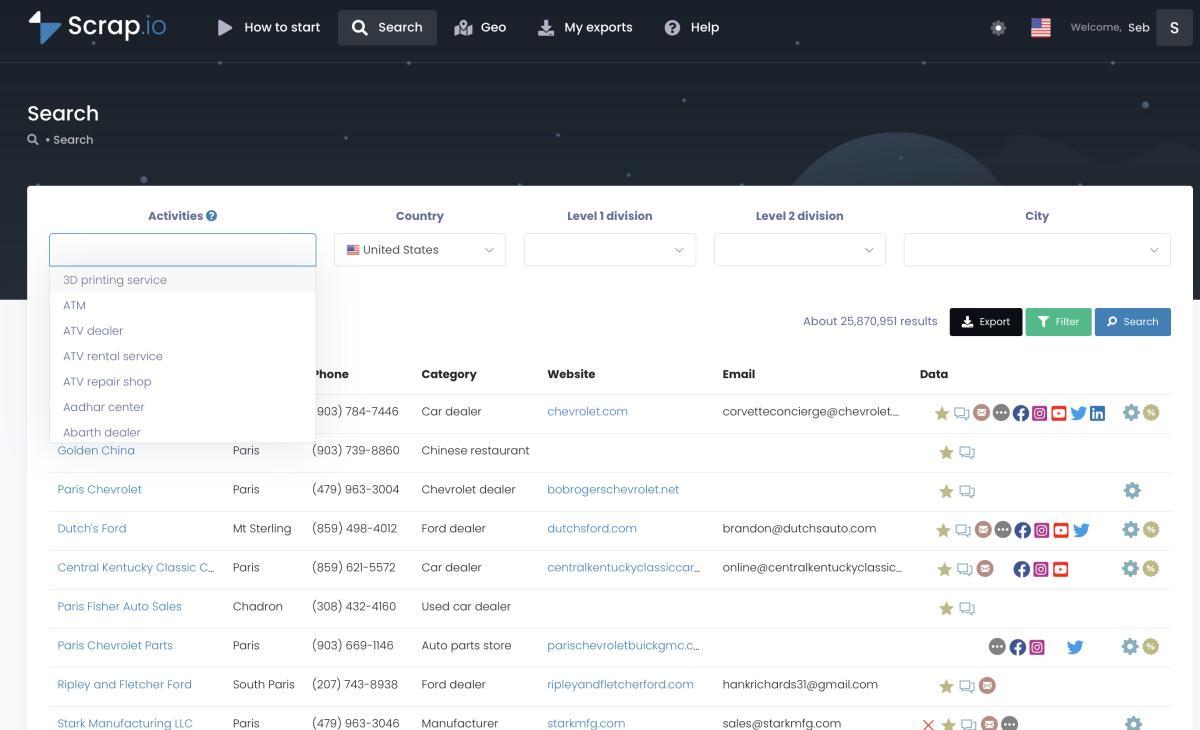
Curious how big your market actually is? See how many businesses match your target across Australia — the count is completely free on Scrap.io. No credits, no commitment. Just type a category and a state, and watch the number appear.
Video: How to Extract Every Business in 1 Click (No Category)
How to Verify AND Enrich Australian Businesses at Scale (with Scrap.io)
No ABR API to wrangle. No developer on speed dial. No $20k data contract. Two clicks and a filter. That's the pitch, and after the register's brick wall, it feels almost unfair.
Honestly, the idea behind Scrap.io is simple. It reads business listings straight from Google Maps in real time, then crawls each business's website to pull the contact details the registry withholds. So you get the verification-adjacent stuff (name, category, location, claimed status) and the reachable stuff — email, phone, socials — in one export. Right now Scrap.io indexes 2,328,413 Australian establishments from Google Maps (exclusive figure, August 2026). Of those, 1,373,656 have a website, and 939,068 carry a public email address. That last number is the one that matters if you're doing outreach: nearly a million reachable Australian businesses.
Extract a Whole State — or the Whole Country
This is the part ABN Lookup simply can't do. Pick a category, pick a location — a city, a state, or all of Australia — and pull every matching business. Victoria's cafés? One search. Every trade in Queensland? Another. Scrap.io covers 195 countries and 4,000+ business categories, so the same trick works whether you're targeting Perth or Paris. Extracting an entire state sits on the Agency plan; the full country lives on the Company plan. Point is, the ceiling is "an entire nation," not "120 results."
Video: How to Scrape Local Leads at the Country Level
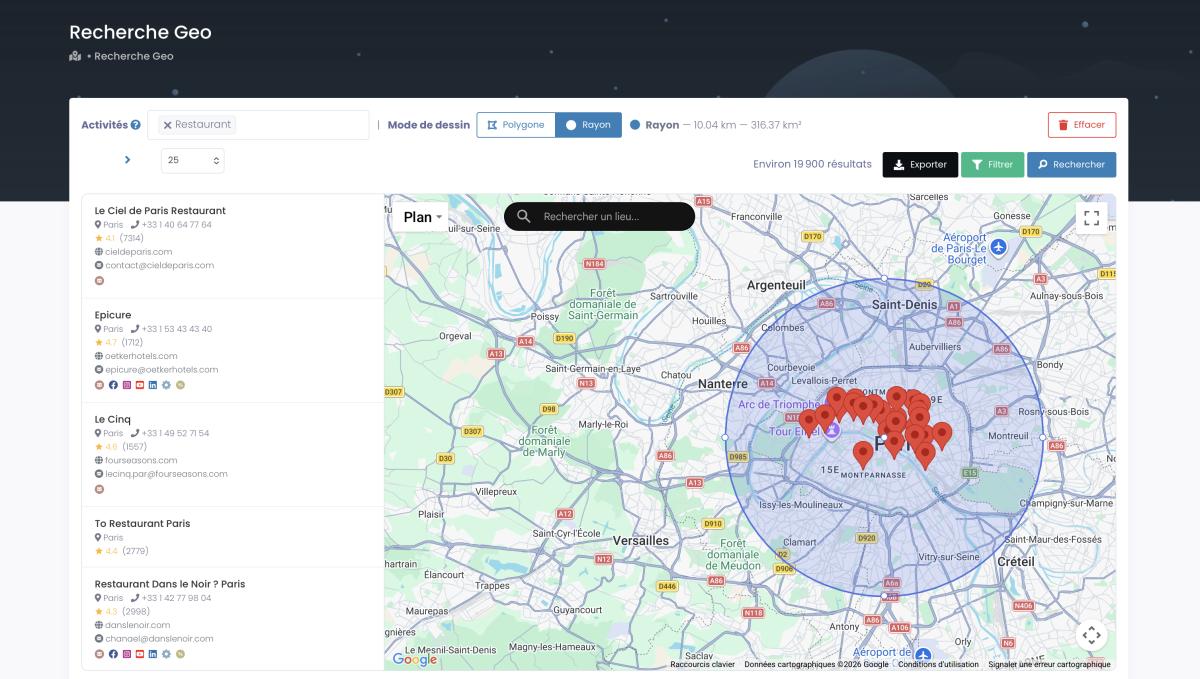
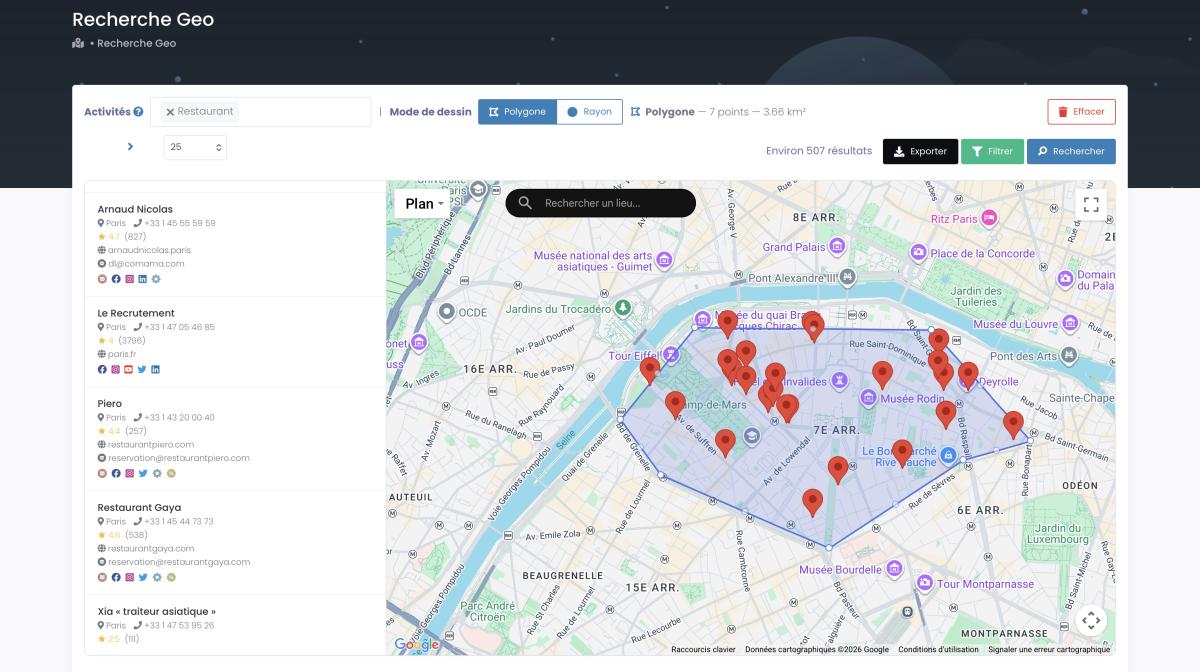
Need something that ignores administrative borders entirely? GeoSearch lets you draw the zone yourself. Radius mode puts a circle around any point on the map — every gym within 25 km of Bondi, say. Polygon mode lets you sketch an irregular shape by hand: a single industrial estate, one strip of the Gold Coast, whatever odd catchment your business actually serves.
Filter Before You Pay (So You Don't Waste a Cent)
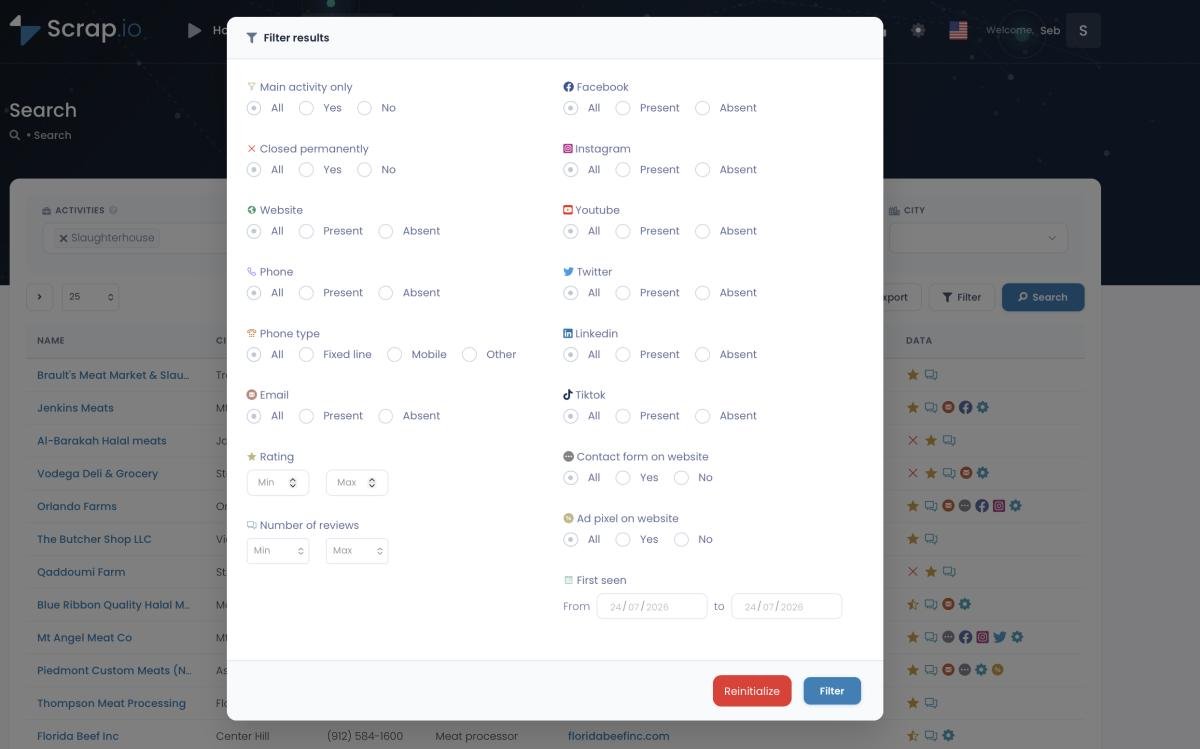
Here's the bit that saves you money. All filters run before extraction, so you only spend credits on businesses worth contacting. Want only the cafés that actually list an email? Filter for it. Only mobile numbers, because you're planning an SMS campaign? Filter for that too — and because Scrap.io classifies every Australian number as mobile or landline, you can target texts to mobiles and cold calls to fixed lines without guessing. (Small caveat: this phone-type split isn't available for US and Canadian numbers. Australia's fine.)
Because Australia's market churns hard — that 13.9% annual exit rate from the ABS means roughly 370,500 businesses shut their doors in 2024-25 — fresh data isn't a nice-to-have. A list built last quarter is already rotting. Scrap.io re-extracts in real time at every export, so you're never dialling a business that closed in March. If you want the deep dive on pulling contact data, the guides on how to find emails on Google Maps and how to scrape phone numbers cover the mechanics.
What You Actually Get in the Export
Each business comes back with the full picture — the stuff the register won't touch. Name, full address (yes, the street, not just a postcode), classified emails (individual with first and last name, plus contact, sales, marketing), phone number with its mobile/landline type, website, social profiles across six platforms, ratings, and the site's tech stack. CSV or Excel, ready to drop into your CRM or cold-mailing tool. Prefer to skip the interface entirely? The Google Maps Scraper API and the MCP connector let you run the whole thing from a script or an AI agent, and you can automate CRM enrichment so records fill themselves in. This is the practical answer to enrich abn data with email and phone and to find australian business contact details at any scale you like.
Try Scrap.io free for 7 days. Get 100 enriched Australian business leads — emails and phone numbers included, not just postcodes. Filter to your exact market, export to CSV, and see the data quality before you commit. Nearly a million reachable Australian businesses are sitting in the index right now. Start your free trial →
Real Businesses That Already Turn Registry Data Into Contact Data
If enriching registry data sounds like a fringe hack, it isn't. Some of Australia's biggest data companies are built on exactly this move — take the public ABR and ASIC records, then layer on the contact and risk data that makes them useful.
CreditorWatch is the obvious one. The commercial credit reporting platform aggregates ASIC and ABR data, then enriches it with scores and monitoring for more than 55,000 customers — its RiskScore engine runs across 11 million-plus tradelines a month. That's a proven playbook: registry data in, actionable intelligence out. No bureau required to copy the logic.
illion plays a similar game. The business credit reporting bureau combines registry identifiers with trade payment history and identity verification, the sort of thing lenders and suppliers lean on during onboarding. And InfoTrack folds CreditorWatch credit reports into its company-search products, so conveyancers and law firms can verify and assess a business in one workflow. Even Swoop Finance (an Australian B2B funding broker, ABN 52 644 513 333, with 110,000+ subscribers) treats the ABN as the first signal in its onboarding funnel.
Bref — the pattern's consistent across all of them. Nobody stops at "the ABN is active." They start there, then enrich. There's even a third-party Australian ABN Lookup actor on Apify — proof that people are automating the lookup step itself, just to get past it faster.
50,000+ professionals already build their lists this way — pulling fresh, enriched business data instead of buying stale files. Scrap.io is rated 4.8 on Capterra and 4.9 on G2. If the big bureaus enrich registry data, so can you. See how it works →
Want to go further than contact details — job titles, tech stack, intent? That's where dedicated data enrichment tools come in. But for the core problem here — turning a verified Australian business into one you can actually phone or email — Google Maps data does the heavy lifting.
Is This Legal? ABN Data, Privacy & the Spam Act
Can you legally build a list of Aussie businesses and email them? Yes — with two rules to respect. Let's be honest about them rather than hand-wave.
First, the data itself. Business contact information that companies publish on their own websites and Google Maps listings is public commercial data. Scrap.io only collects publicly available business data, is GDPR and CCPA compliant, and keeps every data point traceable to its source. So the collection side is on solid ground — you're gathering what businesses chose to make public, not prising open anything private.
Second, the outreach. This is where people get caught. Australia's Spam Act 2003 sets the rules for commercial email and SMS, and there are two you can't skip: you need consent (which for B2B can be inferred when a business publishes a commercial address relevant to what you're offering), and every message needs a clear, working unsubscribe. Ignore those and the penalties get ugly, fast. The Privacy Act 1988 rounds out the picture on how personal information is handled.
None of this is a reason not to prospect. It's a reason to prospect properly — public data, relevant offer, honest sender details, easy opt-out. Do that, and you're on the right side of the line.
FAQ
How do I search for an ABN number?
Go to the official ABN Lookup at abr.business.gov.au and enter the 11-digit ABN, the ACN, or the business name. Results show the entity name, ABN status, entity type, and GST registration — free, no account needed.
Does ABN Lookup show a business's email or phone?
No. ABN Lookup only shows public registration data plus the postcode and state — never the street address, email, or phone number. The ABR states this directly. For contact details, use a source that enriches from public web data, such as Scrap.io.
How do I see who owns an ABN?
ABN Lookup shows the legal entity name and, for companies, the ACN — but not the directors or shareholders. To see who actually owns and controls a company, run an ASIC search rather than relying on ABN Lookup alone.
Can I get an ABN for free?
Yes. Applying for an ABN through the official ABR is completely free, and using ABN Lookup to check one is free too — so any abn lookup free tool built on the register carries no cost. Watch out for third-party sites that charge a fee to "register" your ABN; you never need to pay the government for it.
Is my ABN on myGov?
Your ABN is managed through the ABR and ATO systems linked to your myGovID, and you can confirm it publicly at any time via ABN Lookup. So while you manage the details through government portals, the public status is always visible through the same free search anyone else uses.
The Bottom Line
ABN Lookup is brilliant at one job: confirming a business exists. It's the 60-second check that saves you from a dodgy invoice, and you should absolutely use it. But it was never built to help you reach anyone — no address, no email, no phone, straight from the government's own mouth.
So stop looking businesses up one by one and hoping the contact details appear. They won't. Verify with the register, then enrich at scale: pull your target market, filter to the reachable ones, and export the emails and phones the ABR will never hand over. Nearly a million Australian businesses with a public email are already indexed and waiting.
Start your free 7-day trial and build your Australian list today. 100 enriched leads included — emails and phone numbers, not just postcodes. Pick any category, any state, and turn a registry check into a real prospecting pipeline. Try Scrap.io free →
Generate a list of restaurant with Scrap.io