

Video: How to Extract Every Business in 1 Click with Scrap.io
- Why International Lead Generation Is the Next Growth Lever for B2B
- The Challenge of Finding Quality Leads Across Borders
- Why Google Maps Is the Best-Kept Secret for International B2B Leads
- Step-by-Step: How to Find B2B Leads in Any Country Using Google Maps
- 5 International Lead Generation Strategies That Actually Work in 2026
- Real-World Examples: Companies Winning with International Lead Gen
- Compliance & Legal: Navigating GDPR, CAN-SPAM & International Rules
- FAQ: International Lead Generation
Why International Lead Generation Is the Next Growth Lever for B2B
Here's something wild. The global B2B lead generation market is projected to reach $32.1 billion by 2035, growing at 17.2% CAGR. And yet, most B2B companies still prospect exclusively in their home country.
Think about that for a second.
A $32 billion market, and your competitors are fighting over the same zip codes while entire countries sit untouched. That's not a growth strategy. That's a cage match over scraps.
The shift toward global lead generation isn't some vague "trend." It's math. The lead generation software market alone hit $9.87 billion in 2026 (Fortune Business Insights), split roughly 40% North America, 25% Asia-Pacific, 20% Europe (Business Research Insights). Translation: if you're only prospecting in one region, you're voluntarily ignoring 60-75% of your addressable market.
And the tools? They've caught up. Over half of B2B companies now use AI for lead generation (Martal Group). The barrier to going international isn't technology anymore. It's mindset.
But here's the thing most guides won't tell you: the biggest database of verified local businesses across 200+ countries isn't LinkedIn. It isn't ZoomInfo. It's Google Maps. And almost nobody is using it for international lead generation at scale.
The Challenge of Finding Quality Leads Across Borders
Meet Sarah. Her SaaS product sells perfectly in the US, with 3.2% reply rates and a steady pipeline. Then she decides to target Germany. Four weeks later? Her reply rate: 0.3%. Ouch.
Cross-border lead generation is a different beast. Not impossible. Just different. And the usual playbook, buy a list from ZoomInfo, blast some LinkedIn InMails, falls apart when you try b2b lead generation international style. What works domestically crumbles across borders.
Why? A few reasons that nobody talks about enough.
Data coverage gaps are brutal. Something like 89% of B2B marketers use LinkedIn for lead gen. Great. But LinkedIn's coverage in Southeast Asia, Latin America, or Africa? Patchy at best. Try finding the owner of a plumbing company in Lagos on LinkedIn. Good luck.
Local business data is fragmented. Every country has different directories, registries, and data sources. There's no single "international Yellow Pages." Or is there? (Spoiler: there is, and it's been on your phone this whole time.)
Cultural mismatches kill conversions. The email that works in New York bombs in Tokyo. Handling objections in different markets requires understanding local business norms, not just translating your copy.
Reddit's r/sales community is full of stories like Sarah's. Someone cracks lead gen domestically, tries to go international, and hits a wall. The problem isn't the strategy. It's the data source.
Why Google Maps Is the Best-Kept Secret for International B2B Leads
OK let me be blunt. You've heard of LinkedIn Sales Navigator. ZoomInfo. Apollo. They're fine tools. But the richest database of verified local businesses in 200+ countries? It's free, and you probably used it to find lunch today.
Google Maps.
Not kidding. Every business that shows up on Google Maps has been verified: real address, real phone number, often a website and email. You can find business leads in any city worldwide because Google Maps covers literally every country where Google operates. That's the kind of global lead generation coverage that makes paid databases look like phone books from 2005.
Here's why this matters for international B2B lead generation specifically.
It's hyper-local. Want plumbers in Munich? Restaurants in São Paulo? IT firms in Nairobi? Google Maps has them, with ratings, reviews, and contact details. Compared head-to-head with LinkedIn, or with Facebook, the local coverage is in a completely different league.
The data is fresh. Business owners update their Google Maps listings because customers find them there. Unlike static databases that decay at 30% per year, Maps data is kept current by the businesses themselves. Scrap.io re-checks each listing at the moment you export, so nothing sits and rots.
92% of B2B purchases involve considering local vendors. So the businesses on Google Maps? They're actively trying to be found. That's intent you can't buy from a list broker.
The catch? Extracting data from Google Maps manually is pure pain. Searching "plumber in Munich," opening each listing, copying the phone number, for 50 contacts that's an afternoon. For 5,000? That's a month of your life you're not getting back.
Which brings us to the how.
Step-by-Step: How to Find B2B Leads in Any Country Using Google Maps
Enough theory. Let's do this.
Manually searching Google Maps for "plumber in Munich" and copy-pasting emails one by one is a slow death. There's a faster way. Here's the exact process for how to find B2B leads in other countries.
Video: Scrap.io - How to Start?
Step 1: Pick your target market and industry. Before touching any tool, get specific. "Europe" isn't a target. "Dental clinics in Barcelona" is. The more precise your google maps lead generation international search, the better your results. If you want a method for this, here's how to define your ICP with Google Maps geographic data country by country.
Step 2: Search on Scrap.io. Go to Scrap.io, type your industry plus a city or country. Example: "Dentist, Barcelona." Hit search. Right now that returns 1,237 dental practices listed on Google Maps in the city of Barcelona, and 511 of them (about 41%) already expose an email on their website. You see every matching business with name, address, phone, website, email, ratings, and review count.
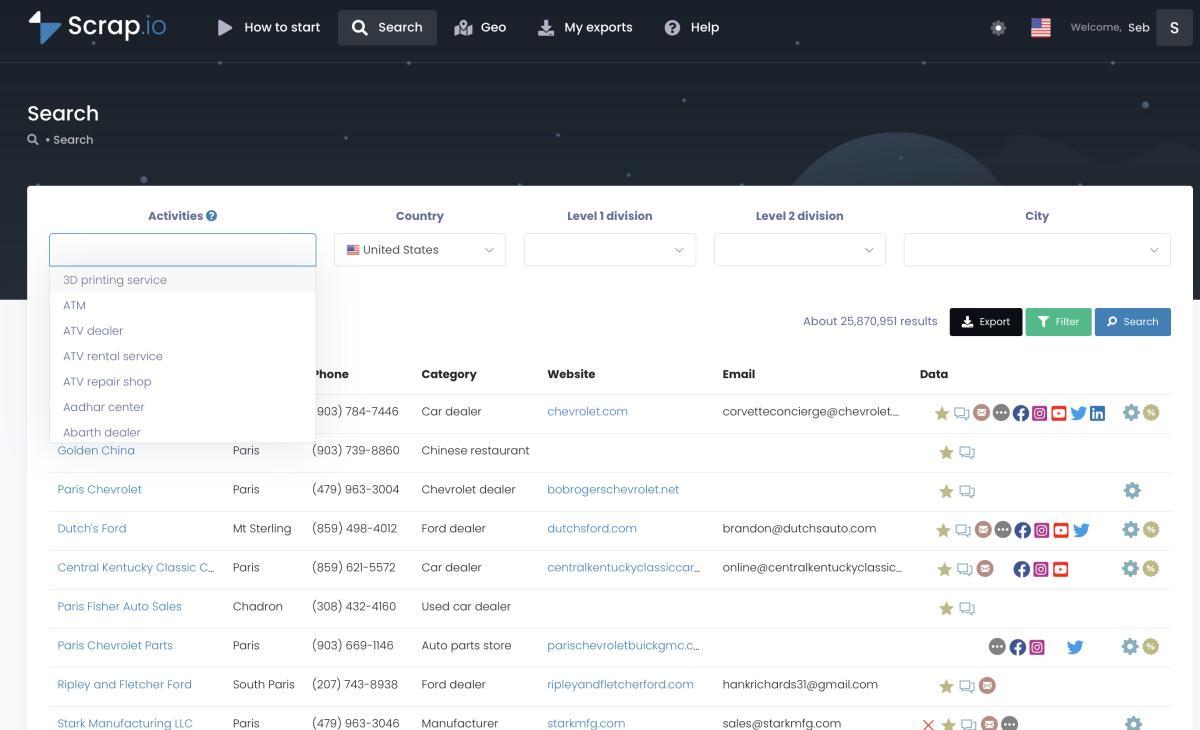
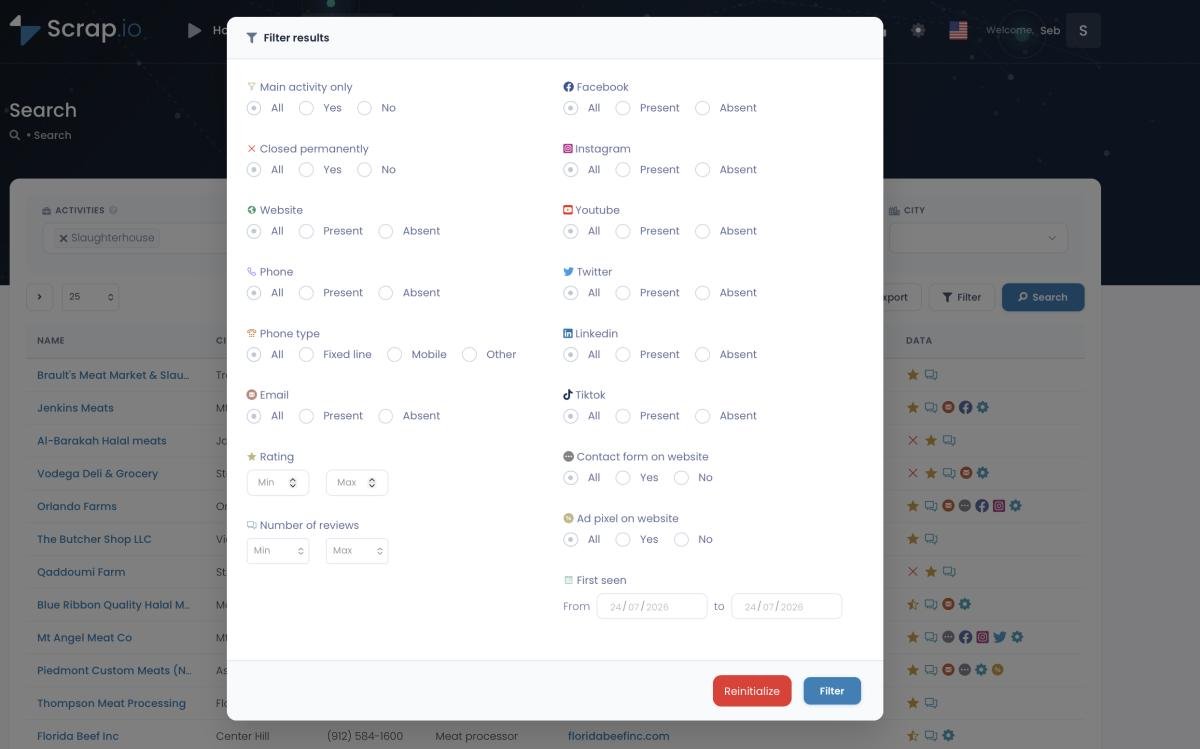
Step 3: Filter by quality signals. This is where it gets good. Don't just export everyone. Use quality KPIs to filter: minimum rating (4+ stars), minimum reviews (shows established businesses), has website, has email. And because the filters run before extraction, you only spend credits on the 511 dentists with an email, not the full 1,237. You're not building a list. You're building a pipeline of businesses that actually pick up the phone.
Step 4: Export and enrich. One click. CSV or Excel. You've got your leads. Now scale it: the same two clicks that pulled one city pull an entire country. Barcelona gives you 1,237 dentists. Spain gives you 23,876, same workflow, no code. Need more emails? Country-level extraction tools like Scrap.io pull emails directly from business websites, no separate Hunter.io subscription needed.
Step 5: Localize your outreach. This is where most people blow it. You've got 1,237 dental clinics in Barcelona. Don't email them in English. Don't use American references. Localize. Mention local regulations, local competitors, local pain points. If your emails need work (most first drafts do), here's how to write a cold email that gets replies. Your reply rate will thank you.
5 International Lead Generation Strategies That Actually Work in 2026
What separates a 0.5% reply rate from a 4.4% one when prospecting internationally? Not magic. Not better copywriting. Data quality and targeting. Here are five strategies working right now for international lead generation strategy 2026.
1. Google Maps Data Extraction at Scale
Forget buying leads from generic scraping tools. The best tools to find leads in other countries connect directly to Google Maps data and give you verified, current information. Scrap.io covers 200+ countries. This is the strategy with the most international upside, so watch it run at the country level first.
Video: How to Scrape Local Leads at the Country Level
Compared to alternatives like Serper.dev, the difference is coverage depth and built-in email extraction. Serper hands back around 20 businesses per call and zero emails. Scrap.io pulls the whole market, emails attached.
2. Localize Everything (Not Just Language)
Translation is the bare minimum. Real localization means adjusting your value prop. A google maps scraper for international prospecting gives you the raw leads, but your cold email international prospects strategy needs local flavor. Mention their city. Reference a local competitor. Show you understand their market. Bref, sound like a human who's been there, not a mail merge.
3. Filter by Quality Signals, Not Just Volume
More leads does not equal better results. Period. When you extract business data from google maps worldwide, the temptation is to grab everything. Resist it. Filter by: 4+ star rating, 50+ reviews, has website, has email. A list of 500 qualified businesses beats 10,000 random ones every time. Remember Barcelona? 1,237 dentists on the map, 511 with a reachable email. The 511 is your list. The rest is noise you never paid a credit for.
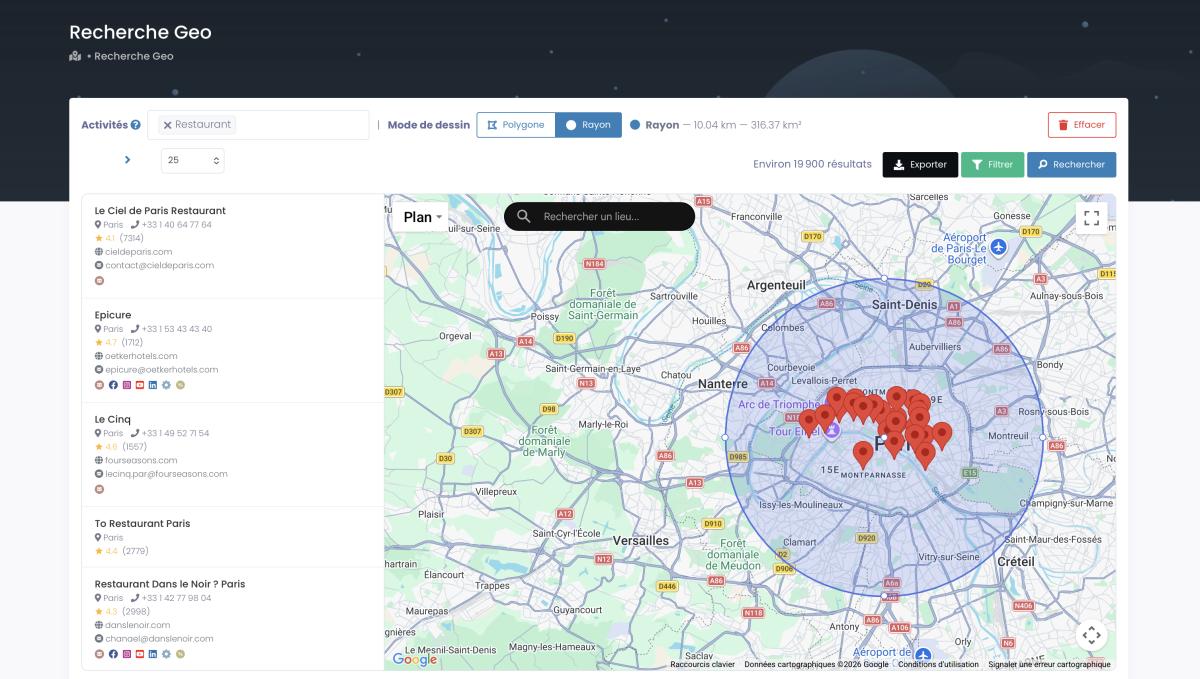
Want tighter than a city? GeoSearch lets you draw a radius around a point, or hand-draw a polygon on the map, so you can carve out a single district in Madrid or a cross-border region that no administrative boundary matches. All filters still apply inside it.
| Tool | Global Coverage | Local Biz Data | Emails Included | Price (Starting) |
|---|---|---|---|---|
| Scrap.io | 200+ countries | ✅ Google Maps | ✅ Built-in | Free trial |
| ZoomInfo | ~100 countries | ❌ Corporate focus | ✅ Separate add-on | $14,995/yr |
| LinkedIn Sales Nav | Global (uneven) | ❌ People, not biz | ❌ InMail only | $99/mo |
| Sopro | UK/EU focus | ❌ B2B only | ✅ Managed | $2,500/mo |
4. Personalized Cold Email at Scale
Generic templates are dead. But you knew that. The trick for B2B lead generation for global expansion is this: use the data you extract (rating, review count, business type) as personalization hooks. "I noticed your clinic has 4.8 stars and 200+ reviews, clearly you're crushing it in Barcelona" hits differently than "Dear business owner." Same logic carries over to the phone, by the way: solid sales prospecting techniques start with the exact same verified data.
5. Automate the Boring Parts
Once you've nailed the process, automate it. Scrap.io plus Make.com lets you build no-code lead generation pipelines that extract, filter, enrich, and push leads to your CRM on autopilot. Set it up once, wake up to fresh leads every morning. Even lead generation companies for small businesses and lead generation for export companies are adopting this approach now. It's not just for enterprises with six-figure martech budgets.
Real-World Examples: Companies Winning with International Lead Gen
Theory is great. Results are better. Here's what winning at cross-border lead gen actually looks like, with numbers you can trace, not fluff.
SimplerQMS, $420K Pipeline in 60 Days
SimplerQMS sells quality management software into life sciences: pharma, biotech, medical devices. Historically, outbound never worked for them. So they ran a focused, account-based cold email campaign into European medical and pharma markets. The result? A 4.4% reply rate (exceptional for cold outreach), 21 enterprise opportunities, and $420,000 in pipeline within 60 days, documented in the frontBrick SimplerQMS case study. Not bad for a company most people haven't heard of.
The Barcelona dentist test (do this yourself)
Here's a real one you can replicate in the next five minutes, no case study required. Search "Dentist, Barcelona" on Scrap.io. You get 1,237 practices on Google Maps. Filter for "has email" and you're down to 511 reachable clinics, each with a verified address published by the business itself. Now widen the net to the whole country: 23,876 dentists in Spain, same two clicks. That's the international angle in one workflow, city precision when you want it, country scale when you need it.
The web design agency play
A pattern we see constantly: a web design agency targets one filter, "businesses with no website", across a foreign market. In a booming market like Dubai, that's a goldmine. Scrap.io counts 280,597 businesses in Dubai on Google Maps, and you can slice out exactly the ones missing a site, then pitch them the thing they obviously need. Our full guide to lead generation in Dubai walks through the numbers for that specific market.
Notice the common thread across all three? Nobody bought a list. They started from public, current data, filtered ruthlessly, and personalized around what the data told them. That's the whole game.
Compliance & Legal: Navigating GDPR, CAN-SPAM & International Rules
The fastest way to kill your international lead gen? Ignoring GDPR. One wrong email can cost up to €20 million. That's not a scare tactic. That's Article 83 of the regulation.
But here's the thing: is lead generation illegal? No. Not even close. What matters is how you do it and what data you use.
Publicly listed business data is generally fair game. When a business puts its email and phone number on Google Maps, it's making that information public. Scrap.io only extracts publicly available business information, no personal data scraping, no shady workarounds. That's a critical distinction for international lead generation compliance.
Quick rules of thumb by region.
EU (GDPR): B2B emails to business addresses are allowed under "legitimate interest" in most EU countries. Always include an unsubscribe. Never email personal addresses without consent. Germany is stricter than the rest, so if you're targeting the EU, read our deep dive on GDPR-compliant cold email for B2B before you hit send.
US (CAN-SPAM): You can email businesses cold as long as you identify yourself, include a physical address, and honor opt-outs within 10 days. No prior consent required for B2B.
UK (PECR + UK GDPR): Similar to the EU. B2B cold email is allowed to company addresses. Sole traders and partnerships need extra care.
Canada (CASL): Stricter. You need implied or express consent. However, publicly available business emails qualify as implied consent if the message is relevant to the recipient's role.
Bref, don't use compliance as an excuse not to prospect internationally. Just do it right. And if you're using a tool like Scrap.io that only surfaces public business data, with every field traceable to its source, you're already ahead of 90% of lead gen operators blasting scraped personal emails from dubious sources.
FAQ: International Lead Generation
How to generate international leads?
Combine local business data (from sources like Google Maps) with localized outreach. Extract verified contacts in your target country and industry, filter by quality signals (ratings, reviews, website presence), then send personalized cold emails in the local language. Tools like Scrap.io cover 200+ countries and pull emails and phone numbers straight from Google Maps listings.
How to find international leads using Google Maps?
Search for your target industry plus a city or country (for example, "dentist Barcelona"). Then use a Google Maps extraction tool like Scrap.io to pull every matching business with contact details in seconds, instead of manually clicking through hundreds of listings. You get name, address, phone, email, website, rating, and review count for each business, and you can scale the same search from one city to an entire country in two clicks.
Is it legal to generate leads from Google Maps internationally?
Yes. Extracting publicly listed business information from Google Maps is legal in most jurisdictions, since the data is published by the businesses themselves. You must still comply with local email rules (GDPR in Europe, CAN-SPAM in the US, CASL in Canada) when you contact those leads. Include an unsubscribe, identify yourself clearly, and respect opt-outs. Using public business data (not personal data) keeps you on the right side of the law.
What is the best tool for international B2B lead generation?
It depends on your target. For local businesses in any country: Scrap.io (200+ countries, Google Maps data, built-in emails). For enterprise contacts: ZoomInfo or LinkedIn Sales Navigator. For a mix, pairing Scrap.io for local business data with LinkedIn for decision-maker names gives you the most complete picture. Can ChatGPT do lead generation? It can help write outreach copy, but it can't extract real, verified business data on its own, though it can now drive Scrap.io directly through its MCP connector.
How much does international lead generation cost?
Anywhere from nearly free to tens of thousands per month. Manually searching Google Maps: free but painfully slow. Scrap.io: a 7-day free trial with 100 leads, then affordable plans for volume extraction. ZoomInfo: starts at $14,995/year. Outsourced agencies like Sopro: $2,500+/month. For most B2B companies testing a cross-border lead generation strategy, starting with a free tool that gives you real data is the smartest move. Scale spending only after you've validated reply rates in your target market.
Generate a list of hotel with Scrap.io