

Video: Google Maps API versus Scraping: What's the best approach for lead generation?
$17 per 1,000 API calls. That's what Google charges you to pull business data through their official Places API. And you still won't get emails. Or social profiles. Or any indication whether the business is actually worth contacting.
Meanwhile, Google Maps sits on top of over 200 million businesses indexed across 195 countries (Google, 2026). That's a staggering amount of lead generation fuel: names, phones, addresses, reviews, websites, just sitting there, publicly visible, waiting for someone to do something useful with it.
And 1.5 million new listings get added every single month (Google, 2026). The directory grows faster than any human could ever browse it.
So naturally, people started building tools to grab that data programmatically. Google Maps scraper APIs. Some cost a fortune. Some are free but break every other Tuesday. Some actually work. I spent the last few weeks testing the ones that matter in 2026, and this is what I found.
Table of Contents
- Why the Official Google Maps API Falls Short for Data Extraction
- What Is a Google Maps Scraper API? (And How It Differs from the Official API)
- The 5 Best Google Maps Scraper APIs in 2026 (Tested & Compared)
- Free & Open-Source Google Maps Scrapers: GitHub, Python & Extensions
- How to Use a Google Maps Scraper API: Step-by-Step Tutorial
- Google Maps Scraping: Is It Legal in 2026?
- Conclusion: Choosing the Right Google Maps Scraper API
- FAQ
Why the Official Google Maps API Falls Short for Data Extraction
Google Maps indexes over 200 million businesses across 195 countries. Getting that data through their official API? That'll cost you $17 per 1,000 requests (Google Cloud, 2026), and you still won't get emails. Not a single one.
Brutal.
Video: Using the Google Maps API and Google Reviews
What Google Places API Actually Returns (and What It Doesn't)
The Places API gives you the basics: business name, address, phone number, rating, hours, a Maps URL. Fine for building a map widget on your restaurant app. Completely useless for lead generation at scale.
Here's what's missing: email addresses, social media profiles, website tech stack, ad pixels, contact forms. You know, the stuff that actually tells you whether a business is worth contacting. The Google Maps API cost compared to scraping alternatives gets even more depressing when you realize you're paying premium prices for an incomplete dataset.
And there's the 120-result cap per query. Try pulling every dentist in Texas through the Places API. Go ahead. I'll wait.
The Real Cost of Google Maps API at Scale
Let's do the math nobody at Google wants you to do. Say you need 10,000 business records per month for a lead gen campaign. That's a Text Search call ($32/1K) plus a Place Details call ($17/1K) for each business. You're looking at $490 minimum, and that's before handling failed requests, retries, and the developer time to build and maintain the integration.
One more 2026 wrinkle worth knowing: Google killed the old universal $200/month credit that used to soften the blow. It's gone. In its place you get free monthly caps tied to each SKU instead: roughly 10,000 calls for Essentials, 5,000 for Pro, 1,000 for Enterprise. Handy for a hobby project. Nowhere near enough for a real prospecting pipeline, and once you cross the cap you're back to paying $17 to $32 per thousand.
But the real problem isn't money. It's the data gap. The official API returns maybe 15 fields per listing. A proper google maps scraping api returns 30+. That's not a minor difference. It's the difference between a spreadsheet and a sales weapon.
What Is a Google Maps Scraper API? (And How It Differs from the Official API)
What if you could get 10x more data fields at a fraction of the cost, without managing a single proxy server?
That's the pitch behind google maps scraper APIs. And honestly? It's not hype. It's just how the market evolved.
How Scraper APIs Work Under the Hood
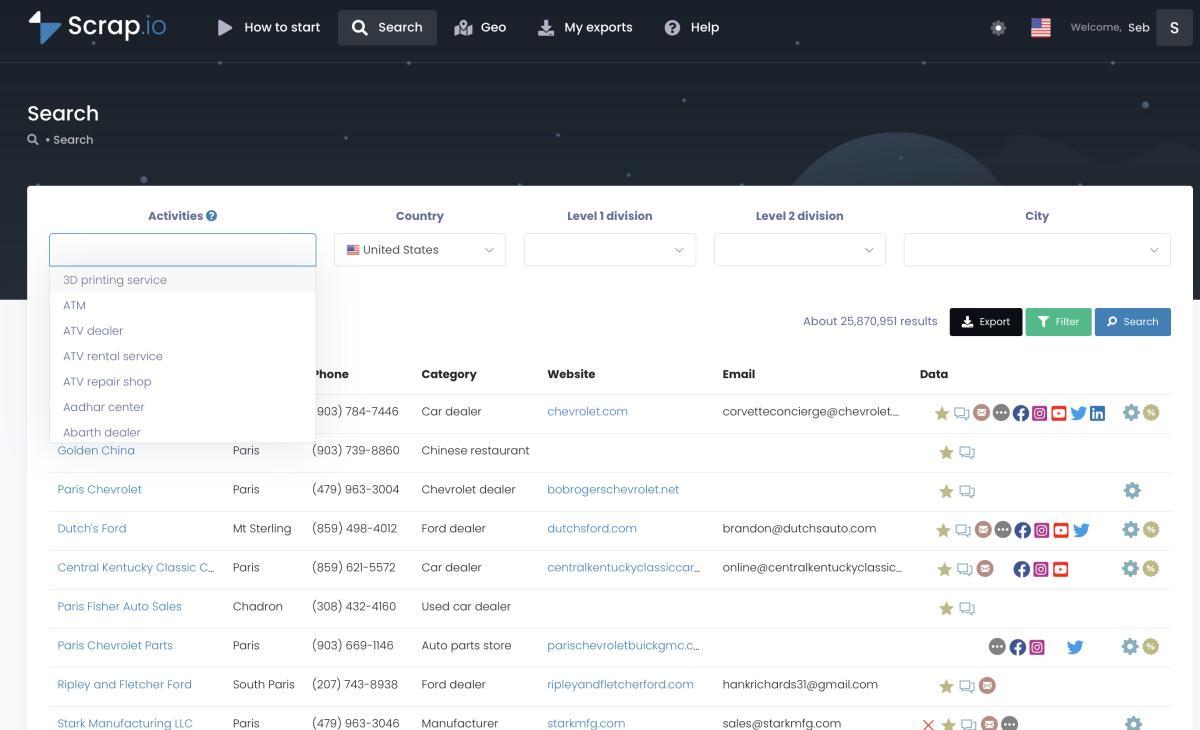
A google maps data extraction api sits between you and Google Maps. You send a request, "give me all plumbers in Chicago", and the service handles everything: rotating proxies, rendering JavaScript, parsing the HTML, crawling linked websites for extra data. You get back clean JSON or CSV.
The difference from the official API is fundamental. Google's API queries their internal database through approved endpoints. A scraper API extracts data from the publicly visible Maps interface, the same stuff any human could see by opening a browser. Same data source, different access method, wildly different pricing.
And before you ask, yes, it's legal. (More on that in the legal section below. Spoiler: courts have been pretty clear about this.)
Key Data Points You Can Extract (emails, phones, reviews, social profiles, tech stack)
This is where scraper APIs embarrass the official one. A good google maps scraper api pulls:
Everything from the listing itself: name, address, phone, hours, rating, review count, review breakdown by score, photos, GPS coordinates, whether the listing is claimed. Want to scrape google maps reviews api-style? Most tools handle review counts and star distributions natively. But also everything from the business's website: email addresses (classified by type: personal, contact, sales, marketing), social profiles (Facebook, Instagram, LinkedIn, TikTok, YouTube, X), CMS detection, ad pixels, contact forms, SEO metadata.
One API call. 30+ fields. That's how you extract emails from Google Maps without building a separate enrichment pipeline.
The 5 Best Google Maps Scraper APIs in 2026 (Tested & Compared)
We tested 8 platforms, burned through hundreds of dollars in credits, and only 5 tools are actually worth your time in 2026. The rest? Broken endpoints, stale data, or pricing models that punish you for breathing. If you want the wider field beyond APIs, our roundup of the 10 best Google Maps scrapers of 2026 ranks ten tools on real cost per usable lead.
Scrap.io: Real-Time Extraction, No-Code, 225M+ Businesses
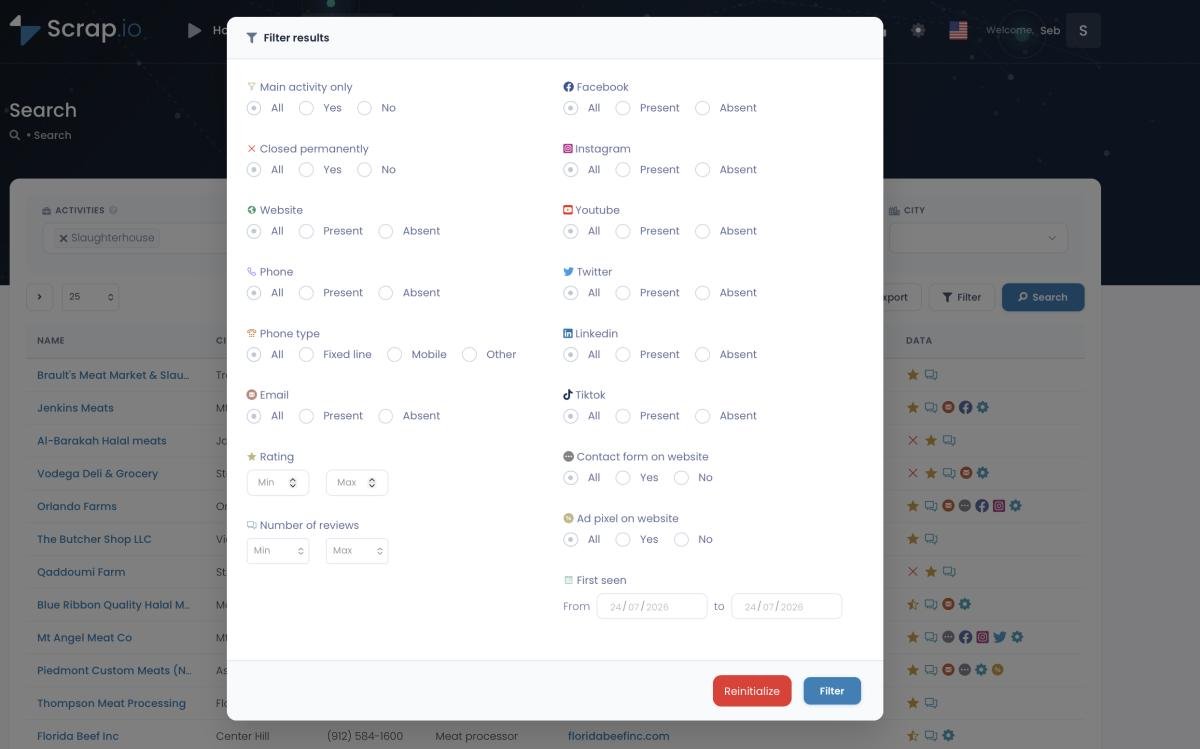
Full disclosure, this is the tool I keep coming back to. Scrap.io indexes 225,676,406 businesses across 195 countries (Scrap.io, 2026) and extracts data in real time. Not from a cached database that was built six months ago. Right now. Live.
The killer feature? Pre-extraction filtering. You set your criteria, only businesses with an email, minimum 4-star rating, must have a website, whatever, and you only pay for leads that match. Zero wasted credits on junk data. Over 50,000 professionals use it (Scrap.io, 2026), which tells you something.
REST API included on all plans. Endpoint at docs.scrap.io. 300 requests/minute rate limit. There's even an MCP connector that lets Claude, ChatGPT or Gemini query the database in plain English. Also a no-code interface if you don't want to write a single line.
Starts at $35/month (annual) for 10,000 credits. One credit = one business exported. Re-exporting the same business within 30 days is free. Honest pricing, no gotchas.
Join 50,000+ professionals extracting leads from Google Maps. Scrap.io offers a 7-day free trial with 100 leads included. Search any market across 225M+ businesses in 195 countries, filter before you export, and see the data quality for yourself. Start your free trial →
Outscraper: Pay-As-You-Go Cloud Platform
Outscraper runs a cloud-based scraping platform with a pay-per-result model. It handles Google Maps, Google Reviews, and a few other sources. The insurance agency use case is well-documented, one user built a complete Texas auto repair shop database for lead gen.
The interface works, the API works. But (and this is a real gripe from AppSumo reviewers) the pricing can be opaque. Multiple users on AppSumo have complained about "unclear pricing" that made it hard to predict monthly costs. If predictability matters to your budget, keep that in mind.
Apify: Developer-First with 42 Data Fields
Apify's Google Maps scraper actor is a beast: 42 data fields extracted per listing (Apify, 2026), 250K+ users, hundreds of reviews with a 4.7 average. It processes billions of pages monthly. Developer-first, meaning you'll be comfortable if you think in JSON and cron jobs.
The downside? Pricing scales with compute units, not results. You pay for the machine time, not the leads. Run an actor that takes 40 minutes and gets you 300 clean results? Great. Run one that takes 40 minutes and crashes halfway? Same bill. That unpredictability is a dealbreaker for some teams.
Bright Data: Enterprise-Grade Infrastructure
Bright Data is the gorilla in the room. Massive proxy network, enterprise SLAs, dedicated account managers. If you're a Fortune 500 company scraping Google Maps as part of a larger data pipeline, this is probably your tool.
For everyone else? Overkill. You're a 5-person agency trying to find plumbers in Ohio, do you really need a proxy network that handles 72 million requests per second? Entry-level pricing starts higher than most SMBs want to stomach, and the setup complexity is real. This isn't a criticism. It's a product built for a specific buyer. That buyer probably isn't reading a blog post about google maps scraper APIs at 11pm.
SerpApi: Fastest Response Time (0.2s)
SerpApi is fast. Like, 0.2-second response time fast (ScrapeBadger, 2026). Their Google Maps API endpoint returns structured JSON for any Maps search query, and the developer experience is genuinely excellent. Clean docs, predictable responses, great SDK support.
There's a well-known n8n + SerpApi workflow floating around the automation community that builds an automated lead pipeline cheaper than the official Google API. Solid if you're already deep in the n8n ecosystem. One caveat worth flagging: SerpApi is currently tangled in a Google lawsuit (more on that in the legal section), and it doesn't extract emails. We put the two head to head in our SerpApi alternative comparison if you're evaluating it seriously.
Bref, SerpApi is a developer's tool. If you're non-technical or need email enrichment built in, look elsewhere.
Two Newcomers Worth a Mention: ScraperAPI & Scrapingdog
The 2026 SERP shuffled a couple of names up the rankings, so they earn a line each. ScraperAPI is a general-purpose scraping API with a Google Maps endpoint: rotating proxies, solid uptime, but no no-code interface and no pre-extraction filtering, so you're back to sorting junk after the fact. Scrapingdog (rated 4.8 across 577 reviews) is another raw-API option, cheap and fast, but it hands you the listing and nothing more, no email enrichment, no filtering. Both are fine if you just want raw JSON and you'll build the rest yourself. Neither is built for someone who wants qualified leads out of the box.
Comparison Table
| Feature | Scrap.io | Outscraper | Apify | Bright Data | SerpApi |
|---|---|---|---|---|---|
| Starting Price | $35/mo | Pay-per-result | $49/mo | $500+/mo | $50/mo |
| Businesses Indexed | 225M+ | On-demand | On-demand | On-demand | On-demand |
| Email Extraction | ✓ Built-in | ✓ Add-on | ✓ Via actor | ✓ Custom | ✗ |
| Pre-Extraction Filters | ✓ | Limited | ✗ | ✗ | ✗ |
| No-Code Interface | ✓ | ✓ | ✗ | ✗ | ✗ |
| Country-Level Extraction | ✓ | Manual setup | Custom code | Custom code | ✗ |
| Real-Time Data | ✓ | ✓ | ✓ | ✓ | ✓ |
| Best For | Sales teams, agencies | Flexible budgets | Developers | Enterprise | Speed-obsessed devs |
Free & Open-Source Google Maps Scrapers: GitHub, Python & Extensions
Jake built his first Google Maps scraper with a GitHub repo and 47 lines of Python. Three hours and two IP bans later, he had exactly 63 leads. Not 63,000. Sixty-three.
Welcome to DIY scraping.
Top GitHub Repos (gosom/google-maps-scraper, omkarcloud)
The gosom/google-maps-scraper repo is probably the most popular open-source google map scraper github option right now: 50+ data points extracted, Go-based, actively maintained. omkarcloud's Python-based alternative is another solid pick.
Both work. Both require you to handle proxies, deal with rate limits, and accept that Google will change their DOM structure at the worst possible moment. (It's always on a Friday. Always.) If you want the full shortlist of repos, benchmarks and the 2026 AI-agent kits, we tested them all in our open-source Google Maps scrapers on GitHub guide.
Python Scraping with Selenium & BeautifulSoup
If you want full control, a google maps scraper python setup with Selenium or Playwright is the classic route. The code looks clean in tutorials. In production? You'll spend more time debugging CAPTCHAs than actually collecting data.
A stripped-down example of how to scrape google maps with api calls via Python:
import requests

API_KEY = "your_scraper_api_key"
response = requests.get(
    f"https://api.example.com/maps/search",
    params={"query": "restaurants chicago", "key": API_KEY}
)
businesses = response.json()["results"]
for biz in businesses:
    print(biz["name"], biz["phone"], biz["email"])
Looks simple. Maintaining it is the hard part.
Chrome Extensions: Quick but Limited
Instant Data Scraper, Data Miner, G Maps Extractor, the google maps scraper extension market is crowded. Install in 10 seconds, scrape 50 listings, done.
For anything beyond a quick research project? Forget it. You're scraping on your own IP (one ban and your whole browser is toast), Google caps results at 120 per search, and none of these extensions extract emails or social profiles. They grab what's visible on the Maps page and nothing more. We ran three of the popular ones side by side in our Chrome extensions for Google Maps scraping guide if you want the honest breakdown.
Why Free Tools Hit a Wall at Scale
Here's the uncomfortable truth about google maps scraper api free solutions: they work for demos and blog post screenshots. They don't work for building a pipeline of 5,000 leads per month. No proxy rotation, no enrichment, no filtering, no deduplication. You get what you pay for, and at zero dollars, what you get is a broken spreadsheet and a blocked IP address.
The AI-tool wave hasn't fixed this either. Clay's native Google Maps source, for instance, leans on Google's official Places API and caps out well short of a full market, and it returns no emails, so you end up bolting on credit-hungry enrichment columns anyway. We documented the exact ceiling in our breakdown of Clay's Google Maps scraper cap. Different wrapper, same wall.
That's not pessimism. That's three years of watching people try.
How to Use a Google Maps Scraper API: Step-by-Step Tutorial
You've chosen your tool. Now what? Let's turn API documentation into actual leads in your CRM in under 15 minutes.
Video: Scrap.io - How to Start?
Setting Up Your API Key & First Request
Most google maps scraper api tutorial guides overcomplicate this. Here's the short version: sign up, go to API settings, generate a key, copy it. That's it. If you're using Scrap.io, the endpoint is https://scrap.io/api/v2/ with Bearer token auth, and the complete Google Maps scraping guide covers the specifics.
First request: search for a business category + location. You'll get back a count of matching results. No credits consumed yet. (Counts are free, a detail most people miss.)
Filtering Results Before Extraction
This is where the smart money is. Most google maps scraper APIs make you export everything, then sort through garbage afterward. Tools like Scrap.io let you filter before extraction: only businesses with an email, minimum review count, specific social networks, whether they run ad pixels.
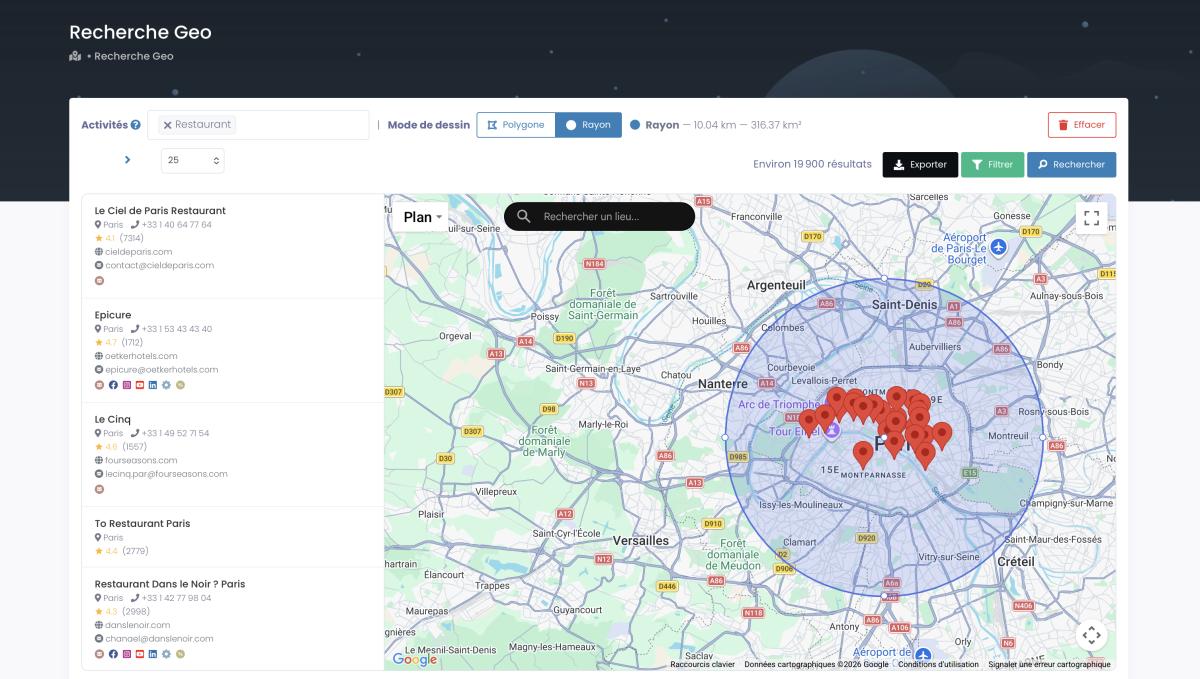
Quick example, say you sell Facebook Ads management. Filter for businesses with a website but NO Facebook pixel. You've just built a list of companies who literally need what you sell and aren't buying it yet. That's absurdly targeted. And if you'd rather drive the whole thing from an AI assistant, the Scrap.io MCP builds those radius and polygon searches from a plain-English prompt.
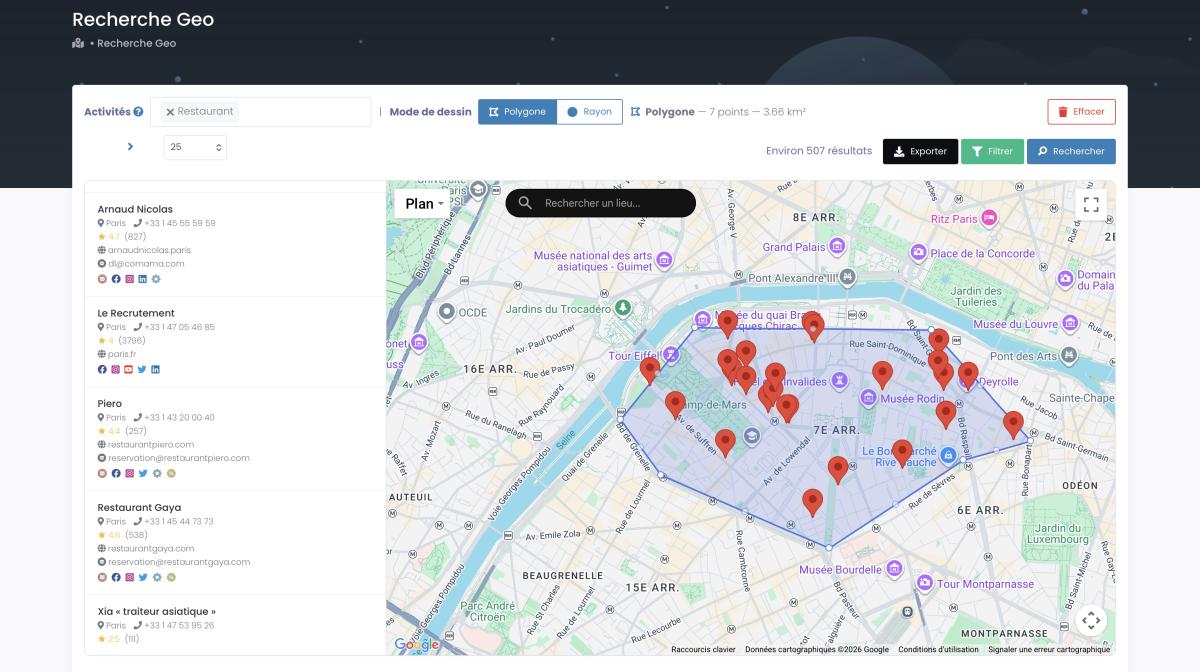
Try it yourself: search any market on Scrap.io for free before spending a single credit. See the exact count, apply filters, preview the data quality. No commitment. Search free on Scrap.io →
Exporting to CSV/Excel & Pushing to Your CRM
Once you've filtered, export. CSV or Excel, your choice. Real-world case: Scrap.io users have extracted 11,734 businesses in 45 minutes for a single campaign (Scrap.io case study). That's not a typo.
From there, you can push data directly into your CRM. The CRM automation guide walks through Pipedrive, HubSpot, and Salesforce integrations. You can also scrape phone numbers from Google Maps and pipe them straight into a cold calling workflow.
Automating with Make.com, Zapier, or n8n
This is where things get genuinely fun. Connect your google maps lead generation api to Make.com (formerly Integromat) and set it to run every Monday morning. New leads, fresh data, zero manual work.
Scrap.io has an official Make.com module. Zapier and n8n connect via the REST API. The n8n community in particular has built some impressive automation workflows, there's a well-documented n8n + SerpApi pipeline that generates leads cheaper than the official Google API. Oh, and also, you can extract all businesses from an entire city without specifying a single category. Wild feature.
Google Maps Scraping: Is It Legal in 2026?
Here's the twist most "is scraping legal?" articles won't tell you: Google itself scrapes publicly available business data to build Maps. Every day. At massive scale. The irony is thick enough to cut with a knife.
What the Law Actually Says (GDPR, CCPA, hiQ vs LinkedIn)
The hiQ Labs v. LinkedIn case went to the Ninth Circuit. LinkedIn argued scraping public profiles violated the Computer Fraud and Abuse Act. The court disagreed. The Supreme Court declined to hear LinkedIn's appeal. That was for semi-public data (you need an account to see LinkedIn profiles). Google Maps data? Fully public. No login. No password. On even firmer legal ground.
The web scraping market is projected to hit $2.7 billion by 2027 (MarketsandMarkets, 2025). This isn't a niche hacker thing anymore. It's a mainstream industry with institutional buyers.
On Reddit's r/Entrepreneur, one highly upvoted thread featured a user who found the official Google Maps API "really expensive to run" for lead gen, which kickstarted a 100+ comment discussion about scraper alternatives. Meanwhile, an independent benchmark on DEV Community compared API response quality across tools and consistently found scraper APIs returned richer datasets.
GDPR protects personal data. A company name, its business address, its phone number? That's business information, not personal data in most interpretations. CCPA carves out publicly available business information from its scope. Standard rules apply. For the full breakdown: is it legal to scrape Google Maps?
The Google vs SerpApi Lawsuit (2025-2026 Update)
Okay, this one moved a lot in 2026, so let's get the timeline straight. On December 19, 2025, Google filed a DMCA suit against SerpApi, one of the tools in our comparison above, in the Northern District of California. SerpApi hit back with a motion to dismiss in February 2026.
Then the interesting part. On July 20, 2026, the court granted SerpApi's motion to dismiss the core claims, tossing with prejudice everything that rested on search results containing no copyrighted content (the DMCA doesn't protect material that isn't copyrighted). Google got 21 days to re-plead a much narrower theory around copyrighted snippets in Knowledge Panels. It refiled on those narrow grounds on August 10, and SerpApi moved to dismiss again on August 25. As of this writing, it's still unresolved.
Here's what matters for you: even in its narrowed form, Google's case targets a commercial SERP-scraping company operating at hundreds of millions of requests per day. It is not aimed at a marketing team pulling 10,000 Google Maps leads for a client campaign. And the underlying precedents, hiQ, Meta v. Bright Data, Van Buren v. United States, all still stand. Sources worth reading if you want to go deeper: Search Engine Land.
Don't let the headline scare you. Read the filing.
Best Practices to Stay Compliant
Keep it simple. Only scrape publicly visible data. Don't log into Google while scraping. Use tools that handle rate limiting (so you're not hammering servers like a maniac). Include opt-out links in any outreach emails. And if you're touching EU data, familiarize yourself with GDPR's legitimate interest basis for B2B prospecting. That's it. The google maps scraping legal 2026 picture is clearer than most people assume.
Conclusion: Choosing the Right Google Maps Scraper API
The best google maps scraper api 2026 depends on what you're actually building. Need speed and developer control? SerpApi. Enterprise infrastructure? Bright Data. Maximum data fields with zero code? Scrap.io. Tight budget and you enjoy debugging Selenium at 2am? GitHub repos.
But don't overthink it. The market is growing, 1.5 million new businesses get listed on Google Maps every month. The data is there. The tools are there. The legal framework supports it. The only question left is whether you'll start extracting or keep paying $17 per thousand API calls for half the data you actually need.
Stop paying $17 per 1,000 API calls for incomplete data. Try Scrap.io free for 7 days, 100 leads included, real-time extraction, 225M+ businesses across 195 countries, pre-extraction filters that actually save you money. Start your free trial →
FAQ
What is the best Google Maps scraper API in 2026?
For no-code users and sales teams, Scrap.io leads the pack: 225M+ businesses indexed across 195 countries, real-time data, built-in email extraction, and pre-filtering so you don't waste credits. Developers who want raw speed often prefer SerpApi (0.2s response times), and Apify is a strong middle ground with 42 data fields per listing. Match the tool to your use case using the comparison table above.
Is it legal to scrape Google Maps data?
Yes. Courts have consistently ruled that scraping publicly available data does not violate the Computer Fraud and Abuse Act (hiQ v. LinkedIn, Meta v. Bright Data, Van Buren v. United States). Google's Terms of Service prohibit it, but a ToS violation is a contract matter, not a criminal offense. Use rate limiting, don't log in, stick to public business data, and you're on solid legal ground. See our full legal analysis.
How much does a Google Maps scraper API cost?
All over the place. Here's a quick 2026 snapshot of entry pricing:
| Tool | Entry price | What you get |
|---|---|---|
| Google Places API (official) | $17–$32 / 1,000 requests | ~15 fields, no emails |
| Scrap.io | $35/mo, 10,000 credits | 30+ fields, emails included |
| Apify | ~$49/mo (compute-based) | 42 fields |
| SerpApi | $50/mo | ~15-20 fields, no emails |
| GitHub repos / extensions | Free | Severe scale & email limits |
The real question is cost per useful lead, not cost per API call, and that google maps scraper api cost comparison consistently favors dedicated scraping platforms over the official API.
Can I scrape Google Maps without coding?
Absolutely. Scrap.io is purpose-built for google maps business scraper no code use cases: pick a category, pick a location, filter, export. That's the whole workflow. Chrome extensions also work for tiny jobs (under 120 results). If you need country-level extraction or email enrichment without writing code, Scrap.io is currently the only option that handles it end to end.
What data can you extract from Google Maps?
From the Maps listing itself:
- Business name, address, GPS coordinates
- Phone number (with fixed/mobile type)
- Rating, review count and review breakdown
- Opening hours, photos, price range, claimed status
And from the linked website, via enrichment:
- Email addresses, classified as personal, contact, sales and marketing
- Social profiles: Facebook, Instagram, LinkedIn, TikTok, YouTube, X
- CMS detection, ad pixels, contact-form presence
- SEO metadata and the site's tech stack
Tools like Scrap.io and Apify pull 30 to 42 fields per business. The official Google API? About 15. And no emails. That's why people switch to scraper APIs and never look back.
Generate a list of restaurant with Scrap.io