

Video: Web Scraper vs Scrap.io: Google Maps Data Extraction Compared
Why Developers Search for Google Maps Scrapers on GitHub
The web scraping market hit $512 million in 2026 and is projected to reach $762M by 2034 (ResearchAndMarkets). That's a CAGR of 6.9%. Meanwhile, AI-driven scraping alone ballooned to $10.2 billion. And honestly? A massive chunk of that activity starts with someone typing "google maps scraper github" into the search bar at 2 AM.
I get it. I've done it too.
The appeal of open-source: free, customizable, transparent
Free is the obvious hook, and searching "google maps scraper free" on GitHub returns hundreds of repos. But that's not the full picture. Open-source Google Maps scrapers let you peek under the hood, tweak the code to your exact use case, and avoid vendor lock-in. You're not at the mercy of someone else's pricing page. You control the pipeline. If you need to scrape Google Maps without relying on proprietary tools, GitHub repos feel like the logical starting point.
And let's be real. For developers, there's a certain satisfaction in building your own data pipeline from scratch. Cloning a repo, tweaking config files, watching those JSON objects roll in.
It's addictive.
What people actually need: leads, emails, reviews, location data
But here's the thing nobody talks about upfront. Most people searching for a github google maps scraper aren't hobbyists. They want business leads. Names, phone numbers, emails, review counts, opening hours, the works. The location intelligence market is heading from $25 billion to $47 billion by 2030 (GrowthFactor, CAGR 13.45%). There's real money in this data. And the gap between "I found a cool scraper on GitHub" and "I have 10,000 verified leads in my CRM" is… wider than most people expect. If you want the shortlist of every route (not just the open-source one), our pillar guide ranks the 10 best Google Maps scrapers in 2026.
Top 7 Google Maps Scrapers on GitHub in 2026
There are 200+ google maps scraper github repos. We tested the ones that actually work. Most don't. Here's what survived.
1. gosom/google-maps-scraper (Go), ⭐ 3,600+
The heavyweight champion of every "best google maps scraper free" list. Written in Go, gosom/google-maps-scraper is fast. We're talking ~120 places per minute with the right proxy setup. It handles concurrent scraping well and exports to CSV or JSON. The codebase is clean. But (and this is a big but) you'll need Go installed, a working proxy rotation setup, and patience to deal with Google's anti-bot measures. Not exactly a plug-and-play situation if you've never touched Go before. New in 2026: the maintainer now flags it as "easiest to run with an AI coding agent" (Claude Code, Codex, Cursor, Copilot), which changes the setup story quite a bit. More on that below.
2. omkarcloud/google-maps-scraper (Python), ⭐ 2,600+
Probably the most popular google maps scraper python project on GitHub right now. omkarcloud/google-maps-scraper extracts 50+ data points per listing: name, address, phone, website, reviews, photos, the whole deal. It uses browser automation under the hood. Fair warning though: scraping an entire country takes 10 to 12 days according to their own docs. That's not a typo. Days.
3. luminati-io/Google-Maps-Scraper (Python)
Built by the team behind Bright Data (formerly Luminati). It's technically open-source, but let's call it what it is: a funnel into their paid proxy network. Works decently for small jobs. Gets expensive fast if you need scale.
4. georgekhananaev/google-reviews-scraper-pro (Node.js)
Specialized. If you only care about reviews (think: reputation monitoring, competitive analysis), this one does the job without the bloat of a full-featured scraper. Node.js-based, reasonably maintained, and the maintainer confirms it still "works in 2026." Niche but useful.
5. conor-is-my-name/google-maps-scraper (Python/FastAPI)
Interesting approach. It wraps the scraping logic in a FastAPI server, so you get an API endpoint out of the box. Great if you want to integrate Google Maps data extraction into an existing workflow. Less great if you just want a CSV file and move on with your life.
6. HasData/google-maps-scraper (Python & Node.js)
Dual-language support. Decent documentation. The hasdata google maps scraper is another one that quietly nudges you toward their commercial offering, but the open-source version works for basic use cases. Don't expect miracles at scale.
7. Zubdata/Google-Maps-Scraper (Python, GUI)
The only one on this list with a graphical interface. If "google maps scraper python github" lands you here and you're not comfortable with terminals, this might be your best bet among the free options. The GUI is basic but functional. Limited in features compared to the CLI-based alternatives. (Honorable mention: zohaibbashir/Google-Maps-Scrapper, a Playwright-based Python repo sitting at 1.1k stars if you want another lightweight option.)
| Repo | Language | Stars | Speed | Email Extraction | GUI |
|---|---|---|---|---|---|
| gosom | Go | 3,600+ | ~120/min | No | No |
| omkarcloud | Python | 2,600+ | Slow (days) | Partial | No |
| luminati-io | Python | 500+ | Medium | No | No |
| georgekhananaev | Node.js | 200+ | Medium | No | No |
| conor-is-my-name | Python | 100+ | Medium | No | No |
| HasData | Python/Node | 300+ | Medium | No | No |
| Zubdata | Python | 150+ | Slow | No | Yes |
Notice a pattern? Not a single google maps scraper github project extracts emails reliably. Keep that in mind. We'll come back to it.
New in 2026: the AI coding agent kits
Here's the shift nobody saw coming. The fastest-rising google maps scraper github repos this year aren't new scrapers at all. They're wrappers that let an AI agent drive an existing scraper for you. Type a sentence, get a lead list. No Go, no proxies, no XPath.
The one climbing the SERP hardest is Mahanaicoach/google-maps-scraper-kit. It's a plug-and-play kit that wraps gosom's scraper in a one-command Docker setup and ships a Claude skill, so you open the folder in Claude Code and literally say "scrape coffee shops in Austin." Claude handles create, poll, download, and clean, following the rate-limit guardrails automatically. Clever. It even documents the honest catch: run big jobs back-to-back without proxies and Google will temporarily block your IP (usually clears in minutes to hours). Same 120-ish wall as everything else, just with a friendlier co-pilot.
Then there's parnika-sa/Google-Maps-Lead-Scraper-Pro, a Python and Flask repo that bolts a clean web interface onto a Playwright scraper. You fill in a keyword, a city, hit "Start Scraping," and download a CSV with names, phones, websites, and (best-effort) emails. It claims 100+ results per search, which already tells you it's fighting the same result cap under the hood. Still, for a google maps lead scraper github project with a real UI and zero terminal, it's a genuinely nice starting point.
The takeaway? The 2026 innovation isn't a better scraper. It's a better steering wheel.
The car still hits Google's walls.
The Real Limits of Open-Source Google Maps Scrapers
You clone the repo, run the script, get 120 results… and then Google blocks your IP. Sound familiar?
The 120-result cap nobody warns you about
Google Maps displays a maximum of 120 results per search query. That's it. Doesn't matter how clever your scraper is, doesn't matter if you're using gosom or omkarcloud or some custom Selenium hack you found on Reddit. 120. This is the google maps 120 result limit workaround everyone's googling, and the honest answer is there's no workaround within a single query. You have to split your searches geographically or by keyword. Which means more queries, more proxy costs, more complexity.
IP blocking, CAPTCHAs, and rate limiting
Google doesn't want you scraping their maps. Shocking. The google maps scraper rate limiting issues are real and getting worse. After a few hundred requests, you'll hit CAPTCHAs, temporary bans, or straight-up IP blocks. The google maps scraper captcha bypass solutions floating around Stack Overflow are mostly outdated. Google's bot detection has gotten significantly better since 2024. You'll burn through residential proxies at $5-15/GB trying to scrape google maps without getting blocked, which is exactly why "google maps scraper github proxies" and "google maps scraper github decodo" are such common searches. Proxies are the tax nobody mentions in the README.
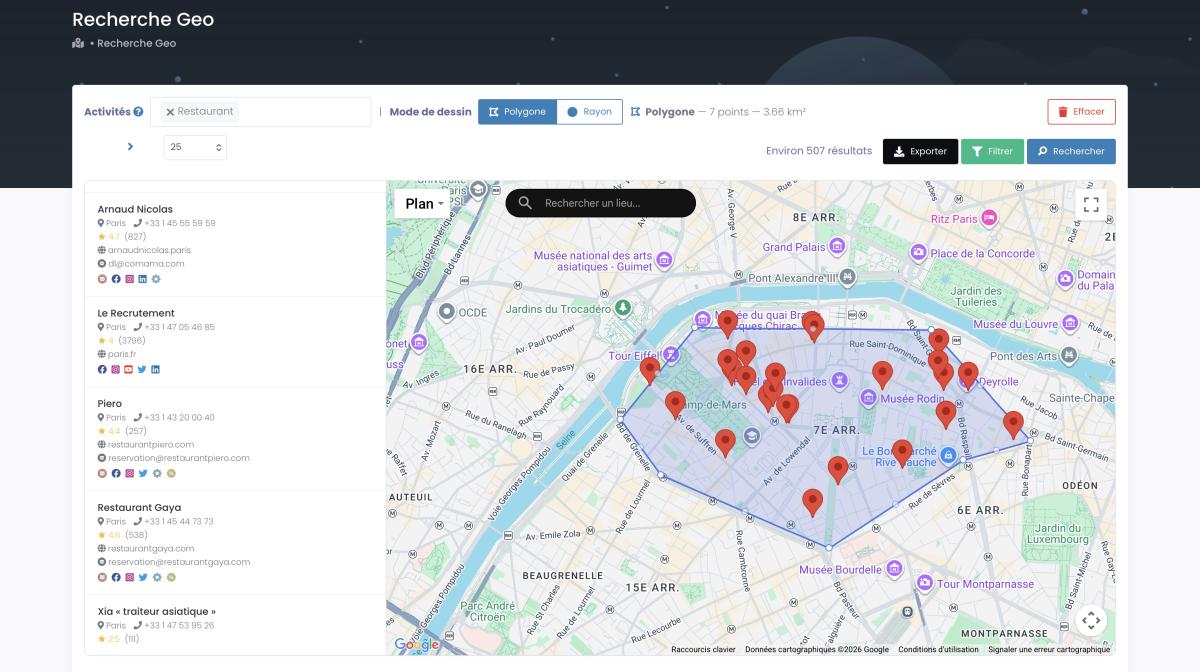
A pre-indexed database sidesteps the query cap entirely: draw a polygon, pull every business inside it.
DOM changes: your scraper will break
Google updates their Maps frontend constantly. No changelog. No heads-up. One morning your scraper works perfectly; the next morning, every CSS selector returns null. The community repos fix these breaks eventually, sometimes within hours, sometimes weeks. But if you're running a scraper in production, "eventually" doesn't cut it.
The hidden cost: proxies, maintenance, and your time
Let's do some quick math. Cloud scraping services like Outscraper charge $0.002-0.004 per result. Sounds cheap until you need 50,000 leads. That's $100-200 just for the raw data. Now add proxy costs ($50-300/month for decent residential proxies), server costs, and (here's the one everyone forgets) your time debugging.
Want proof it isn't just us saying this? On the r/n8n subreddit, one developer documented spending three weeks building a custom google maps scraper before shipping it, and the follow-up thread is 50-plus comments deep, most landing on the same verdict: the build is the easy part, keeping it alive is the grind. Three weeks. For a scraper.
That's the real "free."
Email extraction: the 30% problem
Here's the kicker. Only about 30% of Google Maps listings even have a website (Prospeo, 2026). And having a website doesn't mean you'll find an email on it. Open-source scrapers almost universally skip email extraction, because it requires a separate crawl of each business's website, plus parsing logic that breaks on every other site. If you need emails (and you probably do if you're building a lead list), none of the free google maps email scraper github repos will give you reliable results. We go deep on the workarounds in our guide to finding emails on Google Maps.
Tired of dealing with rate limits and broken scrapers? Scrap.io has 225M+ businesses already indexed across 195 countries, with verified emails included. No 120-result cap, no proxies, no CAPTCHAs. Free trial, 100 leads on the house. Try it here →
Open-Source vs Paid Solutions: What Makes Sense in 2026
Is "free" really free when you spend 3 days debugging a broken scraper? Bref. Let's look at this objectively.
Video: Google Maps Extractor vs Scrap.io: Side by Side Comparison
When open-source makes sense
If you're a developer who wants to scrape a small, specific dataset (say, all pizza restaurants in one city) and you don't need emails, an open-source google maps scraper is perfectly fine. You'll spend an afternoon setting it up, get your data, and move on. Also great for learning how web scraping works under the hood. Education has value.
Oh, and also? If you're building something custom where you need full control over the pipeline, like piping data directly into a Chrome extension or a proprietary CRM, open-source gives you that flexibility. The google maps scraper extension route is worth a look too if browser-based is more your speed.
When a paid tool saves you money
The math flips fast. A SaaS founder recently pulled 11,734 businesses in under 45 minutes using Scrap.io, with verified emails. Try doing that with a GitHub repo. Companies like Apify offer managed scraping at about $4 per 1,000 places, which is reasonable for mid-scale jobs. But if you're weighing DIY against a managed platform, our country-level DIY vs professional test is brutal: the hand-built route pulled 52,000 French restaurants while the managed one hit 139,000, same effort.
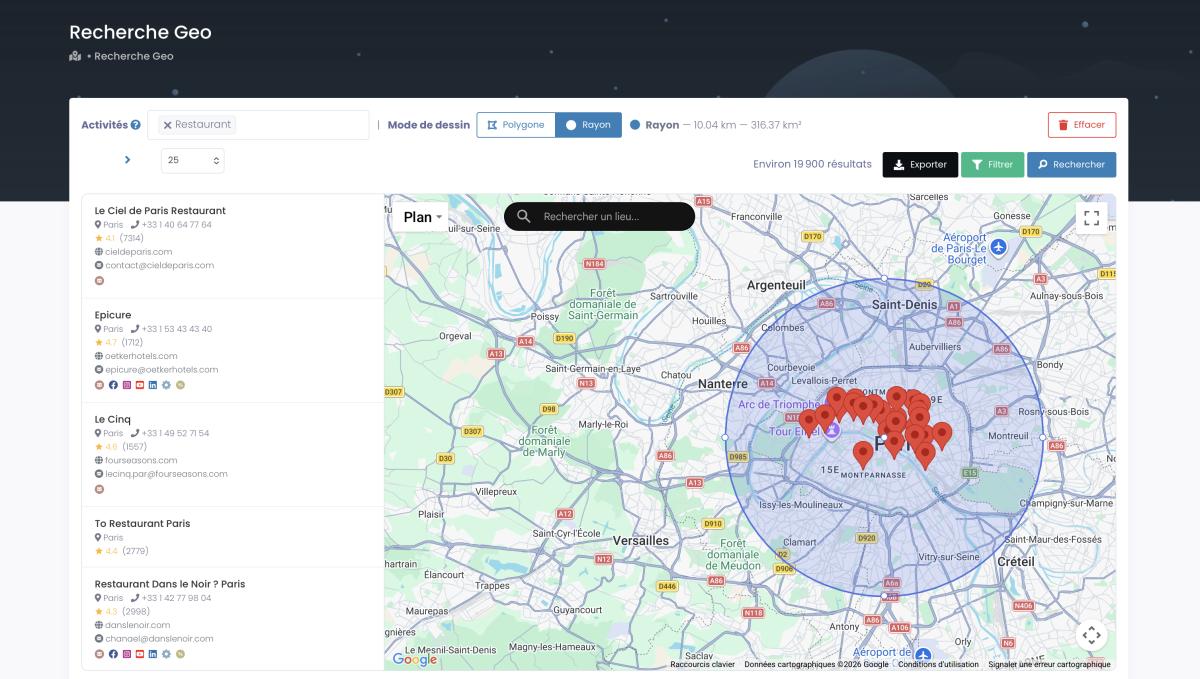
GeoSearch radius: define a circle on the map and pull every business inside, no query-by-query grind.
And honestly, if you're comparing a google maps scraper vs paid alternatives, the question isn't about the tool. It's about what your time is worth.
Quick comparison table: DIY vs API vs Scrap.io
| Criteria | DIY (GitHub) | API (Outscraper, Apify) | Scrap.io |
|---|---|---|---|
| Setup time | Hours to days | Minutes | Instant |
| Cost at 10K leads | $50-300 (proxies) | $20-40 | From $49/mo |
| Verified emails | No | Rarely | Yes |
| 120-result limit | Yes | Workarounds | No (pre-indexed) |
| Maintenance | You | Provider | None |
| Scale | Limited | Good | 225M+ businesses |
225M+ establishments. Verified emails. No proxies needed. See how Scrap.io compares to SerpApi and other alternatives. Free trial, 100 leads included. Start your free trial →
How to Get Google Maps Data Without the Headaches
When a SaaS founder needed 11,000+ contacts in under an hour, cloning a GitHub repo wasn't going to cut it. Here's what the non-masochistic approach looks like.
Video: Scrap.io - How to Start?
Step 1: Search by keyword, category, or location
Instead of writing code, you just type what you're looking for. "Plumbers in Austin." "Restaurants in Brooklyn." "Dentists in London." Scrap.io searches across its database of 225M+ indexed businesses (225,676,406, to be exact, across 195 countries and 4,000+ categories). No scraping in real-time on Google's interface, which means no rate limits, no CAPTCHAs, no IP bans. The data is already there.
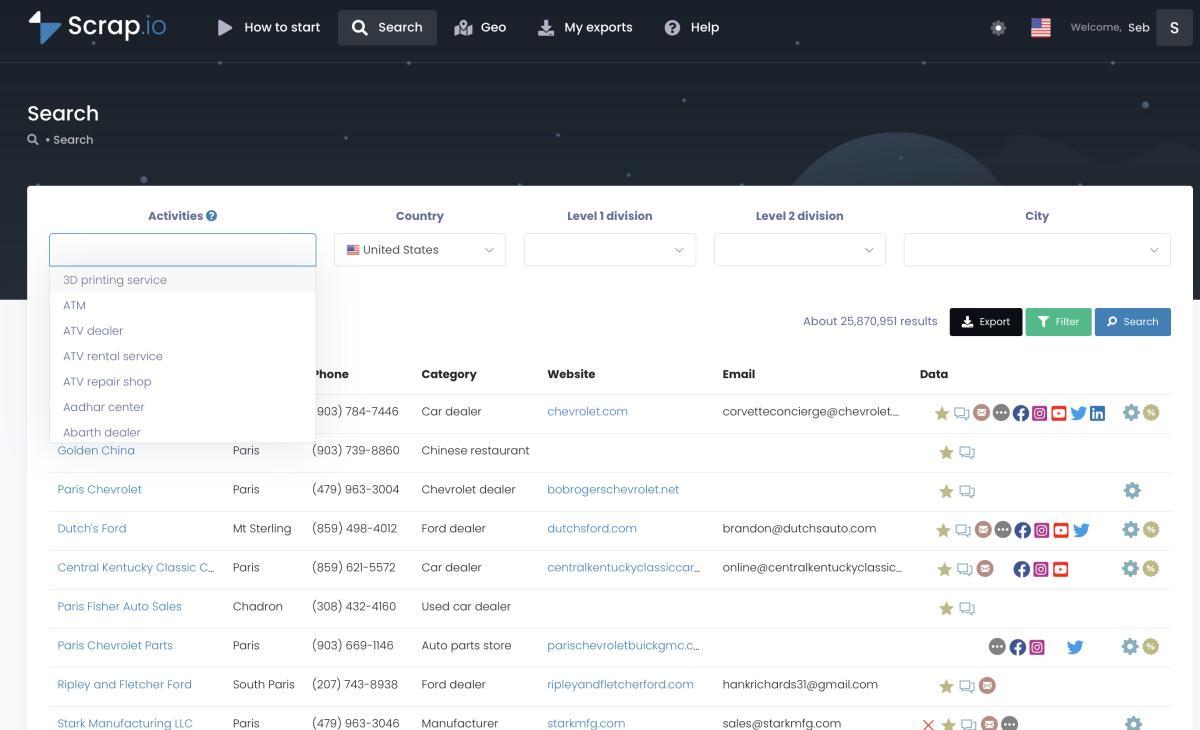
Search by category and location: the counter tells you how many businesses match before you spend a credit.
Step 2: Filter and refine your results
This is where it gets interesting. You can filter by rating, number of reviews, website presence, phone number availability, and more. Want only businesses with 4+ stars and fewer than 50 reviews? Done. Need places that opened in the last 6 months? Also done. And here's the part that actually saves money: filters run before credits are consumed, so you only pay for contacts you can use. Try doing that with a Python script. I'll wait.
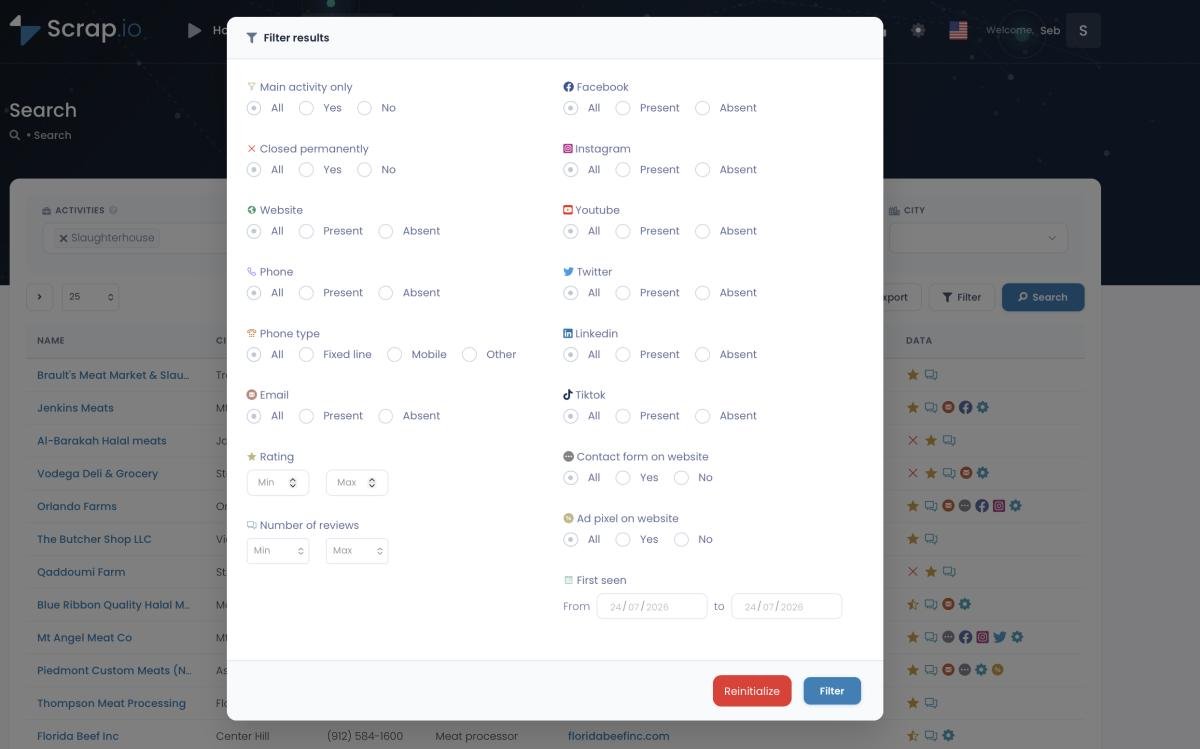
Filters applied before extraction: email present, mobile numbers, rating, review count. Zero wasted credits.
Step 3: Export with verified emails
One click. CSV, Excel, or direct CRM integration. The emails are already verified, not scraped from random "Contact Us" pages and hoped for the best. Scrap.io even classifies them: individual (with first and last name), contact, sales, marketing, admin. This is the part where open-source google maps lead generation tools just can't compete. You can also scrape phone numbers with a mobile-vs-fixed tag, then go straight from export to your cold email tool without an intermediate cleanup step.
OK, enough talking. Free trial, 100 leads included. See the data quality for yourself. Try Scrap.io free →
FAQ
Is it legal to scrape Google Maps?
Short answer: it's a gray area. Web scraping itself isn't illegal in most jurisdictions, but it can violate Google's Terms of Service. The hiQ v. LinkedIn ruling established that scraping publicly available data isn't necessarily a CFAA violation, but Google's situation is different because Maps data isn't purely "public" in the same sense. Using a google maps scraper api from a third party (or a pre-indexed database like Scrap.io) shifts the legal burden: you're accessing data through a service, not scraping Google directly. If compliance matters to your business, that distinction is worth thinking about. We wrote a full breakdown on whether scraping Google Maps is legal.
What is the best free Google Maps scraper on GitHub?
Depends what you mean by "best." Among every google maps scraper github repo we tested, for raw speed: gosom/google-maps-scraper (Go). For data points and ease of use: omkarcloud/google-maps-scraper (Python). For reviews specifically: georgekhananaev/google-reviews-scraper-pro. And if you want an AI agent to drive the whole thing, the Mahanaicoach kit wraps gosom nicely. But "best" depends heavily on your use case. None of them handle emails well, and all of them hit the 120-result cap. Check our complete guide to Google Maps scraping for a deeper breakdown.
Why does my scraper only return 120 results?
Because Google Maps limits search results to 120 per query. This isn't a bug in your code. It's how Google Maps works. The workaround is splitting your search into smaller geographic areas or more specific keywords, but this adds massive complexity. Tools with pre-indexed databases bypass this entirely, since they don't rely on Google's search interface.
Can I extract emails with open-source scrapers?
Technically, some repos claim to. Practically? It's unreliable. Extracting emails requires crawling each business's website (if they even have one; remember, only ~30% do) and parsing contact info from wildly different page structures. Most open-source tools either skip this step entirely or produce data so messy it's unusable. Dedicated platforms with verified email databases are the only consistent option here.
Can you get caught scraping Google Maps?
Scraping publicly available business data isn't illegal, but it does violate Google's Terms of Service, so the realistic "punishment" is technical, not legal: unusual traffic triggers CAPTCHAs, temporary IP blocks, or a short ban (often 15-60 minutes). Basic rate limiting and proxy rotation make detection unlikely. A pre-indexed service moves that risk off your machine entirely.
Is the Google Maps API still free?
Not really, not past the free caps. Since Google's March 2025 overhaul, the old $200 monthly credit is gone, replaced by per-SKU free caps (roughly 10,000 calls/month for Essentials). Beyond that you pay, and Places Nearby Search (the SKU you need for business listings) runs about $32 per 1,000 requests. We ran the full math in our Google Maps API cost calculator.
Scraper vs Google Places API?
The Google Places API is the "official" way to get Maps data. It's reliable, legal, and well-documented. It's also expensive: about $32-40 per 1,000 Place Details requests at 2026 pricing, and it caps you at 120 results per query with no emails. A github google maps scraper technically gets you similar data for free, but with all the headaches we've covered. The API wins on reliability; scrapers win on cost (at small scale); pre-indexed databases like Scrap.io win on both if you need volume.
Bottom line? A google maps scraper github repo is great for learning and small projects. For real lead generation at scale, with emails that actually work, give Scrap.io a spin. Free trial, 100 leads included.
Generate a list of restaurant with Scrap.io