

July 20, 2026: a federal judge threw out Google's lawsuit against SerpApi. Twenty-one days later, Google was back with a narrower complaint. And one thing had quietly gone missing from it: Google Maps.
That detail matters more than the headline, and I'll explain why in a minute. But first, the honest bit. If you've been pulling business data from SerpApi's Google Maps endpoint, the lawsuit was probably the loudest reason you started shopping for a SerpApi alternative. It's no longer the best one.
The better reason is the data. Or rather, the data SerpApi will never hand you, no matter how clean its JSON looks.
So this is the updated 2026 breakdown. SerpApi vs Scrap.io, start to finish: the legal mess (what actually happened, not the March version), the Google Maps results ceiling nobody warns you about, the pricing math, and where each tool genuinely wins. No fluff. Let's go.
Video: SerpApi vs Scrap.io, The Fastest API Is Missing One Column
📋 What's in This Guide
- Google v. SerpApi: What Actually Happened (and What Changed in 2026)
- What Is SerpApi? A Quick Overview
- SerpApi for Google Maps: What You Actually Get
- Scrap.io: Built Specifically for Google Maps Lead Generation
- SerpApi vs Scrap.io: Head-to-Head Comparison
- Pricing Comparison: SerpApi vs Scrap.io in 2026
- Looking for a SerpApi Alternative for Google Search Instead?
- The Legal Question: Is SerpApi Safe to Use in 2026?
- Geo-Targeting: Radius & Polygon Selection
- When to Choose SerpApi (And When to Choose Scrap.io)
- FAQ: SerpApi vs Scrap.io
Google v. SerpApi: What Actually Happened (and What Changed in 2026)
Hundreds of millions of requests a day. A 25,000% jump in scraping volume over two years. One DMCA lawsuit. Then a dismissal. Then round two. Buckle up, because the timeline is the whole story here.
- October 2025. Reddit sues SerpApi, along with Perplexity, Oxylabs and AWMProxy, over unauthorized content access (PPC Land).
- December 19, 2025. Google files its own DMCA suit against SerpApi in the Northern District of California, case no. 4:25-cv-10826-YGR. In its official blog post, Google called the scraping "brazen" and the business model "parasitic." Search Engine Journal flagged it as one of the first big DMCA cases aimed at SERP scraping.
- February 2026. SerpApi files a motion to dismiss. Its CEO's line, for the record: "Google thinks it owns the internet." Covered by PPC Land and The Register.
- July 20, 2026. Judge Yvonne Gonzalez Rogers grants the motion. Claims over content not protected by copyright are dismissed with prejudice. The rest is dismissed with leave to amend within 21 days. The court found Google hadn't shown the rights holders authorized it to impose SearchGuard, while accepting that the circumvention itself was adequately alleged (order, via SerpApi; Search Engine Land; Search Engine Roundtable).
- Late July 2026. Different courtroom, opposite result: a judge lets Reddit's suit against SerpApi survive its own motion to dismiss (Crypto Briefing).
- August 10, 2026. Google files an amended complaint. Fifteen pages, recentered on licensed content, Reddit named as a partner. And here's the part nobody else is writing about: the Google Shopping and Google Maps theories are gone (Search Engine Roundtable; PPC Land).
- August 25, 2026. SerpApi moves to dismiss a second time, asking the court to end it "with prejudice." A hearing was set for late September (PPC Land; SerpApi blog).
- As of October 30, 2026. No public ruling on the second motion. The public docket is the place to check if you want the live status.
So. SerpApi won round one. Google came back smaller. The Reddit case, meanwhile, is still very much alive.
Why does the amended complaint matter to you specifically? Because if you're on SerpApi's Maps endpoint, Google just dropped the exact theory that touched your use case. The "your data source is tangled in a Google lawsuit over Maps" argument doesn't really hold anymore. Which is awkward for an article that used to lead with it. More on how we're handling that honestly in the legal section below.
What Is SerpApi? A Quick Overview
SerpApi has been around since 2016, out of Austin, Texas. It built an API that scrapes search engine results pages, and not just Google: Bing, Baidu, DuckDuckGo, Yahoo, Yandex, plus Amazon, Walmart, eBay, YouTube, Apple, and a long list more. 80+ engines and endpoints, depending on how you count.
The mechanics are clean. You send an API call, SerpApi fetches the results page, parses the messy HTML, and hands you back tidy JSON. Developers like it for exactly that. The docs are solid, the response format is predictable, and on SoftwareAdvice and G2 people rave about the support. Credit where it's due.
It's also got a real compliance story. SOC 2 Type II, SOC 3, ISO 27001, and a "U.S. Legal Shield" bundled into every plan. There's an official MCP server too, so AI agents can call it directly. And the client logos are not small: Nvidia, Shopify, Perplexity, Adobe, Samsung, KPMG. This is a serious, well-run product. Let's be clear about that up front.
But here's the catch, and it's a big one: it's developer-only. No dashboard. No buttons to click. You need to understand API calls, JSON, pagination. My neighbor is not using SerpApi. Neither is your sales intern.
The other thing? It's a generalist. SerpApi does a bit of everything with a search bar attached. Great if you need multi-engine data. Not great if the one thing you actually need is Google Maps lead generation. For that specific job, the official route has its own headaches, which is why developers keep hunting for an official Google Maps API alternative in the first place. Different tool, different job.
SerpApi for Google Maps: What You Actually Get
0.78 seconds. That's about how fast SerpApi returns a page of Google Maps results. Genuinely quick. And it will never return the one column you need for outreach.
Here's why. SerpApi scrapes Google Maps the same way it scrapes everything else: off the results page. It reads what Google already shows in the browser. It doesn't go deeper, it doesn't visit the business website, it doesn't enrich anything. Name, address, phone, rating, review count, GPS, hours, website URL. Roughly 15 to 20 fields. That's the lot.
You know what's not in there? Emails. Zero email extraction. And email is the whole point of scraping Maps for most people. No social profiles either: no Facebook, no Instagram, no LinkedIn, no TikTok. No website tech, no ad-pixel detection, no contact-form flag. The stuff that turns a listing into a prospect simply isn't on the SERP, so SerpApi can't hand it to you.
Then there's the ceiling, and this is the part that quietly wrecks projects. SerpApi returns about 20 results per page, and roughly 120 reliable results per GPS point, which is the same hard cap Google Maps imposes on itself. Want every restaurant in a city? You're building a grid of GPS points, looping calls, and deduplicating the overlaps yourself. In code. One point at a time.
And here's the money part people miss: every search is billed, even an empty one. Straight from SerpApi's own FAQ, "responses with 100 results or empty result sets will both count as 1 search." So a dead query in a thin area costs the same as a full one.
📌 Let's make it concrete. Charlotte, North Carolina has 2,349 restaurants on the map right now, and 953 of them have an email on their website (Scrap.io count, October 30, 2026). With SerpApi, at ~20 results per page and ~120 per GPS point, covering Charlotte means a grid of 20-plus points and at least 118 billed searches before you even start deduplicating. And at the end of all that? None of those 953 email addresses. They were never on the page to begin with.
For the full picture on every way to approach this, we put together a complete Google Maps scraping guide, and if you specifically want the programmatic route, the Google Maps Scraper API guide breaks it down endpoint by endpoint. Chasing review data instead? The Google Reviews API options are their own rabbit hole.
Scrap.io: Built Specifically for Google Maps Lead Generation
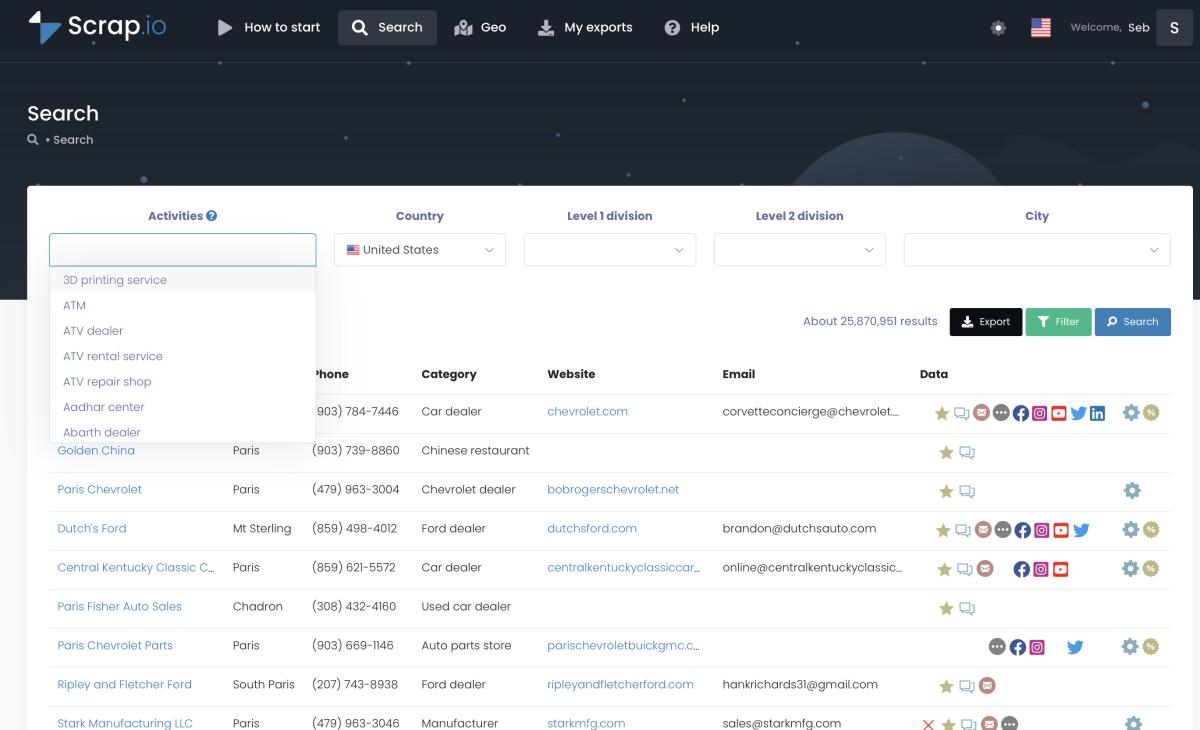
Scrap.io is a different animal. It doesn't chase 80 search engines. It does maps platforms, and nothing else: no web search, no Amazon, no YouTube. One lane, driven well.
The index is big. 225,676,406 establishments, 195 countries, 4,000+ categories. And the part that matters to most people reading this: no code. None. You pick a category (restaurants, plumbers, law firms, whatever). You pick a location (a city, a county, a state, or a whole country). You click search. You filter. You export. Done.
Two clicks, basically. No pagination logic, no GPS grid, no dedup script.
Now the data, because this is where it earns the comparison. Scrap.io doesn't just read the Maps listing. It visits each business's website and pulls what's there. So you get dozens of columns per business, colour-coded in the export: yellow for map data, orange for website data. And the emails aren't a single generic field. They're classified: a main email, an individual email with the person's first and last name, plus contact, sales, marketing, finance and admin addresses. Facebook, Instagram, LinkedIn, YouTube, X and TikTok links. Website tech, ad pixels, contact-form detection, SEO metadata. The useful stuff.
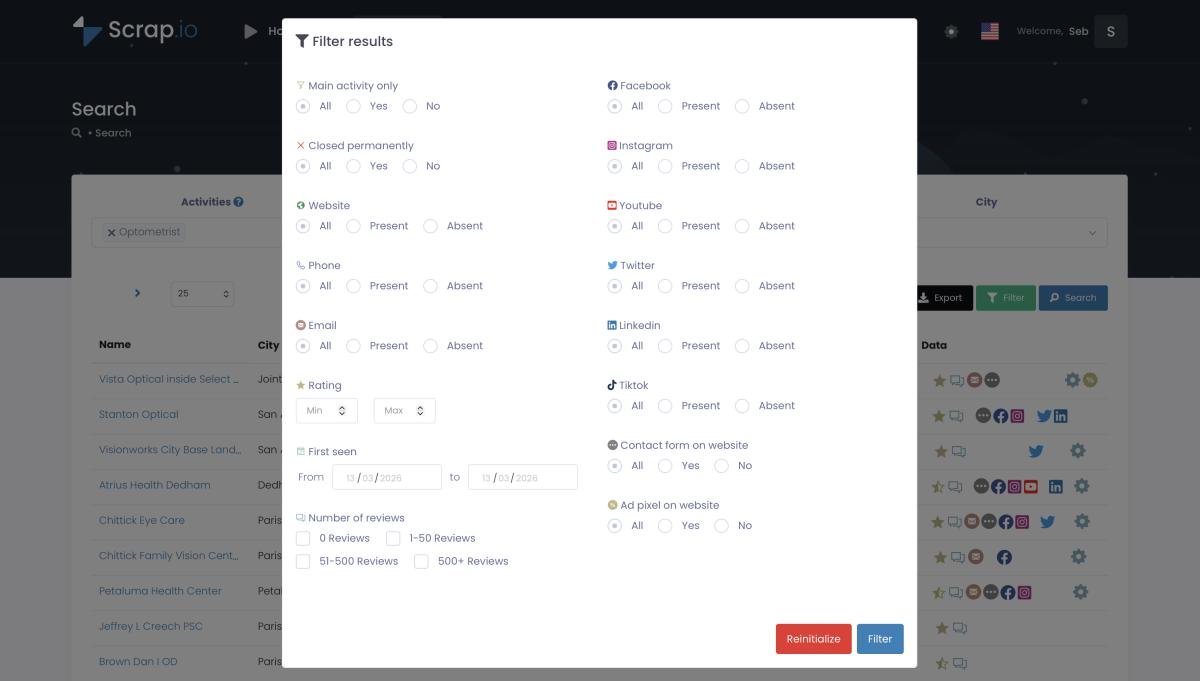
Then there's the filtering system, which is the bit that actually saves money. You filter before you export, across 17-plus criteria: website, email, phone, phone type, each social network, rating, review count, photos, price range, claimed status, permanently-closed status, main category, contact form, ad pixel, first-seen date, and automatic duplicate exclusion. Only want businesses with an email? Filter for it. You pay for the leads that match, not the junk you'd delete anyway.
And the counts are free. Always. In the app, through the REST API (300 requests a minute, included on every plan), and through the official Scrap.io MCP at scrap.io/mcp. So you can size a market before spending a single credit.
Video: Scrap.io - How to Start?
Wanna see the difference yourself? Run a free count for your city first (0 credits, every time), then export with the 7-day trial: 50 searches and 100 export credits, emails and socials included. That's roughly nine million US businesses with an email already waiting behind the filter. Give it a shot → (card required, cancel anytime.)
SerpApi vs Scrap.io: Head-to-Head Comparison
Enough talking. Let's put them side by side.
| Criteria | SerpApi | Scrap.io |
|---|---|---|
| Focus | Multi-engine (80+ engines) | Maps platforms only |
| Interface | API only (code required) | No-code dashboard + API + MCP |
| Email extraction | ❌ Not included | ✅ Classified emails (main, individual with first/last name, contact, sales, marketing, finance, admin) |
| Social media profiles | ❌ Not included | ✅ Facebook, Instagram, LinkedIn, YouTube, X, TikTok |
| Website technologies | ❌ Not included | ✅ Included (tech stack, ad pixels, contact form) |
| Geo-selection (radius/polygon) | ❌ Manual GPS coordinates | ✅ Radius or polygon drawing |
| Results per GPS point | ~120 (same ceiling as Google Maps) | No cap, whole zone extracted |
| Pre-export filtering | ❌ Basic API parameters | ✅ 17+ filters (email, phone, website, socials, rating, reviews, pixel, contact form, first-seen date, dedup) |
| Free counts | ❌ Every search billed, even empty | ✅ Free counts (app, API, MCP) |
| Free tier | 250 searches/month | 7-day trial: 50 searches + 100 export credits (card required) |
| Legal status (2026) | ⚖️ Google's DMCA claims dismissed July 2026; amended complaint pending (Maps theory dropped), Reddit suit ongoing | ✅ Public business listings + business websites |
Yeah.
For Google Maps specifically, it's not close.
And to be fair, that's not an insult to SerpApi. It's an excellent tool when you need data from lots of search engines. That's its whole reason to exist. But for Maps lead generation, it's bringing a Swiss Army knife to a job that needs a surgical instrument. Cool knife though.
One more honest note from the SerpApi reviews on SoftwareAdvice: people genuinely like the product, and one reviewer's "I wish they had smaller packages" sums up the main gripe. Fresh data, happy developers. But fresh data without emails is a sports car with no engine. Looks great. Gets you nowhere for outreach.
Shopping around more broadly? We've run the same real-testing treatment against Serper.dev, Apify, and OutScraper.
Want a Google Maps scraper that was actually built for Google Maps? The 7-day trial gives you 100 export credits, emails and socials included: the exact columns SerpApi doesn't extract. That's the difference between a phone book and a lead list. Start here →
Pricing Comparison: SerpApi vs Scrap.io in 2026
Money time. Let me pull the real numbers from the SerpApi pricing page and the Scrap.io pricing page. No estimates. Actual prices as of October 30, 2026 (pricing pages move, so double-check both before you commit).
SerpApi charges per search, with a throughput cap per hour:
| SerpApi plan | Price/month | Searches/month | Throughput/hour |
|---|---|---|---|
| Free | $0 | 250 | 50 |
| Starter | $25 | 1,000 | 200 |
| Developer | $75 | 5,000 | 1,000 |
| Production | $150 | 15,000 | 3,000 |
| Big Data | $275 | 30,000 | 6,000 |
| Enterprise | Custom | Custom (into the millions) | Custom |
Scrap.io prices by export credits, and splits into no-commitment and annual rates:
| Scrap.io plan | No commitment | Annual | Credits/month |
|---|---|---|---|
| Basic | $49 | $35 | 10,000 |
| Professional | $99 | $69 | 20,000 |
| Agency | $199 | $139 | 40,000 |
| Company | $499 | $350 | 100,000 |
The numbers look close at a glance. They're not even in the same postcode, and here's the part nobody explains properly.
With SerpApi, one "search" is one page of Maps results. About 20 businesses. So 5,000 searches on the $75 Developer plan gets you up to 100,000 raw listings, and those listings come with zero emails, zero socials, zero website data. Names, addresses, phone numbers. A phone book. A pricey digital one.
With Scrap.io, one credit equals one fully enriched lead. Emails, socials, website tech, the lot. So 10,000 credits for $49 (or $35 annual) means 10,000 contacts you can actually do something with. If all you want is raw SERP rows, SerpApi's $25 Starter is genuinely competitive. But "cheapest serp api" and "usable leads" are two different shopping lists.
Quick math, because it matters. Say you need 10,000 actionable leads with emails. On SerpApi: a paid plan for the Maps data, plus a separate email-finding tool ($30 to $200 a month), plus the time to match and merge the two datasets. On Scrap.io: $49. It's all already in there.
One more wrinkle on credits. SerpApi's searches reset each billing cycle, and downgrading rolls the remainder into "Extra Credits." Scrap.io expires unused credits monthly too, but each one was a complete enriched lead, not 20 bare rows, so it stings differently. For a full breakdown with real-world examples, see our Google Maps API cost guide, and for a pure SERP-data head-to-head, Serper vs SerpApi digs into the per-query economics.
Looking for a SerpApi Alternative for Google Search Instead?
Wait. Quick gut check before you keep reading. Are you replacing SerpApi for Google Search results, or for Google Maps leads? Because those are two very different shopping lists, and most of this article is about the second one.
If it's Search data you're after (SERP JSON, rankings, snippets, feeding a RAG pipeline), Scrap.io isn't your tool and we won't pretend otherwise. Here's where to actually look:
| Tool | Best for | Entry pricing |
|---|---|---|
| Serper.dev | Fast, cheap Google-only API for AI agents | 2,500 free queries, from ~$0.30–$1 / 1,000 |
| SearchApi | Google + other engines, real-time SERP JSON | Free trial, usage-based |
| Scrapingdog | Google Search / Shopping, success-rate focus | Usage-based, low per 1,000 |
| DataForSEO | SERP + SEO data at scale, pay-as-you-go | ~$10 / 1,000 (per ScrapingBee) |
| ScrapingBee | General web + SERP scraping | Credit-based plans |
Fair warning on the listicles that rank for this term. ScrapingBee's own "8 Best SERP APIs in 2026" roundup and value-plays like Searlo compare these tools well on price and speed, but not one of them touches Google Maps lead data. And if your workflow runs through an AI agent, most of these ship MCP servers too, so we ranked the ones worth plugging in over in our best MCP servers for lead generation guide.
We go deeper on the fast one in Serper vs SerpApi, and if you're torn between a SERP tool and a Maps tool, Serper.dev vs Scrap.io draws the line. One honest closing thought on all five: if your data lives on Google Maps, none of them visit the business website either. So none of them give you the email.
What Reddit Recommends Instead of SerpApi
The communities had opinions, obviously. After the December lawsuit, the hunt for alternatives spilled across several threads. On r/n8n, a thread titled "We should look for another option besides SerpAPI, right?" got picked up by Google's own AI Overview, with the suggestions skewing toward Serper.dev, Scrapingdog, ValueSERP and Zyte. Over on r/ProxyEngineering, a "what are some good SerpAPI alternatives?" thread ran to dozens of replies in the same vein.
Notice the pattern, though. Every name in those threads is a Search tool. Not one of them is built for Google Maps lead data. Which tells you something: the people answering assumed "SerpApi alternative" meant Search. If what you need is Maps leads with emails, you're shopping in a different aisle than the one Reddit keeps pointing at.
The Legal Question: Is SerpApi Safe to Use in 2026?
The earlier version of this article said the case was stuck in limbo. It isn't anymore. And the update is more interesting than the headline.
Here are the facts, without the drama. Google sued SerpApi in December 2025. SerpApi won the first round on July 20, 2026, when the court dismissed the core DMCA claims. Google refiled a narrower complaint on August 10, SerpApi moved to dismiss again on August 25, and as of this writing there's no public ruling on that second motion. Separately, Reddit's suit against SerpApi cleared its own motion-to-dismiss stage and is still going. SerpApi also includes a U.S. Legal Shield on every plan, which is a genuine point in its favour.
So here's why we stopped leading with the lawsuit. When Google refiled in August, it quietly dropped its Google Maps theory. If you're on SerpApi's Maps endpoint, that means the legal cloud over your use case is thinner than it looked back in March. Honest is honest. The lawsuit is a weaker reason to switch than it used to be.
The stronger reason was always the data anyway. The missing email column doesn't care how the docket resolves.
As for Scrap.io, I'll stick to what's documented and nothing more. It works with publicly available business data, every data point is traceable to its source, and the platform is GDPR and CCPA compliant. That's a different model from SERP scraping, and our legal guide on Google Maps scraping goes deeper if you want the full picture. Standard disclaimer: I'm not a lawyer, and none of this is legal advice.
Geo-Targeting: Radius & Polygon Selection
This feature doesn't get enough attention, and it's one of the biggest differentiators in the whole comparison.
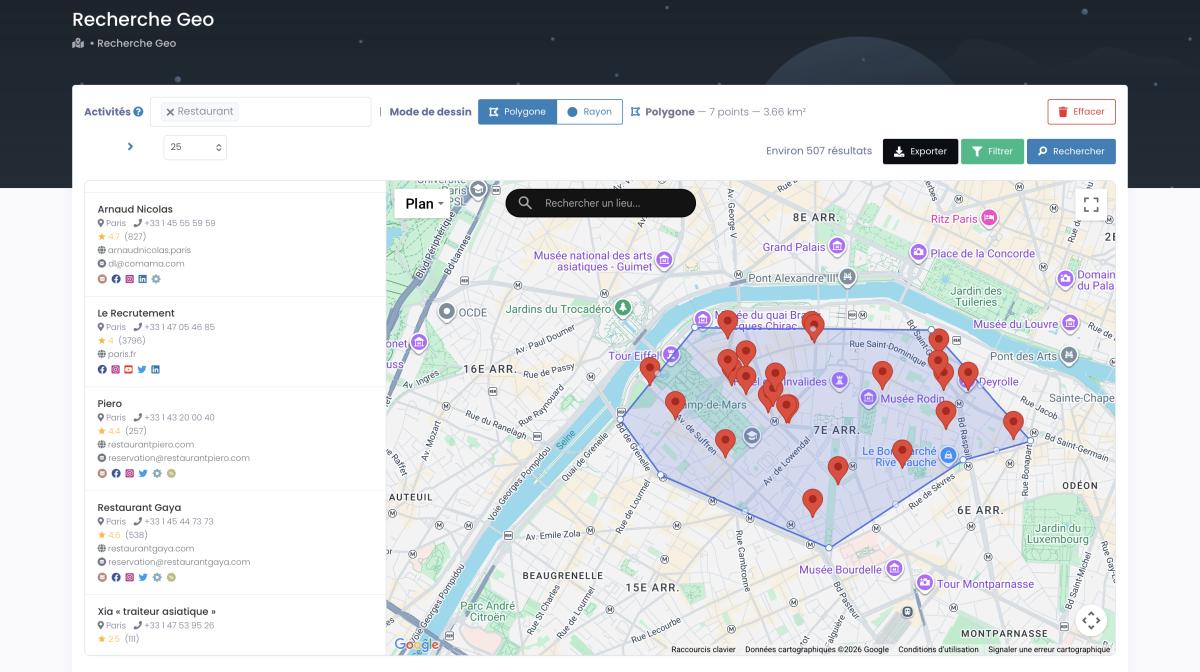
Scrap.io does two things SerpApi can't even approximate. First, radius search: drop a point on the map, set a radius, and it grabs every matching business inside the circle (up to 50 km on Professional, 100 km on Agency, 500 km on Company). Second, polygon selection: you literally draw a shape around a neighbourhood, a commercial strip, a single block, and only businesses inside it get extracted (up to 1,000,000 km² on the Company plan).
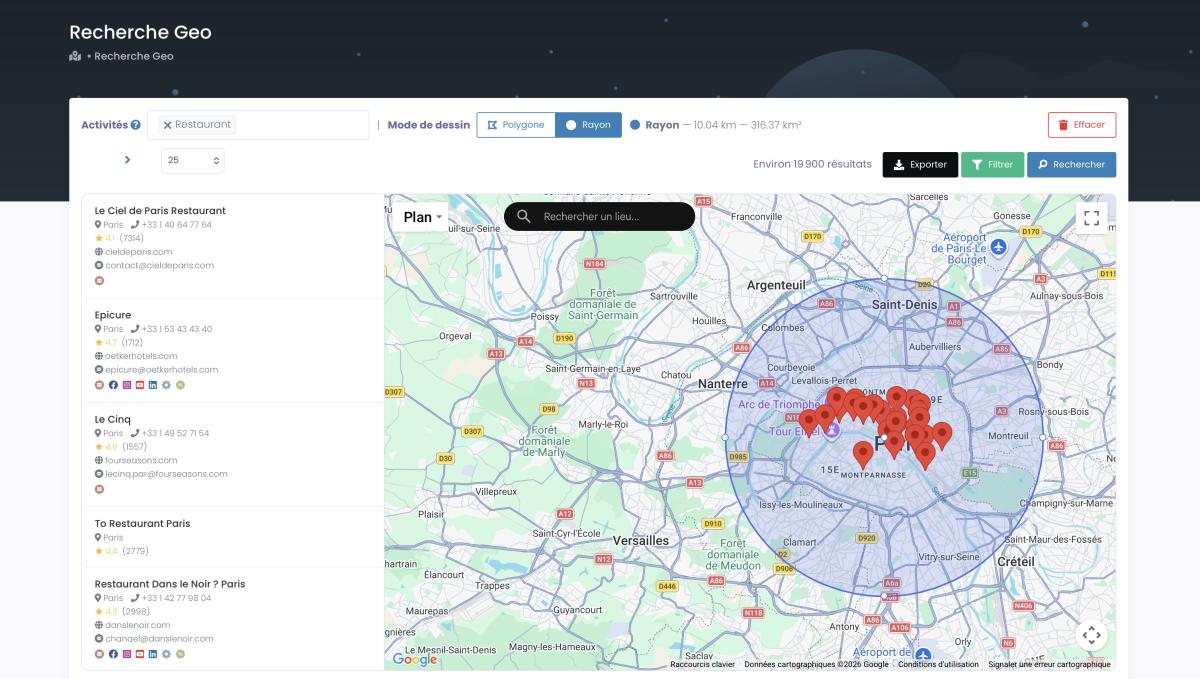
Picture a franchise owner scouting a new location. They want every competitor within 10 miles of a proposed address. With Scrap.io? Drop a pin, set the radius, search. Seconds. With SerpApi? Work out the coordinates, calculate the bounding box, code the calls, handle the pagination. There goes your afternoon.
Or a real estate agency that only works one district. Draw the polygon. Done. Or an agency prospecting downtown Austin specifically, not the suburbs. Polygon again, precise, no wasted credits on irrelevant results. SerpApi gives you raw latitude and longitude parameters and that's it. No map, no slider, no drawing tool. You code it from scratch. Our guides on scraping densely populated areas and geomarketing strategies show what proper geo-targeting unlocks.
Video: How to Scrape Local Leads at the Country Level?
When to Choose SerpApi (And When to Choose Scrap.io)
Look. I've been pretty clear about where the comparison lands for Google Maps. That doesn't make SerpApi bad. It isn't. It just depends on the job.
SerpApi makes sense when your world is bigger than Maps. If you need Google Search, Bing, Amazon listings, YouTube rankings, Scholar papers, news, SerpApi covers all of it and does it well. It makes sense if you're a developer building data infrastructure and you want an API with SOC 2 and ISO 27001 behind it. It makes sense for SEO monitoring and competitive analysis across engines. For that multi-engine work, it genuinely belongs on your shortlist.
Scrap.io makes sense when Google Maps is the thing. If you're a marketing agency building prospect lists. If you're a web shop hunting businesses without websites. If you're cold emailing and you need real addresses with your business data. If you want to extract every business in a city, or a whole country, without writing a line of code. And if you'd rather not build grid logic and deduplication yourself.
Most people searching "SerpApi alternative" in a Google Maps context need the same things: leads, emails, social profiles, geographic precision, no-code simplicity. That's Scrap.io's whole personality. Best Google Maps scraper in 2026? I think so. Don't take my word for it, try it. And if you want the full field first, here's our roundup of the 10 best Google Maps scrapers in 2026, tested and ranked.
Oh, and before I forget. There's a free, unlimited Chrome extension, "Emails and Social Networks for Google Maps", that drops emails and socials straight onto the Maps interface while you browse. Want to compare free options first? Our Chrome extensions guide covers them, and the open-source GitHub scrapers guide is worth a read before you clone anything. More of an AI-driven workflow person? See how vibe prospecting with Claude turns a sentence into a lead list.
And once you've got the leads? The AI email personalization guide and the CRM automation guide show the next step. Because scraping data is step one. Turning it into revenue is the part that pays.
FAQ: SerpApi vs Scrap.io
What is the best SerpApi alternative for Google Maps?
Scrap.io, for Google Maps lead generation specifically. It's built for exactly that: classified email extraction, social profiles, free counts, and no-code operation across 225M+ listings. SerpApi is a generalist multi-engine scraper. For this one job, the specialist wins.
Is SerpApi free?
There's a free tier: 250 searches a month, 50 per hour. Each Maps search returns roughly 20 listings, so that's about 5,000 raw listings, with no emails, no socials, nothing you'd need for outreach. Paid plans start at $25/month. For a genuinely free route to Maps leads, Scrap.io's Chrome extension shows emails and socials at no cost.
Is SerpApi safe to use in 2026?
Google's first complaint was dismissed on July 20, 2026. Google filed a narrower amended complaint on August 10, without its Google Maps theory, and SerpApi moved to dismiss again on August 25. A separate Reddit lawsuit survived dismissal and is ongoing. SerpApi includes a U.S. Legal Shield on every plan. This isn't legal advice, just the facts as they stand.
How much does SerpApi cost?
Public plans run from $25/month for 1,000 searches up to $275/month for 30,000, with custom Enterprise pricing above that. Credits reset each billing cycle rather than rolling over indefinitely.
Can SerpApi extract emails from Google Maps?
No, not natively. SerpApi returns what's on the Maps results page, and emails aren't there. To get them you'd need a separate tool that visits each business website. Scrap.io does this automatically and classifies the results: main, individual (with first and last name), contact, sales, marketing, finance and admin emails.
How many results does SerpApi return per Google Maps search?
About 20 per page, and roughly 120 reliable results per GPS point, the same ceiling Google Maps imposes on itself. Covering a whole city means building a grid of points and deduplicating the overlap. And each search is billed even when it returns nothing, per SerpApi's own FAQ.
What is the difference between SerpApi and Scrap.io?
SerpApi scrapes search results from 80+ engines. It's an API for developers. Scrap.io does maps platforms only, as a no-code platform for anyone. SerpApi hands you 15 to 20 Maps fields and no emails. Scrap.io hands you enriched records with classified emails, socials and website data. Generalist vs specialist, basically.
What's the best free SerpApi alternative?
Depends on the job. For Google Search, self-hosted options like OpenSERP or SearXNG, or the free tiers from Serper and Scrapingdog. For Google Maps leads, Scrap.io's free Chrome extension shows emails and socials right on Maps, and the 7-day trial covers up to 50 searches and 100 export credits.
Is scraping Google Maps legal?
Extracting publicly available business information from Google Maps is generally legal under US and EU law. The hiQ v. LinkedIn case established that scraping public data isn't a Computer Fraud and Abuse Act violation. Scrap.io only collects data businesses made public themselves, and stays GDPR and CCPA compliant. More in our Google Maps scraping legality guide.
Which tool is better for non-technical users?
Scrap.io, and it's not a contest. No code, no API calls, no JSON, no pagination. Pick a type, pick a location, filter, export. SerpApi assumes you can code. The docs are great, but they're for developers.
Can I target a specific area with SerpApi?
Technically yes, but only through manual GPS coordinates in your API parameters. No map, no radius tool, no polygon drawing. With Scrap.io you drop a pin and set a radius, or draw a custom polygon around any area. Big difference for local prospecting.
What data fields does SerpApi return for Google Maps?
About 15 to 20: name, address, phone, website URL, rating, review count, GPS, hours, category, and a few more. Scrap.io returns all of those plus classified emails, Facebook, Instagram, LinkedIn, YouTube, X and TikTok links, website technologies, ad pixels, contact forms and SEO metadata. The gap is wide.
That's the full picture. SerpApi is a solid multi-engine scraping API, great for developers who need data from all over the internet. But for Google Maps lead generation? The missing emails, the missing socials, the ~120-per-point ceiling, the code requirement: it all adds up. The lawsuit, for once, isn't the headline anymore.
If you want Google Maps leads that are ready to use, Scrap.io is the pick. Not because it's perfect at everything, it literally only does maps, but because for this specific job nothing else comes close. The trial includes 100 export credits, so you lose nothing by testing it.
Try Scrap.io free for 7 days. 50 searches and 100 export credits: emails, classified by role, social profiles, and website data, pulled live from a 225M+ business index across 195 countries. Pick a category and a city and it takes about 30 seconds. Card required, cancel anytime. Start here →
Generate a list of restaurant with Scrap.io