

I stopped clicking filters about three months ago. Now I just type what I want — "find me 100 dental clinics in Austin with a website but no Facebook pixel" — and the list shows up. No dropdowns. No tabs. No spreadsheet surgery at 11pm.
That's vibe prospecting. And no, I didn't invent the term.
In December 2025, almost nobody searched for it. By spring 2026 it peaked at 2,900 searches a month in the US, then settled into a steady 1,000 to 1,600 a month through the autumn (DataForSEO, September 2026). The spike cooled; the behavior stuck. The short version: AI assistants like Claude can now plug straight into live business data and build your lead lists by conversation. You talk. It works.
This guide breaks down what vibe prospecting actually is, how the MCP plumbing works under the hood, and — the part nobody else covers — how to do it for local businesses. The plumber down your street. The bakery two towns over. The ones no 800-million-contact database actually has.
Table of Contents
- What is vibe prospecting? (and why 2026)
- The old way is dead: filters, tabs, stale CSVs
- How it works: MCP + Claude, explained simply
- Vibe prospecting for LOCAL businesses (the gap nobody fills)
- Step-by-step: set up the Scrap.io MCP in Claude
- Real prompts that pull real leads
- Tools compared: Scrap.io vs Explorium vs Apollo
- Is it legal? Compliance, freshness & credits
- FAQ
1. What is vibe prospecting? (and why 2026)
In December 2025, the search volume for "vibe prospecting" was basically a rounding error. Single digits — think 10 a month. By spring 2026 it crossed 2,900 searches a month in the US, a roughly 290x jump in a single quarter. You don't see curves like that often. It's since cooled to a steadier 1,000 to 1,600 searches a month (DataForSEO, September 2026), with a keyword difficulty still sitting at just 3. The spring frenzy was a spike; what's left is a real, durable search habit.
So what is it? Vibe prospecting means finding leads by describing what you want in plain language to an AI — instead of clicking through filter menus, copy-pasting, and praying the export isn't garbage. You write a sentence. The AI does the search, the filtering, and hands back a clean list. It's the prospecting cousin of "vibe coding," where you describe an app and the model builds it.
The name caught on for a reason. It describes a real change in how the work gets done. LinkedIn is full of people calling it the next big GTM thing — Tido Carriero, former CPO at Segment, posted that "the best big new thing in GTM is vibe prospecting." When operators that senior start saying it out loud, it's not just hype noise.
One quick bit of housekeeping before we go further. This article is the hands-on, local playbook — Claude plus the MCP, pulling real Google Maps businesses. If you want the wider view first (the full definition, the corporate B2B angle, the market numbers), start with our complete guide to vibe prospecting, then come back here to actually do it.
What is vibe prospecting in Claude?
Vibe prospecting in Claude means using Claude's Connectors — its implementation of MCP — to plug a live data source into the chat, then prompting Claude to build, filter, and export lead lists for you. Connect a source like the Scrap.io MCP for Google Maps data, type what you're after, and Claude runs the actual search against real data and returns the results right there in the conversation.
No code. No API keys to juggle. Just a sentence and a connector.
2. The old way is dead: filters, tabs, stale CSVs
Open Apollo. Click job title. Click geography. Click company size. Add a few more filters. Export. Open the CSV. Realize half the rows are missing emails. Re-filter. Export again.
That workflow is dead. Or at least it should be.
Here's the thing nobody admits about filter-and-click prospecting: most of your time goes into the interface, not the prospects. You're learning where a tool hides its "exclude" toggle instead of thinking about who you actually want to reach. And the data you finally pull? Often months old. Databases get scraped once, frozen, and resold. By the time it lands in your CSV, that "marketing director" left the company in March.
We covered this exact frustration in our breakdown of why Google search operators beat ChatGPT lead generation hype — someone followed a viral "free leads with AI" tutorial step by step and ended up with 41 contacts after 25 minutes of copy-pasting. Forty-one. The promise was 300+. That's the old way wearing an AI costume.
Vibe prospecting flips the order. You start from intent — "restaurants in Miami, 3.5 to 4.2 stars, website but no ads pixel" — and the tool figures out the filters. The interface disappears. That's the whole point.
Quick reality check before we go deeper. The "old way vs new way" debate only matters if the new way actually pulls real data. So here's how the two stack up:
| Old way (filter & click) | Vibe prospecting (prompt & chat) |
|---|---|
| 🔴 You learn the interface | 🟢 You describe the outcome |
| 🔴 Manual filter stacking | 🟢 AI builds the filters |
| 🔴 Export-then-clean | 🟢 Filter before export |
| 🟡 Often stale data | 🟢 Real-time at extraction |
3. How it works: MCP + Claude, explained simply
What if your tool understood a sentence instead of a filter? That's not a metaphor anymore. It's a protocol. It's called MCP.
What is an MCP server?
An MCP server is a standardized bridge that lets an AI — Claude, ChatGPT, Gemini, whatever — call an external tool or data source directly from the chat. MCP stands for Model Context Protocol, an open standard Anthropic introduced to connect AI assistants to live systems. Think of it as a universal plug: instead of every app building a custom integration, they all speak one shared language. You can read the official MCP documentation if you want the technical deep end.
And people clearly want to understand it. Searches for "what is an mcp server" are up 410% over the past twelve months (DataForSEO, 2026), while "claude mcp" alone pulls 5,400 searches a month in the US. The Claude MCP ecosystem went from a developer curiosity to a mainstream search trend in under a year. If you're trying to work out which connectors are actually worth plugging in, we ranked the best MCP servers for lead generation — Scrap.io sits at the top for anyone doing local.
So how does the chain actually work? Three pieces:
- Claude — the chat where you type your request.
- The MCP server — the secure bridge that translates your request into a real API call.
- The data source — in our case, Scrap.io sitting on top of live Google Maps data.
You type "find 200 plumbers in Texas with an email." Claude doesn't hallucinate a list. It calls the MCP, which queries the actual database, which returns actual businesses. Claude just relays what came back. That distinction matters — and we'll come back to the "does the AI make stuff up?" worry later, because it's the first question everyone asks.
This shift is part of a much bigger wave. We wrote a whole piece on how machine learning is transforming data extraction, and MCP is the connective tissue making it all click into place. The AI isn't replacing the data tool. It's becoming the front door to it.
4. Vibe prospecting for LOCAL businesses (the gap nobody fills)
The 800-million-profile databases everyone brags about? They barely contain the plumber down your street.
That's not a knock — it's just what they are. Tools like the original Vibe Prospecting product from Explorium plug Claude into a massive B2B corporate contact graph. Great if you're selling enterprise software to VPs at companies with a LinkedIn presence. Useless if your customer is a three-chair barbershop, a family-run HVAC outfit, or a dentist who's never posted on LinkedIn in their life.
Look — those businesses live on Google Maps. Not LinkedIn. And that's the gap Scrap.io fills.
Under the hood, Scrap.io is a Google Maps scraper — but you never touch the scraping part. It indexes 225,676,406 establishments across 195 countries and 4,000+ categories (2026), pulled live from map data. Through the MCP, Claude can query all of it in plain language. You're not reaching corporate decision-makers — you're reaching the local economy. The businesses that actually pick up the phone.
This is the same engine behind our complete guide to Google Maps scraping, except now you drive it by conversation instead of dropdowns. And because Scrap.io reaches an entire country in two clicks (or one prompt), you're not capped at a city. Every restaurant in France. Every plumber in the US. The whole map.
If you've been hunting for a way to pipe enriched local data straight into your CRM, this is the front of that pipeline.
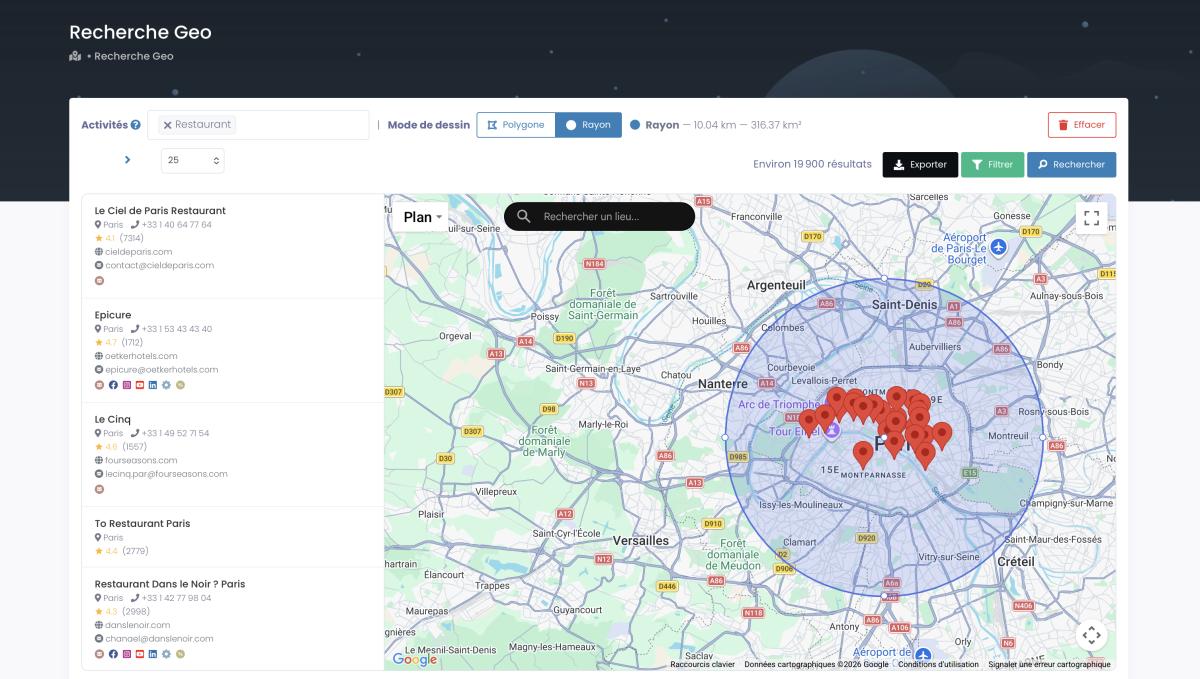
Curious how big your market is? Run a free count with the Scrap.io MCP — counts cost zero credits, every time, in the interface or straight from Claude. Ask "how many dentists are in California?" and Claude comes back with 48,480 — and 15,283 of those have both a website and an email, before you spend a single credit. Try Scrap.io free.
5. Step-by-step: set up the Scrap.io MCP in Claude
Most AI tools need a weekend to configure. This one takes two minutes.
Here's the whole thing:
- Open Claude and go to Settings → Connectors.
- Click Add custom connector.
- Paste the server URL:
scrap.io/mcp - Click Authorize and log into your Scrap.io account.
- Done. Start prompting.
That's it. No code, no command line, no API keys to copy into a config file. The MCP respects whatever plan your account is on, so the search scope (city, state, country) matches what you're paying for. For a deeper look at the connector itself — every tool it exposes, all three AI clients — see Scrap.io's MCP for Google Maps.
People are already doing this in the wild. One marketer, dr.erinjacques on Instagram, demoed pulling 100 leads in about two minutes flat using Claude Connectors. Another creator, avatarist.ai, walked through the exact connector → prompt → leads flow start to finish. This isn't theoretical. It's happening on people's phones.
If you'd rather see the no-code automation side of Scrap.io first, our guide to using an AI data scraper is a solid primer, and the Make.com automated lead generation tutorial below shows the workflow end to end.
Video: Scrap.io + Make.com — Turn Google Maps into Business Leads on Autopilot
And once the first list works, the obvious next move is to stop doing it by hand. This walkthrough shows the daily version — leads pulling, enriching, and landing in your inbox on a schedule, nobody touching a button.
Video: Daily Leads on Autopilot
Connect it now. Add scrap.io/mcp in Claude's Connectors and run your first prompt in two minutes. 225 million businesses, 195 countries, one sentence. Start your free trial — 100 leads to test it on your own market.
6. Real prompts that pull real leads
"Find me 100 dental clinics with a website but no Meta pixel." Hit enter. That's a real prompt that returns a real, segmented list. Let me show you a few more, because the magic is in how specific you can get.
Here are prompts you can copy straight into Claude once the MCP is connected:
Find 200 restaurants in Chicago rated above 4.0 with an email address.List every plumber in Texas that has a website but no Facebook page.How many beauty salons are there in the entire UK? Just the count.Pull dentists in Miami with a contact form but no Google Ads pixel, export to CSV.Give me newly listed coffee shops in Brooklyn from the last 90 days.
Notice what's happening there. You're doing natural language prospecting — describing a customer profile, not building a query. The "no Meta pixel" filter alone is gold: that's a business with a website that isn't running ads yet. If you sell ads management, that's not a lead list. That's a list of people who need exactly what you sell and aren't buying it.
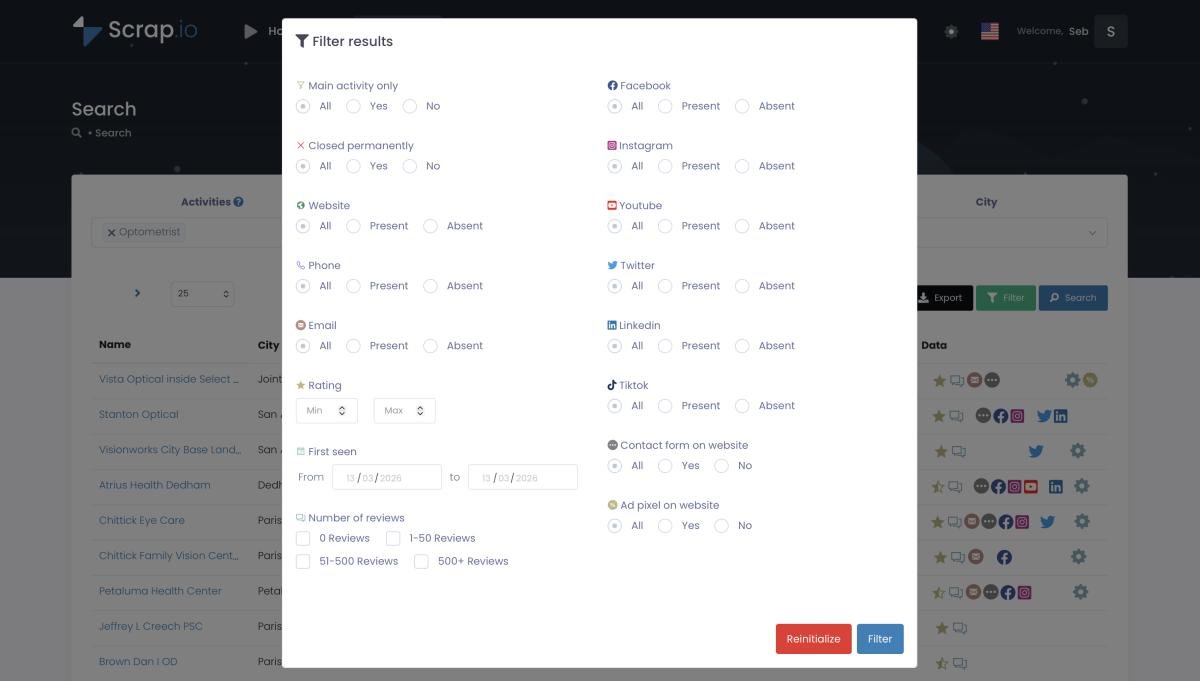
Filtering before export is the part that saves real money. Scrap.io applies your filters before a single credit gets spent, so you only pay for contacts that actually match. Want emails only? You won't burn credits on the businesses without one. We go deeper on email extraction specifically in how to find emails on Google Maps — and the video below covers picking the right email when a business has several.
Video: How to Find the Best Email to Contact a Business
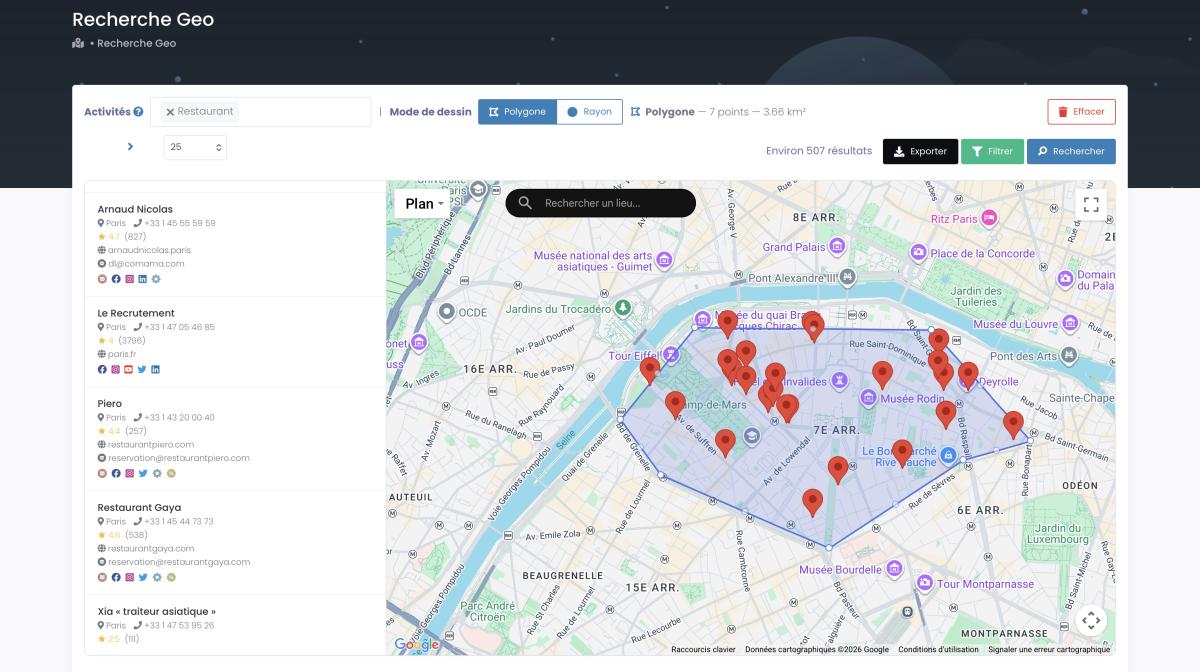
And the scale is real, not a demo. One Scrap.io customer pulled 11,734 businesses in 45 minutes (2026). Try doing that manually. I'll wait.
7. Tools compared: Scrap.io vs Explorium vs Apollo
Which one actually has YOUR market? That's the only question that matters, and the answer depends entirely on who you sell to.
OK so, all three get lumped under "ai prospecting tools," but they're solving different problems. Apollo is the classic filter-based database — huge corporate contact graph, the "old way" done well. Explorium's Vibe Prospecting (also on GitHub) brought the conversational MCP experience to that same corporate data — 800M+ B2B profiles, very slick, sitting at #1 in the SERP. Scrap.io brings vibe prospecting to local Google Maps businesses instead.
| Feature | Scrap.io | Explorium (Vibe Prospecting) | Apollo |
|---|---|---|---|
| Prompt-based (MCP) | ✅ | ✅ | ❌ (filters) |
| Data type | Local (Google Maps) | Corporate B2B | Corporate B2B |
| Reaches local SMBs | ✅ | ❌ | 🟡 limited |
| Real-time data | ✅ at extraction | 🟡 database | 🟡 database |
| Free counts (0 credits) | ✅ | ❌ | ❌ |
| Country-wide in 2 clicks | ✅ | ❌ | ❌ |
To be fair to Explorium: for corporate prospecting it's genuinely good, and its Trustpilot page sits at 39 reviews (2026) from people who like it. It's just aimed at a different buyer. If you want VPs of Engineering, go there. If you want the 4,000 independent gyms in your state, you want map data.
The community knows this distinction well. There's a long-running thread on Reddit's r/AIAgents — "Where are you guys getting high-quality leads?" — with 40-some replies arguing over exactly this, corporate databases versus live local sources. And over on r/GrowthHacking, "the one vibe marketing tool that lived up to the hype" thread keeps circling back to the same point: the tool only matters if it has the data for your niche.
For a wider lens, our roundup of the best AI sales tools of 2026 puts all of these in context next to CRM intelligence and outreach tools. And if you want the category head-to-head specifically, here's our tested list of AI prospecting tools worth testing — where Scrap.io shows up as the local layer the LinkedIn-based tools structurally miss.
See it on your own niche. Scrap.io gives you a 7-day free trial with 100 leads — enough to test a real market segment before committing. Pull your first list and compare the local coverage yourself. Try Scrap.io free for 7 days.
8. Is it legal? Compliance, freshness & credits
Yes, it's legal. Here's why — and the limits.
Scrap.io collects only publicly available business data — the same info any person could see by browsing a map listing. It's GDPR (EU) and CCPA (California) compliant, and every data point is traceable back to its source. Scraping public business data for commercial prospecting sits on solid legal ground. The honest caveat: how you use that data afterward (cold email rules, opt-outs) still falls under regulations like CAN-SPAM, and that's on you.
Now the worry everyone actually has: "doesn't AI just hallucinate this stuff?" No — and this is the key difference from asking ChatGPT to "make me a list of restaurants." Through the MCP, Claude isn't inventing businesses. It's querying Scrap.io's real database and relaying actual records. Every row traces back to a live listing. If it's in your export, it exists.
Freshness is the other quiet advantage. Scrap.io updates in real time at the moment of extraction — no frozen database, no six-month-old emails. And the credit model is built so you don't waste money: filtering happens before extraction, counts are always free, and one establishment only costs one credit on a rolling 30-day window. Re-export the same business next week? No extra charge.
9. FAQ
What is vibe prospecting?
Vibe prospecting is finding leads by describing what you want in plain language to an AI like Claude, instead of clicking through filters. Via an MCP connector, the AI runs the search against a live data source and hands you a ready-to-use lead list. You write a sentence; it does the work.
What is vibe prospecting and how does it work?
Vibe prospecting is finding leads by describing your ideal customer in plain language to an AI, which runs the search and hands back a ready list — no filters, no code. It works through three links: Claude (where you type the request), an MCP connector like Scrap.io (the bridge that turns your sentence into a real query), and the live data source (225 million+ Google Maps businesses). You talk, the connector fetches, real records come back.
What is vibe prospecting in Claude?
It means using Claude's Connectors (its MCP feature) to plug in a live data source — like the Scrap.io MCP for Google Maps — and then prompting Claude to build, filter, and export lead lists directly in the chat. No code, no API keys, just a connector and a request.
Is vibe prospecting free?
The concept itself is free — the cost depends on your data provider. With Scrap.io, counts are always free (0 credits), and you get a free trial that includes up to 50 searches and 100 export credits to test it on a real market. Paid plans start at $49/month.
Is vibe prospecting worth it?
If you prospect at any volume, yes. It collapses the find-filter-export-clean loop into one sentence, and because filtering happens before extraction, you stop paying for contacts you can't use. The honest catch: it's only as good as the data behind it — for local businesses, that means a Google Maps source like Scrap.io, not a corporate database.
Vibe prospecting vs Apollo?
Apollo is filter-based and built around corporate contacts. Vibe prospecting is prompt-based, and with Scrap.io it reaches local Google Maps businesses — restaurants, plumbers, salons, dentists — that Apollo's corporate database simply doesn't index. Different buyer, different data.
What is an MCP server?
An MCP server is a standardized bridge that lets an AI assistant (Claude, ChatGPT, Gemini) call an external tool or data source directly from the chat. Scrap.io runs one at scrap.io/mcp, so you can query 225 million+ Google Maps businesses by conversation.
Stop clicking filters. Start typing what you want. Connect the Scrap.io MCP to Claude and pull local leads from 225 million businesses across 195 countries — by conversation. Try Scrap.io free for 7 days — 100 leads on us.
Generate a list of restaurant with Scrap.io