

Last December, a logistics company documented something that stuck with me. They'd been burning 15 hours a week — every single week — patching broken scrapers. A retail site would rename a CSS class or reshuffle a product grid, and their entire monitoring pipeline would fall over. After moving to an AI-driven extraction system, that maintenance workload dropped 85%. That number comes from a GroupBWT case study published in December 2025. Not a sales deck. A documented deployment.
85%. Read that again.
The web scraping market hit $0.99 billion in 2025 and should cross $1.17 billion this year, per The Business Research Company (18.5% CAGR). And most of that growth? AI-powered tools that flat-out didn't exist three years ago. If you're still duct-taping Python scripts together every time a website rearranges its HTML — yeah, I've lived that too. There's a better way now, and this guide walks the whole thing: what an ai data scraper actually is, the seven tools worth your time, how to run one start to finish, and the legal lines you don't want to cross.
Video: AI Web Scraper vs Traditional SaaS — Which Approach Wins for Lead Generation?
Table of Contents
- What Is an AI Data Scraper? (And Why Traditional Scrapers Are Dying)
- Top 7 AI Web Scraper Tools Compared (2026)
- How to Choose the Right AI Data Scraper for Your Needs
- Step-by-Step: Using an AI Web Scraper (From Setup to Clean Data)
- Real-World AI Scraping Use Cases (With Documented Results)
- AI Data Scraping Market: Key Statistics for 2026
- Legal & Ethical Guide to AI Web Scraping
- Common AI Scraping Challenges (And How to Solve Them)
- Can Your AI Assistant Scrape Data Directly? (MCP & AI Agents)
- The Future of AI-Powered Web Scraping (2026–2030)
- FAQ — AI Data Scraper
What Is an AI Data Scraper? (And Why Traditional Scrapers Are Dying)
An ai data scraper is software that uses machine learning to pull structured data from websites without you hand-coding every CSS selector, XPath, or HTML element. That's the 40-second definition. Here's the intuition: it's the difference between teaching someone to find "the red book on the third shelf" and teaching them what a book looks like. Old scrapers memorize positions. Tools built around web scraping ai recognize patterns.
And that gap matters far more than it sounds. Somebody who's been in the trenches said it better than I can. Lohit Boruah put it on LinkedIn in May 2026: "Web scraping is quietly going through its biggest shift in years. Earlier, building scrapers meant: CSS selectors, XPath, regex, broken scripts, constant maintenance… One frontend update and everything stopped working." (source). One frontend update. Everything dead.
That's the whole problem in one sentence. Websites change layouts constantly, and a traditional scraper dies the second someone renames a div. An ai web scraper looks at the page, works out what's a price, what's a phone number, what's a review, and keeps running. No 2 AM emergency fix. No frantic Slack thread with your dev team.
Three things separate the AI approach from the old one. Self-healing: a layout change doesn't nuke your pipeline. Context awareness: "$49.99" next to a product name is a price, but the same string buried in a footer might be something else entirely. And natural-language instructions — you tell the tool "get me every 4-star restaurant in Austin" instead of wrestling regex into submission. That's ai data extraction in practice, not on a slide. If you want the textbook-grade version, IBM's research team has published extensively on how AI scraping works under the hood.
Here's the contrast, stripped down. Traditional scraper: "Go to this URL, find the element with class 'product-price', grab the text." Works until someone renames it to 'price-display' during a Friday redesign. AI scraper: "Find anything that looks like a price on this page." Still works tomorrow, next month, and after three redesigns. Our deep-dive on AI trends in web scraping covers where the whole field is heading — that piece is the forward-looking companion to this one, which is the hands-on tutorial. Short version of it? Rule-based scrapers are becoming legacy tech. Fast.
Top 7 AI Web Scraper Tools Compared (2026)
I've tested, broken, and occasionally rage-quit more scraping tools than I'd care to admit over the past eighteen months. Some genuinely impressed me. Others were repackaged Puppeteer scripts with "AI" slapped on the pricing page. Before the list, one honest take from an actual user, because it's exactly what I'm about to demonstrate — over on r/automation: "The two that I've used the most are Apify, and Browse AI. No code, free to get started, and uses ai to adapt the code when websites change." (source). No code, adapts when sites change. Hold that thought.
Here are seven ai scraping tools that earned their spot — table upfront, because you probably want to pick a tool and move on, not read 4,000 words of my opinions. (You're welcome.)
| Tool | Best For | Free Tier | Starting Price | JS Support | API | Ease of Use |
|---|---|---|---|---|---|---|
| Browse AI | No-code visual scraping | 50 scrapes | $50/mo | ✅ | ✅ | ⭐⭐⭐⭐⭐ |
| Scrap.io | Google Maps lead gen at scale | Free trial, 100 leads | $35/mo | N/A (database) | ✅ | ⭐⭐⭐⭐⭐ |
| Firecrawl | Developer API | 1,000 credits | Free tier | ✅ | ✅ | ⭐⭐⭐ |
| ScrapeGraphAI | Open-source Python | Free (open-source) | $0 | ✅ | — | ⭐⭐ |
| Thunderbit | Chrome extension quick extract | Limited free | $15/mo | ✅ | — | ⭐⭐⭐⭐ |
| Octoparse | Enterprise data pipelines | Free tier | $89/mo | ✅ | ✅ | ⭐⭐⭐⭐ |
| Kadoa | Natural language queries | Demo | Custom | ✅ | ✅ | ⭐⭐⭐⭐ |
Browse AI — Best for No-Code Visual Scraping
You train a robot by clicking on stuff. Seriously. Point at a product title, click it. Point at the price. The star rating. Browse AI watches what you do, learns the pattern, then replicates it across hundreds of similar pages. No code, no selectors, no XPath. Fifty free scrapes to start, then monitored jobs that keep running even when your laptop's shut.
I ran it for a week tracking prices on about 180 competitor product pages. Beautiful for that. Where it falls apart: scale. Credits evaporate once you're pulling tens of thousands of records, and the per-credit cost climbs to where the math stops making sense. Fine for a few hundred pages weekly. Painful if you need to scrape a whole industry vertical. If it's not clicking for you, plenty of people go hunting for a browse ai alternative the moment volume spikes — that's usually the tell.
Scrap.io — Best for Google Maps Lead Generation at Scale
Scrap.io works differently from everything else here. It's not a scraper — it's a live database. 225,676,406 businesses across 195 countries and 4,000+ categories, pulled from Google Maps and refreshed at the moment you export. You search, you filter, you export. Done.
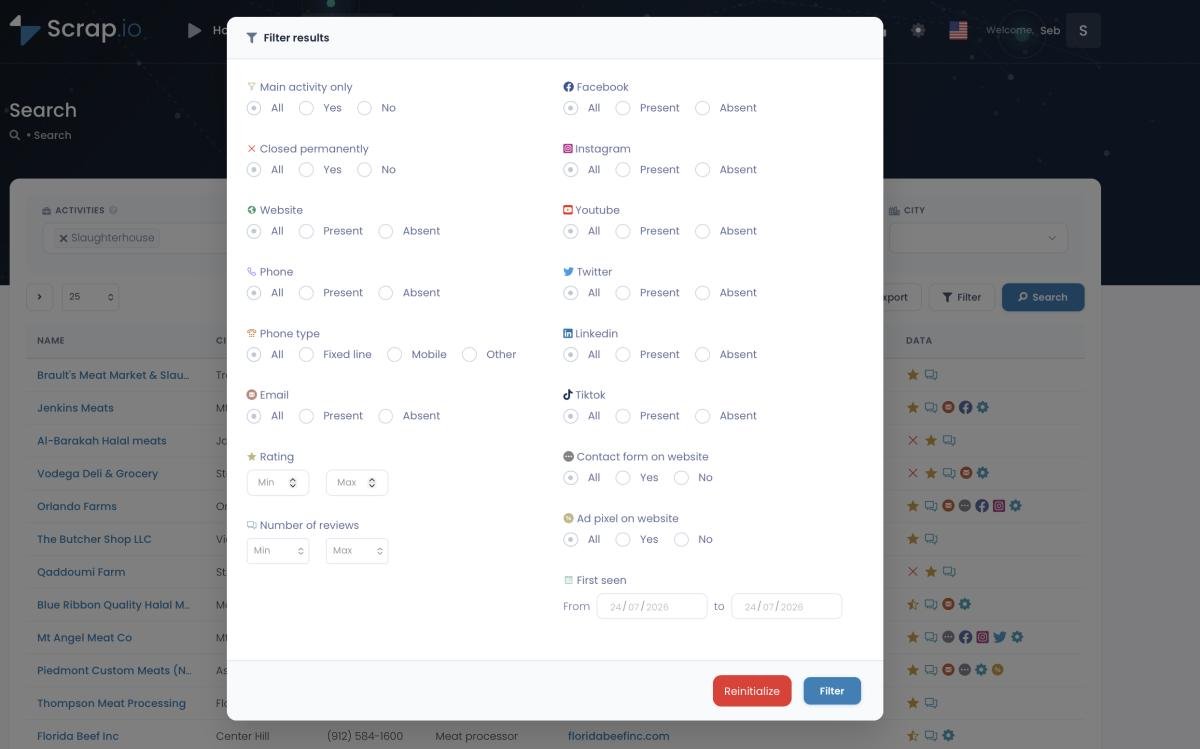
No proxies to configure. No anti-bot battles. No babysitting a spider at 3 AM. Data includes emails (classified by type — individual, contact, sales, marketing), phones, social profiles, Google ratings, website technologies, and 70+ other fields. I've written detailed head-to-heads against OutScraper, Bright Data, and Serper.dev if you want specifics — and a broader shootout in our roundup of the 10 best Google Maps scrapers, tested.
Two things genuinely set it apart. First, you filter before you spend a single credit — email present, mobile only, minimum rating, whatever — so you never pay for junk you'll delete later. Second, real-time data: every export is pulled fresh from the listing and the associated website, never a frozen database from six months ago. One more thing worth flagging, because nobody else on this list has it: Scrap.io now exposes an official MCP connector for Google Maps data, so Claude, ChatGPT or Gemini can query the database in plain English. More on that below. Am I biased? Sure, a little. But the data fields and the pricing hold up against every competitor I've tested.
Firecrawl — Best Developer-Focused API
Send a URL, get back clean markdown or JSON. Firecrawl handles JS rendering, dynamic content, pagination — the annoying stuff. Built for devs piping web data into AI workflows: RAG pipelines, model training, LLM-ready datasets. It's genuinely good, and it's the tool the Google AI Overview keeps citing for this query (their own Top 7 roundup is worth a skim). Not for non-coders, though. Not even a little.
ScrapeGraphAI — Best Open-Source Python Solution
Free. Open-source. Python-native. Uses LLMs to understand pages from natural-language prompts — "extract all product names and prices" and it builds the extraction logic on the fly. That's ai web scraping python the way it should work, and one of the few genuinely capable ai web scraper open source projects going. You need Python chops and either API credits or a local model. No vendor lock-in, though.
Thunderbit — Best Chrome Extension for Quick Extraction
The thunderbit ai web scraper is an ai web scraper chrome extension that auto-detects tabular data on whatever page you're looking at. Install, click, export. The Chrome Extensions Guide covers where browser tools fit in a bigger workflow. Solid for one-off jobs. Terrible past a few hundred records.
Octoparse — Best for Enterprise Data Pipelines
Scheduled scraping, cloud execution, team accounts, built-in IP rotation. Starts at $89/month and climbs from there. For a 50-person marketing team running daily competitive intelligence across thousands of pages, it carries the load.
Kadoa — Best for Natural Language Data Queries
Describe what you want in plain English. Kadoa's ai data extraction approach figures out the rest. Still early-stage — not production-ready at massive scale yet. But compelling for teams experimenting with AI-first data workflows.
How to Choose the Right AI Data Scraper for Your Needs
Essential Features to Look For
Pattern recognition is the one that matters most. If you're manually mapping every field, you're using a traditional scraper wearing an AI costume. The Data Miner alternatives guide lays out why auto-detection is non-negotiable.
JS rendering: table stakes. Anti-detection: also table stakes — 81% of US retailers now scrape competitor prices, up from 34% in 2020 (Mordor Intelligence), and sites fight bots aggressively. Data quality: the actual hard part, and the one everyone underestimates.
Pricing Models Breakdown (Free vs Subscription vs API)
Browse AI charges per credit — fine for small monitoring jobs, dangerous at volume. I've watched someone start with "I'll just scrape 50 pages" and end up staring at a $400 monthly bill six weeks later when the project scaled. Scrap.io runs flat monthly subscriptions — $35 to $350/mo on annual billing, $49 to $499 without commitment (10,000 to 100,000 credits a month) — which makes budgeting boringly predictable; the Leads Sniper comparison breaks down why flat-rate wins for lead gen. Firecrawl bills per API request, which gives developers granular control and confuses marketing teams who just want a number. And free tiers? Every tool has one. They're calibrated to let you kick the tires and nothing more. Don't build a strategy on one.
Technical Requirements Quick Assessment
Can't code? Browse AI or Scrap.io. Python person? ScrapeGraphAI. API-first? Firecrawl. Somewhere in between? Thunderbit or Octoparse. Pick the tool that matches your volume and your skills — not the one with the slickest landing page. Simple, right? In theory, yes. In practice, people pick the logo they saw on Twitter. Don't be that person.
Step-by-Step: Using an AI Web Scraper (From Setup to Clean Data)
Step 1 — Define Exactly What Data You Need
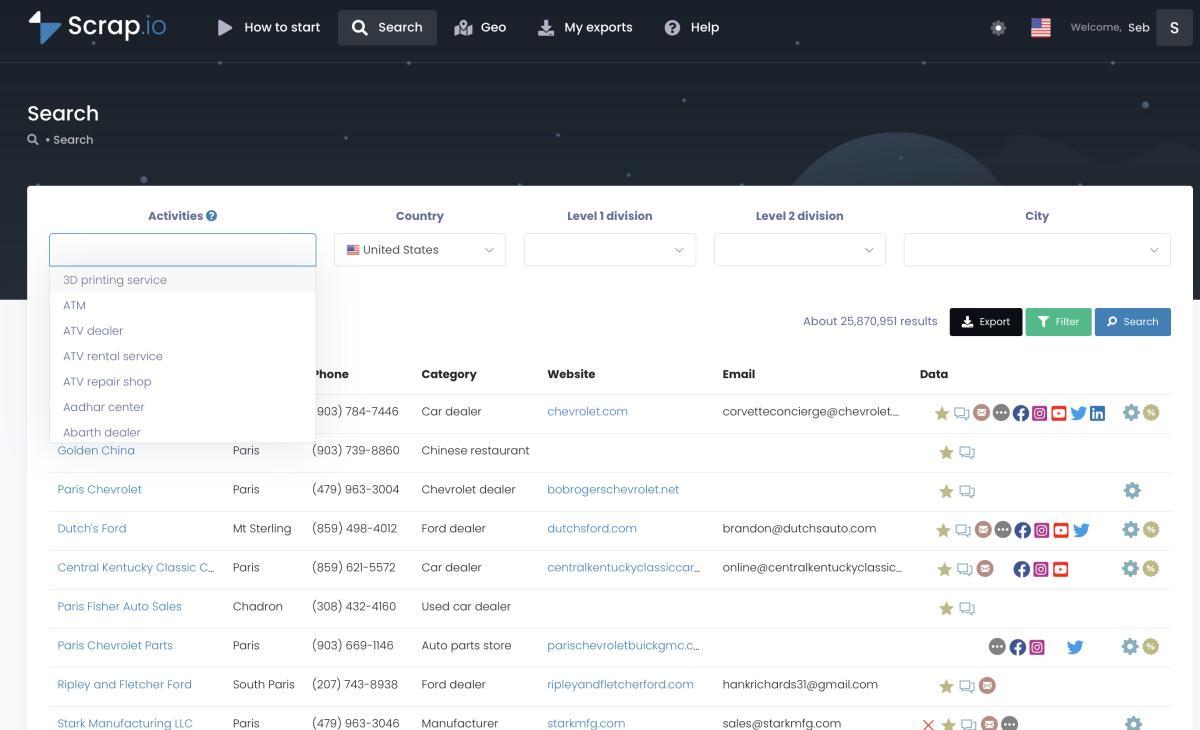
"I need data." No. "Phone numbers, emails, and Google ratings for dentists in Miami with fewer than 20 reviews." Yes. Specificity upfront saves hours of sorting garbage later. And here's where a live database earns its keep: pulled on August 7, 2026, Miami has 1,620 dentists on Google Maps — but only 530 of them (32.7%) have a reachable email address on their site (Scrap.io). A generic AI scraper can read a page. It can't tell you that number before you've spent a credit finding out. Scrap.io does, because it filters before extraction. You can slice by any of 4,000+ Google Maps categories the same way. The scraper-without-Python guide hammers this point too.
Step 2 — Choose Your Extraction Method (Click, Code, or API)
Visual tools for non-coders. APIs for programmatic access. Roll-your-own for full control. Don't overthink it — pick based on your technical level and scale needs. If you go the managed route, the Scrap.io getting-started documentation walks you through your first search in a couple of minutes. And honestly, watching it beats reading it:
Video: Scrap.io - How to Start?
Step 3 — Configure and Test on a Small Sample
I learned this the hard way once. Ran a scraper on 50,000 records before checking the output. Half the "phone numbers" were fax lines that hadn't worked since 2014. Start with 10. Eyeball them. Real, or garbage? The complete Google Maps scraping guide walks through validation properly.
Step 4 — Handle Dynamic Content & Anti-Bot Measures
CAPTCHAs, rate limiting, JS obfuscation, fingerprinting — sites throw everything at scrapers. And honestly? I don't blame them. When a chunk of your traffic is bots, you'd fight back too. Your ai data scraper has to handle all of this automatically: rotate proxies on every request, throttle speed to mimic human browsing, randomize fingerprints. The JavaScript API extraction guide covers the technical weeds. Or — and yes, I'm aware this reads like a pitch — use a managed platform like Scrap.io where proxy rotation and anti-detection are somebody else's headache entirely.
Step 5 — Validate, Clean, and Export Your Data
Check format inconsistencies. "(555) 123-4567" vs "5551234567." Duplicates. Emails ending in ".con" instead of ".com." The Make.com tutorial shows how to automate cleanup so you're not doing it by hand every time.
Scrap.io lets you skip most of these steps. Search, filter, export Google Maps data — two clicks, across 225,676,406 businesses in 195 countries, no proxies and no code. Free trial, 100 leads included.
Real-World AI Scraping Use Cases (With Documented Results)
E-commerce Price Intelligence
Retailers run daily checks across thousands of SKUs, and the AI layer catches what regex never could: coupon offsets, membership discounts, shipping thresholds. "Was $449, now $399 with code SAVE50" isn't parseable with a selector. AI reads the context.
The scale of this is the real story. 81% of US retailers now use automated scraping for dynamic pricing, up from 34% in 2020 (Mordor Intelligence). That jump happened in roughly four years. If you're not in that 81%, your competitors are making pricing calls with data you literally can't see.
B2B Lead Generation — From Google Maps to CRM in Minutes
A YouTube-focused outreach agency was pulling business contacts from Google Maps by hand to pitch video production. Their process looked like what most lead gen teams still do — search Maps, click each listing, copy the phone, hunt for an email on the website, paste it into a spreadsheet. Roughly 50 outreach emails a week, which sounds fine until you clock that it was eating 40+ hours of a real human's time.
After switching to a Google Maps scraper with built-in email extraction, they hit 400 emails a week. Same team. No new hires. The bottleneck was never writing the emails — it was finding the contacts (source: Apify Blog). That's the entire game, and it's exactly what a lead scraper is built to fix. Combine it with AI-powered cold email personalization and pair it with a CRM automation pipeline, and the conversion math gets interesting fast.
Want similar results? There are 344,353 dentists indexed across the United States in Scrap.io's Google Maps database right now — and 100 free leads to start. A real number beats a promise every time. 225M+ businesses, 195 countries, no coding.
Market Research & Competitive Intelligence
Here's what surprised me most about how far this has come. Five years ago, competitive intelligence at any real depth meant a dedicated analyst, expensive data subscriptions, and weeks of manual grind. Now a small agency can pull the same insight in an afternoon. Take that Miami dentist example again: 1,620 businesses, 530 reachable, sized in seconds before spending a cent (Scrap.io, August 2026). That's a whole market mapped over a coffee. The phone number scraping tutorial shows how the AI layer normalizes format chaos — "(555) 123-4567" vs "555.123.4567" vs "+1-555-123-4567" — without a single per-format regex rule.
Content Monitoring & News Aggregation
News and media-monitoring companies scrape hundreds of sources daily. The AI layer does more than collect — it deduplicates across sources (the same AP story syndicated to 47 outlets doesn't need 47 entries), flags which publication broke a story first, and surfaces emerging topics before they trend. Same principle as normalizing phone formats, applied to headlines instead of digits.
AI Data Scraping Market: Key Statistics for 2026
The web scraping market: $0.99B in 2025, projected $1.17B in 2026 at 18.5% CAGR (Business Research Company). On track for $2.28B by 2030.
AI-specific scraping is growing even faster — Research and Markets pegs $3.15B in added market value from 2024–2029, at a 39.4% CAGR. Almost quadruple the pace of traditional scraping. Other numbers worth knowing: AI scrapers now hit 99.5% accuracy on JS-heavy sites (Scrapingdog, 2026), and 62% of the industry has gone no-code (Actowiz Solutions, 2026). North America holds 34.5% of the global market; cloud runs 68% of infrastructure.
For a sense of scale on the data side, one live database gives you the yardstick: Scrap.io alone indexes 225,676,406 establishments across 195 countries and 4,000+ categories (Scrap.io, 2026). This isn't niche anymore. It's infrastructure.
Legal & Ethical Guide to AI Web Scraping
Is AI Web Scraping Legal? (US, EU, and Global Perspective)
Scraping publicly available data is legal in the US and the EU. hiQ Labs v. LinkedIn (2022) confirmed that public web data doesn't violate the CFAA, and the EU stance under GDPR is broadly comparable. But "legal" and "anything goes" aren't the same thing. Is it allowed to scrape Google Maps? covers the nuance.
GDPR, CCPA, and the EU AI Act: What Scrapers Need to Know
EU residents? GDPR applies. Legitimate interest works for B2B with public business data — not for harvesting personal emails off private profiles. CCPA adds California protections. And the EU AI Act, in full enforcement from August 2026, introduces transparency requirements for AI that processes personal data. Worth knowing: grounding an assistant in public business data is a completely different animal from training a model on copyrighted content. Don't let the headlines blur the two.
Scrap.io only touches publicly available business information — the stuff companies voluntarily put on their Google Maps profile and their website. No personal data, no private profiles, no scraping behind login walls. A deliberate architectural choice, not an afterthought.
Respecting robots.txt and Terms of Service
Decent scrapers check robots.txt. Good ones read the Terms of Service too. Some sites ban automated access outright — ignoring that creates legal exposure even when the data is public. Your AI data scraper won't read the ToS for you. That part's on you.
Common AI Scraping Challenges (And How to Solve Them)
CAPTCHAs and Bot Detection
AI web scrapers crack CAPTCHAs at 99.5% accuracy now (Scrapingdog, 2026). But smarter than solving them? Not triggering them. Randomize timing. Rotate proxies. Vary fingerprints. Detection systems flag clockwork patterns, and humans don't browse in perfectly regular intervals.
Scaling from 100 to 100,000 Records
Going from a 10-record test to a 100,000-record production run isn't "click start and wait longer." You need request queuing, error handling with automatic retries, per-domain rate limiting, IP rotation, storage infrastructure, and monitoring to catch the thing that breaks at 3 AM on a Saturday. Building all that yourself costs real engineering weeks — months if you want it reliable.
Or you use a managed platform. Scrap.io handles 10,000 queries per minute without you provisioning a single server. For most companies, building custom scraping infrastructure is like building your own email server. You can. But at this point — why would you?
Data Quality and Validation
Nobody talks about this enough: getting data is the easy part. Getting clean data is the actual job. "Call now!" is not a business description, but I've seen scrapers file it as one. An 8-digit phone number isn't valid. An email ending in ".ocm" is a typo somebody made on their own Google Maps listing, not a real domain. AI handles the initial structuring well — telling a phone number apart from a zip code — but you still need format verification, deduplication, and freshness checks baked into the pipeline.
And this is exactly where filtering before extraction pays off. Take Miami again: instead of pulling all 1,620 dentists and deleting two-thirds by hand, you filter for "has email" first and export the 530 that are actually reachable (Scrap.io, August 2026). You pay for 530, not 1,620. One of our clients skipped that step once and blew their sender reputation in a single afternoon — 5,000 emails from an unvalidated scrape, 30% bounced, Gmail flagged the domain, three weeks to recover. Don't skip validation. Ever.
Can Your AI Assistant Scrape Data Directly? (MCP & AI Agents)
What if you didn't use a scraper at all — and just asked Claude?
That's not a hypothetical anymore. The Model Context Protocol (MCP) is an open standard that lets an AI assistant connect straight to a live data source instead of guessing. Think USB-C for AI: one port, and suddenly your assistant can query real data in plain English. Scrap.io runs an official MCP server for Google Maps data at scrap.io/mcp, compatible with Claude, ChatGPT, Gemini, and any MCP-compatible client. It's included in every plan — nothing extra to buy.
Here's why this matters for a KW like "ai data scraper." An MCP connector is, quite literally, an AI data scraper you drive with a sentence. You type "find every HVAC contractor in Texas with an email and a 4+ rating" and your assistant builds the query, applies the filters before any credit is spent, and hands back a clean list. Counts stay free, even through the MCP. No proxies, no export step if you don't want one — the results can land straight in the chat, on a map, or in a report. If you want the full picture on feeding web data to AI agents, we went deep on it there.
Video: How to Scrape Local Leads with Claude & Vibe Prospecting?
None of the top five results on this search — Gumloop, Browse AI, Firecrawl, Reddit, IBM — treat MCP as an extraction layer. It's the blind spot of the whole SERP. And it's the most concrete answer there is to "can my AI just fetch the data itself." Turns out: yes. If it speaks MCP, it can.
The Future of AI-Powered Web Scraping (2026–2030)
$2.28B by 2030 (Business Research Company). Four drivers push it there.
Agentic scrapers. Tools that decide what to extract, when, and handle edge cases on their own. Early versions already exist. Standard within two years.
No-code everywhere. 62% adoption already (Actowiz, 2026). Your marketing coordinator will be building data pipelines before 2027, and the demand for a slick ai powered web scraper — a search term up 271% over the last twelve months — is the leading indicator.
Compliance built in, not bolted on. The EU AI Act, tightening GDPR enforcement, and a growing list of US state privacy laws (California, Virginia, Colorado, Connecticut — it grows every quarter) mean the tools that bake compliance into their architecture from day one win share. The "scrape everything, figure out the legal stuff later" era is closing. Fast.
LLM integration. Scrapers feeding directly into language models for analysis and decisions. And this one isn't a projection — it's shipping. The Scrap.io MCP connector already does exactly this: your assistant queries 225M+ businesses in real time, no code. Firecrawl does the general-web version. Everyone else follows.
FAQ — AI Data Scraper
What is the best AI web scraper for beginners in 2026?
Browse AI for general visual scraping (50 free scrapes, zero code). Scrap.io for Google Maps business data (even simpler — nothing to configure, just search and export). Both get a non-coder productive by Friday.
Are AI web scrapers better than traditional scrapers?
For most real-world use cases in 2026, yes. They adapt when sites change layouts, handle JavaScript-rendered content without extra config, and take natural-language instructions instead of hand-coded selectors. Documented maintenance reduction runs up to 85% versus rule-based tools. Traditional scrapers still win in one spot: when a developer needs absolute control over a highly custom pipeline. Increasingly niche territory, though.
How much does an AI data scraper cost?
ScrapeGraphAI: $0. Thunderbit: $15/mo. Scrap.io: from $35/mo on annual billing. Browse AI: $50/mo. Octoparse: from $89/mo. Most businesses land in the $35–$100/month range.
Is there a free AI data scraper on GitHub?
Yes — several genuinely capable ones. The ai data scraper github options worth knowing:
- ScrapeGraphAI — Python + LLM, builds extraction logic from a prompt.
- Crawl4AI — LLM-friendly crawler that outputs clean markdown.
- Firecrawl — open-source core, converts pages to LLM-ready data.
All free and open source. The catch is the same across every one: you manage proxies, maintenance, and (usually) email parsing yourself. Free tools, paid in time.
Can I use an AI data scraper as a Chrome extension?
Yes. An ai web scraper chrome extension like Thunderbit auto-detects tabular data on the page you're viewing — install, click, export. Scrap.io also offers a free Chrome extension that surfaces emails and social profiles directly on the Google Maps interface. Extensions are perfect for one-off, small-volume jobs and hit a hard ceiling past a few hundred records. For bulk or country-scale work, you want a cloud platform, not a browser add-on.
Can AI scrapers handle CAPTCHAs?
99.5% accuracy (Scrapingdog, 2026). But avoiding the trigger beats solving the puzzle. Rotate IPs, randomize delays, vary fingerprints.
Is web scraping with AI legal?
Public data: legal in the US and EU. Respect robots.txt, follow GDPR/CCPA for personal data, and check the Terms of Service. Public business data from Maps and directories sits on generally solid ground.
What data can an AI web scraper extract from Google Maps?
With Scrap.io: name, address, phone (with landline/mobile type), email (classified — individual, contact, sales, marketing), website, rating, reviews, social profiles (Facebook, Instagram, LinkedIn, YouTube, X), website CMS and tech stack, business hours, and 70+ additional fields.
How accurate are AI-powered web scrapers in 2026?
Best-in-class: 99.5% on JS-heavy sites (Scrapingdog, 2026). Google Maps data runs even higher because the format is standardized. Always validate a sample first. Always.
What is the best free AI web scraping tool?
ScrapeGraphAI is the most capable free option — fully open-source, Python-native, genuinely powerful if you're comfortable running LLM inference. Browse AI's 50-scrape free tier works for quick evaluations. Scrap.io's Chrome extension shows emails and socials on Maps for free. But every free tool hits a hard volume ceiling. If you regularly need more than a few hundred records a session, budgeting $35–100/month for a paid tool saves you more time than it costs.
What's the difference between AI scraping and traditional web scraping?
Traditional: you define every selector by hand, and the scraper breaks when the site changes. AI: it recognizes patterns, adapts to changes, and understands context. Documented maintenance reduction: up to 85%.
Can I use an AI data scraper without coding?
Yes. Browse AI, Scrap.io, Thunderbit, Octoparse, Kadoa — all no-code. 62% of the industry has already gone that way. And with an MCP connector, you can now drive extraction from Claude or ChatGPT in plain English, which is about as no-code as it gets.
Try Scrap.io free for 7 days — 100 verified business leads from Google Maps, no coding needed. Search, filter, export across 225,676,406 businesses in 195 countries, or plug the MCP straight into your AI. Free trial, 100 leads included. Start now.
Generate a list of restaurant with Scrap.io