

25,000% increase in scraping volume. Hundreds of millions of bot requests hitting Google every single day. And then — boom — a federal lawsuit.
That's SerpApi's 2025 in a nutshell. And if you've been using their Google Maps API endpoint to pull business data, you're probably sitting there right now thinking "okay so... what do I do?" I get it. A buddy of mine runs a small lead gen agency in Texas. He woke up one morning in December, saw the Google lawsuit headline, and immediately started looking for a SerpApi alternative. Like, that same hour.
Thing is, most "alternative" articles out there are just generic listicles. Ten tools, zero depth. Nobody actually compares the data fields. Nobody shows you the pricing math. Nobody mentions the lawsuit in the context of Google Maps specifically.
So that's what we're doing here. SerpApi vs Scrap.io. Everything. Pricing, data, legal stuff, features. No fluff. Let's go.
Video: Google Maps API versus Scraping — What's the best approach?
📋 What's in This Guide
- What Happened: Google's Lawsuit Against SerpApi
- What Is SerpApi? A Quick Overview
- SerpApi for Google Maps: What You Actually Get
- Scrap.io: Built Specifically for Google Maps Lead Generation
- SerpApi vs Scrap.io: Head-to-Head Comparison
- Pricing Comparison: SerpApi vs Scrap.io in 2026
- The Legal Question: Is SerpApi Safe to Use in 2026?
- Geo-Targeting: Radius & Polygon Selection
- When to Choose SerpApi (And When to Choose Scrap.io)
- FAQ — SerpApi vs Scrap.io
What Happened: Google's Lawsuit Against SerpApi (December 2025)
Okay so here's the backstory. December 19, 2025. Google drops a DMCA lawsuit on SerpApi. Federal court, Northern District of California. Not a cease-and-desist letter. Not a slap on the wrist. An actual lawsuit. In their official blog post, Google called the scraping "brazen" and "unlawful." Pretty strong words coming from the company that literally built its empire by crawling other people's websites, but I digress.
The numbers in the filing are wild. Google claims SerpApi was sending hundreds of millions of automated requests every single day. And get this — the volume apparently increased by 25,000% over just two years. Twenty-five thousand percent. Google called SerpApi's entire business model "parasitic," saying they were reselling content that Google licenses from third parties. We're talking images in Knowledge Panels, product data from Shopping, location stuff from Maps. Search Engine Journal noted this was one of the first major DMCA cases targeting SERP scraping specifically.
Oh and it gets worse. Two months earlier, in October 2025, Reddit also sued SerpApi. Along with Perplexity AI, Oxylabs, and AWMProxy. Reddit claimed they were scraping Reddit content through Google Search results while hiding who they were. Reddit even said they set a "trap" post that was only visible to Google's crawler — and it later showed up in Perplexity's results. That's... creative detective work, I'll give them that.
SerpApi pushed back. February 2026 — they filed a motion to dismiss the whole thing. Their CEO wrote that "Google thinks it owns the internet" and that nobody owns the internet. According to PPC Land's coverage and The Register, the case is docketed as Google LLC v. SerpApi, LLC — case no. 4:25-cv-10826-YGR, before Judge Yvonne Gonzalez Rogers. The motion-to-dismiss hearing was set for May 19, 2026.
Here's the thing: that date has already come and gone. As of this writing (mid-2026), the court hasn't issued a ruling. The motion is fully briefed, the matter's with the judge, and there's no decision on the record yet. Translation? Still pending. Still unresolved.
I'm not a lawyer. I don't know who wins this. But if you're running a business that depends on Google Maps data? You probably don't want your main data source stuck in the middle of a federal lawsuit with the company that owns the data. Just saying.
What Is SerpApi? A Quick Overview
SerpApi has been around since 2016. Based in Austin, Texas, 42-person team. They built an API that scrapes search engine results pages — not just Google, but Bing, Yahoo, Baidu, DuckDuckGo, and like 10 others. Fifteen plus search engines total. The company pulls in a few million dollars a year in revenue according to the court filings.
How does it work? Pretty straightforward actually. You send an API call, SerpApi goes and fetches the search results page, parses all that messy HTML, and hands you back clean JSON. Developers love it for that reason — the documentation is solid, the response format is predictable. On SoftwareAdvice and G2, people consistently rave about the customer support. "Exceptional," one reviewer wrote. Can't argue with that.
But — and this is a big but — it's developer-only. No visual interface. No dashboard where you click buttons. You need to know how to code. You need to understand API calls, JSON parsing, pagination. My grandmother is not using SerpApi. My neighbor probably isn't either.
The other thing? It's a generalist. SerpApi does Google, Bing, Amazon, YouTube, Walmart, eBay, Scholar... basically everything with a search bar. That's great if you need multi-engine data. It's not great if what you specifically need is Google Maps lead generation. Different tool for a different job.
SerpApi for Google Maps: What You Actually Get
Video: Using the Google Maps API and Google Reviews
Okay, SerpApi does have a "Google Maps API" endpoint. I've seen people get excited about this and then... not so excited once they actually use it.
Here's why. SerpApi scrapes Google Maps results the same way it scrapes everything else — from the search results page. It parses what shows up in the browser. It doesn't go deeper. It doesn't visit the businesses' actual websites. It doesn't enrich anything. It just reads the SERP and gives you back what Google already showed you.
So what do you actually get? Name, address, phone, rating, review count, GPS coordinates, hours, website URL. Around 15 to 20 fields. That's it.
You know what you don't get?
Emails. Zero email extraction. If you want to actually contact these businesses — which, let's be real, is the whole point of scraping Google Maps for most people — you need a completely separate tool just for emails. That's extra cost, extra setup, extra headaches.
Social media links? Nope. No Facebook, no Instagram, no LinkedIn, no YouTube, no Twitter. Website technology detection? Also no. You won't know if they're running Google Ads, using Shopify, or have a contact form on their site.
And then there's the scalability problem. Each SerpApi search returns about 20 results. One page. Want 10,000 business listings from Google Maps? You're writing code to loop through 500+ API calls. One at a time. Handling pagination. Handling failures. Handling rate limits. It's doable if you're a developer with time on your hands. It's a nightmare if you're not. For all the ways you can approach this, we put together a complete Google Maps scraping guide that covers every method — and if you specifically want the programmatic route, our Google Maps Scraper API guide breaks down the endpoints tool by tool.
Scrap.io: Built Specifically for Google Maps Lead Generation
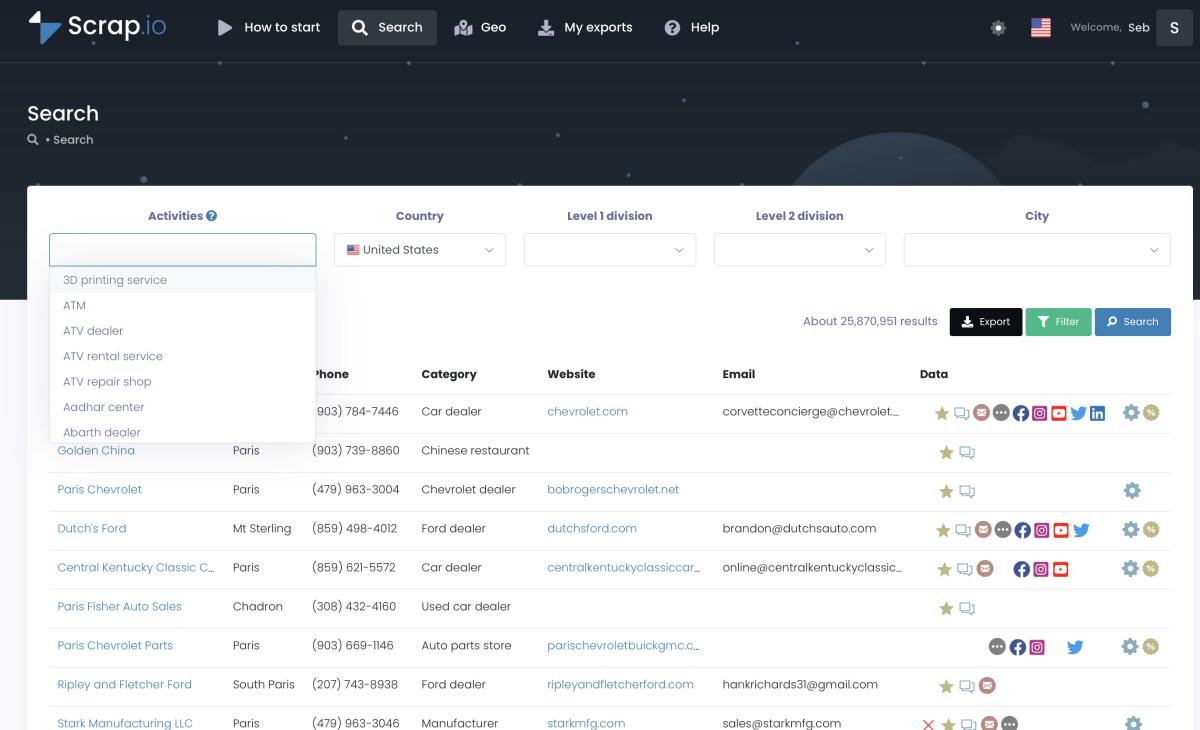
Scrap.io is... different. Like fundamentally different. It doesn't try to scrape fifteen search engines. It does one thing: Google Maps. That's it. And it does that one thing stupidly well.
225 million establishments indexed — 225,676,406 as of July 2026, to be exact. 4,000+ categories. 195 countries. And the part that actually matters to most people reading this: you don't need to write any code. None. You pick a category — restaurants, plumbers, law firms, whatever. You pick a location — could be a city, a county, a state, or an entire country. You click search. You click export. Done.
Two clicks. My 90-year-old grandmother could probably do it. (I keep saying that but it's true.)
Now here's where it gets really good. The data. Scrap.io doesn't just read the Google Maps listing. It goes to each business's website and scrapes additional information from there. That means you get 70+ data columns per business. Emails — up to 5 per listing. Facebook, Instagram, LinkedIn, YouTube, Twitter links. Website technologies. Ad pixels. Contact form detection. SEO meta data. The works.
By the way — the filtering system is what really sold me. You filter BEFORE you export. So you're not wasting credits on junk. Only want businesses with an email address? Filter for it. Only want places with a rating below 3 stars and no Instagram? Weird flex but sure, you can do that too. Only operational businesses with a website? Two clicks.
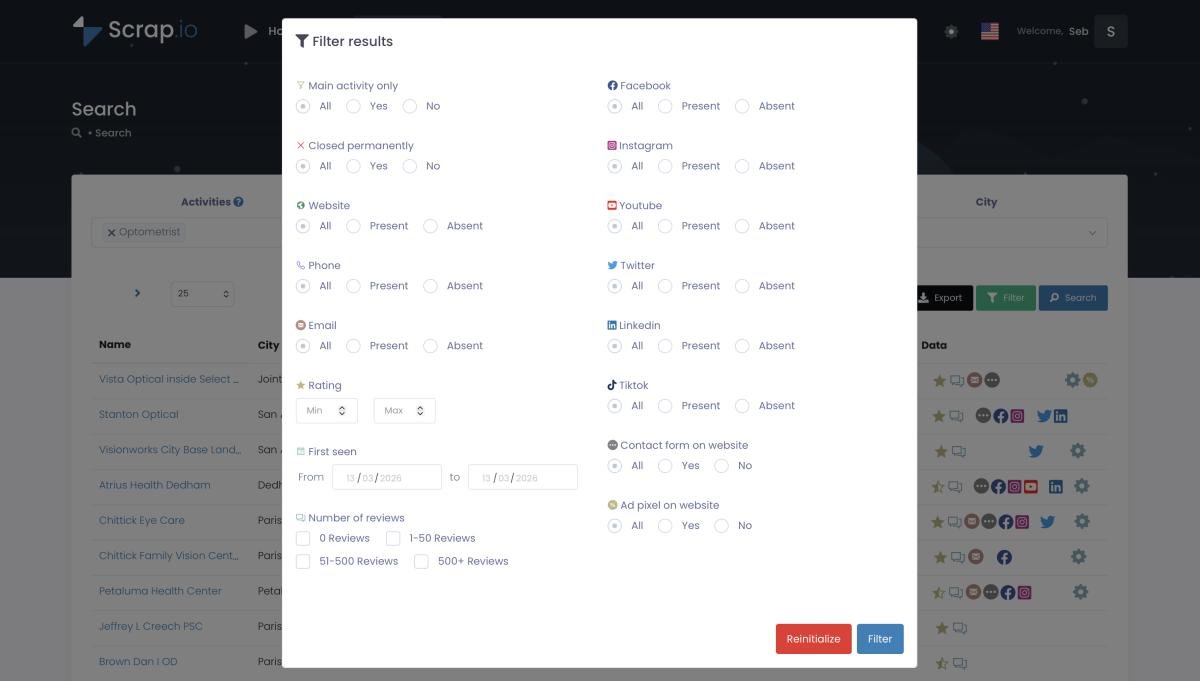
You only pay for leads that match your criteria. Not for the garbage you'd throw away.
Video: Scrap.io - How to Start?
Wanna see the difference yourself? Scrap.io has a free 7-day trial — 100 leads with emails and social profiles included. The exact stuff SerpApi doesn't even extract, pulled live from a 225M+ business index across 195 countries. Give it a shot →
SerpApi vs Scrap.io: Head-to-Head Comparison
Alright, enough talking. Let's just put them next to each other and see what happens.
| Criteria | SerpApi | Scrap.io |
|---|---|---|
| Focus | Multi-engine (15+ search engines) | Google Maps exclusively |
| Interface | API only (code required) | No-code dashboard + API |
| Data fields per business | ~15-20 | 70+ |
| Email extraction | ❌ Not included | ✅ Up to 5 per business |
| Social media profiles | ❌ Not included | ✅ Facebook, Instagram, LinkedIn, YouTube, Twitter |
| Website technologies | ❌ Not included | ✅ Included |
| Geo-selection (radius/polygon) | ❌ Manual GPS coordinates | ✅ Radius or polygon drawing |
| Scalability | Manual pagination via code | Extract entire country in a few clicks |
| Results per search | ~20/page (pagination required) | Unlimited (complete zone extraction) |
| Pre-export filtering | ❌ Basic API parameters | ✅ 17+ advanced filters |
| Free tier | 250 searches/month | 7-day trial + 100 leads |
| Legal status (2026) | ⚠️ Google DMCA lawsuit pending | ✅ Public data extraction |
Yeah. It's... not close. For Google Maps specifically.
Now to be fair — SerpApi is an excellent tool if you need data from multiple search engines. That's its whole thing. But for Google Maps lead generation? It's bringing a Swiss Army knife to a job that needs a surgical instrument. Cool knife though.
One thing I noticed reading SerpApi reviews on SoftwareAdvice: people genuinely love the product. One reviewer said "I wish they had smaller packages." Another praised the Google Maps data as "live fetch" — which is true, the data is fresh. But fresh data without emails is like a fancy sports car without an engine. Looks great. Doesn't get you anywhere for outreach.
And then after the Google lawsuit dropped in December? Reddit lit up. Users on r/n8n posted about needing to find another option besides SerpApi. Over on r/scrapingtheweb, someone started a thread called "Looking for SerpApi alternatives for Google" and the comments were... let's say people had opinions.
If you're shopping around, we've also done deep comparisons with Serper.dev, Apify, and OutScraper. Same format — real testing, real data, no BS.
Want to try a Google Maps scraper that was actually built for Google Maps? 100 free leads with Scrap.io — emails and socials included, no code, no legal drama. That's the difference between a phone book and a lead list. Start here →
Pricing Comparison: SerpApi vs Scrap.io in 2026
Okay, money time. Let me pull up the actual numbers from the SerpApi pricing page and the Scrap.io pricing page. No estimates. No guesses. Actual prices as of July 2026 — pricing pages move, so double-check both before you commit.
| Volume tier | SerpApi | Scrap.io |
|---|---|---|
| Entry-level | $25/mo → 1,000 searches | $49/mo → 10,000 exports |
| Mid-range | $75/mo → 5,000 searches | $99/mo → 20,000 exports |
| High volume | $150/mo → 15,000 searches | $199/mo → 40,000 exports |
| Top tier | $275/mo → 30,000 searches (custom above) | $499/mo → 100,000 exports |
Numbers look kinda close at first glance, right? They're not. Not even a little bit. And here's the part that nobody explains properly.
With SerpApi, one "search" returns one page of Google Maps results. About 20 businesses per page. So 5,000 searches on the $75 Developer plan gets you up to 100,000 raw listings. Sounds amazing until you realize those listings come with zero emails, zero social profiles, and zero website data. It's names and addresses and phone numbers. That's basically a phone book. A really expensive digital phone book.
With Scrap.io, one "export" equals one fully enriched lead. Emails included. Social profiles included. Website technologies included. The whole 70+ column enchilada. So 10,000 exports for $49 means 10,000 contacts you can actually do something with. If you want the cheapest SERP API for raw search data, SerpApi's $25 Starter is genuinely competitive — but "cheapest serp api" and "usable leads" aren't the same shopping list.
Let me do quick math because I think this matters. Say you need 10,000 actionable leads with email addresses for outreach. With SerpApi you need: a paid plan for the Maps data (the $25 Starter covers roughly 1,000 searches ≈ 20,000 raw rows), PLUS a separate email-finding tool (anywhere from $30 to $200/month depending on what you use), PLUS the time to match and merge those datasets. With Scrap.io you need... $49. That's it. Everything's already in there.
Oh, one more thing. Both platforms expire your credits monthly. Use them or lose them. But with SerpApi, your unused "searches" expire and each one only got you 20 basic rows. With Scrap.io, each unused credit would have been a complete enriched lead. Stings a bit more. If you want a full breakdown with real-world examples, check out our API cost comparison guide — and for a pure SERP-data head-to-head, Serper vs SerpAPI digs into the per-query economics.
The Legal Question: Is SerpApi Safe to Use in 2026?
I know you want a simple answer. Yes or no. Safe or not safe.
I can't give you that. What I can give you are the facts, and you can decide for yourself.
Fact: Google filed a DMCA lawsuit against SerpApi on December 19, 2025. Northern District of California, case no. 4:25-cv-10826-YGR. The complaint says SerpApi built tools to circumvent SearchGuard — Google's anti-bot system — to scrape copyrighted content at massive scale. We're talking licensed images, third-party data, the whole deal. Fact: Reddit filed a separate lawsuit in October 2025 naming SerpApi among other companies. Different claims, same general vibe.
Fact: SerpApi filed a motion to dismiss in February 2026. They argue Google doesn't have standing because Google isn't the copyright holder of the content in question. They argue SearchGuard isn't a "technological protection measure" under the DMCA. They say what they do is protected speech. Their CEO literally wrote "Google thinks it owns the internet." The motion-to-dismiss hearing was scheduled for May 19, 2026 before Judge Yvonne Gonzalez Rogers.
Fact: that hearing date has now passed, and as of mid-2026 the court hasn't ruled. The motion's fully briefed and sitting with the judge. No dismissal, no trial date, no settlement announced. Just... limbo.
Fact: nobody knows how this ends. Could be dismissed. Could go to trial. Could settle quietly. Could set new legal precedent that reshapes the entire scraping industry. All still possible.
Here's what I do know: Scrap.io works differently. It doesn't scrape Google's search results pages. It doesn't circumvent SearchGuard. It doesn't touch copyrighted SERP content. It extracts publicly available business data from Google Maps listings and their linked websites — information those businesses chose to make public themselves. That's a fundamentally different model. No SERP scraping. No anti-bot circumvention. Different animal entirely. Our legal guide on Google Maps scraping goes deeper if you want the full picture.
Geo-Targeting: Radius & Polygon Selection
This feature doesn't get enough attention and honestly it's one of the biggest differentiators.
Scrap.io lets you do two things that SerpApi can't even approximate. First: radius search. You pick a point on the map, set a radius — 5km, 10 miles, whatever — and the tool grabs every matching business inside that circle. Second: polygon selection. You draw a custom shape. Literally draw it. Around a neighborhood, a commercial district, a specific block. Only businesses inside your shape get extracted.
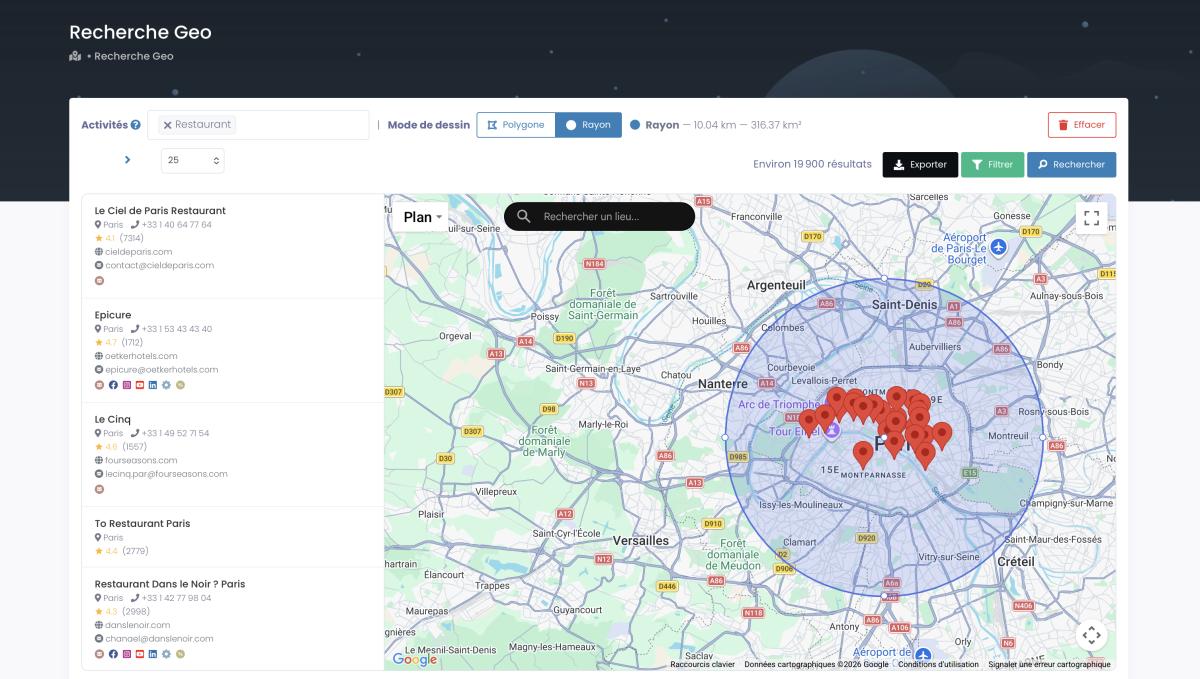
Think about that for a second. You're a franchise owner looking at opening a new location. You want to know every single competitor within a 10-mile radius of your proposed address. With Scrap.io? Drop a pin, set the radius, click search. Three seconds. With SerpApi? You'd need to figure out the GPS coordinates, calculate the bounding box, code the API calls, handle the pagination... could take you an afternoon if you're fast.
Or maybe you're a real estate agency that only works in a specific district. Polygon. Draw the district. Done. Or a marketing agency prospecting businesses in downtown Austin specifically, not the suburbs. Polygon again. Precise. No wasted credits on irrelevant results.
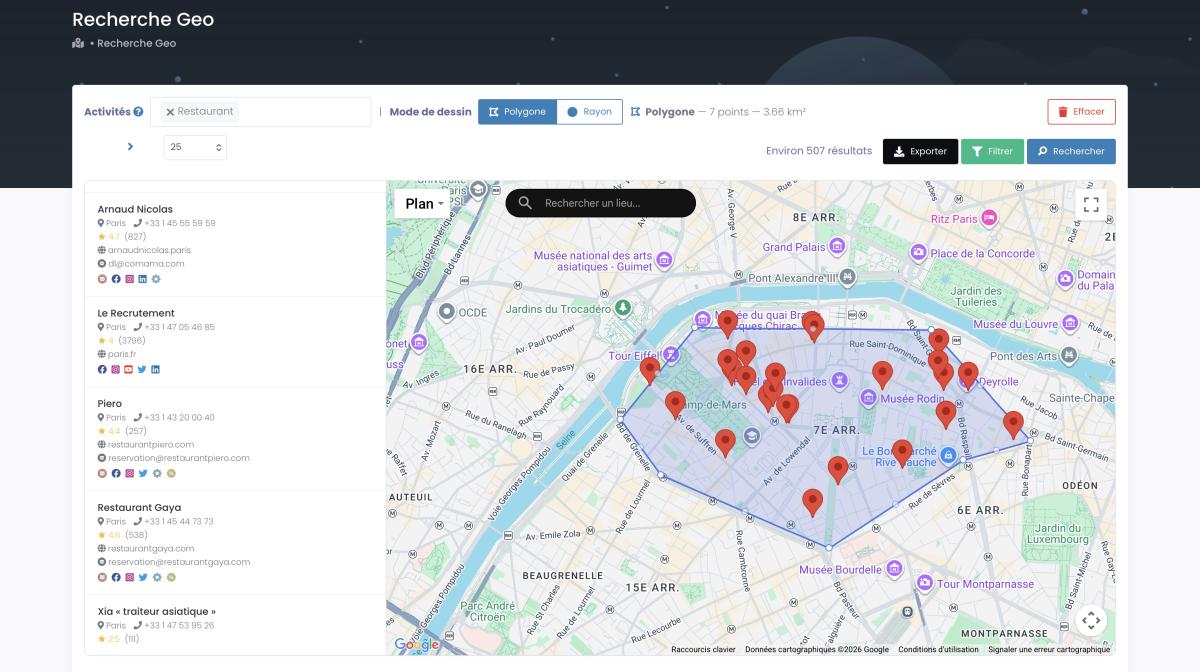
SerpApi gives you raw latitude/longitude parameters in the API. That's it. No visual map. No radius slider. No polygon drawing tool. You code it from scratch. Check out our guide on scraping densely populated areas and the geomarketing strategies guide to see what's possible with proper geo-targeting.
When to Choose SerpApi (And When to Choose Scrap.io)
Look. I've been pretty clear about where I think the comparison lands for Google Maps. But that doesn't mean SerpApi is bad. It's genuinely not. It just depends on what you need.
SerpApi makes sense if your world is bigger than Google Maps. If you need to scrape Google Search results, Bing, Amazon product listings, YouTube rankings, Scholar papers, news articles — SerpApi covers all of that and does it well. It makes sense if you're a developer building data infrastructure and you want an API you can trust (legal stuff aside). It makes sense if you're doing SEO monitoring or competitive analysis across multiple search engines. Honestly, if you're weighing the best serp api for that kind of multi-engine work, it belongs on your shortlist.
Scrap.io makes sense if Google Maps is the thing. If you're a marketing agency building prospect lists. If you're a web design company looking for businesses without websites. If you're doing cold email outreach and you need actual email addresses with your business data. If you want to extract all businesses from a city or even a whole country without writing a line of code. If the idea of a pending Google DMCA lawsuit makes you nervous.
Most people searching for "SerpApi alternative" in the context of Google Maps? They need leads. Emails. Social profiles. Geographic precision. No-code simplicity. That's Scrap.io's whole thing. Best Google Maps scraper in 2026? I think so. But don't take my word for it — try it. And if you want to see the full field first, here's our roundup of the 10 best Google Maps scrapers in 2026, tested and ranked.
Oh and before I forget. There's a completely free Maps Connect Chrome extension that adds emails and social profiles directly to Google Maps while you browse. No account needed for that one. If you want to compare more free options first, here's our Chrome extensions guide — and if you're the DIY type eyeing open-source repos, the GitHub Google Maps scrapers guide is worth a read before you clone anything.
And once you have your leads? The AI email personalization guide and the CRM automation guide show you what to do next. Because scraping data is step one. Turning it into revenue is the part that actually matters.
FAQ — SerpApi vs Scrap.io
What is the best SerpApi alternative for Google Maps?
For Google Maps specifically? Scrap.io. It's built for exactly that — Google Maps lead generation with 70+ data fields, email extraction, social profiles, and no-code operation. SerpApi is a generalist multi-engine scraper. Scrap.io is a specialist. For this particular job, the specialist wins.
Is SerpApi free?
There's a free tier — 250 searches a month. Sounds decent until you do the math. Each search returns roughly 20 Google Maps listings. So 250 searches equals maybe 5,000 raw listings. Without emails. Without social media. Without anything you'd actually need for outreach. For real volume, paid plans start at $25/month. If you want a truly free alternative to SerpApi for Maps, Scrap.io's Chrome extension shows emails and socials at no cost.
Is SerpApi safe to use in 2026?
Honest answer: it's unclear. Google filed a DMCA lawsuit in December 2025 (case 4:25-cv-10826-YGR). Reddit filed a separate lawsuit in October 2025. SerpApi is fighting both and filed a motion to dismiss the Google case in February 2026. The May 2026 hearing has passed and no ruling has been issued yet — the case is still pending as of mid-2026. I'm not making a legal judgment here. Just the facts as they stand.
How much does SerpApi cost?
Standard plans go from $25/month for 1,000 searches up to $275/month for 30,000 searches, with custom enterprise pricing above that. Credits don't roll over — whatever you don't use by the end of the month, gone.
Can SerpApi extract emails from Google Maps?
No. Not natively. SerpApi gives you what shows up on the Google Maps search results page. Emails aren't on that page. To get emails, you'd need a separate tool that visits each business website and scrapes the contact info. Scrap.io does this automatically — up to 5 email addresses per listing.
What is the difference between SerpApi and Scrap.io?
SerpApi scrapes search results from 15+ engines. It's an API for developers. Scrap.io scrapes Google Maps exclusively. It's a no-code platform for anyone. SerpApi gives you 15-20 data fields. Scrap.io gives you 70+. SerpApi doesn't extract emails. Scrap.io does. Basically: generalist vs specialist.
Is scraping Google Maps legal?
Extracting publicly available business information from Google Maps is generally legal under US and EU law. The hiQ v. LinkedIn case established that scraping public data isn't a violation of the Computer Fraud and Abuse Act. Scrap.io only collects data that businesses made public themselves. More on this in our Google Maps scraping legality guide.
Which tool is better for non-technical users?
Scrap.io. And it's not even a contest. No code, no API calls, no JSON, no pagination. You pick a business type, you pick a location, you filter, you export. That's the whole thing. SerpApi assumes you can code. Their docs are great — but they're for developers.
Can I target a specific area with SerpApi?
Technically yes, but only through manual GPS coordinates in your API parameters. There's no map, no radius tool, no polygon drawing. With Scrap.io you can drop a pin and set a radius, or draw a custom polygon around any area you want. Huge difference when you're doing local prospecting.
What data fields does SerpApi return for Google Maps?
About 15-20 fields: business name, address, phone, website URL, rating, review count, GPS coordinates, hours, category, and a handful of others. Scrap.io returns all of those plus emails (up to 5), Facebook, Instagram, LinkedIn, YouTube, Twitter links, website technologies, ad pixels, contact forms, meta descriptions, SEO data. The gap is massive.
That's the full picture. SerpApi is a solid multi-engine scraping API — great for developers who need data from all over the internet. But for Google Maps lead generation? The missing emails, the missing social profiles, the limited geo-targeting, the code requirement, and yeah, the pending lawsuit — it all adds up.
If you want Google Maps leads that are actually ready to use? Scrap.io. Not because it's perfect at everything — it literally only does Google Maps — but because for this specific job, nothing else comes close. And your first 100 leads are free. So you lose nothing by trying.
Try Scrap.io free for 7 days. 100 verified Google Maps leads. Emails, social profiles, 70+ data fields, pulled live from a 225M+ business index across 195 countries. Just pick a category and a city — it takes about 30 seconds. Start here →
Ready to generate leads from Google Maps?
Try Scrap.io for free for 7 days.