

Video: Prospecting Local Businesses Like Alex Hormozi — Scrap.io
- Alex Hormozi's "Core Four" Prospecting Framework
- What Is a Lead? Defining Local Business Lead Generation
- Why Google Maps Is the #1 Source for Local Leads in 2026
- Cold Outreach in 2026: What the Data Says
- The ACA Method: Hormozi's 3-Step Conversation Framework
- Crafting Your Prospecting Messages: Phone, Email & DM Scripts
- The Indirect Selling Approach: Why Hormozi Never "Pitches"
- Your Daily Prospecting Action Plan (With Math)
- Advanced Hormozi Techniques for Local Business Outreach
- Common Prospecting Mistakes (And Hormozi's Fixes)
- Cold Outreach Compliance: TCPA, CAN-SPAM & GDPR Essentials
- Multi-Channel Prospecting: Combining Phone, Email & Social
- FAQ: Local Lead Generation & Hormozi Prospecting
Alex Hormozi was $50,000 in debt. Now he's worth over $100 million. And no — his YouTube channel didn't do that. His prospecting did.
The guy built his fortune by investing in and scaling companies doing at least $5 million in annual revenue. But the foundation of all of it? Cold outreach. Talking to strangers. Getting rejected a lot. Then getting rejected slightly less.
That's what local lead generation actually looks like when you strip away the motivational fluff. You find businesses, you reach out, you follow a framework, you do it again tomorrow. Hormozi's methods aren't complicated. They're just disciplined. And most people won't do them — which is exactly why they work. If you've ever wondered how to generate leads in sales without burning cash on ads, this is the playbook.
This guide breaks down his entire prospecting playbook and shows you how to apply it to local businesses using Google Maps data in 2026. Real scripts. Real numbers. Real benchmarks from actual outreach campaigns.
Understanding Alex Hormozi's "Core Four" Prospecting Framework
Sales prospecting sounds like one thing. It's actually four. Hormozi calls them the "Core Four" prospecting techniques:
- Warm outreach — contacting people who already know you exist
- Cold outreach — reaching out to complete strangers
- Free content — attracting leads through videos, blogs, podcasts
- Paid ads — buying attention directly
That's the engine. But an engine without fuel goes nowhere. The fuel? Leads.
Most business owners hear "prospecting" and think cold calling. But Hormozi's framework is broader — and understanding all four types matters even if you only use one.
Warm outreach? Great when you're starting out. Your existing contacts, former colleagues, that guy you met at the chamber of commerce mixer. But you'll burn through those in a week if you're doing serious volume. Free content builds long-term authority but doesn't pay rent next month. Paid ads work when you've got budget and a dialed-in cost per acquisition. But cold outreach — reaching strangers with a relevant, personalized message — scales from day one with almost no upfront investment. If you want the full phone-first breakdown, our guide to sales prospecting techniques walks through the whole workflow.
For local business lead generation specifically, cold outreach is where the money is. Content takes months to compound. Ads need budget and testing cycles. Cold outreach gets you on the phone with a plumber in Tucson by Thursday. We'll focus there.
What Is a Lead? Defining Local Business Lead Generation
A lead is a person you can contact. That's it. Not a "qualified prospect." Not a "marketing-qualified opportunity." A person with a phone number or an email. Full stop.
Local lead generation means finding those people within a specific geographic area — the chiropractor three blocks from the coffee shop you like, the HVAC company your neighbor uses, the 14-person accounting firm downtown.
The goal of all prospecting strategies is turning a lead into an engaged lead: someone who's shown interest in what you're selling. You build a list, pick your channel (phone, email, DM, even snail mail), and start conversations. Not every name deserves the same effort, which is why knowing how to qualify your leads before you dial saves you hours of dead-end calls.
According to Alex Hormozi, we all already have a list of leads without realizing it. Contacts, email addresses, social media followers — they're all leads by definition. But for B2B local business prospecting? Those personal contacts dry up fast. Hormozi advises contacting 100 people every single day. Your cousin's dentist friend isn't going to carry that kind of volume.
So you need a platform with enough data to sustain daily outreach at scale. Google Maps indexes 225,676,406 businesses across 4,000+ categories in 195 countries. That's your platform. That's not a niche directory — that's most of the local economy, mapped.
Why Google Maps Is the #1 Source for Local Leads in 2026
I'll skip the buildup: Google Maps is the single best database for local lead generation, and it's not particularly close.
Consider the raw scale. Scrap.io currently mirrors 225,676,406 establishments across 195 countries and 4,000+ categories, refreshed in real time at the moment of extraction (Scrap.io, 2026). Not a frozen file scraped last spring. A live database of nearly the entire local economy.
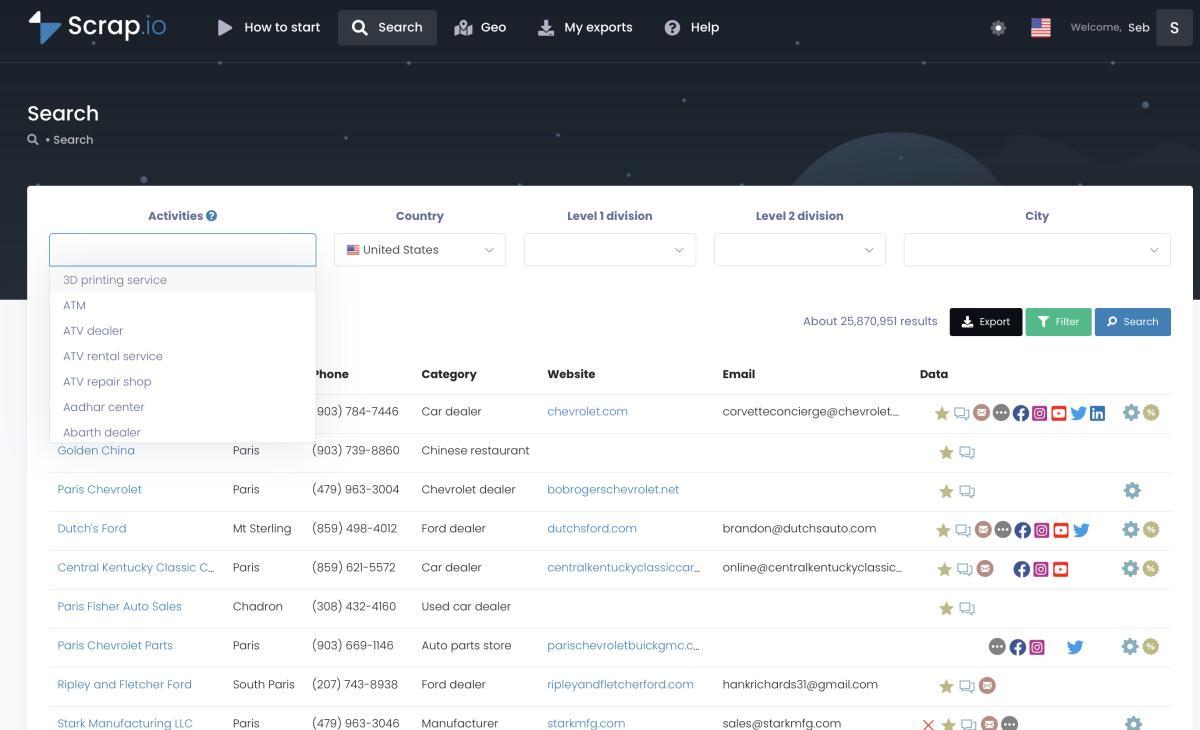
Think about what you get from a single Google Maps listing: business name, phone number, website URL, email (sometimes), reviews with full text, star rating, hours of operation, physical address, categories, and even specific characteristics like "women-owned" or "wheelchair accessible." That's more intelligence on a local business than most paid B2B databases will give you. And it's free to browse.
Every local business that matters is listed there. A 12-person roofing company in Nashville doesn't have a LinkedIn company page. They don't run Facebook ads. But they've got a Google Maps listing with 47 reviews, a phone number that rings (sometimes), and a website built in 2019 that hasn't been updated since.
That's enough data to write a personalized cold email in under two minutes. "I noticed your listing has 47 reviews but your website doesn't mention any testimonials — want me to show you how three of your competitors are already doing this?" Try doing that kind of google maps lead generation from a LinkedIn Sales Navigator search. If you want the scale-focused playbook, we wrote a whole guide on how to generate Google Maps leads at scale.
And 62% of incoming calls to local businesses go unanswered. Think about that for a second. More than half the time, nobody picks up. The businesses that do answer are already ahead. The ones that don't? They need help — and they don't even know it yet.
Platforms like Scrap.io let you pull local business data — emails, phone numbers, social profiles — directly from Google Maps. You can test it with a free trial that includes 100 leads.
For a deeper comparison of where to source your leads, check out Google Maps vs LinkedIn for B2B lead generation. Short version: LinkedIn wins for enterprise. Google Maps wins for local. And for most cold outreach campaigns targeting SMBs, local is where the money is.
Ready to build your first list? Scrap.io pulls verified emails, phone numbers and social profiles from 225M+ Google Maps businesses across 195 countries — updated in real time at every export. Trusted by 50,000+ professionals (4.8 on Capterra, 4.9 on G2). Start free for 7 days — 100 leads included.
Cold Outreach in 2026: What the Data Says
Here's where people either trust the process or bail. Cold outreach feels awkward. It feels old-fashioned. And every year someone writes a LinkedIn post declaring it dead.
It's not dead. It's just gotten harder for lazy people.
Start with the freshest number on the table. Instantly analyzed billions of cold email interactions for its 2026 Cold Email Benchmark Report and landed on a hard figure: the average reply rate is now 3.43%. Top quartile senders hit 5.5%. And the elite tier — the top 10% of all senders — clears 10%+. Same inboxes. Same market. Roughly a 3x gap between average and elite.
Read that spread again, because it is the whole game. The average is drifting down as volume climbs. The top is climbing. The difference isn't luck — it's micro-segmentation, problem-first messaging, and follow-up discipline. Instantly's own data backs the last one hard: 58% of all replies come from the very first email, and the remaining 42% come from follow-ups. Skip the follow-up and you're leaving four out of ten conversations on the table.
The older benchmarks still hold up, dated honestly. Saleshandy analyzed over 100 million cold emails and found an average reply rate between 1-5% overall, with top performers hitting 8.2%. Sopro went deeper — 151 million outreach touchpoints across 440+ B2B decision-makers — and documented roughly a 5% response rate for well-executed campaigns. And Belkins (in their 2024 analysis of 16.5 million emails across 93 domains) found reply rates dipping to 5.8% from 6.8% the year before. Notice the trend line across every study: generic outreach is dying, personalized outreach is thriving, and the gap widens every quarter.
So is cold outreach dead in 2026? No. The community that actually does this for a living keeps proving otherwise — the r/LeadGeneration thread bluntly titled "Looking to start local lead generation" is full of operators still building businesses on exactly this. The answer isn't just yes. It's yes, and it's getting more effective for people who personalize. Hormozi was preaching this before the data caught up. Now the numbers prove him right.
Some other numbers worth knowing:
- 61% of B2B decision-makers prefer email as their primary outreach channel (Snov.io, 2026)
- Average reply rates by industry: consulting hits 7.88%, healthcare 7.49%, SaaS 7.42% (The Digital Bloom)
- Campaigns with 3-5 follow-ups see an 8.3% reply rate vs 4.1% without (Saleshandy)
- Cold email ROI: $36 for every $1 spent — that's a 3,600% return (SmartLead/Manyreach)
The ACA Method: Hormozi's 3-Step Conversation Framework
OK, someone responded to your message. Now what?
This is where most salespeople blow it. They get excited, shift into pitch mode, and watch the conversation die. Hormozi's answer is the ACA method — and it's deceptively simple.
A — Acknowledge. Notice something specific about the lead. Not "nice business." Something real. "Cool, my dad is also an accountant."
C — Compliment. Connect a sincere compliment to that acknowledgment. "You must be incredibly detail-oriented." (Not over-the-top flattery. Subtle.)
A — Ask. Transition from the compliment to a question related to what you sell. "Does sitting all day prevent you from exercising?" — if you're in the fitness space.
Three steps. That's the whole thing. But it works because it mirrors how humans actually build rapport — through recognition, not through pitching.
ACA vs Traditional Sales: A Side-by-Side Look
| Hormozi's ACA Method | Traditional Sales Approach | |
|---|---|---|
| Opening | Acknowledge something specific about the prospect | Generic intro + company pitch |
| Tone | Conversational, curious | Salesy, scripted |
| Focus | The prospect's situation | Your product features |
| Goal of first contact | Start a dialogue | Book a meeting or close |
| How it feels | Like talking to a knowledgeable stranger | Like being sold to |
| Response rates | 2-3x higher (personalized) | Baseline 1-3% |
The indirect approach works because it sidesteps the defensive reflex. Nobody wants to be pitched. But everybody's willing to answer a genuine question from someone who clearly paid attention.
And here's something people miss: the ACA method isn't just for first contact. It's a follow-up tool too. "I know you mentioned you were busy last time we spoke... which makes sense because successful business owners always are. Have you had a chance to think about [topic], or should I check back next month?"
Personalization can double cold email response rates. The ACA method is basically systematized personalization. That's why Hormozi keeps winning. So what is the ACA method, in one line? It's paying attention on purpose.
Crafting Your Prospecting Messages: Phone, Email & DM Scripts
Different channels, different scripts. Same underlying principle: make it about them, not you.
Phone Prospecting
Phone is still king for local business prospecting. Most local business owners don't check LinkedIn. They do check voicemail. (Well, some of them.)
Let's talk about that unanswered-call number, because it's uglier than most people realize. Roughly 62% of calls to small businesses go unanswered during business hours — a figure documented across the 411 Locals study of 85 businesses spanning 58 industries. And the fallout is brutal: 85% of callers who don't reach a live person never call back, and the average local service business bleeds an estimated $126,000 a year in lost revenue from missed calls (SkipCalls, 2026). The caller doesn't wait around. They just dial the next name on the list. So the prospect who does pick up your call? Already rarer, already more valuable than you think. For the full breakdown of what that number really costs, we dug into the cold calling success rate data from 200K+ analyzed calls.
Video: Why Your Google Maps Emails Don't Get Replies?
Hormozi's voicemail script is brilliantly simple:
"Hi [first name], it's [your name]. I'm calling in reference to [their competitor]. Please give me a call back at [number]."
Example: "Hi John, it's François. I'm calling in reference to Nike. Please give me a call back at 0642 582 62."
The curiosity is irresistible. What does this person know about my competitor? They call back. That's the whole point. This is exactly how to get local business owners on the phone — you give them a reason they can't ignore.
The Competitor Reference Cold Calling Script
Want a repeatable cold calling script you can actually copy? Here's the one that works best for local prospecting, built on the competitor-curiosity trigger:
"Hi [Name], quick one — I've been looking at [industry] businesses around [city] and noticed [competitor] just [did something specific: redesigned their site / started collecting reviews / added online booking]. You're clearly in the same space, so I figured it was worth a 30-second call. Are you the right person to talk to about [outcome]?"
Notice what it doesn't do. No pitch. No feature list. No "I help companies like yours" preamble (the single most-ignored opener in existence). It states a real, verifiable observation, then hands the prospect an easy yes/no. For fifteen more field-tested templates and objection handlers, steal from our roundup of proven cold calling scripts and our guide on how to introduce yourself in a cold call.
Email Prospecting
Subject line: "I'm watching you"
"Hi [name], I was checking out your site and noticed a cool opportunity with your email setup. Didn't want to overload you with a long email, so I put together a short video to show you exactly what I found that might double your email revenue. Do you have 15 minutes in the next couple of days to discuss this? Let me know."
No pitch. No features list. Just curiosity and a low-commitment ask. The question doubles as a CTA — "Let me know" is easier to respond to than "Book a 30-minute strategy session." And keep it short: Instantly's 2026 data found elite senders average under 80 words per first email. Brevity forces clarity.
For more advanced email techniques, our guide on cold email outreach strategies for lead generation goes deep on this. And if you want to automate the personalization part, look at AI-powered cold email personalization for local businesses. Writing cold email to a local business is a different animal from enterprise outreach — the personalization hook is sitting right there on their Google Maps listing.
Social Media DMs
Social media gives you more context than any other channel. You can see what a business has been posting, what they're proud of, what they're struggling with.
Hormozi's DM template is almost aggressively simple:
"Are you still looking to [their goal]?"
- "Are you still looking to get more leads?"
- "Are you still looking to boost your LinkedIn profile?"
- "Are you still looking to get more reviews?"
The word "still" implies you've been paying attention — even if this is your first contact. It invites a yes/no answer that naturally opens the conversation. (If the lead is totally cold, drop the "still." Works almost as well.)
Channel Comparison
| Channel | Best For | Typical Response Rate | Script Style |
|---|---|---|---|
| Phone | Immediate connection, local services | 2-5% connect rate | Competitor reference + voicemail |
| Scalable outreach, detailed value prop | 3.43% avg, 10%+ elite | Curiosity subject + short body | |
| Social DM | Warm-ish prospects, context-rich | 3-10% reply rate | One-line question |
| Contact Form | Businesses with websites, ~100% read rate | Varies | Personalized short message |
For an underrated channel most people ignore, check out the contact form strategy with nearly 100% read rates. Emails get filtered. Contact form messages go straight to the owner.
The Indirect Selling Approach: Why Hormozi Never "Pitches"
Here's the move that separates Hormozi from every other sales guru on the internet.
When it's time to present the offer, he doesn't. Not directly anyway. Instead of saying "buy my product," he says:
"Do you know anyone who is facing [problem] and looking to achieve [results] within [time]?"
Read that again. He's asking for a referral, not a sale.
But here's what actually happens in practice: if the person you're talking to has that exact problem themselves, they'll volunteer it. "Actually, yeah, I've been dealing with that." And just like that, they've self-identified as a prospect — without feeling an ounce of sales pressure. You didn't pitch. They raised their hand.
And if they genuinely do know someone else? Even better. "Hello, I'm reaching you on behalf of so-and-so." That's a warm introduction built from a cold outreach. Free social proof. Zero awkwardness.
One agency we work with tested this indirect selling approach on a batch of 50 local business owners last quarter. They ran it side-by-side against a direct pitch version of the same message. The indirect version pulled 3x more responses. Not because the offer was different — because the framing was different. People don't resist help. They resist being sold to. This indirect sales technique removes that resistance entirely.
The psychology works because it shifts control to the prospect. They decide whether to engage, not you. Traditional prospecting puts the salesperson in the driver's seat. Hormozi puts the prospect there. Paradoxically, that produces more conversions, not fewer.
Your Daily Prospecting Action Plan (With Math)
Theory is nice. Execution pays rent. Here's what a Hormozi-style daily prospecting routine looks like in practice.
If you're wondering how to get into local lead generation and actually stick with it, run this exact five-step loop every morning:
- Export 50 fresh leads from Scrap.io, filtered to your ICP before you spend a single credit.
- Research 5 prospects in depth (Google Maps profile, website, recent reviews) and draft your ACA angle for each.
- Run your outreach block — 20 calls, 15 emails, 10 DMs, 5 follow-ups.
- Log every interaction in your CRM the moment it happens.
- Prep tomorrow's list so you never start a day from zero.
Now the detail, block by block.
Morning Setup (15 minutes):
- Export 50 new leads from Scrap.io or your Google Maps research
- Pick 5 prospects and spend 2-3 minutes researching each one
- Prepare your ACA talking points based on what you found
Active Prospecting Block (2 hours):
- 20 phone calls using the competitor reference voicemail script
- 15 personalized emails with curiosity-based subject lines
- 10 social media DMs (LinkedIn, Facebook, Instagram)
- 5 follow-up messages to people who responded previously
End-of-Day Review (10 minutes):
- Log every interaction in your CRM
- Schedule follow-ups for interested leads
- Prep tomorrow's target list
That's 100 daily contacts. Hormozi isn't kidding about that number. But look how manageable it is when you break it into blocks instead of staring at "contact 100 people" as one terrifying task.
Here's the part most people skip: filter before you extract. This is where Scrap.io quietly saves your budget and your sanity. Instead of pulling 500 listings and then deleting the ones with no email, no website, or a dead phone number, you apply the filters first — before a single credit is spent. Only want businesses with a listed email? Toggle it. Only the ones with no website at all (a web agency's dream list)? Toggle that. You pay only for contacts you can actually use. Zero waste.
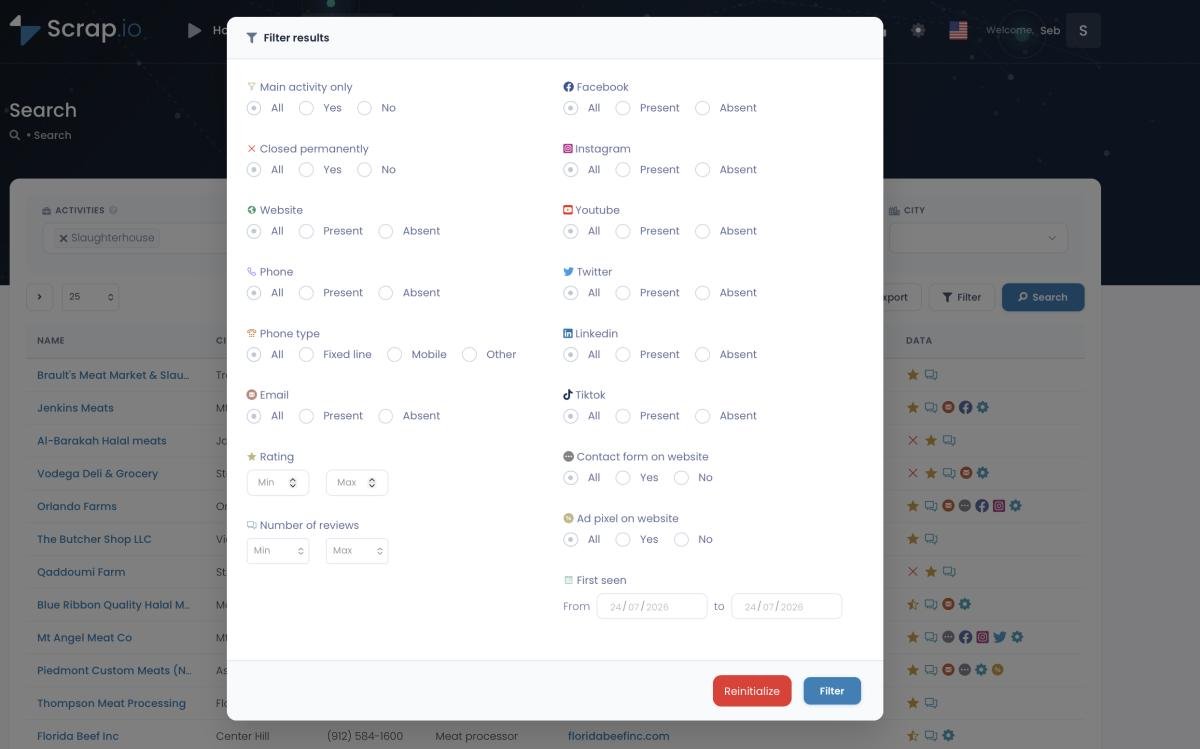
New to the tool? Here's the two-minute version of how the whole thing works:
Video: Scrap.io - How to Start?
Now the math:
- 100 prospects contacted daily
- 3-5% response rate = 3-5 responses per day
- ~30% of those are qualified = 1-2 qualified leads daily
- ~10% close rate = 3-6 new clients per month
These conversion estimates align with the 2026 benchmarks from LevelUp Leads' analysis of Smartlead's 14.3 billion cold email sends: out of 100 emails, roughly 40 open, 3 reply, and about 1 books a demo. That's the reality of business lead generation in 2026 — it's a volume game, but personalization is the multiplier.
And here's where it gets interesting from a cost perspective. Running 100 daily outreach contacts through Google Maps data costs a fraction of what you'd spend on paid ads for the same number of qualified conversations. The comparison isn't close:
| Channel | Cost per 5 qualified conversations | ROI | Main trade-off |
|---|---|---|---|
| Google Ads ("plumber near me") | $500-$1,500 ($15-50+ per click) | Varies, often thin | Pay per click, forever |
| Cold outreach (Google Maps data) | Your time + a Scrap.io plan | ~$36 per $1 (3,600%) | Effort, not passive |
Cold email ROI sits at roughly $36 for every $1 spent (SmartLead/Manyreach data). That's 3,600% ROI. Google Ads can't touch that, and neither can most paid channels. The trade-off is effort — nobody's pretending cold outreach is passive. But the economics are wildly in your favor, especially when you're starting out and every dollar matters.
Campaigns with 3-5 follow-ups achieve an 8.3% reply rate versus just 4.1% for single-touch outreach (Saleshandy, 2026). So those 5 follow-up messages in your daily block? They're not optional. They're where most of the actual deals come from.
Want to track all this properly? Here are 20 essential KPIs for local prospecting you should be monitoring.
Advanced Hormozi Techniques for Local Business Outreach
The basics work. These techniques make them work better.
The "Competitor Reference" Method
"Hi [Name], I was just helping [competitor] with [specific result]. I noticed your business has [similar challenge]. Are you interested in hearing how we solved it?"
Nobody wants to fall behind their competition. This script triggers that instinct immediately. A landscaping company in Portland doesn't care about your features. They care deeply about what the landscaping company across town is doing.
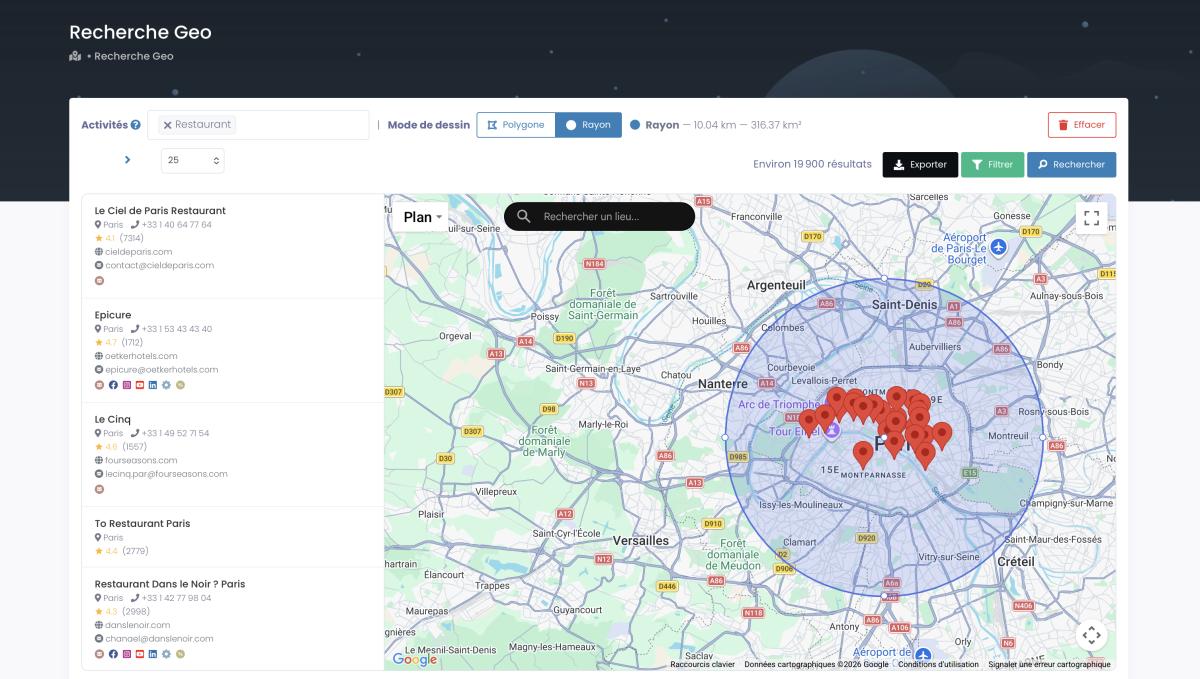
The beauty of this with Google Maps data? You can actually see who their competitors are. Draw a radius around a business and Scrap.io hands you every competing listing inside it, sorted by rating and review count. Mention the one that's beating them — the one with 200 reviews to their 30 — and suddenly your cold call isn't cold anymore. It's urgent.
One thing to watch: don't fabricate the competitor relationship. If you say "I was just helping [competitor]," it needs to be true, or at least based on a general observation you can defend. "I noticed [competitor] just redesigned their website" is factual and verifiable. That's enough to trigger the curiosity.
The "Google Maps Insight" Technique
You've got data from Google Maps. Use it. But most people assert the opportunity instead of proving it. So let's prove it.
Pull the numbers on a single trade in the US. Google Maps lists 75,733 plumbers across the country. Of those, 31,532 have no website at all — that's 41.6%. And only 27,760 expose an email address on their site — a mere 36.7% (Scrap.io, data extracted August 7, 2026).
Sit with that first figure. Four out of ten American plumbers have no website. None. For a web agency, that isn't a statistic — it's a pre-built list of prospects with a visible, solvable problem, identifiable in a single filter before you spend one credit. That's the "Google Maps Insight" Hormozi describes, except chiffré. Measured. Real.
Now the script that uses it:
"Hi [Name], I was reviewing local [industry] businesses in [city] and noticed you have [specific detail — maybe 3.2 stars, no website, or only 4 photos on your listing]. Most businesses in your industry struggle with [common problem]. Have you found a solution for that?"
This shows homework. It shows you're not mass-messaging every listing in a ZIP code. The prospect can feel the difference between a personalized outreach and a template with a mail-merged first name.
31,532 US plumbers with no website are waiting. That's one filter, one trade, one country. Scrap.io lets you isolate businesses with no site (or no email, or a low rating) before you spend a credit — across 4,000+ categories and 195 countries. Try Scrap.io free for 7 days — 100 leads included and build your first "unqualified for a competitor, perfect for you" list in minutes.
Let Your AI Build the List: The Scrap.io MCP
Here's the 2026 upgrade Hormozi couldn't have scripted. You no longer need to touch a single dropdown to build a prospect list. Scrap.io exposes an official MCP connector — a live bridge that plugs the full 225M+ business database straight into Claude, ChatGPT or Gemini. You type a sentence, your AI pulls real leads.
"Find me every roofer in Texas without a website." "How many dentists in California have an email address?" The AI builds the search, applies the filters, even constructs the geographic zones — and queries real data instead of hallucinating a list of businesses that don't exist. Counts stay free, even through the MCP. For the full setup (it takes about two minutes), see our guide on getting Google Maps data inside your AI with the Scrap.io MCP.
The "Whole Territory" Angle
Most people cap their ambition at one city because most tools choke past a few hundred results. Scrap.io doesn't. You can pull an entire administrative zone — city, county, region, or a whole country — in one export. Or draw a custom polygon on the map for a specific neighborhood or catchment area.
And here's the move nobody talks about: extract every business in a zone with no category at all. Not "restaurants in Austin." Every business in Austin. That's a genuine economic map of a territory — which is exactly what Hormozi means when he talks about "owning" a local market. You're not renting a slice of it. You've mapped the whole thing.
The "Scarcity + Social Proof" Combo
"Hi [Name], I only work with 3 businesses per quarter in [location]. Currently helping [type of business 1] and [type of business 2]. Do you know any [their industry] owners who might benefit from [specific outcome]?"
Scarcity (limited spots) + social proof (already working with others nearby) + the indirect approach (asking for referrals). Three Hormozi principles stacked into one message.
What makes this particularly effective for local business prospecting is the geographic element. "I work with three businesses in [their city]" hits differently than "I work with three businesses." The locality creates implied relevance. They're not wondering if you understand their market. You're literally naming their neighbors.
Common Prospecting Mistakes (And Hormozi's Fixes)
The community that does this daily keeps repeating the same lessons. Scroll the r/b2bmarketing thread titled "New to local lead gen and looking for advice" or the r/Entrepreneur post "18 month update: I went all in on local lead gen" and you'll see the same three mistakes surface again and again. Here they are, with the fix.
"I don't have time to contact 100 people every day."
Everyone says this. And then they spend 45 minutes scrolling industry news, another 30 minutes "optimizing" their CRM tags, and two hours in meetings about meetings. The time exists. It's just being spent on things that feel productive but don't generate revenue.
Hormozi's fix: batch your activities. Don't alternate between calling and emailing — that's where all your time disappears, in the context-switching. Do all 20 calls in one focused block. All 15 emails in another. The DMs after that. Hormozi-style outreach done in focused 30-minute sprints takes about 2.5 hours total. If you can't find 2.5 hours in a workday, the problem isn't time management. It's priorities.
"My response rates are terrible."
Nine times out of ten, this means you're not personalizing enough. The Belkins study of 16.5 million emails made it clear: generic blasts are tanking industry averages. But that same data shows personalized outreach holding strong.
Those two extra minutes per prospect — checking their Google Maps listing, reading their most recent review, glancing at their website — that's the difference between a 1% reply rate and a 5% reply rate. Five percent doesn't sound like much until you do the math: at 100 emails a day, that's 5 responses instead of 1. Over a month, that's 150 conversations instead of 30. Generic messages aren't just ineffective — they actively hurt your sender reputation with email providers, making your next batch even less likely to land in the inbox.
"People don't want to be sold to."
Correct. That's exactly why Hormozi doesn't sell. He asks questions. He builds curiosity. He uses the indirect approach ("Do you know anyone who...") so the prospect never feels cornered. If someone's interested, they volunteer it. If not, you move on without burning the bridge.
The mental shift here is important: you're not trying to convince anyone of anything on the first contact. You're just trying to start a conversation. That's it. Lower the stakes in your own head and the outreach gets easier immediately.
Cold Outreach Compliance: TCPA, CAN-SPAM & GDPR Essentials
Skip this section at your own legal risk. Seriously.
Cold outreach is legal. It's also heavily regulated. And the rules are different depending on the channel and the country. Mess this up and you're not just losing leads — you're losing money in fines.
CAN-SPAM (US email rules): Every commercial email must include a clear, working unsubscribe mechanism, your physical mailing address, and accurate sender information. No deceptive subject lines. No misleading "from" fields. The FTC can fine you up to $53,088 per email for violations. And they do enforce it — this isn't a theoretical number gathering dust in a legal textbook.
TCPA (US phone rules): This is where things get serious for cold callers. You need prior express consent before using auto-dialers or prerecorded messages for telemarketing. Manual dialing to business numbers during normal hours? Generally fine. But robocalling a list of cell numbers without explicit consent? That's class-action lawsuit territory. TCPA cases have produced settlements north of $100 million. A 6-person marketing agency can absolutely get sued here.
GDPR (EU contacts): If any of your prospects are based in Europe, different rules apply. You need either explicit consent or a legitimate business interest justification for your outreach. You must provide an easy opt-out mechanism, be transparent about how you're using their data, and avoid retaining information longer than necessary. "I scraped your email from Google Maps" is not inherently a GDPR violation — but you need to handle that data responsibly and honor removal requests immediately.
Compliance Quick-Reference
| Regulation | Applies To | Key Requirements | Max Penalty |
|---|---|---|---|
| CAN-SPAM | US commercial emails | Unsubscribe link, physical address, accurate sender info, honest subject lines | $53,088 per email |
| TCPA | US phone calls & texts | Prior consent for auto-dialers/prerecorded messages, DNC list compliance | $500-$1,500 per call |
| GDPR | EU/EEA contacts | Consent or legitimate interest, easy opt-out, data minimization, transparent processing | €20M or 4% global revenue |
The practical takeaway: cold outreach to businesses using publicly available information (like what's on Google Maps) is generally permissible under US and EU law when you follow the rules above. Scrap.io only extracts data that businesses have chosen to display publicly, is GDPR and CCPA compliant, and keeps every data point traceable to its source. But compliance is your responsibility, not your tool's.
For a complete breakdown with specific examples, read the full cold email compliance and anti-spam regulations guide.
Multi-Channel Prospecting: Combining Phone, Email & Social
Single-channel outreach is leaving money on the table. Period.
The businesses that respond to your email might ignore your call. The ones who pick up the phone might never check their inbox. And some owners — especially younger ones running newer businesses — live on Instagram DMs and barely look at their email unless it's from a customer.
I've seen this play out dozens of times: someone sends 100 cold emails, gets 3 replies, and calls it a day. Meanwhile, 15 of those businesses would've picked up the phone. And 8 of them would've responded to a DM on Facebook. You didn't have a response rate problem. You had a channel problem.
Hormozi doesn't explicitly frame his "100 contacts a day" as multi-channel, but the math forces it. Twenty calls. Fifteen emails. Ten DMs. Five follow-ups. That's four channels by default. And the data backs this up — Saleshandy found campaigns with 3-5 touchpoints across multiple channels achieve double the response rate of single-channel campaigns. If you want to run this properly, our full omnichannel outreach strategy guide shows how to sequence the touches so each channel knows what the others did.
Google Maps data makes multi-channel easy because a single business listing often gives you the phone number, the website (where you find the email and contact form), and links to their social profiles. One data source, four outreach channels.
The combination of Google Maps scraping for leads and multi-channel outreach is what turns Hormozi's framework from a theory into a machine. You're not relying on one channel to carry all the weight. You're surrounding the prospect with relevant, personalized touches across wherever they actually spend time.
Learn how to find email addresses from Google Maps to build comprehensive multi-channel prospect profiles. And for the complete technical side of Google Maps data extraction, our comprehensive Google Maps scraping guide covers everything.
Your outreach machine is only as good as your list. Scrap.io pulls classified emails, phone numbers, website data and social profiles from 225M+ Google Maps businesses — filtered before you spend a credit. Try Scrap.io free — 7 days, 100 leads included.
FAQ: Local Lead Generation & Hormozi Prospecting
What is local lead generation?
Local lead generation is the process of finding and contacting potential customers within a specific geographic area, then turning them into engaged prospects through cold outreach, content, or advertising. It's about owning a territory, not casting a wide global net.
What is the ACA method in sales?
The ACA method is Hormozi's three-step conversation framework: Acknowledge something specific about the prospect, offer a sincere Compliment tied to that observation, then Ask a question that transitions naturally toward your offer. It works because it mirrors how humans actually build trust — through demonstrated attention and genuine interest, not through feature dumps and pricing sheets. The method builds rapport before any selling happens, which is why it consistently produces higher response rates than opening cold with a pitch.
How many prospects should you contact daily?
100 contacts per day. That breaks down to roughly 20 phone calls, 15 personalized emails, 10 social media messages, and 5 follow-ups. Sounds aggressive, but in focused blocks it takes about 2.5 hours. The volume matters because cold outreach is a numbers game — at typical conversion rates, 100 daily contacts generates 3-6 new clients per month. Drop to 30 contacts a day and you might get one client per month. Maybe.
Is cold outreach still effective in 2026?
Extremely. Instantly's 2026 benchmark of billions of emails puts the average reply rate at 3.43%, with elite senders clearing 10%+. Personalization roughly doubles response rates across the board (Sopro). Cold email ROI sits at roughly $36 for every $1 spent. The people who claim cold outreach is dead are usually sending the same template to 10,000 people and wondering why nobody responds. Personalized outreach to a targeted list of local businesses? That's a completely different game — and it remains one of the most cost-effective business lead generation strategies available.
Is lead generation worth it in 2026?
Yes — the ROI math is hard to argue with. Cold email returns roughly $36 for every $1 spent (a 3,600% return), and even at the 2026 average reply rate of 3.43%, a disciplined 100-contacts-a-day routine produces 3-6 new clients a month. The catch is effort: it rewards consistency and personalization, not spray-and-pray volume.
How to prospect local businesses in 2026?
Start with Google Maps data — tools like Scrap.io let you extract business details at scale with filters for rating, location, category, and contact availability, applied before you spend a credit. Apply Hormozi's ACA method for your conversations. Use the indirect selling approach rather than hard pitching. Maintain daily consistency across phone, email, and social media. And always prioritize personalization over raw volume. One thoughtful message to a business you've researched beats ten copy-paste templates.
What makes a good Alex Hormozi prospecting script?
A good Hormozi-style script avoids direct pitching entirely. Instead of "Here's what my product does," ask: "Do you know anyone who is facing [problem] and looking to achieve [results] within [time]?" This framing creates curiosity, removes sales pressure, and lets prospects self-identify their interest. Combine it with the competitor reference method ("I was just helping [their competitor] with [result]") and you've got a cold outreach approach that feels nothing like a cold outreach — which is exactly why it works.
Ready to prospect like Hormozi? Get 100 verified local business leads instantly and start your daily outreach routine today. Scrap.io indexes 225,676,406 businesses across 195 countries and 4,000+ categories, updated in real time — filter by email, phone, rating or "no website" before you spend a credit. Try Scrap.io free for 7 days — 100 leads included.
Generate a list of restaurant with Scrap.io