

- Why 68% of Your Deals Are Lost Before You Even Know Who You're Competing Against
- What Are Competitive Intelligence Tools? (A 2026 Definition)
- The 8 Best Competitive Intelligence Tools in 2026 (Tested & Compared)
- The Competitive Intelligence Blind Spot: Why Google Maps Data Changes Everything
- How to Use Google Maps Data for Competitive Intelligence (Step-by-Step)
- Real Companies Using CI Tools (With Documented Results)
- CI Tools vs Google Maps Scrapers: What's the Difference?
- CAN-SPAM, GDPR & Compliance
- FAQ
Why 68% of Your Deals Are Lost Before You Even Know Who You're Competing Against
Last quarter, a SaaS sales director I know lost a $180K deal. Not because his product was worse. Because a competitor he'd never heard of undercut him by 15%, and he found out from the prospect's rejection email.
That's not an isolated story. According to Crayon's 2025 State of Competitive Intelligence report, 68% of B2B deals now involve at least one direct competitor. And here's the kicker: most sales teams rate their competitive preparedness at 3.8 out of 10.
3.8 out of 10. That's a failing grade in any school I've attended.
The cost of this blind spot isn't theoretical. It's lost revenue, wasted outreach hours, entire market shifts you only notice six months too late. And the CI tools market shows how urgent the problem has become. Fortune Business Insights values it between $557M and $870M in 2026, growing at 12.6% CAGR through 2033.
So here's what this article actually covers: the best competitive intelligence tools available right now, a head-to-head comparison, and an angle almost nobody's talking about. Using Google Maps data as a competitive intelligence source. (Yes, really. Stay with me.)
What Are Competitive Intelligence Tools? (A 2026 Definition)
If a colleague asked you to define competitive intelligence tools right now, would you have a clean answer? Most people say something vague about "tracking competitors." Fair enough, but incomplete.
Competitive intelligence tools are software platforms that systematically collect, analyze, and distribute information about competitors, market conditions, and industry trends to support strategic decision-making.
That's the textbook version. The real question is how to gather competitive intelligence efficiently, without drowning in data or paying enterprise prices. In practice, CI tools fall into a handful of buckets:
- Market monitoring: tracking competitor website changes, pricing shifts, new product launches
- Sales enablement: battlecards, win/loss analysis, real-time alerts for reps
- Pricing intelligence: automated price tracking across competitors
- Location intelligence: physical market presence, expansion patterns, local competitor density
That last category? Almost nobody thinks about it. But Google Maps data for market research is arguably the most underrated CI source in 2026. 225,676,406 business listings, to be exact. Across 195 countries. Publicly accessible. Updated constantly by business owners themselves. And the vast majority of competitive intelligence software completely ignores it.
The 8 Best Competitive Intelligence Tools in 2026 (Tested & Compared)
Most "best CI tools" articles just copy-paste vendor marketing pages and call it a day. We actually tested these. (Or at minimum, sat through the demos and talked to real users. Same thing, right?)
People constantly search for free competitive intelligence tools 2026, and sure, some exist. Semrush has a free tier. Similarweb gives you limited data for free. But the serious AI competitive intelligence tools? Those cost real money. Except for one category we'll get to in a minute.
Here's the comparison. And no, we didn't rank ourselves first out of politeness. The tools are listed by category fit, not some imaginary "best overall" score.
| Tool | Best For | Price Range | Key Strength |
|---|---|---|---|
| Crayon | Enterprise CI & battlecards | $25K–$40K/yr | AI-powered competitor tracking |
| Klue | Sales enablement & win/loss | $15K–$30K/yr | Battlecard delivery to reps |
| Semrush | SEO & digital competitor analysis | $130–$500/mo | Organic & paid search intel |
| Similarweb | Website traffic & market share | $125–$500/mo | Traffic estimation accuracy |
| Contify | News & market monitoring | Custom pricing | AI-curated news feeds |
| AlphaSense | Financial & market research | $10K–$50K/yr | SEC filings + earnings analysis |
| Kompyte | Automated competitor tracking | $10K–$25K/yr | Website change detection |
| Scrap.io | Location intelligence & B2B leads | $49/mo | Google Maps data extraction at scale |
A few things jump out. Crayon competitive intelligence is the gold standard for enterprise teams. Their AI tracks millions of competitor signals automatically. But $25K+/year? Ouch. Klue is slightly cheaper and better at getting battlecards into salespeople's hands. Both are excellent competitive intelligence tools for sales teams with the budget to match.
Oh, and one more thing. If you're looking at the best tools to monitor competitor activity but you're a 20-person agency trying to track competitors online without blowing your marketing budget? Most of these enterprise platforms aren't built for you. You need affordable ways to track competitors online, and offline.
Semrush and Similarweb are solid for digital competitor analysis tools and decent competitive analysis software for SEO-focused teams: organic rankings, traffic estimates, ad spend. But they're blind to anything that happens offline or on the physical map. And here's a question nobody asks: what if your biggest competitive threat isn't another website? What if it's the 14 new businesses that just opened in your target ZIP code?
That's where the newer market intelligence platforms with a location angle come in, tools like business database search tools and location-based CI platforms that fill the gap.
The Competitive Intelligence Blind Spot: Why Google Maps Data Changes Everything
The most powerful competitive intelligence database in 2026 isn't locked behind a $40K annual contract. It's Google Maps.
Think about it. More than 225 million business listings worldwide, across 195 countries. Real-time reviews. Phone numbers, emails, opening hours, photos, service areas. All of it updated by business owners themselves, verified by Google, and accessible to anyone with a browser.
But here's the problem: nobody can do anything useful with it manually.
Try this exercise. Open Google Maps. Search "plumber" in Phoenix, AZ. You'll get maybe 20 results per scroll. To map the full competitive landscape (how many plumbers, where they cluster, their average rating, who's growing, who's declining) you'd need to spend days copy-pasting into a spreadsheet. Nobody does that. (OK, some interns do. They quit soon after.)
Want the scale of what you're up against? Scrap.io counts 76,325 plumbers across the United States, 28,133 of them with an email address on file (September 2026). Now try building that list by hand. I'll wait.
That's the blind spot. The data exists. The competitive intelligence tools and techniques to extract it at scale? Those are new.
And the numbers back this up. According to Google's own research, 98% of retail CEOs recognize location intelligence as vital to business strategy. 30% of organizations using geospatial data report a 20%+ improvement in key performance indicators.
Real use cases for Google Maps data for market research:
- Market density analysis: how saturated is your target area?
- Review sentiment tracking: what are customers complaining about at competitor locations?
- Expansion planning: where are your competitors opening new locations?
- Pricing signals: business descriptions, service menus, and listed price ranges
Video: Find Businesses That JUST Opened (Before Your Competitors Do)
If you're doing account-based marketing with Google Maps data, you already know this. But most market intelligence tools still act like the physical world doesn't exist.
How to Use Google Maps Data for Competitive Intelligence (Step-by-Step)
Still manually searching Google Maps and copy-pasting business info into a spreadsheet? I've seen agencies spend 40 hours a week on this. Forty. Hours. For data that's outdated by the time they finish entering it.
Video: Scrap.io - How to Start?
If you're wondering how to use Google Maps for competitive analysis without losing your mind, here's the exact step-by-step process for using Google Maps scraping for business intelligence at scale:
- Define your market scope. Pick your target geography (city, state, country) and the business categories you want to analyze. Be specific. "Dentists in Dallas" beats "healthcare in Texas."
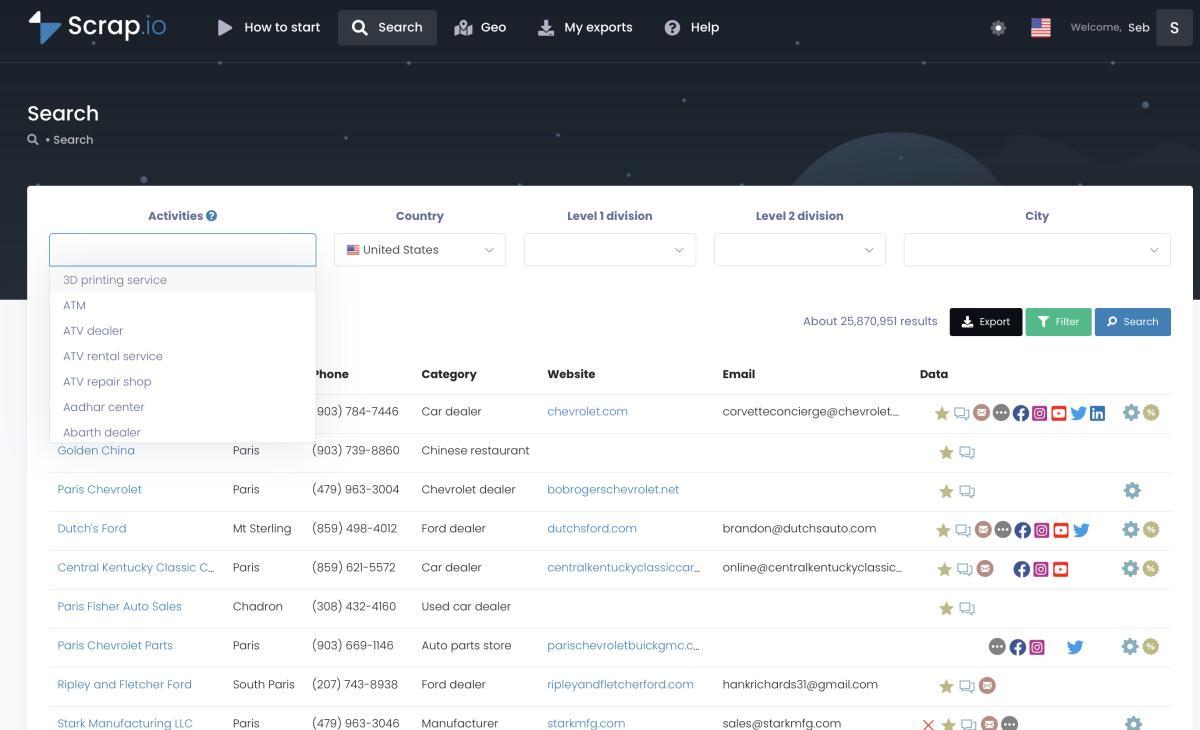
- Extract competitor data at scale. Use a tool like Scrap.io's Google Maps scraper to pull every matching business listing: names, addresses, phone numbers, emails, ratings, review counts, opening hours. All of it, in minutes, not weeks.
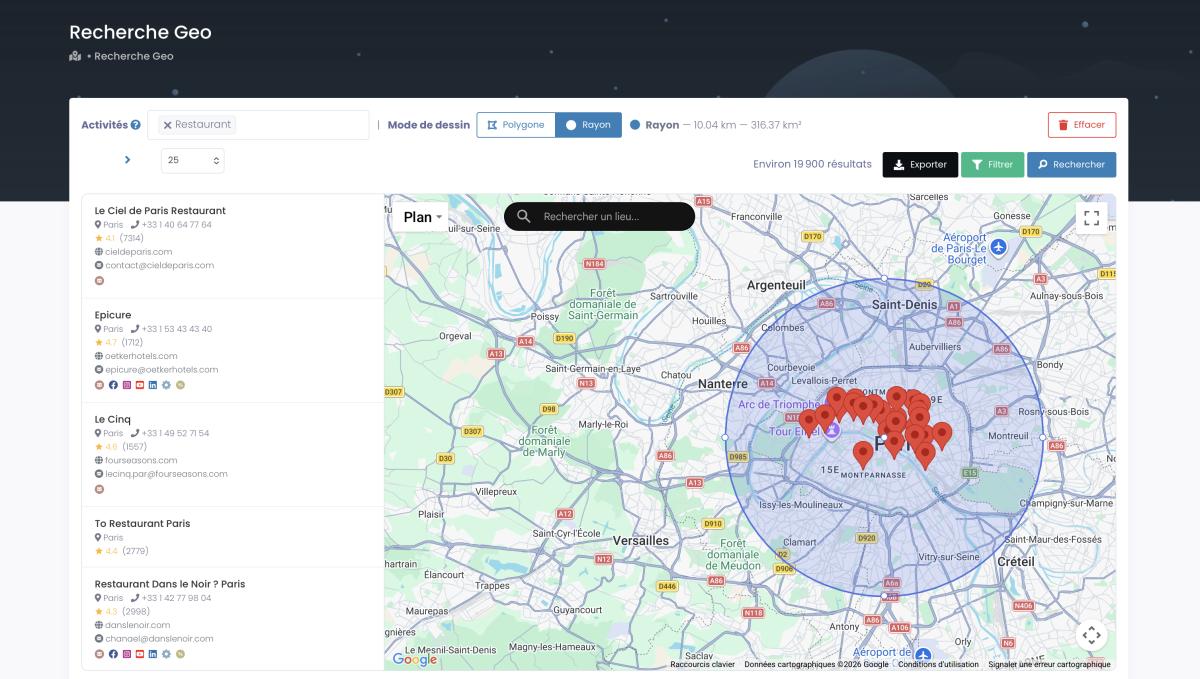
- Analyze competitor density. Map the results geographically. Where do competitors cluster? Where are the underserved zones? A heat map of your market is worth more than ten strategy decks.
- Monitor reviews and reputation. Sort competitors by review count and average rating. The ones with 200+ reviews and a 4.8 average? Those are your real threats. The ones with 15 reviews and a 3.2? Potential customers you can poach.
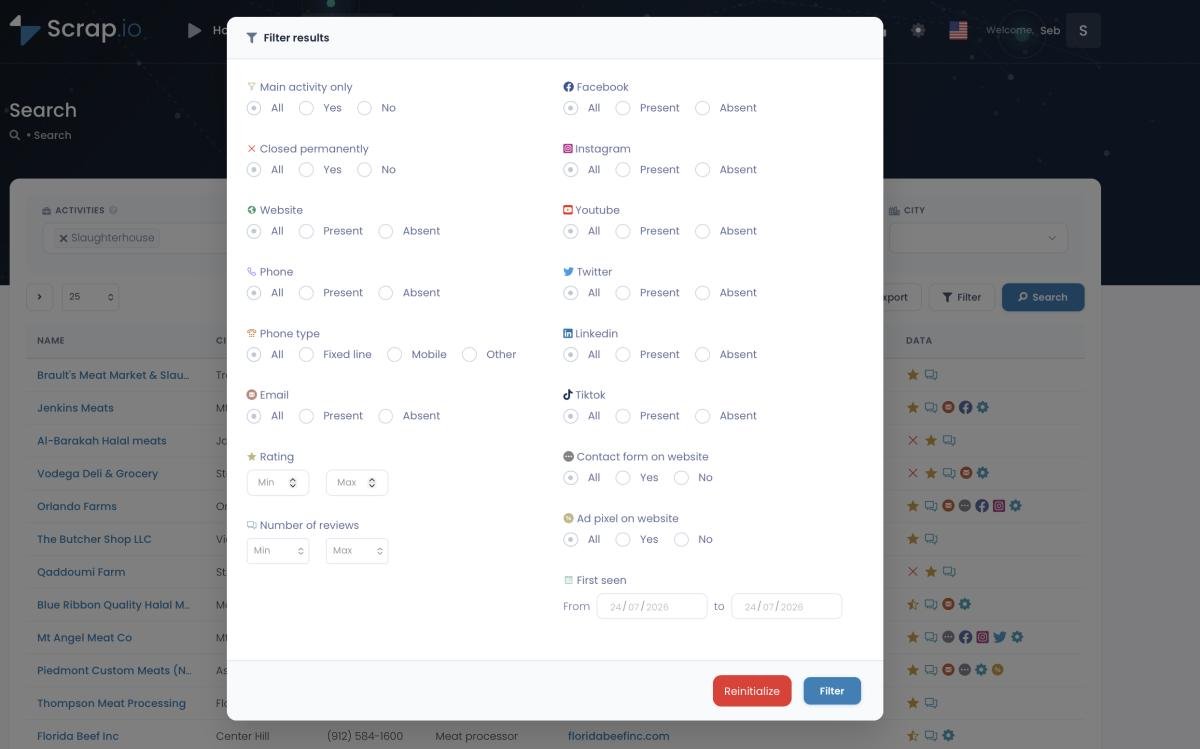
- Build targeted outreach lists. Export the data. Filter by geography, rating, or review count. Integrate with your CRM or cold email tool. Suddenly you've got a hyper-targeted business email database built from live Google Maps data.
- Set up ongoing monitoring. Markets shift. New competitors pop up. Run your extraction monthly to catch changes early. Competitive intelligence automation tools make this a 10-minute recurring task, not a quarterly research project.
The whole thing takes about 20 minutes from "I wonder who my competitors are" to "I have a full spreadsheet with emails and phone numbers for 3,000 businesses." That's not marketing hyperbole. That's just what happens when you stop doing things manually. And because Scrap.io applies filters before extraction, you only spend credits on contacts you can actually use. No wasted budget on dead listings.
Real Companies Using CI Tools (With Documented Results)
When Autodesk's CI team started using AI-powered battlecards through Klue, their win rates didn't just improve. They doubled. Well, "double-digit increases," which in enterprise sales, on deals averaging six figures, is massive money. (Source: Klue case study.)
But Autodesk wasn't alone.
Blackbaud, a cloud software company for nonprofits, saw a 28% increase in win rates after implementing Klue's competitive intelligence platform. Not a marginal bump. Twenty-eight percent. Community Brands, another Klue customer, reported a 10% win rate lift. Smaller, sure. But on their deal volume, that's still millions in recovered revenue.
And Crayon's own data paints an even broader picture. Their 2025 State of CI report found that companies delivering daily competitive intelligence saw an 84% increase in CI program effectiveness. Teams using conversational intel (think Slack alerts, not quarterly PDF reports) experienced an 82% lift in win rates.
Those are the enterprise plays. Big budgets, big outcomes. The competitive intelligence companies behind them (Crayon, Klue, Kompyte) all built their reputations on digital signals. But what about the rest of us?
On the location intelligence side, Google reports that 30% of organizations using geospatial data see 20%+ KPI improvement. These are concrete competitive intelligence examples in business: not theory, not projections. That includes small businesses using Google Maps data to identify underserved markets, track local competitor expansion, and build cold email outreach lists from scratch.
One pattern kept coming up in our research across forums and industry discussions: teams that combine traditional CI platforms (Crayon or Klue for digital tracking) with location-based tools (like Scrap.io for physical market data) report the most complete competitive picture. As one product marketer noted on Gartner Peer Insights: the biggest gap in most CI setups is "real-world market data that doesn't come from a website." Another reviewer pointed out that "we spend $30K/year on CI software and still miss local competitive threats because none of these tools look at actual storefronts."
CI Tools vs Google Maps Scrapers: What's the Difference?
Do you actually need a $500/month competitive intelligence software platform? Or would a $49 Google Maps scraper do the job?
Honest answer: it depends. And they're not interchangeable.
Video: Stop Paying $20,000/Year for ZoomInfo, This Does More for $49/Month
| Feature | Traditional CI Tools | Google Maps Scrapers (e.g. Scrap.io) |
|---|---|---|
| Primary data source | Websites, news, SEC filings | Google Maps listings |
| Competitor tracking | Digital presence, pricing, messaging | Physical presence, reviews, location density |
| Lead generation | Limited (not core feature) | Built-in (emails, phones, contacts) |
| Price range | $500–$3,000/mo | $49/mo |
| Best for | Enterprise SaaS, product marketing | SMBs, agencies, local businesses |
| Data freshness | Near real-time (web crawl dependent) | Real-time (Google Maps live data) |
The real answer? They're complementary, not substitutes. Crayon tells you your competitor changed their pricing page copy. Scrap.io tells you they just opened 12 new locations in your target market. Different intel, both valuable.
For competitive intelligence tools for small business and local business competitive analysis tools, though? A $49/mo B2B lead generation platform that also gives you competitive data from Google Maps is a no-brainer compared to a $25K enterprise CI contract from the big competitive intelligence companies. Bref, use both if you can afford it. Use the scraper if you can't.
CAN-SPAM, GDPR & Compliance
Quick compliance primer because nobody wants a lawsuit with their lead list.
CAN-SPAM (US): You can send unsolicited B2B emails in the US. That's legal. But you must include a physical address, a clear unsubscribe option, and accurate subject lines. Violations cost up to $51,744 per email. Not per campaign. Per email. So yeah, get this right.
GDPR (EU/UK): Stricter. You need a lawful basis for processing personal data. For B2B prospecting, "legitimate interest" typically applies, but you must provide clear opt-out mechanisms and honor every unsubscribe request immediately.
The good news: Google Maps data is publicly available business information. Phone numbers, email addresses, and business details published on Google Maps by the business owners themselves are fair game for B2B outreach, as long as you follow the rules above. Scrap.io only processes publicly available business data, keeps every record traceable to its source, and stays GDPR and CCPA compliant.
For more detail on staying compliant, check our cold email compliance guide. Boring but necessary reading.
FAQ
What are the best competitive intelligence tools in 2026?
The best competitive intelligence tools depend on your use case. For enterprise CI and sales battlecards, Crayon and Klue lead the market. For digital competitor analysis, Semrush and Similarweb. For location-based competitive intelligence using Google Maps data, Scrap.io offers the most complete solution at $49/mo, a fraction of enterprise CI pricing.
What is the cheapest competitive intelligence tool?
Scrap.io is the cheapest serious competitive intelligence tool at $49/month (or $35/month billed annually), versus $25,000+ per year for enterprise platforms like Crayon or Klue. It turns Google Maps into a live competitive database: competitor density, reviews, openings, and contact data across 225M+ listings in 195 countries. A 7-day free trial with 100 leads is included.
What's an example of competitive intelligence?
A concrete example: a home-services company extracts every plumber in its metro area from Google Maps, maps where competitors cluster, sorts them by rating and review count, and spots underserved ZIP codes. That density analysis, built from public location data in minutes, is competitive intelligence you can act on the same day.
How can I use Google Maps for competitive analysis?
You can use Google Maps for competitive analysis by extracting business listings in your target market, analyzing competitor density by geography, monitoring review sentiment, and tracking new business openings. Tools like Scrap.io automate this process, extracting thousands of listings with emails, phones, and reviews in minutes.
Are competitive intelligence tools worth the investment for small businesses?
Competitive intelligence tools for small business are absolutely worth it, if you pick the right price tier. Enterprise CI platforms at $25K+/year are overkill for most SMBs. But affordable tools like Scrap.io ($49/mo) give small teams access to competitor analysis using location data that was previously only available to large enterprises with dedicated CI teams.
What's the difference between competitive intelligence tools and Google Maps scrapers?
Traditional CI tools monitor digital competitors (websites, pricing, messaging). Google Maps scrapers extract physical market data (locations, reviews, contact info). They're complementary. The best approach for complete competitive intelligence is using both: digital tracking from a CI platform, plus location data from a Google Maps scraper.
Is it legal to scrape Google Maps for business intelligence?
Scraping publicly available business data from Google Maps for B2B purposes is generally legal in most jurisdictions. Google Maps business listings, including names, addresses, phone numbers, and reviews, are public information. However, you should always comply with local data protection laws (GDPR, CAN-SPAM) when using this data for outreach. Check our compliance guide for details.
Generate a list of restaurant with Scrap.io