

Last year, a friend of mine (he runs a mid-size e-commerce brand) told me he'd been "keeping an eye on competitor prices." Turned out his strategy was opening five browser tabs every Monday morning and squinting at product pages. That was it. His entire competitor pricing intelligence operation.
He's not alone. Most businesses treat pricing intelligence like a chore you do when you remember. Meanwhile, the price intelligence software market is projected at roughly $3.74 billion in 2026, growing about 16.8% a year (Mordor Intelligence). Someone's buying these tools. And if it's your competitors and not you? Well, you're already playing catch-up.
This guide breaks down how to track, analyze, and actually use competitor pricing data in 2026. No fluff. Real tools, real case studies, real frameworks you can steal today.
Video: How to Extract Every Business in 1 Click (No Category)
📌 What's inside:
- What Is Competitor Pricing (And Why It Matters in 2026)
- How to Track Competitor Pricing: 4 Proven Methods
- Best Competitor Price Monitoring Tools in 2026
- Competitive Pricing Analysis: A Step-by-Step Framework
- Using Google Maps Data for Local Competitor Pricing
- Competitor Pricing Strategy: From Data to Action
- Compliance & Legal Considerations
- FAQ
What Is Competitor Pricing (And Why It Matters in 2026)
Competitor pricing is the practice of systematically tracking what your rivals charge, how they position those prices, and how they change them over time, then using that intelligence to set your own prices for maximum revenue and margin. It rolls price monitoring, positioning analysis, and competitive benchmarking into one ongoing process.
Competitor Pricing Defined
Competitor pricing is exactly what it sounds like: systematically tracking what your rivals charge, how they position themselves, and what pricing moves they make over time. But here's where most people get it wrong. They think it's just about knowing the number. It's not.
Good competitive pricing analysis connects price points to perceived value, market positioning, and customer behavior. The price tag is the output. Understanding why a competitor charges what they charge? That's the insight.
The 2026 Pricing Landscape
The numbers are wild. Roughly 78% of US retailers already lean on AI-enabled pricing tools (Deloitte), and the wider picture is even louder: around 89% of retail and CPG companies are using or testing AI, with active deployment hitting 58% in 2026 (Ringly.io).
Dynamic pricing is where it gets spicy. 55% of retailers plan to run AI-driven dynamic pricing in 2026, yet fewer than 15% actually pull it off today (Master of Code). Translation: the gap between intent and execution is enormous. That gap is your opening.
For scale, the global AI-in-retail market hit roughly $18.4 billion in 2026 (Ringly.io), and the competitive intelligence tools market sits at $557.6 million this year, on track for $1.28 billion by 2033 at a 12.6% CAGR (Coherent Market Insights).
Ignore this and you're pricing blind. Simple as that.
How to Track Competitor Pricing: 4 Proven Methods
Still checking competitor websites one by one in a spreadsheet? That's not a strategy. That's a part-time job nobody applied for. Let's look at what actually works in 2026 for price tracking competitors.
Manual Monitoring (and Why It Doesn't Scale)
The classic approach. Open a browser, visit competitor sites, write down prices. Repeat weekly. It works, if you have three competitors and infinite patience. (Spoiler: you probably have neither.)
A typical team burns ~2,080 hours per year on manual competitor tracking (PriceMole). That's a full-time employee doing nothing but checking prices. Teams that switch to automated monitoring tend to make that time back within the first month. There's a better way.
Web Scraping & Price Crawlers
Automated scripts that crawl competitor websites and extract pricing data. More scalable than manual tracking. But (and this is a big but) you need technical skills, ongoing maintenance, and a plan for when sites change their HTML structure. Which they will. Constantly.
Google Maps Data Extraction (for Local/Service Businesses)
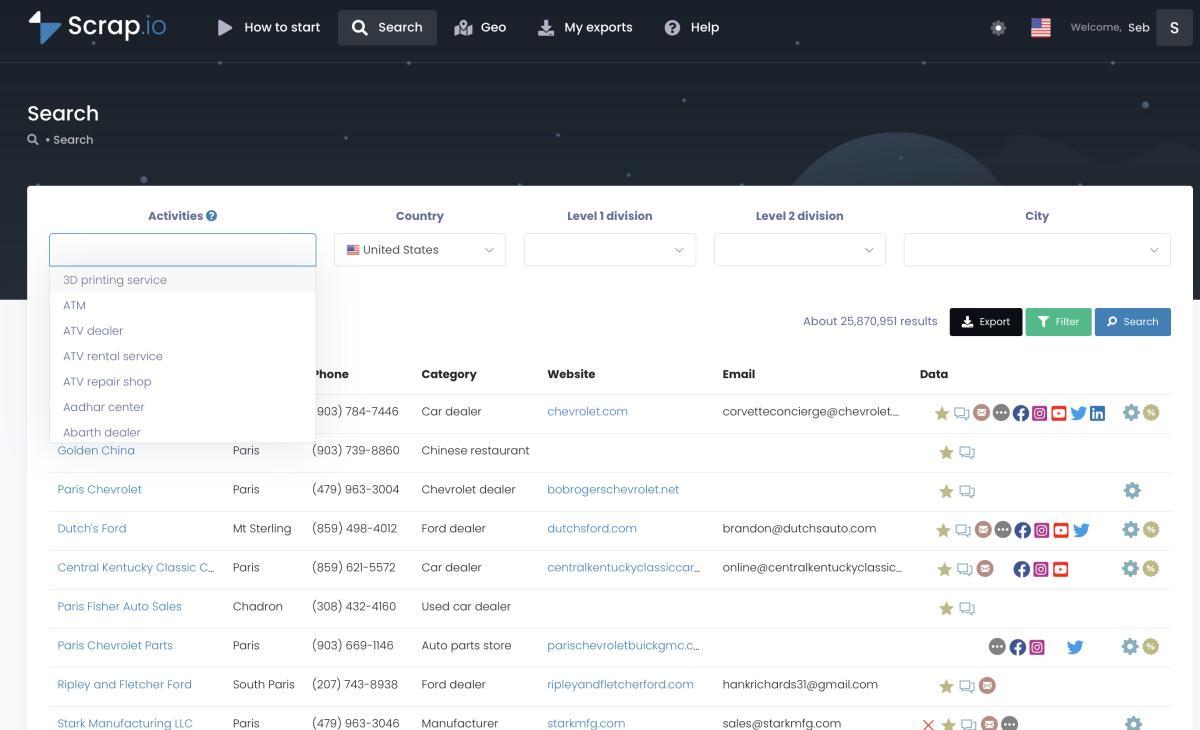
Here's one that most people overlook completely. Google Maps shows pricing tiers ($, $$, $$$, $$$$), customer ratings, review volumes, and business details for millions of local businesses. That's Google Maps competitor pricing data sitting there, free and public. Tools like Scrap.io let you scrape Google Maps for business data at scale: hundreds or thousands of competitors in minutes.
Dedicated Price Intelligence Platforms
Enterprise-grade solutions like Prisync, Competera, or Vendavo that do the heavy lifting: automated crawling, normalization, real-time competitor price alerts, repricing recommendations. If you want a full competitor pricing software comparison, keep reading. There's a table below. Great for e-commerce at scale. Less great for your wallet. Most start at $200+/month.
Bref, here's how the four methods stack up:
| Method | Cost | Scalability | Accuracy | Best For |
|---|---|---|---|---|
| Manual Monitoring | Free (but time = 💰) | 🔴 Low | 🟡 Medium | <10 competitors |
| Web Scraping | $-$$ | 🟡 Medium | 🟢 High | Tech-savvy teams |
| Google Maps Extraction | $ | 🟢 High | 🟢 High | Local & service businesses |
| Price Intelligence Platforms | $$$-$$$$ | 🟢 High | 🟢 High (95-99%) | E-commerce at scale |
Best Competitor Price Monitoring Tools in 2026
There are now 50+ competitive pricing tools on the market. Most of them solve the same problem the same way. Here's how to pick the right one without drowning in feature lists.
For E-commerce (Prisync, Price2Spy, Competera)
Prisync is the crowd favorite: highest-rated on Capterra and G2 for competitive pricing. Tracks product-level pricing across marketplaces and competitor websites. Price2Spy does something similar with a slightly older interface. And Competera? They got named Gartner Representative Vendor in the 2024 Market Guide for Pricing Software (Gartner). Not bad.
But (and I'll be honest with you) these tools are built for product-based e-commerce. If you sell services, run a local business, or operate in B2B? They won't help much.
For B2B (Vendavo, PROS, Zilliant)
Enterprise pricing suites designed for complex B2B scenarios with contract pricing, volume discounts, and custom quotes. Think industrial suppliers, SaaS with tiered plans, wholesale distributors. Expensive. Powerful. Overkill for 90% of businesses.
For Local & Service Businesses (Scrap.io + Google Maps)
OK, now let's get practical. If you're a restaurant, dentist, cleaning service, or any local player working out competitor pricing for local businesses, your competitors aren't listed on Amazon. They're on Google Maps. And that's exactly where Scrap.io shines.
Hotels are a perfect example: rate shopping is practically its own discipline, with a whole category of hotel rate shopping tools built around monitoring competitor room rates. But for most local and service businesses, the pricing signal you need is already sitting on the map.
Scrap.io extracts competitor data directly from Google Maps: pricing tiers, ratings, review counts, locations, business hours. No code. No API limits. No Google Maps API pricing headaches. You filter by category, location, rating, and export everything to CSV or Excel.
Video: How Pizzerias Spy on Competitors Using Google Maps
💡 See how Scrap.io pulls competitor data from Google Maps. Extract pricing tiers, ratings, and business details for any industry across 225M+ listings in 195 countries. Start your free trial →
Comparison Table: 10 Competitor Pricing Tools
| Tool | Focus | Starting Price | Best For |
|---|---|---|---|
| Prisync | E-commerce | $99/mo | SMB e-commerce |
| Price2Spy | E-commerce | $94/mo | Marketplace sellers |
| Competera | AI pricing | Custom | Enterprise retail |
| Vendavo | B2B | Custom | Industrial/manufacturing |
| PROS | B2B | Custom | Airlines, logistics |
| Zilliant | B2B | Custom | Distribution |
| Scrap.io | Local/Maps | Free trial | Local & service businesses |
| Visualping | Web monitoring | Free tier | Page-change alerts |
| Klue | Competitive intel | Custom | Sales enablement |
| Crayon | Competitive intel | Custom | Market intelligence |
Competitive Pricing Analysis: A Step-by-Step Framework
Here's a pattern I see constantly. A founder launches a SaaS priced 20% below the market leader, and still loses deals. Why? The prospects didn't want the cheapest option. They wanted proof of value. That's what a real competitive pricing analysis gives you.
If you want to know how to do competitive pricing analysis that actually drives decisions, here's a framework that works whether you sell software or sandwiches.
Step 1: Identify Your Competitors
Not just the obvious ones. Direct competitors, sure. But also indirect competitors: the DIY option, the "do nothing" option, the weirdly cheap alternative from a different category. Map them all. You can use geolocation data for B2B marketing to identify competitors in your radius that you might not even know exist.
Step 2: Collect Pricing Data (at Scale)
Manual collection caps out fast. Use one of the four methods above. Automated competitor price tracking is non-negotiable if you have more than 15-20 competitors to watch. Try doing it by hand with 200 local competitors. I'll wait.
Step 3: Normalize & Compare
Raw price data is useless without context. Normalize for units, bundles, contract lengths, and included features. A $99/month tool with unlimited users is wildly different from a $49/month tool charging per seat. Sounds obvious? You'd be surprised how many teams skip this.
Step 4: Map Pricing to Value
Plot competitors on a price-vs-value matrix. Where are the gaps? Where's the premium space nobody's occupying? Where's the race-to-the-bottom nobody should join? This is where competitor pricing strategy examples from your industry become gold.
Step 5: Act on Insights
Data without action is just trivia. Decide: do you match? Undercut? Position as premium? Adjust dynamically? (More on that in the strategy section below.)
A competitor pricing analysis template helps systematize this. Even a simple spreadsheet with columns for competitor, price point, features included, positioning tier, and update frequency works. Nothing fancy. Just consistent.
Using Google Maps Data for Local Competitor Pricing
Google Maps isn't just for directions. It's the world's largest real-time database of local business intelligence: pricing tiers, reviews, and competitive positioning. And most businesses are ignoring it completely.
It's also the backbone of broader Google Maps competitor analysis, and it doubles as one of the sharpest market research tools for local businesses going. Same data, three jobs.
What Google Maps Tells You About Competitor Pricing
Every business listed on Google Maps can have a price level indicator: $, $$, $$$, or $$$$. Combined with ratings, review counts, photos, and business descriptions, you've got a surprisingly rich competitive dataset. For competitor pricing for local businesses, this is often better than any paid tool.
Price Tier Detection ($, $$, $$$, $$$$)
Google's price tiers aren't random. They're aggregated from user contributions, business-provided data, and menu/price analysis. A $$ restaurant in Manhattan means something very different from $$ in rural Texas. But within a geographic area, the tiers are remarkably consistent for competitive benchmarking.
How Scrap.io Extracts Competitor Data at Scale
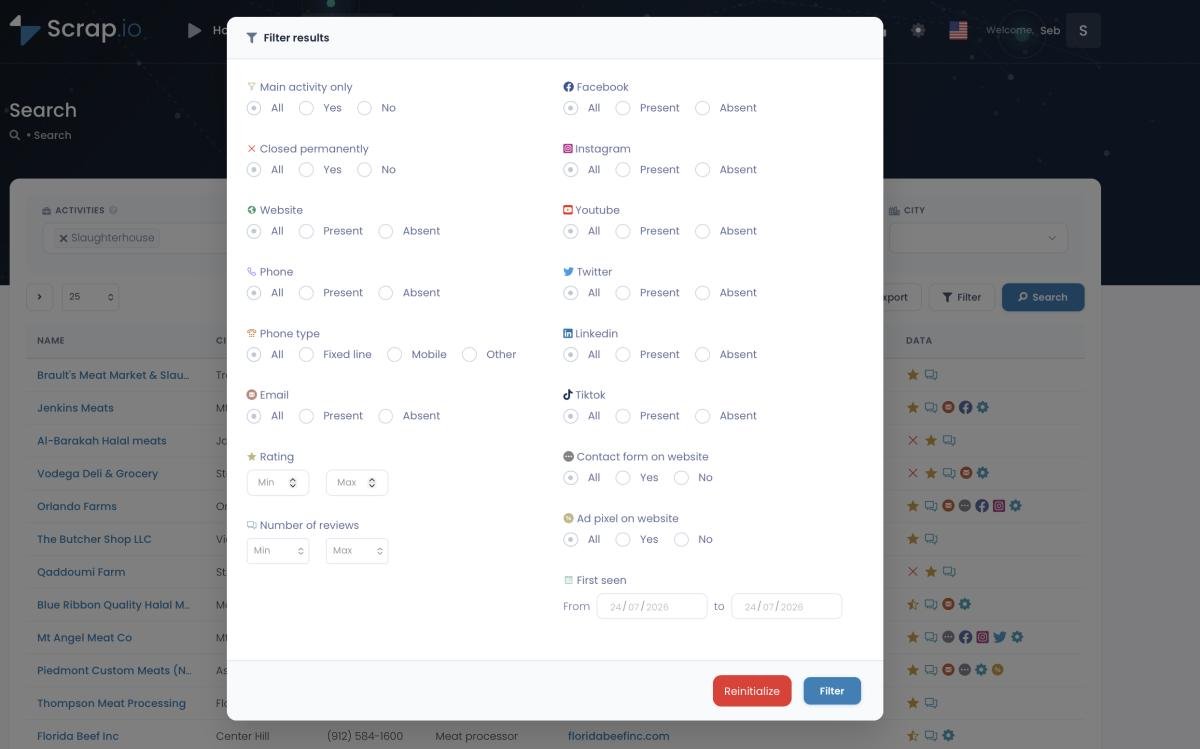
Here's the thing. You can't manually check 500 Google Maps listings. But Scrap.io does it in seconds. Filter by category, location (down to neighborhood or radius), price level, rating, review count. Export everything. Done.
No code required. No API key. No $200/month Google Maps Platform bill. Just a Google Maps scraping guide and a search bar. If you've never touched the tool, this two-minute walkthrough covers the whole flow.
Video: Scrap.io - How to Start?
Real Example: Monitoring 500+ Restaurants in a Metro Area
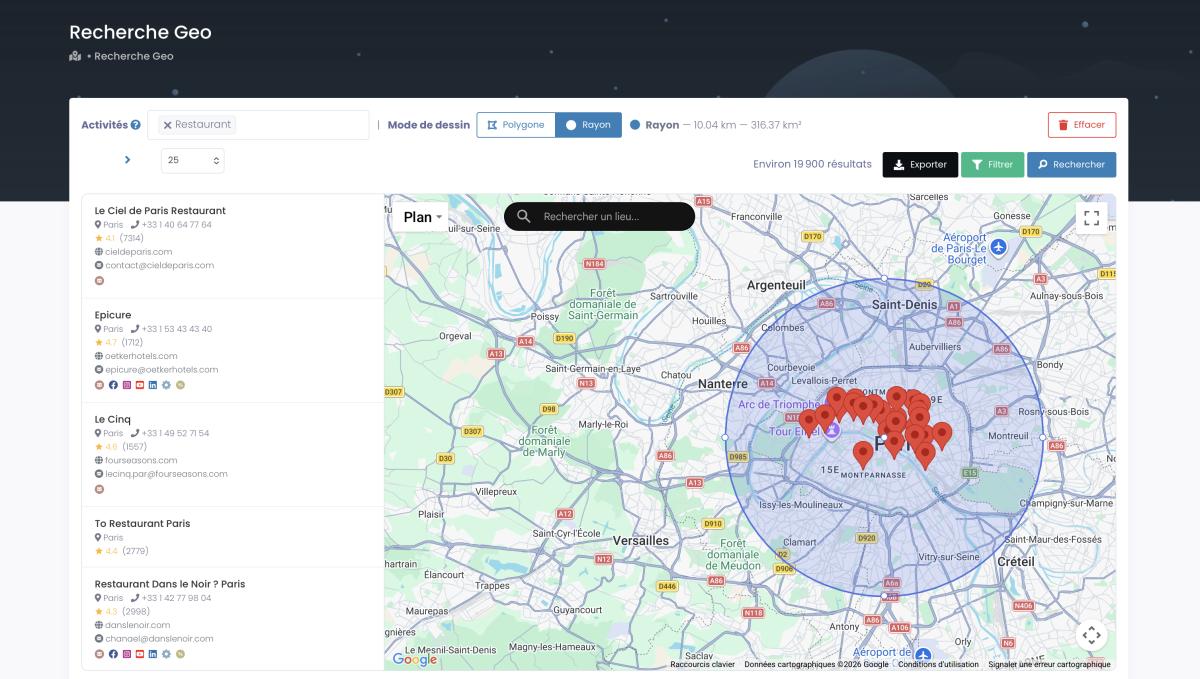
Say you manage a restaurant group and want the competitive pricing landscape across your metro area. The workflow is dead simple. Search "restaurant" within a 20km radius of your location. In one export, you get 500+ competitors with their price tier, average rating, review volume, and exact location.
Sort by price tier to see where the market is concentrated. Filter by rating to find the overpriced-and-underperforming competitors you can eat alive. (Pun intended.) Cross-reference with review sentiment to find pricing gaps nobody else has spotted.
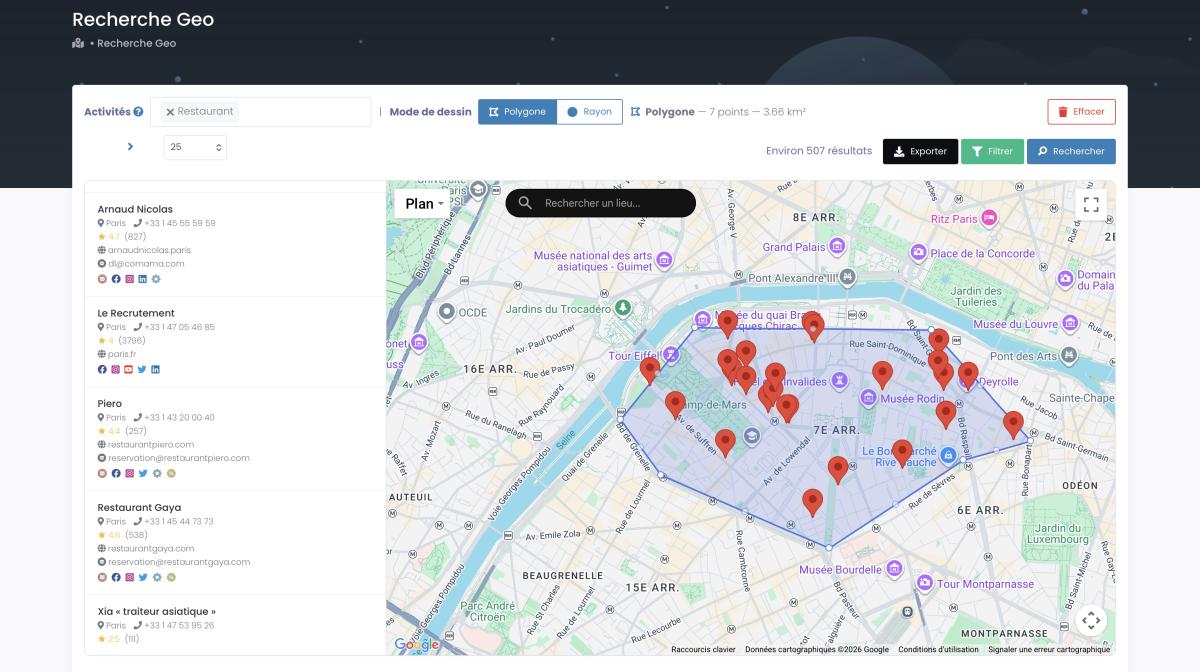
It's the kind of move small-business owners quietly swear by: Google Maps is an underrated goldmine for reading what your local competitors are actually doing with their pricing. Need a shape that isn't a tidy circle? A polygon search carves out a single neighborhood, a corridor, whatever ignores city lines.
📌 Try Scrap.io free for 7 days and extract 100 leads from Google Maps: competitor pricing tiers, ratings, and locations. Filter before you export, so you only spend credits on data you'll use. Start your free trial →
Competitor Pricing Strategy: From Data to Action
You've got the data. Now what? Most teams collect competitive pricing intelligence and then… do nothing with it. Spreadsheets pile up. Reports get filed. Prices stay the same. Ask anyone who's run pricing at a growing company and you'll hear the same line: the hard part isn't collecting the data, it's deciding what to do with it. Sound familiar?
Before we get tactical, the four core pricing methods, quickly:
- Cost-plus pricing: add a fixed margin on top of your costs.
- Competitive (competitor-based) pricing: set prices relative to what rivals charge.
- Value-based pricing: price to the value the customer perceives.
- Dynamic pricing: adjust in real time based on demand, competitors, and rules.
If you want to go wider than price alone, the same Maps data powers full competitive intelligence with Google Maps, not just pricing. Expansion, review trends, service gaps, the lot.
Price Matching vs. Price Leading vs. Value-Based
Three basic plays. Price matching keeps you competitive but kills margins if you're not careful. Price leading (undercut everyone) works for commodities and is terrible for differentiated products. Value-based pricing? Hardest to execute, most profitable when done right.
My advice? Value-based, always. But you need the competitive data to prove your value story. That's where competitor pricing strategy meets reality.
Dynamic Repricing: When & How
Companies using dynamic pricing see a 2-5% margin bump on average (McKinsey), and the newer AI-driven systems push that to a 3-6% gross-margin lift (Master of Code). But dynamic doesn't mean erratic. Set rules: match competitor X within 5% if they drop below threshold Y. Raise prices when demand spikes and competitors are out of stock. The data makes the decision. You set the guardrails.
And dynamic pricing vs competitor pricing? They're not opposites. Dynamic pricing uses competitor pricing data as one of its inputs. The best systems combine both.
Turning Insights Into Revenue (Case Studies)
A global petrochemical company deployed ML-enabled dynamic pricing across 6 business units and generated approximately $100 million in additional earnings (McKinsey case study). Massive.
Closer to earth: a home appliances brand in India used agentic competitor price intelligence for e-commerce marketplaces and saw a 15% uplift in e-commerce sales volume with 25% system accuracy improvement over 6 months (TheAgentics.co). And a Portland kitchenware store discovered through competitive analysis that no local rivals offered price matching, implemented it, and got a 15% increase in conversion rate with minimal margin impact (FirstPier.com analysis).
Organizations that implement competitor price monitoring consistently report around a 15% cumulative profit increase over 5 years (PriceMole / industry reports). Not overnight wins, but compounding gains that actually stick.
Oh, and also: you can feed your CRM automation with Google Maps data to turn pricing intelligence into actual sales workflows. Then personalize cold emails for local businesses based on what you've learned about their positioning.
Compliance & Legal Considerations
Is it legal to monitor competitor prices? Short answer: yes. Long answer: it depends on how you do it.
Public Data vs. Protected Data
Publicly listed prices (on websites, Google Maps, marketplaces) are fair game. That's public information anyone with a browser can see. Protected data behind logins, paywalls, or contractual restrictions? Stay away.
Anti-Scraping Policies & Best Practices
Some websites explicitly prohibit automated scraping in their Terms of Service. Respect that. Use tools that collect public data responsibly. Scrap.io, for instance, only extracts publicly available information from Google Maps. No logins. No bypassing. No gray areas.
GDPR and B2B Price Data
Good news: business pricing data generally isn't personal data under GDPR. You're tracking what a company charges, not individual consumer behavior. That said, if your B2B competitor pricing intelligence process involves collecting personal information (contact details of pricing managers, for example), GDPR rules apply. Keep it clean.
Conclusion
Competitor pricing intelligence isn't optional anymore. The tools exist. The data is accessible. And your competitors are almost certainly using it. Ten local competitors on Google Maps or 1,000 e-commerce SKUs, the framework is the same: collect, normalize, analyze, act.
The best B2B lead generation platforms already integrate competitive data. The question isn't whether to start. It's how fast you can.
Your competitors are already tracking your prices. Start tracking theirs. Try Scrap.io free for 7 days, 100 leads included, filtered before you spend a credit. Start now →
Then? Convert those Google Maps prospects into customers. That's the endgame.
FAQ
What is competitor pricing analysis?
Competitor pricing analysis is the process of systematically collecting, comparing, and evaluating the pricing strategies of competing businesses. It includes monitoring price changes, understanding positioning (premium vs. budget), and using that data to optimize your own pricing for maximum revenue and margin. Not rocket science, but it does require consistency.
How often should you track competitor prices?
For e-commerce, daily monitoring is standard, since prices change constantly on marketplaces. For B2B and local businesses, weekly or bi-weekly checks work fine. The best competitor price monitoring tools 2026 can run continuous monitoring so you never miss a shift, Scrap.io included.
Is it legal to monitor competitor pricing?
Yes, monitoring publicly available pricing information is legal. This includes prices on websites, Google Maps pricing tiers, and published rate cards. Avoid accessing protected data behind logins, and comply with website terms of service and GDPR for personal data. Public pricing is public. Period.
Can you give me an example of competitor-based pricing?
Sure. Picture two neighboring restaurants with near-identical menus. One sits at $$ on Google Maps, the other at $$$. The $$$ spot notices it's losing price-sensitive diners, so it repositions: a value lunch menu to match the $$ rival, while keeping premium dinner pricing. That's competitor-based pricing in a single move.
What's the best competitor pricing tool for local businesses?
For local and service businesses, Google Maps is the richest data source. It shows pricing tiers, ratings, reviews, and competitor locations. Scrap.io is purpose-built to extract this data at scale, while tools like Prisync and Price2Spy focus more on e-commerce product pricing. Different problems, different tools.
How does Google Maps data help with competitor pricing?
Google Maps displays pricing tiers ($ to $$$$), customer ratings, review volume, business hours, and locations for millions of businesses. By extracting this data with tools like Scrap.io, you can benchmark your pricing against hundreds of local competitors simultaneously, identify pricing gaps, and learn how to monitor competitor prices at scale without breaking the bank. That's price intelligence for small business done right.
Generate a list of restaurant with Scrap.io