

- What Is an Email List by Industry?
- Why Industry-Specific Targeting Beats Generic Lists
- Top Industries for B2B Email Outreach in 2026
- How to Buy Email Lists by Industry (The Right Way)
- Best Email List Providers Compared (2026)
- How Scrap.io Delivers Industry Email Lists from Google Maps
- Real-World B2B Campaigns Using Industry Email Lists
- Is Buying Email Lists Legal? (CAN-SPAM, GDPR, CCPA)
- FAQ
I've been scraping business data for years. And the single most common question I get from cold outreach beginners? "Where do I find an email list by industry that doesn't bounce half the time?"
Fair question. The B2B data market is exploding. It's on track to hit $15 billion by 2030 (MarketScale, July 2026), and even the narrower contact-data slice is projected at $3.2 billion by 2030, up from $863.2 million recently, a 24.6% CAGR (Prospeo). That's a mountain of money chasing contact data. But here's the thing. Most of it is garbage.
Seriously. B2B data doesn't age like wine. It rots. ZoomInfo puts the decay rate at roughly 25-30% per year, driven mostly by people changing jobs (ZoomInfo, 2026). Compound that across three or four years and you sail right past the 75% mark, which is where those scary "your list is mostly dead" headlines come from. So that "premium" industry mailing list you bought six months ago? A big chunk of those people have already moved on. Companies closed. Contacts switched jobs. The emails just... don't exist anymore.
So I wrote this. Everything I know about finding a reliable email list by industry, which providers are actually worth your money (spoiler: not all of them), and how to dodge the classic traps that turn your outreach into a bounce-rate nightmare.
Video: Why Your Google Maps Emails Don't Get Replies
What Is an Email List by Industry?
An email list by industry is exactly what it sounds like. A database of business email addresses organized by sector. Healthcare. Construction. Real estate. Restaurants. You pick the vertical, and you get contacts in that vertical.
The concept behind an email list by industry is segmentation. Not all lists are created equal. Some are compiled from public records and web scraping (that's more or less what we do at Scrap.io). Others are aggregated from trade show registrations, intent data providers, or straight-up purchased from third-party brokers who won't tell you where the data came from. Red flag.
The core idea is simple. Instead of blasting 50,000 random email addresses and praying, you target a specific industry where your product or service actually solves a problem. A business email list organized as an email list by industry means higher open rates, better reply rates, and (most importantly) fewer people hitting "Report Spam."
One thing to keep in mind: the term "email list" gets thrown around loosely. Sometimes it means opt-in subscribers (great), sometimes it means scraped contacts (fine if done right), and sometimes it means... a CSV file some guy on a forum is selling for $29. Guess which one gets your domain blacklisted.
Why Industry-Specific Targeting Beats Generic Lists
OK but why bother with an email list by industry at all? Can't you just buy a massive list and filter later?
You can. People do. And they get terrible results.
Here's why. When you send a cold email to a restaurant owner about your POS system, and you mention the specific pain points of running a restaurant (margins, turnover, delivery platform fees), that email feels relevant. It lands differently than "Dear Business Owner, we have a solution for you." Nobody reads that. Nobody has ever read that.
The numbers back this up hard. Email marketing still delivers $36 to $42 for every dollar spent (Omnisend, 2026). But that ROI assumes you're emailing people who care. A generic list? Your ROI is closer to "negative, plus a damaged sender reputation."
Industry-specific lists let you personalize at scale. Write one template per vertical, reference metrics that actually matter in that sector, and suddenly your cold email reads like you understand the recipient's world. Because (ideally) you do.
And the bounce-rate difference is massive. It comes straight back to freshness: if your provider hands you a static file that decays 25-30% a year, you're paying to email ghosts. A real-time, industry-segmented source doesn't have that problem, because there's nothing to go stale. That's the whole game.
Bref. Generic lists are cheap for a reason. They produce cheap results.
Top Industries for B2B Email Outreach in 2026
Not every industry responds to cold email the same way. Some sectors are drowning in outreach (looking at you, SaaS). Others are still wide open because nobody's doing it properly yet.
If you're shopping for an email list by industry, these are the verticals we see performing best right now:
Healthcare
Massive market, fragmented players. Thousands of private clinics, dental offices, and specialized practices that actively need software, supplies, and services. The catch? Compliance is stricter, so your data source matters. Check our full breakdown on healthcare email lists and dentist email lists.
Real Estate
Agents, brokers, property managers. They live on their phones and check email obsessively. Response rates are among the highest we've tracked. More details in our real estate agent email list guide.
Restaurants
Everyone eats. And every restaurant owner is fighting the same battles: margins, staffing, online reviews. If your product helps with any of those, an email list of restaurant owners is gold. Quick reality check on the scale here: as of today, Scrap.io indexes 666,782 restaurants on U.S. Google Maps, 198,958 of them with a public email address ready to export (Scrap.io, real-time). That's not a broker's dusty CSV. That's today's data. We wrote an entire guide on restaurant email lists if you want the deep dive.
Tech & SaaS
Oversaturated inbox. Harder to stand out. But if your offer is genuinely relevant (not another "We help SaaS companies grow" pitch), the deal sizes make it worth the effort.
Finance
Insurance agents, financial advisors, accounting firms. Very email-responsive, surprisingly underserved by quality outreach. Most of the emails they receive are from compliance departments, so a well-crafted cold email actually gets read.
Construction & Trades
Contractors, electricians, plumbers, general contractors. These folks rarely get B2B cold email, which means your open rates can be insane. See our construction company email list guide for specifics.
How to Buy Email Lists by Industry (The Right Way)
Let's get one thing out of the way. Yes, you can buy an email list by industry. No, it's not illegal (in most cases). But the way you buy them determines whether you'll get results or get your sender domain torched.
Here's how to buy email lists, and specifically how to buy an email list by industry, without ruining your outreach before it starts:
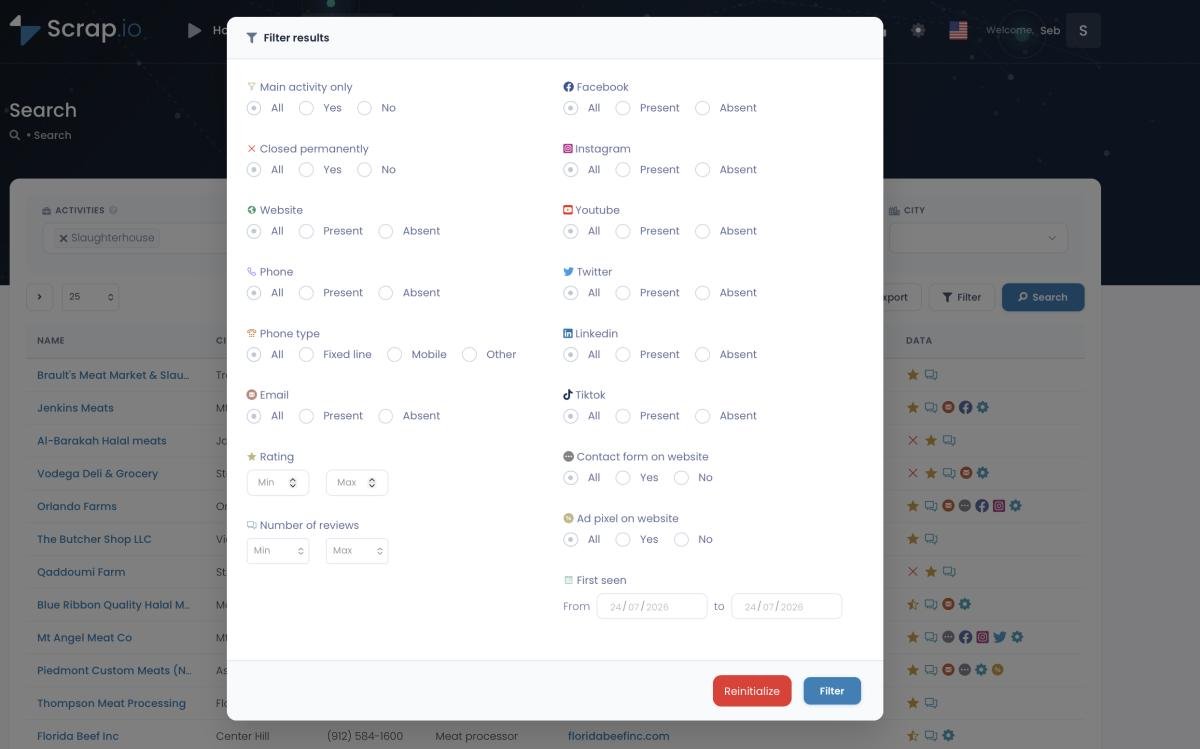
Step 1 - Define your ICP first. Not "small businesses." Not "companies in the US." I mean: restaurants with 10-50 employees in Texas that have a Google Maps listing with at least 4 stars and a working website. That level of specificity. If your list provider can't filter to that level, you're already compromising. This is exactly where filtering-before-extraction pays off, because you apply every constraint before a single credit gets spent.
Step 2 - Ask where the data comes from. This is the question that separates legit providers from data resellers. Good sources: public business directories, Google Maps data, company websites, verified opt-in databases. Bad sources: "we can't disclose our methodology." Walk away.
Step 3 - Check freshness. Remember that 25-30% annual decay stat? Ask when the data was last verified. If they can't answer, or if the answer is "quarterly," you're looking at 20-30% bounce rates minimum.
Step 4 - Request a sample. Any provider worth their salt will give you a sample before you commit. Run it through a verification tool like NeverBounce or ZeroBounce. If the valid rate is below 85%, don't buy.
Step 5 - Start small. Don't buy 100,000 contacts on day one. Buy 1,000. Test your campaign. Measure open rates, bounce rates, reply rates. Scale what works.
Oh, and one more thing. Those "free email lists for marketing" you find on random websites? They exist. They're also the fastest way to get blacklisted by every major email provider. Those lists have been recycled through hundreds of campaigns. Every spam trap in existence is on them. Just don't.
Don't take my word for it, either. The folks who send cold email for a living say the same thing, bluntly. One operator's advice on bought lists over in r/coldemail: "Do not send cold emails from your primary company domain... buy trycompany.com" (r/coldemail). Read that again. People who do this professionally assume a purchased list will torch their domain, so they plan around the damage instead of avoiding it. And when someone asks the obvious follow-up, "where do I even find these contacts?", the honest r/SaaS thread on it (r/SaaS) ends the way they all do: there's no magic file, and hand-building one at scale eats months you don't have.
The real move is building your own email list by industry from scratch, or using a tool that does the heavy lifting. Which brings us to the comparison section.
Video: How to Find the Best Email to Contact
Best Email List Providers Compared (2026)
If you're looking to buy an email list by industry, there are genuinely good providers out there. There are also plenty that charge enterprise prices for data that's two years old. Let me save you some time.
Best Email List Providers
| Provider | Data Source | Industry Filters | Email Verification | Starting Price | Best For |
|---|---|---|---|---|---|
| Scrap.io | Google Maps (real-time) | 4000+ categories | Built-in | Free trial + $49/mo | Local B2B, SMBs |
| Apollo.io | Multi-source aggregation | Yes | Partial | Free + $49/mo | Tech/SaaS outreach |
| ZoomInfo | Proprietary + web crawling | Extensive | Yes | ~$15,000/yr | Enterprise sales |
| Cognism | GDPR-compliant sources | Yes | Phone-verified | Custom pricing | European markets |
| Lemlist | 182M+ email database | Yes | Yes | $59/mo | Outreach + sequences |
| Hunter.io | Domain-based search | Limited | Yes | Free + $34/mo | Finding specific emails |
| UpLead | Multi-source + verification | Yes | 95% accuracy guarantee | $99/mo | Mid-market B2B |
Quick take: if you're targeting local businesses (restaurants, clinics, contractors, law firms...), Scrap.io is purpose-built for that. Google Maps is the single best source of SMB data on the planet, and Scrap.io pulls it in real-time, which solves the freshness problem that plagues every other email list by industry provider.
For enterprise B2B with named accounts? ZoomInfo or Cognism, depending on whether you're US-focused or Europe-focused. But be ready to write a big check.
And Lemlist is interesting because it pairs a large database (182M emails, per its own marketing) with an outreach tool. The catch? Industry filtering isn't as granular as a dedicated data provider. Different tool, different job.
How Scrap.io Delivers Industry Email Lists from Google Maps
OK, full transparency. This is the section where I talk about our own tool. But I think the "how" matters here, because it explains why the data is different from what you'll get elsewhere.
Scrap.io works by extracting business data directly from Google Maps. You search for a category (say, "plumber" or "Italian restaurant") in a specific location, and Scrap.io pulls every matching listing with the associated data: business name, address, phone, website, email, ratings, reviews, opening hours. The works.
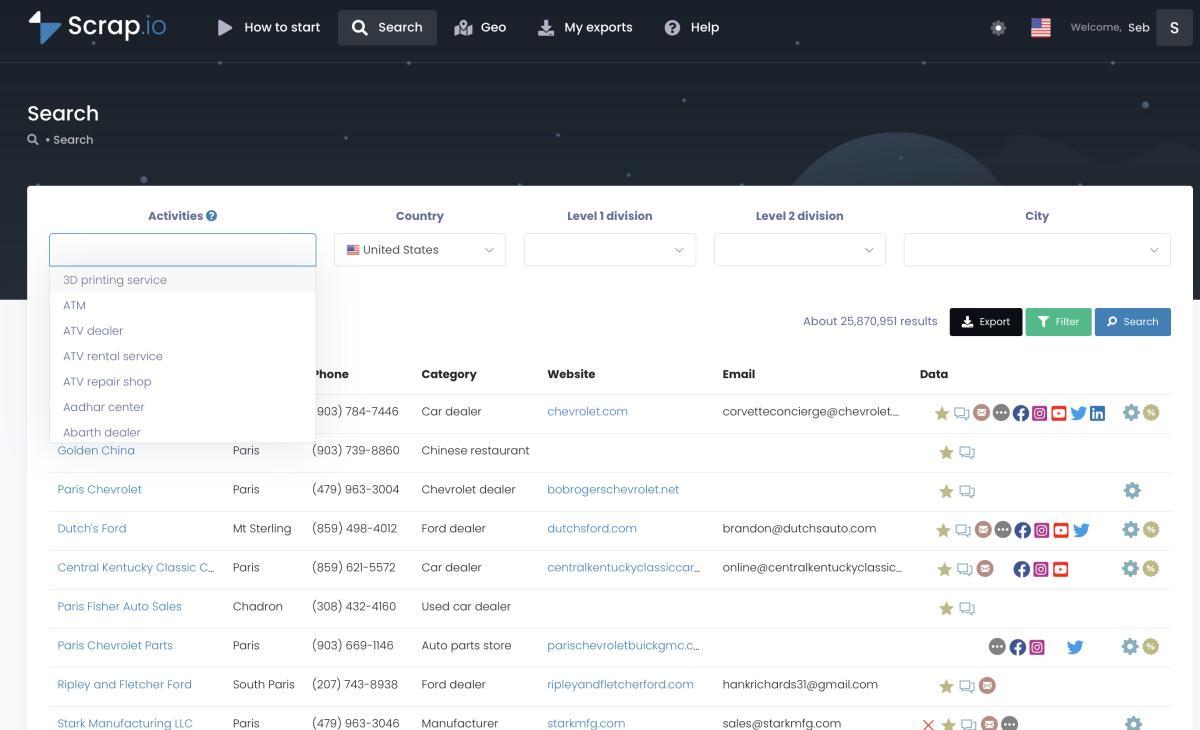
Why does this matter? Because Google Maps data is self-reported and constantly updated by business owners themselves. When a restaurant changes its email or a law firm hires a new partner, the Google listing gets updated. That means the data you extract today is today's data. Not last quarter's. Not last year's. And remember, filters apply before extraction, so you only ever spend a credit on a listing that already matches your criteria (email present, rating above 4.0, whatever you set).
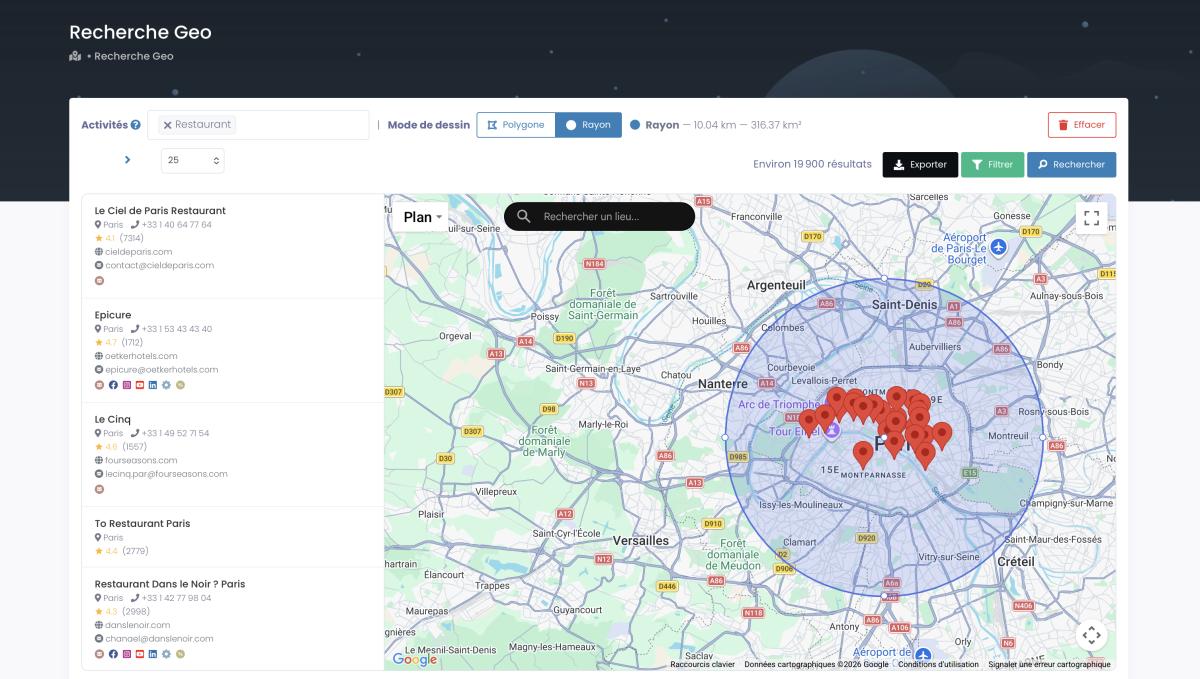
The other advantage: you can filter by industry in a way that no generic B2B database can match. Want dentists within 15 km of Houston with at least 50 reviews? Done. Want hotels in Miami Beach with a website but no booking platform? Also done. And if you'd rather target a hand-drawn zone than a whole city, the radius and polygon tools let you cover exactly the territory you need.
We also have dedicated guides for specific verticals: hotel email lists, lawyers email lists, and many more in our email database hub. Prefer to grab emails one listing at a time straight from the map? The free Chrome extension surfaces emails and social profiles right on the Google Maps interface.
Video: Scrap.io - How to Start?
Real-World B2B Campaigns Using Industry Email Lists
Theory is nice. Results are better. But let me be straight with you about the numbers you'll see floating around the internet on this topic: most of the flashy case-study figures ("we hit 84% open rates!") come from vendor blogs, and they're almost never independently verifiable. So take the exact percentages below as vendor-reported illustrations, not gospel. The pattern they point to, though, is real and repeatable.
The mechanism is dead simple. Narrow the audience, match the message to the sector, and reply rates climb. A company mailing restaurant-specific copy to restaurants and retail-specific copy to retailers will beat the same company blasting one generic template at everyone. That's not a growth-hack secret. It's just relevance.
Take the freshness angle. A team switching from a static, aging file to a verified, industry-segmented source typically watches its bounce rate collapse, because it stopped mailing dead inboxes. Vendors like Cognism have publicly claimed data-quality improvements in the 80% range after cleaning and re-verifying (their own reporting). Believe the exact figure or not, the direction is obvious: cleaner data, fewer bounces, healthier sender reputation.
Cost per contact is where the gap gets embarrassing. A broker will happily charge you $0.10 to $0.50 per record for a shared, aging file. Pull the same contacts fresh from Google Maps and you're looking at a fraction of that, exclusive to you, filtered before you spend a credit. Do that math on a 5,000-contact campaign and the comparison isn't close.
The takeaway isn't "trust the 220% number in that case study." It's this: a good email list by industry leads to better targeting, which leads to better results. Groundbreaking, I know. The companies winning at this in 2026 aren't the ones with the fattest databases. They're the ones working from precisely targeted contacts that were accurate yesterday, not last fiscal year.
Is Buying Email Lists Legal? (CAN-SPAM, GDPR, CCPA)
This is the question everyone asks and nobody wants to hear the answer to. Because the answer is: it depends.
Helpful, right? Let me break it down by regulation.
CAN-SPAM (United States): Buying email lists is legal. Sending unsolicited commercial emails is legal. What's not legal: using deceptive subject lines, failing to include an opt-out mechanism, and not identifying the message as an ad. The bar is surprisingly low, but you do need to meet it.
GDPR (European Union): This is where it gets strict. You need a "legitimate interest" or explicit consent to email someone. Buying a list and blasting it without any prior relationship is a legal risk. If you're targeting EU contacts, make sure your data provider can demonstrate GDPR compliance. Cognism built their entire business on this. If you're Europe-focused, look into them.
CCPA (California): Similar to GDPR in spirit, but focused on consumer data. B2B contacts are mostly exempt under CPRA amendments, but you still need to offer opt-out mechanisms and not sell personal data without disclosure.
Bottom line: in the US, buying and using a B2B email list by industry is generally fine as long as you follow CAN-SPAM rules. In Europe, tread carefully. And everywhere, the best practice is the same: use verified, fresh data from transparent sources (Scrap.io only ever surfaces publicly available business data, traceable to its source and RGPD/CCPA compliant), include an easy unsubscribe link, and don't be spammy.
That last part isn't legal advice. It's just common sense.
FAQ
Can I buy an email list by industry?
Yes, you can buy an email list by industry from data brokers or extract one yourself. Buying a pre-built list is fast but risky: files are often shared across buyers and decay 25-30% a year. The safer route is real-time extraction, where you pull fresh, industry-filtered contacts from public Google Maps listings and the data is exclusive to you.
How much does a quality email list by industry cost?
A quality email list by industry can range wildly. Scrap.io starts at $49/month (or $35/month billed annually) with generous monthly credits. ZoomInfo will run you $15,000+/year. And those $29 lists on forums? They'll cost you more in damaged reputation than they ever save. For SMB-focused outreach, expect to spend $50-200/month on a decent data provider.
What's the best industry for cold email in 2026?
Real estate and construction are killing it right now. Low competition in the inbox, high response rates. Healthcare is strong too but requires more compliance awareness. If you're just starting out, pick an industry where decision-makers are reachable individuals (not corporate gatekeepers) and where your offer directly solves a known pain point.
Can I use a purchased email list with Mailchimp or HubSpot?
Most ESPs (email service providers) have strict anti-spam policies that prohibit uploading purchased lists. Mailchimp will straight-up ban your account. For cold outreach with a purchased email list by industry, use a dedicated cold email platform like Lemlist, Instantly, or Smartlead. These tools are designed for it and won't penalize you.
How often should I update my email list?
Here's the thing: if you're using a tool like Scrap.io that pulls real-time data from Google Maps, you don't "update" at all. You just run a new export and get today's contacts. For static purchased lists, the story is grimmer. B2B data decays 25-30% per year (ZoomInfo), and email addresses rot even faster, so re-verify through a tool like NeverBounce before every single campaign. Or skip the treadmill entirely and extract fresh.
What bounce rate is acceptable for an industry email list?
For any email list by industry, under 5% bounce is excellent. Under 8% is acceptable. Above 10%? Your data is bad and your sender reputation is at risk. If you're consistently hitting bounce rates above 10%, switch providers immediately.
Generate a list of restaurant with Scrap.io