

Video: Scrap.io - How to Start?
- What Is Geocoding and Why Does It Matter in 2026?
- The 7 Best Free Geocoding APIs in 2026 (Compared)
- Free Geocoding APIs: Side-by-Side Pricing & Limits Comparison
- Google Geocoding API: Is It Really Free?
- Reverse Geocoding: Free APIs That Convert Coordinates to Addresses
- How to Choose the Right Free Geocoding API for Your Project
- Free Geocoding & the Legal Fine Print (Licenses, ToS, GDPR)
- When Free Geocoding Isn't Enough: Scaling with Scrap.io
- FAQ: Free Geocoding APIs
What Is Geocoding and Why Does It Matter in 2026?
Type an address into Google Maps and a geocoding API does the heavy lifting. Quietly. Behind the scenes. Processing over 10 billion location queries every single day (Source: Google Cloud blog, 2025). That's the address-to-coordinates magic running under every ride-hailing app, every delivery tracker, every "find a store near me" widget you've ever tapped.
Here's what most people get wrong, though. A geocoding API isn't just for mapping nerds. If you're building anything that touches physical locations, lead generation, logistics, real estate, local SEO, you need one. Forward geocoding turns "221B Baker Street, London" into latitude and longitude. Reverse geocoding does the opposite. Simple concept. Expensive problem if you pick the wrong provider.
And in 2026? The market keeps swelling. The geocoding and reverse geocoding market is on track to hit $33.4 billion by 2030 (Source: DataM Intelligence, 2024). More APIs, more options, more confusing pricing pages that bury the important number three scrolls down.
So choosing a free geocoder that actually works for your use case matters more than ever.
(Spoiler: "free" doesn't always mean what you think it means.)
The 7 Best Free Geocoding APIs in 2026 (Compared)
So which free geocoding API should you actually trust with your next project? I've tested all of these. Some are genuinely great. Some are, let's say, "aspirational" with their marketing.
1. Nominatim (OpenStreetMap): Truly Free, Open-Source
Nominatim is the OG of free geocoding. Built on OpenStreetMap data, it's 100% open-source, no API key required, and technically a free unlimited geocoding API if you self-host it. The catch? The public instance caps you at 1 request per second (Source: nominatim.org, 2026). That's it. One. Per. Second.
For prototyping or small-scale projects, Nominatim is unbeatable. For anything resembling production traffic, you'll need your own server. As one user on Reddit's r/gis put it: "Nominatim is a free geocoding engine that utilizes the OpenStreetMap database". True. But they forgot to mention the part where you'll spend a weekend configuring PostgreSQL and cursing at import logs.
Best for: hobbyists, open-source purists, anyone with a spare server. A solid geocoding API free OpenStreetMap option if you don't mind the DIY setup. And yes, it doubles as reverse geocoding without API key, which is rarer than it sounds.
2. Mapbox Geocoding API: 100K Free Requests/Month
Now we're talking. Mapbox gives you 100,000 free geocoding requests per month (Source: mapbox.com, 2026). That's not a typo. A hundred thousand. Used by Instacart, The Washington Post, and Shopify, so the data quality is legit.
The free geocoding API Python and JavaScript SDKs are well-documented, and you grab a geocoding API key free in about two minutes. Coverage is global. Batch support exists on paid plans. If you need a free geocoding API for commercial use, Mapbox is probably your safest bet right now.
Downside? Once you cross 100K, pricing kicks in fast. But for most startups and side projects, you'll never hit that ceiling.
3. OpenCage Geocoding API: 2,500 Free Requests/Day
OpenCage is the quiet overachiever. UK-based, GDPR-compliant by design, and they've got 40+ SDKs across every language you can think of. Free tier: 2,500 requests per day, roughly 75,000 per month (Source: opencagedata.com, 2026).
What makes OpenCage interesting is their data aggregation approach. They pull from OpenStreetMap plus other open datasets, so coverage can sometimes beat single-source providers. Also, and this matters, their geocoding API free limit resets per day, not per month. So you won't accidentally torch your whole quota in week one.
4. Geoapify: Generous Free Tier + Batch Support
German engineering applied to geocoding. Geoapify is one of the few providers offering free batch geocoding API access on the free plan. Need to geocode a CSV of 10,000 addresses overnight? Geoapify handles that without blinking.
They use open data sources, the pricing is transparent (rare in this industry), and their map tiles are actually pretty. Good option if you want a free geocoding API JavaScript integration with mapping built in.
5. Maps.co (Geocode.maps.co): 25K Demo Requests
Maps.co offers 25,000 demo requests at 5 requests per second (Source: geocode.maps.co, 2026). Decent for testing. The API is dead simple: REST endpoint, JSON response, done.
But "demo" is the operative word. This isn't really a production-grade free tier. It's a "try before you buy" situation. Fine for evaluation. Not something to build a business on.
6. Positionstack: Simple REST API with Free Tier
Oof. This one hurts. Positionstack technically has a free plan: 100 requests per month (Source: positionstack.com, 2026). A hundred. Not a hundred thousand. A hundred.
That's barely enough to test whether the API even works. The paid plans at 25,000 requests are more reasonable, but if you're reading an article about the best geocoding API free options, Positionstack's free tier is essentially decorative.
7. US Census Geocoder: 100% Free for US Addresses
Completely free. No API key. No signup. No rate limits (within reason). The US Census Geocoder is a government service that geocodes US addresses against Census TIGER data.
The catch is obvious: US addresses only. And accuracy can be hit-or-miss on rural addresses or brand-new developments. But for bulk geocoding of American addresses, especially if you need Census tract data for enrichment, nothing beats free. Hands down the best free reverse geocoding API for US-specific projects.
Bonus: Geocodio: 2,500 Free/Day for US & Canada, No Card
One more worth knowing, and it keeps showing up in Google's AI Overview for a reason. Geocodio gives you 2,500 free geocoding lookups per day across the US and Canada (Mexico too, as of 2026), with no credit card required (Source: geocod.io, 2026). Full feature access on the free tier: batch spreadsheet uploads, API, data appends, the lot.
If your addresses are North American and you want batch without a billing page, this is arguably the easiest on-ramp on the list. It's the cheapest geocoding api path to production for US and Canadian data, because for 2,500 a day the price is exactly zero.
Free Geocoding APIs: Side-by-Side Pricing & Limits Comparison
The word "free" in API marketing has more asterisks than a Terms of Service page. Here's what you're actually getting:
| Provider | Free Tier | Rate Limit | Data Source | Coverage | Batch | Reverse | Commercial Use |
|---|---|---|---|---|---|---|---|
| Nominatim | Unlimited (self-host) | 1 req/sec (public) | OpenStreetMap | Global | No | Yes | Yes (self-host) |
| Mapbox | 100K/month | 600 req/min | Proprietary + OSM | Global | Paid only | Yes | Yes |
| OpenCage | 2,500/day (~75K/mo) | 1 req/sec | OSM + multi-source | Global | No | Yes | Yes |
| Geoapify | 3,000/day | 5 req/sec | Open data | Global | Yes | Yes | Yes |
| Geocodio | 2,500/day (no card) | Daily cap | Multi-source | US + Canada | Yes | Yes | Yes |
| Maps.co | 25K demo | 5 req/sec | OSM | Global | No | Yes | Demo only |
| Positionstack | 100/month | Not documented | Multi-source | Global | Paid only | Paid only | Yes |
| US Census | Unlimited | Reasonable use | TIGER/Census | US only | Yes | Yes | Yes |
Look at that table. Really look at it. The spread between "100 requests/month" and "100,000 requests/month" is absurd. And they all call themselves "free." So read the fine print on the geocoding API free quota before you commit to anything.
Anyway. Comparing geocoding API pricing across providers is half the battle, and our Google Maps API pricing calculator helps visualize where costs really pile up. And if you want the wider landscape of paid and free providers side by side, our complete geocoding API guide is the pillar piece that zooms all the way out.
Google Geocoding API: Is It Really Free?
Time to bust a myth that half the internet still repeats. For years, the answer to "is Google Maps geocoding API free" was "you get a $200 monthly credit." Not anymore.
Google retired that shared $200 credit on February 28, 2025 (Source: Google Maps Platform, Geocoding usage & billing). The pool that floated across every Maps product? Gone. In its place, per-SKU free tiers. For geocoding specifically, you now get 10,000 free requests per month, then $5 per 1,000 requests after that (Source: Google Maps Platform Pricing, 2026).
Do the math on 100K monthly requests and your jaw will drop. That's roughly $450 a month for a single endpoint.
You'll still see the old number quoted everywhere. One Stack Overflow answer, for instance, states: "With Google Maps APIs you have $200 of free credit each month" (see the discussion on Stack Overflow). That was accurate before March 2025. It isn't now. If a tutorial still leans on the $200 figure, it's out of date, full stop.
And here's what really stings. Google's accuracy is excellent, arguably the best in developing countries where OpenStreetMap data gets patchy. But for US and EU addresses? The gap between Google and free alternatives like Mapbox or OpenCage is honestly negligible. You're paying premium prices for marginal gains.
Video: Using the Google Maps API and Google Reviews
Want the full breakdown? Our Google Maps API cost calculator shows exactly where the money disappears at scale. And if you're still setting up Google's platform, here's our complete guide to getting your API key.
Oh, and also, is Google's geocoding free for batch processing? Not really. The per-request pricing applies regardless, and there's no built-in batch endpoint. You'll handle queuing yourself, plus manage the Google geocoding API free limit resetting monthly. Doable. Annoying.
Reverse Geocoding: Free APIs That Convert Coordinates to Addresses
You've got GPS coordinates from 50,000 mobile check-ins. Now what?
That's where reverse geocoding API free options come in. You feed in coordinates, you get back a human-readable address. Most of the APIs listed above support it: Nominatim, Mapbox, OpenCage, Geoapify, Geocodio, even the US Census Geocoder.
Anyway. Not all reverse geocoding is created equal. Accuracy varies wildly by region. Google wins in rural Southeast Asia. OpenStreetMap dominates in European cities. The US Census Geocoder is king for American addresses and useless everywhere else. People ask about this constantly, there's a whole "Reverse GeoCode Free" thread on r/gis where folks argue the exact same tradeoffs. And over on Quora, "What is the best API for geocoder and reverse geocoder?" gets the predictable answer: it depends where your points are.
For a deeper technical comparison of free reverse geocoding API providers, including latency benchmarks and accuracy tests, check our dedicated reverse geocoding API comparison guide. We tested response times across 10,000 coordinates. Some results were surprising. If your input is Google Maps URLs rather than raw lat/long, this guide on extracting latitude and longitude from Google Maps covers the reverse direction too.
Quick reality check: doing reverse geocoding at scale (think 100K+ coordinates)? Free tiers won't cut it. Period. You'll either self-host Nominatim or budget for a paid plan. There's no magical free unlimited geocoding API that handles both directions at volume. Anyone who tells you otherwise is selling something.
How to Choose the Right Free Geocoding API for Your Project
Forget feature matrices for a second. Most teams overthink this. Imagine a two-person startup that wired everything to Google's API "because it's the standard," then watched the bill balloon the month they crossed the free tier. Classic. Avoidable. The fix is asking three boring questions before you write a line of code.
1. What's your monthly volume? Under 2,500/day → OpenCage, Geoapify, or Geocodio (if you're North American). Under 100K/month → Mapbox. Over 100K → self-host Nominatim or budget for paid. Hunting for a free geocoding API Reddit thread that solves the "I need 500K free requests" problem? Good luck. It doesn't exist.
2. Where are your addresses? US only → Census Geocoder (free, no questions asked). US and Canada with batch → Geocodio. Global with good EU coverage → OpenCage. Global with best accuracy → Mapbox or Google. The geocoding API free OpenStreetMap stack works great in well-mapped regions and falls apart in developing markets.
3. Do you need batch processing? Geoapify, Geocodio, and the US Census Geocoder are your realistic free batch geocoding API options, and all three eat a spreadsheet happily, so a free batch geocoding API Excel workflow is genuinely doable. Everything else? One request at a time, baby.
For the complete picture on Google Maps as a data source, beyond just geocoding, our complete Google Maps API guide covers every endpoint, pricing tier, and alternative. And if your real goal is extracting business data (not just coordinates), our Google Maps scraping guide will save you a lot of API headaches.
Free Geocoding & the Legal Fine Print (Licenses, ToS, GDPR)
Nobody reads this part. You should.
"Free" and "do whatever you want" are not the same thing. Each provider wraps its free tier in a license, and those licenses actually differ. Nominatim and anything built on OpenStreetMap ship under ODbL, which means attribution is required and, in some cases, share-alike obligations apply to derived databases. The public Nominatim instance also has a strict usage policy: one request per second, a valid User-Agent, no heavy bulk jobs. Break it and you get blocked, fairly.
Then there's storage and caching. Google's terms restrict how long you can cache geocoded results (historically 30 days), so building a permanent coordinate database on Google's API is a ToS problem, not just a cost one. Free tiers from Mapbox, OpenCage, and Geocodio each spell out their own commercial-use and retention rules, so read them before you archive a single row.
And privacy law doesn't care that the API was free. Geocoding a business address is usually fine. Geocoding personal home addresses pulls you straight into GDPR (EU) and CCPA (California) territory, where you need a lawful basis and a retention policy. Business data, public and traceable, is the safer lane. Scrap.io, for what it's worth, works only with publicly available business data and stays GDPR- and CCPA-compliant by design.
When Free Geocoding Isn't Enough: Scaling with Scrap.io
Free tiers work great for prototypes. But the moment you need 100,000+ geocoded business records with emails and phone numbers, the math changes completely.
Here's what nobody tells you about the free geocoding API workflow: you geocode an address, get coordinates, and then what? You still don't have the business name. The phone number. The email. The reviews. The opening hours. You've converted an address into two floating-point numbers. Congratulations.
Scrap.io flips this on its head. Every business exported from Google Maps comes pre-geocoded: latitude, longitude, full address, plus the enrichment data you actually need. Emails, phone numbers, ratings, review counts. No rate limits. No API complexity. No "oops, I hit my geocoding API free quota at 2 AM."
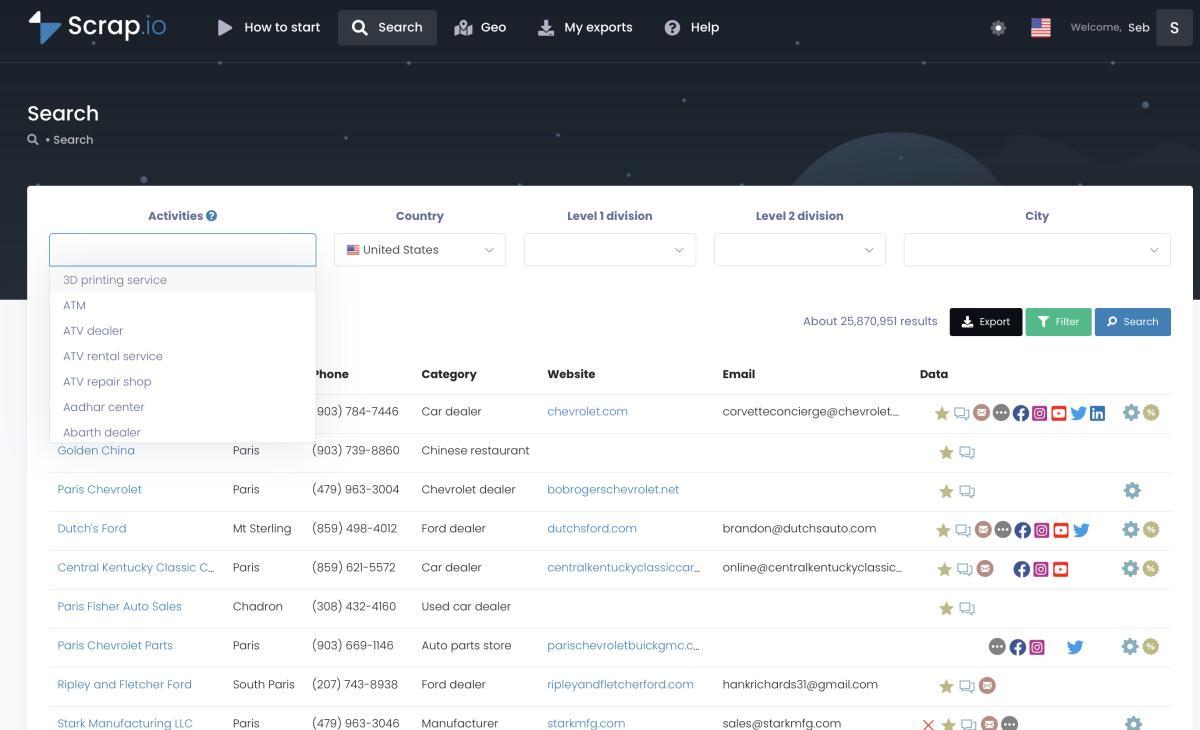
Here's the search interface, where you pick categories and a location and see the count before spending a single credit:
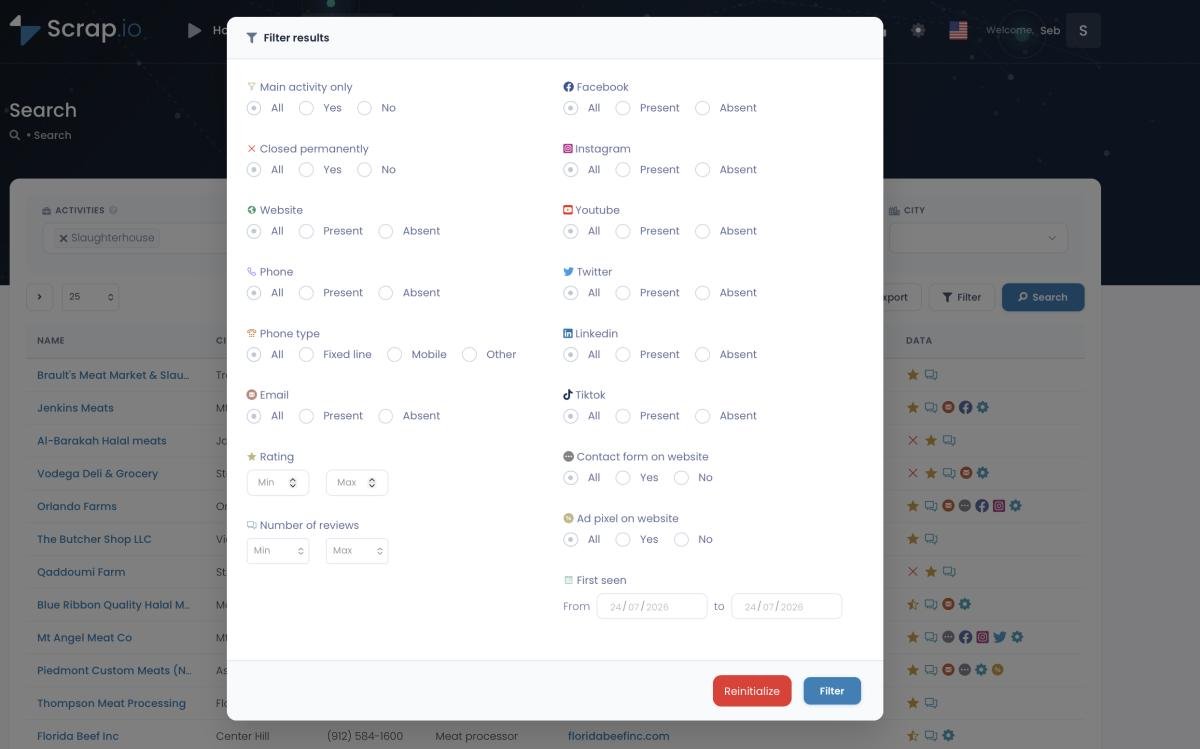
And the part that saves real money, filtering before extraction. Website present, email present, mobile number only, minimum reviews. Credits only get spent on contacts you can actually use:
Three things that make the difference:
Pre-geocoded data. Every record includes lat/long coordinates. Zero API calls needed.
Beyond coordinates. Emails, phone numbers, reviews, ratings, all in one export.
No rate limits, no API complexity. Export by category, city, or a whole country, in a couple of clicks. One real Scrap.io campaign pulled 11,734 businesses in 45 minutes (Source: Scrap.io case study).
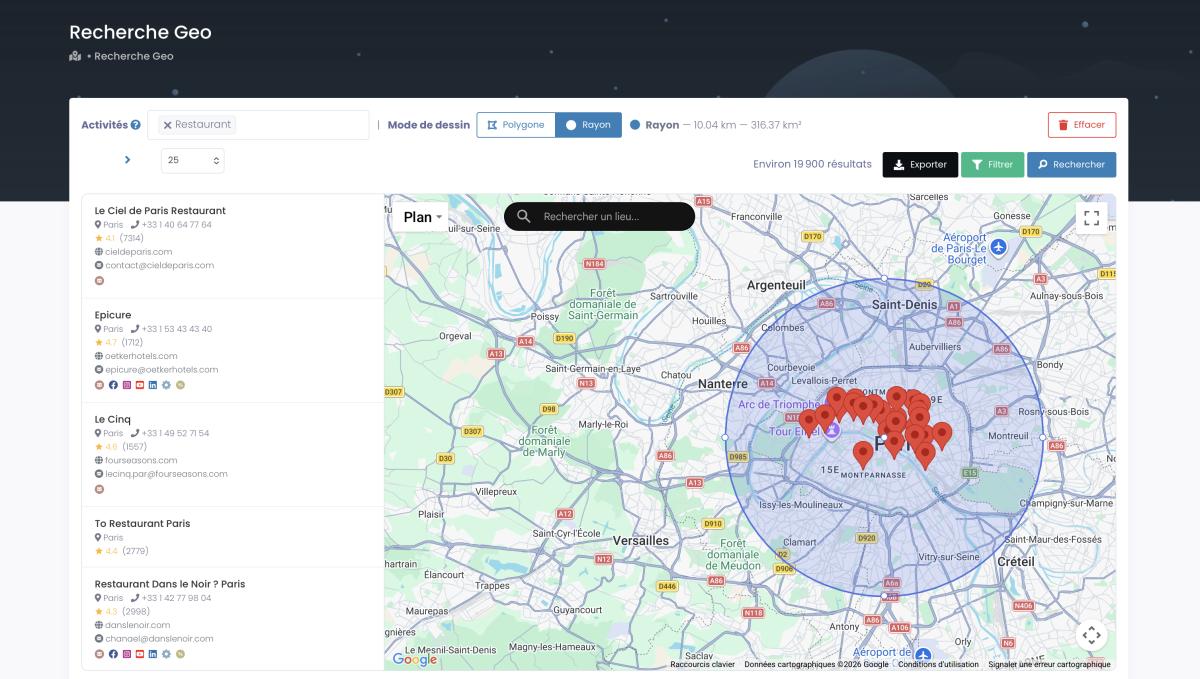
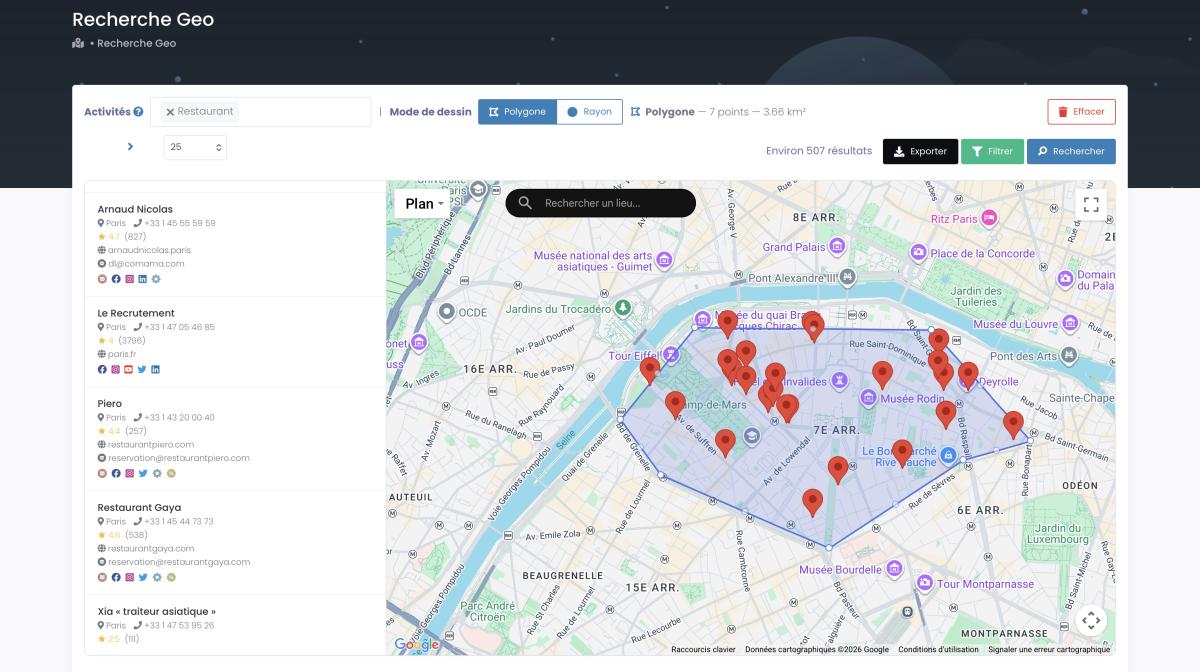
You don't even have to search by category. Draw a radius on the map, or trace a polygon around a neighborhood, and pull every business inside. Same filters apply. Here's radius mode:
And polygon mode, for boundaries that don't fit a tidy circle:
Video: How to Extract Every Business from Google Maps in 1 Click
Right. So if you're currently chaining a free geocoding API + an email finder + a phone number scraper + a review aggregator, stop. That's five tools doing what one does better. See how people find emails on Google Maps, compare Serper.dev vs Scrap.io for a head-to-head, or if you'd rather call it programmatically, our Google Maps scraper API returns the same enriched records over REST. Prefer to drive it from an AI assistant? The Scrap.io MCP connector lets Claude, ChatGPT, or Gemini run the whole thing in plain English.
FAQ: Free Geocoding APIs
Is Google Geocoding API free?
Google offers 10,000 free geocoding requests per month (per-SKU since March 2025), then $5 per 1,000 requests. The old shared $200 monthly credit no longer exists, it was retired on February 28, 2025. Mapbox stays far more generous at 100,000 free requests per month, so for most commercial projects the free alternatives give you way more headroom.
How many free geocoding requests do you really get?
It varies a lot by provider. Rough monthly ceilings on the free tiers:
- Mapbox: 100,000 requests/month
- OpenCage: 2,500/day (~75,000/month)
- Geoapify: 3,000/day (~90,000/month)
- Geocodio: 2,500/day, US and Canada, no card
- Google: 10,000/month, then paid
- US Census: unlimited (US addresses only)
- Nominatim: unlimited if you self-host (public instance: 1 req/sec)
- Positionstack: 100/month (yes, really)
What is the best free geocoding API for commercial use?
Mapbox. Full stop. 100,000 requests per month on the free tier, commercial use explicitly allowed, production-grade data quality. OpenCage (2,500/day) is a solid runner-up with GDPR compliance and multi-source data. If you're US-only, the Census Geocoder is unbeatable, completely free with no restrictions. North American and want batch without a credit card? Geocodio.
What is reverse geocoding?
Reverse geocoding converts GPS coordinates (latitude/longitude) back into a human-readable address. Most free geocoding API providers support it: Nominatim, Mapbox, OpenCage, Geoapify, Geocodio, and the US Census Geocoder all handle reverse lookups on their free tiers. Accuracy depends heavily on region and data source.
How accurate are free geocoding APIs compared to Google?
In the US and Europe, the difference is minimal. Mapbox and OpenCage regularly match Google's accuracy within a few meters for urban addresses. Where Google pulls ahead is in developing countries, Southeast Asia, Africa, Latin America, where OpenStreetMap coverage can be patchy. For 90% of commercial use cases in Western markets, free alternatives perform just as well.
Which APIs offer free batch geocoding?
Your main options: Geoapify (batch endpoint on free tier), US Census Geocoder (unlimited batch for US addresses), and Geocodio (2,500 free/day, US and Canada). Mapbox and OpenCage don't offer batch on their free plans, you'll build your own queue and respect rate limits. Not the worst problem in the world, but definitely annoying if you've got a spreadsheet with 50,000 rows waiting.
Generate a list of restaurant with Scrap.io