

By the Scrap.io Team · B2B lead generation & Google Maps data since 2021
Last updated: October 2026
There are 44,223 gastroenterology listings on Google Maps in the US right now. The list you bought last quarter knows about a fraction of them. And half its emails are already dead.
That's not a scare tactic. It's just how bought data ages. A medtech rep we talked to last spring dropped real money on a "premium" GI contact file, hit send, and watched a third of it bounce before lunch. Another slice went to doctors who'd switched practices months earlier. So the math worked out to maybe 60 cents of value for every dollar spent, and that's being generous.
There's a better way to build a gastroenterology email list, and it doesn't involve renting someone else's decaying spreadsheet. Let's get into it.
Video: How to Scrape Local Leads at the Country Level with Scrap.io
- What Is a Gastroenterology Email List (And Who Actually Buys One)?
- How Many Gastroenterologists Are There in the US in 2026?
- Why Most Gastroenterology Email Lists Fail (the Data-Decay Trap)
- Where to Get a Gastroenterology Email List: 5 Sources Compared
- Build Your Own Fresh GI Email List in 2 Clicks (Scrap.io)
- Who Markets to Gastroenterologists, and How (Real Examples)
- Is Buying a Gastroenterology Email List Legal? (CAN-SPAM, HIPAA, GDPR)
- How to Write a Cold Email GI Practices Actually Answer
- FAQ
What Is a Gastroenterology Email List (And Who Actually Buys One)?
A gastroenterology email list sounds simple. So why do most of them quietly torch your sender reputation?
Start with the definition, because people muddle it. A gastroenterology email list is a contact database of GI practices, clinics, and the digestive-health specialists who run them: business email, phone, practice address, sometimes a named decision-maker. Think of it as your direct line to the people who sign off on equipment, software, and supply contracts for a GI practice, whether you're after a broad gastroenterology clinic email list or a tight set of named specialists. Not patient data. Business data. There's a real difference, and it matters a lot once we get to the legal section.
Now, who actually pulls out a credit card for one? Five buyer types, mostly. Medical device companies selling endoscopy gear and scopes. Pharma reps covering GI therapeutics. Healthcare staffing and recruitment firms chasing a shrinking specialist pool. EHR and practice-management SaaS vendors. And the medical marketing agencies who serve all of the above. Different products, same bottleneck: where are the GI practices, and how do I reach them without burning my domain?
Email List vs Mailing List: What's the Difference?
People use gastroenterologist mailing list and gastroenterologist email list like they're the same thing. They're not, quite. An email list is for email campaigns. A mailing list, strictly speaking, is physical addresses for direct mail. In practice most buyers want both in one file, and a good extraction hands you the email, the phone, and the postal address in the same row. So the distinction is mostly semantic, right up until you're stuffing envelopes.
Here's the honest part. Gastroenterology sits inside a bigger family of medical lists, and the KW you search shifts the volume. A broad doctor email list or a wider healthcare email list covers far more contacts than "GI" alone. But broad is also where relevance goes to die. A gastroenterologist does not care about your dermatology scheduling tool, and a generic medical email list blast proves you didn't do the work. Narrow wins. It almost always does.
How Many Gastroenterologists Are There in the US in 2026?
The US has roughly 15,678 gastroenterologists. But 44,223 GI business listings. That gap is exactly where the leads hide.
Let me explain the two numbers, because they look like a contradiction and they aren't. The AAMC's 2022 Physician Specialty Data Report counts 15,678 active gastroenterologists as individuals (2021 data): 80.3% male, 19.7% female, and 50.8% aged 55 or older. That last figure should make any vendor targeting this space sit up. Half the specialty is edging toward retirement. Becker's puts it in perspective: about 20,830 people in the US per active gastroenterologist, with 14,116 of them focused on direct patient care.
So where do 44,223 come from? Those are Google Maps business listings, not individual doctors. One gastroenterologist can show up across a main practice, two satellite clinics, and an endoscopy center. Group practices multiply the entry points, which is why a gastroenterology group practices contact list often beats a list of individual names. That's not a data error. It's more doors to knock on. Here's the fresh snapshot, pulled from Scrap.io in September 2026:
| Metric (US, 2026) | Figure | Source |
|---|---|---|
| GI business listings on Google Maps | 44,223 | Scrap.io, Sept 2026 |
| …with a website | 34,254 (77%) | Scrap.io, Sept 2026 |
| …with a verified email | 9,498 (21%) | Scrap.io, Sept 2026 |
| …with a phone number | 43,293 (98%) | Scrap.io, Sept 2026 |
| Active gastroenterologists (individuals) | 15,678 | AAMC, 2021 data |
Read the email row again. 9,498. That's the real reachable universe for cold email, the slice of listings that actually expose a verified address on their site. Everything else needs a phone, a form, or a different channel. Knowing that number before you spend a cent is the whole game, and it's why filtering before extraction matters so much. More on that shortly.
One more thing worth saying out loud: this is a high-value, hard-to-reach audience that's getting harder to reach. Fewer specialists, more consolidation, aging workforce. Every GI contact you reach today carries more purchasing weight than it did five years ago. Which also means your outreach data can't be a year old. If you want the parent-specialty context, the physician email list guide and the internist email list guide (GI is an internal-medicine subspecialty) both cover the broader workforce math.
Why Most Gastroenterology Email Lists Fail (the Data-Decay Trap)
Here's what nobody selling you a list says out loud: the day it's delivered, it's already decaying.
The numbers are brutal. B2B contact data decays around 22.5% per year, roughly 2.1% every month (Dun & Bradstreet). In healthcare specifically, it runs faster, 20 to 30% a year, because doctors move practices, retire, and change affiliations constantly. Work email is the single fastest-decaying field of them all. The Validity State of CRM Data Management report backs the broader pattern: a big chunk of CRM admins admit less than half their data is accurate. And the Bureau of Labor Statistics pegs annual job-switching at 15 to 20% of professionals, with median tenure around 4.1 years.
Do the arithmetic on a GI list. Buy 5,000 contacts in January. By summer, a fifth of them are wrong. By the following January, you're emailing ghosts. (Spoiler: your sender reputation takes the hit, not the vendor's.)
Picture Dr. Alvarez, a gastroenterologist who leaves a solo practice in Phoenix to join a hospital GI group in February. New email, new phone, new procurement chain. She updates her Google Maps listing the same week because patients need to find her. But the static list you bought? Still shows her old office. Your "personalized" email lands at a dead address, or worse, in front of whoever inherited it. Not a great first impression.
This is the quiet case against the big list sellers. MedicoLeads advertises "9,000+ gastroenterologists" on a database that was compiled once and resold many times. Fine. But a static file can't un-rot itself. Scrap.io's answer is different: 9,498 GI listings with a verified email, regenerated the moment you export, plus 44,223 entry points to filter from. That's the whole fresh vs old gastroenterologist email list debate in one line. Fresh on export day. Not fresh last spring.
Where to Get a Gastroenterology Email List: 5 Sources Compared
Broker, directory, LinkedIn, enrichment tool, or DIY extraction? Let's put the five real options side by side, because knowing how to get a gastroenterologist email list (or whether to buy gastroenterology email list data at all) starts with knowing the trade-offs.
| Source | Freshness | Cost | Watch out for |
|---|---|---|---|
| Medical data brokers (MedicoLeads, MedicoReach, LakeB2B, TargetNXT) | 🔴 Months to a year old | Per record or per campaign, often undisclosed | Resold to many buyers; opaque sourcing |
| Medical directories / NPI lookups | 🟡 Varies | Free to low | Rarely include a usable email |
| LinkedIn Sales Navigator | 🟢 Current | Subscription | Misses the long tail of independent GI clinics |
| Enrichment / email-finder tools (ZoomInfo, ContactOut) | 🟡 Mixed | Subscription, per credit | Guessed email patterns, not verified addresses |
| Real-time Google Maps extraction (Scrap.io) | 🟢 Fresh on export | From $35/mo (10,000 credits) | You build it yourself (that's the point) |
A few honest notes on each. The brokers, MedicoLeads and the MedicoLeads gastroenterology page is the classic example, sell you a snapshot. Monthly updates, they say. Maybe. But when you buy a gastroenterology email list this way, you're buying the same GI doctors email list three competitors already bought. And the "gastroenterologist email list free" downloads floating around search results? Treat them as stale by default. Free almost always means recycled. Directories and NPI databases are exhaustive and official, yet they almost never hand you an email you can actually use for a list of gastroenterologists in the usa that converts.
LinkedIn is genuinely good for reaching a VP at a hospital system. It's weak on the independent GI practice down the road that never built a company page. And the enrichment tools? This is where it gets slippery. ZoomInfo's listing for a practice like Gastroenterology Ltd in Virginia Beach gives you an employee directory, sure, but it's gated and pricey. ContactOut's page for Premier Gastroenterology in Little Rock literally shows you a guessed format, "{first initial}{last}@pgalr.com, used 75% of the time." Seventy-five percent. So one in four of your sends is a coin flip. A verification tool like NeverBounce's page for Gastroenterology & Digestive Wellness will tell you the dominant format too, but a format isn't a verified contact. It's a hopeful guess with a confidence score.
Which leaves extraction. Instead of renting a guess, you pull the address that's published on the practice's own site, today, and filter down to only the listings that have one. Different model entirely. Here's how it works in practice.
Build Your Own Fresh GI Email List in 2 Clicks (Scrap.io)
Now the fun part: building your own list, from scratch, in about two clicks.
Scrap.io extracts business data in real time from Google Maps and the websites behind each listing, across 225 million+ establishments, 195 countries, and 4,000+ categories. No code. No proxies. No 3 a.m. scraper maintenance. For the GI use case, the flow is embarrassingly short.
Step 1: search. Type the category ("Gastroenterologist") and pick your geography. A single city, a county, a whole state, or every GI practice in the US in one shot (the country-level search lives on the Company plan). The result count appears instantly, and counting is always free.
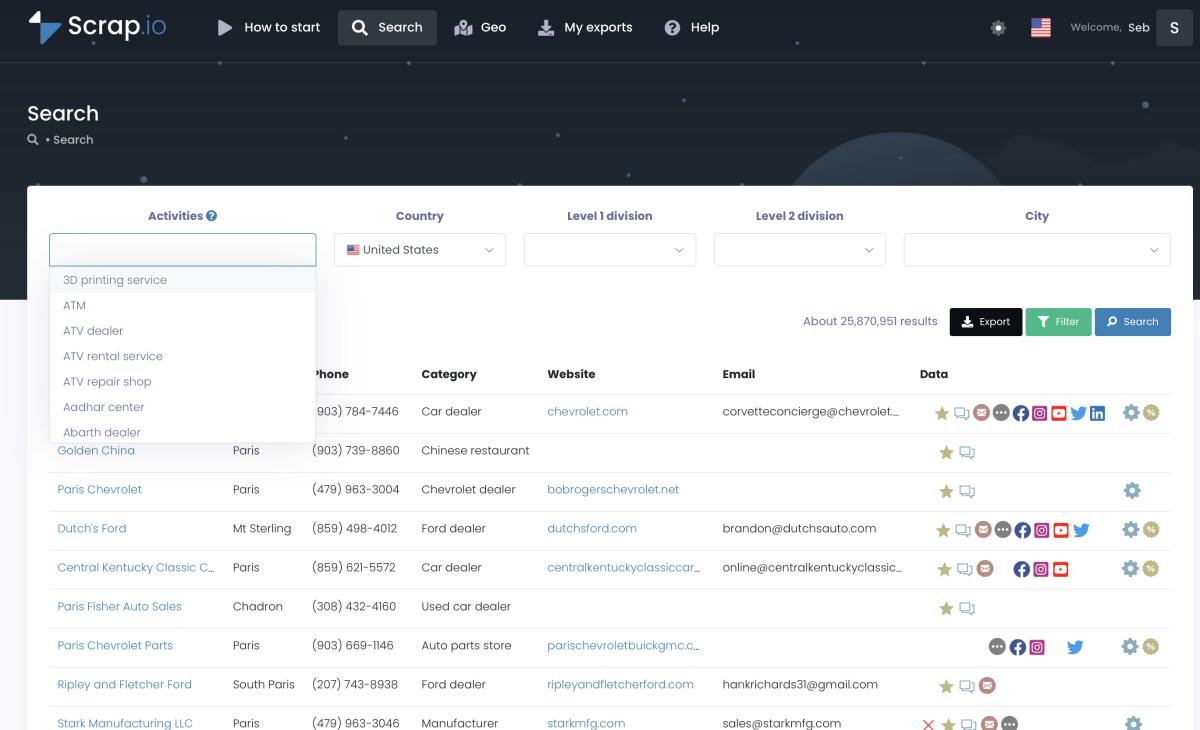
Search a GI category and location, the matching count shows up before you spend a single credit.
Step 2: filter before you pay. This is the part that saves real money. Toggle "email present" and your 44,223 listings collapse to the 9,498 that actually carry a verified email, and you only ever spend credits on those. Want just mobile numbers for an SMS campaign? Filter it. Practices with no website (prime targets if you sell web design)? One toggle. Low Google rating (reputation-management angle)? Set the range. Filters run before extraction, so zero credits get wasted on dead-end records.
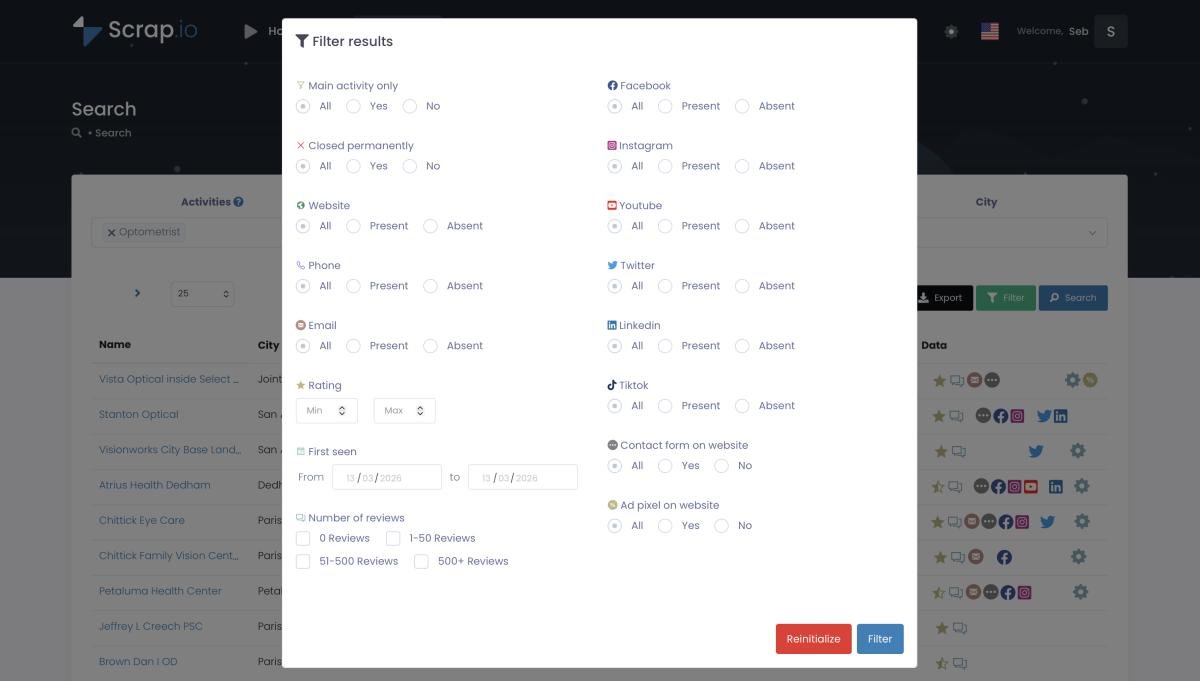
Filters apply before extraction, so you pay only for the GI contacts that match your exact criteria.
Step 3: target a precise area. Need a hospital corridor, a metro, or a custom catchment that doesn't match any county line? GeoSearch handles it. Draw a radius around any point, or trace a polygon by hand on the map, and every filter still applies inside it.
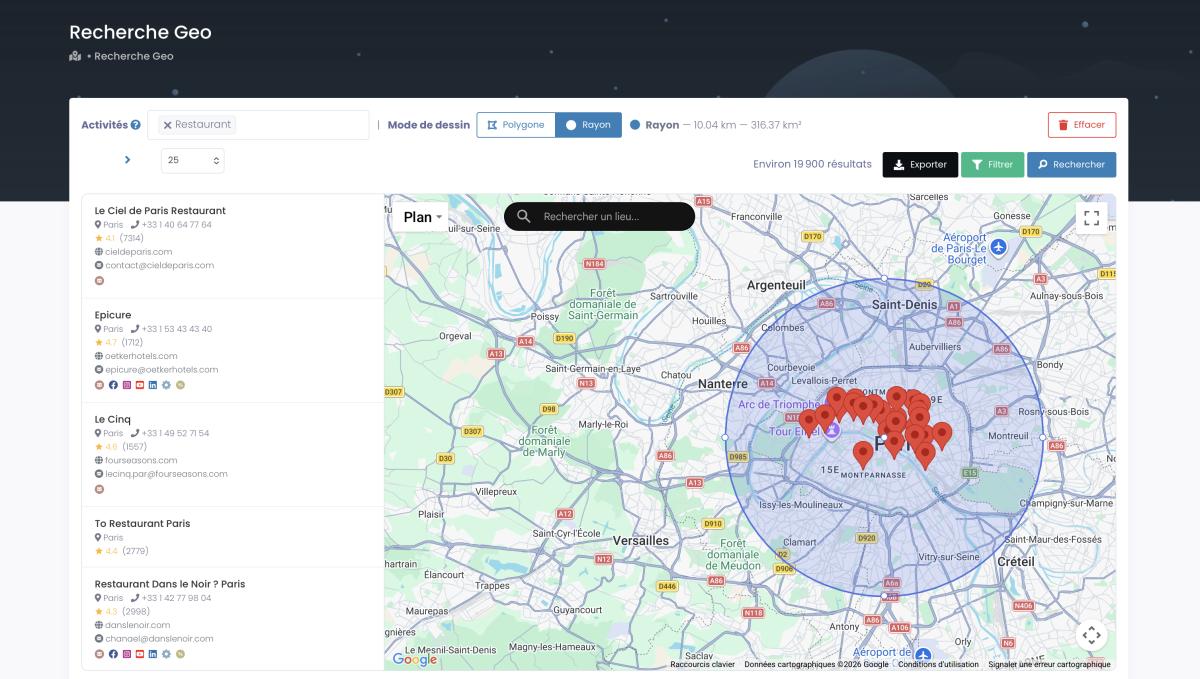
GeoSearch radius, target every GI practice within a set distance of any point on the map.
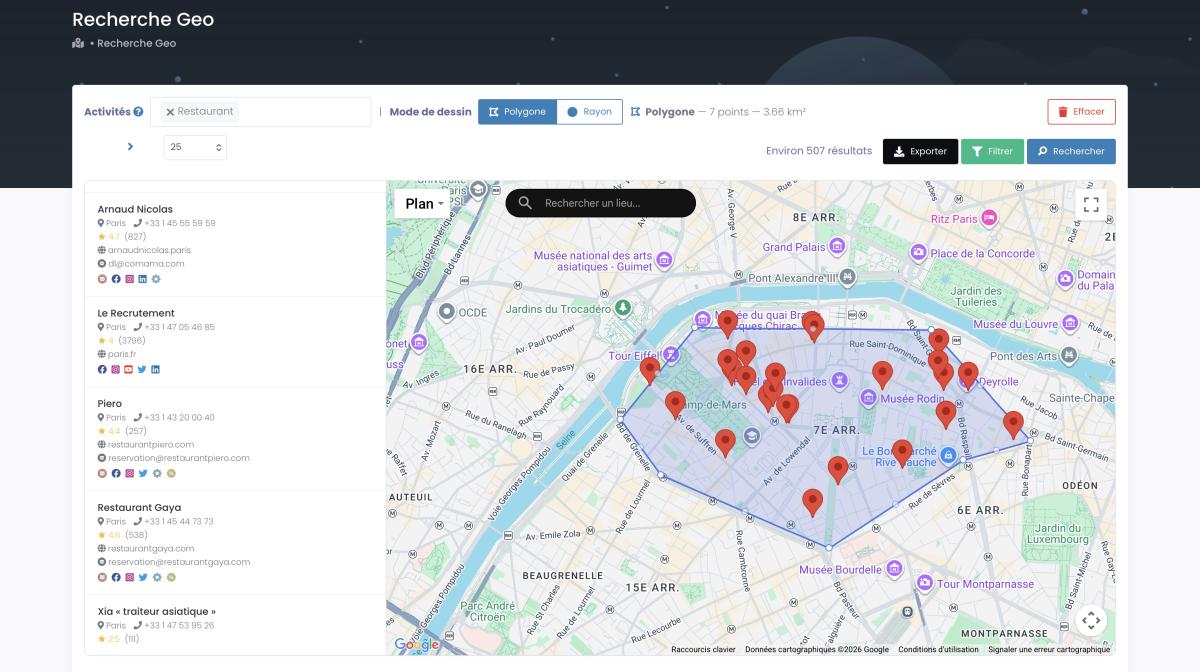
Or draw a polygon by hand for a custom zone that doesn't fit an administrative border.
Step 4: export. CSV or Excel. You get the business name, address, phone with type (mobile or fixed), up to five classified emails per listing (individual with first and last name, contact, sales, marketing, finance), social profiles, Google rating, review count, and the website's tech stack. Import it straight into your CRM or cold email tool. Total time from login to exported file: about a minute.
Video walkthrough if you'd rather watch than read:
Video: Get Emails from Google Maps for Free
Want the deeper mechanics? Our guide on how to find emails on Google Maps and the full Google Maps email extractor walkthrough cover edge cases and advanced filtering. The short version is this: you stop buying guessed gastroenterology practices email addresses and start pulling verified gastroenterologist emails yourself.
Who Markets to Gastroenterologists, and How (Real Examples)
Take a medtech founder selling an endoscopy scheduling tool. Her whole pipeline starts with one question: where are the GI practices? Not the theory of them. The actual addresses, with a live email, in the states where her reps can follow up.
That's the pattern across every buyer of a gastroenterologist contact database. The medical device teams want practices showing signals of growth or robotic adoption. Pharma reps covering GI therapeutics want a targeted gastroenterology email database segmented by practice type, because a solo gastroenterologist and a 20-provider group buy nothing the same way. Staffing agencies want fresh affiliations, since you can't recruit a doctor who left three months ago, and pitching an employed physician a job at their old clinic kills your credibility instantly.
Look at how the existing players position themselves, and you can see the gap. MedicoLeads leans on a frozen "9,000+" number. ZoomInfo is strong on enterprise employee directories, thin on the independent GI clinic. ContactOut and NeverBounce surface an email format for a practice, which is useful intel but not a verified send list. Brokers like MedicoReach, LakeB2B, and TargetNXT sell NPI-sourced files with no freshness guarantee and prices nobody publishes. Every one of them has a weakness that comes down to the same thing: the data isn't current, and it isn't exclusively yours.
The buyers notice. On Quora, the same question keeps surfacing, "Which is the best portal for buying doctors' email lists?", and the answers circle the same warning every time: the cheap databases get recycled, resold, and bounce hard within weeks. That frustration is the opening. Fresh, filtered, exclusive data is the answer to it.
GI isn't the only specialty that works this way. The playbook is identical for sister specialties, our urologist email list guide runs the same logic for a market with the same aging-workforce squeeze. Same method, different category.
Is Buying a Gastroenterology Email List Legal? (CAN-SPAM, HIPAA, GDPR)
Okay, the less-fun-but-essential part: is any of this actually legal? Short answer, yes, if you do it right.
Start with the regulation everyone panics about and shouldn't. HIPAA governs Protected Health Information, patient records, treatment data, medical histories. Emailing a gastroenterologist at their published business address to pitch your software touches none of that. HHS guidance on marketing is about communications involving patient data, not B2B vendor outreach. You're contacting a business professional at a business address. HIPAA has nothing to say about it.
The rule that actually applies is CAN-SPAM. The requirements are not complicated: a real physical address in every email, honest subject lines, accurate sender info, and a working opt-out you honor within 10 business days. The FTC's CAN-SPAM compliance guide spells out penalties north of $50,000 per email for violations. Per email. Read that twice, then take list hygiene seriously.
Going international? GDPR enters the picture for any EU contacts, usually under the "legitimate interest" basis for B2B, which still needs a clear opt-out and a documented reason for each contact. US-focused campaigns using public business data from Google Maps are generally in the clear, and CCPA carves out publicly available business information anyway. Our cold email compliance guide walks through the country-by-country detail if you're sending across the Atlantic.
Here's Scrap.io's actual edge on compliance, and it's not marketing fluff: every record comes from publicly available business data that practices chose to publish on Google Maps and their own sites, and every data point is traceable to its source. When a regulator asks "where did this come from?", you have a real answer. That's a stronger position than a broker file whose sourcing is a shrug. Is 44,223 a list of real doctors? No, and we say so plainly, they're practice and clinic listings, which you filter down to 9,498 with a verified email or dedupe by domain. Transparency is the whole credibility play.
How to Write a Cold Email GI Practices Actually Answer
You've got 9,498 verified GI emails. The goal now is simple: reach gastroenterologists by email without landing in spam. So what do you write so a busy practice manager replies instead of deleting?
First, verify before you send. Even fresh data deserves a quick validation pass before a big campaign, because a bounce rate above 5% starts tanking your sender reputation with Gmail and Microsoft. It's cheaper to clean a list up front than to rebuild a torched domain later.
Second, use the email classification. An email to a generic info@ inbox should read nothing like one to an owner's individual address. Scrap.io labels each one, individual, contact, sales, marketing, finance, so you know who's on the other end before you hit send. Personalize the individual ones. Keep the generic ones value-first.
Third, lead with something specific. Not "our solution improves efficiency." Try: "I noticed [Practice Name] has 4.7 stars but no online scheduling, that gap is sending patients to the group down the road." That gets read. "Dear Healthcare Professional" gets trashed. Reference their rating, their location, the fact that they run three clinics. Prove you did thirty seconds of homework.
And go multi-channel. Email alone is a coin flip. Email, then a LinkedIn touch, then a call to the practice line (98% of these listings have a phone, remember), that's a system. One more honest note: keep your send volume sane and warm up a new domain slowly. GI practices sit behind medical-grade spam filters, and words like "breakthrough" or "revolutionary" get you binned on arrival. Write like a human who understands what their Tuesday looks like. That's the entire trick.
FAQ
How many gastroenterologists are there in the US?
There are roughly 15,678 active gastroenterologists in the US (AAMC, 2021 data), but 44,223 gastroenterology business listings appear on Google Maps in 2026, practices, clinics, and group locations that multiply your points of contact. Of those listings, 9,498 carry a verified email and 43,293 list a phone number (Scrap.io, September 2026).
Where can I get a gastroenterology email list?
Four main routes: medical data brokers (MedicoLeads, ZoomInfo), medical directories and NPI lookups, LinkedIn Sales Navigator, or extracting fresh data yourself from Google Maps with a tool like Scrap.io. Only the last option lets you filter before you pay and pull real-time, verified data instead of a recycled file.
How much does a gastroenterology email list cost?
Broker lists are priced per record or per campaign, often without a public rate. Extracting your own with Scrap.io starts free (a 7-day trial with 100 leads included), then from $35/month on the Basic plan for 10,000 export credits, which works out to well under a penny per contact.
Are purchased gastroenterology email lists legal?
Yes, for B2B outreach in the US under CAN-SPAM: use honest subject lines, include a physical address, and provide a working opt-out. Scrap.io uses public business data, traceable to its source, and is GDPR- and CCPA-compliant. HIPAA governs patient data, not business contact information, so it doesn't apply to professional B2B email.
How accurate are gastroenterology email lists?
A static list decays 20 to 30% per year in healthcare (Dun & Bradstreet), because doctors change practices and retire constantly. Real-time extraction sidesteps the problem: you pull verified, live data the day you send, so your bounce rate stays low and your sender reputation stays intact.
Stop Renting a Decaying List
The whole GI market is tightening. Fewer specialists, more consolidation, half the workforce past 55. Every gastroenterologist you reach carries more purchasing weight than ever, which means your data can't be a quarter old when you hit send.
A bought list starts rotting the day it lands. A fresh extraction doesn't. You pull 44,223 listings, filter to the 9,498 with a verified email, and export a file that's current as of this morning, exclusive to you, and traceable to its source. That's not a marginal upgrade over a broker CSV. It's a different category.
Generate a list of gastroenterologist with Scrap.io