

_202606040910-resized.jpg)
Table of Contents
- Why You Need a Real-Time NYC Business Directory in 2026
- NYC Business Landscape: Borough-by-Borough Data (2026)
- How to Search 293,700+ NYC Business Listings
- Real-Time Data vs Traditional Business Directories
- Building Your NYC B2B Contact List with Scrap.io
- NYC Business Directory vs Competitors
- FAQ: NYC Business Directory
293,700 businesses. That's what Scrap.io indexes across all five NYC boroughs right now, and about 41% of them have a verified email address. Not last year's number. Not an estimate. A live count you can check yourself in about eight seconds.
And yet, most people trying to prospect in New York are still working with directories that update once a year. Maybe twice if they're fancy about it.
Here's what that actually looks like. A sales rep I know dropped $900 on a "premium" NYC business directory last quarter. Sent 2,000 emails. 680 bounced. Another 400 went to businesses that had closed or moved. That's over half his budget, gone. On data that was probably accurate back when people still cared about NFTs.
Brutal? Sure. But predictable. Traditional directories lose 2-3% accuracy every single month. After a year, you're basically cold-calling a phone book from the past. And in a city where NYCEDC data shows roughly 25,500 new business registrations per year, that decay rate is a death sentence for your pipeline.
This article covers what actually works: how to find businesses in NYC using real-time data, what each borough looks like by the numbers, and why the old approach to New York business directory data is basically dead. Whether you need a quick NYC business directory lookup or a full NYC business contact list with emails, this is the breakdown. If you need the state-level picture, that link covers all of New York. This one focuses on the city.
Why You Need a Real-Time NYC Business Directory in 2026
NYC's economy is worth $2.3 trillion. Manhattan alone generates 73% of that: $939 billion in GDP, according to NYCEDC. The city also hit a record 4.26 million private-sector jobs in 2025, even as job growth cooled to about half its 2024 pace (NYCEDC, 2026). If you're doing anything B2B (sales, consulting, marketing, whatever) this is the single densest concentration of potential clients on the planet.
But getting to those businesses? That's where it falls apart.
The city changes constantly. Brooklyn went from 17.8% of all NYC businesses in 1990 to 24.4% today. Manhattan dropped from 54.6% to 45.5%. Entire neighborhoods flip in a year. A restaurant opens in Williamsburg on Tuesday and closes in Bushwick three months later. A tech startup launches in DUMBO, pivots, and relocates to Long Island City before your annual directory update even ships.
And the churn is worse than most people think right now. NYCEDC counted roughly 8,400 business closures across the city in Q2 2026, with net business formation running negative at around -4,900. The weakest quarter in five years. Read that again. More businesses shut down than opened. A directory printed in January is describing a city that no longer exists by spring.
Static lists can't keep up. They never could. But the problem got worse. NYC Comptroller data puts new business registrations at roughly 25,500 per year. That's almost 500 per week. Your "updated" directory is already stale before the PDF finishes downloading.
Oh, and here's what nobody tells you about the traditional NYC business search approach: even the city's own government portals (like the NYS DoS corp/LLC lookup) only give you entity registrations. No emails, no phones, no contact data. You get a company name and a filing date. Useful for legal research. Useless for prospecting.
(Spoiler: this is exactly why real-time extraction from Google Maps changed the game. More on that in a minute.)
Video: How to Extract Every Business in 1 Click, Scrap.io
NYC Business Landscape: Borough-by-Borough Data (2026)
Borough Business Distribution
Forget gut feelings. Here's what the numbers actually say about where NYC's 293,700 businesses are: live data from Scrap.io, cross-referenced with NYCEDC and NYC Comptroller reports.
| Borough | % of NYC Businesses | Key Trend |
|---|---|---|
| Manhattan | 45.5% | Still #1, but shrinking share since 1990 |
| Brooklyn | 24.4% | +1,000 firms since 2019, fastest growth |
| Queens | ~17% | Underrated. Strong in food, intl. trade |
| Bronx | ~9% | Healthcare & logistics hub |
| Staten Island | ~4% | Construction, retail. Less competition. |
Which NYC borough has the most businesses? Manhattan leads with 45.5% of all private establishments, down from 54.6% in 1990 but still dominant. Brooklyn is second at 24.4% and growing the fastest. Queens sits around 17%, then the Bronx near 9% and Staten Island near 4%.
Manhattan dominates on paper. Obviously. Wall Street, Midtown, all the tech money pouring into Lower Manhattan. But the real story in 2026 is Brooklyn.
Crain's New York reported that Brooklyn hit 46,300 firms, up over 1,000 since 2019. North Brooklyn alone is booming, per the Brooklyn Eagle. DUMBO has real tech startups now. Industry City has manufacturing. It's not just artisanal pickles anymore. (Though those are still there too.)
And Queens? Everyone forgets Queens. Big mistake. With some of the most diverse immigrant communities in the world, Queens crushes it in food manufacturing and international trade. If you're selling to import/export businesses and you're ignoring Queens, you're leaving money on the table.
The Bronx and Staten Island get skipped by most directories. Their loss, and your opportunity. Less competition means higher response rates when you actually reach out. Anyone looking for NYC business data by borough and ignoring these two is leaving easy wins on the table.
Top Industries Driving NYC's Economy
Finance still runs Manhattan. No surprise there. But tech and healthcare are the growth stories. The SBA counts 183,000 small businesses in NYC, a record. Healthcare is everywhere now, driven by an aging population and post-pandemic expansion. Professional services (lawyers, accountants, consultants) used to be a Manhattan-only game. Not anymore. They're spreading to Brooklyn and Queens fast.
Miss that shift and you miss half your addressable market. (And good luck finding it with a NYC business directory free tool that hasn't been updated since last year.)
Want to see how many businesses are in your target borough? Scrap.io lets you search any NYC borough across 293,700+ live listings, and counts are always free, no credits needed. Check live borough counts here.
How to Search 293,700+ NYC Business Listings
Video: How to Scrape Google Maps, Ultimate Guide to Extract Business Data
What if you could search every NYC business, filter by borough, industry, reviews, in under a minute? Not a hypothetical. That's literally what real-time extraction does.
Search by Borough
New here? This two-minute onboarding walks through your first search, from picking a category to hitting export.
Video: Scrap.io, How to Start?
Here's where most people mess up. They search "New York" and get overwhelmed by 293,700 results. Yeah. You need to be specific.
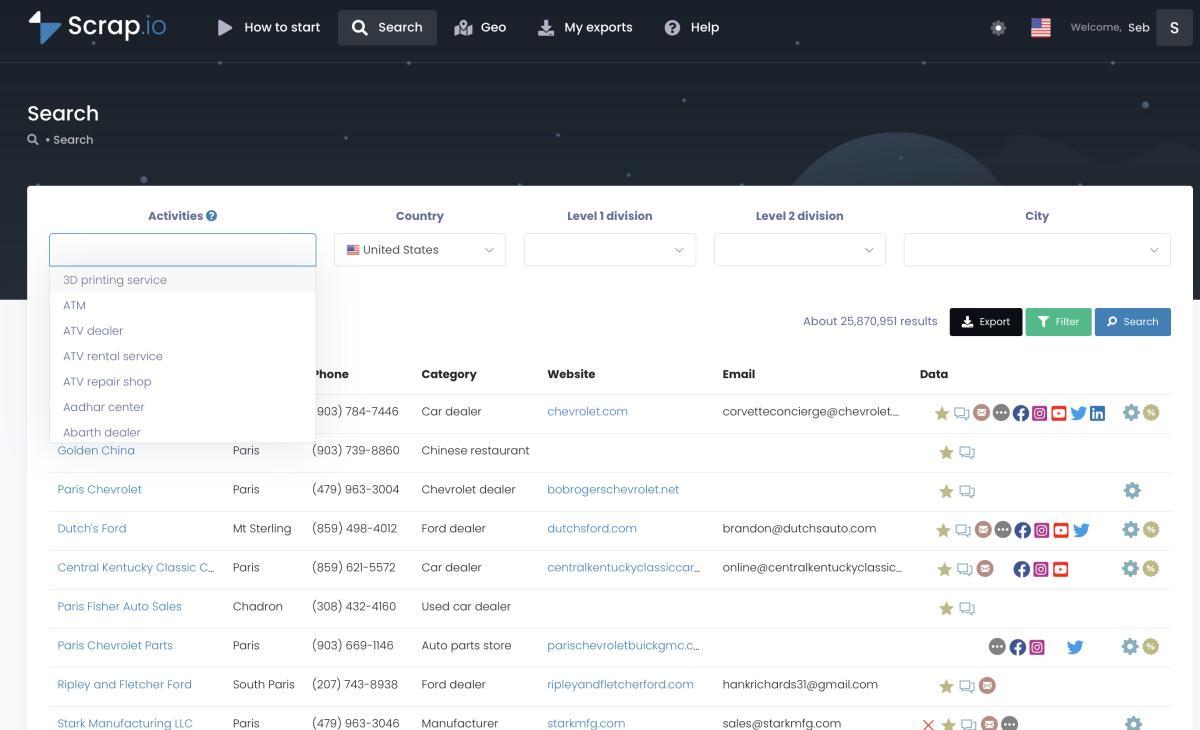
Manhattan isn't one market, it's fifty. Wall Street finance firms have nothing in common with Upper East Side medical practices. Chelsea tech startups look nothing like Harlem retail shops. Your Manhattan business listings real-time search needs borough-level or even neighborhood-level precision.
With Scrap.io, you can target by city (any of the 5 boroughs), by county, or even draw a custom polygon on a map using GeoSearch. Need every restaurant within a 3-mile radius of Penn Station? Done. Every contractor in the Bronx? Two clicks.
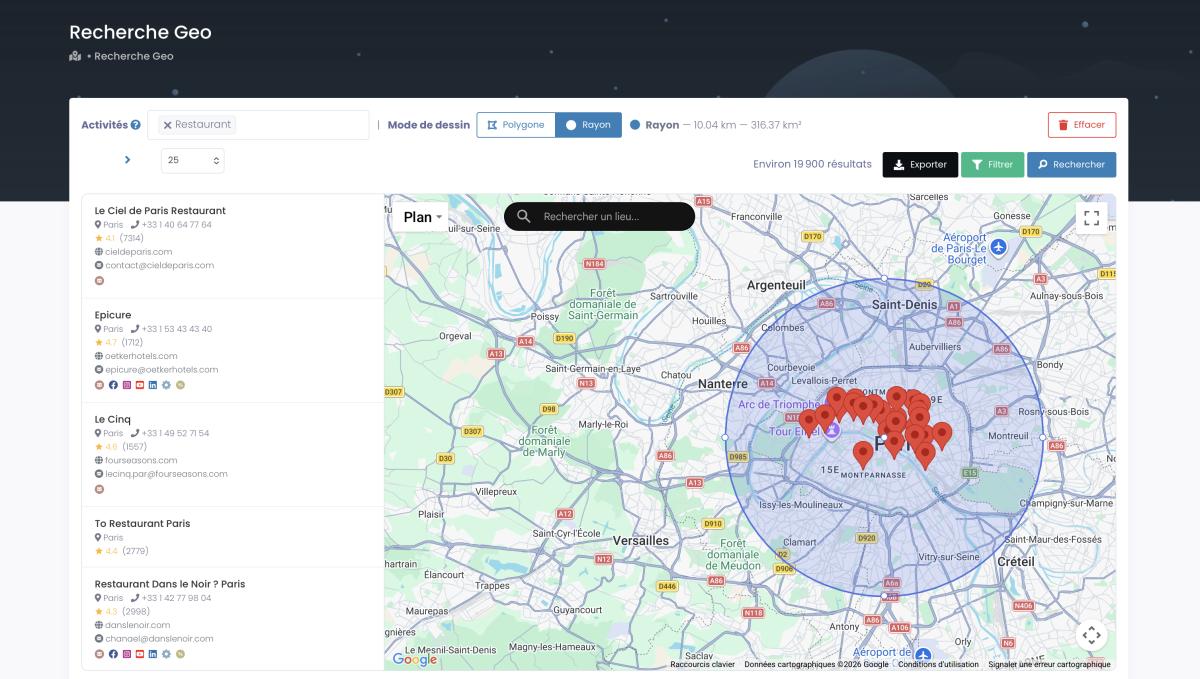
And here's what makes this different from a static NYC business directory search: the data comes from Google Maps, extracted in real time. When a business updates their listing (new phone number, new hours, new address) you get it immediately. Not six months from now. Now.
For a deeper look at how extracting all businesses from a city works, that guide walks through the whole process. And if you just want a ready-made pull of local business leads, there's a full playbook for that too.
Filter by Industry, Reviews, and Contact Data
Raw data is useless. 293,700 businesses in a spreadsheet? That's not a lead list. That's a nightmare.
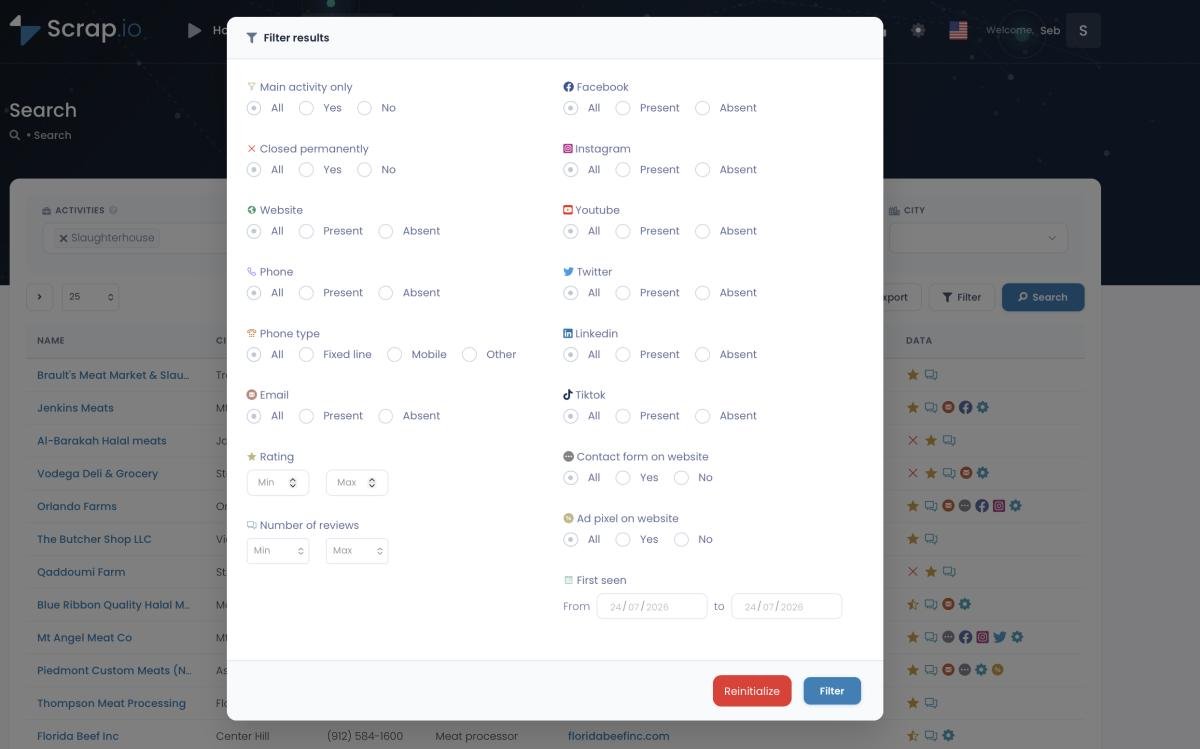
Filters are what turn a NYC business database into something you can actually work with. And the key difference with Scrap.io: you filter before you pay. Only want businesses with an email? Toggle. Only want ones with a website? Toggle. Minimum 4-star rating? Set it. Has Instagram but no Facebook ads pixel? Sure.
4,000+ categories. Filter by review count, photo count, price range, social media presence, whether the listing is claimed, whether there's a contact form on the website. All before a single credit gets consumed. This is also how a NYC small business directory stops being a data dump and starts being a targeted list.
Try doing that with a PDF directory from 2024. I'll wait.
Real-Time Data vs Traditional Business Directories
Traditional directories are dead. Should have died years ago, frankly.
Think about how absurd this is. NYC sees roughly 25,500 new business registrations per year, and just lost net -4,900 businesses in a single quarter. And traditional NYC business listings update once a year? By the time that list ships, thousands of entries are already wrong: businesses moved, closed, changed numbers, hired new people.
As Belkins.io puts it: "Winners spend 80% of their time on list building." Makes sense. Bad list = bad results. No amount of clever copy fixes a 30% bounce rate.
NYC business directory vs traditional directories: what's the real difference?
Traditional directories refresh yearly and drift to 60-70% accuracy within twelve months. Real-time extraction pulls fresh Google Maps data on every search, holding 95%+ accuracy, classifying emails, and letting you filter before you pay. Here's the side-by-side.
| Feature | Traditional Directories | Real-Time Data (Scrap.io) |
|---|---|---|
| Update frequency | Yearly (if you're lucky) | Every search (live extraction) |
| Accuracy after 12 months | 60-70% | 95%+ |
| Email classification | None | 6 categories (individual, contact, sales...) |
| Cost per contact | $0.10 – $0.50 | $0.0035 |
| Filter before paying | No | Yes, all filters, all plans |
| Borough-level targeting | Sometimes | Yes + GeoSearch (radius & polygon) |
The math is straightforward. A year-old list has 30-40% bad data. At $0.10-$0.50 per contact, you're paying full price for contacts that will bounce. Real-time NYC business data Google Maps extraction at $0.0035 per lead, with filters applied before you pay, is completely different economics. It's not even close.
For the technical breakdown of how Google Maps extraction works, the Google Maps scraping guide covers every method in detail.
Building Your NYC B2B Contact List with Scrap.io
A Midtown agency needed restaurant contacts across all 5 boroughs. Not "restaurants in Manhattan," the whole city. With Scrap.io: 119,503 businesses with emails, exported with full contact data, in under an hour. That's not marketing copy. That's a real use case.
And they're not alone. Callbox, one of NYC's bigger B2B lead gen firms, built their ABM prospecting around this kind of real-time data, expanding target accounts way beyond what traditional directories offered. LevelUp Leads reported 4x more qualified meetings after switching from static lists to live extraction. The pattern is always the same: better data in, better results out.
Here's what the NYC small business database 2026 numbers actually look like on Scrap.io right now:
- 293,700 total businesses indexed
- 119,503 with a verified email address
- 176,544 with a website
- 252,720 with a phone number
And as BuiltForB2B.com found: "One client increased response rates from 2% to 11% by narrowing ICP." Narrowing your Ideal Customer Profile is what filters let you do, before you spend a dime on credits.
Ready to build your NYC contact list? Start your free trial: 7 days, 100 leads included. Search any borough, filter for exactly what you need across 293,700+ live listings, and only pay for contacts you can actually reach. Start your free trial now.
Essential Data Points for B2B Outreach
Not all data is equal. A generic info@ email gets you a 5% open rate. A direct individual email? 25-40%. That's not a small difference, it's the difference between a campaign that works and one that doesn't.
Scrap.io classifies emails into 6 categories automatically: individual (with first and last name extracted), contact, sales, marketing, finance, and admin. You know exactly who you're emailing before you hit send.
Beyond email, the export includes 50+ data points per business: phone numbers, social media profiles, website tech stack, whether they run ad pixels, Google rating, review count, operating hours. Enough data to segment your outreach by industry, size, location, digital maturity, whatever matters for your ICP.
One honest caveat on phones. Scrap.io tags numbers as mobile or landline worldwide, but that mobile/fixed classification isn't available for US numbers. So for NYC campaigns, segment on other signals (industry, rating, website presence) rather than assuming you can split mobile from landline. Better to know that upfront than to build an SMS list that isn't really a mobile list.
If you're trying to find NYC businesses with emails at scale, not just a handful but thousands, the workflow is search, filter, export. For more on finding emails on Google Maps, that guide covers 5 methods from free Chrome extensions to full API integration. And the USA business email database article has the broader national picture. Even a Brooklyn business directory with emails is just one filter away: borough + "email present" + export. That's it.
Compliance and Data Accuracy
Let's get this out of the way. Using public business data for B2B prospecting is legal. Period.
These businesses voluntarily put their information on Google Maps. They want to be found. Scrap.io extracts only publicly available data, and every contact is traceable to its source. GDPR compliant. CCPA compliant. Nothing sketchy, nothing scraped from behind login walls.
Accuracy? Real-time extraction from Google Maps gives you 95%+ accuracy because you're pulling data businesses update themselves. Traditional directories lose 2-3% accuracy every month. After a year, a quarter of your contacts are garbage. Math doesn't lie.
For the full legal breakdown, the cold email compliance guide covers CAN-SPAM, GDPR, and CCPA requirements in detail.
NYC Business Directory vs Competitors
You've tried the other options. Here's what none of them give you.
SBS Connect is the city's official directory. Solid for what it is. But it only covers M/WBE certified businesses, a tiny fraction of NYC's 293,700 total. Chamber.nyc limits access to dues-paying members. Same deal with the Brooklyn Chamber of Commerce: members only, limited listings. Yellow Pages? That's still around? (Barely. And the data is ancient.)
| Feature | SBS Connect | Chamber.nyc | Yellow Pages | Scrap.io |
|---|---|---|---|---|
| Total businesses | M/WBE only | Members only | Partial | 293,700 |
| Real-time data | No | No | No | Yes |
| Emails included | Limited | Limited | Rarely | 119,503 |
| Direct phone numbers | No | No | Some | 252,720 |
| Borough filters | Yes | Limited | Yes | Yes + GeoSearch |
| Industry categories | ~20 | ~15 | ~200 | 4,000+ |
| Export (CSV/Excel) | No | No | No | Yes |
| API access | No | No | No | Yes |
| Price | Free | Membership | Free (ads) | From $35/mo |
SBS Connect is great if you need M/WBE vendors. It's a government tool, respect where it's due. But if you need a full NYC business directory by industry with emails, phones, and export capability? It covers maybe 5% of the market.
Bref, the gap isn't subtle. Traditional directories give you a sliver. Real-time extraction gives you everything.
FAQ: NYC Business Directory
How many businesses are in NYC?
Scrap.io indexes 293,700 businesses across NYC's five boroughs, every establishment with a Google Maps listing. Of those, about 119,503 have a verified email and 252,720 have a phone number. The SBA separately reports 183,000 small businesses, a city record. The difference is methodology: Scrap.io counts every listed establishment, including chains and larger companies.
Which NYC borough has the most businesses?
Manhattan leads with 45.5% of all private establishments, down from 54.6% in 1990, but still dominant. Brooklyn is second at 24.4% and growing the fastest, with 46,300 firms and 1,000+ added since 2019. Fun fact: Manhattan still generates 73% of NYC's GDP even as its business share shrinks. The money concentrates even when the businesses spread out.
What's the difference between real-time and traditional business directories?
Traditional directories update once a year (maybe). Real-time extraction pulls data from Google Maps at the moment you search, so you get current phone numbers, current emails, current business status. The accuracy difference is massive: 95%+ for real-time vs. 60-70% for year-old lists. In a city with 25,500 new registrations annually, that gap matters.
Can I export NYC business data with emails and phone numbers?
Yes. Scrap.io exports CSV or Excel files with 50+ data points per business: contact info, emails (classified by type), phone numbers, social media, website data, Google rating, reviews, hours, and more. Of NYC's 293,700 businesses, 119,503 have a verified email and 252,720 have a phone number. You can find NYC businesses with emails by filtering before you export, so you spend zero wasted credits.
How much does it cost?
Plans start at $35/month (annual) or $49/month without commitment, for 10,000 credits per month. One credit = one business exported. At $0.0035 per contact, it's 30-100x cheaper than traditional list brokers. Free trial: 7 days, 100 leads included. Counts and searches are always free, you only pay when you export.
Get started with 100 free NYC business leads. Search any borough across 293,700+ live listings, filter for exactly who you need, and only export what matters. Free trial, 7 days, 100 leads. Start your free trial.
Generate a list of restaurant with Scrap.io