

Updated July 2026 — By Scrap.io Team
Video: How to Extract Every Business in 1 Click (No Category)
Last quarter I talked to a sales rep who sells autorefractors. She'd just spent $700 on a so-called premium optometrist email list. Sent it out to 4,000 contacts. Guess what happened. 1,400 bounced. Another 600 landed in the inboxes of ODs who'd retired, moved states, or joined a completely different practice months ago.
Seven hundred bucks. For a spreadsheet that was maybe half-useful on a good day.
And the kicker? The US optometry market is worth $21.5 billion in 2026 (IBISWorld). There are 106,288 optometrist establishments sitting in Scrap.io's database right now — 87,220 of them listing optometry as their main activity. The Bureau of Labor Statistics projects 9% growth for optometrists between 2023 and 2033. Globally, the optometry market clocked $79.1 billion in 2024 and should hit $100.4 billion by 2030 according to Research and Markets (4.1% CAGR).
Enormous opportunity. And most B2B companies chasing these eye care professionals? Burning cash on stale contacts that were outdated before the invoice cleared.
This guide covers how to build an optometrist email list that doesn't suck — real-time data, named company examples, honest pricing. No filler.
Platforms like Scrap.io let you search 106,288+ optometrist establishments in real time — with a free 7-day trial that includes 100 export credits, so you can test the data yourself before committing a dime.
Table of Contents
- The Optometry Market in 2026: $21.5B and Growing
- Why Traditional Optometrist Email Lists Fail
- Who Targets Optometrists — and Why
- How to Build Your Optometrist Email Database with Scrap.io
- Advanced Filtering for Eye Care B2B Leads
- Real-World Success: Companies Selling to Optometrists
- Pricing Comparison: Fresh Data vs Traditional Lists
- Compliance and Best Practices for Optometry Email Marketing
- FAQ — Common Questions About Optometrist Email Lists
The Optometry Market in 2026: $21.5B and Growing
Market Size & Revenue Trends
IBISWorld pegs US optometry revenue at $21.5 billion for 2026. That's spread across roughly 29,062 businesses. The global picture's even wilder — $79.1 billion in 2024, climbing toward $100.4 billion by 2030 at a 4.1% CAGR (Research and Markets).
Around 41,000 optometrists are actively practicing in the US right now (BLS/Gitnux). The Vision Council says 92% of American adults use some kind of vision correction. Ninety-two percent. That's basically everyone who isn't a teenager with mutant-level eyesight.
The BLS projects 9% employment growth through 2033. People keep staring at screens. The population keeps getting older. More eye exams, more prescriptions, more money flowing through practices. Not complicated.
Video: How to Scrape Local Leads at the Country Level
Geographic Distribution of Optometrists
Where are all these optometrists? Not evenly distributed, that's for sure. Scrap.io platform data breaks the share down like this (percentages of the 106,288 US total):
| State | % of US Total |
|---|---|
| California | 11.8% |
| Texas | 6.7% |
| New York | 5.7% |
| Florida | 5.4% |
| Pennsylvania | 4.0% |
| Ohio | 3.8% |
| Illinois | 3.5% |
| Michigan | 3.1% |
| Georgia | 2.8% |
| North Carolina | 2.7% |
California's on top. Shocker — massive population, massive tech workforce torching their retinas on dual monitors fourteen hours a day. Texas and New York follow. But here's the thing a lot of B2B reps miss: the real money might be in Ohio or Michigan. Less competition. Same equipment budgets. Fewer sales reps fighting for attention in the waiting room.
Why This Market Matters for B2B
Optometry practices aren't mom-and-pop shops anymore. Average revenue? Around $850K per year (Gitnux/industry reports). When a practice buys a retinal camera or an OCT system, that's a $50,000 to $200,000 check. The optometry equipment market alone hit $5.09 billion in 2025 and is growing at 6.35% annually (Mordor Intelligence).
About 75% of optometrists still work in private practice (BLS). Corporate optometry keeps gaining ground though — roughly 45% of practices now have some corporate affiliation. And this one's wild: 20% of US counties have an optometry workforce shortage.
Think about that for a second. One in five counties doesn't have enough eye doctors. Those practices are slammed. They need better equipment yesterday. They need scheduling software that actually works. They need streamlined supply ordering. If you're only targeting Manhattan and Beverly Hills, you're competing with every other sales team in America for the same 200 practices. Meanwhile, clinics in mid-size cities across the Midwest are hungry for solutions and nobody's calling them.
Why Traditional Optometrist Email Lists Fail
The way traditional eye doctor email databases work is almost comically outdated. Some company scrapes contact info once, dumps it in a spreadsheet, and sells that same spreadsheet to you, your competitor, and about 300 other buyers. For $700+. The data's probably six months old when you download it. Maybe older.
Meanwhile — optometry practices change all the time. Doctors switch groups. Clinics merge with hospital systems. New grads open solo shops. Partnerships blow up. A list that was "95% accurate" in January? By summer it's maybe 70%. Maybe less.
I keep seeing this play out. Someone buys a list, sends their first campaign, watches 35% of it bounce, and then spends the next three months trying to repair their sender reputation. Gmail doesn't care that you paid good money for that data. Gmail cares that you're hammering dead addresses.
And it's not just me saying it. The cold-outreach crowd on Reddit has been screaming this for years. One operator in r/coldemail put the standard playbook bluntly: "Do not send cold emails from your primary company domain... buy trycompany.com." Read that again. People who do this for a living assume purchased lists will torch their reputation — so they plan around the damage instead of avoiding it. That's the tell. When the pros build a firewall between their real domain and the list they bought, the list is the problem.
Over in r/SaaS, the question comes up on loop — "Where to find an email list to cold email your users?" — and the top answers all say the same thing. Don't buy the pre-made file. Build it fresh. There's a reason that advice keeps winning.
Here's what the comparison actually looks like:
| Feature | Static Databases | Real-Time Data (Scrap.io) |
|---|---|---|
| Data freshness | 6-12 months old | Updated as businesses update listings |
| Bounce rate | 30-40% typical | Under 10% |
| Price per contact | $0.14–$0.40 | ~$0.005 |
| Filtering | Basic geography + specialty | 17+ filters incl. reviews, social, website tech |
| Update frequency | 1-2x per year | Continuous |
| Transparency | "Trust us" | Verify freshness yourself |
| Source | Aggregated, recycled | Google Maps + business websites directly |
(And no — "cleaning" a stale list with a verification tool doesn't really solve the problem. You're still starting with contacts that are months behind reality. Verification catches dead emails. It doesn't catch Dr. Martinez who left her group practice in February and now works at a hospital where she doesn't make purchasing decisions anymore.)
Want the deeper economics of why the pre-made file almost never pays off? We wrote a whole breakdown on why you should think twice before you buy email lists. Same lesson, more math.
Who Targets Optometrists — and Why
Medical Equipment Suppliers
Carl Zeiss Meditec, Topcon, NIDEK — these companies live and die by their optometrist prospecting databases. One diagnostic equipment sale (OCT machine, autorefractor, retinal camera) runs $50,000 to $200,000+. At those ticket sizes, even a 1% conversion rate on a well-targeted list generates real revenue.
What they need from the data is specific. Practice size. Current equipment — which often shows up in Google reviews or on the practice website. Geographic clusters so regional reps can plan efficient routes. A 3-doctor practice outside Atlanta that mentions in a Google review that their phoropter keeps glitching? That's a lead worth having. Real-time data catches signals like that. A spreadsheet from last year doesn't.
Pharmaceutical Companies
Pfizer, Novartis, Johnson & Johnson — all of them throw serious budget at optometry email marketing campaigns. They want practices that treat dry eye, glaucoma, diabetic eye disease. High-volume clinics for sample programs. Key opinion leaders who present at conferences and influence what other ODs prescribe.
The granularity matters here. A pharma rep launching a new dry eye formulation doesn't want to blast every optometrist in the country. She wants practices in high-allergy regions, clinics whose service descriptions specifically mention dry eye management, doctors with enough patient flow to move real volume. That requires data with actual depth — not just name, email, zip code. This is also where an optometrist contact database beats a raw mailing list: depth beats volume, every time.
Vision Insurance Providers
VSP Global runs the largest managed vision care network in the US — over 41,000 providers. EyeMed is the other big one. Both of them constantly need fresh optometrist mailing lists to expand coverage, especially in underserved zip codes where patients currently drive 45 minutes for an eye exam.
They're not looking for "optometrists." They're looking for specific practices: ones in geographic gaps where their network is thin, clinics actively accepting new patients, multi-location groups that could bring twenty providers into the network with one deal.
Software & Teleoptometry
This space blew up during COVID and never came back down. Weave does practice communications and management tools. RevolutionEHR builds electronic health records specifically for eye care (not a generic system forced into optometry like some competitors). EyeCarePro is a digital marketing agency that only works with optometry practices — their published case studies show results like 158% web traffic growth and 220% jumps in new patient online bookings for their clients.
Teleoptometry became permanent too. Remote consultations, virtual follow-ups, AI-powered screening — all targeting practices that haven't modernized yet. And you can identify those practices through real-time data. No online booking on their website? No social media listed? Still using a generic @yahoo.com email for the practice? That's a software company's dream lead. Selling into the wider medical field too? The same platform builds a physicians email list the exact same way.
| Who | What They Sell | Why They Need Fresh Data |
|---|---|---|
| Equipment (Zeiss, Topcon, NIDEK) | Diagnostic/surgical devices ($50K-200K) | Identify upgrade-ready practices |
| Pharma (Pfizer, Novartis, J&J) | Eye care meds & treatments | Target by specialty & patient volume |
| Insurance (VSP, EyeMed) | Vision plans & networks | Fill geographic coverage gaps |
| Software (Weave, RevolutionEHR) | Practice management, EHR | Find tech-lagging practices |
| Marketing agencies (EyeCarePro) | SEO, web design, social | Spot weak digital presence |
How to Build Your Optometrist Email Database with Scrap.io
OK, enough context. Here's the actual how-to. Four steps. Building a verified optometrist contact database with Scrap.io's Google Maps extraction takes about ten minutes once you've done it once. Prefer to watch it happen? Here's the two-minute version:
Video: Scrap.io - How to Start?
Step 1: Pick your geography. Could be a single city. Could be "every optometrist in the entire United States." Scrap.io doesn't care. Two clicks either way. Most people start with a state or metro area to keep their first campaign focused. The categories come straight from Google Maps, so if you're not sure which one to pick, skim the Google Maps categories list first.
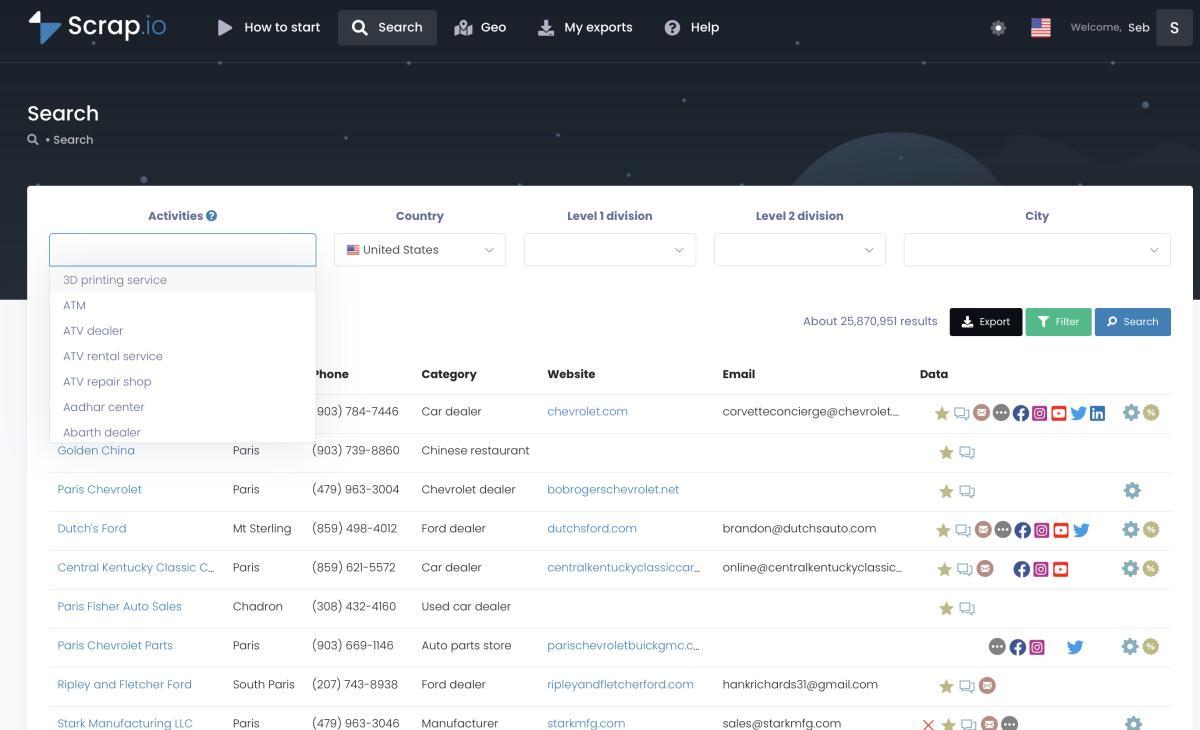
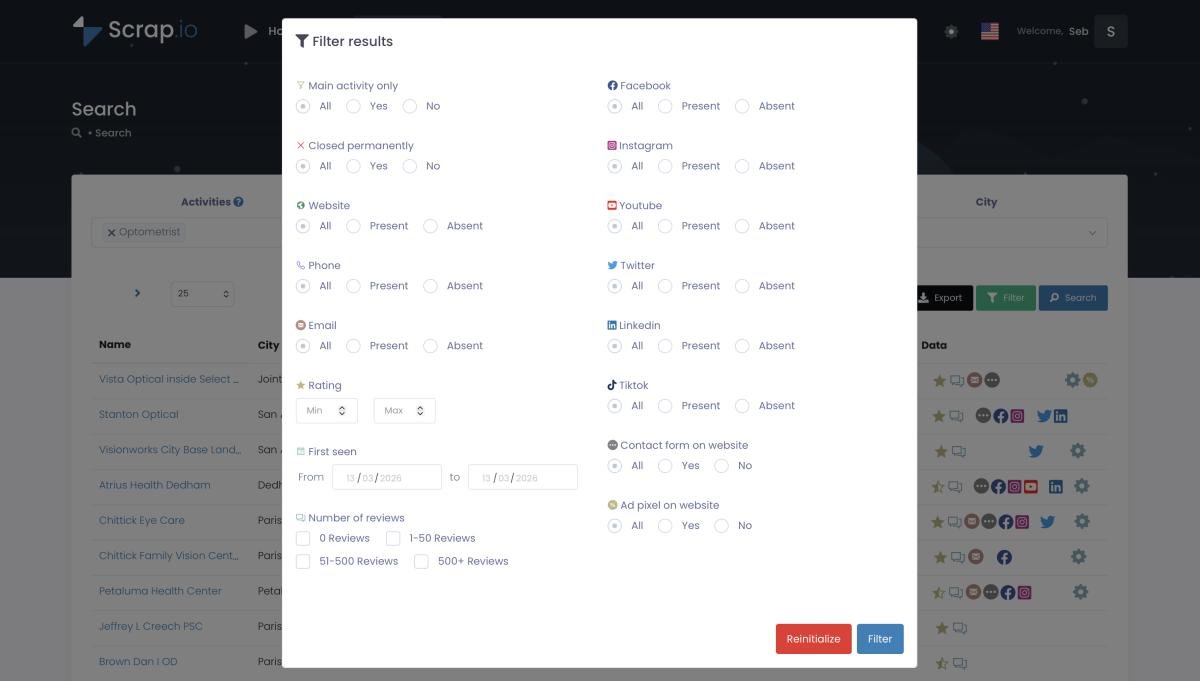
Step 2: Stack your filters. This is where the magic happens. Seventeen filters. Google review rating. Social media presence. Website status. Whether they have a published email. Whether they have a contact form. What ad pixels are on their site. You get granular fast. And here's the money move — the filters apply before you spend a single credit. Right now only 35,762 of those 106,288 US optometrist listings publish an email address. Toggle "email present" and you pay for those 35,762 useful records instead of burning budget on 70,000 dead ends.
Step 3: Hit export. Emails, phone numbers, addresses, websites, social profiles — every data point these businesses have published publicly on Google Maps and their own sites. Pulled at the moment you request it. Not cached from three months ago. No email on file but you still want to reach them? 103,854 of those listings carry a phone number — plenty of runway for cold calling or SMS.
Step 4: Drop it into your CRM. CSV export, or use the API for direct integration. Connect through Make.com if you want automated refreshes on a schedule. Some teams re-pull their target lists monthly so they're always working with current data. If this is your first cold campaign, our guide on how to build a cold email list walks through the verify-and-warm-up steps that keep you out of spam.
One thing though. Don't do what most people do — export 50,000 contacts and send the same email to all of them. A solo practitioner in rural Oklahoma has completely different pain points than a 5-doctor group in downtown Houston. The data gives you enough dimensions to build proper segments. Use them. Your response rate will thank you.
Build your first list in 10 minutes — start with 100 free leads and a 7-day trial. Filter to the 35,762 optometrist listings that already have an email, and export a fresh, ready-to-send file. Start free on Scrap.io →
Advanced Filtering for Eye Care B2B Leads
Filters separate the amateurs from the people who actually close deals. Single-filter lists — "optometrists in California" — are basically spray-and-pray with extra steps. And because every filter runs before extraction, tightening your criteria doesn't just sharpen the list. It saves you money.
Say you're selling practice management software. Build a list like this: optometry practices with 3+ doctors, no EHR mentioned on their website, located in metro areas, and reviews that complain about appointment scheduling or long wait times. That's not a generic optometrist marketing list. That's a list of people who already have the problem you solve.
Or flip it. You sell premium frames. Target practices in high-income zip codes with 4.5+ star ratings but no ecommerce on their site. They're killing it with patients but leaving online revenue on the table.
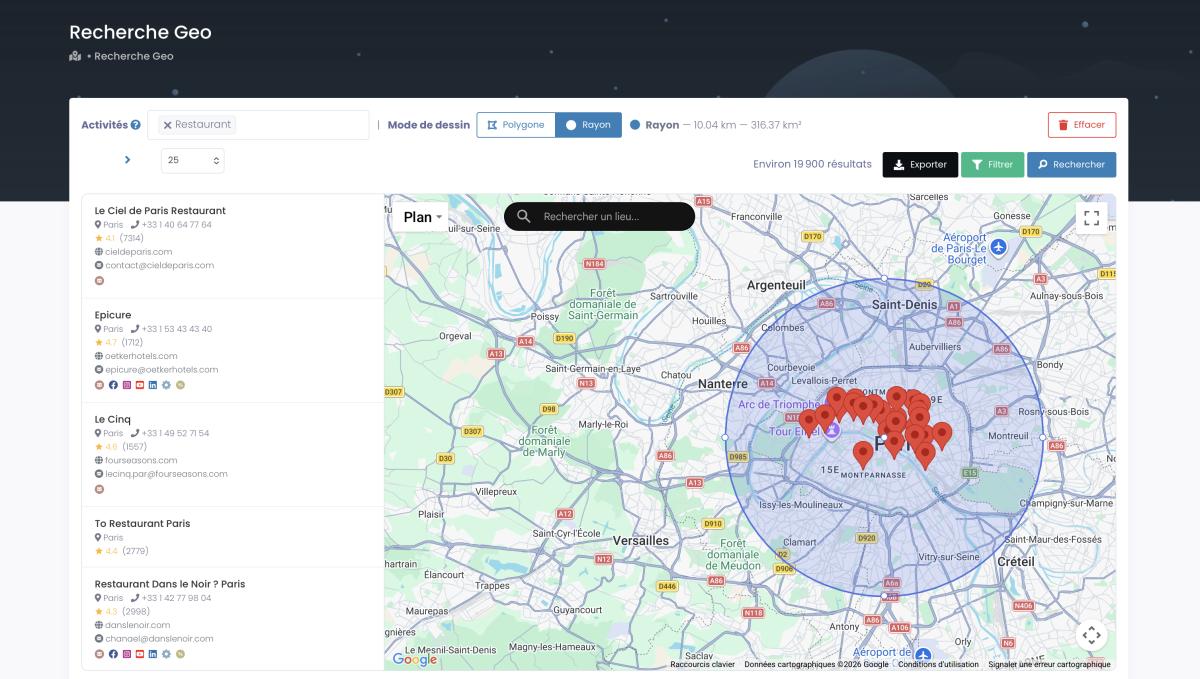
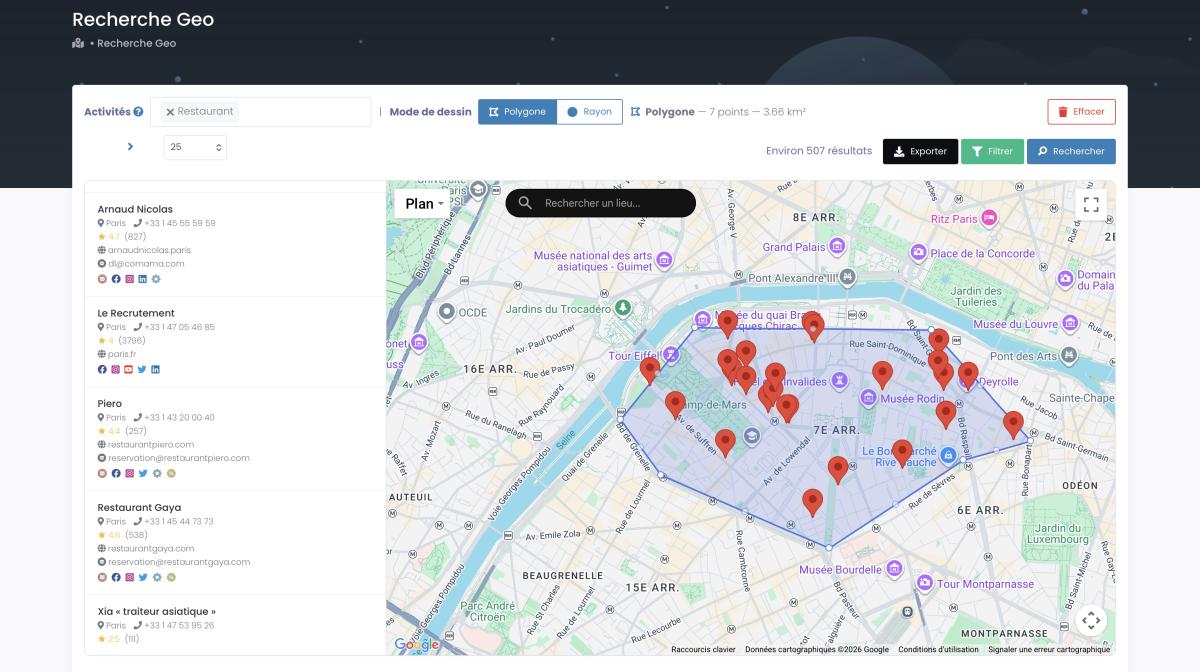
Need a shape that doesn't match a city or a county line? GeoSearch handles it. Draw a radius around a single point, or hand-draw a polygon over an exact territory — a metro's affluent suburbs, one sales rep's drive-time zone, whatever. Every filter still applies inside it.
Real example: a digital marketing agency I spoke with was targeting optometrists for website and social media services. They filtered for practices that had a website but zero social media presence, located in metro areas with 100K+ population, with Google ratings between 3.0 and 4.2 (busy enough to stay open, not so successful they don't need help), and with published email addresses.
Result: about 900 hyper-qualified prospects instead of 50,000 random ODs. Response rate went from under 2% on generic blasts to over 10% on the targeted one. That's not a marginal improvement. That's a completely different business model.
Real-World Success: Companies Selling to Optometrists
Most articles about optometrist email lists throw around vague examples. "A pharmaceutical company" did this. "A medical device rep" did that. No names. No verification possible. We're going to do it differently.
Carl Zeiss Meditec makes the CIRRUS OCT systems and ATLAS corneal topographers you'll find in mid-to-large optometry practices worldwide (see zeiss.com/meditec). When Zeiss rolls out a new product line, they don't email-blast every OD in America and hope for the best. They target practices most likely to upgrade — based on practice size, specialty mix, and geography. Better targeting data equals higher close rates on $100K+ equipment deals. Pretty straightforward math.
EyeCarePro is a digital marketing agency exclusively focused on optometry. They've been in the space for over two decades and work with 2,000+ practices. Their published case studies show specific results: one practice saw 158% web traffic growth with 220% more online bookings, another saw a 491% traffic jump. EyeCarePro itself is the poster child for a company that needs fresh optometrist email addresses — they need to find practices with outdated websites, no social media, or weak local SEO. That's their entire customer pipeline.
Weave sells communication and practice management tools, with optometry and dental as their core verticals. They need to identify practices still relying on paper appointment reminders or clunky legacy phone systems. Data that shows which practices lack modern online booking capability? That's Weave's ideal prospect filter.
VSP Global manages the biggest vision care provider network in America (vsp.com). Recruiting optometrists into underserved areas is a constant growth effort. Current, verified contact data for practices in zip codes where VSP has thin coverage directly feeds their expansion strategy.
RevolutionEHR / EyeFinity builds electronic health records designed specifically for optometry. They compete against generic EHR platforms by arguing (correctly, in my opinion) that eye care workflows need specialized software. Their target? ODs who haven't adopted a specialty EHR yet. Filtering for practices that still appear to use general-purpose systems — or worse, paper — identifies exactly those prospects. Every one of these companies is chasing the same thing: a list that reflects reality this week, not last spring.
Pricing Comparison: Fresh Data vs Traditional Lists
Money time. The top Google results for "optometrist email list" are almost all vendor landing pages — MedicoReach, AverickMedia, MedicoLeads, DataCaptive, LakeB2B. Here's how the field looks:
| Provider | Claimed Contacts | Price | Update Freq. | Bounce Rate |
|---|---|---|---|---|
| MedicoReach | 21K+ | Request quote (est. $700-1,500) | Quarterly | 25-35% |
| AverickMedia | "100% verified" | Request quote | Unknown | Unknown |
| MedicoLeads | 48K+ | Request quote | Unknown | Unknown |
| BizProspex | Varies | ~$340 | Unknown | Unknown |
| ReadyContacts | 19,840 records | Not specified | Unknown | Unknown |
| Scrap.io | 106,288 establishments | From $49/mo | Real-time | Under 10% |
Notice the pattern? Almost everyone hides pricing behind "request a quote." You fill out a form, wait for a sales call, sit through a demo, negotiate, and eventually pay $700 to $2,000 for a CSV that might already be half a year old. The whole process wastes a week before you send a single email.
Scrap.io's pricing is public. Starts at $49/month. Ten thousand contacts run about $49. That's $0.005 per contact vs $0.14-0.40 at traditional providers. 90% cheaper. And the data is current — not something that's been sitting on a server since before the last update cycle.
Quick math on the ROI. Buy 10,000 optometrist contacts from a traditional provider for $1,200. Expect 35% bounce. You're down to 6,500 deliverable emails. Real cost per delivered contact: $0.18. Same 10,000 from Scrap.io: $49. Under 10% bounce, so 9,000+ deliverable. Cost per delivered: about half a cent. Oh, and your sender reputation stays intact because you're not carpet-bombing dead addresses.
Over twelve months the gap compounds. Traditional: $14,400+ with declining deliverability. Scrap.io: $600 with steady or improving deliverability. Pick whichever one makes more sense to you.
Public pricing from $49/mo — no "request a quote," no week-long sales dance. Compare it yourself against the $700+ quotes the incumbents email back. See Scrap.io pricing and start free →
Compliance and Best Practices for Optometry Email Marketing
CAN-SPAM, GDPR & Healthcare-Specific Rules
Scrap.io only collects publicly available information — stuff businesses themselves publish on Google Maps and their own websites. That puts you on solid legal footing from the start. No purchased private data. No sketchy sourcing.
You still need to follow CAN-SPAM requirements though: clear sender identification, honest subject lines, real physical address in every email, working one-click unsubscribe, and opt-outs processed within 10 business days. This isn't optional. Penalties run up to $50K+ per violating email.
Healthcare-specific wrinkle: you're contacting business professionals, not patients, so HIPAA doesn't directly apply to your outreach. But optometrists deal with patient privacy every single day. They're more aware of data practices than the average business owner. If your email feels even slightly shady from a privacy standpoint, it's getting deleted. Or worse — reported as spam. Make your compliance posture obvious.
Also — if you're calling optometrists too (the phone numbers come with the data), TCPA applies. Check the Do Not Call registry before you dial. Violations are expensive and extremely avoidable. And if any of your targets sit in the EU, the rules shift again — here's the full picture on GDPR cold email for B2B before you send across the pond.
Email Authentication in 2026
Gmail, Yahoo, and Microsoft got strict. Not "kind of strict." Strict-strict. Unauthenticated emails don't land in spam anymore — they get flat-out rejected before they hit the inbox. Your optometry industry mailing lists are worthless if your domain isn't configured right.
You need SPF, DKIM, and DMARC. All three. Properly set up. If those acronyms mean nothing to you, read Scrap.io's SPF, DKIM & DMARC setup guide before sending anything. Setting up authentication takes an afternoon. Recovering a wrecked sender reputation takes three to six months. Sometimes longer.
Once your emails are actually reaching inboxes, make sure the addresses you're emailing are real in the first place. The email validator guide walks through how to verify lists for 95%+ deliverability.
FAQ — Common Questions About Optometrist Email Lists
How many optometrists are in the Scrap.io database?
106,288 optometrist establishments currently open in the US, according to Scrap.io platform data (July 2026). 87,220 of those list optometry as their primary activity. Numbers update in real time — new practices show up as they create Google Maps listings, closed ones drop off.
How much does an optometrist email list cost?
Traditional vendors: $700 to $2,000+ for 5,000-20,000 contacts, typically with "request a quote" pricing. Scrap.io: starts at $49/month, roughly $49 for 10,000 contacts. The price gap is massive. The data quality gap is arguably even bigger because fresh contacts actually convert.
Is it legal to buy an optometrist mailing list?
Yes — when the data comes from publicly available sources. Scrap.io pulls only what businesses have published on Google Maps and their own websites. For actually sending emails, follow CAN-SPAM (US) and GDPR (EU): honest subject lines, clear sender identity, easy unsubscribe.
What's the difference between optometrist and ophthalmologist for marketing?
Optometrists (ODs) do eye exams, prescribe glasses and contacts, diagnose common conditions. Ophthalmologists are MDs — they do surgery and treat complex eye diseases. Completely different audience. Different budgets, different needs, different messaging approach. If you need ophthalmologist data too, there's a separate ophthalmologist email database guide.
How often should I update my optometrist contact database?
On a static list? Every 3-4 months minimum. Optometry has real turnover — doctors switch practices, clinics close, new ones open. With Scrap.io's real-time extraction, the question is irrelevant. Every pull is current.
What data points are included in an optometrist email list?
Practice name, all publicly listed email addresses, phone numbers, full address, website URL, Google Maps rating, review count, social media profiles (Facebook, Instagram, LinkedIn, YouTube), website technologies, ad pixels, and more. Over 70 data fields per record.
Can I target optometrists by specialty?
Yes. Google Maps category filtering plus keyword analysis of practice descriptions lets you isolate pediatric optometrists, low-vision specialists, sports vision practices, dry eye clinics — whatever you need. Combine that with geographic and review-based filters for precision targeting of vision care providers and OD contacts.
What should I include in emails to optometrists?
Something relevant. These people get pitched all day long — generic cold emails get nuked on sight. Reference their practice specifically (their location, a review, their specialty). Keep it short. Offer clear, concrete value. Before you send anything, read the guide on how to write cold emails that actually get responses.
Can I also target related healthcare professionals?
Scrap.io covers 4,000+ Google Maps business categories. If you're selling into the broader healthcare market, you can build doctor email lists, dentist email lists, pharmacy email lists, or general healthcare email lists using the same platform.
Stop Paying for Dead Leads
$21.5 billion market. 106,288 establishments. 92% of American adults need vision correction. Equipment deals running $50K to $200K. Software subscriptions worth thousands per year.
Every company selling into this space — Zeiss pushing retinal cameras, a SaaS startup with scheduling software, a marketing agency pitching redesigns — needs current contact data to win. And right now, most of them are wasting money on recycled spreadsheets that bounce a third of the time.
Traditional optometrist email list providers want $700+ for stale contacts. That's not an investment. That's a donation to your spam folder. In 2026, with email authentication requirements tightened and ISPs punishing high bounce rates harder than ever, it's actively self-destructive. Building fresh from a real-time source isn't a nice-to-have anymore. Whatever vertical you're in, you can extract the same way — here's the whole email list by industry playbook.
Try Scrap.io free for 7 days — get 100 verified optometrist leads. Fresh contacts, transparent pricing, 17+ filters, 195 countries. See what real-time data does for your eye care B2B campaigns.
Generate a list of optometrist with Scrap.io