

Last week a client called me, furious. He'd just spent two days pulling 4,000 Delaware LLCs out of the state registry for a cold outreach campaign. Clean list. Real company names, real filing dates, all "Active." Then he loaded it into his sending tool and realized every single mailing address pointed to one of eight buildings in Wilmington. Not one phone number. Not one email. Four thousand ghosts.
That's the secretary of state business search in a nutshell. Free, official, and — for anyone trying to actually sell to those companies — half a step away from useless.
Here's the number nobody frames properly: in 2025, Americans filed 5.62 million business applications (US Census Bureau, Business Formation Statistics). And 2026 is running hotter — 3.08 million applications already filed year-to-date, up 16.94% on the same stretch of 2025. Every one of them landed in one of 51 separate government databases that don't talk to each other. No national registry. No shared search. Fifty-one front doors, fifty-one interfaces, and behind all of them, the same missing data. This guide gives you every door — plus what to do once you realize the room is empty.
- What a Secretary of State Business Search Actually Is
- All 50 States + DC: Direct Links to Every Business Registry
- Free vs. Paid: What Every State Actually Charges
- The 6 Things a Secretary of State Search Will Never Give You
- Status Codes Decoded: "Active" Isn't the Same Everywhere
- Registered Agent vs. Real Address: The Mistake That Kills Campaigns
- Bulk Data & APIs: Which States Let You Export Everything
- What to Do After the Registry: Getting the Data That Lets You Sell
- Is Any of This Legal? Compliance in 2026
- FAQ
What a Secretary of State Business Search Actually Is
A secretary of state business search — sometimes called a business entity search, sometimes an SOS business search (SOS is just shorthand for "Secretary of State"), sometimes even a corporation and business entity search database — is a public lookup tool run by each state's corporate filings office. When a company incorporates or registers an LLC, the paperwork gets filed with that state. The search tool lets anyone query those filings.
What you get: the legal entity name, an entity or file number, the current status, the formation date, the entity type (LLC, corporation, LP…), the registered agent, the principal address on file, and the filing history. Useful stuff. Real records.
What you need to burn into your brain from the start: a legal entity is not a physical business. The registry describes what was declared on a form. It says nothing about whether that company answers the phone, has a storefront, or even exists in any operational sense. A holding company with zero employees and a shopping mall with 200 staff look identical in there. Both are just a name and a status code.
So the honest one-line definition, the kind you'd want a featured snippet to lift: a secretary of state business entity search is a free public tool that confirms a company's legal registration, name, status, and registered agent in a given state — but it does not include phone numbers, emails, or the company's real operating address. Keep that last clause in mind. The entire back half of this guide lives there.
All 50 States + DC: Direct Links to Every Business Registry
There is no national business registry in the United States. There are 51. Here they are.
Every state below offers a free online business entity search. What changes wildly is the interface, the bulk-data policy, and the little landmines nobody warns you about — a portal that only works in one browser, a state that dumps its whole dataset for free, another that hides everything behind a $12,000 wall. The "Notable quirk" column is the part the copycat directories never bother with.
Worth knowing before you start clicking: on the head search term, the entire first page of Google is government portals. The one exception is e-SecretaryOfState.com, a free directory run by a registered-agent company (InCorp) — the lone non-.gov result in the top ten. Useful as a backup link list. Just remember its business model is selling you incorporation services, not helping you prospect.
Video: How to Extract Every Business in 1 Click (No Category)
| State | Agency | Entity search | Free online search | Bulk data / API | Notable quirk |
|---|---|---|---|---|---|
| Alabama | Secretary of State | Search | ✅ | Paid | Some detailed records cost $0.25+ to view |
| Alaska | Dept. of Commerce (CBPL) | Search | ✅ | Limited | Registry sits under Commerce, not the SOS |
| Arizona | Corporation Commission | Search | ✅ | Paid ($2,000+/yr) | Bulk data subscription runs into the thousands |
| Arkansas | Secretary of State | Search | ✅ | Limited | Clean search, thin data fields |
| California | Secretary of State (bizfile) | Search | ✅ | Paid ($100) | "Master Unload" full file for a flat $100 |
| Colorado | Secretary of State | Search | ✅ | Free open data | Publishes its entire dataset for free |
| Connecticut | Secretary of the State | Search | ✅ | Limited | Salesforce-based portal, occasional timeouts |
| Delaware | Division of Corporations | Search | ✅ | Paid | Name search free; almost everything else costs |
| Florida | Division of Corporations (Sunbiz) | Search | ✅ | Free open data | One of the few with genuinely rich free records |
| Georgia | Secretary of State | Search | ✅ | Limited | eCorp portal, decent UX for once |
| Hawaii | DCCA (Business Registration) | Search | ✅ | Paid | Detailed docs behind a per-view fee |
| Idaho | Secretary of State | Search | ✅ | Free open data | Modern portal, downloadable datasets |
| Illinois | Secretary of State | Search | ✅ | Paid | LLC and corp searches live on separate tools |
| Indiana | Secretary of State (INBiz) | Search | ✅ | Limited | INBiz bundles filings + search |
| Iowa | Secretary of State | Search | ✅ | Free open data | Bulk downloads offered openly |
| Kansas | Secretary of State | Search | ✅ | Limited | BESS portal feels straight out of 2009 |
| Kentucky | Secretary of State | Search | ✅ | Free open data | Publishes structured data downloads |
| Louisiana | Secretary of State | Search | ✅ | Limited | geauxBIZ handles filings separately |
| Maine | Secretary of State | Search | ✅ | Paid | Some lookups carry a small charge |
| Maryland | Dept. of Assessments & Taxation | Search | ✅ | Paid | Run by SDAT, not the SOS |
| Massachusetts | Secretary of the Commonwealth | Search | ✅ | Limited | Records deep, interface dated |
| Michigan | LARA (Corporations Division) | Search | ✅ | Limited | Lives under LARA, not the SOS |
| Minnesota | Secretary of State | Search | ✅ | Free open data | Explicitly states it excludes phone & email |
| Mississippi | Secretary of State | Search | ✅ | Limited | Business ID search is the fast path |
| Missouri | Secretary of State | Search | ✅ | Limited | Solid free records, no bulk export |
| Montana | Secretary of State | Search | ✅ | Limited | Modern portal, account needed for filings |
| Nebraska | Secretary of State | Search | ✅ | Paid | Full details often behind a subscription |
| Nevada | Secretary of State (SilverFlume) | Search | ✅ | Limited | Popular for privacy, so ownership data is thin |
| New Hampshire | Secretary of State (QuickStart) | Search | ✅ | Limited | QuickStart portal is famously finicky |
| New Jersey | Treasury (Revenue & Enterprise) | Search | ✅ | Paid | Status report is a paid add-on |
| New Mexico | Secretary of State | Search | ✅ | Limited | Corp search separate from LLC filings |
| New York | Department of State | Search | ✅ | Limited | The go-to for a new york llc search |
| North Carolina | Secretary of State | Search | ✅ | Free open data | Handles nc secretary of state business registration; offers data downloads |
| North Dakota | Secretary of State (FirstStop) | Search | ✅ | Limited | FirstStop portal, login for full details |
| Ohio | Secretary of State | Search | ✅ | Free open data | Good Standing certs are just $5 |
| Oklahoma | Secretary of State | Search | ✅ | Paid | Certified copies cost extra |
| Oregon | Secretary of State | Search | ✅ | Limited | Business Registry search is separate from filings |
| Pennsylvania | Department of State | Search | ✅ | Limited | Home of the low-competition pa llc search |
| Rhode Island | Secretary of State | Search | ✅ | Limited | Corp database is thorough for a small state |
| South Carolina | Secretary of State | Search | ✅ | Paid ($12,000/yr UCC) | UCC bulk data is eye-wateringly expensive |
| South Dakota | Secretary of State | Search | ✅ | Limited | Clean search, no export |
| Tennessee | Secretary of State (TNBear) | Search | ✅ | Free open data | Offers a downloadable business list |
| Texas | Secretary of State / Comptroller | Search | ✅ | Paid ($1/search on SOSDirect) | Free Comptroller lookup; SOSDirect charges per search |
| Utah | Dept. of Commerce | Search | ✅ | Paid | Bulk lists sold by Commerce |
| Vermont | Secretary of State | Search | ✅ | Limited | Small dataset, tidy portal |
| Virginia | State Corporation Commission | Search | ✅ | Limited | Run by the SCC, not the SOS |
| Washington | Secretary of State (CCFS) | Search | ✅ | Free open data | Corporations data available for download |
| West Virginia | Secretary of State | Search | ✅ | Limited | Business search bundled with licensing |
| Wisconsin | Dept. of Financial Institutions | Search | ✅ | Limited | Sits under DFI, not the SOS |
| Wyoming | Secretary of State | Search | ✅ | Limited | Privacy-friendly, so ownership is minimal |
| District of Columbia | DLCP (CorpOnline) | Search | ✅ | Limited | Not a state, but the 51st registry |
Bookmark the four big ones if you do any volume: the California business directory market, the Texas business directory (the second-largest cluster by search demand), the New York business directory, and the Florida business directory. Those four states alone hold more than a third of US business activity.
New York LLC search
Running a new york llc search? Use the New York Department of State's Corporation & Business Entity Database. Type the LLC name, and you'll get the entity's status, county, filing date, and registered agent (their "DOS Process" address). What you won't get: a phone number, an email, or the members' names. New York keeps ownership details off the public record.
Pennsylvania (PA) LLC search
A pa llc search is one of the easiest organic wins on this whole list, and the tool is decent too. Head to Pennsylvania's Department of State business search, enter the company name, and you'll see the entity number, status, and registration date. Same catch as everywhere else, though — the filing gives you the legal shell, never the contact details you'd actually cold-email or call.
One warning. State portals change URLs more often than you'd believe — it's the number-one reason competitor guides rot into a graveyard of 404s within a year. If a link above ever dies, go to the state's official .gov homepage and search "business entity search." Never trust a third-party mirror.
Free vs. Paid: What Every State Actually Charges
So it's free, right? Yes. Until you need anything beyond a name and a status code.
The online search itself costs nothing in all 51 jurisdictions. Type a name, see the entity. Where the meter starts running is the second you want a document — a certified copy, a scanned filing, a Certificate of Good Standing, or the whole dataset in bulk.
Certificate of Good Standing pricing is all over the map. $5 in California and Ohio. Up to $175 for a Delaware long-form. Same piece of paper, thirty-five times the price, purely because of which state you incorporated in. Bulk data is even wilder: Colorado hands you its complete entity file for free, California sells a "Master Unload" for $100, Arizona wants $2,000+ per year, and South Carolina charges up to $12,000 per year for UCC bulk data. (Those state-by-state fee ranges are compiled from the official schedules and cross-checked against Global Database's registry guide.)
Is a Texas business search really free?
Depends which door you use. The Texas Comptroller's Taxable Entity Search is free and confirms a business is real and tax-active. But texas secretary of state business search free is a bit of a myth — the official SOSDirect system charges $1 per search. Run 500 lookups for a prospecting list and you've spent $500 on names with no contact data attached. That math gets ugly fast, and it's exactly why people go looking for something better.
The 6 Things a Secretary of State Search Will Never Give You
The most complete public record of a US company contains no phone number, no email, and — half the time — not even its real address. Read that again. This is the single most important section of this guide, because it's the gap every competitor tiptoes around.
- No phone number. It's not collected at filing. Ever. There's no field for it on the form, so it can't be in the record.
- No email address. Same story. Minnesota's registry goes as far as stating the exclusion outright — no phone, no email, on purpose.
- No website URL. The registry has no idea whether the company even has a site, let alone what it is.
- The address is the registered agent's, not the business's. This is the killer. What you're looking at is usually a law firm or an agent service in Dover or Wilmington — not the shop, office, or warehouse where the company actually operates. Nobody explains this. We'll spend a whole section on it below.
- No sole proprietors. Independents operating under their own name never register with the state, so they're invisible here. That's millions of real businesses, gone.
- No cross-state search. A company registered in three states means three separate searches on three separate portals. There is no "search all 50" button. There never has been.
And a bonus landmine: officer and director data only refreshes at the annual report. So the "current" leadership you're looking at can be 12 to 24 months stale. The CFO left last spring? The registry won't know until the next filing. You're reading a snapshot, and you don't know how old it is.
Don't take my word for any of this. Matt Horwitz, who's run the 51-registry directory at LLC University since 2016, gets asked these exact questions in his comments. When a reader asked how to search a company across multiple states, his answer was blunt: "There isn't a national database that we know of." When another reader (Varun) asked about programmatic access, same honesty: "At this time, I'm not sure about APIs." These aren't gaps in his guide — they're gaps in the registries themselves.
And the data quality? It's declarative, not verified. One commenter on that same thread wrote that his "home landline phone number somehow became associated with a particular business in Florida (I am in NY)" — a number he doesn't control, attached to a company he has nothing to do with, sitting in a state record as fact. That's the raw material you'd be building outreach on.
This is where a lot of teams hit a wall. They wanted contact data. What they got was a legal skeleton. If email is your missing piece specifically, the USA business email database route is built for exactly that hole — but hold that thought, we'll connect the dots in section 8.
Status Codes Decoded: "Active" Isn't the Same Everywhere
A lender in Texas once rejected a perfectly healthy Delaware LLC because its status read "Good Standing" instead of "Active." Same reality. Different vocabulary. The deal stalled for a week over a word.
Status codes are one of those things everyone mentions and nobody bothers to resolve. Here's the resolution. These are the labels you'll actually run into, and what each one really means:
| Status label | What it actually means |
|---|---|
| Active | Registered and operating; the most common "everything's fine" label |
| Good Standing | Same as Active in most states — all fees paid, all reports filed |
| Current | Up to date on obligations; used in a handful of states instead of "Active" |
| In Existence | Texas-flavored "Active" — the entity legally exists and is compliant |
| Forfeited | Lost its rights, usually for unpaid franchise tax; recoverable, but not healthy |
| Administratively Dissolved | The state shut it down for non-compliance, not the owners |
| Revoked | Authority to operate withdrawn; often terminal |
| Suspended | Temporarily blocked, frequently for tax reasons; can sometimes be reinstated |
The practical takeaway: don't treat a status label as a verdict without knowing which state's dictionary you're reading from. "Good Standing" in Delaware and "In Existence" in Texas describe the same healthy company. Judge the meaning, not the word.
Registered Agent vs. Real Address: The Mistake That Kills Outreach Campaigns
You just built a list of 4,000 Delaware companies. Congratulations — you have 4,000 mailing addresses that all point to the same eight registered agent offices. Remember the client from the top of this article? This is what happened to him.
A registered agent is just a person or company designated to receive legal mail on a business's behalf. That's the whole job. And in states like Delaware, a tiny number of agent services represent hundreds of thousands of entities each. It's why Delaware — population under a million — holds 2,287,728 registered entities (Delaware Division of Corporations). More companies than people. The state formed 334,461 new entities in 2025 alone, up 15% year-over-year, and nearly 70% of 2025's US IPOs domiciled there. None of them actually work there. And each one only surfaces fresh information once a year, when the Delaware annual report comes due — so between filings, even the little data that exists goes stale.
So a prospecting list built on registry addresses is worse than useless — it's actively misleading. You'll map your entire territory to a few office towers in Wilmington and Dover. Your "local" campaign targets a lawyer's mailroom. Every SDR who's tried this knows the sinking feeling of realizing 4,000 rows collapse to eight buildings.
Curious what a business list looks like when the addresses are the real ones — the actual storefront, the working phone, the inbox someone reads? Here's a sample Scrap.io export so you can see the difference before committing to anything.
Bulk Data & APIs: Which States Let You Export Everything
Can you just download the whole thing? In a handful of states, yes. In most, absolutely not.
There are basically three tiers of secretary of state business database access, and knowing which bucket a state falls into saves you a lot of wasted emails to records departments:
- Free open data. The good states. Colorado is the poster child — its complete entity, trademark, and trade-name datasets are downloadable at no cost. Florida, Washington, Ohio and a few others also publish structured data openly.
- Paid subscription. California's $100 Master Unload, Arizona's $2,000+/year, South Carolina's $12,000/year for UCC. You can get the data — you just pay for the privilege.
- Nothing at all. The majority. One name at a time, through a web form, and that's your lot.
Because the states won't fill the gap, commercial APIs have grown up to rebuild the cross-state layer. Being honest about them: these are good tools for legal verification — not for prospecting. Cobalt Intelligence queries the official portals in real time at $0.50–$2.00 per lookup (Cobalt Intelligence). Middesk runs a centralized database and claims 92% of records refreshed within 10 days. OpenCorporates aggregates registries worldwide at roughly $0.10–$0.50 per lookup. OpenSOSData undercuts everyone at about $0.03 per lookup. All solid for KYB and compliance. None of them will hand you a phone number to actually call.
Video: How to Scrape Local Leads at the Country Level
If you want to compare these verification APIs against actual lead-gen platforms side by side, this breakdown of business database search tools lays out where each one fits — and where each one falls apart.
What to Do After the Registry: Getting the Data That Actually Lets You Sell
The Secretary of State tells you a company exists. Google Maps tells you it's open, where it really is, what it charges, and who to call. That's the whole thesis of this article, compressed into two sentences.
Think of it as two layers. The registry is the legal layer — who's declared, on paper, in a given state. The map is the ground layer — who's actually operating, right now, with a real address and a phone that rings. The registry answers "does this entity exist?" The map answers "can I reach it and sell to it?" You need both, and they come from completely different places.
Here's the contrast that says everything. Delaware's registry holds 2.28 million legal entities. Scrap.io currently maps 25,781,610 active US business establishments — real ones, on Google Maps, with the operational data the registry structurally cannot hold. And of those, 8,851,644 (34.3%) expose a usable email address on their site, 10,959,073 (42.5%) have no website at all — the exact hunting ground for a web agency — and 3,331,577 appeared on the map in just the last 12 months (Scrap.io data, August 2026). That's not a legal skeleton. That's a living market.
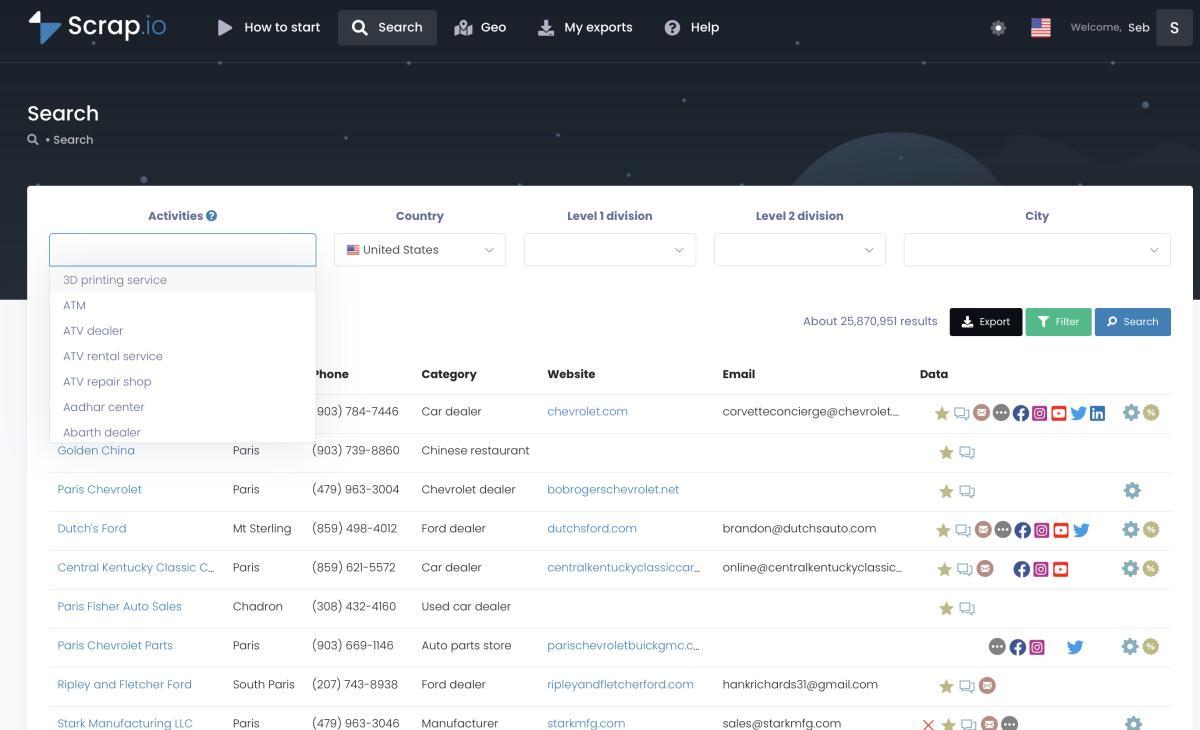
Four things the registry can't do, that the ground layer does in a couple of clicks:
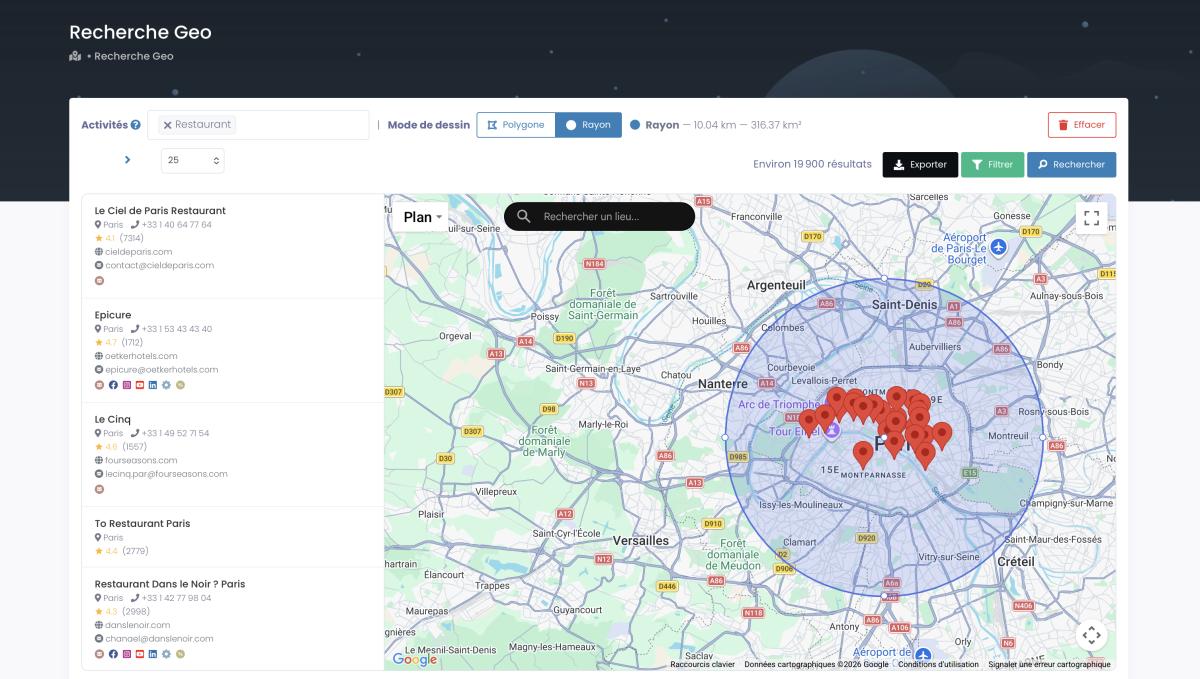
- Extract a whole state — or the whole country — at once. Where the SOS forces a name-by-name search and Arizona bills $2,000/year for an export, you pull every business in a territory in one go. Coverage spans 195 countries and 4,000+ categories.
- Real-time data. Nothing is served from a frozen file. The extraction happens live at the moment of export — versus the 12–24 month lag on registry officer data.
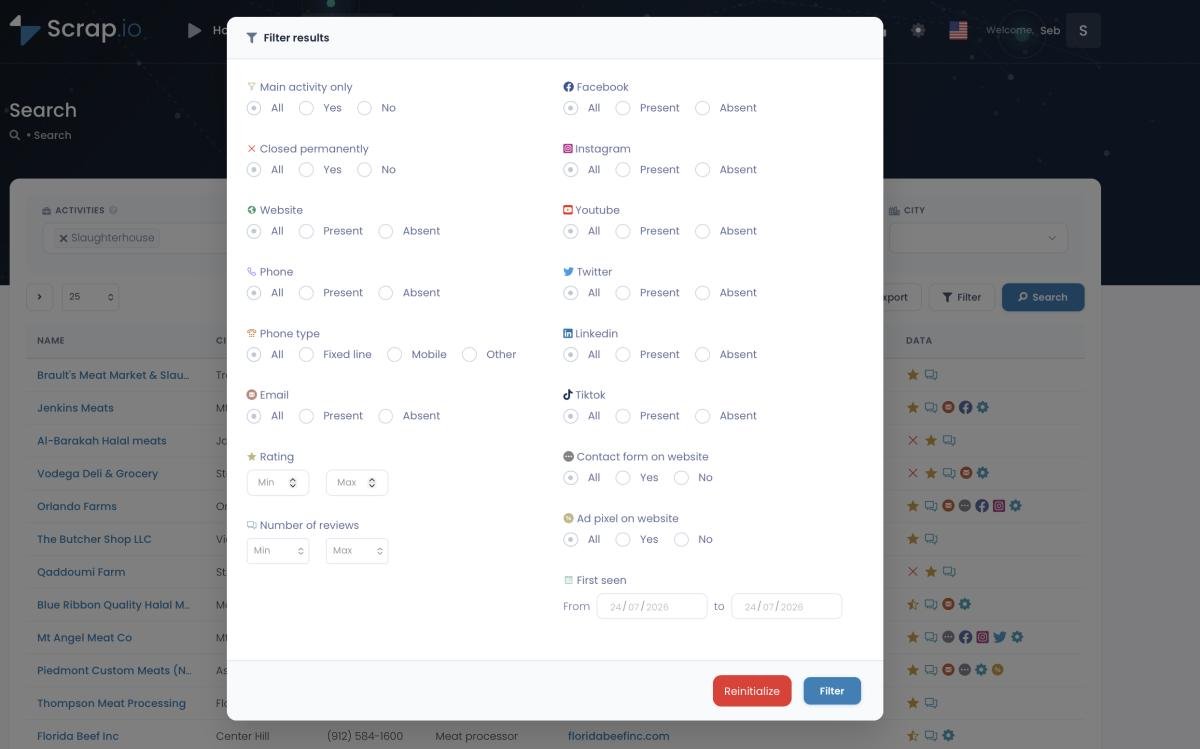
- Filter before extraction. This is the money-saver. You only pay for records worth having — only businesses with an email, only the ones with no website, only the ones that popped up in the last six months. Zero credits burned on dead rows.
- Draw your own zone. A radius or a hand-drawn polygon around the exact neighborhood you sell into — no administrative boundary required, and none of the registered-agent nonsense.
So how do you actually bridge the two layers? A simple four-step matching workflow:
- Pull the legal name from the registry (or your existing entity list).
- Normalize it — strip the "LLC," "Inc.," punctuation, and casing noise.
- Match on name + city against live map data.
- Enrich: attach the phone, the classified email, the website, the rating and reviews.
The email piece is worth a beat. Scrap.io doesn't just dump addresses — it classifies each one as individual (with first and last name pulled out), contact, sales, marketing, or admin. You know if it's the owner on the other end or just info@, before you hit send. If you want the granular version of the enrichment step, the guide on how to find emails on Google Maps walks through it end to end.
Video: Scrap.io - How to Start?
Pick a state, pick a category, hit export. Scrap.io's free trial gives you 7 days and 100 export credits — enough to test the entire workflow on a real list and see the contact data the registry never had. Start your free trial, 100 leads included.
Is Any of This Legal? Compliance in 2026
OK, the less-fun part. Public business data is legal to use for B2B prospecting — with three conditions worth knowing.
First, business data isn't personal data. A company's public phone number, its contact@ address, its storefront location — that's commercial information the business itself published, not someone's private profile. That distinction is the whole legal foundation.
Second, know which rules touch your outreach. CCPA matters if you're hitting California businesses, though publicly available business info is largely carved out of its scope. GDPR comes into play the moment a prospect is European, where "legitimate interest" typically covers B2B outreach that includes an opt-out. And CAN-SPAM governs the emailing itself: accurate sender info, a physical address, a working unsubscribe link, opt-outs honored within 10 days. That's the floor, not the ceiling.
Third, keep your data traceable to its source. That's not just good hygiene — it's what separates a defensible list from a liability. Scrap.io only extracts publicly available business data, stays GDPR and CCPA compliant, and keeps every field traceable back to where it came from. None of this is legal advice — check with your own counsel if a specific campaign makes you nervous — but the shape of the rules is genuinely in your favor for B2B.
FAQ
Is a Secretary of State business search free?
Yes. All 50 states plus DC let you search their business entity registry online at no cost. What costs money is everything else: certified copies, Certificates of Good Standing ($5 in California and Ohio, up to $175 for a Delaware long form), scanned filings, and bulk data downloads.
How do I search a business in all 50 states at once?
You can't — not through official channels. There is no national US business registry. Each state runs its own portal with its own search syntax. Commercial aggregators (OpenCorporates, Middesk, Cobalt Intelligence) rebuild a cross-state layer on top, and mapping-based tools like Scrap.io let you query the entire country in one search.
Does a Secretary of State search show a company's phone number or email?
No. Phone numbers, email addresses and website URLs are not collected at filing, so they are never part of the public record. Minnesota's registry states the exclusion explicitly. To get contact data you need a second source built on operational data rather than legal filings.
Is the address shown in a business entity search the company's real address?
Often not. Most listings show the registered agent's address — a law firm or agent service that accepts legal mail on the company's behalf. This is why Delaware holds 2,287,728 registered entities with a population under one million. For a real, verifiable business location, use a map-based source.
Which states offer bulk business data downloads?
Only a handful. Colorado publishes its complete entity dataset free through its open data portal. California sells a "Master Unload" file for $100. Arizona charges $2,000+ per year, South Carolina up to $12,000 per year for UCC bulk data. Most states offer nothing at all.
The Registry Is the Start, Not the Finish
Here's the thing to walk away with. The secretary of state business search is a genuinely good tool — for what it's for. Confirming a company is real. Checking a status before you sign. Verifying an entity in one specific state. For that, it's free and it's official and it's exactly right.
But it was never built to help you sell. It has no phone number, no email, no website, and half the time not even the real address. It stops at "this company exists." Everything that turns a name into a conversation — that lives on the ground layer, on the map, in real time.
The registry tells you a company exists. Scrap.io tells you how to reach it. Start free for 7 days — 100 leads included, no commitment.
Turn 51 dead-end registries into one live, filterable list of 25.7 million US businesses — with the phone numbers, emails, and real addresses the state never collected. Try Scrap.io free: 7 days, 100 leads included.
Generate a list of restaurant with Scrap.io