

By the Scrap.io Team
There are 1,342,494 businesses in South Africa you can reach right now. Today. From your laptop. The problem? The directories most people still use let you look at them one fiche at a time, like it's 2006 and you're thumbing through a phone book.
That number stopped me the first time I ran it. 1.34 million establishments, all sitting on Google Maps with addresses, phones, and — for a big chunk of them — emails. And the "South Africa business directory" everyone Googles hands you a search box and a "list your business" button. Great. Now try exporting anything.
This guide is about the gap between those two worlds. The old listing sites, and a live, filterable, exportable business directory South Africa companies actually live inside of. Let's get into it.
Video: Scrap.io - How to Start?
- What is a South Africa business directory in 2026?
- How many businesses are in South Africa?
- Why classic SA directories fall short
- Turn Google Maps into a live South Africa database
- Build a targeted list by industry
- Filter before you extract
- Zoom in on a city or province
- Is scraping a business directory legal in SA? (POPIA)
- From list to revenue: outreach that works
- FAQ
- Conclusion
What is a South Africa business directory in 2026?
Quick question before anything else: are we talking about a website you browse, or a database you can download? Because those are two completely different things, and the difference is your entire prospecting workflow.
A South Africa business directory is a structured list of companies operating in the country — names, addresses, phone numbers, and ideally emails — that you can search, filter, and export for research or outreach. The classic version is a listing site you scroll. The 2026 version is a live database pulled straight from Google Maps and refreshed every time you extract.
That second definition matters. A directory you can only look at is a phone book. A directory you can filter and download is a pipeline. One of them helps you find a plumber in Durban. The other one helps you email 6,000 of them by Friday.
And the raw material for the modern version already exists. Every business with a Google Maps pin is, effectively, a directory entry — geolocated, categorised, often linked to a website. Nobody sat down and "compiled" it. The businesses did it themselves, because that's where their customers find them. Which, honestly, makes it the freshest company database South Africa has going.
How many businesses are in South Africa?
Here's where it gets counterintuitive. South Africa has an estimated 2.67 million SMMEs — but only about a third of them are formally registered. The rest run informally, off the books, invisible to any official register. So the "real" number depends entirely on which lens you use.
Start with the official one. The Companies and Intellectual Property Commission (CIPC) lists roughly 1.8 million active registered entities. That's the legal backbone — companies that filed paperwork and exist on the state's books. Then the economic lens: research compiled by the Small Business Institute and echoed by UN development work puts total SMMEs around 2.67 million, with only about 37% formally registered with the CIPC.
And the weight of these businesses is enormous. According to The Banking Association South Africa, SMEs make up roughly 91% of the country's formalised businesses, employ close to 60% of the workforce, and generate about a third of GDP. That's not a niche. That's the economy.
| Lens | Count | Source |
|---|---|---|
| Registered active entities (CIPC) | ~1.8 million | CIPC / IRIS RegTech, 2026 |
| Total SMMEs (formal + informal) | ~2.67 million | Small Business Institute / UNDP, 2024 |
| Share formally registered | ~37% | Small Business Institute, 2024 |
| Reachable on Google Maps (Scrap.io) | 1,342,494 | Scrap.io, July 2026 |
So which number matters to you? If you're doing outreach, it's the last one. 1,342,494 South African establishments are visible on Google Maps and extractable in real time via Scrap.io. That's not the whole economy — the informal traders won't all be there — but it's the slice with a pin, a phone, and often a website. In other words, the slice you can actually contact.
Why classic SA directories fall short
SABL lists over 1.2 million companies.
Go ahead and try to export them.
You can't. That's the whole story of the traditional South Africa business directory in one sentence. SA Business Listings (SABL) claims "over 1.2 million companies listed" — a genuinely impressive number — and a Google rating hovering around 2.6 out of 5, which tells you what users think of the experience. You browse one entry. Then the next. Then the next. No bulk download, no email column, no way to filter to "construction firms in Gauteng with a website but no email."
The others are variations on the theme. Brabys, the old-guard South African directory. Bizcommunity, a B2B repertoire spanning 18 industries. Then the paid-database crowd: Global Database with roughly 130,730 South African companies, or Blue Label Data Solutions sitting on an opt-in base of 16 million-plus subscribers. Some are free to browse. Some cost real money. All of them share one flaw: the data is frozen the moment it's published.
| Classic directory (SABL, Brabys) | Live database (Scrap.io) | |
|---|---|---|
| Browsing | One entry at a time | Whole country in two clicks |
| Export | None | CSV / Excel |
| Freshness | Static, ages fast | Real-time at every extraction |
| Filtering | Minimal | Filter before you pay |
| Emails | Rarely, unstructured | Classified (contact, sales, individual…) |
A bought database has the same problem as a listing site, just with a receipt attached. In a country where businesses open and close constantly, a list that was 95% accurate in January is bouncing a chunk of your emails by June. If you've read our Saudi Arabia business directory guide, this is the exact same pattern — different country, identical frustration. Static is static, wherever you are.
Turn Google Maps into a live South Africa database
Let me tell you about Thabo. Runs a small web agency in Durban. He needed every construction company in South Africa that didn't have a website — because those are the ones who might, you know, pay him to build one. Old way: months of manual searching. His way that afternoon: two clicks, one filter. 13,713 companies. Done before his coffee went cold.
That's the shift. Instead of treating Google Maps as a place you look things up, you treat it as the database it secretly is. You pick a category, pick a location — a city, a province, or all of South Africa — and pull every matching listing into a spreadsheet. No copy-pasting. No Python. No proxies breaking at 2am.
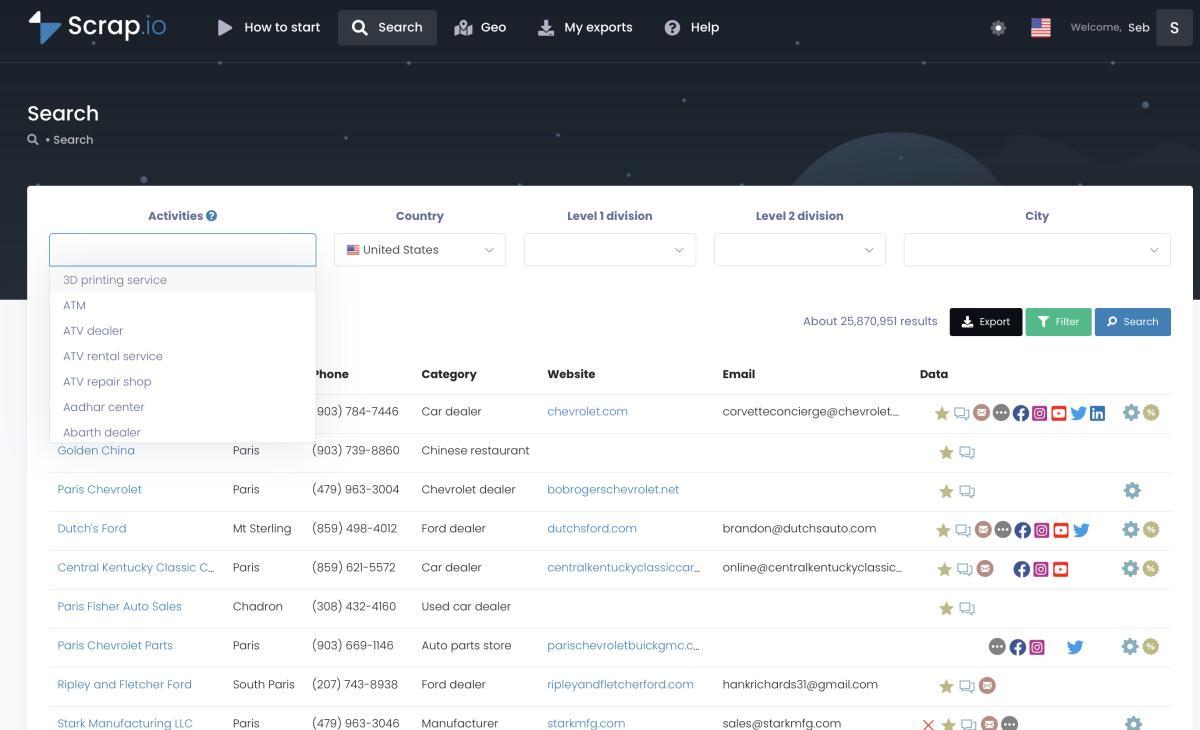
The mechanics are covered in depth in our guide on how to extract all businesses from Google Maps, and the five methods (DIY scripts, extensions, APIs, no-code) are broken down in the full Google Maps scraping guide. And if South Africa is just your first market, the same country-level approach works anywhere on the map — that's the whole idea behind international lead generation from Google Maps.
Country-level extraction is the part that surprises people, so here's a video on exactly that:
Video: How to Scrape Local Leads at the Country Level?
Curious how many businesses match your niche in South Africa? Counting is free inside Scrap.io — no credits spent, no card charged for the number itself. Run "dentists in Cape Town" or "logistics companies in Gauteng" and see the size of your market before you commit to anything. See the count on Scrap.io.
Build a targeted list by industry
Numbers make this real, so here are three straight from Scrap.io (July 2026): 23,360 construction companies, 12,256 doctors, and 4,699 law firms across South Africa. Each one geolocated, categorised, and ready to filter.
| Industry | Businesses on Google Maps | Notable segment |
|---|---|---|
| Construction companies | 23,360 | 13,713 with no website |
| Doctors | 12,256 | Clinics, GPs, specialists |
| Law firms | 4,699 | 2,686 with an email |
Look at that construction row again. 13,713 companies without a website. If you're a web agency, that's not a statistic — that's a client list with the "needs what I sell" box pre-ticked. Thabo built his entire pipeline on that single filter. For a deeper play here, our construction company email list guide walks through the targeting, and the law firm email list guide does the same for legal — a segment where 2,686 firms already have an email waiting.
You can also cross categories in a single search. Construction plus electricians plus plumbers, in one extraction. Or go broad and pull every business in a zone with no category at all — a full economic map of a town. Try assembling that from a listing site. I'll wait.
Filter 23,360 South African construction firms down to the 6,946 with an email — before spending a single credit. That's the whole trick: you shape the list first, pay for it second. Build your industry list on Scrap.io.
Filter before you extract
Nothing burns a prospecting budget faster than 20,000 rows you can't email. You paid for them. Half of them have no address you can reach.
That's money on fire.
So flip the order. Scrap.io applies every filter before credits are consumed — which means you only ever pay for contacts that match what you actually need. Want only businesses with an email? Toggle it. Only mobile numbers, for an SMS campaign? Toggle it. Minimum rating, minimum review count, has-a-contact-form, runs an ad pixel, recently opened — all of it upfront.
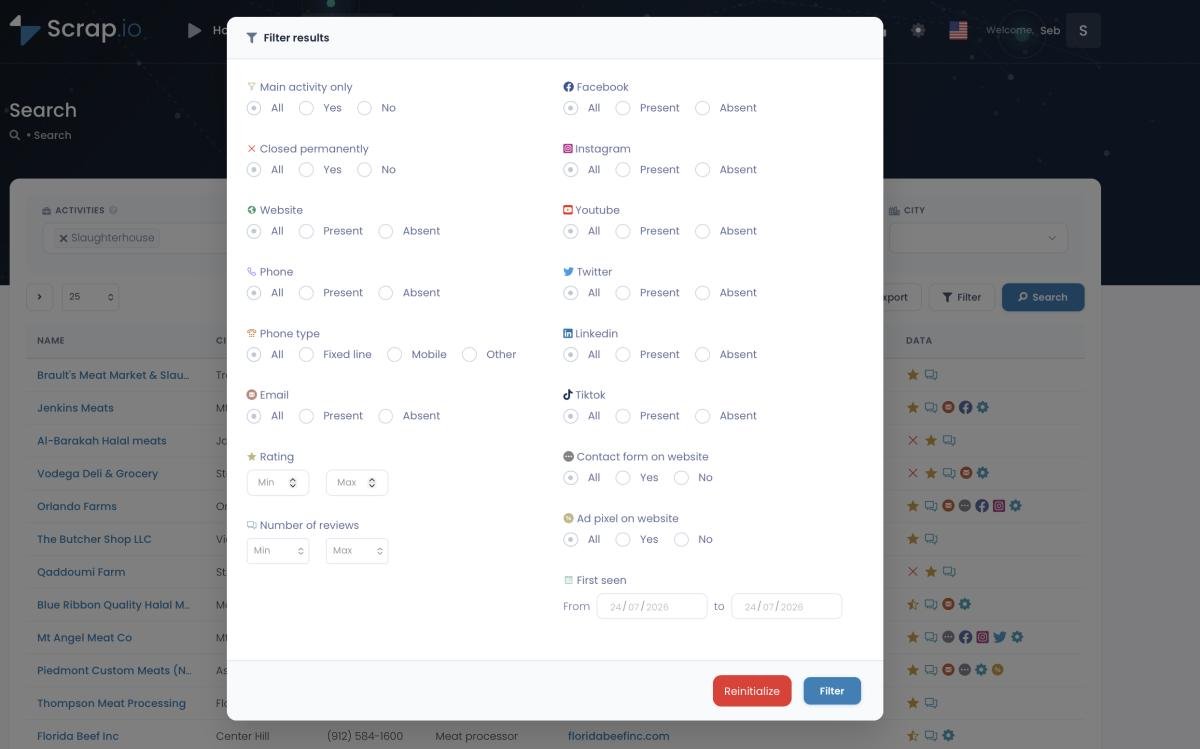
Back to construction. Start at 23,360 companies. Apply "has an email." You land on 6,946 directly emailable firms. You just turned a bloated, half-useless dump into a clean, contactable list — and you paid for 6,946 instead of 23,360. That maths works in your favour every single time. The full walkthrough of pulling verified addresses lives in our guide on how to find emails on Google Maps.
And the emails don't come as a blob. Scrap.io classifies them — individual (with first and last name parsed out), contact@, sales@, marketing@, admin@. So before you write a word, you know whether you're emailing the owner or a generic inbox. That's the difference between a template and a message that lands.
Zoom in on a city or province
Only prospecting Jozi? Then why on earth would you download the whole country?
You wouldn't. And you don't have to. Beyond the standard city / province / country levels, Scrap.io's GeoSearch lets you draw the exact zone you care about. Two modes, both useful. Radius: a circle of whatever size around a point — say, every business within 20 km of the Sandton CBD. Polygon: a shape you draw by hand on the map, tracing a neighbourhood, an industrial corridor, a coastline, whatever doesn't fit a neat administrative box.
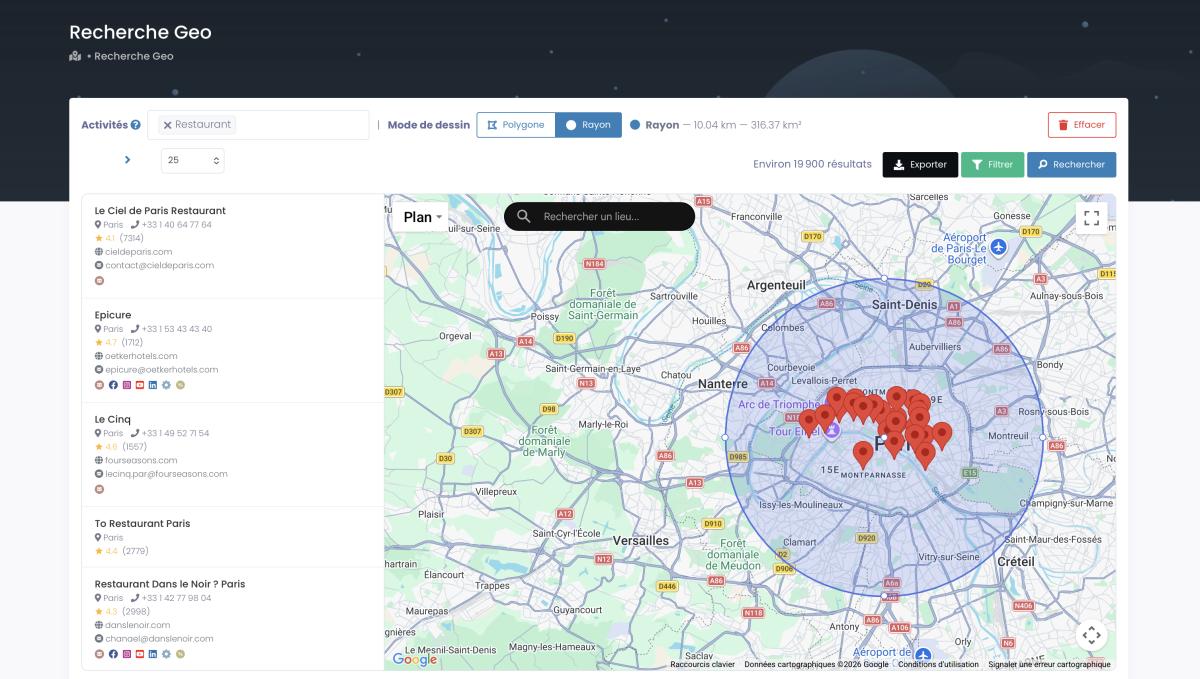
All the filters and multi-category search still work inside a radius or a polygon. So "law firms with an email, within 15 km of the Durban city centre" is a completely normal request. Try drawing that on Brabys.
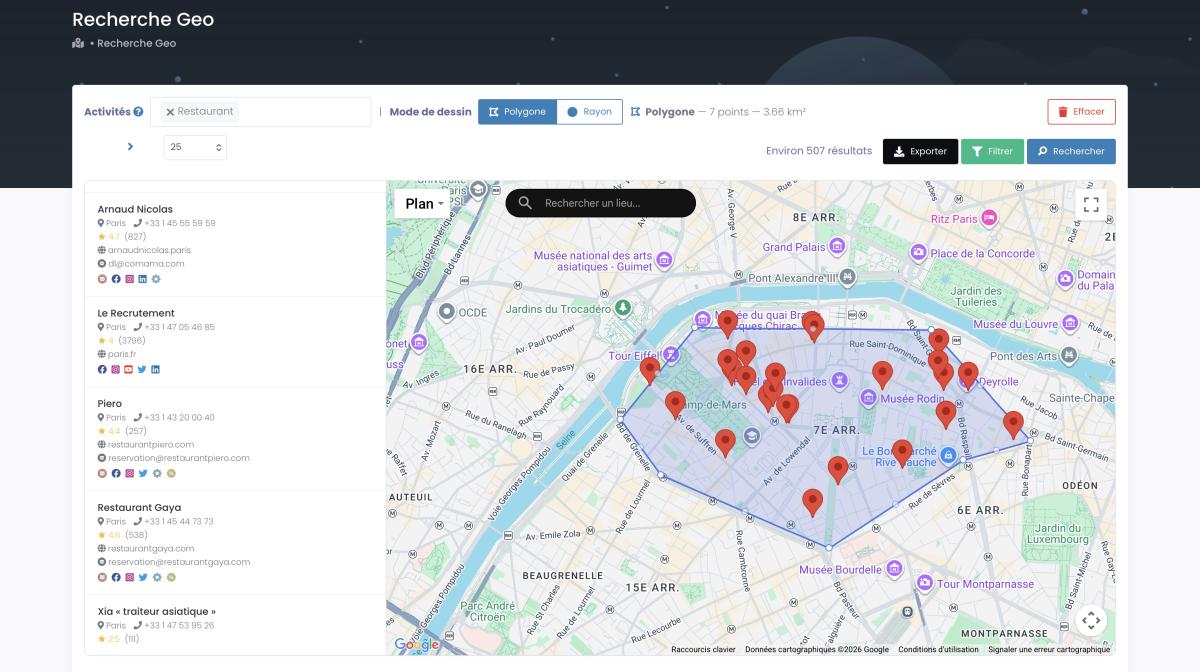
This is how local agencies and regional sales teams stop wasting spend on leads three provinces away. You target the exact patch of map that matters, and nothing else.
Is scraping a business directory legal in SA? (POPIA)
Short answer: yes — with one POPIA caveat. Let me be specific, because vague hand-waving helps nobody.
The data we're talking about is public business information. A company's phone number, its business address, the email it published on its own website — that's information a business deliberately made public so customers could find it. Collecting publicly available business data is broadly legal, and Scrap.io only ever touches that kind of data, with every point traceable back to its source. The platform is GDPR and CCPA compliant by design.
Now the South African wrinkle. The Protection of Personal Information Act (POPIA), overseen by the Information Regulator, is the local privacy law — and unlike GDPR, it also extends protection to juristic persons, meaning companies, not just individuals. That doesn't make prospecting illegal. It means you follow the direct-marketing rules: identify yourself clearly, keep your data sourced from public places, and honour opt-outs the moment someone asks. Standard hygiene, really.
The recurring question in South African business communities — the kind you'll see popping up on r/southafrica and Quora — is some version of "where can I get a verified list of SA companies with emails that won't bounce?" The honest answer is: a real-time source you control, used within the rules. Not a random spreadsheet from 2019. When real money's on the line, talk to a lawyer — but for public business data used responsibly, you're on solid ground.
From list to revenue: outreach that works
A clean list is worth exactly nothing until the first reply lands. So let's talk about turning 6,946 rows into actual conversations.
This is where the email classification earns its keep. An email to info@ should read nothing like an email to the owner's individual inbox. Generic addresses get a value-first pitch that doesn't assume who's reading. Individual emails get real personalisation — reference their city, their Google rating, the fact that they've got 4.8 stars across 200 reviews and are clearly doing something right. The full framework, with before-and-after examples, is in our guide on how to write a cold email.
The pattern that works, over and over: problem first, you second. Nobody in Polokwane cares that you founded your company three years ago. They care whether you understand their problem. Lead with theirs, keep it short, ask one question. That's it.
And go multi-channel. The data gives you phone type (mobile vs fixed) and social profiles alongside the email — so email opens the door, a well-timed call closes it, and LinkedIn keeps you familiar in between. Here's the same idea applied with an AI assistant doing the heavy lifting:
Video: How to Scrape Local Leads with Claude & Vibe Prospecting?
Try Scrap.io free for 7 days — up to 50 searches and 100 export credits to build and test a real South African list. Free trial, 100 leads offered. Start your free trial.
FAQ
What is the best business directory in South Africa?
The classic names are SABL, Brabys, and Bizcommunity — fine for browsing a single company. But for prospecting, a real-time, exportable source like Scrap.io is far more useful: it's built live from Google Maps, so you filter by industry, city, and email, then download thousands of contacts at once instead of clicking through one fiche at a time.
How many companies are registered in South Africa?
The CIPC lists roughly 1.8 million active registered entities. Counting all SMMEs, formal and informal, the total is around 2.67 million, with only about a third formally registered. On Google Maps specifically, about 1.34 million South African businesses are reachable in real time via Scrap.io (July 2026).
Is there a free business directory in South Africa?
Yes — SABL, Brabys, and TheBusinessDirectory.co.za let you browse and list businesses for free, but none of them let you bulk-export. For a downloadable, filterable list, Scrap.io offers a free 7-day trial with 100 export credits, so you can test a real segment before paying anything.
How do I get a list of businesses in South Africa with email addresses?
Use a real-time tool rather than a static file. Pick a category, choose a location (from a single city up to the whole country), apply the "has email" filter, and export to CSV or Excel. For example, of 23,360 South African construction companies on Google Maps, 6,946 have a website email — and you only pay for those.
Is it legal to scrape a business directory in South Africa?
Scraping public business data is generally legal, and Scrap.io collects only public, source-traceable information while staying GDPR and CCPA compliant. POPIA also applies in South Africa — and notably covers juristic persons — so follow direct-marketing rules such as clear identification and honouring opt-outs. When in doubt, consult a lawyer.
Conclusion
The old South Africa business directory asks you to look. The 2026 version lets you build, filter, and export — 1.34 million businesses, live from Google Maps, shaped to exactly the niche and province you sell to. That's the difference between a phone book and a pipeline.
Your first 100 South African leads are on the house. Free trial, 100 leads offered — pick a city, pick an industry, and see the data quality before you spend a cent. Start your free trial on Scrap.io.
Generate a list of restaurant with Scrap.io