

Video: Google Maps API versus Scraping
Last week I asked Claude to find me every dentist in Austin with fewer than 10 Google reviews. It gave me a confident list. Twelve names, addresses, phone numbers. Looked great.
Seven of them didn't exist.
That's the dirty secret behind the $50 billion AI agents market. These models can write poetry, debug code, and generate entire marketing strategies, but ask them for real-time data about actual businesses? They hallucinate. They guess. They make stuff up with the confidence of a politician on live TV.
And it's not their fault. LLMs are trained on static snapshots of the internet. The world moves. Businesses open, close, change phone numbers. Your AI agent is working with yesterday's map in tomorrow's city. The result? Bad leads, wasted outreach, embarrassing cold calls to businesses that closed six months ago.
So the question isn't whether AI agents are useful. Obviously they are. The question is: how do you feed them real-world data that's actually current?
Table of Contents
- Why AI Agents Are Starving for Real-World Data
- 5 Ways to Feed Web Data to AI Agents
- Google Maps Data: The Untapped Goldmine for LLMs
- How to Feed Google Maps Data to an LLM (Step by Step)
- Real-World Use Cases: AI Agents Powered by Business Data
- Web Data for AI Agents: Tools Compared (2026)
- Legal and Compliance Considerations
- Conclusion
- FAQ
Why AI Agents Are Starving for Real-World Data
Your AI agent can write a 3,000-word blog post about Austin's restaurant scene. But ask it how many coffee shops in downtown Austin are open right now? No clue. Zero. It'll try, and it'll sound convincing doing it, but the data simply isn't there.
This isn't a niche problem. Bright Data's 2024 report found that the number one reason companies use public web data is building AI models. And yet, 8 in 10 companies cite data limitations as the main blocker to deploying agentic AI (Landbase, 2025). Eight out of ten. Let that sink in.
Bottom line: the bottleneck isn't intelligence. It's information.
OK so here's what's happening under the hood. LLMs like GPT-4, Claude, and Gemini are trained on massive text datasets, but those datasets are frozen in time. They don't update when a restaurant changes its phone number or a plumber moves across town. The model "knows" what the internet looked like months ago. Not today. Not right now.
For tasks like code generation or creative writing, that's fine. For anything involving real time data for ai agents, lead generation, competitor analysis, market research, it's a dealbreaker. You need a way to ground your LLM in current, structured, verified business data. Otherwise you're building on quicksand. (If you're brand new to this, our guide on how to use an AI data scraper covers the ground-level workflow first.)
And the market knows it. The web scraping industry is projected to grow from $0.99B to $2.28B by 2030 (The Business Research Company, 2025). Browserbase, the cloud browser infrastructure company powering Perplexity, just hit 50 million browser sessions, doubled year-over-year. Everyone's scrambling to solve the same problem: how to ground LLM with real world data.
5 Ways to Feed Web Data to AI Agents
So how do you actually get fresh, structured data into your AI agent's hands? Five paths. They're not all created equal. (Honestly, three of them kind of suck for most use cases. But let's be fair and cover them all.)
1. Official APIs
The "proper" way. Google's Places API, Yelp's Fusion API, etc. Clean data, structured responses, zero legal gray area.
Clean. Reliable. Boring.
The catch? Cost and coverage. Google charges $17 per 1,000 Place Details requests, and that doesn't include emails, social profiles, or website metadata. Pull data on 50,000 businesses and you're looking at $850+ just for basic fields. Oh, and the Google Maps API caps search results at ~120 per query. Good luck doing country-level extraction with that.
2. Traditional Web Scraping
Write Python scripts, manage proxies, wrestle with CAPTCHAs. Total control. Total headache. The dream of every ai agent web scraping enthusiast, until reality hits. LLM-powered scrapers reduce maintenance by 70% compared to traditional ones (DataRobot, 2025), but "70% less of a nightmare" is still a nightmare. Every time Google tweaks their DOM, your scraper breaks at 3 AM. And if you're wondering how to use google maps data with llm this way, you'll spend more time fixing broken selectors than actually using the data.
3. MCP Servers (Model Context Protocol)
This is the new hotness. MCP is an open standard that lets AI agents connect directly to external data sources, think of it as USB-C for AI. Instead of your agent guessing about the world, it queries a live data source in real-time.
Scrap.io runs an official MCP server that works with Claude, ChatGPT, and Gemini. Your agent asks "find all plumbers in Dallas with no website" and gets back structured, current data. Not hallucinations. Not guesses. Actual businesses with actual phone numbers. Want the full walkthrough? Here's exactly how the Scrap.io MCP for Google Maps plugs into your AI.
4. Browser Automation
Tools like Browserbase and Playwright let AI agents control actual browsers, navigate pages, click buttons, fill forms. Powerful for complex workflows. Overkill (and slow) for bulk data extraction. Also expensive at scale. Not worth it for most people, honestly.
5. Pre-built Datasets and Scraping Platforms
No-code platforms like Scrap.io, Apify, and Firecrawl handle the infrastructure for you. They manage proxies, anti-bot systems, data cleaning, and hand you structured output ready for your LLM or RAG pipeline. If you need an ai agent that scrapes websites without babysitting, this is your category. For web scraping tools for ai agents 2026, this is where most non-developers end up. And honestly? Most developers too. The whole point of web data extraction for rag pipeline is getting clean, structured records into your vector store without losing your sanity.
Curious how much data is available? Run a free count on Scrap.io for any business category in any country, no credits required. 225 million+ businesses indexed across 195 countries. See what's out there before you commit to anything.
Google Maps Data: The Untapped Goldmine for LLMs
Google Maps indexes over 250 million businesses worldwide. That stat comes straight from Google themselves when they launched Maps Grounding in Vertex AI. It's the largest real-time business database on the planet, and most AI agents can't touch it.
Think about what's sitting in those listings. Names, addresses, phone numbers, websites, ratings, review counts, opening hours, GPS coordinates, business categories. It's essentially a massive POI database, and Scrap.io goes further, crawling associated websites to pull emails (classified by type: individual, sales, marketing, admin), social media profiles, tech stacks, and ad pixels. That's 50+ data fields per business.
Why does this matter for AI? Because google maps data for ai solves the grounding problem. Instead of your LLM guessing whether a business exists, it queries a live source. Instead of hallucinating a phone number, it returns the one from the actual Google Maps listing, updated by the business owner themselves. If you've ever wondered whether "real-time" is just a marketing word, here's how Scrap.io extracts data in real time: a preview layer for instant counts, then a live re-scrape on every export.
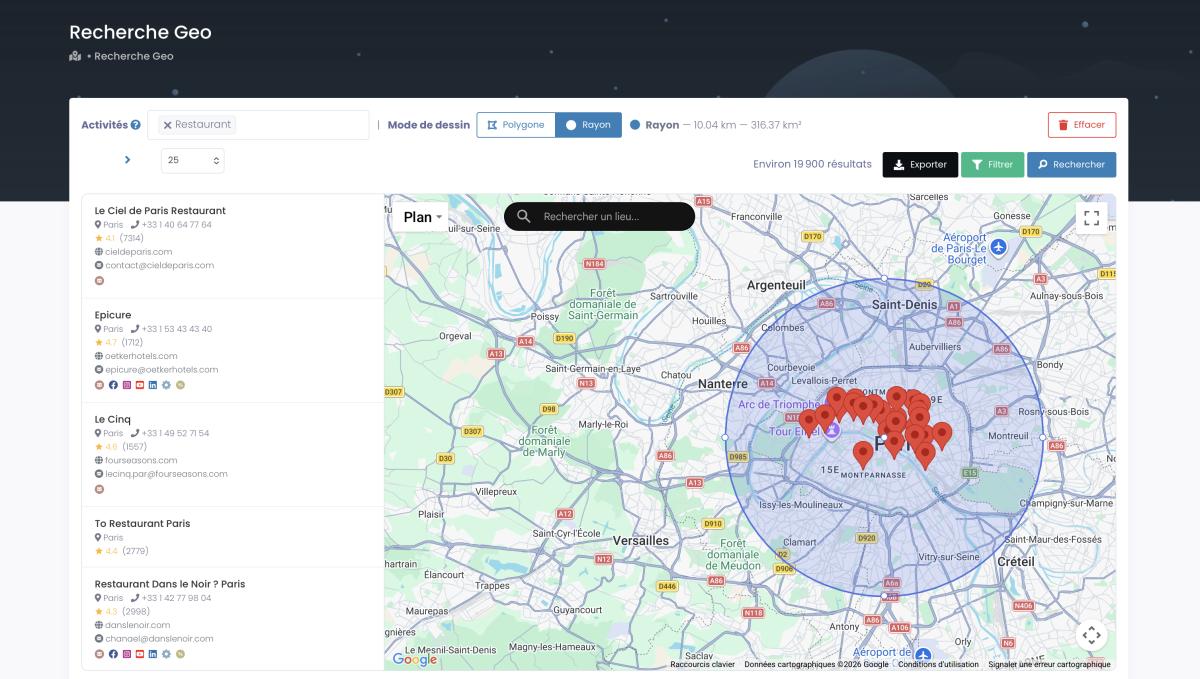
Honestly, the comparison with traditional data providers is brutal:
| Criteria | Google Maps API | Web Scraping (DIY) | MCP + Scrap.io |
|---|---|---|---|
| Cost per 10K businesses | $170+ | Dev time + proxies | From $35/mo |
| Data freshness | Real-time | Depends on your setup | Real-time |
| Emails included | No | If you build it | Yes (classified) |
| Phone type (mobile/landline) | No | No | Yes |
| Social profiles | No | If you build it | Yes |
| Setup complexity | Medium (dev needed) | High | Low (2 clicks) |
| AI-compatible output | JSON | Whatever you build | CSV, Excel, API, MCP |
The google maps api vs scraping for ai debate really comes down to this: the API gives you clean but expensive and incomplete data. Scraping gives you everything but requires infrastructure. Scrap.io gives you everything without the infrastructure headache. Pick your poison.
How to Feed Google Maps Data to an LLM (Step by Step)
Video: How to Scrape Local Leads at the Country Level
Let's say you're building an AI agent that finds every dentist in Texas with no website and no email. Here's how you'd do it, and I timed it. Under five minutes.
Method 1: Export + RAG Pipeline (no code)
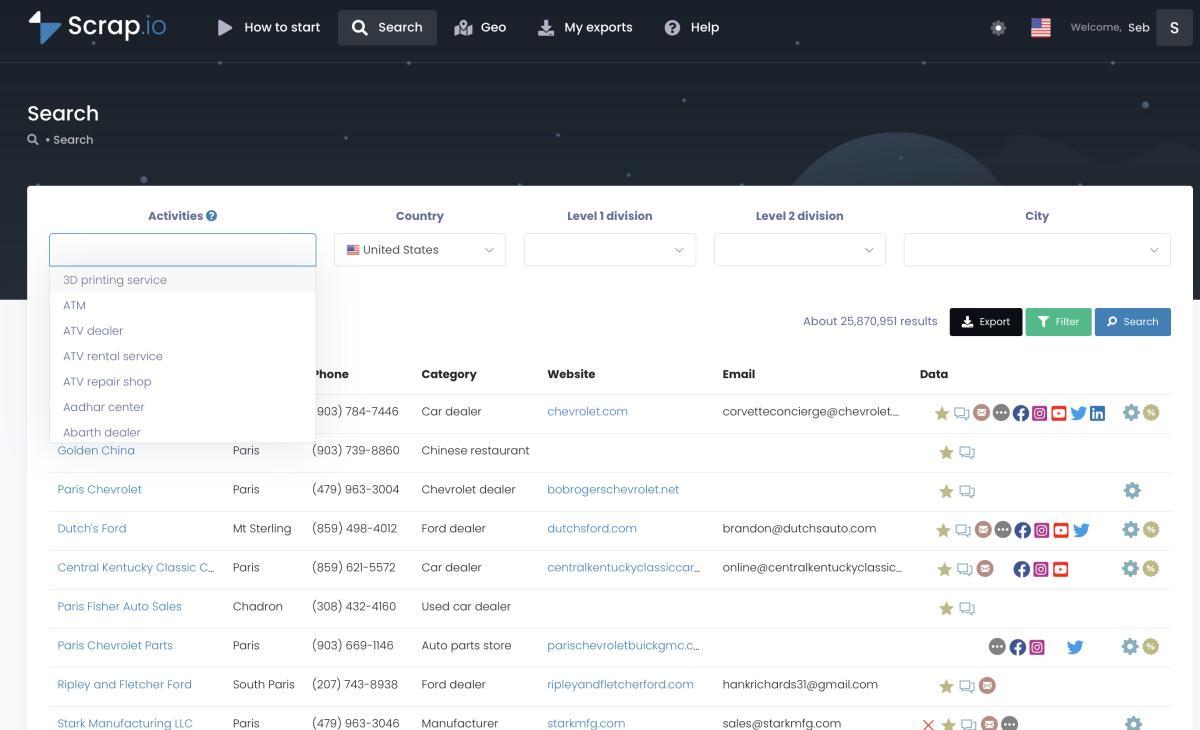
- Go to Scrap.io. Search "dentist" → Texas.
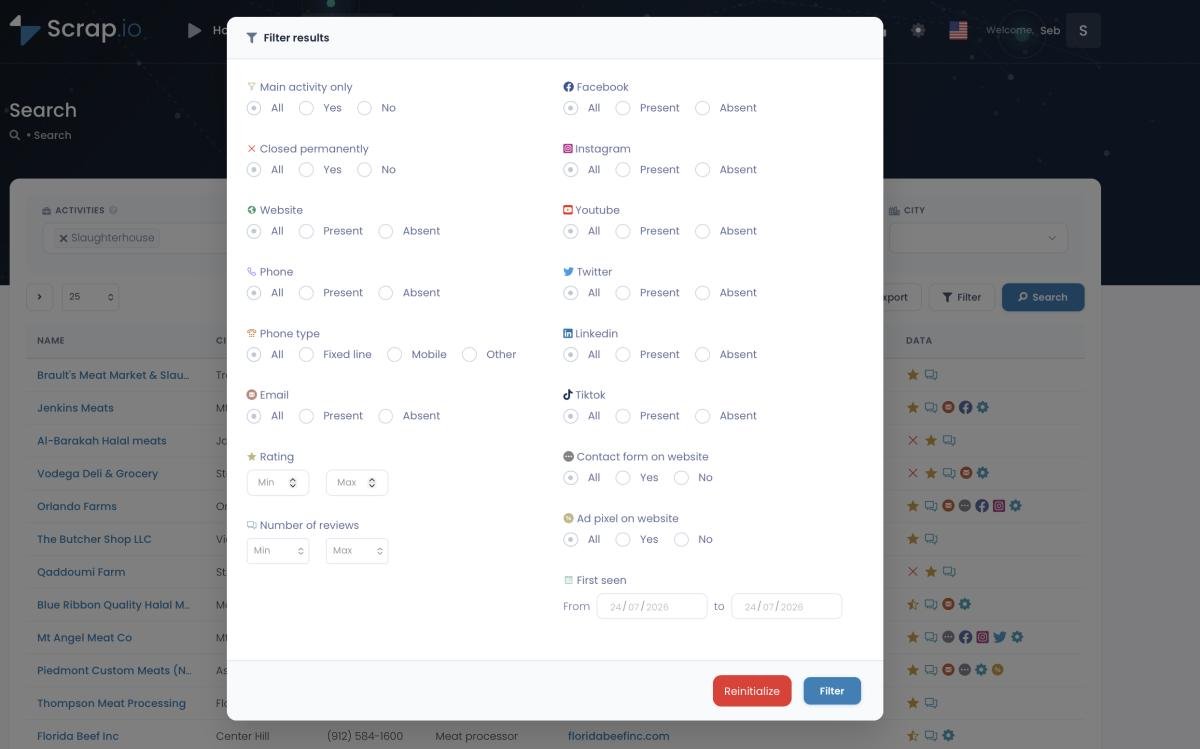
- Filter: website = absent, email = absent.
- Export as CSV. You'll get names, addresses, phones, ratings, review counts, everything available on those listings.
- Feed the CSV into your LLM via a RAG pipeline (LangChain, LlamaIndex, whatever you're using). Your agent now has structured data extraction for llm that's actually grounded in reality.
OK. That's the simple version.
Method 2: MCP Server (real-time, zero export)
- Connect the Scrap.io MCP server (scrap.io/mcp) to Claude, ChatGPT, or any MCP-compatible client.
- Ask your agent: "Find all dentists in Texas without a website."
- The agent queries Scrap.io's mcp server for web scraping in real-time. Results come back structured. No hallucinations. No stale data.
That second method is where things get wild. Your AI agent doesn't just analyze data, it fetches it. In real-time. From 225 million+ businesses. You can ask it to connect google maps to chatgpt or feed google maps data to claude and it just... works. Here's what that looks like end to end, driving the whole thing from Claude:
Video: How to Scrape Local Leads with Claude & Vibe Prospecting
Method 3: API + Automation (Make.com / n8n)
For ongoing pipelines, plug Scrap.io's API into Make.com or n8n. Schedule extractions. Auto-feed results into your CRM. Let your AI agent process new leads as they arrive. No code web scraping for ai at its finest.
Try it yourself. Scrap.io offers a free 7-day trial with 100 leads included. Connect via MCP, API, or just export a CSV. See what grounded AI actually feels like. Start your free trial.
Real-World Use Cases: AI Agents Powered by Business Data
The companies winning with AI agents aren't the ones with the best models. They're the ones with the best data pipelines. Full stop.
Apify runs 22,000+ pre-built scrapers with MCP integration for LangGraph, CrewAI, and OpenAI. Their clients include Accenture, Samsung, and Princeton. They've built the infrastructure layer for ai agent for web scraping at enterprise scale, but, I mean, the output is only as good as the data source you connect it to.
Bright Data serves 20,000+ teams with enterprise web data for LLMs. They launched Browser.ai plus an MCP Server. And they won in court against both Meta and X Corp, establishing key legal precedents for web data collection. (More on that in the legal section.) If you're weighing them specifically for Maps data, we ran the numbers in our Bright Data vs Scrap.io comparison, 200 vs 2,000+ results on the same search.
Browserbase raised $40M in a Series B at a $300M valuation, and they power Perplexity's web search under the hood. 50 million browser sessions, doubled year-over-year. That's how seriously the market takes browser-based ai agent for web scraping infrastructure. But Browserbase is a horizontal tool, it gives your agent a browser, not business data. You still need a specialized source for structured leads. (Which brings us back to CRM automation with enriched Google Maps data, the real endgame for sales teams.)
Reworkd (YC S23) raised $4M to build self-healing LLM-powered scrapers. Their co-founder KhoomeiK dropped a truth bomb on Hacker News that stuck with me: "Using LLMs for web data extraction does not work unless you generate code." Meaning, the LLM orchestrates the scraping, but you still need proper tools doing the actual extraction.
Firecrawl converts websites to LLM-ready Markdown and JSON. 100K+ GitHub stars. Official MCP for Claude. Excellent for turning unstructured web pages into something your agent can actually parse, but it's a general-purpose tool, not specialized for business data.
ScrapeGraphAI combines Python, LLMs, and graph logic for scraping. Featured on Hacker News with 194 upvotes. One commenter (ewild) shared something fascinating: "At my job we are scraping using LLMs. For a 10M sector. GPT4 turbo has never hallucinated out of 1.5M API requests." That's 0% hallucination rate, but only because they're using the LLM to structure data that's already been properly scraped. Not to generate it from thin air.
Still. Another HN user (jumploops from MagicLoops) kept it real: "We use Apify and it works most of the time. The long-tail is difficult though." The long tail is always difficult. That's why specialized tools for specific data sources, like Google Maps, outperform general-purpose scrapers for best way to get business data for ai agents.
And then there's Google itself. Maps Grounding in Vertex AI went GA back in September 2025, giving developers direct access to 250M+ business listings through Gemini. A year on, it's their standing answer to the grounding problem, but it's locked inside Google's ecosystem, priced for enterprise, and (per Google's own launch note) limited to places in the US and India. Worth knowing before you bet a workflow on it. We pressure-tested the wider set of Google Maps AI features and, spoiler, most of the flashy stuff still doesn't exist outside two countries.
Web Data for AI Agents: Tools Compared (2026)
Choosing a web data tool for your AI agent is like choosing a database, the wrong pick costs you months. Here's what actually matters:
| Tool | Type | MCP Support | Google Maps Focus | Emails | Best For |
|---|---|---|---|---|---|
| Scrap.io | No-code + API + MCP | Native | 225M+ businesses | Yes (classified) | Business data at scale |
| Apify | Cloud scraper platform | Yes | Via Actors | Depends | General-purpose scraping |
| Firecrawl | Open-source crawler | Yes | No | No | Web-to-Markdown for LLMs |
| Bright Data | Enterprise data platform | Yes | Partial | Via enrichment | Enterprise-scale ops |
| Browserbase | Cloud browser infra | Limited | No | No | Browser automation for agents |
| Google Maps API | Official API | Via Vertex AI | 250M+ places | No | Dev prototyping, small scale |
| ScrapeGraphAI | Python + LLM scraping | No | No | No | Dev-friendly LLM scraping |
Quick take: if you need web data for ai agents from Google Maps specifically, business contacts, emails, social profiles, at country-level scale, Scrap.io is the only tool built for that exact job. Everything else either lacks the Google Maps depth or requires you to glue five tools together.
For general web scraping (turning any webpage into LLM-ready data), Firecrawl and Apify are solid. For enterprise budgets with complex compliance needs, Bright Data. For browser-based agent workflows, Browserbase.
Oh, and one more thing, companies seeing avg 171% ROI from agentic AI deployments (Arcade.dev, 2025) aren't using just one tool. They're building stacks. But the data layer, the part that connects your agent to reality, that's where you start. If sales is your angle, our roundup of the best AI sales tools shows where a real-time data source slots into the rest of the stack.
Legal and Compliance Considerations
Can you legally scrape business data and feed it to an AI? Short answer: yes, if you do it right.
The landmark case is hiQ Labs v. LinkedIn (9th Circuit, 2022). The court ruled that scraping publicly available data does not violate the Computer Fraud and Abuse Act. This was reinforced by Meta v. Bright Data (2024), where Meta dropped its claims after the court found that logged-out scraping = no ToS agreement = no breach. Full breakdown here.
For Google Maps data specifically: it's public. No login needed. Business owners put it there voluntarily. Scraping it for B2B prospecting is legal in the US and falls under "legitimate interest" in the EU (GDPR Article 6). Just don't scrape personal consumer data, honor opt-out requests, and follow CAN-SPAM/CCPA for outreach.
One thing worth watching: the EU AI Act has been in force since August 2026. It adds rules around scraping for AI model training specifically. But using structured business data to ground your agent's responses? That's a completely different animal from training an LLM on copyrighted content. Don't let the headlines confuse the two.
Conclusion
Look. AI agents without real-world data are just very eloquent liars. The models are ready. The frameworks exist. What's missing, for most teams, is the data pipeline that connects their agent to what's actually happening in the real world.
Google Maps is sitting on 225 million+ business listings. Updated in real-time. Structured. Filterable. And now, thanks to MCP and tools like Scrap.io, directly accessible to your AI agent without a single line of code.
Start your free 7-day trial. 100 leads on us. Connect via MCP, export CSV, or plug into Make.com. See what your AI agent can do when it stops guessing and starts knowing. Try Scrap.io free.
Frequently Asked Questions
How do AI agents get data from the web?
Through APIs, web scraping ai agent tools, MCP servers, or browser automation. APIs like Google's Places API give structured but expensive and limited data. Scraping tools extract broader datasets. MCP servers, like Scrap.io's at scrap.io/mcp, let agents query live data sources in real-time, returning clean, pre-filtered datasets that eliminate hallucinations.
Can you feed Google Maps data to ChatGPT or Claude?
Yes. Two ways. Export from Scrap.io as CSV/Excel and upload it, your LLM can then query the structured data directly. Or connect via the Scrap.io MCP server for real-time access. Claude and ChatGPT both support MCP connections. Your agent queries 225M+ businesses without ever leaving the chat.
Is it legal to scrape Google Maps data for AI?
Yes. Public business data scraping has been upheld in multiple US court rulings, hiQ v. LinkedIn (9th Circuit, 2022) and Meta v. Bright Data (2024). Google Maps listings are public, with no login required. For B2B use, GDPR's "legitimate interest" applies in the EU. Stick to business data, not personal data. Detailed legal analysis here.
What is MCP for AI agents?
Model Context Protocol, an open standard that connects AI agents to external data sources. Think of it as a universal plug between your LLM and the real world. Instead of the agent hallucinating answers, it queries live tools. Scrap.io's MCP server at scrap.io/mcp gives agents direct access to Google Maps business data, searches, counts (free), and exports with all filters.
What's better for AI: web scraping or APIs?
APIs are clean but expensive and incomplete, the Google Maps API doesn't return emails or social profiles at all. Scraping tools like Scrap.io extract richer data (50+ fields per business) at a fraction of the cost. For best ai agent for web scraping use cases, the sweet spot is an MCP connection to a specialized data platform, you get API-level structure with scraping-level depth. Full comparison here.
Generate a list of restaurant with Scrap.io