

Video: How to Scrape Local Leads with Claude & Vibe Prospecting. The exact workflow behind feeding an AI lead scoring model.
$2.38 billion. That's the size of the AI lead scoring market right now, according to GII Research. Growing at 23.3% year-over-year. And the same analysts (The Business Research Company) project it climbing to $5.47 billion by 2030. Meanwhile, I'd bet my lunch money most B2B teams are still ranking leads in a spreadsheet with color-coded cells and gut feelings.
Been there. Done that. Got the wasted pipeline to prove it.
Here's the thing nobody explains properly: AI lead scoring isn't some far-off tech fantasy. 61% of B2B teams already use it, up from 23% in 2024. The gap between companies using AI-powered lead scoring and those still doing it manually? It's not a crack anymore. It's a canyon. And it's getting wider every quarter.
This guide breaks down exactly how AI lead scoring works, why manual methods are basically dead, and (the part nobody else covers) how to feed your scoring model with Google Maps data that no CRM captures by default. Real examples. Real numbers. Zero corporate fluff.
What Is AI Lead Scoring?
Stripped to its bones: AI lead scoring is letting machine learning algorithms rank your prospects by how likely they are to buy. Instead of your sales manager eyeballing a list and going "yeah, this one looks good," the model crunches hundreds of data points and spits out a number. Higher number = warmer lead. Lower number = don't waste your Tuesday.
Sounds simple. But the implications are massive.
Traditional vs. AI Lead Scoring
Old-school lead scoring, the kind your CRM probably came with, runs on static rules. Opened an email? +5 points. Visited the pricing page? +10. Job title is VP? +15. You set the rules. The system follows them. Blindly.
Problem is, you don't actually know which signals matter most. You think VP titles close better? Maybe. Or maybe in your specific market, Operations Managers with 50+ Google reviews convert at 3x the rate. You'd never catch that with rules-based scoring. (True story from an agency I know, by the way.)
AI lead scoring flips this. The model analyzes your actual closed-won deals, hundreds or thousands of them, and figures out the patterns itself. No guesswork. No bias from that one time a CEO replied to a cold email and everyone decided CEOs are the best target forever.
Predictive lead scoring vs traditional scoring comes down to one thing: accuracy. Manual methods land somewhere around 15-25%. AI? 40-60%. Same data. Wildly different outcomes.
Key Data Points AI Analyzes
A good machine learning lead scoring model doesn't just look at email opens and page views. It eats everything you feed it:
Firmographic data: company size, revenue, industry, location. The basics. But even here, AI finds non-obvious correlations. Maybe companies between 12 and 45 employees in your niche close 4x faster than enterprise accounts. Rules-based scoring would never surface that.
Behavioral signals: website visits, content downloads, email engagement, form submissions. Standard stuff. But AI weights these dynamically. A pricing page visit from an ICP-fit company gets scored differently than one from a random Gmail address.
Technographic intel: what tools they run. Shopify? Salesforce? Still on spreadsheets? This tells you budget, sophistication, and willingness to adopt new solutions.
External data: and this is where it gets interesting. Google reviews. Social media presence. Ad pixels on their website. Phone number type (mobile vs. landline). Stuff that lives on Google Maps, not inside your CRM. More on that later.
How AI Lead Scoring Works: 3-Step Process
Manual scoring: 15-25% accuracy. AI scoring: 40-60%. Same data, wildly different outcomes. How does AI lead scoring work to achieve that gap? Three steps. That's it.
Data Collection + Enrichment
Garbage in, garbage out. Everyone says it. Almost nobody acts on it.
Your scoring model is only as good as the data feeding it. CRM data alone is thin: name, email, maybe a company name. You need enrichment: firmographics, technographics, intent signals, and (here's the part everyone misses) real-world business data from sources like Google Maps.
Tools like waterfall enrichment platforms can stack multiple providers to fill gaps in corporate data. But for local businesses and SMEs, the 200M+ establishments on Google Maps that don't show up in ZoomInfo or Clearbit, you need a different approach entirely. We'll get to that.
The key insight: more diverse data inputs = more accurate predictions. A study published in Frontiers in Artificial Intelligence confirmed that predictive scoring models using multi-source data significantly outperform single-source models.
Pattern Recognition with ML
Once the data is in, the machine learning model goes to work. Gradient Boosting and Random Forest are the workhorses here. They handle messy, real-world B2B data better than most alternatives.
The model looks at your historical wins and losses and finds correlations humans miss. Maybe leads from companies with 30-100 Google reviews AND a contact form on their website close at 4x the rate of leads without those signals. The kind of pattern a human would need years to spot, the model finds in hours.
And unlike static rules, the model keeps learning. Feed it new data quarterly, and it recalibrates. Your scoring adapts as your market shifts.
Dynamic Predictive Scoring
The output? A score for every lead, updated in real-time as new data comes in. Lead visits your pricing page? Score bumps. Their company just got featured in local press? Score bumps again. They unsubscribed from your newsletter? Yeah, score drops.
This is automated lead scoring at its best: dynamic, self-correcting, always current. Your reps see a prioritized list every morning. No more guessing who to call first.
Why AI Beats Manual Methods in 2026
What if your reps waste 40 hours a month calling dead leads? Because that's what happens without a proper scoring system. Let's quantify the damage.
138% ROI vs. 78%
Companies implementing lead scoring achieve 138% ROI on lead generation. Companies without it? 78%. That's not a marginal improvement. It's nearly double.
And here's where it gets painful to ignore: 75% of B2B companies are projected to adopt AI-driven scoring by end of 2026. If you're still in the 25% that hasn't, you're not just behind. You're handing qualified deals to competitors who score faster than you can manually qualify.
25-30% Productivity Increase
Here's a number that should make every sales manager sit up: 25-30% sales productivity increase from AI-driven scoring (Sopro/Nimitai). That's not theoretical. That's reps spending less time researching and more time selling.
89% of revenue organizations now use AI-powered tools, up from 34% in 2023. The adoption curve isn't gradual anymore. It's a cliff edge. And you're either on the right side of it or wondering why Q4 looks so grim.
Faster Cycles, Bigger Deals
AI-scored leads move through the pipeline faster because reps aren't wasting early-stage time on unqualified prospects. Discovery calls happen with people who actually have budget, authority, and need. Proposals go to decision-makers, not tire-kickers.
The result? Shorter sales cycles and higher average deal sizes. When your team focuses on leads with a genuine propensity to buy, negotiations start from a stronger position. Try doing that with a spreadsheet and a prayer.
The Google Maps Data Advantage
225 million businesses on Google Maps. Unscored, uncontacted, ready to buy. And almost nobody is feeding this data into their lead scoring models.
That's insane.
Local Business Data = Scoring Gold Mine
Every lead scoring article you'll find online talks about the same data sources: CRM activity, email engagement, LinkedIn interactions. Cool. But what about the businesses that don't have LinkedIn profiles? The local plumber, the dental practice, the restaurant chain expanding to a third location?
This is exactly why ai lead scoring for local businesses is such an untapped play. Over 80% of businesses on Google Maps don't exist in traditional B2B databases. No ZoomInfo entry. No Clearbit match. No Apollo record. They're invisible to conventional scoring tools.
But they're not invisible on Google Maps. And the data sitting there (review count, rating, phone type, website technology, ad spend signals) is pure scoring gold that no CRM captures by default. If you're doing lead scoring with Google Maps data, especially for local lead scoring, you have an unfair advantage. Full stop.
Scoring with Google Maps Signals
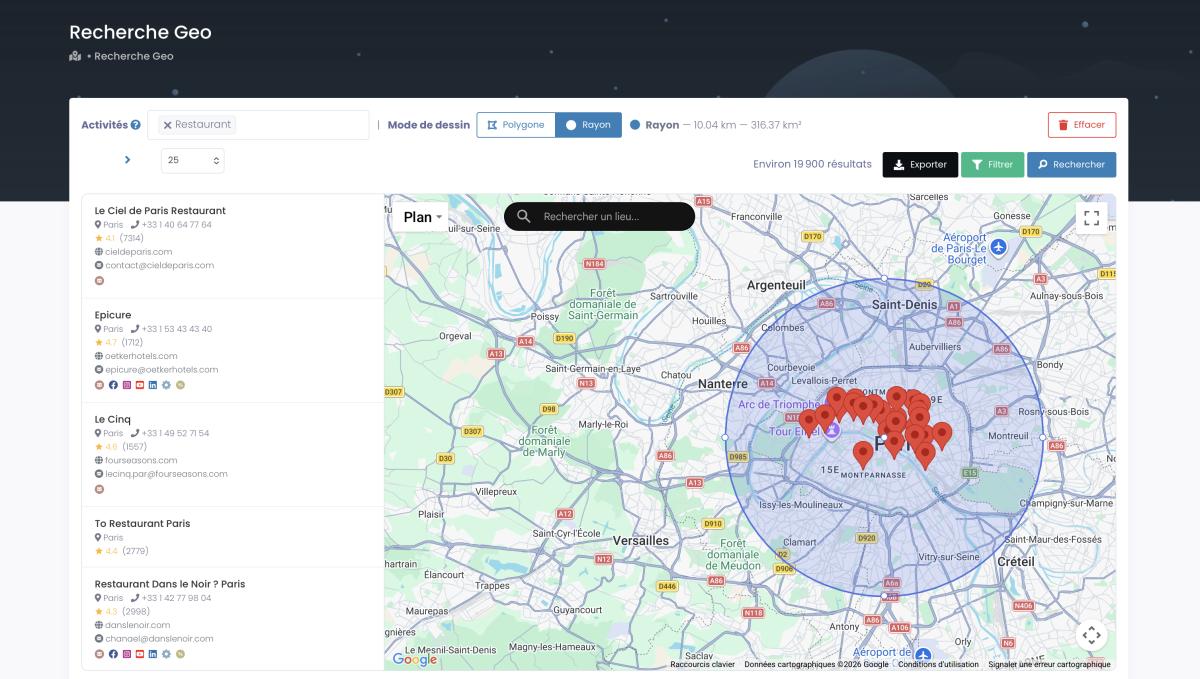
Here's how specific Google Maps signals translate into scoring criteria. This is the stuff your competitors aren't doing:
| Google Maps Signal | What It Tells You | Score Impact |
|---|---|---|
| Review count (50+) | Established business with customer base | High: they have revenue |
| Rating < 4.0 stars | Struggling with customer experience | High: pain point = urgency |
| No website detected | Digital maturity gap | High for web agencies |
| Running Google Ads pixel | Has marketing budget, spends on acquisition | Very high: money is flowing |
| Mobile phone number | Direct access to decision-maker | High for outbound |
| Claimed listing + recent photos | Active owner who cares about online presence | Medium-high |
| No social media links | Opportunity for social/marketing agencies | Context-dependent |
That second row deserves its own playbook. A rating under 4.0 is one of the strongest urgency signals you can score on, and it's the whole premise behind finding businesses with bad reviews for lead generation. Struggling on Google means they feel the pain daily, and they'll pay to fix it.
One agency I know built their entire scoring model around Google Maps signals. Businesses with 30+ reviews, a website running WordPress, and no Facebook Ads pixel? Their sweet spot. Conversion rate went from 2.1% to 6.4%. Not because they changed their pitch. Because they stopped pitching to the wrong people.
How Scrap.io Feeds Your Pipeline
Scrap.io does something fundamentally different from traditional AI sales tools. Instead of enriching existing records from LinkedIn-based databases, it goes straight to Google Maps, pulling real-time data from 225M+ establishments across 195 countries.
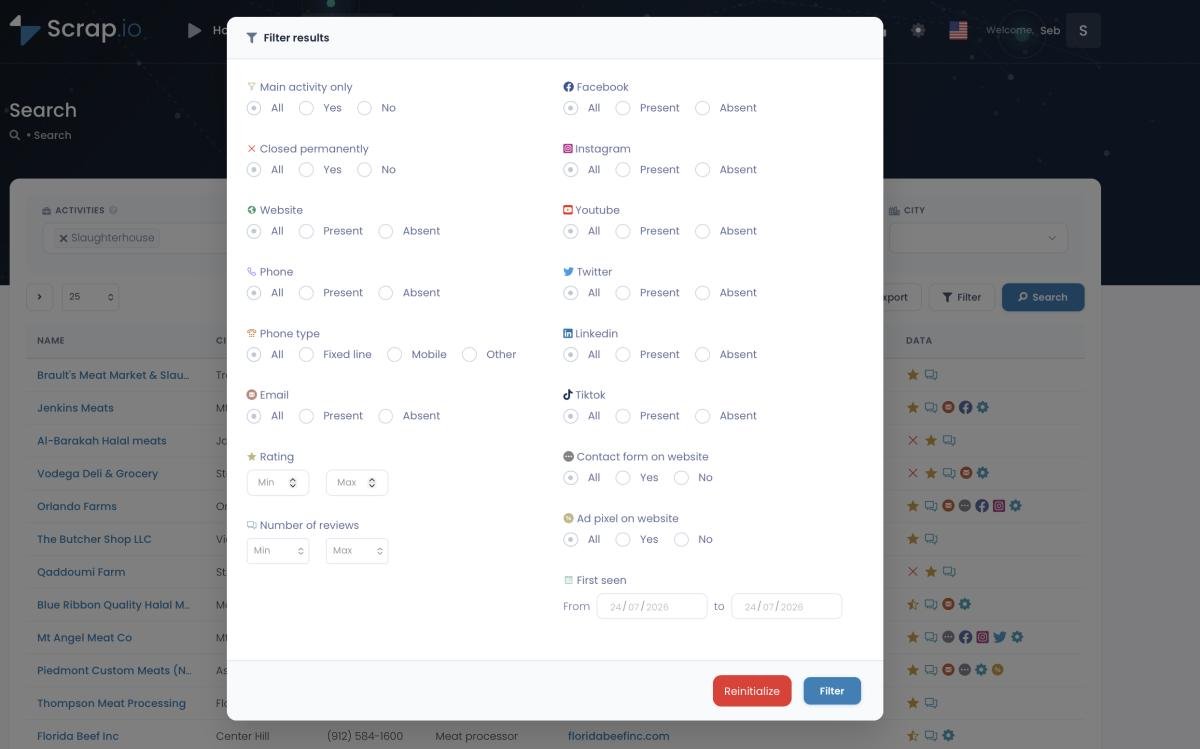
Each lead comes with 50+ data points. Emails. Phone numbers (with mobile/landline classification). Social media profiles across six platforms. Google ratings. Review counts. Website tech stack. Ad pixels. Opening hours. Whether the listing is claimed. When the business first appeared on Maps.
And here's the kicker: you filter before you export. Only businesses with an email? Check. Only those with bad reviews? Check. Only restaurants in Phoenix running Google Ads but not Facebook Ads? Yep. You define the criteria, Scrap.io returns only matching results. Zero wasted credits on irrelevant leads.
Real-world speed? One user pulled 11,734 businesses in 45 minutes. That's not a database query. That's real-time extraction with enrichment built in. Feed that into your scoring model and you've got a pipeline your competitors literally can't replicate with HubSpot alone.
Video: How to Turn Your CRM Into a War Machine Using Google Maps Data. Feeding scoring signals straight into your pipeline.
5 Best AI Lead Scoring Tools (2026)
Sarah runs a 12-person marketing agency in Denver (an illustrative example, but you'll recognize the pattern). She was paying for three different lead gen tools, spending $800/month, and still manually qualifying leads every morning with coffee and regret. Then she combined Google Maps data with a proper scoring workflow. Result? Conversion rate jumped from 3.2% to 6.1%. Here's what she, and other smart teams, are using.
The 5 best AI lead scoring tools in 2026, at a glance:
- HubSpot: best all-in-one CRM with built-in predictive scoring.
- Salesforce Einstein: best for enterprise teams already on Salesforce.
- MadKudu: best for product-led growth companies.
- Clay + Scrap.io: best for custom scoring with Google Maps signals.
- 6sense: best for enterprise ABM and intent data.
| Tool | Best For | AI Scoring | Data Source | Starting Price |
|---|---|---|---|---|
| HubSpot | All-in-one CRM + scoring | Predictive (built-in) | CRM + engagement data | Free → $890/mo |
| Salesforce Einstein | Enterprise teams on Salesforce | ML-powered scoring | Salesforce CRM data | $25/user/mo |
| MadKudu | Product-led growth companies | Behavioral + firmographic | Product usage + external | Custom pricing |
| Clay + Scrap.io | Custom scoring with Google Maps data | Build-your-own (100+ sources) | Google Maps + 100 providers | $149 + $49/mo |
| 6sense | Enterprise ABM + intent | Intent-based predictive | Proprietary intent data | Enterprise pricing |
Quick take on each:
HubSpot: if you're already on HubSpot, their predictive scoring is genuinely decent. Not the most sophisticated, but the integration is seamless and it gets more SQLs out of the same funnel. For ai lead scoring for small business teams, it's hard to beat the value. There's a free tier, and predictive scoring lives in the paid Sales and Marketing Hub plans.
Salesforce Einstein: the enterprise standard. Lives inside Salesforce, analyzes every interaction and pattern in your CRM. But let's be honest, it's only as good as the data inside your Salesforce instance. And if that data is thin on local business signals? So is Einstein.
MadKudu: the PLG darling. If your model is product-led (free trial → paid), MadKudu scores based on product usage patterns alongside firmographic data. Clever approach, but niche.
Clay + Scrap.io: and here's the combo play. Clay lets you build custom waterfall workflows across 100+ data providers. Plug Scrap.io in as a source and suddenly you're scoring leads based on Google Maps signals that no other tool captures. Review count? In. Ad pixels? In. Phone type? In. This is how you build a scoring model that actually differentiates. (Oh, and Scrap.io data is fresh: real-time extraction, not some database from last quarter.)
6sense: the big gun for enterprise ABM teams. Intent signals at the account level. If someone at your target company is researching solutions, 6sense knows before they fill out a form. Expensive. Powerful. Overkill for teams under 50 reps.
For the ai lead scoring HubSpot Salesforce comparison crowd: HubSpot wins on simplicity and value for smaller teams. Salesforce wins on depth for enterprise. But neither captures Google Maps signals natively, which is exactly why the Clay + Scrap.io combo exists.
How to Build Your Model: Step-by-Step
Most guides say "plug in HubSpot." Cool. Super helpful. (Sarcasm.)
Here's how to actually build a scoring model that works, even if you're starting from scratch. How to set up AI lead scoring without losing your mind in the process.
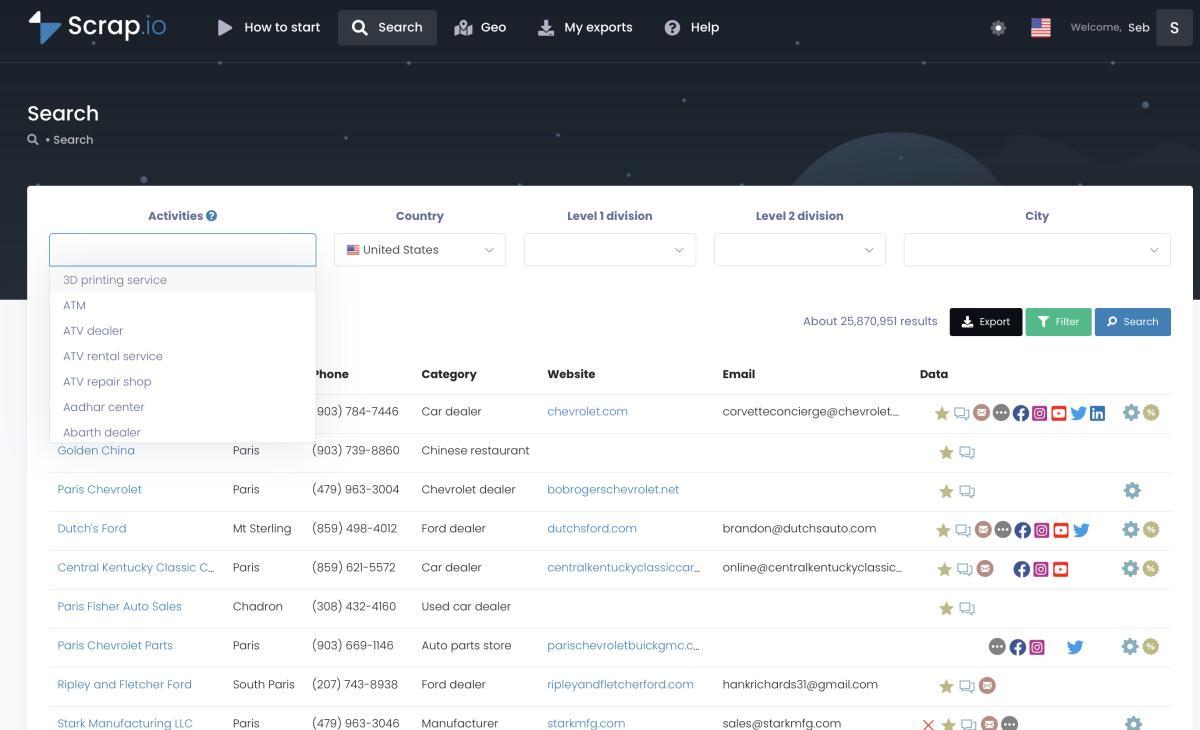
Video: Scrap.io - How to Start? The 5-minute setup before you feed your scoring model.
Step 1: Define Your ICP
You can't score what you can't define. Start with your ideal customer profile. Analyze your best 10-20 customers, not by logo size, but by retention, expansion, and referrals. Find the patterns.
For local businesses, your ICP might look like: "Restaurants in major US metros, 30+ Google reviews, rating above 3.5, has a website but no online booking system." That's not a guess. That's a measurable, filterable profile. Want the full playbook? Here's how to define your ICP with Google Maps data, cluster by cluster.
Step 2: Choose Your Signals
Not all data points are equal. Pick 10-15 signals that correlate with your closed-won deals. Mix internal signals (email engagement, page visits) with external ones (review count, ad pixels, tech stack).
Here's the honest truth: if you're only scoring on CRM data, you're leaving 70% of the picture on the table. The best B2B lead generation platforms combine multiple data sources. Your scoring model should too.
Step 3: Enrich Before Scoring
This is the step most teams skip. And it's the one that matters most.
Before you run any model, enrich your lead data. Use waterfall enrichment for corporate contacts. Use Scrap.io for local businesses and SMEs, matching on domain, phone, or Google Place ID to pull 50+ fresh data points per lead.
Then plug that enriched data into your CRM automation workflow. This is where the lead scoring automation workflow really comes together. Scrap.io's API integrates with Make.com, Zapier, n8n, whatever orchestration tool you prefer. The enrichment runs automatically on every new lead. Your scoring model gets fed without anyone lifting a finger.
Step 4: Train + Iterate
Start simple. You don't need a PhD in machine learning. HubSpot's predictive scoring works out of the box. If you want more control, tools like MadKudu or a custom model in Python (Random Forest is your friend) let you tweak weights and features.
The critical bit: retrain quarterly. Markets change. Your product evolves. A scoring model built on 2024 data is already drifting. Feed in your latest closed-won data every 90 days and watch accuracy improve each cycle. That's b2b lead scoring best practices 2026 in a nutshell: iterate or stagnate. And track the right numbers while you're at it, because your local prospecting KPIs are what tell you whether the model is actually earning its keep.
Case Studies
3.5x conversion rate. 80% less time on unqualified leads. Some of what follows is documented and named, some is illustrative. I'll tell you which is which, because that distinction matters.
SUPALABS / U.S. Bank: U.S. Bank implemented AI lead scoring analyzing 200+ data points per lead: banking history, engagement patterns, market conditions. The result? 260% increase in conversions. The AI discovered that leads engaging with educational content about cash management were 3.5x more likely to close within 60 days, a pattern human analysts had completely missed.
Agency using Google Maps + AI scoring (illustrative): picture a web design agency in Austin that used Scrap.io to pull every business without a website in their metro area. 3,400 leads. They scored them based on Google reviews (more reviews = more revenue = bigger budget), whether the listing was claimed (shows digital awareness), and presence of a contact form on competitor sites. Top-scored leads got personalized outreach. The rest went into automated sequences. This one's a representative composite, not a single named client, but it mirrors exactly how agencies use the signals in practice.
The broader picture: academic research across 44 studies confirms what these examples illustrate: predictive scoring models consistently outperform manual methods on conversion rates, cost efficiency, and revenue impact. It's not a debate anymore. It's settled science.
Common Pitfalls
I've watched smart teams wreck their scoring models in preventable ways. Don't be them.
Scoring on stale data. Your model is only as current as its inputs. Contact data degrades 22-70% annually depending on the industry. If you're scoring leads against six-month-old enrichment data, you're making decisions on ghosts. Use real-time sources. (This is literally why Scrap.io extracts live data from Google Maps instead of querying a static database.)
Ignoring the negative ICP. Knowing who NOT to sell to is just as valuable as knowing who to target. If restaurants under 10 reviews always churn within 90 days, document it. Build it into your score. A negative signal is still a signal.
Over-engineering the model. You don't need 150 features in your scoring algorithm. Most successful models run on 10-15 signals. Adding noise doesn't improve accuracy. It degrades it. Start lean. Add complexity only when you have the data volume to justify it (200+ closed-won deals minimum for ML models).
Not retraining. Built your model in January? It's May now. Markets shifted. Retrain. Quarterly at minimum. The teams that treat their scoring model as a living system outperform the ones that set it and forget it, every single time.
Trusting one data source blindly. There's a recurring theme on r/sales: teams build their entire scoring model on CRM data, wonder why half the "hot leads" ghost them, then blame the reps. Threads on lead scoring circle back to the same lesson over and over, that the CRM only knows what you put in it. If your enrichment is thin, your scores are fiction. Layer in external signals (Google Maps data, intent signals, technographics) or accept mediocre results.
Is AI Lead Scoring GDPR & CCPA Compliant?
Short answer: yes, when your data comes from public business sources. AI lead scoring built on publicly available business information (Google Maps listings, company websites, published contact details) is legal for B2B prospecting under both the GDPR and the CCPA. The key distinction: you're processing business data for a legitimate commercial interest, not scraping private personal profiles.
Two things keep you clean. First, traceability. Every signal you score on should be traceable back to its public source, so if a prospect asks where you got their data, you have an answer. Second, your outreach still follows the rules: honest sender identification, a physical address, and an easy opt-out (CAN-SPAM in the US, legitimate interest plus data-subject rights under GDPR). Scrap.io only extracts publicly available business data, each field traceable to its source, which is exactly what makes it usable for compliant B2B prospecting. Public data, used for business outreach, with an off-ramp. That's the compliant lane.
FAQ
What is AI lead scoring?
AI lead scoring uses machine learning to analyze historical sales data and predict which leads are most likely to convert. Unlike manual scoring, where a human assigns points based on fixed rules, AI identifies patterns across hundreds of data points and ranks leads by conversion probability. The model learns from your actual wins and losses, not assumptions.
How accurate is AI vs. manual lead scoring?
Manual scoring typically achieves 15-25% accuracy in predicting conversions. AI-powered scoring reaches 40-60%, a 2-3x improvement using the same underlying data. The difference comes from pattern recognition: machine learning catches non-obvious correlations between data points that humans simply can't process at scale. A peer-reviewed study in Frontiers in Artificial Intelligence confirmed these gaps across industries.
What data do I need to start AI lead scoring?
At minimum, 200+ closed-won and closed-lost deals with associated lead data (company size, source, engagement history). The more diverse your data, the better. Add firmographic data, technographic signals, Google Maps data (reviews, rating, website tech, ad pixels), and behavioral data for maximum accuracy. Under 200 historical deals? Stick with rules-based scoring until you build volume.
Can Google Maps data improve lead scoring?
Absolutely, and it's probably the most underutilized signal source in B2B scoring today. Google Maps provides real-time data on 225M+ businesses: review count and rating (business health), website technology (digital maturity), ad pixels (marketing budget), and phone type (outreach channel). These signals feed scoring models with information no CRM captures natively. Scrap.io makes this data filterable and exportable for direct model input.
Is it legal to use Google Maps data for lead scoring?
Yes. Google Maps listings are publicly available business data, and using them for B2B prospecting is legal under both GDPR and CCPA when the information is business-related and traceable to its public source. Your outreach must still comply with CAN-SPAM and GDPR: honest identification, a physical address, and an easy opt-out. Scoring on public signals is compliant; spamming without an off-ramp is not.
How much does AI lead scoring cost?
It ranges wildly. HubSpot's predictive scoring is included in its Sales Hub plans (a free tier exists). Salesforce Einstein starts around $25/user/month. MadKudu and 6sense run enterprise pricing. For a scrappy setup, Scrap.io ($49/mo for 10,000 enriched leads) plus a free-tier CRM and basic Python scripting gets you a functional scoring system for under $100/month. The ROI math works at every price point: 138% ROI with scoring vs. 78% without.
Stop Guessing. Start Scoring.
Look, the data is clear. AI lead scoring isn't some shiny future tech. It's table stakes in 2026. 61% of B2B teams already use it. 75% will by year-end. The companies still ranking leads by gut feeling are hemorrhaging pipeline to competitors who don't.
And the biggest untapped advantage? Google Maps data. 225 million businesses sitting there with scoring signals (reviews, ad spend, website tech, phone type) that no CRM captures and no competitor is using in their models. That's not a small edge. That's a moat.
Whether you go with HubSpot's built-in scoring, Salesforce Einstein, or a custom Clay + Scrap.io stack, the point is the same: stop wasting your reps' time on leads that were never going to close. The math doesn't lie. 138% ROI vs. 78%. Pick a side.
The teams winning right now aren't the ones with the biggest budgets. They're the ones with the best data feeding the smartest models. And that starts with how to score leads using AI and enrichment data from sources your competitors haven't even thought to tap.
Generate a list of restaurant with Scrap.io