

Video: How to Automate Data Enrichment with Scrap.io
📋 What's in This Guide
- What Is Waterfall Enrichment?
- 8 Best Waterfall & Lead Enrichment Tools Compared (2026)
- Waterfall Enrichment Comparison Table
- The Waterfall Blind Spot: Why It Fails for Local Businesses
- The Complementary Approach: Google Maps Enrichment
- The Hybrid Strategy: Waterfall + Google Maps = Full Coverage
- Waterfall Enrichment Best Practices & Common Mistakes
- Compliance: GDPR, CCPA & Waterfall Enrichment
- Frequently Asked Questions
Okay so listen. "Waterfall enrichment finds 90% of emails." You've heard that before, right? Every LinkedIn post, every SaaS landing page, every cold email guru on Twitter. Ninety percent. Sounds amazing.
Here's what nobody mentions though. The data enrichment market? It's going from $2.37 billion in 2023 to $4.58 billion by 2030 according to Grand View Research. That's a 10.1% CAGR. So obviously every tool on the planet now claims to be the best waterfall enrichment tool for b2b email enrichment. Some of them are genuinely great. I'll give them that.
But I've watched way too many sales teams — smart people, good budgets — dump hundreds of dollars in credits into these platforms expecting magic. And then they discover something nobody warned them about. If your prospects are local businesses? SMEs? Tradespeople? Anyone without a polished LinkedIn profile and a corporate email domain? Waterfall enrichment just... doesn't work. Like at all. It shrugs and walks away. And that's a problem because over 80% of businesses on Google Maps fall into exactly that bucket.
So here's what we're gonna do. I'll walk you through what waterfall enrichment actually is, compare 8 lead enrichment tools head-to-head with real numbers, show you the exact blind spot where the whole thing falls apart, and then give you the complementary strategy smart teams are using to get full coverage. If you're already familiar with data enrichment tools, this zooms in on the waterfall method specifically — and where it breaks.
No fluff. No disguised sales pitch. Just what actually works and what doesn't. Let's go.
What Is Waterfall Enrichment?
Simple version. Waterfall enrichment queries multiple data providers in sequence, one after another, until one of them returns the missing email or phone number. Some people call it waterfall lead enrichment. A single provider typically lands somewhere between 40–70% coverage. Stack them in a waterfall and that climbs to 75–95% (the range Google's own AI Overview keeps quoting). That gap is the whole reason the method exists.
Think of it like calling different friends to find someone's number. Friend A doesn't know it. Friend B doesn't either. Friend C? Bingo. Got it. That's waterfall. Provider A takes a shot. Misses. Provider B steps in. Misses again. Provider C finally hits. Process stops.
The whole idea is pretty straightforward: instead of relying on one database that might have gaps, you stack a bunch of lead enrichment tools together and let them tag-team your lookup. For corporate B2B contacts? It works surprisingly well. But the devil's definitely in the details here.
How Waterfall Enrichment Works (Step by Step)
Let me break this down real quick because it's simpler than people make it sound:
- You feed in what you have — A name, a company, a LinkedIn URL, a domain. Whatever starting data you've got. More input = better output.
- Sequential provider lookup — Your record hits Provider A. Found something? Great, done. Nothing? Falls to Provider B. Still nothing? Provider C. And so on through the chain.
- Result or bust — Either somebody in the chain finds it and the cascade stops, or your record goes through every single provider and comes back empty. In that case you've burned credits for nothing.
Some platforms do this one provider at a time. Others like FullEnrich run parallel checks — hitting multiple sources at once. The difference matters because it affects how fast you get results and how many credits you burn.
Waterfall vs. Single-Provider Enrichment
| Criteria | Single-Provider Enrichment | Waterfall Enrichment |
|---|---|---|
| Email find rate | 40–70% | 70–95% |
| Cost per contact | Lower per lookup | Higher (multiple providers) |
| Speed | Faster | Slower (sequential lookups) |
| Best for | Quick checks, known domains | Maximum coverage on corporate leads |
| Data freshness | Depends on the provider | Combines multiple fresh sources |
8 Best Waterfall & Lead Enrichment Tools Compared (2026)
Alright. The fun part. I'm gonna give you actual numbers and honest takes — not the polished marketing version every vendor puts on their homepage. Whether you're trying to figure out clay vs fullenrich or you're just starting your waterfall enrichment tools comparison, here are the email enrichment tools and lead enrichment tools that actually matter right now.
1. FullEnrich — Best Dedicated Waterfall Platform
FullEnrich is probably the first name you'll hear when someone says "waterfall enrichment." They aggregate 15–20+ data providers and run both parallel and sequential lookups. In a benchmark test published on waterfallenrichment.com, they hit a 91% email find rate and 71% phone find rate. Those are legitimately strong numbers for a dedicated platform.
Pricing starts at $29/month for 500–750 credits. Not bad. The tool does one thing and does it well — pure enrichment, no outreach, no CRM, no fluff.
Now that being said. There's one thing worth flagging. FullEnrich killed their Chrome extension back in June 2024. If your workflow involves enriching profiles while you browse LinkedIn, that's gone now. Other tools still have browser extensions. This one doesn't anymore. Depending on how you work, that could be a dealbreaker or a non-issue.
2. Clay — Best for Custom Workflow Builders
Clay is the tool that makes power users drool. Over 100 data providers — most on this entire list — and you can build completely custom sequential waterfalls. Check ZoomInfo first. Then Apollo. Then Clearbit. Only if all three miss, try Hunter. You decide the order, the logic, everything.
The catch. It's not cheap. Starts at $149/month. And here's something a Reddit user in r/coldemail said that stuck with me: "Credits go fast. Most teams get better results by only triggering enrichment when initial data is missing." Smart advice for any clay waterfall enrichment setup. Configure your workflows to skip providers when the data already exists. Otherwise your credits will literally evaporate overnight.
3. BetterContact — Best Pay-Per-Result Model
BetterContact takes a slightly different approach by claiming 99.5% email verification accuracy across 20+ providers with a 4-layer verification system. Their big selling point is the pay-per-result model — you only get charged when they actually find something. Starting at $29/month with 10 free credits, it's accessible enough for testing.
The AI-powered provider ordering is interesting too. Instead of a fixed waterfall sequence, BetterContact dynamically orders providers based on which are most likely to find data for your specific lead. That's genuinely clever.
4. Apollo.io — Best All-in-One with Built-in Waterfall
If Clay is the specialized race car, Apollo.io is the SUV. It does everything. Prospecting, outreach, CRM, and yeah — waterfall enrichment too. Their system checks across "dozens of data providers" according to their knowledge base, mixing their own massive database with third-party stuff.
Starting at $49/month you get the enrichment plus literally everything else. For sales teams who don't want to stitch together five different tools, Apollo's hard to beat. Trade-off? Dedicated lead enrichment tools like FullEnrich usually achieve higher find rates. Because enrichment is all they do. Jack of all trades, master of... well, most trades honestly. Apollo's pretty solid. And if its data accuracy has you shopping around, we ran the numbers on the best Apollo.io alternatives in a separate test.
5. Lemlist — Best for Outreach + Enrichment Combo
Lemlist has been quietly building enrichment features alongside their cold email stuff. They claim 88% email find rate and 50% phone number find rate through a built-in waterfall. At €6 per 100 emails it's one of the cheapest options out there.
If you're already on Lemlist for outreach, the integrated lemlist waterfall enrichment is kind of a no-brainer. Why pay for a separate enrichment tool when your outreach platform already does it? One less subscription. One less tab open. I get it.
6. Instantly (SuperSearch) — Best for Cold Email Power Users
Instantly's SuperSearch brings waterfall enrichment into one of the most popular cold email platforms around. $30/month. They don't publish exact find rates which is... slightly annoying. But SuperSearch taps into multiple providers automatically behind the scenes.
For teams sending serious volume, the combination of enrichment plus warmup plus sending in one place is pretty compelling. Less duct tape in your stack. Less stuff breaking at 2 AM.
7. Dropcontact — Best for European B2B Enrichment
Let me be straight with you. Dropcontact isn't a waterfall tool. Not really. They use their own proprietary database instead of cascading through external providers. Find rates land between 50–75% which is lower than true waterfall platforms. They do give you 100 free credits though.
Where Dropcontact genuinely shines is European B2B data. French market especially. If you need GDPR-native enrichment for EU targets, it's legit. But if you need broader coverage — or a completely different approach to finding leads — you'll probably want a Dropcontact alternative.
8. Cognism — Best for GDPR-Compliant Phone Data
Cognism is the enterprise play. Premium pricing (demo only — good luck getting a number). Their "Diamond Data" phone numbers are manually verified which is cool. Higher accuracy on what they have.
Here's the thing though. Cognism isn't really a waterfall tool either — more like a proprietary database with some partner integrations. But I'm including them because they're surprisingly honest about waterfall's limitations. Their own blog mentions "compliance concerns" and "inconsistencies with data quality" as cons of the waterfall approach. When the advocates themselves admit there are problems? That tells you something.
💡 Most waterfall tools are amazing at finding corporate contacts. But what about the 225M+ local businesses sitting on Google Maps? Scrap.io lets you generate and enrich leads directly from Google Maps — 195 countries, 4,000+ categories, 50+ data points per business, no starting list required. Try it free for 7 days with 100 leads included.
Waterfall Enrichment Comparison Table
| Tool | Type | # Providers | Email Find Rate | Phone Data | Pricing (starts) | Free Tier | Best For |
|---|---|---|---|---|---|---|---|
| FullEnrich | Dedicated waterfall | 15-20+ | ~91% | ✅ | $29/mo | 50 free leads | Pure enrichment at scale |
| Clay | Workflow platform | 100+ | Varies | ✅ | $149/mo | Free tier available | Custom workflows & power users |
| BetterContact | Dedicated waterfall | 20+ | ~98.5% (claimed) | ✅ | $29/mo | 10 credits/mo | Pay-per-result budgets |
| Apollo.io | All-in-one platform | Dozens | High (built-in DB) | ✅ | $49/mo | Free plan | All-in-one sales teams |
| Lemlist | Outreach + enrichment | Multiple | ~88% | ✅ (50%) | €6/100 emails | Trial | Budget outreach combos |
| Instantly | Cold email + enrichment | Multiple | Not disclosed | ✅ | $30/mo | Trial | Cold email power users |
| Dropcontact | Email enrichment | Single (own DB) | 50-75% | ❌ | 100 free credits | 100 credits | EU/French market |
| Cognism | Enterprise B2B data | Own DB + partners | High | ✅ (diamond data) | Enterprise pricing | Demo only | GDPR-compliant EU data |
| Scrap.io ★ | Google Maps generation + enrichment | Google Maps + website crawler | N/A (generates leads) | ✅ | $49/mo (10K credits) | 100 free leads | Local businesses, SMEs, trades, geo-targeted B2B |
★ Scrap.io is not a waterfall tool. It's the complementary approach for when waterfall can't help. More on that below.
Want the wider picture beyond waterfall specifically? Our sibling guide ranks the 10 best data enrichment tools 2026 — from email-only enrichers to full lead-generation platforms — and shows where each one actually fits.
By the way — looking for waterfall enrichment free options? Most tools have some kind of free tier. FullEnrich gives 50 free leads. BetterContact has 10 credits a month. Apollo's got a free plan. Clay too. But honestly? Free tiers are for testing. If you're doing anything serious, you'll need to pay.
Worth a quick mention for 2026: newer entrants like Oppora, Explorium, and Unify GTM are pushing the waterfall model further with AI-driven provider routing and intent signals baked in. None of them crack our core eight yet, but they're worth watching if you're building a stack from scratch this year.
The Waterfall Blind Spot: Why It Fails for Local Businesses
Okay. Here's the section nobody else writes. And I mean nobody. I went through every single top-10 result for "waterfall enrichment." Apollo's documentation. Clay's landing page. FullEnrich's guide. BetterContact's big comparison. Cognism's editorial. Every. Single. One. assumes you're sitting there with a spreadsheet full of LinkedIn profiles and corporate domains.
And for that? Yeah. Waterfall is brilliant. No argument.
But here's what I keep asking myself. What about the other 80%?
The LinkedIn Dependency Problem
Here's the fundamental thing. All these waterfall enrichment tools — every single one of them — rely on the same data chain: LinkedIn profiles, company domains, corporate databases. That's where the providers pull from. ZoomInfo. Clearbit. Apollo's own DB. LinkedIn itself. It's all the same ecosystem. And if you're weighing those corporate databases against each other, our roundup of ZoomInfo alternatives breaks down where each one actually pulls its data from.
Now think about your local plumber for a second. A family restaurant. A roofing contractor. A dentist. The dry cleaner on the corner. These people might have a Google Maps listing and maybe a Wix website their nephew built three years ago. But LinkedIn? With a polished company page and employee profiles? Come on. Their owners are not updating ZoomInfo records. They're not showing up in Clearbit's database. They're fixing pipes and pulling teeth and making pizza. That's also why a LinkedIn email finder comes up empty for them: there's simply no profile to read in the first place.
For these businesses — and there are hundreds of millions of them around the world — waterfall has nothing to cascade through. Provider A finds nothing. B finds nothing. C finds nothing. D, E, F... nothing, nothing, nothing. You've burned through your credits and got absolutely zero back.
That's not an edge case. That IS the case for most businesses that exist. If you're comparing B2B lead generation platforms, this corporate-vs-local distinction is the single most important thing nobody explains properly.
The Numbers: Waterfall Coverage Drops Below 40% for SMEs
Even Cognism — one of the most respected names in this space — admits it on their own blog. They mention "inconsistencies with data quality" as a straight-up con of waterfall. And FullEnrich killing their Chrome extension in mid-2024? That tells you even LinkedIn-based workflows aren't always cutting it anymore.
Here's the honest truth. For local businesses, tradespeople, SMEs without a corporate digital footprint? Waterfall find rates can drop below 40%. Sometimes way below. That's not me bashing the tools. They're doing exactly what they were built for. But the assumption that waterfall is a universal solution? That's the problem. It's a corporate solution. Full stop. And if your target market is local businesses, you need something fundamentally different.
The Complementary Approach: Google Maps Enrichment
So what DO you do when waterfall can't help you? This is where it gets interesting. Instead of looking up contacts in corporate databases, what if you just... went where local businesses actually live online?
That place is Google Maps. Obviously.
225M+ establishments indexed. 195 countries. 4,000+ business categories. It's the largest public database of local businesses on the planet. And unlike LinkedIn or ZoomInfo, practically every single local business — from the barbershop around your corner to the HVAC company three towns over — has a Google Maps listing. It's where their customers find them. It's where they exist online.
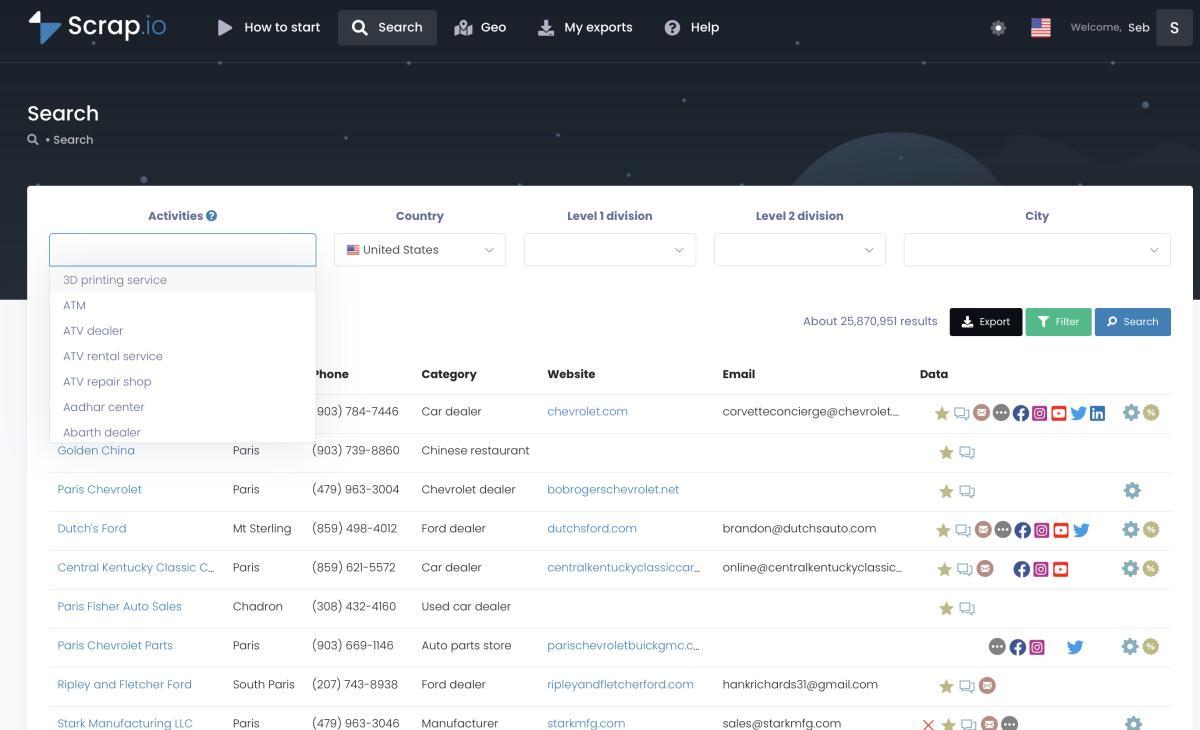
How Scrap.io Fills the Gap Waterfall Can't
Scrap.io does something completely different from traditional lead enrichment tools. No cascading through corporate data providers. Instead it goes straight to Google Maps and crawls the associated business websites — pulling data in real time for google maps lead generation. When a business updates their listing or their website, you get that info right away. Not six months later from some static database.
Each lead comes with 50+ data points. Emails. Phone numbers. Facebook, Instagram, LinkedIn, YouTube, Twitter/X links. Google ratings. Review counts. Opening hours. Website technologies. Ad pixels. The works. And because the filters apply before extraction, you only spend a credit on a business that actually matches what you need — email present, phone present, minimum rating, whatever. Zero waste. If you want the full breakdown, check the complete Google Maps scraping guide.
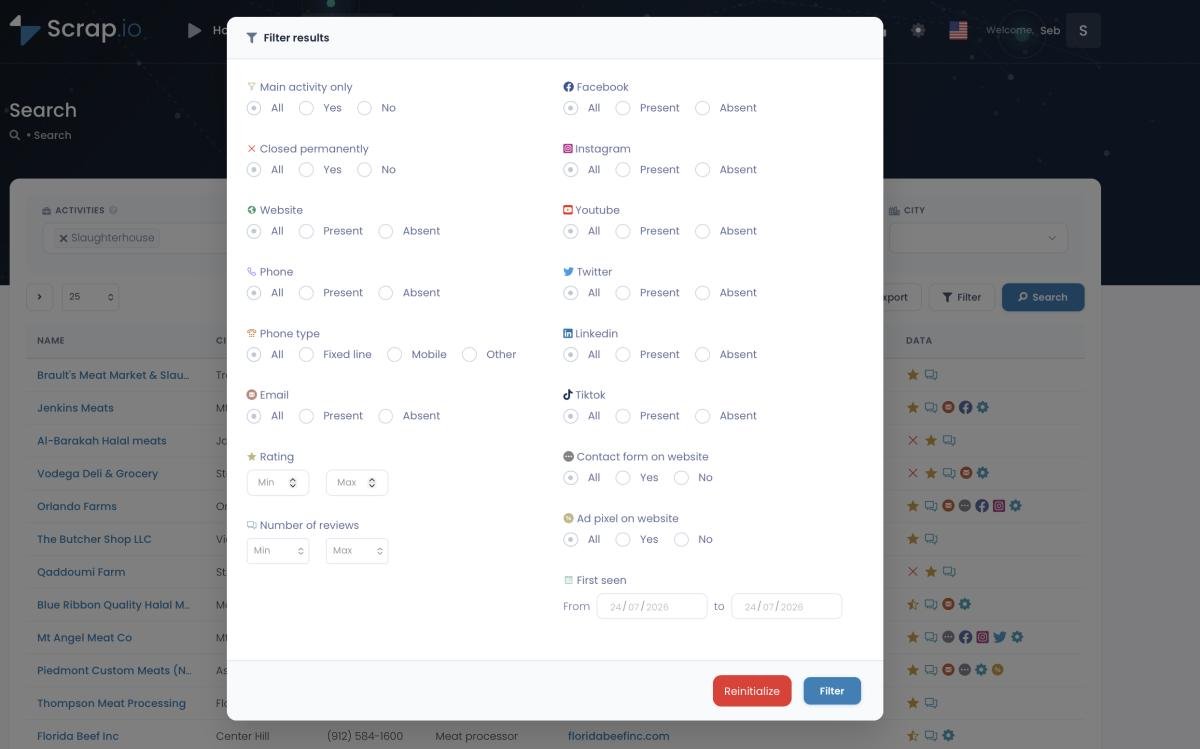
And here's the kicker. You don't need ANY starting data. No names. No company domains. No LinkedIn URLs. You pick a business category and a location. That's it. Two clicks. Scrap.io handles everything else. That's exactly why it works where waterfall doesn't — the data source is fundamentally different.
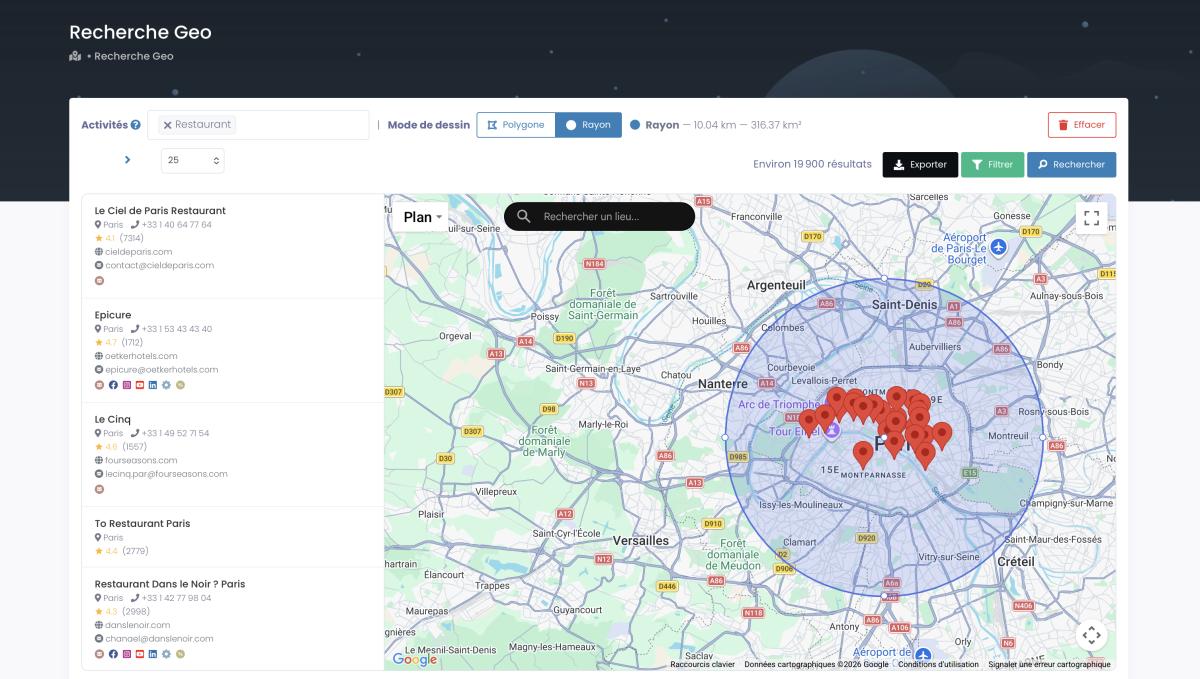
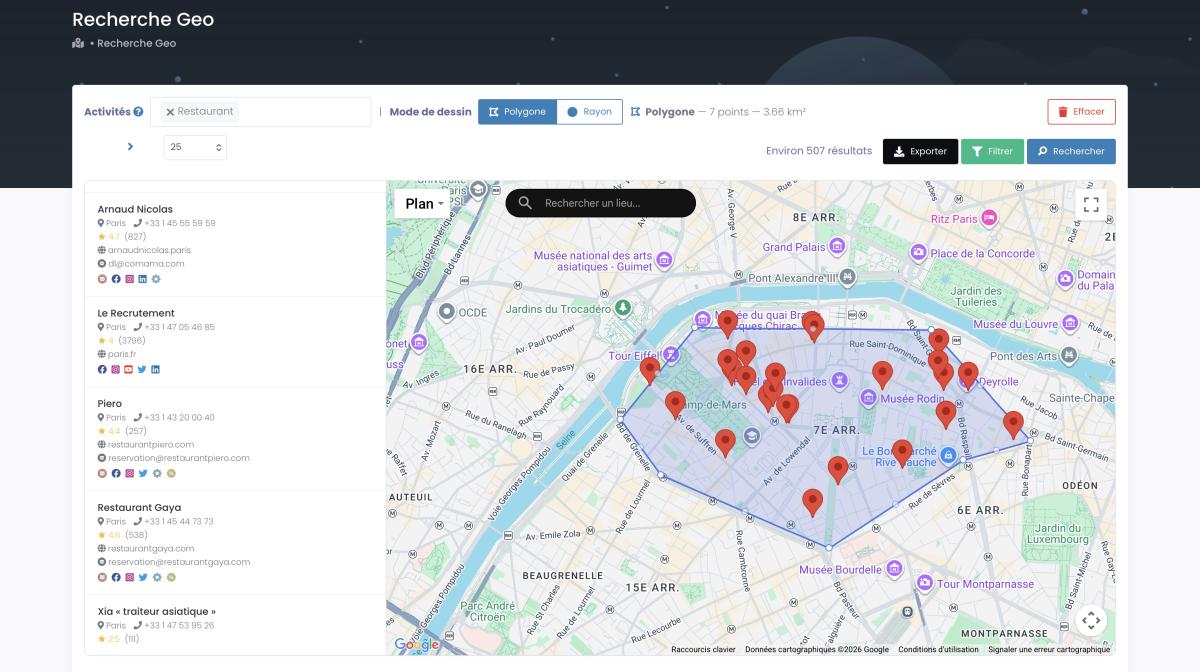
Geographic Targeting: Radius & Polygon Selection
Here's something literally zero waterfall tools can do: geographic targeting. Scrap.io gives you two ways to define where you want leads.
Radius search — Pick a center point and a distance. All dental clinics within 25 miles of downtown Chicago? Done. Polygon search — Draw a custom shape directly on the map. Perfect for weird zones like industrial districts, downtown cores, or specific neighborhoods that don't follow neat administrative boundaries.
Try telling FullEnrich or Clay "find me all plumbers in a 10-mile radius of Austin, Texas." They'll just stare at you. These tools have zero concept of geography. They work with names and domains, not maps. Geographic precision is what makes Google Maps enrichment a completely different animal for local prospecting. Want to learn the basics? Here's how to find emails on Google Maps — it's way simpler than you'd think.
Enriching Your CRM with Google Maps Data (Place ID, Phone, Domain)
Okay but what if you already HAVE leads in your CRM? What if you don't need to generate new ones — you just need to fill in the gaps on existing records? This is where Scrap.io's CRM data enrichment gets really cool.
You can enrich your existing CRM contacts by matching on three things:
- Place ID — Exact match to a Google Maps listing. Got a Place ID, Google ID, or CID? Scrap.io returns the full business profile. Boom.
- Phone number — Got a phone number? Match the business and pull everything Google Maps knows about it.
- Domain name — Got a website URL? Match on that and get the complete profile.
Let me paint you a picture. You've got a CRM full of leads but half of them are missing addresses, phone numbers, social media links. Classic problem. So you set up CRM automation with Google Maps data through Make.com. New lead comes in with just a domain name → hits Scrap.io's API → matched on the domain → your CRM auto-populates with full address, phone, review count, social links, opening hours, and like forty other fields. No manual research. No copy-pasting from Google. Just runs in the background while you do actual work.
Video: How to Turn Your CRM Into a War Machine Using Google Maps Data
Already got leads in your CRM? Scrap.io can enrich existing records using Place ID, phone number, or domain — automatically adding Google Maps data like reviews, address, social links, and opening hours across 225M+ indexed businesses. Start your 7-day free trial with 100 leads.
The Hybrid Strategy: Waterfall + Google Maps = Full Coverage
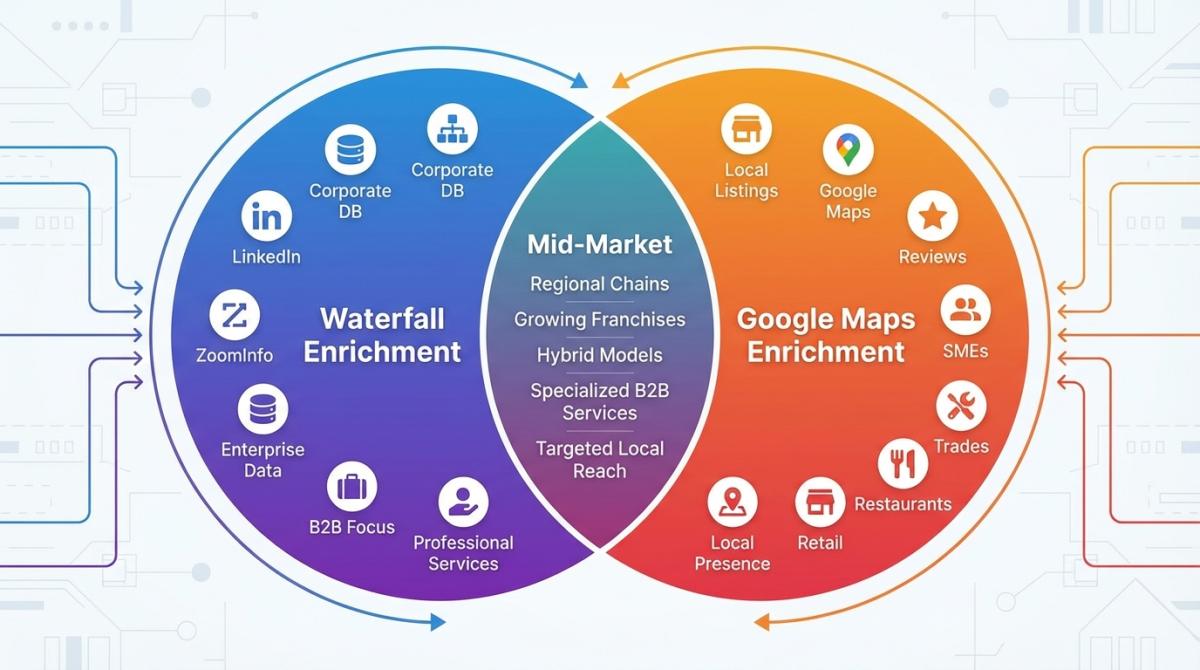
All that to say that the smartest teams in 2026? They're not picking one or the other. They're running both. Because it's not a competition between waterfall enrichment and Google Maps enrichment. They cover different universes.
When to Use Waterfall (Corporate/Enterprise Targets)
Waterfall is your weapon for the corporate ecosystem. SaaS buyers. Enterprise decision-makers. Marketing directors. VPs of Sales. People with LinkedIn profiles, @company.com emails, entries in ZoomInfo and Clearbit. For these people, FullEnrich, Clay, or Apollo will consistently get you find rates above 80%. Sometimes 90+. That's where waterfall absolutely earns its money.
When to Use Google Maps Enrichment (Local/SME Targets)
Google Maps enrichment through Scrap.io is what you use for local businesses. SMEs. Tradespeople. Professional services. Restaurants. Healthcare practices. Retail stores. Basically anyone who serves a local market. They're on Google Maps but they're NOT in corporate databases. With 225M+ establishments and 4,000+ categories across 195 countries, the coverage is insane.
Combining Both in One CRM Workflow (Make.com Example)
Here's how it actually works in practice with Make.com automated lead generation:
- New lead hits your CRM — Webform, cold outreach response, manual entry, whatever.
- Corporate or local? — Simple conditional. Corporate domain (@company.com)? Route to waterfall. Gmail, local domain, physical address? Route to Scrap.io.
- Corporate path → FullEnrich / Clay / Apollo API. Returns email, phone, LinkedIn, company data.
- Local path → Scrap.io API (match on domain, phone, or Place ID). Returns address, reviews, social media, website tech, opening hours, 50+ data points.
- CRM gets updated automatically. Both paths feed back in. Every record enriched. Doesn't matter if the lead is a Fortune 500 VP or a plumber in Tampa.
That's full coverage. Neither approach gives you that alone. Together? Nothing falls through the cracks.
Waterfall Enrichment Best Practices & Common Mistakes
Whether you're doing pure waterfall, pure Google Maps, or the hybrid thing — there's some stuff that'll save you real money. These waterfall data enrichment pros cons are worth knowing before you commit budget.
Cost Management: Provider Ordering & Credit Optimization
This is the thing people mess up the most. Provider ordering MATTERS. Put your cheapest providers first in the cascade. If a $0.01 lookup finds the email, why would you trigger a $0.10 provider after that? Most platforms let you set the order. Actually use that feature.
And for the love of everything — only trigger enrichment when data is actually missing. That Reddit r/coldemail thread nailed it: "Most teams get better results by only triggering enrichment when initial data is missing." Don't re-enrich contacts who already have valid emails. Sounds obvious. I've watched teams waste thousands doing exactly that.
The Verification Layer: Why Raw Waterfall Data Isn't Enough
Here's a mistake that'll cost you real money. Trusting waterfall output without verifying it first. A 91% find rate does NOT mean 91% of those emails work right now. People switch jobs. Domains die. Inboxes overflow. Servers go down.
Always — always — run enriched data through an email validator before you launch a campaign. You can even verify an email address without sending anything first, so you catch dead inboxes before they ever cost you a bounce. Target less than 3% bounce rate. One bad campaign can absolutely destroy a domain reputation you spent months warming up. Real-time data sources like Google Maps help because you're pulling current info, not something from last quarter's database snapshot.
Compliance: GDPR, CCPA & Waterfall Enrichment
Real talk about compliance. When your data cascades through 15+ providers, can you actually trace where each data point came from? Can you demonstrate lawful basis for processing under GDPR? These aren't hypothetical questions. Regulators are asking them.
Most reputable waterfall tools handle this at the provider level. Each integrated source is supposed to be compliant on its own. But the aggregation adds messiness. If one provider somewhere in the chain sourced data in a questionable way, your entire enrichment output has a problem.
Scrap.io sidesteps a lot of that because it only grabs data businesses have publicly posted themselves — on Google Maps and their own websites. Publicly available info under US and EU law, and every data point is traceable back to its source. No scraping LinkedIn profiles. No buying from dodgy third-party brokers. The cold email compliance guide goes deep on CAN-SPAM, GDPR, and CCPA if you want the full picture.
Bottom line regardless of your approach: include a working unsubscribe link. Write honest subject lines. Put your real business address in. And when someone says "stop emailing me" — stop emailing them. It's not complicated.
Frequently Asked Questions
What is waterfall enrichment?
Waterfall enrichment queries multiple data providers in sequence, one after another, until one returns the missing email or phone number. If Provider A misses, the record falls to Provider B, then C, and so on. It pushes find rates from roughly 40–70% on a single provider to 75–95% across the full chain.
How does waterfall enrichment work?
Three steps. You feed in your lead data — name, company, domain, LinkedIn URL. The record goes to Provider A first. Found something? Done. Nothing? Falls to Provider B. Then C. Either someone in the chain finds it, or you've gone through every provider and come up empty.
What is the best waterfall enrichment tool in 2026?
Depends what you need. Here's the short version:
| Tool | Approach |
|---|---|
| FullEnrich | Dedicated waterfall, 91% email find rate |
| Clay | Custom workflows, 100+ providers |
| Apollo.io | All-in-one prospecting + enrichment |
| BetterContact | Pay-per-result, AI provider ordering |
| Scrap.io | Google Maps generation + enrichment (local businesses) |
For corporate contacts, FullEnrich, Clay, or Apollo win. For local businesses though, none of the waterfall tools work well. That's where Scrap.io fills the gap with Google Maps-based lead generation.
Is waterfall enrichment worth the cost?
For corporate leads with LinkedIn profiles and company domains? Yeah, absolutely. You're comparing 80–95% find rates against 40–70% from single providers. The math works. But watch your provider ordering, skip enrichment when data already exists, and always verify before you campaign.
What is the difference between waterfall enrichment and single-provider enrichment?
Single-provider checks one database. Waterfall checks many databases in sequence, stopping when it finds a match. Waterfall gets you 20–40% higher find rates but costs more per lookup and takes longer.
Does waterfall enrichment work for local businesses?
Honestly? No. Waterfall relies on LinkedIn, corporate domains, and B2B databases. Local plumbers, restaurants, dentists, and tradespeople don't exist in those systems. For them, Google Maps enrichment through Scrap.io is what actually works, because these businesses maintain Google Maps listings, not LinkedIn profiles.
How do I turn off waterfall enrichment in Apollo?
Go into your enrichment settings in Apollo. You can disable automatic waterfall at the account level or tweak it per sequence. The interface changes pretty regularly though so check their knowledge base under "Enrichment Settings" for current steps.
Can I combine waterfall enrichment with Google Maps data?
Yes. This is actually the ideal setup. Waterfall for corporate and enterprise leads. Google Maps enrichment via Scrap.io for local businesses and SMEs. A Make.com workflow routes each lead to the right source automatically. Best of both worlds.
What is the 30/30/50 rule for cold emails?
Rough framework that says 30% of your success comes from list quality, 30% from your message and offer, and 50% from timing and follow-up execution. Main takeaway? Even the best email copy in the world won't help if your contact data is garbage. Which is why enrichment quality matters this much.
Is waterfall enrichment GDPR compliant?
Depends on the providers in the chain. Each one needs to be individually GDPR compliant. Stacking multiple sources adds complexity because you need to trace where data came from. Platforms using only publicly available data — like Scrap.io pulling from Google Maps — generally have a simpler compliance story since the businesses published that info themselves.
Look. The waterfall enrichment world in 2026 is genuinely impressive for corporate B2B. FullEnrich, Clay, Apollo — they've pushed find rates to levels that would've seemed crazy five years ago. No complaints there.
But here's the thing nobody wants to say out loud. Waterfall has a massive blind spot. 225M+ local businesses on Google Maps that don't exist in LinkedIn or corporate databases. For those businesses, waterfall is useless. Not bad. Not underperforming. Useless.
Different data ecosystems need different strategies. That's not a criticism. That's just reality.
The winning formula is dead simple. Waterfall for corporate. Google Maps for local. Both feeding into one CRM. Full coverage. That's the hybrid strategy that gives you an edge over everyone else pretending one tool does everything.
Not sure where to start? This three-minute walkthrough shows you the whole thing end to end:
Video: Scrap.io – How to Start?
Now stop reading and go do something. Try a tool comparison like Skrapp.io vs Scrap.io. Test a free Google Maps extraction. Whatever. The important thing is matching your enrichment strategy to your actual target market. Your competitors are already doing it.
Ready to generate leads from Google Maps? Try Scrap.io free for 7 days — 100 leads included, 225M+ businesses across 195 countries, filters applied before you ever spend a credit. Start your free trial now.
Generate a list of restaurant with Scrap.io