

Video: Scrap.io — How to Start?
Here's a stat that should terrify anyone still building lists by hand: 87% of sales teams already run some form of AI in their workflow (Salesforce State of Sales 2026). Eighty-seven. You're not early anymore. You're late.
And most of these teams are drowning. Not in a lack of tools — in the opposite. There are a hundred AI prospecting tools now, every single one promising to "10x your pipeline," and half of them pull from the exact same well. LinkedIn. Which means you and your competitor are emailing the identical 400 people. Fun.
So we tested 12. Real accounts, real pricing, real data quality checks. We scored them by what they actually do, not by their landing-page adjectives. And we flagged the one thing almost none of them handle — the businesses that don't live on LinkedIn at all.
- What Is an AI Prospecting Tool (And What It Isn't)
- The 2026 Landscape: Why Everyone's Stack Looks the Same
- The 12 Best AI Prospecting Tools in 2026
- How to Choose the Right AI Prospecting Tool
- The Local-Leads Gap: Businesses That Aren't on LinkedIn
- AI Prospecting in Practice: The Agent / MCP Workflow
- Staying Compliant (GDPR & CCPA)
- Conclusion + Next Step
- FAQ
Quick preview of who made the cut, before we get into the weeds:
| Tool | Best for | Starting price |
|---|---|---|
| Apollo.io | All-in-one B2B database + outreach | Free / $49/mo |
| Clay | Data orchestration | $0–446/mo |
| ZoomInfo Copilot | Enterprise intent data | Custom (~$31,875/yr median) |
| Wiza | LinkedIn extraction | Free / $49/mo |
| AiSDR | Autonomous outreach agent | Custom |
| Lavender | AI email coaching | Freemium |
| Amplemarket | All-in-one sales copilot | Custom |
| HubSpot Prospecting Agent | HubSpot-native automation | Included in Sales Hub |
| Salesloft | Engagement + cadences | Custom |
| Nooks | AI dialer / parallel calling | Custom |
| Seamless.AI | High-volume contact search | Free / paid tiers |
| Scrap.io | Local / Google Maps data | $35/mo (trial: 7 days, 100 leads) |
What Is an AI Prospecting Tool (And What It Isn't)
Strip away the hype for a second. What does an AI prospecting tool actually do that a spreadsheet and a strong coffee can't?
Three things. That's it.
It finds leads (sourcing contacts that match your ICP), it enriches them (adding emails, phone numbers, firmographics, intent signals), and it personalizes the outreach (writing the first line so it doesn't read like a mail merge from 2014). Machine learning, predictive scoring, and natural-language generation sit under the hood of each step. The point is simple: reps spend their hours selling instead of researching.
What it isn't? A magic button. An AI prospecting tool doesn't invent demand, and it definitely doesn't fix a bad offer. Feed it garbage input and it'll hand you polished garbage output — faster than ever, sure, but still garbage. (We've all watched someone blast 5,000 "Hi [First Name]" emails and call it a strategy. It's not. It's masochism with a dashboard.)
The distinction that matters most in 2026 is between tools that generate and tools that source. Writing is now a commodity — every model on earth can draft a decent cold email. The real edge is the data going in. Which is exactly where most of this list starts to fall apart.
💡 Curious what fresh, real-time local data actually looks like? Peek at a live Scrap.io export — 225M+ businesses indexed, free 7-day trial with 100 leads included.
The 2026 Landscape: Why Everyone's Stack Looks the Same
Open any "best AI prospecting tools" list and you'll notice something. They're all pulling from the same LinkedIn well.
Apollo, ZoomInfo, Wiza, Sales Navigator scrapers, LeadIQ — brilliant tools, genuinely. But they share a bloodline: professional profiles and company records tied to LinkedIn and B2B tech databases. Which is fantastic if you sell software to VPs of Engineering. Less fantastic if your buyer runs a dental clinic, a plumbing outfit, or a taquería with 900 five-star reviews and no LinkedIn page whatsoever.
The market kept adopting anyway, and the numbers back it up. 55% of reps now use AI specifically for prospecting, with another 38% planning to (Salesforce/Outreach 2026). Teams save 4 to 7 hours a week — up to about 12 hours in the best cases — by handing the grunt work to machines (Outreach 2026). And AI-equipped teams grew revenue at 83% versus 66% for teams without it — a 17-point gap that compounds every quarter (Salesforce 2026).
The payoff is real, too. AI-driven teams report +50% more leads and meetings booked (McKinsey B2B Sales Pulse 2025). Half again as much pipeline, from the same headcount.
So the tools work.
Nobody's disputing that.
But here's the catch nobody puts on their homepage: when everyone sources from the same database, "AI prospecting" quietly becomes "spamming the same list, faster." The reply rates prove it. Cold email response dropped from 5.1% in 2024 to 3.43% in 2026 (Instantly/Belkins 2026). The channel didn't break. It got crowded. Advanced personalization still pulls around 18% reply rates versus roughly 9% for basic personalization — but personalization only works if you've got something specific to say, which means you need data nobody else has.
This is also why so many people end up using ChatGPT to find leads and coming away disappointed. The model hallucinates contacts. It guesses phone numbers. It doesn't know that Joe's Auto Repair moved across town in March. Generation isn't sourcing, and confusing the two costs you a sender reputation.
The 12 Best AI Prospecting Tools in 2026
Sales pros using AI report being up to 47% more productive, and AI agents specifically cut prospect-research time by 34% and email-writing time by 36% (Salesforce 2026). Those gains are real — but only if you pick the AI sales prospecting tool that fits how you actually sell. Here's the full breakdown of the best AI sales prospecting tools, scored by what each one does best.
| Tool | Category | Data / focus | Starting price |
|---|---|---|---|
| Apollo.io | Database + outreach | 270M+ contacts, 60M companies | Free / $49/mo |
| Clay | Orchestration | 100+ data providers, waterfall + AI | $0–446/mo |
| ZoomInfo Copilot | Enterprise intelligence | 320M+ contacts, intent signals | ~$31,875/yr median |
| Wiza | LinkedIn extraction | Real-time verified emails/phones | Free 25 leads / $49/mo |
| AiSDR | Autonomous agent | Finds, writes, replies | Custom |
| Lavender | Email coaching | Real-time email scoring | Freemium |
| Amplemarket | Sales copilot | All-in-one outbound | Custom |
| HubSpot Prospecting Agent | CRM-native agent | HubSpot ecosystem data | Included in Sales Hub |
| Salesloft | Engagement | Cadences + analytics | Custom |
| Nooks | AI dialer | Parallel calling | Custom |
| Seamless.AI | Contact search | Real-time B2B search engine | Free / paid |
| Scrap.io | Local data (Google Maps) | 225M+ local businesses, 195 countries | $35/mo |
1. Apollo.io — the all-in-one workhorse
Apollo is the default first pick for a reason. 270 million+ contacts, 60 million companies, built-in sequencing, AI lead scoring, and a genuinely usable free tier. At roughly $0.10 per contact and plans from $49/mo, the cost-per-lead math is hard to argue with. Data quality is strong for US B2B and gets shakier the further you travel from North America. Best for outbound teams that want database and sending in one login. See it alongside the rest in our roundup of best AI sales tools.
2. Clay — the orchestration layer
Clay isn't a database. It's the plumbing that connects 100+ data providers into a single waterfall — query provider A, and if it comes up empty, fall through to B, then C, layering AI enrichment on top. That flexibility built a $100M ARR business with a reported 200% net revenue retention, which is bananas. Pricing runs $0 to $446/mo. It's powerful. It's also a rabbit hole — you can spend a full day building one table. Worth it if you're technical and want total control.
Video: Clay's Google Maps Source is Broken. Here's the Fix
The community backs it up. As one user put it on r/GrowthHacking: "Clay is pretty good. It has integrations of over 100 other data providers." Exactly the point — Clay's value is the connective tissue, not the raw data itself.
3. ZoomInfo Copilot — the enterprise heavyweight
The 800-pound gorilla. ZoomInfo brings 320 million+ contacts, deep intent signals, org charts, and a Copilot AI layer that surfaces who's in-market. You'll pay for it — median contracts land around $31,875/year. For an enterprise sales org, that's table stakes. For a three-person startup, it's a mortgage. Best for teams with budget and a dedicated ops person to run it.
4. Wiza — LinkedIn, extracted and verified
Wiza does one job extremely well: it pulls verified emails and phone numbers from LinkedIn and Sales Navigator in real time, at the moment you ask, rather than serving cached data that went stale two job-changes ago. Free for your first 25 leads, then $49/mo on Starter. If LinkedIn is where your buyers live, Wiza is a clean, honest tool.
5. AiSDR — the autonomous agent
This is where "AI prospecting agent" stops being a buzzword. AiSDR finds target accounts, writes cold emails tuned per persona, and manages the replies — mostly on its own. It's the closest thing on this list to hiring an SDR who never sleeps. The obvious caveat: an autonomous agent working from mediocre data will confidently email the wrong people at scale. Garbage in, garbage out, just faster.
6. Lavender — the email coach
Lavender doesn't source anything. It scores your cold emails in real time as you type, flagging the stuff that tanks reply rates — too long, too many "I"s, reading level too high. Think of it as a co-pilot for the writing step specifically. Freemium, and honestly useful even for experienced reps who've gotten lazy.
7. Amplemarket — the all-in-one copilot
Amplemarket bundles sourcing, multichannel outreach, and AI copywriting into a single copilot aimed at outbound teams. It competes head-on with Apollo on the "everything in one place" promise. Custom pricing, so you'll need a demo. Solid if you want fewer logins and don't mind a heavier platform.
8. HubSpot Prospecting Agent — native and frictionless
If you already live in HubSpot, their Prospecting Agent automates research and outreach directly against your CRM data — no new tool to bolt on, no data sync to babysit. It's not the deepest database on the market, but the zero-friction integration is the whole selling point. Included in Sales Hub tiers.
9. Salesloft — engagement at scale
Salesloft is the engagement layer, not the finder. AI-guided cadences, multichannel plays, conversation analytics, forecasting. It shines when you've got a team of SDRs running structured sequences and a manager who wants to see what's working. Overkill for a solo operator. Custom pricing.
10. Nooks — the AI dialer
Nooks attacks the part of prospecting everyone hates: the phone. Parallel dialing, AI that skips voicemails and navigates phone trees, plus coaching analytics. If cold calling is core to your motion, this is a real time-multiplier. If it isn't, skip it. Custom pricing.
11. Seamless.AI — volume-first search
Seamless.AI markets itself as a real-time search engine for B2B contacts, built for high-volume outbound. The pitch is speed and scale. The trade-off, per most reviews, is that you'll want to verify emails before you send — data quality is hit-or-miss. Free tier available, paid plans on top.
12. Scrap.io — the source nobody else covers
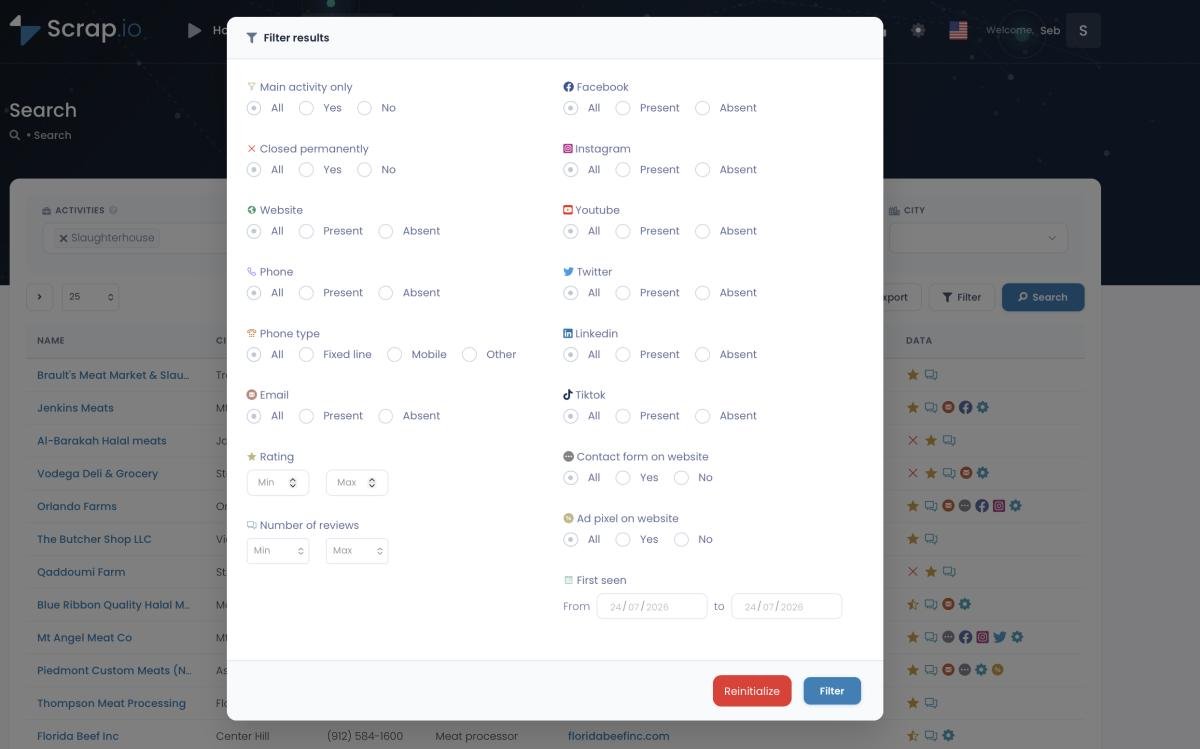
Every tool above shares one blind spot: they can't see businesses that aren't on LinkedIn. Scrap.io is the opposite lens. It extracts 225,676,406 establishments straight from Google Maps across 195 countries and 4,000+ categories, in real time — restaurants, contractors, dentists, gyms, salons, the entire local economy that Apollo and ZoomInfo structurally miss. You filter before extraction (email present, mobile only, no website), so you never burn a credit on a contact you can't use. It's not a competitor to the LinkedIn tools. It's the complementary layer. More on that below, because it's the whole point of this article. It also slots neatly into any lead generation software stack.
📌 Scrap.io indexes 225M+ businesses across 195 countries — the local layer every tool on this list skips. See what's in your market free (7-day trial, 100 leads, counts are always free).
How to Choose the Right AI Prospecting Tool
The best tool isn't the one with the most data. It's the one with the right data for who you actually sell to.
Read that twice, because it's the opposite of how most people shop. Everyone chases the biggest contact count. But 320 million records mean nothing if zero of them are the local businesses in your territory. So start from your buyer, not from the leaderboard.
Three questions cut through the noise when you're weighing AI tools for prospecting:
Who's your ICP? Selling SaaS to enterprise tech? Apollo, ZoomInfo, Wiza — the LinkedIn crowd is your home turf. Selling to local, brick-and-mortar, service businesses? Those tools will return empty rows, and you need Google Maps data instead. This single question eliminates half the list instantly.
What's your budget — really? A solo founder does not need a $31,875 ZoomInfo contract. A free Apollo tier plus a $35/mo local data source will out-perform it for local outreach, at 1% of the cost. Match spend to motion.
What's your workflow? Do you want an autonomous agent (AiSDR), an orchestration canvas (Clay), a dialer (Nooks), or a clean export you control (Scrap.io)? Be honest about how hands-on you want to be. Clay is incredible and will also eat your Tuesday.
One more thing most guides skip: score your leads before you touch them. A tool that hands you 10,000 contacts is worthless next to one that tells you which 200 to call first. If that's your gap, our guide to AI lead scoring walks through building a model on signals your CRM doesn't capture.
And the community says the same thing, in fewer words. From r/salestechniques: "Comparing AI prospecting tools after too many demos, what questions actually cut through the polish?" The answer is always the same three: who, budget, workflow.
The Local-Leads Gap: Businesses That Aren't on LinkedIn
Sarah runs a web agency. Her ideal clients are dentists, plumbers, and restaurants — the businesses that desperately need a decent website and will happily pay for one. None of them are on Sales Navigator. Her $99/mo prospecting tool returns... nothing. Row after empty row.
She's not doing anything wrong.
She's using the wrong map.
This is the blind spot at the center of every list you'll read this year. Apollo's 270 million and ZoomInfo's 320 million contacts are a professional database — people with job titles at companies with LinkedIn pages. Scrap.io's 225 million+ are establishments — physical businesses pinned to Google Maps. Two entirely different universes. One is not better than the other. They barely overlap. And almost nobody is fishing in the second one — which is exactly why Google Maps AI prospecting is such an underused edge.
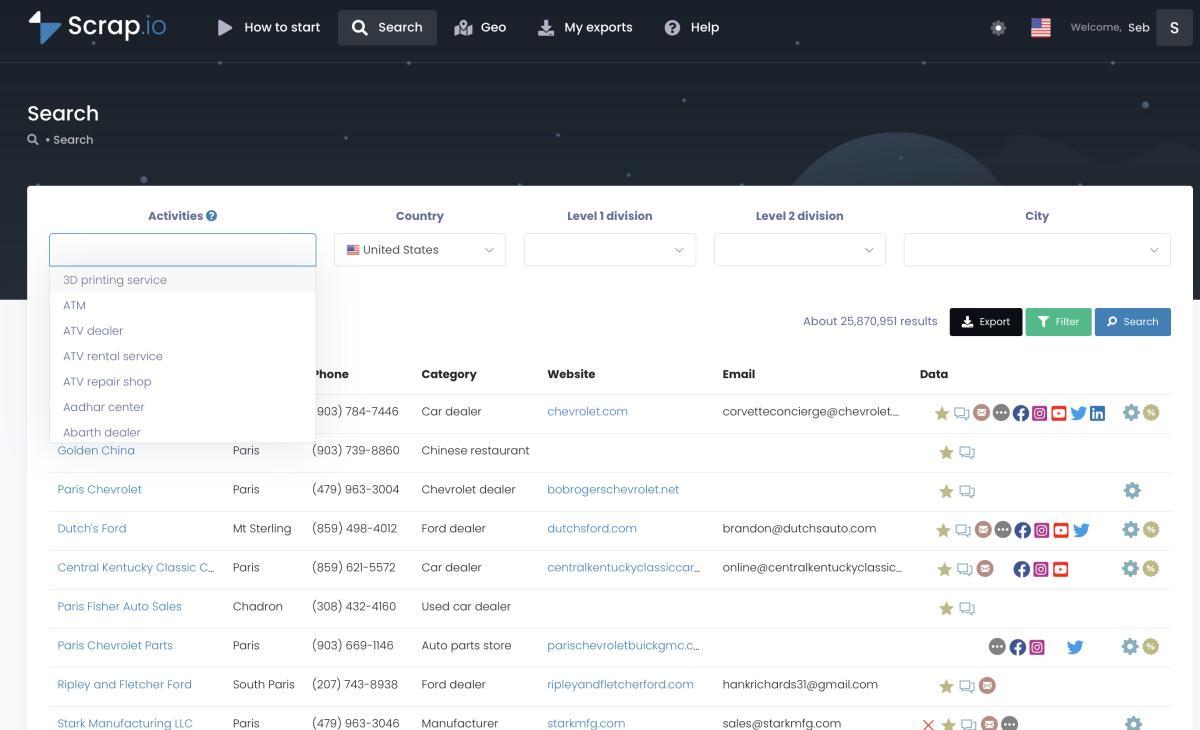
Think about who lives there. The 33 million+ small businesses in the US alone. The taquería with 900 reviews. The three-location HVAC company whose owner checks his phone, not his LinkedIn inbox. For a web agency, a marketing shop, an SMS campaign, or anyone selling to local — that's the entire addressable market. Invisible to the tools everyone else uses.
And the data quality argument here is brutal in Scrap.io's favor: the data is a con if it's stale, and traditional B2B databases are snapshots that degraded the moment they were saved. Scrap.io extracts in real time, at the instant of export, straight from the live Google Maps listing and the associated website. New business opened last week? It's there. Phone number changed? Updated. You're not prospecting ghosts.
There's a case study that makes the whole point better than any pitch. A four-person SDR team at a mid-market SaaS ran two campaigns. Campaign A: 2,000 purchased contacts from a big database — 1.8% reply rate. Campaign B: 200 contacts sourced from an actual engagement signal — 9.2% reply rate (Getcleed/Cleanlist 2026). Ten times fewer contacts. Five times the response. The data beat the volume, and it wasn't close.
Want to see the emails, not just the listings? Here's how to find emails on Google Maps — the mechanics behind pulling verified, classified contact data from those local listings.
🔥 Try it on your own city. Pull every dentist, plumber, or restaurant with a verified email in 2 clicks — no code. Free 7-day trial + 100 leads. Filter before you export, so you only pay for contacts you can actually use.
AI Prospecting in Practice: The Agent / MCP Workflow
Let's be real about what you actually want. You don't want another dashboard. You want to type "find me every dentist in Texas with an email and no website" and get a file back. In seconds. Without learning a new interface.
That's not a fantasy anymore.
It's called vibe prospecting — sales prospecting with AI at its most literal — and it runs on MCP.
MCP — the Model Context Protocol — is an open standard that lets AI agents connect directly to live data sources. Think of it as a universal plug between your LLM and the real world. Instead of ChatGPT hallucinating a list of businesses, it queries an actual database in real time and hands back structured, current records. Scrap.io runs an official MCP server at scrap.io/mcp, compatible with Claude, ChatGPT, and Gemini.
Video: How to Scrape Local Leads with Claude & Vibe Prospecting
Here's what it looks like in practice. You connect the MCP server to Claude once (Settings → Connectors → add scrap.io/mcp → authorize). Then you just... talk to it. "Count the restaurants in the 11th arrondissement of Paris." The agent builds the polygon itself, runs the count — free — and tells you there are 1,400. "Now export the ones with a mobile number and no Facebook page." Done. A clean CSV, no code, no clicking through filter menus.
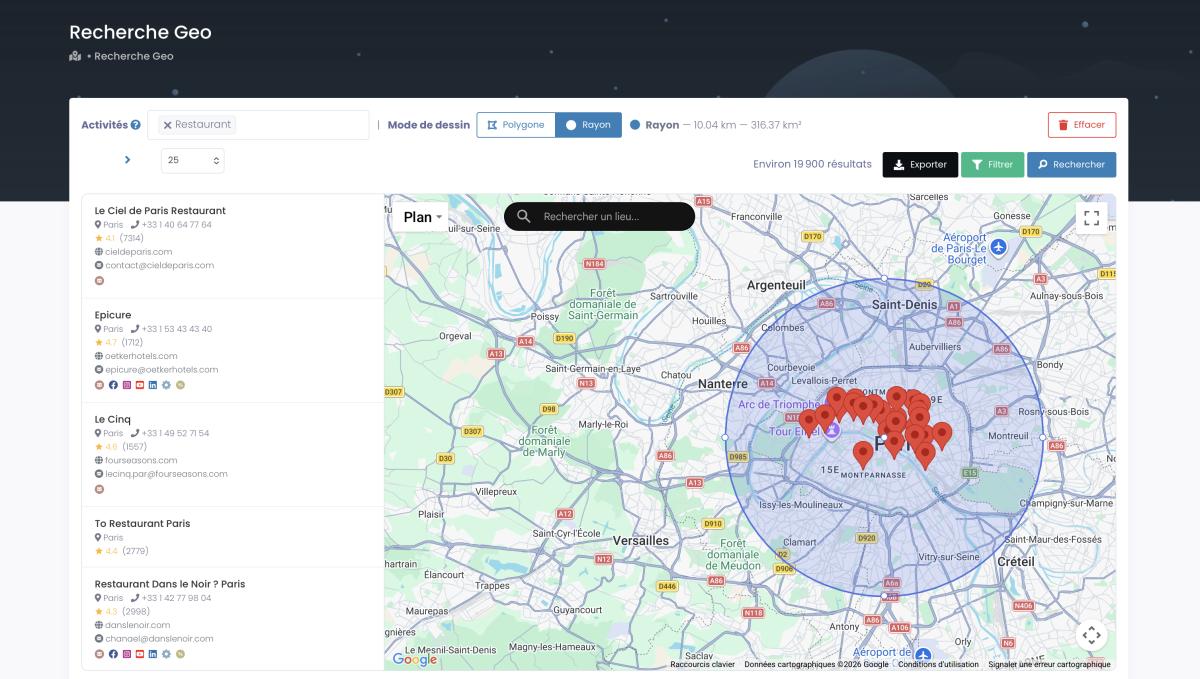
The geographic targeting is where it gets genuinely clever. Ask for a radius around a point, and the agent draws it — a circle up to 500 km on the higher plans.
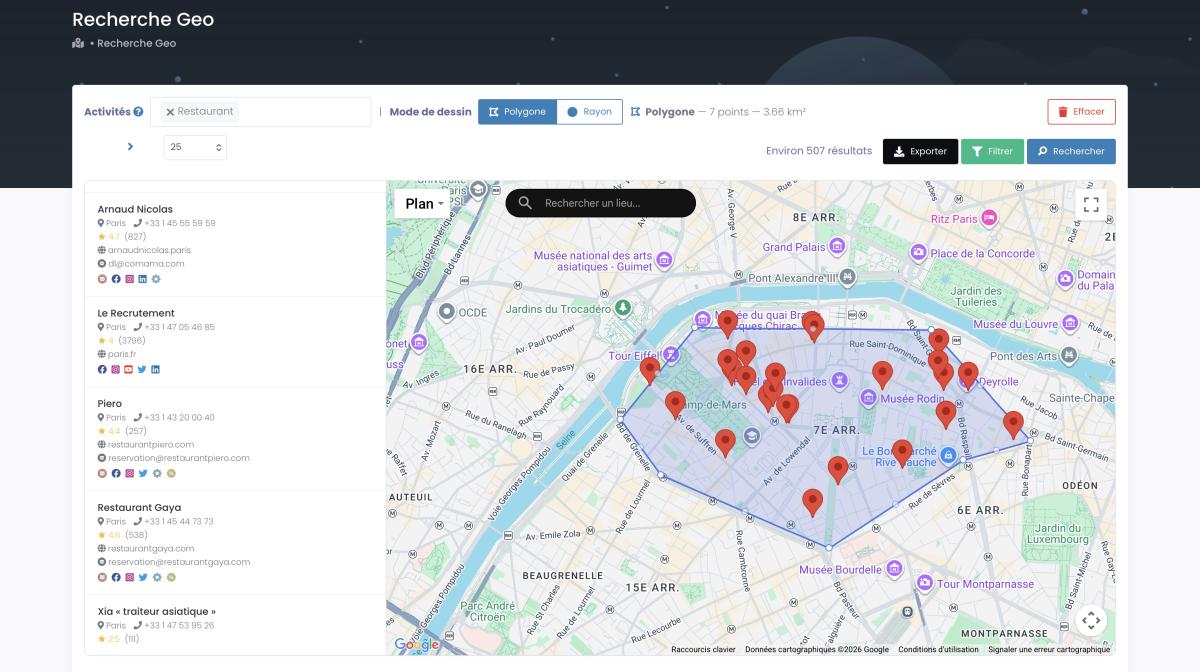
Need something messier than a circle — a specific neighborhood, a sales territory, an oddly shaped catchment area? Describe it, and the agent builds a custom polygon on the map for you.
The productivity numbers explain the hype: AI agents cut prospect-research time by 34% and email-writing time by 36% (Salesforce 2026), and 92% of reps equipped with AI agents say it directly benefits their prospecting. The workflow collapses hours into a sentence.
The obvious question: doesn't this mean the AI does everything? No. The agent handles the fetching and the first draft. You still own the strategy, the offer, and the judgment about who's worth a real conversation. And once you've got the list, the writing still matters — a lot. Pair the sourcing with proper AI cold email personalization, and if you want the fundamentals nailed down, our breakdown of how to write a cold email covers the first three lines that decide everything.
One founder summed up the whole shift on r/automation: "I couldn't afford to hire a B2B sales team so I built an AI agent that does 95% of the prospecting for me." That's not the future. That's a Tuesday in 2026.
Staying Compliant (GDPR & CCPA)
The less-fun but essential part: AI doesn't get you a free pass on data laws. Nobody wants to read this section. Read it anyway.
The good news is that B2B prospecting on public business data sits on solid legal ground in both major frameworks. Under GDPR (EU), business contact information — a company's published email, a listed phone number — generally falls under "legitimate interest" (Article 6). The catch: every outreach message needs a clear opt-out. Non-negotiable. Under CCPA (California), publicly available business information is carved out of scope entirely — you're handling commercial data, not consumer profiles.
The variable is the source. A tool that scrapes public business listings and keeps every data point traceable to where it came from is playing clean. A shady database of dubious origin is not. This is where Scrap.io's model matters: it extracts only publicly available business data, is GDPR- and CCPA-compliant by design, and every record traces back to its source. No mystery lists, no scraped personal profiles.
Bottom line — verify sourcing before you run any EU or California campaign, include an unsubscribe link every single time, and honor opt-outs fast. Do that, and you're prospecting like a professional instead of gambling with your domain.
Conclusion + Next Step
Twelve tools. Five categories. And one recurring blind spot running through eleven of them.
The LinkedIn-based tools — Apollo, ZoomInfo, Wiza, and the rest — are excellent at what they do. If you sell to tech companies with named decision-makers, build your stack there and don't overthink it. The autonomous agents (AiSDR) and orchestration layers (Clay) are genuinely impressive, and the MCP workflow is quietly rewriting what "fast" means in prospecting.
But the tool you pick matters less than the data you feed it. Writing is a commodity now. Sending is a commodity. The one thing that still separates a 1.8% reply rate from a 9.2% one is the quality and the exclusivity of the list going in. And if your buyers are local businesses, that list simply doesn't exist inside the tools everyone else is using.
So stop feeding your AI the same recycled LinkedIn list as your competitors. Go find the leads they can't see.
🚀 Start free — 7 days, 100 leads. Scrap.io indexes 225M+ businesses across 195 countries and 4,000+ categories, in real time. Filter before you extract, pilot it in plain English via MCP, and pull your first local list in 2 clicks. Try Scrap.io free →
FAQ
What is an AI prospecting tool?
An AI prospecting tool is software that uses machine learning, predictive data, and natural-language processing to automate three tasks: finding leads, enriching their contact data, and personalizing outreach. The goal is to let sales reps spend time selling instead of researching. Examples range from all-in-one databases like Apollo to autonomous agents like AiSDR.
What are the best AI prospecting tools in 2026?
The strongest options are Apollo.io (all-in-one database and outreach), Clay (data orchestration), ZoomInfo Copilot (enterprise intent), Wiza (LinkedIn extraction), and AiSDR (autonomous agent). For local businesses that don't appear on LinkedIn, Scrap.io adds real-time Google Maps data across 195 countries — the layer the others miss.
Are there free AI prospecting tools?
Yes. Apollo and Wiza both offer free tiers (Wiza starts with 25 free leads), Seamless.AI has a free plan, and Lavender is freemium. Scrap.io offers a 7-day trial with 100 export credits included. Test the data quality on your real target market before you commit to any of them.
Can AI prospecting tools find local businesses?
Most can't. Tools like Apollo, ZoomInfo, and Wiza pull from LinkedIn and B2B databases that exclude local shops, restaurants, and service businesses. Google-Maps-based tools like Scrap.io cover 225M+ local establishments across 195 countries and 4,000+ categories — the businesses that never appear in a traditional B2B database.
Is AI prospecting GDPR compliant?
It depends on the source. Tools that scrape publicly available business data and keep every record traceable — like Scrap.io — operate within GDPR's "legitimate interest" basis and are carved out of CCPA scope. Always verify sourcing before an EU or California campaign, and include a clear opt-out in every message.
Generate a list of restaurant with Scrap.io