

Video: B2B Lead Gen, Google Maps vs LinkedIn. Which one should you choose?
- What Is Lead Generation Software (And Why You Need One in 2026)
- How We Tested and Ranked These 15 Tools
- The 15 Best Lead Generation Software in 2026
- Lead Generation Software Comparison Table
- How Google Maps Data Is the Untapped Gold Mine for Lead Generation
- How to Choose the Right Lead Generation Software
- FAQ: Lead Generation Software
$6.44 billion. That's how much the lead generation software market is worth right now, according to The Business Research Company. Growing at 9.6% year-over-year. And yet, 60% of marketers still pick the wrong tool for their team.
I get it. There are 200+ lead generation platforms out there. Every single one claims to be "the best." Half of them look identical. The other half cost more than your car payment.
So we actually tested them. Not a quick demo. Not a screenshot from a press kit. We dug into 15 lead generation tools over three months: real accounts, real data, real frustration when something didn't work. Here's what survived. (And if you'd rather pay someone else to do the hunting, that's a separate list, our rundown of the best lead generation companies.)
What Is Lead Generation Software (And Why You Need One in 2026)
The software most used for lead generation includes Apollo.io and ZoomInfo for outbound B2B data, HubSpot for inbound marketing, LinkedIn Sales Navigator for social selling, and Scrap.io for Google Maps business data. The right pick depends on whether you hunt for leads or wait for them to come to you, and on your team size and budget.
Lead generation software is any tool that helps you find, capture, or qualify potential customers before they've raised their hand. That's it. No fancy definition needed.
But here's where it gets interesting. HubSpot's 2026 State of Marketing report found that 80% of marketers who use automation get more leads than those who don't. Not slightly more. Significantly more. And the average starter plan costs between $5-49/user/month, yielding a 3-5x ROI.
Still doing it manually? Bold choice.
How Lead Generation Software Actually Works
Most lead gen tools fall into one of three buckets: they either find contacts (prospecting tools like Apollo or Scrap.io), capture them (forms, chatbots, pop-ups like OptinMonster or Intercom), or qualify them (intent data and scoring platforms like 6sense). Some try to do all three. Few succeed at more than two. The best sales prospecting techniques combine multiple tools rather than relying on a single platform.
Inbound vs. Outbound: Two Sides of the Same Coin
Inbound lead generation tools (HubSpot, OptinMonster, Intercom) wait for prospects to come to you. Content, SEO, ads. Patient stuff. Outbound tools (Apollo, ZoomInfo, Scrap.io) go hunt. Cold email, cold call, LinkedIn DMs. Less patient. Way faster results if you know your ICP.
Most B2B teams in 2026 use both. And honestly? The ones winning are the ones using data sources their competitors haven't discovered yet. (More on that later.) Whether you need sales lead generation software for outbound or an SEO lead generation software strategy for inbound, the right lead generation management software ties both channels together.
How We Tested and Ranked These 15 Tools
With 200+ lead generation platforms on the market, how do you separate the hype from what actually fills your pipeline?
We evaluated every tool on five criteria: data accuracy (are the emails and phone numbers real?), integrations (does it plug into your CRM without duct tape?), pricing transparency (hidden fees are an instant red flag), ease of use (if onboarding takes 3 weeks, it's a no), and unique features (what does this tool do that nobody else does?).
We also factored in real user reviews from Gartner Peer Insights, case studies from companies like LlamaLeadGen (who generated 2,800+ leads with a 274% ROI using multi-channel lead gen), and data from Prospeo's B2B case studies. No sponsored placements. No affiliate bias on rankings. We also looked at results from agencies like LeadGenDept, where one FDA consulting firm saw a 2,005% increase in leads per quarter and an 89% decrease in CPL. Numbers don't lie.
The 15 Best Lead Generation Software in 2026
We've spent 3 months testing every major lead gen platform. Here's who made the cut, and the one that surprised us most.
1. Scrap.io: Best for Google Maps Lead Generation
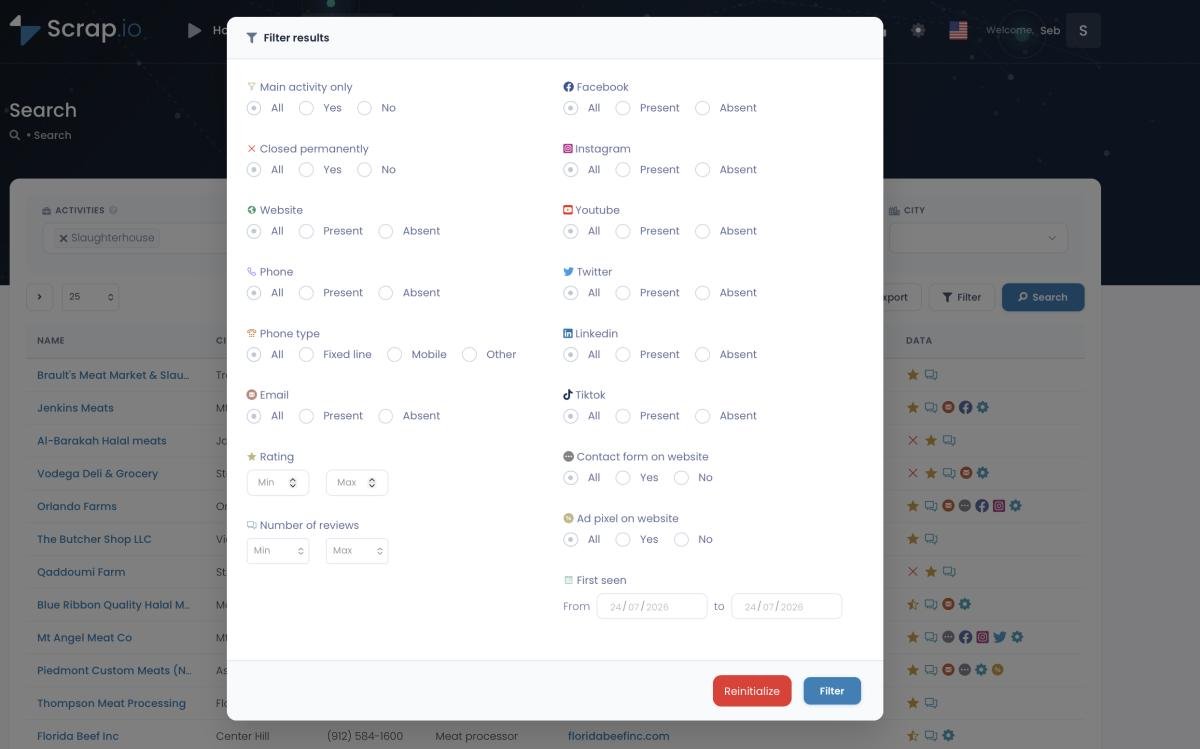
Scrap.io does something none of the other tools on this list can do: it extracts business data directly from Google Maps across 195 countries. We're talking 225 million+ businesses with real phone numbers, emails, websites, and social profiles, scraped in real time, not from a stale database. The killer feature? You can extract an entire country's businesses in two clicks. No code. Filters are applied before extraction, so you never waste credits on junk contacts.
Pricing: From $35/mo (annual). Free trial, 7 days, 100 leads included.
Best for: Agencies, local B2B prospecting, lead generation software for real estate agents, and anyone tired of LinkedIn-only databases.
Not sure where to start? This two-minute walkthrough shows the whole search-to-export flow.
Video: Scrap.io - How to Start?
2. Apollo.io: Best All-in-One for Outbound Prospecting
Apollo claims 275 million contacts across 65M+ companies, and the data quality is genuinely solid for US-based B2B. Built-in sequencing, email verification, and a generous free tier make it the go-to for SDR teams just getting started. The downside? Data gets shaky outside North America. And their credit system can drain fast if you're not careful. If that credit math starts to sting, we compared the strongest Apollo.io alternatives in a separate test.
Pricing: Free plan available. Paid from $49/user/mo.
Best for: Outbound-first sales teams, startups.
3. ZoomInfo: Best Enterprise B2B Data Platform
The 800-pound gorilla. ZoomInfo has the deepest enterprise B2B database, period. Intent data, org charts, technographics, it's all there. But you'll pay enterprise prices for enterprise features. We're talking $15K+/year contracts with annual commitments. For smaller teams, that's overkill. For enterprise sales orgs, it's table stakes. Choking on the price tag? We rounded up cheaper ZoomInfo alternatives that cover most of the same ground.
Pricing: Custom (starts ~$15K/year).
Best for: Enterprise sales teams with budget.
4. LinkedIn Sales Navigator: Best for Social Selling
If your prospects live on LinkedIn (and in B2B, they probably do), Sales Navigator's advanced search filters and InMail credits are hard to beat. The integration with CRMs has improved. But, and this is a big but, you can't export data natively. You'll need a third-party tool to actually get those contacts into your workflow.
Pricing: From $99/mo.
Best for: Account-based selling, relationship-driven sales.
5. HubSpot Marketing Hub: Best for Inbound Lead Generation
HubSpot is the Swiss Army knife of inbound marketing. Landing pages, email automation, CRM, analytics, all in one. Nucleus Research found that HubSpot users see a 505% ROI over 3 years. The free CRM is genuinely useful for small teams. The catch? You'll outgrow the free tier fast, and the jump to paid plans is steep.
Pricing: Free CRM. Marketing Hub from $45/mo.
Best for: Inbound-focused marketing teams, content-driven businesses.
6. Cognism: Best for GDPR-Compliant European Data
If you sell into Europe, Cognism should be on your shortlist. Their phone-verified mobile numbers (Diamond Data) are legitimately impressive, they claim 98% accuracy on verified contacts. GDPR and CCPA compliant by design. The tradeoff? Pricing isn't cheap, and the US database isn't as deep as ZoomInfo's or Apollo's.
Pricing: Custom (typically $15K-30K/year).
Best for: Teams selling into EMEA markets.
7. Lusha: Best Lightweight Contact Lookup
Lusha is the "just give me the email and phone number" tool. Chrome extension, quick lookups, decent accuracy. Perfect for individual reps who need contact data without a massive platform commitment. Not great for bulk prospecting or complex workflows.
Pricing: Free plan (5 credits/mo). Paid from $36/user/mo.
Best for: Individual sales reps, quick lookups.
8. Seamless.AI: Best for High-Volume Prospecting
Seamless.AI bills itself as a real-time search engine for B2B leads. The pitch detection and "autopilot" features are useful if you're doing high-volume outbound. Data quality is hit-or-miss though, you'll want to verify emails before blasting. Their aggressive sales tactics are... well-documented on Reddit.
Pricing: Free plan available. Pro plans from $147/mo.
Best for: High-volume outbound teams with email verification in place.
9. Leadfeeder (Dealfront): Best for Website Visitor Identification
Leadfeeder flips the script: instead of hunting for leads, it tells you which companies are already visiting your website. De-anonymizes traffic, shows which pages they viewed, and pushes the data into your CRM. Essentially lead generation tracking software that turns anonymous visitors into named accounts. Brilliant for ABM. Less useful if your website traffic is low.
Pricing: Free plan (last 7 days only). Paid from $99/mo.
Best for: ABM teams, high-traffic B2B websites.
10. OptinMonster: Best for Conversion Rate Optimization
OptinMonster isn't a prospecting tool, it's a lead capture machine. Pop-ups, slide-ins, exit-intent forms, floating bars. If you have traffic but not enough conversions, OptinMonster will probably fix that. It won't find you new prospects though. Different category entirely.
Pricing: From $9/mo (billed annually).
Best for: Content marketers, e-commerce, anyone with traffic and poor conversion.
11. LeadIQ: Best for SDR Workflow Automation
LeadIQ is built for SDRs who live in LinkedIn and Salesforce. One-click capture from LinkedIn profiles, automatic CRM enrichment, and AI-powered email personalization. It's not a database, it's a workflow tool that makes your existing prospecting faster. Great for teams, less useful for solo operators.
Pricing: Free plan. Paid from $39/user/mo.
Best for: SDR teams integrated with Salesforce.
12. 6sense: Best for Intent-Based ABM
6sense is the poster child of ai powered lead generation tools, it uses AI and intent data to identify accounts that are actively researching solutions like yours, before they fill out a form. It's the "know before they know they know" tool. Powerful for enterprise ABM. Completely overkill (and overpriced) for small teams. This is AI sales tools territory at its most sophisticated.
Pricing: Custom (enterprise only, typically $50K+/year).
Best for: Enterprise ABM, demand gen teams with budget.
13. Clearbit (by HubSpot): Best for Real-Time Data Enrichment
Now part of HubSpot, Clearbit enriches your existing leads with firmographic and technographic data in real time. Great if you already have contacts but need more context. The HubSpot integration is seamless (obviously). As a standalone lead gen tool? Not really, it's an enrichment tool, not a finder.
Pricing: Included in HubSpot plans, or custom pricing standalone.
Best for: HubSpot users, data enrichment workflows.
14. Hunter.io: Best for Email Finding & Verification
Hunter does one thing very well: finds and verifies professional email addresses. Domain search, email verification, outreach campaigns. It's simple, it's fast, and the accuracy is solid. Won't give you phone numbers or company data though, it's laser-focused on email. Good fit for cold email software stacks.
Pricing: Free plan (25 searches/mo). Paid from $34/mo.
Best for: Cold emailers, link builders, PR teams.
15. Intercom: Best for Conversational Lead Capture
Intercom's chatbot and live chat combo captures leads right when they're browsing your site. The AI chatbot (Fin) can qualify leads automatically, book meetings, and route to the right rep. It's not cheap, but if you have website traffic, it converts visitors into conversations better than a static form ever will.
Pricing: From $39/seat/mo.
Best for: SaaS companies, product-led growth teams.
Lead Generation Software Comparison Table
Comparing 15 tools in 15 different tabs? We already did it for you. This lead generation software comparison 2026 edition covers everything from free lead generation tools to enterprise monsters. Bookmark it, you'll come back. (Also worth checking Salesforce's list for a second opinion, though they're obviously biased.)
| Tool | Best For | Starting Price | Key Feature | Data Source | Free Plan? |
|---|---|---|---|---|---|
| Scrap.io | Google Maps Leads | $35/mo | Extract entire country in 2 clicks | Google Maps (225M+ businesses) | ✅ 7-day trial |
| Apollo.io | All-in-One Outbound | Free / $49/user/mo | Built-in sequencing + 275M contacts | Proprietary B2B database | ✅ |
| ZoomInfo | Enterprise B2B Data | ~$15K/year | Intent data + org charts | Proprietary + partnerships | ❌ |
| LinkedIn Sales Nav | Social Selling | $99/mo | Advanced LinkedIn filters + InMail | LinkedIn network | ❌ (free trial) |
| HubSpot | Inbound Marketing | Free / $45/mo | All-in-one CRM + marketing | Inbound traffic + Clearbit | ✅ |
| Cognism | European / GDPR Data | ~$15K/year | Phone-verified mobile numbers | Proprietary EU-focused | ❌ |
| Lusha | Quick Contact Lookup | Free / $36/user/mo | Chrome extension lookup | Proprietary + community | ✅ (5 credits) |
| Seamless.AI | High-Volume Prospecting | Free / $147/mo | Real-time AI-powered search | AI-aggregated web data | ✅ |
| Leadfeeder | Website Visitor ID | Free / $99/mo | De-anonymize website traffic | Reverse IP + integrations | ✅ (7 days) |
| OptinMonster | Conversion Optimization | $9/mo | Exit-intent pop-ups + A/B tests | Your own traffic | ❌ |
| LeadIQ | SDR Workflow | Free / $39/user/mo | One-click LinkedIn capture | LinkedIn + proprietary | ✅ |
| 6sense | Intent-Based ABM | Custom ($50K+/yr) | AI intent detection + ABM | Intent signals + web data | ❌ |
| Clearbit | Data Enrichment | Custom / HubSpot | Real-time firmographic enrichment | Proprietary + web crawling | ✅ (via HubSpot) |
| Hunter.io | Email Finding | Free / $34/mo | Domain email search + verification | Web crawling + patterns | ✅ (25/mo) |
| Intercom | Conversational Capture | $39/seat/mo | AI chatbot (Fin) + live chat | Your own traffic | ❌ (free trial) |
How Google Maps Data Is the Untapped Gold Mine for Lead Generation
Everyone's fighting over the same LinkedIn databases. Meanwhile, Google Maps has 225 million+ businesses listed with real phone numbers and emails, and almost nobody's using it for lead generation. Wild.
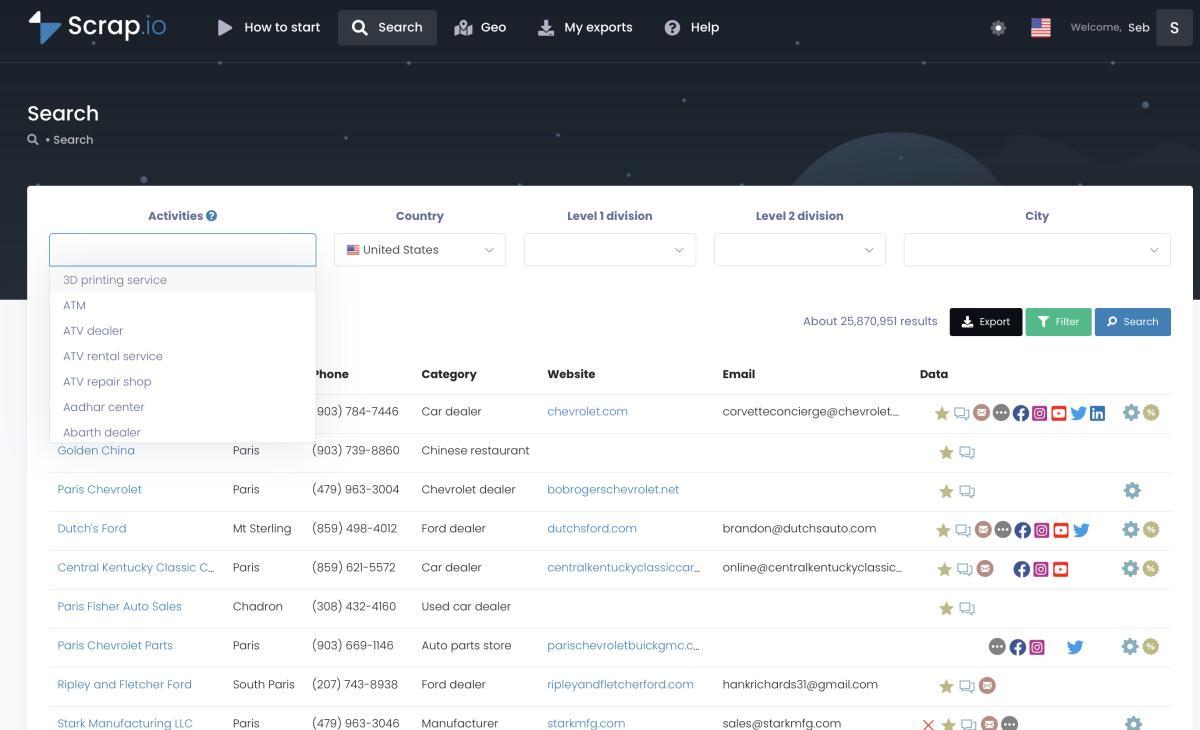
Here's the thing most lead gen tools don't want you to know: their databases are all pulling from roughly the same sources, LinkedIn profiles, company websites, public filings. That means you and your competitors are emailing the exact same people. That's not a competitive advantage. That's a spam party.
Google Maps is different. It indexes businesses that don't even have a LinkedIn page. Local service providers, restaurants, contractors, agencies, retail stores, real businesses with real contact information that your competitor's fancy B2B database completely misses. Honestly, it's the best lead generation for contractors, roofers, and local trades you'll find anywhere, because those are exactly the businesses that never bothered with a corporate profile.
Why Google Maps Beats Traditional B2B Databases
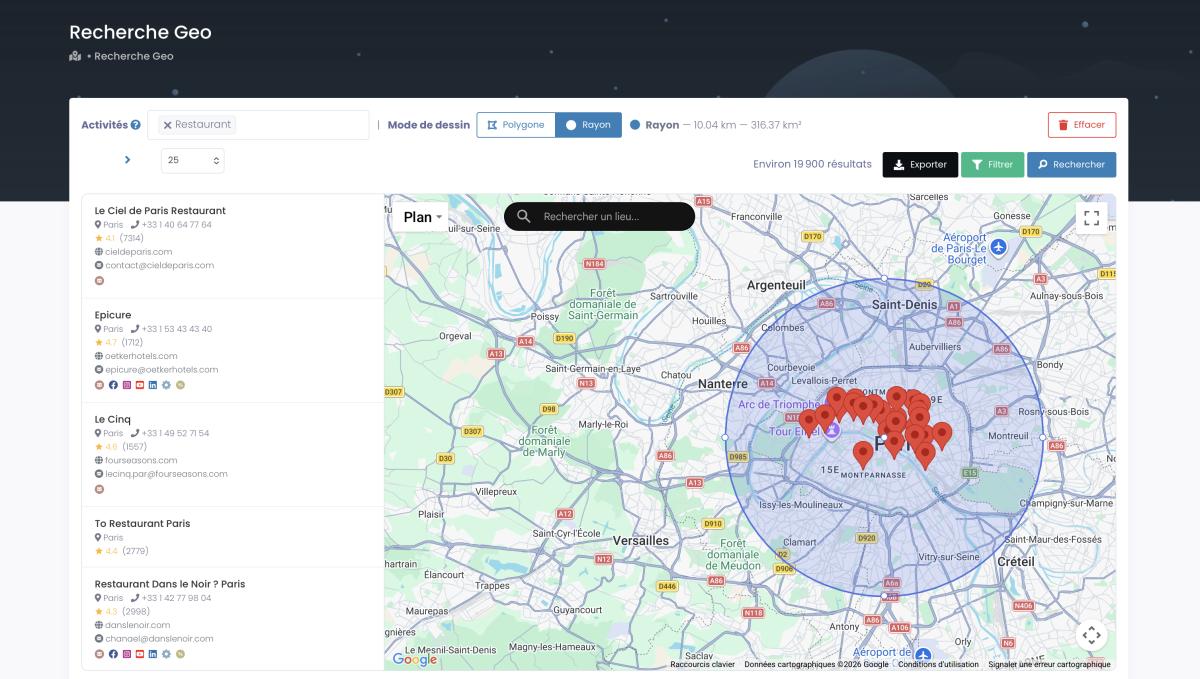
Traditional B2B data platforms give you a snapshot. A frozen-in-time spreadsheet that was maybe accurate three months ago. Google Maps data is updated continuously by Google itself, new businesses appear, closed ones get flagged, phone numbers get verified by owners. It's the closest thing to real-time business data at scale.
And the coverage? 195 countries. 4,000+ business categories. Try getting that from ZoomInfo without selling a kidney.
How Scrap.io Extracts an Entire Country's Businesses in 2 Clicks
Scrap.io is the only lead generation software that lets you scrape Google Maps at scale, legally and without code. It works like a purpose-built lead scraper for the whole map. Pick your country, set your filters (has email? has website? minimum rating?), and hit export. That's it. You get a clean CSV with names, addresses, phone numbers (classified as mobile or landline), categorized emails, social media profiles, and even the tech stack of their website.
One customer extracted 11,734 businesses in 45 minutes. Try doing that on LinkedIn Sales Navigator. I'll wait.
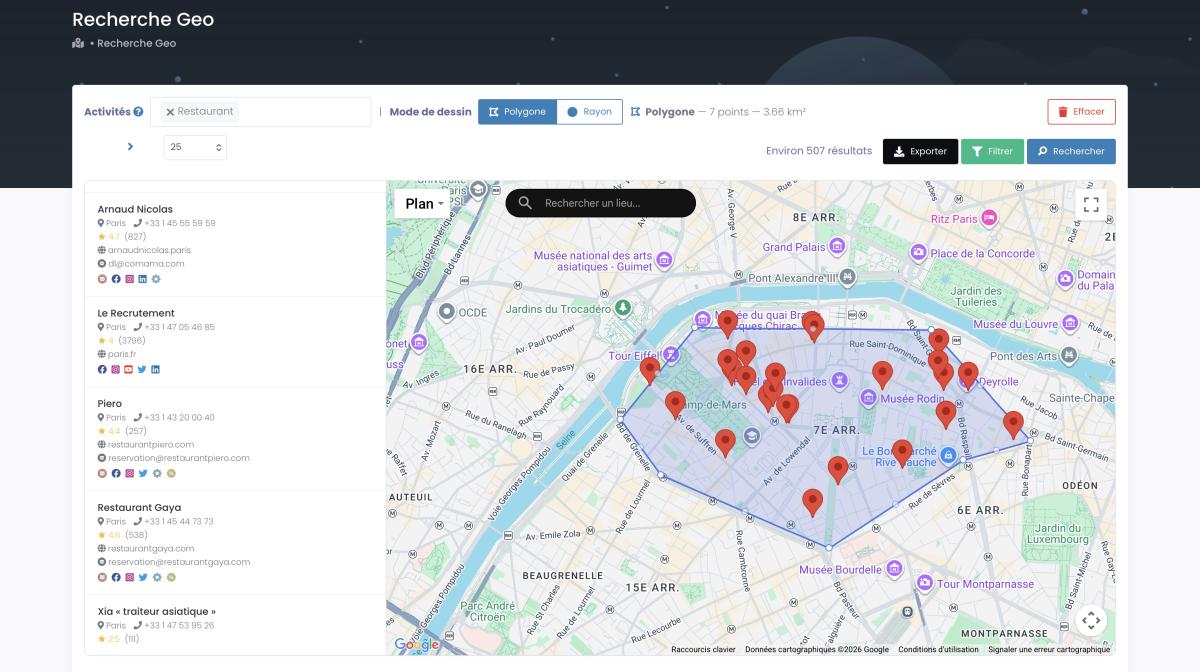
Need an odd-shaped territory instead of a whole country? GeoSearch lets you draw a polygon by hand or set a radius around a point, and every filter still applies inside it.
Video: How to Scrape Google Maps, Ultimate Guide
How to Choose the Right Lead Generation Software
Meet Sarah. She spent $12K on ZoomInfo last year. Her team used 8% of the credits. Don't be Sarah.
Choosing the right lead generation software isn't about picking the "best" tool, it's about picking the right tool for you. And that depends on three things.
Data Quality vs. Database Size
275 million contacts sounds impressive until 40% of the emails bounce. A smaller, verified dataset beats a massive, stale one every time. Ask yourself: do you need volume (Seamless.AI, Apollo) or accuracy (Cognism, Scrap.io)? If you're running cold email outreach, one bad bounce rate can tank your sender reputation for months.
Real talk from Reddit's r/Entrepreneur: bootstrapped founders consistently say they got better results from niche, affordable tools than from enterprise platforms with credits they never used. Companies outsourcing B2B lead gen reach their first qualified meeting 2.3x faster, according to a Callbox / IDC report. And hybrid AI+human agencies reduced cost per qualified opportunity by 34%.
Integration With Your Existing Stack
The best lead generation software is the one your team actually uses. If your CRM is Salesforce, LeadIQ and ZoomInfo have native integrations. If you're on HubSpot, Clearbit is already baked in. If you need to automate lead enrichment into your CRM, check whether the tool supports direct CRM sync or if you'll need Zapier/Make as middleware.
Scrap.io, by the way, integrates with Make.com natively and works with any CRM through its API or via Zapier and n8n. The waterfall enrichment approach, layering multiple data sources, often beats relying on a single provider.
Don't Skip Compliance (GDPR & CCPA)
One factor people ignore until it bites them: compliance. In 2026, both GDPR (Europe) and CCPA (California) govern how you collect and use contact data, and the penalties aren't cosmetic. The safe play is to stick to tools that pull only publicly available business data and keep every record traceable to its source, the way Scrap.io does, being GDPR and CCPA compliant by design. Public business info used for B2B outreach sits on solid legal ground. Scraping personal profiles or reselling consumer lists doesn't.
Pricing: What You're Really Paying For
Here's something nobody says loud enough: 2026 pricing is climbing 20-30% YoY across major lead gen platforms, according to Improvado's industry analysis. ZoomInfo just hiked again. Apollo's free tier keeps shrinking. The market is consolidating and prices are going up.
Watch for these traps: per-credit pricing that looks cheap but drains fast, annual contracts with no monthly option, "implementation fees" that double your first-year cost, and minimum seat requirements. The best lead generation software for small business isn't necessarily the cheapest, it's the one where you understand exactly what you're paying for before you sign. If you're hunting for lead generation software b2b free options, Apollo and HubSpot have genuinely useful free tiers. And Scrap.io's trial gives you 100 real leads to test with, enough to validate the data before committing.
Bref, know your budget, know your ICP, and test before you commit. If you're still wondering how to choose lead generation software, here's the shortcut: define your ICP first, pick 2-3 tools that match (one for finding, one for capturing, maybe one for enrichment), and test them for a week. Most tools offer free trials or free tiers. Use them. All of them. Then decide. Best lead generation tools for B2B? It depends on whether you need volume, accuracy, or both, but the best free lead generation software options (Apollo free tier, HubSpot CRM, Hunter's 25 monthly searches) give you enough to start without a credit card.
FAQ: Lead Generation Software
Which software is used for lead generation?
The most-used lead generation software in 2026 is Apollo.io for outbound prospecting, HubSpot for inbound marketing, ZoomInfo for enterprise B2B data, LinkedIn Sales Navigator for social selling, and Scrap.io for Google Maps business data. Many teams pair a CRM software for lead generation with a dedicated prospecting tool. Your best pick depends on team size, budget, and inbound versus outbound.
What is the best free lead generation software?
The best free lead generation software options in 2026 are HubSpot CRM (unlimited free contacts), Apollo.io's free plan (limited credits plus sequencing), and Hunter.io (25 free email searches a month). If you want free ai tools for lead generation, Apollo's AI features and HubSpot's free automations both qualify. Scrap.io's 7-day trial adds 100 real Google Maps leads to test with.
How much does lead generation software cost?
Lead generation software ranges from free (HubSpot CRM, Scrap.io's 100 trial leads) to $5-49/user/month for starter plans, up to $500-5,000+/month for enterprise tools like ZoomInfo. Most use per-seat or credit-based pricing. Watch for hidden costs like implementation fees and minimum annual contracts before you sign.
Can AI replace lead generation?
AI enhances lead generation but doesn't replace it. AI-powered lead generation tools help with prospecting research, email personalization, and lead scoring, think of them as ai lead generation software that augments your team, not replaces it. But you still need quality data sources and human judgment for relationship-building. Connect an AI to the Scrap.io MCP and it pulls real Google Maps leads instead of hallucinating them. The 2026 trend is hybrid AI+human approaches that cut cost per qualified opportunity by 34%.
What's the difference between lead generation software and CRM?
Lead generation software finds and qualifies new prospects before they know you exist. CRM software manages relationships with leads you already have. Most teams need both, a lead gen tool to fill the pipeline and a CRM to manage it.
Is Google Maps data useful for B2B lead generation?
Absolutely. Google Maps indexes 225 million+ businesses worldwide with real-time verified data including phone numbers, emails, websites, ratings, and hours. Tools like Scrap.io can extract entire countries or cities in minutes with granular filters. It's especially powerful for local businesses, agencies, and SMBs that don't appear in traditional B2B databases like ZoomInfo or Apollo.
Generate a list of restaurant with Scrap.io