

The average ZoomInfo contract costs $31,875/year. And that's before the 10-20% renewal hike (Vendr, 2026).
Let that number sit for a second.
The sales intelligence market hit $4.85 billion in 2025 and is projected to reach $10.25 billion by 2032 (Fortune Business Insights). That kind of growth means one thing: more tools, more options, more reasons not to overpay. G2 now lists over 150 tools in its Sales Intelligence category alone. So why are so many teams still locked into contracts that make their CFO twitch?
Good question. We tested 10 real zoominfo alternatives, not just skimmed landing pages, but actually signed up, pulled data, and compared results. Some are genuinely better. Some are just cheaper. A few are both. And one targets a data source most sales teams completely ignore.
(Spoiler: it's not LinkedIn.)
Need the broader map of tooling first? Our roundup of the best lead generation software zooms out beyond ZoomInfo. Otherwise, keep going.
Table of Contents
Why Teams Are Leaving ZoomInfo in 2026
When Jake's renewal quote jumped from $32K to $42K, he didn't negotiate. He left.
That's not an isolated story. Spend five minutes on r/salesforce and you'll find dozens of threads asking the same thing: "ZoomInfo is too expensive, what to use instead?" One rep in that thread put it bluntly, saying they were hunting for anything that did the job "without the enterprise price tag." Search zoominfo alternatives reddit and the frustration is everywhere. Over on r/sales, the complaints repeat almost word for word: great data in patches, brutal pricing, contracts nobody enjoys signing. It's not just about price. It's about what you get for that price.
Here's the pattern. Year one, the contract feels reasonable. Year two, renewal comes with a 10-20% increase baked in. By year three, you're paying enterprise money for data that bounces at 15-20%. That's insane.
And the data quality complaints? They're real. Stale emails, wrong direct dials, contacts who left the company two quarters ago. When you're paying north of $30K, you expect accuracy. Many teams aren't getting it.
Then there's the contract rigidity. Multi-year commitments. Seat minimums. Cancellation hoops that feel designed by someone who really doesn't want you to leave. (Trust me, we've all been there.)
Look, ZoomInfo built a massive product. Nobody's denying that. But the zoominfo competitors landscape in 2026 looks nothing like it did three years ago. Smaller, leaner tools are catching up, sometimes with better data in specific niches, almost always at a fraction of the cost.
Who is ZoomInfo's biggest competitor in 2026?
Short answer: it depends on the segment. Apollo.io is the closest head-to-head challenger on value, matching most of ZoomInfo's core functionality for a tiny fraction of the price. In Europe, Cognism leads on GDPR-compliant, phone-verified data. And for local business data, Scrap.io covers a segment ZoomInfo barely touches. No single tool beats ZoomInfo feature-for-feature, but each of these wins its own lane.
Wondering what $30K buys elsewhere? Keep reading.
The 10 Best ZoomInfo Alternatives (Ranked)
Not all zoominfo alternatives are actually alternatives. Some are just cheaper clones with the same problems: stale data, opaque pricing, and contracts designed to trap you.
So we filtered hard. Our criteria: pricing transparency (can you actually see what it costs before talking to sales?), data quality, ease of use, and whether the tool brings a genuinely different angle. No filler picks. Every tool on this list does something ZoomInfo either can't do, won't do, or charges way too much for.
Here they are.
1. Apollo.io, Best All-in-One for Startups & SMBs
If you're asking "zoominfo vs apollo which is better," the answer depends entirely on your budget. Functionally, Apollo covers about 80% of what ZoomInfo does. At roughly 3% of the price.
Apollo offers a free tier (yes, actually free) plus paid plans starting at $49/month. Its database spans 275M+ contacts with built-in email sequencing, a dialer, and CRM functionality. Basically, it's trying to be your entire outbound stack in one tool. And for many startups, it succeeds.
The numbers on G2 tell the story: Apollo holds a 4.7/5 rating across 9,400+ reviews. ZoomInfo? 4.5/5 from roughly 9,000 reviews. More reviews, higher score. That's rare for a tool that costs this much less.
Real-world proof: Cotera saved $32,600 per year after switching from ZoomInfo, a 78% cost reduction. By month 6, they'd outperformed their previous ZoomInfo pipeline.
Apollo isn't perfect, though. Its email accuracy gets shaky outside North America and the credit system drains fast. If it starts feeling stale, we keep a full breakdown of the best Apollo.io alternatives too. And if you're still torn between a big corporate database and a live local-data source, this side-by-side settles it fast.
Video: Scrap.io vs Apollo, Which Tool for Which Type of Prospecting
Best for: Startups and SMBs running outbound who need prospecting, sequencing, and a CRM without stitching together five different tools. A strong pick if you're looking for zoominfo competitors for startups.
2. Cognism, Best for European Prospecting & GDPR
If your target market includes Europe, most US-built databases fall short. Cognism doesn't. It's the best zoominfo alternative for europe gdpr compliance, with phone-verified mobile numbers and a data set built specifically for EU coverage.
ResponseiQ reported winning new clients after switching from ZoomInfo to Cognism, not just saving money, but actually improving results. That's the part people miss. Cheaper doesn't have to mean worse.
Pricing runs between $22,500 and $37,500/year for enterprise plans. Not cheap. But for EU-focused teams who need GDPR-compliant data with verified mobiles, there's no better option. The compliance piece alone saves you from the legal headaches that American-first platforms tend to create in European markets.
Best for: Teams selling into the UK, DACH, Nordics, or France who can't afford GDPR violations. Nope, ZoomInfo's EU data doesn't come close.
3. Lusha, Best for Quick, Affordable Lookups
Not every rep needs a $30K database. Some just need a phone number. Fast.
Lusha gets this. Free tier with 5 credits per month, paid plans from $22/month. The Chrome extension sits on LinkedIn and pulls direct dials and verified emails in seconds. No contracts. No calls with sales reps. No "let's schedule a demo to discuss pricing."
The data isn't as deep as ZoomInfo or Apollo. You won't get intent signals or company technographics. But for individual reps who prospect on LinkedIn and just need accurate contact info, Lusha is hard to beat. It's one of the most popular free zoominfo alternatives 2026 for a reason.
Best for: Individual sales reps and small teams who need quick, accurate lookups without the overhead.
4. Lead411, Best for Intent Data on a Budget
Intent data usually means enterprise pricing. Lead411 breaks that rule.
At $75/month per user, you get Bombora intent data bundled in, the same intent signals that ZoomInfo charges significantly more for. The database covers 450M+ contacts with verified emails and direct dials.
And here's what matters: you can actually see the pricing on their website. No "contact sales" gatekeeping. For mid-market teams wanting to prioritize accounts showing buying signals, Lead411 is one of the most affordable sales intelligence tools 2026 has to offer.
Best for: Mid-market sales teams that want intent-driven prospecting without negotiating a five-figure contract.
5. RocketReach, Best for Pay-Per-Lookup Simplicity
700M+ profiles. Plans from $33/month. That's it.
RocketReach doesn't try to be your CRM, your sequencer, or your analytics platform. It finds contact info. Emails, phones, social profiles. You search, you get results, you move on. The simplicity is the selling point.
Recruiters love it. So do journalists, researchers, and anyone who does occasional prospecting without needing a full-blown sales intelligence platform. If you just need a reliable b2b contact database alternative without the complexity, RocketReach delivers.
Best for: Recruiters, freelancers, and anyone who needs one-off lookups without subscribing to a platform they'll use twice a month.
6. Scrap.io, Best for Local Business & Google Maps Data
What if you don't need a $30K database to prospect local businesses?
Here's the thing most B2B data providers miss: millions of businesses aren't on LinkedIn. They're not in ZoomInfo's database. But they are on Google Maps. Every plumber, dentist, restaurant, agency, and local service provider maintains a Google Business Profile. That's real, owner-updated, public data, and Scrap.io is built to extract it at scale.
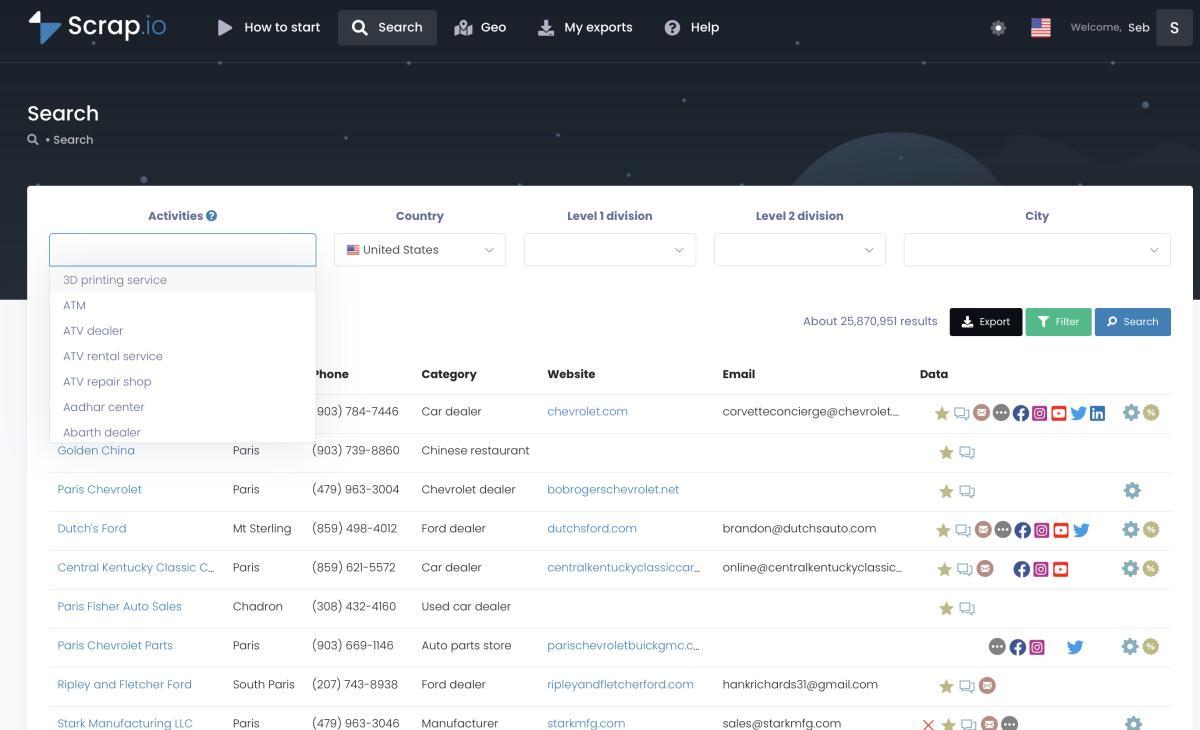
Now put the scope side by side. ZoomInfo maps the corporate world: LinkedIn profiles, org charts, @company.com emails. Scrap.io indexes 225,676,406 businesses across 195 countries and 4,000+ categories, updated in real time at the moment you export. Different universe entirely. Where ZoomInfo sees a blank space (the roofer, the clinic, the family restaurant), Scrap.io sees a full record with phone, email, reviews, and socials.
And unlike traditional scraping tools, Scrap.io lets you filter before extraction, by category, location, rating, reviews, even email type. No wasted credits on irrelevant leads. Toggle "has an email" and you only spend a credit on businesses that actually have one.
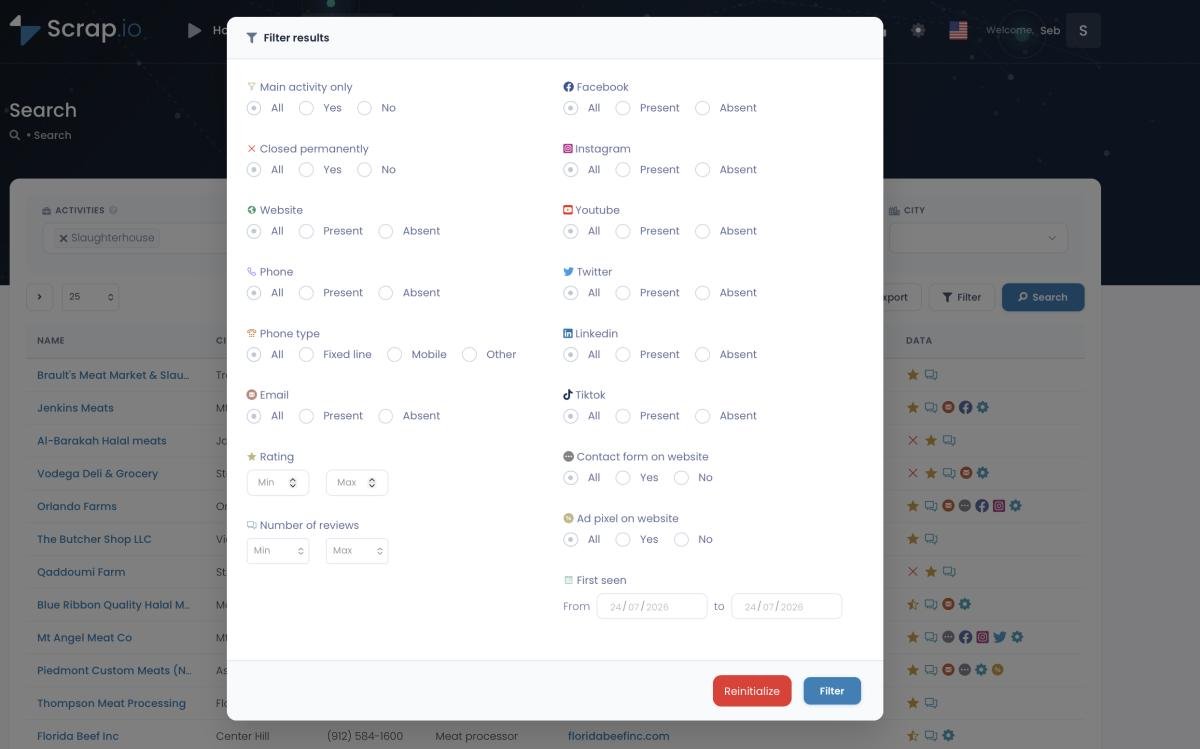
(Oh, and also, the email classification is genuinely useful. It separates individual emails from generic contact@, sales@, and marketing@ addresses. That alone saves hours of manual sorting.)
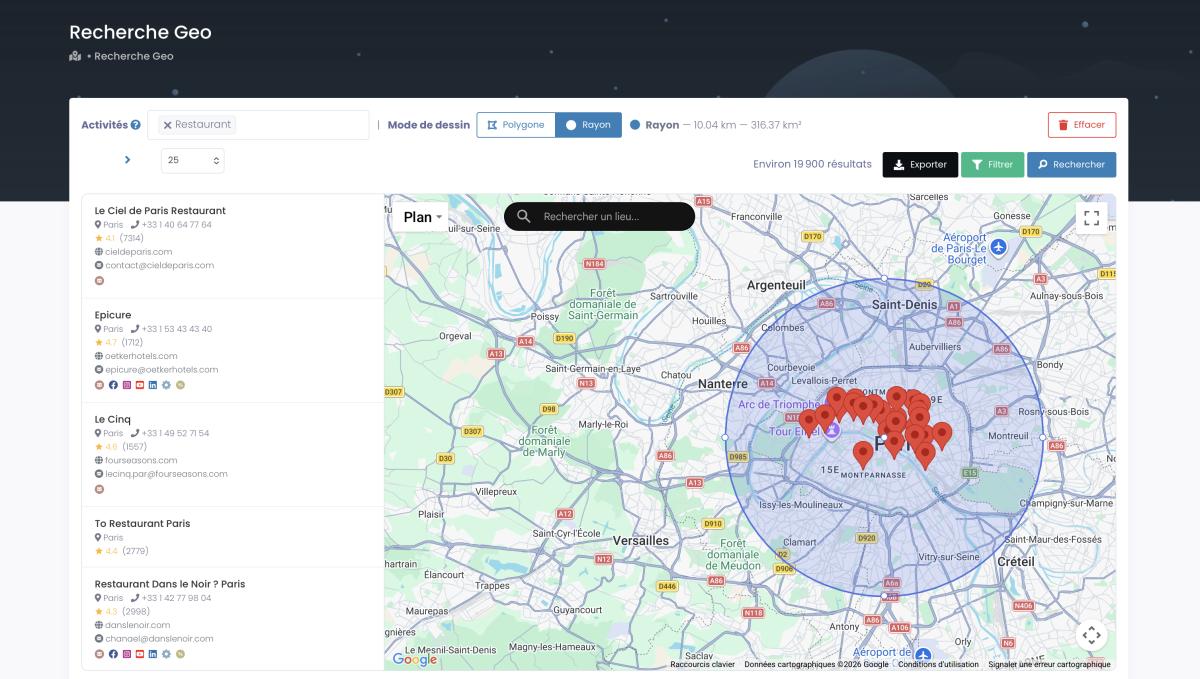
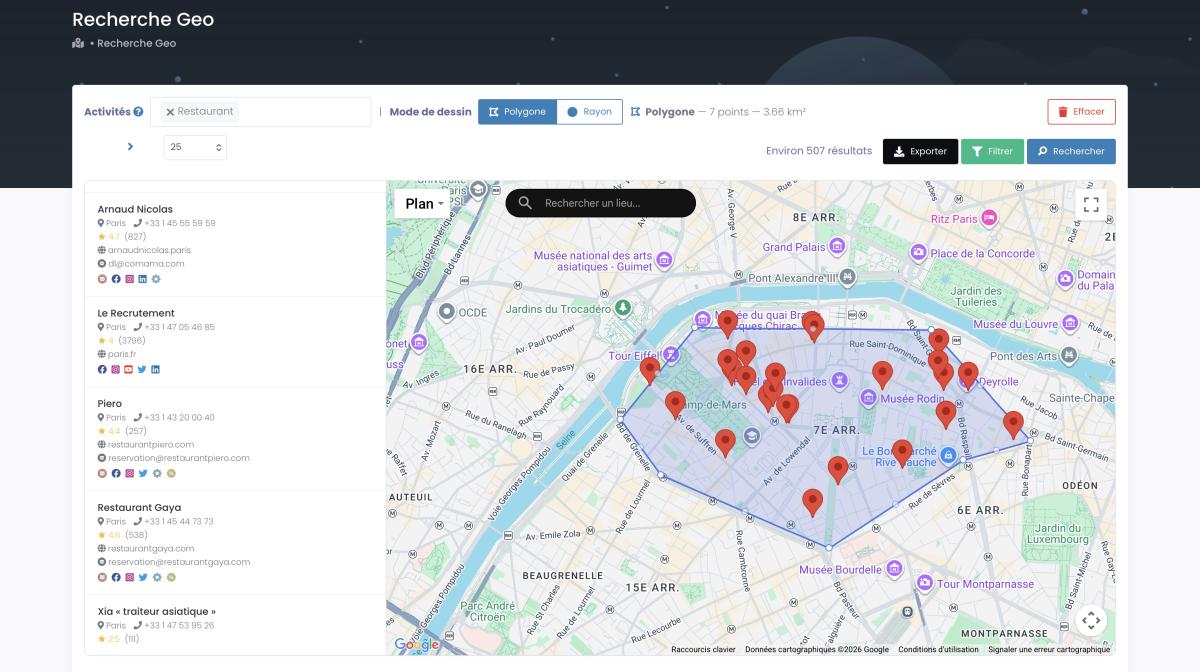
GeoSearch deserves a mention too. Draw a polygon on a map or set a radius, and pull every matching business within that zone. Try doing that with ZoomInfo. I'll wait.
For ops teams and AI-forward companies, Scrap.io offers both a full REST API and an MCP connector for AI agents (Claude, ChatGPT, Gemini). Plans start at $35/month on annual billing, with a 7-day trial that includes 100 free export credits.
Rated 4.9/5 on G2, 4.8 on Capterra, 4.5 on Trustpilot. Used by 50,000+ professionals including teams at Revolut, Amazon, Uber, and Airbnb. GDPR and CCPA compliant, public business data only. Not sure where to start? This two-minute onboarding walks you through your first export.
Video: Scrap.io, How to Start?
Best for: Agencies, local service providers, real estate, restaurants, and anyone whose prospects live on Google Maps rather than LinkedIn. A true zoominfo replacement for local business data. Also check out our guides on how to scrape Google Maps, B2B lead generation platforms, and data enrichment tools.
Try Scrap.io free: 7-day trial, 100 leads included. Pull every business in your city from Google Maps, filtered to only the ones with an email, in two clicks. Start your free trial →
7. Kaspr, Best for LinkedIn Prospecting
Kaspr lives inside LinkedIn. Literally. The Chrome extension pulls phone numbers and emails directly from LinkedIn profiles as you browse. No tab switching, no separate platform, no friction.
Free tier available. Paid plans are affordable. The data quality on European contacts is surprisingly strong. Kaspr is French-built, so the EU data tends to be fresher than what US-first platforms offer.
The limitation? It's LinkedIn-dependent. If your prospecting doesn't happen on LinkedIn, Kaspr won't help much. But if it does, this is one of the smoothest experiences out there.
Best for: Sales reps and recruiters who live on LinkedIn and want contact data without leaving the platform.
8. SalesIntel, Best for Human-Verified Data
Here's a stat that should make you think. AlleyOop reported a 35% connection rate with SalesIntel data versus 16% with ZoomInfo. More than double.
Why? SalesIntel's data is 95% human-verified. Actual researchers check and re-verify contacts every 90 days. It's slower to scale than AI-scraped databases, but the accuracy shows in the results.
Best for: Teams where data accuracy directly impacts revenue, think high-ticket B2B sales where a wrong number means a lost deal worth thousands.
9. Seamless.AI, Best for AI-Powered List Building
Seamless.AI works like a real-time search engine for B2B contacts. Type in your criteria, and it crawls the web to find and verify contact info on the spot, not from a static database, but from live sources.
The AI-powered recommendations surface lookalike prospects based on your best customers. High-volume list building becomes fast. Almost too fast. (The quality can vary, so verify before blasting.)
Best for: SDR teams building large prospecting lists quickly who can tolerate some data cleanup in exchange for speed and volume.
10. Clay, Best for Advanced Workflow Automation
Clay isn't a database. It's a data orchestration layer. Brutal distinction, but an important one.
It pulls from 50+ data sources using waterfall enrichment, meaning if Source A doesn't have the email, it tries Source B, then C, then D. The enrichment rates are consistently higher than any single provider, ZoomInfo included. That's why the zoominfo vs clay debate keeps coming up in RevOps circles, and why so many zoominfo pricing reddit threads end with someone recommending Clay for the enrichment layer.
But Clay is a power tool. The learning curve is real. If you're a RevOps team comfortable with formulas, integrations, and building custom workflows, Clay is absurdly powerful. If you just want to look up a phone number, it's total overkill.
Best for: RevOps teams, growth engineers, and anyone who thinks in workflows rather than simple lookups.
ZoomInfo Alternatives Pricing Comparison (2026)
Here's what actually matters. Side by side.
| Tool | Starting Price | Free Tier | Best For |
|---|---|---|---|
| ZoomInfo | $14,995/year | No | Enterprise sales teams |
| Apollo.io | $49/month | Yes | Startups, SMB outbound |
| Cognism | ~$22,500/year | No | European prospecting |
| Lusha | $22/month | Yes (5 credits) | Quick lookups |
| Lead411 | $75/month | No | Intent data on a budget |
| RocketReach | $33/month | No | Pay-per-lookup |
| UpLead | $99/month ($74 annual) | 7-day trial (5 credits) | 95% accuracy guarantee |
| Scrap.io | $35/month | 7-day trial (100 leads) | Local business data |
| Kaspr | Free / $49/month | Yes | LinkedIn prospecting |
| SalesIntel | Custom | No | Human-verified data |
| Seamless.AI | Custom | Limited | AI list building |
| Clay | $134/month | Limited | Workflow automation |
ZoomInfo starts at $14,995/year. Apollo.io starts at $588. Let that gap sink in.
If you're hunting for free zoominfo alternatives 2026 or tools like zoominfo but cheaper, the table speaks for itself. Every tool on this list except Cognism, UpLead, and SalesIntel comes in under $1,200/year for basic plans. Some are literally free. And if ZoomInfo's price tag is making you search for cheaper alternatives to zoominfo, you're not alone. It's one of the most common searches in sales communities right now.
50,000+ users already extract Google Maps data with Scrap.io. See why →
Need help building your email lists the right way? Check our guide on buying B2B email lists.
How to Choose the Right ZoomInfo Alternative
Forget feature matrices. Start with your use case.
Selling to enterprise accounts with big budgets? Cognism. The GDPR compliance and phone-verified mobiles justify the enterprise price tag, especially for EU markets.
Running outbound at a startup or SMB? Apollo. The free tier alone covers what many small teams need. The paid plans scale without the sticker shock. Already on a similar tool like Snov.io and hitting its ceiling? Our Snov.io alternatives breakdown maps the same territory from a different angle.
Prospecting local businesses? Scrap.io. Full stop. No other tool on this list indexes 225M+ businesses from Google Maps with the filtering depth Scrap.io offers. If your prospects are on Maps, not LinkedIn, this is your answer.
Just need a phone number, fast? Lusha. Install the extension, get the data, move on.
Want intent signals without enterprise pricing? Lead411. Bombora data at $75/month is hard to argue with.
Building complex enrichment workflows? Clay. But only if your team can handle the learning curve. Seriously.
So, what is the best alternative to zoominfo? Depends on who's asking. A 5-person startup and a 500-person enterprise have fundamentally different needs. The best zoominfo alternatives for small business won't be the same tools that serve Fortune 500 sales floors.
The days of one platform fitting every team are over. And honestly, that's a good thing. The best b2b data provider alternatives in 2026 are specialized. They do one thing exceptionally well rather than everything adequately. For more on the tool landscape, see our breakdown of AI sales tools and cold email tools.
The Angle Nobody Talks About: Google Maps as a B2B Data Source
Google Maps indexes over 200 million businesses worldwide.
Read that again. Two hundred million. Updated by business owners themselves. Verified by Google. Free for anyone to see, but painful to extract manually.
Here's where the conversation about zoominfo alternatives usually goes wrong. Everyone compares databases of corporate contacts: who has more emails, more direct dials, more technographic data. That's fine for enterprise sales. But it completely ignores a massive segment of the market. If you want the wider version of this argument, our guide to business database search tools and similar company finders lays out why live location data beats a frozen file.
Local businesses. Service companies. Multi-location franchises. Restaurants, clinics, agencies, contractors. These businesses don't show up in ZoomInfo's database, or if they do, the data is thin. But their Google Business Profiles? Rich with information. Phone numbers, websites, hours, reviews, categories, even photos.
And the targeting goes way past a city name. Set a radius around any point on the map, and pull every matching business inside it.
Or draw a custom polygon around an industrial park, a downtown core, or a single neighborhood that doesn't follow neat administrative lines. Every filter still applies inside the shape.
The difference between google maps data vs zoominfo comes down to this: ZoomInfo maps the corporate org chart. Google Maps maps the real-world business landscape. Different data. Different use cases. Both valuable.
Scrap.io bridges that gap. It takes raw Google Maps data and structures it for prospecting, with email enrichment, category filtering, and geographic targeting built in. Agencies use it to find local clients at scale. Real estate teams pull property-adjacent businesses. Service companies identify prospects within specific radiuses. If you need a true zoominfo replacement for local business data, this is the only platform purpose-built for the job.
Anyway, the point isn't that Google Maps replaces ZoomInfo. It doesn't. But for 50,000+ professionals, it fills a gap that traditional sales intelligence tools completely miss. If you've been paying enterprise prices for local business data, that should bother you.
For more on this approach, check out our complete Google Maps scraping guide, our email validator guide, and our comparison of B2B lead generation platforms.
FAQ
Is there anything better than ZoomInfo?
Better is relative. For SMB outbound, Apollo.io matches most of ZoomInfo's functionality at a fraction of the cost. For European prospecting, Cognism outperforms ZoomInfo on EU data quality and GDPR compliance. For local business data, Scrap.io covers a segment ZoomInfo barely touches. The best b2b contact database alternatives depend entirely on your specific use case, not on which platform has the biggest database.
Is there a free alternative to ZoomInfo?
Yes, a few. Apollo.io has a genuinely usable free tier. Lusha gives 5 free credits a month. Scrap.io offers a 7-day free trial with 100 export credits included. None of these match ZoomInfo's full database for free, but for most SMB and local use cases, they cover the job without spending a dollar upfront.
What is the cheapest ZoomInfo alternative?
Apollo.io and Lusha both offer functional free tiers. Paid plans start at $49/month (Apollo) and $22/month (Lusha). Scrap.io starts at $35/month on annual billing with a 7-day free trial. Compare that to ZoomInfo's $14,995/year minimum. If you're searching for tools like zoominfo but cheaper, the savings are dramatic.
Can I get ZoomInfo data for free?
ZoomInfo offers a Community edition where you contribute your contacts in exchange for limited access. Apollo and Lusha both have free tiers with no data-sharing requirement. Scrap.io offers a 7-day trial with 100 export credits. None of these match ZoomInfo's full database for free, but they cover most use cases without spending a dollar.
What is the lawsuit against ZoomInfo?
ZoomInfo has faced right-of-publicity litigation in the US. In Ramos et al. v. ZoomInfo Technologies, the company agreed to a settlement of roughly $29.5 million over claims that it used people's names and profile details to promote paid subscriptions in states including California, Illinois, Indiana, and Nevada (official settlement site). ZoomInfo denied wrongdoing and settled to avoid further litigation. If you need current legal status, check the official filings directly, since these cases evolve.
Is ZoomInfo outdated?
Not outdated, but no longer the default. ZoomInfo still runs one of the deepest corporate databases for enterprise sales, with intent data and org charts that smaller tools can't match. What's changed is the competition: leaner, cheaper, more specialized tools now beat it in specific niches. For local data, EU compliance, or tight budgets, it's often the wrong pick. For large sales orgs with dedicated ops teams, it still earns its place.
How much will ZoomInfo cost in 2026?
Expect a floor around $14,995/year for entry-level access, with most real-world contracts landing in the $30,000 to $40,000 range once you add seats, credits, and features. Renewals typically climb 10-20% year over year. Public pricing isn't published, so the exact number depends on negotiation, but budget five figures at minimum.
Who are ZoomInfo's biggest competitors in 2026?
Apollo.io, Cognism, Lusha, Lead411, and Scrap.io represent the strongest zoominfo competitors across different segments. Apollo dominates on value. Cognism leads in EU data. Scrap.io owns the local business niche. The market has fragmented. No single competitor matches ZoomInfo feature-for-feature, but specialized tools outperform it in their respective categories.
Is ZoomInfo worth it for small businesses?
At $15,000 to $40,000 per year? For teams under 10 people? Almost never. That's money better spent on a combination of Apollo (outbound + CRM), Scrap.io (local data), and Lusha (quick lookups), all for under $2,000/year combined. ZoomInfo makes sense for large sales orgs with dedicated ops teams. For everyone else, it's overkill. And honestly, "zoominfo too expensive what to use instead" is one of the most common searches in sales communities for a reason.
Conclusion
The ZoomInfo tax is optional now. It wasn't three years ago. It is today.
If you're selling to enterprises and have the budget, ZoomInfo still works. Nobody's pretending otherwise. But most teams reading this article aren't in that position. They're the 8-person startup paying $32K for data they could get from Apollo at $49/month. They're the agency paying enterprise rates when their actual prospects, local businesses, aren't even in ZoomInfo's database.
The smartest move isn't switching to the biggest competitor. It's picking the right tool for your specific prospecting workflow. Maybe that's Apollo for outbound sequences. Maybe it's Cognism for EU compliance. Maybe it's Scrap.io for the local business data that traditional lead generation software ignores entirely.
Your renewal is coming. Before you sign, give Scrap.io 7 days. 100 leads on the house, pulled live from 225M+ businesses across 195 countries. Start your free trial →
And if you're building your prospecting stack from scratch, don't forget to verify your email lists before hitting send.
Generate a list of restaurant with Scrap.io