

Your credits vanish in week two. Your warm-up tool goes quiet for three days. Half your "verified" emails bounce anyway. Sound familiar?
If you're reading this, you've probably already hit the wall with Snov.io and you're shopping for something better. Good. There's plenty out there. But here's the part that every "best snov.io alternatives" list gets wrong, and I'll be honest with you about it up front: they all compare tools pulling from the exact same well. Corporate databases and LinkedIn. Apollo, Hunter, RocketReach, Cognism — same source, different logo.
Meanwhile the businesses a lot of you actually want to reach — the dentist, the roofer, the boutique agency down the street — aren't on LinkedIn at all. They're on Google Maps. And almost nobody talks about that source. So we'll fix that here: ten real Snov.io alternatives ranked by what they're actually good at, honest pricing, honest limits, and one pick that plays a completely different game.
Video: Scrap.io vs Apollo — Which Tool for Which Type of Prospecting
Why teams leave Snov.io in 2026
Snov.io isn't a bad product. Let's get that out of the way. It bundles an email finder, a verifier, a browser email finder extension (the snov io extension a lot of reps live in), drip campaigns, and a lightweight CRM into one dashboard, and for a three-person team on a budget that combo genuinely makes sense. Starter plans run around $30–39/month for 1,000 credits and 5,000 recipients; the Pro tier climbs from $99 all the way to $554/month as your volume grows (Snov.io/Saleshandy, 2026). Reasonable on paper.
So why do people leave? Three reasons keep surfacing on G2, TrustRadius, and the cold-email corners of Reddit.
The credits burn even when you miss. This is the big one. You spend a credit whether the tool actually finds a usable contact or not. Search for a local business that isn't in the database, get nothing, still pay. Do that a few hundred times a month and the math stops being cute.
Deliverability wobbles. The warm-up feature goes silent for stretches, bounce rates spike the moment you scale volume, and shared IP reputation drags your sending down with everyone else's. One user on r/b2bmarketing laid out exactly this trade-off between Snov.io's email + LinkedIn sequences and the competition. And the LinkedIn automation everyone wants? It's an add-on — roughly $69/month per slot. Costs stack fast.
The database has a blind spot. Snov.io leans corporate. Great for a SaaS VP with a company domain. Useless for the plumber whose only web presence is a Google Maps pin and a Facebook page. A whole thread on r/Emailmarketing asking for a Snov.io alternative circled the same frustration — the tool can't see the leads some of us actually need.
Three different problems. And here's the thing most people miss: they need three different fixes. A low hit rate is not the same as bad deliverability, which is not the same as missing local data. Swap tools blindly and you'll just inherit a new version of the same headache.
If your real problem is which businesses you can even find — not deliverability, not sequencing — keep reading. There's a data source most of these lists skip entirely, and it's the one built for local leads. See what Scrap.io pulls from Google Maps →
What to look for in a Snov.io alternative
Before you swap one tool for another, ask the uncomfortable question: what exactly is Snov.io failing you at? Because the answer decides everything. Here's the grid I'd use.
Data source. Corporate database, LinkedIn, or Google Maps? This is the fork in the road. If your prospects have a company domain, a database tool works. If they're local businesses, you need a different well entirely.
Hit rate, not database size. "275 million contacts" sounds huge until 40% of the emails bounce. Single-source enrichment lands somewhere around 40–60% valid; a waterfall approach chaining multiple providers hits 85–95% (SyncGTM, 2026). Big number, small truth.
Deliverability. Warm-up quality, dedicated vs shared IPs, sending caps. What's the point of finding an email if it lands in spam?
Filtering before you pay. Can you narrow results — has an email, has a mobile, minimum rating — before a credit gets spent? Most tools make you pay first, filter never.
Compliance. GDPR and CCPA, and not just a badge on the pricing page. Where does the data actually come from?
Bookmark that list. It's the same framework the "how to choose" section at the bottom leans on, and it's how you match a tool to the best lead generation software for your bottleneck instead of the loudest one on a listicle.
The 10 best Snov.io alternatives
There's no single "best" Snov.io alternative. There's a best one for your bottleneck. So instead of ranking these by some made-up composite score, I've matched each to the specific Snov.io pain it fixes — with real 2026 pricing and an honest note on where it falls short.
1. Apollo.io — Best all-in-one database
Apollo.io is the tool most people mean when they say "Snov.io but bigger." 275M+ contacts across 73M companies, built-in sequencing, a dialer, email verification. Basic runs $49/month, Professional lands around $79–99/user/month (Apollo/SyncGTM, 2026). Fixes the volume problem Snov.io has for US corporate prospecting.
The catch: it's still one database, and accuracy on SMBs drops off a cliff. Try finding a Nashville roofing contractor in there. You won't. If Apollo itself starts feeling stale, we keep a full breakdown of the best Apollo.io alternatives too.
2. Hunter.io — Best pure email finder
Hunter.io does one thing and does it cleanly: give it a domain, get back every email pattern on that domain, verified at over 95% accuracy on most domains tested (Modern Inbound/SyncGTM, 2026). Free tier is 25 searches a month; Starter is $34/month. Fixes Snov.io's accuracy problem for domain-based lookups.
The limit? No phones, no intent data, no local businesses — it needs a domain to exist. For the local gap specifically, there's a dedicated Hunter.io alternative for local leads that reads Google Maps instead.
3. Instantly — Best for high-volume cold email
Instantly is for people who send a lot of email. Unlimited sending accounts, a private warm-up network spanning 500,000+ inboxes, from around $30–37/month (Modern Inbound, 2026). Fixes Snov.io's deliverability problem head-on. Teams that switched report a 10–20% lift in inbox placement.
It's a sending platform, though — not a finder. You bring the leads. Pair it with a data source and it sings. It's one of the best cold email tools for pure volume, and if you're running the classic lemlist vs Instantly debate, this is the volume side of it. The agency Modern Inbound ran a 90-day test switching clients off Snov.io and booked 3,000+ meetings, with migration taking one to two weeks and warm-up 14–21 days. Not instant. But the deliverability payoff was real.
4. Lemlist — Best for personalization
Lemlist wins one category outright: making emails feel handmade. Dynamic images, personalized video thumbnails, custom landing pages per recipient. Around $39/month to start. If your reply rates are dying because everything reads like a template, this is your fix.
The trade-off is cost per email and a learning curve. Overkill if you just need to blast a clean list.
5. Reply.io — Best multichannel sequencer
Reply layers email, LinkedIn, calls, and SMS into one cadence, with AI helping draft the steps. Solid for teams who want every channel firing from a single dashboard — the thing Snov.io charges an add-on for. Plans start around $59/month.
Honestly? It's a lot of tool. If you only do email, you're paying for cabins you'll never sleep in.
6. RocketReach — Best for global coverage
When you need to find one specific decision-maker at one specific company and everything else came up empty, RocketReach's 700M+ profiles are the backup. Free tier gives 5 lookups a month; paid runs Essentials $399/year, Pro $899/year (email + phone), Ultimate $2,099/year (2026).
Accuracy is decent, not stellar. A reliable second string, not a starter.
7. Lusha — Best for quick LinkedIn lookups
Lusha lives in your browser. You're on a LinkedIn profile, click the extension, and there's the direct dial and email. Free tier is 50 credits/month, Pro is $36/user/month (SyncGTM, 2026). Perfect when you need a number in three seconds.
Not built for bulk. And like the rest of this cluster — LinkedIn only, so local businesses stay invisible.
8. Cognism — Best for GDPR-compliant European data
Selling into Europe? Cognism is the safe bet. Phone-verified mobiles, strong UK/DACH/Nordics coverage, GDPR compliance as the entire brand identity. Enterprise pricing, so not for bootstrapped teams — but for EU outbound where a compliance slip costs 4% of revenue, it earns its keep. It slots into the same category as the big ZoomInfo alternatives if you're weighing enterprise databases.
9. Woodpecker — Best for agencies watching deliverability
Woodpecker is quietly obsessed with getting email delivered. Adaptive sending, built-in verification, agency-friendly account management. Not flashy. But agencies running dozens of client campaigns lean on it precisely because it stays boring and reliable. From around $29/month.
Thin on personalization compared to Lemlist. Trade-off, as always.
10. Scrap.io — Best for local leads Snov.io can't see
And now the odd one out. Every other tool on this list makes you bring data before it gives data back — a name, a domain, a LinkedIn URL. Scrap.io doesn't work that way at all. You pick a business category from 4,000+ options, pick a location, and it pulls every matching business straight off Google Maps in real time.
225,676,406 establishments indexed across 195 countries. Each lead ships with classified emails, phone numbers tagged mobile or fixed, social profiles, ratings, hours, website tech. And filters apply before a credit is spent — the exact answer to Snov.io's "burned a credit on a miss" complaint. Plans start at $35/month (annual) for 10,000 credits. More on why this one deserves its own section below.
Honorable mentions and the Chrome extension question
Two more worth naming. UpLead deserves a comparison mention if you want a mid-sized US database with a strict verified-only guarantee — leaner than Apollo, pricier per contact, but the bounce protection is nice. And a lot of you searching for a snov.io alternative without LinkedIn friction really just want a browser tool: a good email finder extension or linkedin email finder extension that surfaces a contact right on the page. Snov.io, Hunter, and Lusha all ship one. Handy for one-off lookups, useless for building a list of 3,000 local businesses. Pick the extension for speed, the platform for scale.
So which is the best email finder for cold email in 2026? Wrong question. There's the best one for corporate domains (Hunter), the best for a big database at a fair price — the snov.io vs apollo matchup usually lands on Apollo there — and the best for local. If you mostly need something cheaper than Snov.io that still finds the right people, the answer is almost always "the one that matches your data source," not the one with the flashiest feature list.
Side-by-side comparison
The cheapest tool isn't always the cheapest — not once you factor in bounces and credits torched on misses. Here's everything lined up. Skim it.
| Tool | Fixes which Snov.io pain | Starting price | Data source | Free tier |
|---|---|---|---|---|
| Snov.io | (baseline) | $30–39/mo | Corporate + LinkedIn | 50 credits |
| Apollo.io | Database size | $49/mo | Proprietary B2B | Yes |
| Hunter.io | Email accuracy | $34/mo | Domain crawling | 25/mo |
| Instantly | Deliverability | $37/mo | Sending platform | Trial |
| Lemlist | Personalization | $39/mo | Sending platform | Trial |
| Reply.io | Multichannel | $59/mo | Sequencer + DB | Trial |
| RocketReach | Global coverage | $399/yr | 700M+ profiles | 5/mo |
| Lusha | Quick lookups | $36/user/mo | LinkedIn + proprietary | 50/mo |
| Cognism | EU / GDPR data | Custom | Proprietary EU | No |
| Woodpecker | Agency deliverability | $29/mo | Sending platform | Trial |
| Scrap.io | Missing local data | $35/mo | Google Maps (225M+) | 7-day trial (100 leads) |
One thing jumps out when you read down the "data source" column. Nine of these eleven tools pull from the same two places: corporate databases and LinkedIn. You and your competitors are emailing the identical people. That's not an edge — that's a spam party. Which brings us to the exception.
The alternative nobody lists: local leads on Google Maps
Every list compares the same tools pulling from the same place. But the local businesses you want — the dentist, the roofer, the boutique agency — aren't on LinkedIn. They're on Google Maps, phone number and email and reviews all sitting right there in the open. And almost no "Snov.io alternatives" roundup mentions it.
That's the gap Scrap.io fills. Instead of crawling websites to find people, it crawls Google Maps to find businesses. Here's why that matters in practice.
The source Snov.io simply doesn't have. Scrap.io extracts local establishments Google Maps knows about but LinkedIn never will. If your ICP has a physical location, this is the well nobody else is drawing from.
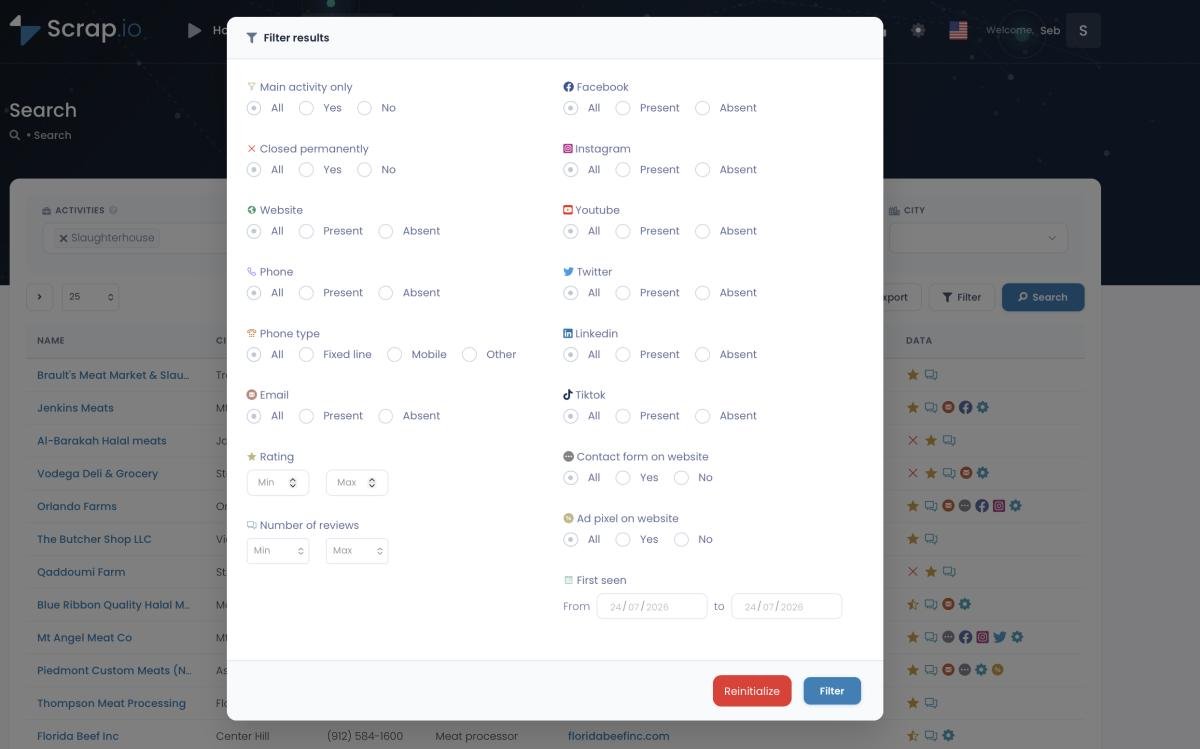
Filter before extraction — zero wasted credits. Remember the "burned a credit on a miss" complaint? Gone. You toggle filters — email present, has a website, minimum rating, mobile number only — before a single credit gets consumed. You only pay for contacts you can actually use.
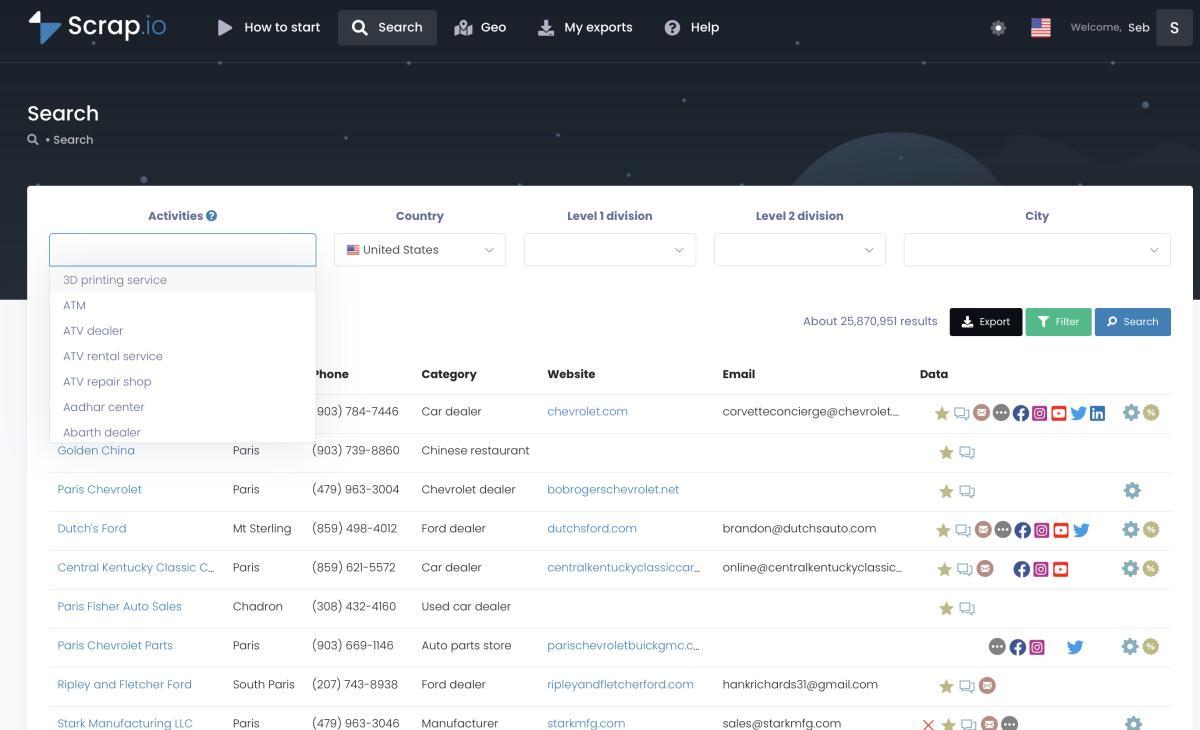
Fresh data, whole country in two clicks. No frozen database from last quarter. Every export pulls in real time, updated at the moment you extract, from a city up to an entire country — no code. One SMMA agency pulled 11,734 businesses in 45 minutes with verified emails, phones, and socials attached. Try that in Sales Navigator. I'll wait.
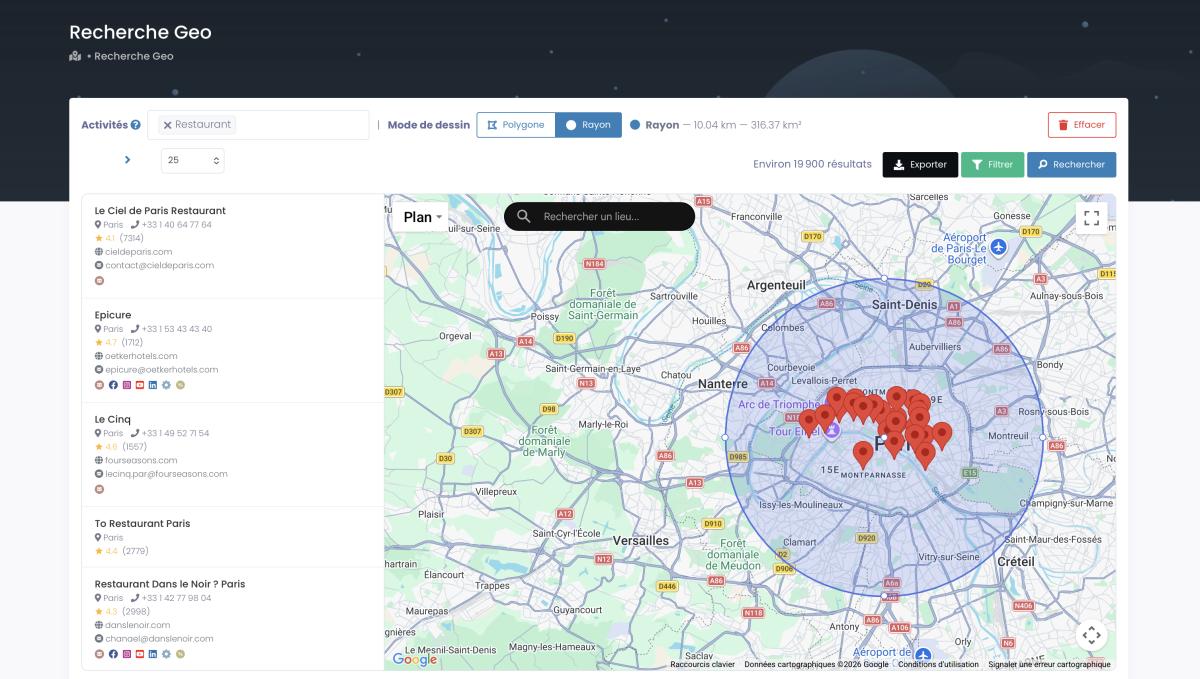
And the geographic targeting goes further than any administrative boundary. Set a radius around a point on the map, or draw a custom polygon around a specific neighborhood, industrial park, or commercial strip. Every filter still applies inside it.
Now, let me be straight with you, because the whole point of this article is honesty. Scrap.io is not a like-for-like Snov.io swap. It won't hand you the corporate email of a VP at a 500-person SaaS company — that's Apollo's or Hunter's job, and you should keep one of them for that. Scrap.io is complementary. Same cold-email workflow, different source: it outputs classified emails plus phone plus social links, ready to drop into whatever sending tool you already run. If your gap is local and SMB, nothing else here competes.
Worried about "I do cold email, not Maps scraping"? Doesn't matter. The output is a clean list with an email column, a phone column, and social columns. Your outreach tool can't tell where the data came from. Rated 4.8 on Capterra and 4.9 on G2, GDPR and CCPA compliant, public business data only — traceable to source.
Video: Scrap.io — How to Start
See it for yourself. Pull every restaurant in your city from Google Maps, filtered to only the ones with an email, in two clicks. 225M+ businesses across 195 countries, filtered before you spend a credit. Start your free Scrap.io trial — 100 export credits included →
If you want to go deeper on the mechanics, here's the full walkthrough on how to find emails on Google Maps. And since Scrap.io also enriches records you already have, it doubles as one of the more unusual data enrichment tools around — matching your CRM against Maps by Place ID, phone, or domain.
Where does the email finder comparison land?
People ask how a Maps-based tool stacks up against a classic email finder like Skrapp or Snov.io head-to-head. Short version: different source, different job. This tutorial breaks down the difference better than another paragraph from me would.
Video: Skrapp.io vs Scrap.io (Tutorial)
How to choose the right Snov.io alternative
Match the tool to the failure. That's the whole framework. Low hit rate, bad deliverability, and missing local data are three different problems — stop treating them as one.
So, walk the decision:
- Snov.io's finding corporate emails but the accuracy's shaky? Hunter.io for domain precision, or Apollo for a bigger database.
- Your emails land in spam no matter how clean the list is? That's deliverability. Instantly or Woodpecker.
- You need a bigger, deeper B2B database for enterprise selling? Cognism (EU) or a heavyweight from the ZoomInfo tier.
- You can't find the local businesses you're targeting at all? That's a source problem, and only one fix exists here: Scrap.io and its Google Maps data.
Most sharp teams end up running two tools, not one. Something for corporate contacts, something for local. There's no rule that says your stack has to be monogamous. And whichever you pick, do this before your first send: run the list through an email verifier. Bounce rates above 2% torch your sender reputation faster than any tool can save it.
Compliance: GDPR & CCPA
Nobody else in these roundups talks about this. They should. If you're prospecting into the EU or California, the legal basis for your data isn't optional — it's the floor.
Good news for B2B: publicly available business contact information is treated very differently from personal data. Under GDPR, outreach to business contacts pulled from public sources typically rests on the "legitimate interest" basis in Article 6 — provided every email carries a working opt-out. Non-negotiable, that last bit. CCPA carves publicly available business information out of its scope almost entirely.
The practical takeaway: favor tools that source from public business data and can trace each record to where it came from. Scrap.io only extracts public business data and is GDPR and CCPA compliant — but the compliance still sits with you. Keep the opt-out running, document your basis, and send responsibly.
FAQ
What is the best Snov.io alternative in 2026?
It depends on your bottleneck. Apollo.io for a huge database (275M+ contacts), Hunter.io for email precision, Instantly for high-volume cold email deliverability, and Scrap.io for the local businesses missing from LinkedIn — the Google Maps source most lists forget. There's no universal winner, only the right fix for the specific thing Snov.io is failing you at.
Is there a free Snov.io alternative?
Yes, several with free tiers. Hunter.io gives 25 free searches a month, Apollo and Lusha both have free plans (Lusha at 50 credits/month), and Scrap.io offers a 7-day free trial with 50 searches and 100 export credits. Snov.io's own trial runs on 50 credits. Free tiers are for testing, not for running real campaigns at volume.
Snov.io vs Hunter.io — which is more accurate?
Hunter.io tends to score higher on domain-based email accuracy, verifying at over 95% on most domains tested. Snov.io is the broader all-in-one — finding, verification, and sending in a single dashboard. If raw email precision is your priority, Hunter wins; if you want one tool that also sequences campaigns, Snov.io covers more ground.
What's the cheapest Snov.io alternative?
Instantly starts around $30/month for sending and Hunter.io at $34/month for finding. For local B2B specifically, Scrap.io Basic is $35/month (annual) for 10,000 export credits — which works out to well under a cent per lead. Cheapest per usable lead beats cheapest sticker price every time.
Can I find local business leads with a Snov.io alternative?
Snov.io and most of its rivals pull from corporate databases and LinkedIn, so local SMBs — plumbers, restaurants, clinics, agencies — slip through the cracks. To reach them, use a Google Maps source like Scrap.io: 225M+ establishments across 195 countries, filtered by email, phone, or website presence before you spend a credit. Different source, same cold-email workflow.
The bottom line
Leaving Snov.io isn't really about finding a better clone. It's about naming the actual problem first, then picking the tool built for it. Accuracy? Hunter. Volume? Apollo. Deliverability? Instantly or Woodpecker. Europe? Cognism. And the local businesses hiding in plain sight on Google Maps that none of the others can see? That's Scrap.io, and it's the one nobody else on these lists will tell you about.
Most teams win by running two: one for corporate, one for local. No overlap, maximum reach.
Try Scrap.io free for 7 days — 50 searches plus 100 export credits, no commitment. Pick a category, pick a location, and pull local leads from 225M+ businesses across 195 countries that Snov.io and its clones simply can't reach. Start your free trial →
Generate a list of restaurant with Scrap.io