

📋 What's in This Guide
- Why 70% of Cold Emails Die After the First Send
- Cold Email Follow Up Benchmarks in 2026
- The Optimal Follow-Up Sequence: Timing, Spacing & Structure
- 5 Cold Email Follow Up Templates That Get Replies
- Real Campaigns, Real Results: Follow-Up Case Studies
- 7 Follow-Up Mistakes Killing Your Reply Rate
- Technical Setup: Deliverability Essentials for 2026
- Is Cold Email Follow Up Legal? CAN-SPAM & GDPR
- FAQ
70% of cold emails never get a single follow-up. That's not a typo. Seven out of ten salespeople send one email, hear nothing back, and just move on. Meanwhile the people who actually follow up? They're closing deals, booking meetings, and wondering why everyone else makes it look so hard.
I know this guy. Let's call him Jake. Jake sells B2B software. He spent two weeks crafting the perfect cold email. Great subject line. Personalized opening. Killer value proposition. He sent it to 500 prospects. Got 8 replies. Then he sat there refreshing his inbox like it was going to magically produce more responses. Spoiler: it didn't.
Here's what Jake didn't know. 80% of sales require at least 5 follow-up touches according to IRC Sales Solutions. His one-and-done approach was basically leaving money on the table. A lot of money.
So how do you follow up on a cold email without being annoying, desperate, or completely ignored? That's exactly what we're covering. The sequences. The timing. The templates. The stuff that actually works in 2026.
Let's get into it.
Why 70% of Cold Emails Die After the First Send
According to Backlinko's cold email study, 70% of cold email chains stop after the first message. Zero follow-up. Nothing. And yet the data shows something wild: your first email generates roughly 58% of total replies, but follow-ups account for the remaining 42%. That's almost half your potential responses sitting in a pile of emails you never sent.
Even crazier? 93% of cold email chains end after Email 1. That's basically everybody giving up at the starting line.
Think about that for a second. If you're the person who actually sends a second, third, or fourth email, you're competing against almost nobody. The field is wide open. Most of your competitors already quit.
The problem isn't that prospects don't want to hear from you. The problem is they're busy. They saw your email while waiting for coffee, thought "I'll reply later," and then forgot about it completely. That's just how inboxes work now. Everyone's drowning in messages.
Your follow-up isn't being pushy. It's being helpful. You're literally reminding someone about something they might actually need.
And this is where your data source quietly decides everything. If you're emailing people who moved companies six months ago, half your "no replies" are actually just dead addresses. This is one reason Scrap.io extracts B2B emails in real time from Google Maps instead of serving a frozen database. Fresher contacts mean fewer bounces, which means the replies you're chasing actually have somewhere to land. The starting point for all of it is a solid list, and here's a full walkthrough on how to build a cold email list that doesn't decay before you hit send. The video below breaks down why Google Maps emails so often get ignored, and what to fix first.
Video: Why Your Google Maps Emails Don't Get Replies?
Is cold email follow up still effective in 2026?
Yes, and the gap between senders who follow up and those who don't is widening, not shrinking. Follow-ups still generate roughly 42% of all cold email replies, and most competitors quit after one send. If you're not convinced the channel works at all, we settled that debate here: is cold emailing an effective strategy.
Cold Email Follow Up Benchmarks in 2026
Before we talk strategy, let's talk numbers. Because if you don't know what good looks like, you can't aim for it.
The average cold email reply rate sits between 3.4% and 5% according to Belkins and Instantly benchmarks. Down from 8.5% in 2019. Yeah, it's gotten harder. More people sending emails means more noise in every inbox.
But here's the good news. A single follow-up email increases replies by 49% to 65.8% according to Woodpecker's 2026 data. One extra email. That's it. And you almost double your responses.
It gets better. Lemlist's 2026 benchmark study found that campaigns with 4 to 7 emails get 3x more responses than campaigns with just 1 to 3 emails. Three times. For basically the same amount of work upfront.
Here's a framework I like to use: the 50/30/20 rule. 50% of your results come from list quality (are you emailing the right people?), 30% from your copy (is your message any good?), and 20% from timing (are you catching them at the right moment?). Most people obsess over copy and completely ignore list quality. That's backwards.
If your open rates are below 20%, you don't have a copy problem. You have a deliverability problem. Healthy campaigns should hit 60% to 70% open rates. Anything less means your emails aren't even reaching the inbox. And often the fix isn't the follow-up at all, it's the very first line: here's how to nail email subject lines that actually get opened.
There's a community consensus on this too. Over on Reddit, the recurring advice on how to follow up without being annoying is almost always the same: stop "checking in" and start adding something new each time. One r/agency thread documenting an agency's cold outreach lands on the blunt version of it, nobody replies to a reminder, they reply to a reason. Hard to argue with that.
Stale data quietly ruins your bounce rate, and your sender reputation with it. Scrap.io pulls B2B contacts in real time from Google Maps across 195 countries and 4,000+ business categories, so you're never emailing a list that decayed months ago. Free trial, 100 leads included.
The Optimal Follow-Up Sequence: Timing, Spacing & Structure
So you know you need to follow up. But when? How often? And when do you stop?
The sweet spot is 4 to 7 emails total in your sequence. Less than 4 and you're leaving replies on the table. More than 8 and spam complaints start spiking. Nobody wants that.
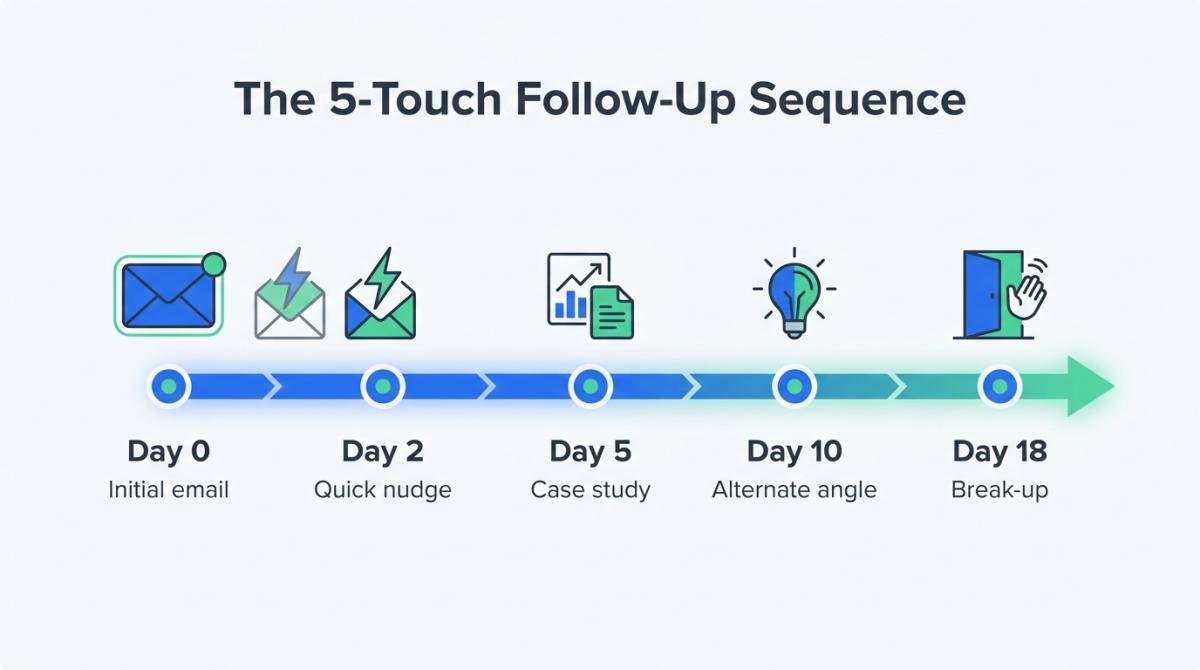
For spacing, think Fibonacci. Not exactly, but the principle works: start close together and spread out over time. Here's the cadence that works, laid out so you can steal it wholesale:
| Day | Email in the sequence | Job of this email |
|---|---|---|
| Day 0 | Initial email | Open the loop, no links |
| Day 2 | Follow-up 1, quick nudge | Surface back to the top |
| Day 5 | Follow-up 2, case study | Add social proof |
| Day 10 | Follow-up 3, alternate angle | Reframe the value |
| Day 18 | Break-up email | Trigger loss aversion |
Why this spacing? The 3-7-7 cadence captures roughly 93% of all replies by Day 10. After that, you're in diminishing returns territory. Each email after the third one sees about a 30% drop in effectiveness compared to the previous one. Still worth sending, but the big gains happen early.
The key insight: most replies come from emails 2 and 3. That's where the magic happens. If you're only sending one email, you're literally missing the window where most people would've said yes.
How long should you wait to follow up on a cold email?
Wait 3 to 4 business days before your first follow-up, then widen the gaps as the sequence goes on. Two days is fine for the very first nudge, but three to four gives a busy prospect time to surface without feeling chased. Space later emails 5 to 8 days apart, and cap the whole thing at 18 days.
How do you follow up without being annoying?
Add value, don't send a reminder. An annoying follow-up says "just checking in" and puts the work on the prospect. A welcome one hands them something new: a fresh stat, a competitor example, a relevant case study, a different angle on their problem. If every email could stand on its own even without the first one, you're following up right, not nagging.
Follow-Up Email After No Response
This is the scenario everyone actually googles: the follow up email after no response. You sent something good. Silence. Now you're staring at your outbox wondering if a second email makes you look desperate.
It doesn't. Here's the thing. A follow-up after no response isn't a nag, it's a new pitch wearing a familiar subject line. Don't apologize for following up. Don't write "I never heard back." Just show up with something they didn't have before: a fresh stat, a competitor example, a different angle on their pain point. The cold email follow-up after no response that works is the one that could stand on its own even if the first email never existed.
Follow-Up Email After Cold Call
Here's a scenario nobody talks about enough. You had a cold call. It went okay. Maybe they said "send me some info." Now what?
This is actually your best follow-up opportunity. The prospect already knows who you are. They already heard your pitch. Your email just needs to do three things: remind them of the conversation, deliver on whatever you promised, and give them one clear next step.
Keep it short. Reference something specific from the call so they know it's not a generic blast. Something like: "Great chatting earlier about your Q2 pipeline challenges. Here's that case study I mentioned." Simple. Personal. Effective. If the call itself is where you keep stalling, brush up on how to start a cold email so the whole thread opens stronger.
5 Cold Email Follow Up Templates That Get Replies
Alright, here's what you actually came for. Five cold email follow up templates, one for each stage of your sequence. Copy them. Adapt them. Make them yours. (And if you want the deeper library, we've got a whole cold email templates guide built from $20M in sales.)
Email 2: The Quick Nudge (Day 2)
Subject: Re: [Original Subject]
Hey [Name],
Shot you a note on [day]. Figured it might've gotten buried, happens to me all the time.
Quick question: are you still [dealing with specific pain point from Email 1]?
If so, I've got something that might help. If not, no worries at all.
[Your name]
The "Re:" trick in the subject line works because it looks like a reply in an existing conversation. Woodpecker data shows it consistently outperforms new subject lines. Also notice there's no link. Links in early emails trigger spam filters. Introduce them from Email 3 onward.
Email 3: The Case Study (Day 5)
Subject: How [Similar Company] solved [Problem]
[Name],
Thought this might be interesting. [Similar company in their industry] was dealing with [specific challenge]. After switching to [your solution], they [specific measurable result].
Here's the quick version: [one-sentence summary with numbers].
Worth a 15-min chat to see if something similar would work for [their company]?
[Your name]
Social proof does the heavy lifting here. Personalized subject lines boost open rates by 26% to 32.7% according to Campaign Monitor and Experian. Use their industry, their competitor, or their specific pain point.
Email 4: The Alternate Angle (Day 10)
Subject: Different thought on [topic]
Hey [Name],
Totally get if [original pitch] wasn't the right fit. But I was thinking about [their company] and realized there's another angle that might make more sense.
[Different value proposition or pain point, something you didn't mention before.]
Would that be worth exploring?
[Your name]
This one's important because maybe your first angle just didn't resonate. Different people care about different things. What the CEO worries about is not what the VP of Sales worries about. Shift the frame.
Email 5: The Break-Up Email (Day 18)
Subject: Should I close your file?
[Name],
I've reached out a few times and haven't heard back, which is totally fine. I know things get busy.
I'll assume the timing isn't right and won't reach out again. But if [pain point] ever becomes a priority, just reply to this thread and we'll pick up where we left off.
Good luck with [something specific about their business].
[Your name]
Loss aversion is powerful. The idea that this is your last email creates a tiny bit of urgency. Plenty of people reply to break-up emails specifically because they realize they actually do want to continue the conversation. They just needed a nudge.
Real Campaigns, Real Results: Follow-Up Case Studies
Templates are great. But you know what's better? Seeing real numbers from real campaigns.
Ambition ran an outbound campaign targeting 578 prospects. First email? 6 responses. Okay, not amazing. But they kept going with a structured follow-up sequence. Total responses after the full sequence: 67. That's a 12.6% total response rate. The follow-ups generated more than 10x the initial replies.
Weedig Agency used a hyper-targeted approach. They pulled 100 metalworker contacts using Google Maps data through Scrap.io, then hit them with a smart cold email sequence. The winning angle? "The pergola is the new veranda," opportunity framing instead of a boring sales pitch. Result: 8 appointments from 100 emails, and they closed a deal worth €15K to €20K immediately.
LeadFuze built a 4-email cold sequence and systematically scaled it. Within 12 months they went from zero to $30K per month in revenue. The entire business was built on cold email follow-ups done right.
Agisko took a creative approach with what they called the "Trojan Horse" follow-up sequence. Results: 70+ calls scheduled, 54% open rate, and a 58% reply rate. Those numbers are insane for cold email. The secret was each follow-up added genuinely useful content instead of just "checking in."
Les Rippers, a construction waste startup, sends about 6,000 emails per month and consistently lands 3 to 4 new clients monthly. Their ROI? Roughly 250x. The tool costs about €150/month. Each client is worth €5K to €10K per year. They combine direct outreach with Google Maps data and a structured follow-up sequence.
Notice a pattern? Weedig and Les Rippers both start from the same place: fresh Google Maps data, not a bought list. That's not a coincidence. When your list is current, your follow-ups land on real people who still work there, so the sequence gets to do its job instead of bouncing.
Want to run a campaign like Weedig or Les Rippers? Start with 100 free verified B2B leads on Scrap.io and extract contacts directly from Google Maps in seconds. With 225M+ businesses indexed across 195 countries, fresh data means higher deliverability and better reply rates from day one.
7 Follow-Up Mistakes Killing Your Reply Rate
You'd be surprised how many people sabotage their own campaigns. Here are the cold email mistakes to avoid. I've seen every single one of these kill reply rates. The video below walks through the worst offenders if you'd rather watch than read.
Video: 7 Common Cold Email Mistakes to Avoid
1. Stopping after Email 1. We already covered this. 70% of people do it. Don't be one of them.
2. Using generic "just checking in" templates. Here's a brutal stat: 99% of cold emails are templated, and they get 1% to 3% reply rates. Generic follow-ups blend into the noise. If your email could've been sent to literally anyone, it's not personalized enough. Only about 5% of senders personalize every email in their sequence. Be in that 5%.
3. Guilt-trip phrases. "I never heard back from you" and "Just wanted to circle back," these phrases reduce bookings by 12% to 14%. They make the prospect feel bad, and nobody responds to guilt with enthusiasm. Cut them completely.
4. Sending 8+ emails. There's a line between persistent and annoying. Cross it and spam complaints spike. 4 to 7 total is the sweet spot. Beyond that, you're hurting your sender reputation more than helping your pipeline.
5. Zero personalization. "Hi [First Name]" is not personalization. It's mail merge. Real personalization means referencing their company, their challenges, their industry. It takes more time but the difference in response rate is massive.
6. Wrong timing. Mondays everyone's dealing with weekend backlog. Fridays people are mentally checked out. Tuesday through Thursday, between 8 AM and 11 AM in the prospect's time zone works best. This isn't a guess, it's consistent across every benchmark study out there.
7. Links in Email 1. This one trips up so many people. Including links in your first cold email triggers spam filters. Save the links for Email 3 and beyond. Your first email should be pure text: zero links, zero images, zero HTML formatting.
One more, straight from the trenches. A recurring takeaway in the r/sales discussion on sequencing cold outreach is that the follow-ups do more heavy lifting than the first email ever does, but only once they stop sounding like reminders and start sounding like a person. That's the whole game.
Technical Setup: Deliverability Essentials for 2026
None of this matters if your emails land in spam. Here's the technical foundation you need.
Authentication is mandatory. SPF, DKIM, and DMARC records need to be properly configured. If you've never touched them, start with this SPF, DKIM & DMARC setup guide. Gmail and Yahoo's email authentication requirements are being enforced harder every quarter. Skip this step and you're dead on arrival.
Watch your metrics. Keep bounce rate below 2%. Keep spam complaint rate below 0.1%. Anything above these thresholds and email providers start throttling or blocking your domain. (Not sure whether a bounce is fixable or fatal? Here's the difference between a soft bounce vs hard bounce.)
Volume matters. Max out at 100 to 150 emails per day per inbox. If you need more volume, add more sending accounts. Don't try to blast 500 emails from one inbox, that's a fast track to getting flagged.
Use the right tools. Dedicated cold emailing tools like Instantly, Lemlist, or Smartlead are built for this. Do NOT use Mailchimp, HubSpot, or any marketing automation platform for cold outreach. They're designed for opted-in lists and will shut your account down.
Validate before you send. Use an email validator to check your list before every campaign. Target less than 0.3% bounce rate. One bad campaign can tank a domain reputation you've spent months building.
And this is where your data source matters more than anything. Here's the part most tools won't tell you: Scrap.io applies its filters before extraction, so you only pull, and only pay for, the listings that actually have an email attached. No credits wasted on dead-end records, no bloated list padded with contacts you can't use. Combine that with real-time extraction from Google Maps, and you're working with contacts that are actually current. That alone can be the difference between a 2% bounce rate and a 15% one.
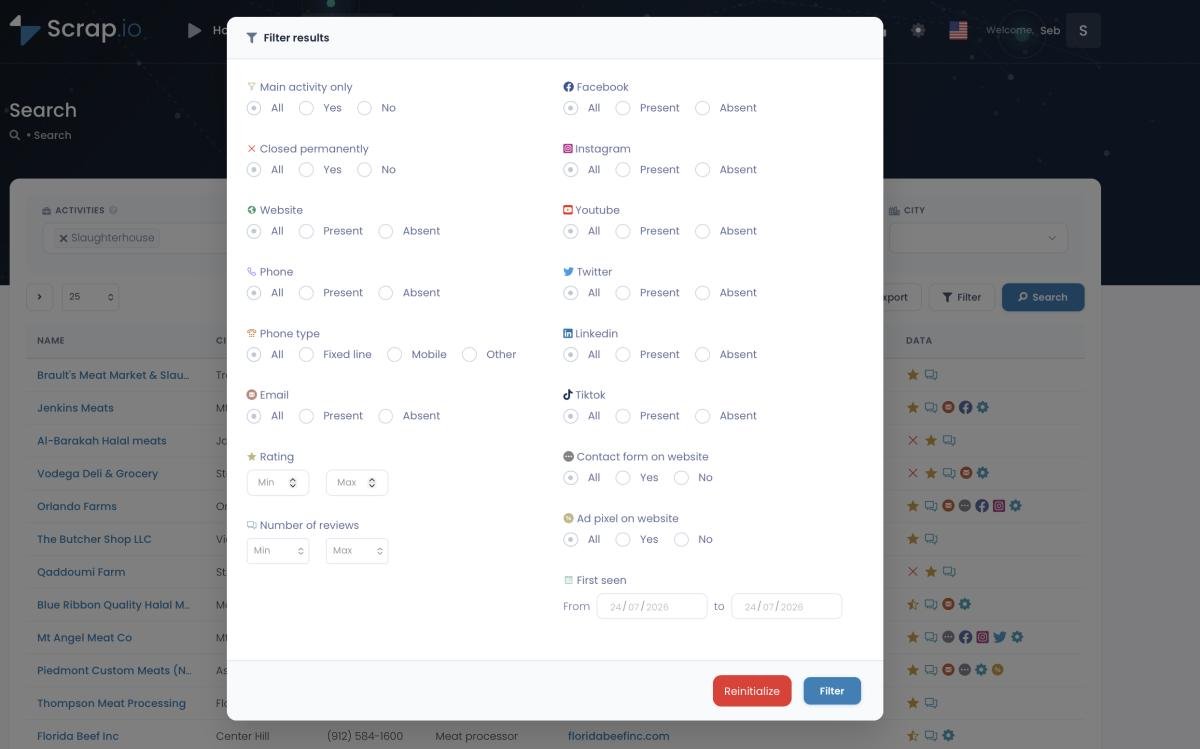
Scrap.io filters, applied before extraction, so you only pay for contacts with an email.
Is Cold Email Follow Up Legal? CAN-SPAM & GDPR
Short answer: yes. Cold email follow up is legal when done correctly.
The CAN-SPAM Act (US) requires honest subject lines, clear identification of who's sending the email, a working unsubscribe mechanism, and your real physical business address in every message. Follow these rules and you're fine. Violate them and you're looking at fines up to $53,088 per email according to the FTC. Don't mess around with this.
GDPR (EU/UK) allows B2B cold email under the "legitimate interest" basis, but you need an easy unsubscribe option and you should be able to justify why you're contacting that specific person. If you're emailing the marketing director of a company that fits your target market, that's legitimate interest. If you're blasting random people, that's not.
One-click unsubscribe is now mandatory for bulk senders on Gmail and Yahoo. Make sure your cold email tool supports this natively.
Here's the thing that makes compliance much simpler: when you're using publicly available data, like business contact info from Google Maps listings, you're on solid legal ground. These are details that businesses chose to make public themselves. Scrap.io only collects this kind of public business data, and every field is traceable back to its source, which keeps you GDPR and CCPA compliant without the legal headaches.
FAQ
How do you write a follow-up cold email?
Start by referencing your previous email briefly. Then add new value: a case study, a different angle, or a relevant insight. Keep it under 100 words. Include one clear call to action. Don't guilt-trip or apologize for following up. Each email in your sequence should stand alone while building on the previous one.
What do you say in a follow-up cold email?
Say something new, never just "checking in." A strong follow-up cold email does four things: it references the original message in one line, adds a fresh piece of value (a stat, a customer result, or a different angle), asks one specific question, and closes with a single clear next step. Keep the whole thing under 100 words and drop the apologies. The goal is to give the prospect a reason to reply, not a reminder that they didn't.
How many follow-up emails should I send?
The optimal number is 4 to 7 total emails in your cold email sequence. Lemlist's data shows campaigns in this range get 3x more responses than shorter sequences. After 7 or 8 emails, you hit diminishing returns and risk spam complaints. Most replies come from emails 2 and 3, so at minimum send those.
What is the best time to send a follow-up?
Tuesday through Thursday, between 8 AM and 11 AM in the prospect's local time zone consistently performs best across all major benchmarks. Avoid Mondays when inboxes are overloaded from the weekend and Fridays when people are already mentally checked out for the week.
What is the 30/30/50 rule for cold emails?
It's a framework for diagnosing campaign performance. If your reply rate is low, look at three areas: 30% depends on your subject line and open rate, 30% on your email body and value proposition, and the remaining weight falls on list quality and targeting. Some practitioners use the 50/30/20 variant where list quality gets 50%, copy gets 30%, and timing gets 20%. Either way, the same lesson holds: a great follow-up can't save a bad list. If you want the full playbook, here's our complete cold emailing strategy.
Is cold email follow-up legal in the US?
Yes. Cold email, including follow-ups, is legal in the US under the CAN-SPAM Act, and the law makes no exception for B2B messages. You need to use accurate header and subject information, identify the message as a commercial one, include a valid physical postal address, and offer a working opt-out that you honor within 10 business days. Get any of those wrong and each individual email can carry a penalty of up to $53,088, per the FTC. Using publicly available business data keeps you on the right side of the line.
Should I use the same subject line for follow-ups?
Using "Re:" followed by your original subject line is one of the most effective follow-up subject line strategies. It creates the appearance of an ongoing conversation thread, which boosts open rates significantly. For later emails in the sequence, you can test switching to short 1-to-3-word curiosity hooks or questions to re-engage prospects who've been ignoring the thread.
Start Sending Follow-Ups That Actually Work
Here's the bottom line. The data is clear. Follow-ups work. They've always worked. The problem is that most people give up way too early or do it wrong.
You now have the sequence, the templates, the timing, and the benchmarks. But none of that matters without quality contacts to email. Stale lists with bounced emails and outdated contacts will sabotage even the best follow-up sequence. If you're brand new to this, the two-minute walkthrough below shows exactly how to pull your first list.
Video: Scrap.io - How to Start?
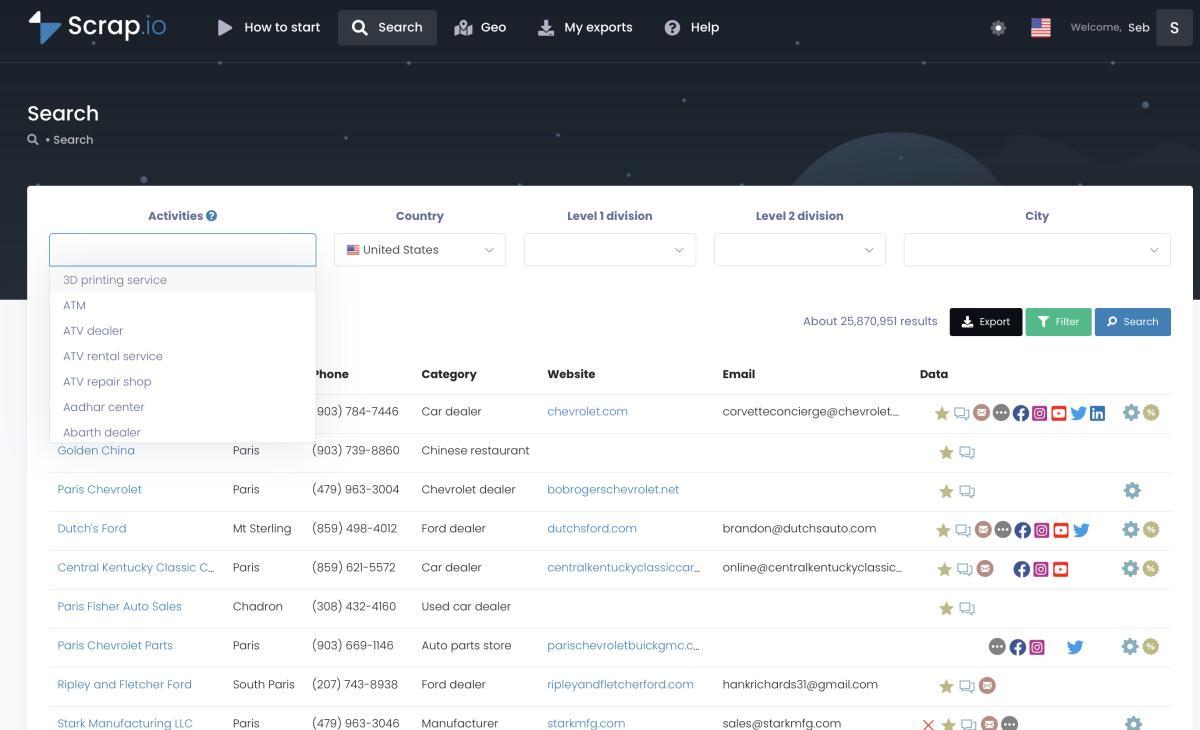
Scrap.io search, build a targeted B2B list from Google Maps in a couple of clicks.
Try Scrap.io free for 7 days, get 100 verified B2B leads instantly, extracted in real time from Google Maps across 195 countries and 4,000+ categories. Free trial with 100 leads offered. Fresh data means lower bounce rates and a follow-up sequence that actually reaches humans.
Because honestly? Your competitors are already following up. The question is whether you will too.
Generate a list of restaurant with Scrap.io